SUBHEAD: Now that we've entered the Anthropocene you need to do your part in supporting the living environment.
By Amy Brady on 28 July 2018 for Orion Magazine -
(https://orionmagazine.org/2018/07/rewilding-your-lawn-in-the-anthropocene-an-interview-with-author-jeff-vandermeer/)
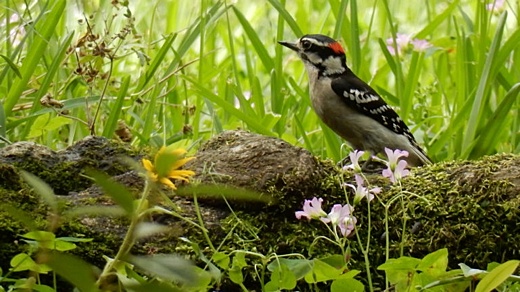
Image above: Photographs of a yard gone wild. From original article.
Jeff VanderMeer, award-winning author of Borne and the Southern Reach Trilogy, is also an avid environmentalist.
As part of his desire to make outdoor spaces more habitable for birds and insects, he’s embarked on a yard rewilding project that involves letting native grasses and plants (many of them deemed “weeds” by some less-than-pleased neighbors) take over his lawn.
If you follow the author on Twitter, you may have read his amusing—and educational—anecdotes about the project. Here, we discuss the yard project in more depth, including the benefits a wild yard provides for local wildlife and what others can do to improve their own neighborhood ecosystems.
AB: What inspired you to re-wild your yard?
JV: I was the writer-in-residence at Hobart and William Smith Colleges in upstate New York in 2016 and lived in a house with a very lively bird population. I started putting out feeders.
Then Trump was elected president and my stress level went through the roof. We returned to our home in Florida and, to distract myself from the news, I put up a lot of bird feeders and tried to emulate the things that we’d loved about upstate New York.
We got several more birds than in the past, although I’d always been an avid birdwatcher. The feeders made me feel like I could help semi-urban wildlife and migrating birds in the moment, which was important at a time when I felt useless and worn down by the news.
I then began investigating how to make the yard more bird and bee and butterfly friendly. Given that our attempts at a “normal” lawn had always led to bare dirt, I figured nothing would grow.
But as soon as we gave the yard over to whatever would naturally grow there, we had a great burgeoning of
plant, insect, and animal life. We even have, ironically enough, a fair amount of grass in the yard now.
AB: What do you hope to achieve by doing this? Do you anticipate an environmental impact?
JV: I already know we’re creating a safe haven for migratory birds. We’re also helping to cement a corner of an unacknowledged greenway for raccoons and possums and other nocturnal animals, none of which have been a bother. They also eat insects and are beneficial in other ways.
I’ve also seen more toads and frogs and in general a healthy little ecosystem quietly building up. Contrary to the generalizations people make about non-traditional yards, we’ve not seen any ticks. Either the possum eats those or they just aren’t present.
In addition, we’ve had some exciting finds, like Florida lupine growing in one part of the yard. Florida lupine is rare these days and should be encouraged.
Does all this mean much in the grand scheme of things? I don’t know. But it acknowledges that in addition to dealing with things on the macro level, you can support the environment in your own backyard by not using pesticides and, while not letting things look totally unkempt, support life rather than a mono-lawn that nothing else can thrive on.
AB: You’ve said on Twitter that your neighbors are less than thrilled. How would you sum up their response to your yard?
JV: I think it’s accurate to say that the “neighbor complaint” has become in my mind an existential threat from The Neighbor. By that I mean I feel like I need to anticipate the possible objections to what I’m doing, and thus The Neighbor is always on my mind.
This is probably very unfair to the actual neighbor in question, which is why I keep everything very anonymous [on Twitter] and try to acknowledge that it’s the system and our assumptions at the neighborhood association and city government level that are flawed.
We also have lots of lovely neighbors, and even the neighbor who complained is not automatically not-lovely. But the system is crap.
The fact that I can grow weeds only so long as they’re in a straight line and look like a garden—or put up a white fence around a part of the mayhem to ritualistically create a “lawn”—is hilarious and also a bit depressing to me.
A traditional “lawn” is really about signs and symbols and status. What we’re really talking about is whether you admit life onto your property or decide to kill it off.
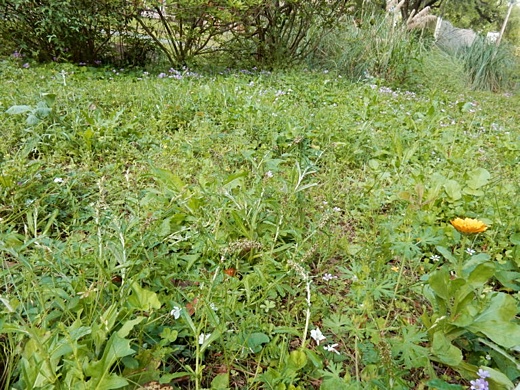
Image above: Photographs of a yard gone wild. From original article.
AB: What kinds of wildlife have entered your yard since starting this project?
JV: In addition to a regular polite possum and raccoon, we have many more bats out at night. We also have a wealth of birds that we didn’t have before. For example, the thrashers are out in force and very comfortable.
We’ve had migrating grosbeaks, a first, and we have almost all of the Florida woodpeckers in our yard: downy, hairy, red bellied, flickers, and pileated. They used to be much rarer sightings. We also have a resurgence of snakes and tree frogs and toads of all kinds.
We used to have a few skinks, pretty big ones, and now we have a lot more. And more bees. And tons of different kinds of plants—too many for me really to go into. Except, of course, the famous one, Fred the Weed, a giant wild lettuce.
Fred blew down in a storm, but is currently convalescing and plotting his return. I’m only just learning more about the plants in our yard, and some are likely invasive, but I must admit that paying attention to what’s growing in the yard has made landscapes so different for me in general. I used to think of plants as the backdrop for animals, but now I see acutely the plant life and how it’s growing.
I feel like when we visit other people’s houses I can tell a lot about them just from the yard. I’m grateful to Jenn Benner, an Orlando friend, who helped me identify a lot of these plants.
AB: Have any of these lifeforms inspired new characters or settings in your writing?
JV: This sense of plants being in the foreground will definitely seep into my fiction. The fact that I know individual cardinals and individual downy woodpeckers—that I can see them interacting with other individual birds—is also something that will influence my work.
Somehow the whole world is now more alive than before, which is, to be honest, also painful, because suddenly I’m aware that even yards that seem green and healthy are actually sterile spaces.
That’s hard to take. It’s also quite frankly hard to take when I find a vole dead in the yard, a victim of some passing cat.
Luckily, we don’t get cats much—I chase them away and sometimes squirt them with orange juice, which they hate. In a sense, I feel very connected to this little piece of land and I feel it in my body when something goes wrong.
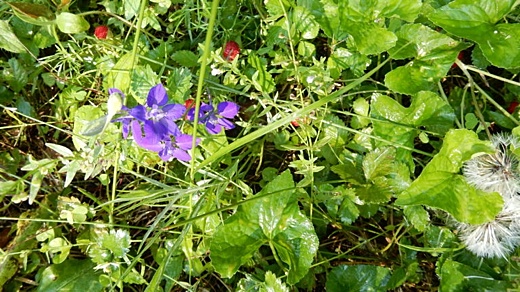
Image above: Photographs of a yard gone wild. From original article.
AB: Do you have any tips for readers who’d like to do something similar with their yards?
JV: I’d say let the space speak to you and really observe what’s going on. Go with the flow of what seems to grow well—don’t try too hard to push back against what nature tells you needs to happen.
And before uprooting a plant, make sure you know what you’re doing. Early on I wound up taking out some beneficial plants and leaving some that weren’t from pure ignorance. And be aware that herbicides aren’t really any better than pesticides in many cases.
Bring in a local specialist for a consult, even if you don’t want them to do any actual landscaping.
Finally, where possible, do leave some dead leaves around, especially in places in shade, where they’ll help form good habitats for toads and worms. These are really beneficial creatures that will only add to the richness of the place.
AB: Do you have any suggestions for people living in urban and suburban areas who want to have a positive environmental impact but who can’t let their yards grow wild?
JV: You can always do something. Even a few potted plants that your local nursery says are good for butterflies or birds can be of use.
Even a small bird feeder can be of use, too.
In that case, I’d learn what migratory birds pass through your area, what they tend to eat, and when they tend to appear.
Keep in mind that birds might take as long as a month to find a new feeder and deem it safe.
Finally, and this is controversial in some areas, keep in mind that outdoor cats do kill lots of birds. There’s no two ways about it.
So keep your cat inside if at all possible. If your cat seems too energetic for that, all apologies, but you may need to increase your efforts in engaging and playing with your cat inside.
AB: What has been the most rewarding thing about this project?
JV: Rewilding the yard has largely saved me from situational depression, which means I can be more effective in my other, wider environmental efforts.
Also rewarding has been the daily connection, in some form, to our environment. It is so important to our health in general to understand what it is we’re losing and what we need to save and why.
.
By Amy Brady on 28 July 2018 for Orion Magazine -
(https://orionmagazine.org/2018/07/rewilding-your-lawn-in-the-anthropocene-an-interview-with-author-jeff-vandermeer/)
Image above: Photographs of a yard gone wild. From original article.
Jeff VanderMeer, award-winning author of Borne and the Southern Reach Trilogy, is also an avid environmentalist.
As part of his desire to make outdoor spaces more habitable for birds and insects, he’s embarked on a yard rewilding project that involves letting native grasses and plants (many of them deemed “weeds” by some less-than-pleased neighbors) take over his lawn.
If you follow the author on Twitter, you may have read his amusing—and educational—anecdotes about the project. Here, we discuss the yard project in more depth, including the benefits a wild yard provides for local wildlife and what others can do to improve their own neighborhood ecosystems.
AB: What inspired you to re-wild your yard?
JV: I was the writer-in-residence at Hobart and William Smith Colleges in upstate New York in 2016 and lived in a house with a very lively bird population. I started putting out feeders.
Then Trump was elected president and my stress level went through the roof. We returned to our home in Florida and, to distract myself from the news, I put up a lot of bird feeders and tried to emulate the things that we’d loved about upstate New York.
We got several more birds than in the past, although I’d always been an avid birdwatcher. The feeders made me feel like I could help semi-urban wildlife and migrating birds in the moment, which was important at a time when I felt useless and worn down by the news.
I then began investigating how to make the yard more bird and bee and butterfly friendly. Given that our attempts at a “normal” lawn had always led to bare dirt, I figured nothing would grow.
But as soon as we gave the yard over to whatever would naturally grow there, we had a great burgeoning of
plant, insect, and animal life. We even have, ironically enough, a fair amount of grass in the yard now.
AB: What do you hope to achieve by doing this? Do you anticipate an environmental impact?
JV: I already know we’re creating a safe haven for migratory birds. We’re also helping to cement a corner of an unacknowledged greenway for raccoons and possums and other nocturnal animals, none of which have been a bother. They also eat insects and are beneficial in other ways.
I’ve also seen more toads and frogs and in general a healthy little ecosystem quietly building up. Contrary to the generalizations people make about non-traditional yards, we’ve not seen any ticks. Either the possum eats those or they just aren’t present.
In addition, we’ve had some exciting finds, like Florida lupine growing in one part of the yard. Florida lupine is rare these days and should be encouraged.
Does all this mean much in the grand scheme of things? I don’t know. But it acknowledges that in addition to dealing with things on the macro level, you can support the environment in your own backyard by not using pesticides and, while not letting things look totally unkempt, support life rather than a mono-lawn that nothing else can thrive on.
AB: You’ve said on Twitter that your neighbors are less than thrilled. How would you sum up their response to your yard?
JV: I think it’s accurate to say that the “neighbor complaint” has become in my mind an existential threat from The Neighbor. By that I mean I feel like I need to anticipate the possible objections to what I’m doing, and thus The Neighbor is always on my mind.
This is probably very unfair to the actual neighbor in question, which is why I keep everything very anonymous [on Twitter] and try to acknowledge that it’s the system and our assumptions at the neighborhood association and city government level that are flawed.
We also have lots of lovely neighbors, and even the neighbor who complained is not automatically not-lovely. But the system is crap.
The fact that I can grow weeds only so long as they’re in a straight line and look like a garden—or put up a white fence around a part of the mayhem to ritualistically create a “lawn”—is hilarious and also a bit depressing to me.
A traditional “lawn” is really about signs and symbols and status. What we’re really talking about is whether you admit life onto your property or decide to kill it off.
Image above: Photographs of a yard gone wild. From original article.
AB: What kinds of wildlife have entered your yard since starting this project?
JV: In addition to a regular polite possum and raccoon, we have many more bats out at night. We also have a wealth of birds that we didn’t have before. For example, the thrashers are out in force and very comfortable.
We’ve had migrating grosbeaks, a first, and we have almost all of the Florida woodpeckers in our yard: downy, hairy, red bellied, flickers, and pileated. They used to be much rarer sightings. We also have a resurgence of snakes and tree frogs and toads of all kinds.
We used to have a few skinks, pretty big ones, and now we have a lot more. And more bees. And tons of different kinds of plants—too many for me really to go into. Except, of course, the famous one, Fred the Weed, a giant wild lettuce.
Fred blew down in a storm, but is currently convalescing and plotting his return. I’m only just learning more about the plants in our yard, and some are likely invasive, but I must admit that paying attention to what’s growing in the yard has made landscapes so different for me in general. I used to think of plants as the backdrop for animals, but now I see acutely the plant life and how it’s growing.
I feel like when we visit other people’s houses I can tell a lot about them just from the yard. I’m grateful to Jenn Benner, an Orlando friend, who helped me identify a lot of these plants.
AB: Have any of these lifeforms inspired new characters or settings in your writing?
JV: This sense of plants being in the foreground will definitely seep into my fiction. The fact that I know individual cardinals and individual downy woodpeckers—that I can see them interacting with other individual birds—is also something that will influence my work.
Somehow the whole world is now more alive than before, which is, to be honest, also painful, because suddenly I’m aware that even yards that seem green and healthy are actually sterile spaces.
That’s hard to take. It’s also quite frankly hard to take when I find a vole dead in the yard, a victim of some passing cat.
Luckily, we don’t get cats much—I chase them away and sometimes squirt them with orange juice, which they hate. In a sense, I feel very connected to this little piece of land and I feel it in my body when something goes wrong.
Image above: Photographs of a yard gone wild. From original article.
AB: Do you have any tips for readers who’d like to do something similar with their yards?
JV: I’d say let the space speak to you and really observe what’s going on. Go with the flow of what seems to grow well—don’t try too hard to push back against what nature tells you needs to happen.
And before uprooting a plant, make sure you know what you’re doing. Early on I wound up taking out some beneficial plants and leaving some that weren’t from pure ignorance. And be aware that herbicides aren’t really any better than pesticides in many cases.
Bring in a local specialist for a consult, even if you don’t want them to do any actual landscaping.
Finally, where possible, do leave some dead leaves around, especially in places in shade, where they’ll help form good habitats for toads and worms. These are really beneficial creatures that will only add to the richness of the place.
AB: Do you have any suggestions for people living in urban and suburban areas who want to have a positive environmental impact but who can’t let their yards grow wild?
JV: You can always do something. Even a few potted plants that your local nursery says are good for butterflies or birds can be of use.
Even a small bird feeder can be of use, too.
In that case, I’d learn what migratory birds pass through your area, what they tend to eat, and when they tend to appear.
Keep in mind that birds might take as long as a month to find a new feeder and deem it safe.
Finally, and this is controversial in some areas, keep in mind that outdoor cats do kill lots of birds. There’s no two ways about it.
So keep your cat inside if at all possible. If your cat seems too energetic for that, all apologies, but you may need to increase your efforts in engaging and playing with your cat inside.
AB: What has been the most rewarding thing about this project?
JV: Rewilding the yard has largely saved me from situational depression, which means I can be more effective in my other, wider environmental efforts.
Also rewarding has been the daily connection, in some form, to our environment. It is so important to our health in general to understand what it is we’re losing and what we need to save and why.
.