Hostage Racket

SUBHEAD: Health care, like everything else, will be a much smaller, modest, and local in the near future. By James Kunstler on 2 July 2012 for Kunstler.com - (http://kunstler.com/blog/2012/07/hostage-racket.html) Image above: From (http://medgadget.com/2011/05/philips_ingenia_digital_broadband_mri_coming_to_us_1.html). Not to put to fine a point on it, but didn't that cunning rogue Chief Justice John Roberts pour a jug of Karo syrup into the gas tank of America's twelve trillion cylinder engine. Or, put another way (forgive the metaphor juke), didn't he just give President Obama enough rope to hang himself? Out to dry, that is. Roberts must know exactly what he is doing: prompting x-million young and/or poor voters to an election year tea party tax revolt. The Obama health care reform will henceforth be defined as a tax against people too economically strapped to buy health insurance - in other words, a gross injustice, courtesy of Obama.
Or call it a poison pill. Obama gets to brag that the heart of his 2700-page reform package stands - at the expense of the very people it was designed to protect. Forget about the niceties regarding the interstate commerce clause and other chatter points. This was all about Chief Justice Roberts interfering in a presidential election in a most mischievous way. He might as well have just heated up a branding iron that spelled out T-A-X and applied it to Mr. Obama's forehead.
Of course, with or without the so-called reform, the American health care system remains a hostage racket. When you are sick, you will do anything to get better, and the system knows it. You will sign onto any agreement to keep yourself alive, even if the health care system ends up taking your house and your children's educations. It is a well-established fact that the chief cause of personal bankruptcy in the USA is unpayable medical bills on the part of people who have health insurance. It is considered bad manners to inquire of a surgeon what his fee might be for a life-saving operation. Anyway, you don't want to know because it will be a figure with no anchor in the reality of hours spent or services rendered. Ditto the folks who run the hospital, where there is no reality-based relationship between things dispensed and prices charged. It's simple racketeering and true health care reform would be the vigorous application of Department of Justice attorneys on the doctors, pharma companies, insurers, hospitals, and HMOs who are engaged in routine, systematic swindling. But the truth is, we don't want to remove the swindle and the grift, we just want to find some way to get the American public to pay for their own swindling.
Before you get too exercised over the multiple idiocies and injustices of the current American medical situation just reflect for a moment that the whole creaking system cannot possibly survive no matter what the Supreme Court might have ruled or whatever Obama sought to accomplish. The US economic system is about to blow up. The banking sector has been kept technically alive on the life-support of accounting fraud since 2008, but that artful racket is coming to an end because sooner or later the abstraction called "money" must make truthful representations of itself in relation to reality, or else people cease to accept its claims of value. Without a functioning banking system none of the rackets organized into US health care can continue.
The eventual destination of health care, like everything else in society categorically, is a much smaller, more modest, more local scale of operation. We'll be lucky if the people with medical expertise can reorganize the wreckage of the system into something resembling small local clinics with all the costly and pernicious racketeering bureaucracy peeled off it. The insurance companies will be in the elephants' graveyard of failed institutions. Let's hope the doctors and their support staff remember to wash their hands.
A couple of side notes:
Anyone seeking to understand the deplorable physical condition of the general public need only stroll through the supermarket aisles and see the endless stacks of manufactured sugary shit that pretends to be food in this culture. That whole matrix is coming to and end, too, by the way, but probably not soon enough to save the multitudes programmed into metabolic disorder. They will just have a shorter life-span, aggravated by loss of income in a cratering economy and everything that comes with being impoverished. The doctors themselves by and large know almost nothing about nutrition, and make no organized effort to militate against the homicidal processed food industry - which brings me to the second side note.
Namely, that the diminishing returns of extreme bureaucratization and turbo-specialization in medicine has only made the doctors generally stupider and more inept. My own situation is a case in point. For two years I suffered an array of peculiar symptoms ranging from numb hands to supernatural fatigue. My ex-GP showed no interest in investigating the cause. Even my request for a toxicology workup was essentially shrugged off. I had to become my own doctor. For a while I suspected Lyme disease, which is raging in my corner of the country. I went to see a Lyme specialist who didn't accept insurance (because the insurance companies did not recognize his aggressive treatment protocols as falling within the current "standards of practice" - and this because the medical establishment doesn't know its ass from a hole in the ground about Lyme disease).
Anyway, I asked the Lyme specialist to include a test for cobalt levels in my bloodwork because I thought there was an outside chance I had cobalt poisoning. The reason I thought this was because Google searches of my symptoms kept pointing to metal-on-metal hip replacement failure. I had gotten just such a metal-on-metal hip replacement in 2003. The hardware was developed because the orthopedists wanted to give younger patients a longer-lasting implant. That's when the diminishing returns of technology stepped in and kicked everybody's ass, including mine.
My cobalt blood test came back off-the-charts high. (My many Lyme tests all came back negative.) Wouldn't you know, though, that the Lyme specialist wanted to treat me for Lyme anyway. He ignored the cobalt numbers and wrote out a prescription for $400 worth of antibiotics. He was the proverbial guy with a hammer to whom everything looked like a nail. I declined that course of treatment and instead went to my new GP for a first appointment and asked for an additional cobalt test, along with one for chromium. (My hip implant is an alloy of titanium, cobalt, and chromium.) They both came back way over the toxic level. Apparently, the rotation of the metal joint has been shedding metal ions into my system for nine years.
Next I went to the orthopedic surgeon who put the implant in. He ordered an MRI and xrays and appeared rather concerned. Eventually I was routed to yet another orthopedic surgeon who specializes in "revising" hip implant failures - in particular ones of the type I have, which have been failing at such a staggering rate that the lawyers have assembled one of the greatest litigation feeding frenzies in history. They are going after the manufacturers of these devices.
I have health insurance but I am quite sure that I will be soaked for many thousands of dollars beyond the coverage to resolve this problem, which will involve at least the changing out of the terminal bearings of my implant - if I am lucky. In the meantime, I have to become exactly the kind of pain-in-the-ass patient who asks too many questions so I don't end up crippled, or dead, or taken for ride like a purloined human ATM machine. I suppose I am also lucky that this happened to me soon enough to even have this kind of remedial surgery. Another year or two and I would have just steadily turned purple and croaked like some poor 19th century foundry worker
There's an excellent chance that I will be on the operating table at the same moment that another financial crisis erupts, one that will be orders of magnitude worse than the 2008 Lehman collapse. Won't that be something? I hope that the surgeon and the anesthesiologist, and whoever else happens to be on hand, don't all run out of the room at once to call their investment managers while I'm lying there inert, like a boned-out Thanksgiving turkey. Pray for my ass. I'm a hostage in the system.
.

Cuckoo in a Coal Mine

SUBHEAD: Are you trying to play the canary in a coal mine and find, instead, your the cuckoo in the clock? By Skip Breakfast on 1 July 2012 for the Automatic Earth - (http://theautomaticearth.com/Earth/cuckoo-in-the-coal-mine.html) Image above: A dead canary in front of a cuckoo clock. From original article. I decided to post this comment under the "Community category"--hope that's okay. Actually, if there were a "Family" category, I would have lodged it under that instead. Or maybe the "My Sisters Think I'm Crazy" category.

I wanted to post this story for the same reason many of you probably come to TAE on a regular basis: we come not just to expand our understanding of finance, but to connect with like-minded individuals and not feel so utterly alone. Because honestly, there aren't that many of us. Sure, one might believe everyone's a "doomer" after spending a bit too much time reading finance blogs.

But the truth of the matter is, almost no one I meet anywhere, no matter what level of intellect or education, no matter what occupation, from finance to oceanography, not a one that I encounter in the real-rather-than-the-virtual world seems to be remotely aware of the risks inherent in the current system. Like my sisters.

Now, the first time I tried to raise a few alarm bells with my loved ones was when Dad sold off the family ranch to my youngest sister. It's not a particularly productive ranch. It's in a cold, rugged and beautiful part of Canada. I love it with all my heart. But at the time of the sale, it was grossly inflated in value, along with the rest of the real estate bubble.

At the time, I had only recently become aware of just how precarious our world's financial ponzi scheme had become. So, I tried to persuade my family that we should take advantage of this once in a lifetime opportunity to make out like bandits and preserve some capital for a torrentially rainy day. Bad move on my part, apparently. Somehow it all came off looking to them like I was some heartless profiteer who didn't care about family history or the desires of my siblings.

My warnings went unheeded, and my father sold my sister the home for a bargain according to the going rate of the day but clearly far too much considering my view of the future. That sister, sadly, has hardly spoken to me since. Nevertheless, I've told myself that when the day comes and she has to leave the house behind (it's hard to imagine the place as anything but a ghost-town-in-the-making), I will be there for her however I can.

I thought I might have better luck with my older sister. She's a single mom with a baby, living an over-extended lifestyle in the Big City. I feel she has even more to worry about. It's hard to be very adaptable when you're raising an infant in a concrete jungle--the thought that fragile supply chains suddenly make life difficult for her haunts me. So, I try to gently raise my concerns again. Very cautiously mind you--I know my reputation in the family now seriously colours my advice.

In fact, I hate bringing it up. But I tell myself it's my moral obligation. I love her little boy like he's my own (weirdly! as a gay guy without any intention of having children, I avoid the sticky creatures on the bus like they're infectious!). I start by talking a bit about how weird everything is in Europe, eh. And how I've read things might even get worse. Yes, yes, my sister agrees--poor Greece is really screwed!

Aha, that's an opening, and I try to pry it wider--I continue: you know, it really does concern me, I mean how we're facing the possibility of some catastrophic failure in the financial system like nothing we've faced in our or even our parents' lifetimes. If ever there were a good time to put some food and cash away, this is it, I say.

Her response is downright curt. "I'm starting to get very concerned about you Skip. You seem obsessed. You can't stop talking about the end of the world." I go quiet for a moment. To be honest, I feel downright embarrassed, I really do. Is that how I sound? Like a raving lunatic? I realize that's exactly how I sound to someone who hasn't even begun to understand that the things we thought we knew about money and the state of our world are really, really quite wrong.

You see, it isn't that we're not on the same page--we're actually in completely different books. I try to back-pedal: I reiterate that I'm just very concerned, and there's no harm in taking a few precautions. I tell her I'm actually still having a great time in life (essentially true). And that I think that it could all turn out for the best (maybe the environment will be saved and we'll have a healthy reassessment of our societal values). But I'm now fully aware of the fact that she can't hear me.

I'm trying to be the canary in the coal mine, but my sister thinks I'm just plain cuckoo. I hang up the telephone feeling a million miles away (maybe because I am--I moved to the South Pacific a few years ago). I'm afraid I'm too far away from her to help, not just in physical distance but in point-of-view. There's just no bridging that gap, and it breaks my heart.

I don't try to bring this stuff up with friends anymore either. It seems to have no impact at all, even though I think of myself as being a fairly persuasive advocate when I believe in something. The gulf is plainly too wide. Maybe my words to my sister will help her react faster once things start falling apart in earnest. Just maybe she won't be as in denial as her neighbors and friends, because I helped plant a seed. I hope so, for her sake. I feel helpless to do much more than be there for her when the time comes.

But I'm just not going to talk about it anymore. Not with anyone, I don't think.

.

Rising Oceans - Missing Beaches

SUBHEAD: Visited a missing Hawaiian beach lately? Get used to it.  

By Jan TenBruggencate on 1 July 2011 for Raising Islands - 
(http://raisingislands.blogspot.com/2012/07/visited-missing-beach-lately.html)

 
Image above: Hurricane Isabelle breaches an Outer Banks islands off North Carolina. From (http://www.seathos.org/earth-day-2012-the-top-5-threats-to-our-oceans-part-two/).
 

With the lack of aggressive action on climate change over the past decades, continued sea level rise is now essentially baked in, ocean and climate scientists are saying.

A study in the journal “Nature – Climate Change,”a new study argues that there’s little we can do now to prevent dramatic sea level rise.

Even with an aggressive program of controlling greenhouse gas emissions, sea levels will continue to rise based on our past misdeeds, write researchers Michiel Schaeffer, William Hare, Stefan Rahmstorf and Martin Vermeer. Schaeffer is from the Netherlands, much of which is below sea level, where accurate modeling of sea conditions is taken seriously.

He works with the Environmental Systems Analysis Group of Wageningen University and Research Centre in Holland. His co-authors are climate researchers from Germany and Finland.

Their message: A 50% change that sea levels will be a couple of feet (75-80 centimeters) higher than 2000 levels by 2100, if we can hold warming below 2 degrees Centigrade. And it will keep rising, they argue, to more than 8 feet by 2300.

We would not even recognize the coastlines of our great-great-grandkids . The islands would be significantly smaller as the ocean washes much higher on their shoulders.

“Halting (sea level rise) within a few centuries is likely to be achieved only with the large-scale deployment of CO2 removal efforts, for example, combining large-scale bioenergy systems with carbon capture and storage,” write Schaeffer and his team.

The globe needs to not only stop rising CO2 levels, but to drive CO2 production to negative levels, if sea level rise is to be slowed. Without that level of effort, imagine even larger rise.

The authors concede that the science of sea level change is still evolving and that there are many uncertainties—but they point out that current estimates are more likely to be low than high—thus, it could be worse than they now estimate.

“Physics-based models attempting to predict the combined contributions from thermal expansion, glaciers and ice sheets are not yet mature and underestimate the (sea level rise) observed in past decades,” they write.

There’s a fair amount of other alarming science out there. One piece is that sea level rise isn’t uniform across the oceans, and one group of researchers suggests that the northern Atlantic coast of the North America will see higher rise than other areas. It attributes this to salinity, currents, changing gravity and the Earth’s rotation.

“(Sea Level Rise) rate increases in this northeast hotspot were ~3-4 times higher than the global average,” write the authors of a paper, “Hotspotof accelerated sea-lkevel rise on the Atlantic Coast of North America.

Add storm surge, and they predict serious vulnerability for harbors and coastal cities.

It doesn’t help that the popular media are screwing up the story. One big component of global sea level predictions is whether and how quickly the Greenland glaciers melt. Two recent pieces on the same day, May 3, 2012, had these contradictory headlines.

Greenland’s ice melting more slowly than expected.”
"Greenland's glaciers melting faster, say scientists."

If you only read the headlines, you’d think those stories were contradictory. They’re not. The first one just says the glaciers are melting scary fast, but just not at breakneck speed. It says they’re not melting fast enough for 6 feet of sea level rise in the next 88 years—just 3 feet.

Well, three feet is enough to erase virtually every beach we now know in Hawai`i, to put much of coastal Honolulu underwater, to push Hilo and Hanalei Bays deep inland, to have significant impacts on coastal Kihei.

Have you visited a missing beach in Hawai`i?

If you visit the shore at all, you know the scenario. Where there used to be sand, there are rocks. Where there used to be palm trees and heliotropes, there’s water. Where kids used to build sand castles, there’s ancient sandstone washed by waves.

And that's just what's happening now.

Here is University of Hawai`i coastal geologist Chip Fletcher's famous progression of what happense to Waikiki under three feet of sea level rise--think street surfing.

See also:
Ea O Ka Aina: Wailua Beach Erosion 6/13/12
.

Exxon CEO - "We'll Adapt"

SUBHEAD: With regards to raging wildfires - "We've spent existence adapting." CEO Rex Tillerson.  

By Matt McDermott on 29 June 2012 for TreeHugger - 
(http://www.treehugger.com/climate-change/exxons-ceo-right-we-will-adapt-climate-change.html)

 
Image above: Small portion of the mammoth, and still burning, Waldo fire in Aspen Colorado on 6/29/12. From (http://www.csmonitor.com/USA/Latest-News-Wires/2012/0627/Waldo-Canyon-fire-reaches-epic-proportions-video).


I'm a day late to this image above and the social media outrage around it, but I've been thinking, and unfortunately ExxonMobil's CEO is right. That's the unfashionable thing to say in green circles, but he is right.

Humanity has spent its time on this planet adapting. Both adapting the world we inhabit to meet our needs, on various timescales and over various areas of the globe, as well as adapting to the local conditions under which we live.

And, we will adapt to climate change.

But nevertheless, the statement is obfuscation of the highest order; it is literally true but contextually entirely false. And it is there where it's deep insidiousness resides.

How many humans the planet can support in a world that is 2°C, 3°C, 4-6°C warmer on average—with all the ecosystem, biodiversity, agricultural changes that brings—is a very much open question. The odds are solidly in favor of far less than it now does, just because of climate change, ignoring resource overconsumption and population growth.

Which is all to say, that while humanity will adapt to a climate changed world is true, there is no doubt that climate change will create, in comparison to today, let alone a pre-industrial, lower population world, a world that is less bountiful, prone to more extremes of temperature and weather in many places, less fecund—and since we're talking about human adaptation, more difficult to live in and less conducive to human civilization.

The thing in Rex Tillerson's statement that is so mind-numbing egregious to me is the apparent full public blindness to the fact that this is the world that we are creating, that humanity is creating largely because of the products that Tillerson's company produces. It's made worse by the fact that Exxon has historically, and currently, funded countless organizations that attempt to sow doubt about this fact, apparently solely to enrich themselves.
 
.

What Is Harper Afraid Of?

SOURCE: Katie Gelfling (k.gelfling@gmail.com)

SUBHEAD: Canada's Stephen Harper is George Bush without the foreign wars - just the war on Canada itself.


Image above: Opening illustration from "What is Harper Afraid Of?" series by Franke James. From (http://www.frankejames.com/debate/?p=11818).  

[Note by source Katie Gelfling: Here is a political comic/visual animated essay by Franke James about the tar sands, First Nations tribes, the loosening of environmental regulations, and Prime Minister Harper. Be sure to visit her site (http://www.frankejames.com/debate/?p=11818). There have been a lot of pro-tar sands ads in movie theaters and television, so I think it's important to try to understand what is not being said. The real controversy of lowering environmental standards and their potential impact is being hidden so that the public won't notice that the costs are being externalized by the oil companies onto them. I know only a little about the tar sands, so this opened my eyes about some of the issues up in Canada. I hope more folks in Canada wake up and it makes a difference. Stephen Harper is basically George Bush without the wars, and like the US, Canada has a large rural population whose livelihoods depend on resource extraction.] By Franke James on 3 March 2012 for FrankeJames.com - (www.frankejames.com/debate/?p=11818)
Video above: Animated video of "What is Harper Afraid Of?" by Franke James. From (http://vimeo.com/43432620).
Below is a sample of a letter you can send to Prime Minister Harper.


Subject: What is Harper afraid of?
Dear Prime Minister Harper,

What are you afraid of? Rivers that turn black and run into the sea? Birds falling from a heavy sky? People fleeing a toxic land? Or maybe you're most afraid of this... Tar Sands Oil being labeled dirty.

I am writing to you because I am afraid of the Harper Government's plans to build the Northern Gateway pipeline straight through the Rocky Mountains. And the Great Bear Rainforest -- all to facilitate the expansion and export of tar sands oil, which Environment Canada identifies as our "fastest growing source of greenhouse gas emissions."
With all the changes that Harper is making...
  • Gutting the fisheries act
  • Trashing the environmental assessment act
  • Overruling the National Energy Board
  • Barring environmental groups from hearings
  • Barring Canadian citizens from hearings (unless they live or work in the area)
  • Speeding up environmental reviews
  • Slashing Environment Canada's budget
  • Silencing the Scientists (and anyone who disagrees with the Harper Government)
  • Lifting the 40 year ban on tankers on B.C.'s coast
... We could be hit with some major environmental catastrophes.
The Harper Government claims they are doing "responsible resource development". But a "secret" Environment Canada report, released under access to information laws, shows that to be false. (See: http://www.frankejames.com/pdf/ATIP-Oilsands-Pollution.pdf)
The May 2011 report states that contamination of the Athabasca River is a "high profile concern". It cited recent studies which suggest that "elevated levels of pollutants near mining sites including hydrocarbons and heavy metals raises questions about possible effects on health of wildlife and downstream communities." The government report also said that current data cannot generate a "big picture" view of impacts on the ecosystem. And that "oil sands development will continue to put pressure on vulnerable species."
Surprisingly, Minister Joe Oliver -- the man who has travelled across Canada pitching the need to speed up Environmental Reviews -- said he'd never seen the secret government report and didn't know whether the fish from the Athabasca River were safe to eat. (When pressed, he admitted that he had heard about deformed and contaminated fish in the news.) See: http://www.frankejames.com/debate/?p=11818
Why is the government looking the other way? Is this 'environmental racism' as the First Nations contend?
Shouldn't the Federal Minister in charge of the oil sands be held accountable for oil sands mining that is polluting our air, land and water?
Does this mean that poisoning downstream communities and wildlife, is just the "cost of doing business" in Canada?
The government and the oil industry need to be held accountable for the pollution from oil sands mining. Canadian taxpayers and oil sands investors are at risk of class action lawsuits if we look the other way.
Canada's environmental international standing will be dragged further through the proverbial mud as the federal government invites the oil industry to treat the natural environment in a manner similar to standards applied in developing nations to foster economic growth.
Tell the oil industry and the Harper Government that doing business in Canada must include protecting our air, land, water, wildlife and people from oil pollution.
Please stand up for Canada. Say no to irresponsible resource development. Keep our country beautiful from sea to shining sea.
.

Savanna into Forest

SUBHEAD: With rising CO2 there could be a significant transition of savana into forest by 2100.

 By Matthew McDermott on 29 June 2012 for TreeHugger - 
  (http://www.treehugger.com/climate-change/african-savanna-turn-into-forest-2100.html)

 Image above: Trees dotting Tarangire National Park in Tanzania, Africa. From National Geographic (http://environment.nationalgeographic.com/environment/photos/savannah/).
 
When we think about the coming effects of climate change, this one doesn't top the expected list (at least not for me): New research published in Nature shows that by 2100 large parts of the African savanna could become forests.

The research finds that "a switch from savanna to forest occurs once a critical threshold of CO2 concentration is exceeded, yet each site has its own critical threshold. The implication is that each savanna will switch at different points in time, thereby reducing the risk that a synchronous shock to the earth system will emanate from savannas." (Science Daily)

Something which may seem reassuring report lead author Steven Higgins notes, but is still very very fast on a geologic timescale.

The research itself is pretty wonky, so read it at the summary above, or the original research at the top, but one very interesting practical implication for climate mitigation is raised by the authors.
They identify a belt of land across central Africa where if fires are suppressed it would encourage the transition from savannah to forest, and this would be an ideal places to sequester carbon in the forest, even if this belt of land will move over time.

.

Flying in America

SUBHEAD: Nearly arrested in Houston, no questions permitted, no return ticket necessary.  

By Jim Karger on 28 June 2012 for The Dollar Vigilante -  
(http://www.dollarvigilante.com/blog/2012/6/28/nearly-arrested-in-houston-no-questions-permitted-no-return.html)
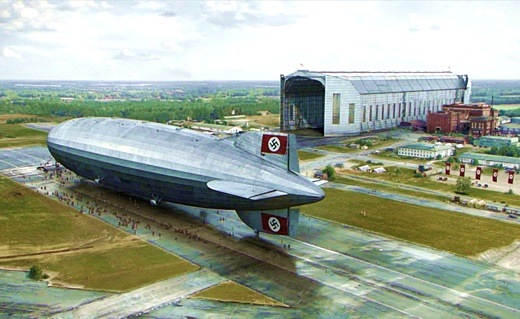
 
 Image above: Hindenburg on the tarmac. The Nazis provided a better time flying than today's American carriers. From (http://explow.com/the_hindenburg_%28film%29).
 
It all began last Sunday as a run-of-the-mill trip to give a couple of talks to an industry association in the States. I knew the travel would be grueling, but when I have the opportunity to talk about government incursions into liberty, I usually jump at the chance. 

I flew United Airlines (formerly Continental) out of Leon, Mexico, near my home in San Miguel de Allende, and arrived in Houston without incident. It was when I boarded a United flight to San Francisco that things went south in a hurry.

I noticed there were several people on the flight with the same boarding pass numbers. One of those duplicate boarding passes turned out to be mine. 

After taking my assigned seat 37F, a flight attendant (who we will call Linda, mostly because that was her name) walked over, looked at me distractedly, asked to see my boarding pass, and told me matter-of-factly, "You have to move to 21B." I wasn't keen on moving from my window seat to a middle seat and told her I was sitting in my assigned seat, and asked why I had to move, adding that the other guy with 37F not only came after me, but had arrived late.

Linda rolled her eyes and said she would check. I found it an inappropriate response. She returned a few minutes later with no answer to my question, but said firmly, "They say you have to move to 21B."

I told Linda that her response was "unhelpful," that I still didn't have a reason why I needed to move and that I didn't know who "they" were. 

She disappeared again, clearly perturbed. When she returned, she wore a smile and said, "They want to help you with your seating assignment. Just go to the front and they will work it out for you."

I took the bait; my mistake. When I got to the front of the plane, several airline employees (not flight crew) were standing on the jetway. A 50-something blonde woman asked that I step out and talk to her. The second I stepped out of the plane she grabbed my boarding pass and said, "You are off the flight."

At this moment, I noticed another airline employee, a young male, shuttle a young kid by me onto the plane. I asked the obvious, "Why?" 

"Because you are refusing to fly in 21B and you were late."

I replied, "Not right, lady. I was sitting in 37F, my assigned seat, when the guy who was late came with a 37F boarding pass, and I never refused to sit anywhere. I wanted to know why I was being forced to move. I have a speech to give in the morning and I must be there."

She snarled openly, "Well, that doesn't matter to me. You are being uncooperative. You are off the flight," the tensile haired Femi-Nazi repeated with finality.

A male airline employee then came up behind me and grabbed my arm. I jerked out of his grasp and told him, "Don't touch me, ever." I could see fear in his eyes and he instantly backed off.

We had a proverbial Mexican standoff, with me being the only one from Mexico. 

By that time, my mind was racing. Should I wait and be arrested? No problem with that. It would be a good test of the system. But then I thought to myself, "You are working on a second passport (through TDVPassports) and they all require background checks. A recent trumped up charge of air piracy would not look good on your record." It would be a tough decision.

At that moment the senior flight attendant on the plane, Celeste, broke the mental tie. She had apparently watched the whole sordid affair from inside the plane, stepped to the door and said, "No, he was not late and I want him on the flight." She reached out of the doorway and literally pulled me back onto the plane. 

Apparently, she had the authority because except for a scowl by the Femi-Nazi and her gang of uniformed-thugs, nothing more was said and they jerked the kid out of 21B and put me there. After we were airborne, Celeste announced on the intercom, "I apologize for the harsh treatment of some of our passengers by our boarding crew." I knew she was talking about me. 
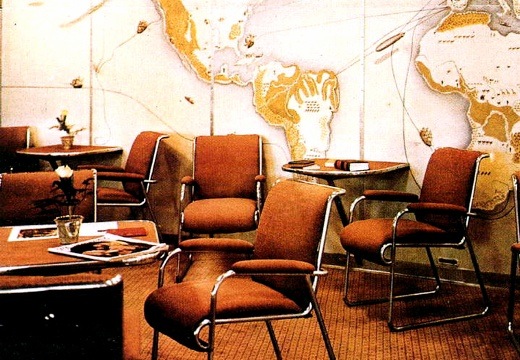
 
Image above: Interior photo of Hindenburg lounge area with free seatng. From (http://www.kingsacademy.com/mhodges/03_The-World-since-1900/05_Depression/05c_Shifting-Sense-of-Order-2.htm).
 
Then, not once, but twice, she came to my seat and told me how sorry she was and how embarrassed she was for what had happened. She actually reached down and took my hand the second time, very emotional. I told her how much I appreciated what she did but that she knew what happened wasn't right. She said nothing. What could she say? She probably took personal risk standing up for me.

As I sat there in 21B, exactly what had happened and why it happened became clear to me. The tensile haired blonde holding court on the jetway had in her own mind, and perhaps in fact had, legal authority to take me off the plane, not for sitting in my seat but for not being a good sheep, one who lined up, sat down, did what he was told when he was told to do it, without question. And, I learned later, with a little research, she was one of those who had been given a little authority. This from the FAA website:

Passengers & Cargo
Unruly Passengers
FAA Enforcement Actions

Violations of 14 CFR 91.11, 121.580, 135.120 & 49 U.S.C. 46318

"Unruly Passengers" 
Interfering with the duties of a crew member violates federal law.

Federal Aviation Regulations 91.11, 121.580 and 135.120 state that "no person may assault, threaten, intimidate, or interfere with a crew member in the performance of the crew-member's duties aboard an aircraft being operated."

The FAA's database contains only those incidents reported to FAA. Reporting is at the discretion of the crew member.

Security violations are excluded. Those cases are handled by the Transportation Security Administration (TSA).

Updated numbers are posted on this web page quarterly.

The repercussions for passengers who engage in unruly behavior can be substantial. They can be fined by FAA or prosecuted on criminal charges.

As part of the FAA's Reauthorization Bill (April 16, 2000) FAA can propose up to $25,000 per violation for unruly passenger cases. Previously, the maximum civil penalty per violation was $1,100. One incident can result in multiple violations.

Did I "interfere" with Linda in the performance of her duties? Not really. I believe Linda's duty is to get me a drink when I want one. Regardless, I merely asked a question of Linda and they didn't want to answer. But I am convinced that Linda and her blonde buddy on the jetway could have made a case that by sending her away twice for the answer to my question that I was being "unruly," as in not able to be ruled, which in the most literal sense was true.

In a Police State, given time, everyone becomes the police. People begin to act out what they see and feel themselves. Physical authority becomes more important than property rights and since authority is all there is, it is often used indiscriminate and harsh. Transparency ceases to exist, and the audacity to question authority meets with immediate and severe repercussions. 

On occasion, a human being whose ethics depend on principles rather than situations, will intercede, but many will stand by idly and watch, and most will participate in the abuse if only because it makes them feel important inside a collective in which they have no importance at all. 

Such is the problem with statism. The state is the ultimate authority. The state uses its authority to punish those who reject the party line, or even question it, which causes others to cower. People are afraid of the state rather than the state being afraid of the people, the latter necessary to have any semblance of freedom. The state carefully parcels out bits of authority to those who comply, to those who are "good soldiers", a euphemism for anyone who will do anything regardless of what is right, regardless of whose person or property is being violated.

Mine was an admittedly small but acute example of this dynamic. The state expects travelers to line up as many times as is necessary, to ignore the value of their own time, and show up two hours early for no good or apparent reason, and then be herded into a corral before being told to put their hands over their heads and be stripped naked by a high-tech scanner. The State assumes that anyone who would tolerate such abuse would surely give up their seat when told to do so by someone with the critical imprimatur of the state.

Upon arrival in San Francisco, waiting for my plane to Spokane, I witnessed not one, but two other abuses of passengers, one who merely wanted to board a plane that was clearly sitting right in front of her, and the other an older woman who dared to drag her bag into an area "reserved for airline personnel". They were both castigated bitterly and loudly. 

Epilog: No word from United. I wasn't expecting any. The good news is that this, along with a myriad of other recent events, has convinced me that the light isn't worth the candle as far as humping airplanes to speak to audiences (the same realization Jeff Berwick came to) who oftentimes leave shocked, shaking their heads, but who rarely actually do anything to better their own conditions. So, United Airlines, I won't be needing a return ticket to the USSA if only because I have no intention of returning except as necessary to visit family and friends who I will strongly encourage to instead visit me here in much freer Mexico. 

• Jim Karger is a lawyer who has represented American businesses against incursions by government and labor unions for 30 years. He has been the subject of many feature articles, including, "Outlandish Labor Lawyer Gets No Objections From Staid Clients," published in the Wall Street Journal, and most recently was featured in an article entitled, "You Can Get There From Here," published by the American Bar Association. In 2001, he left Dallas, and moved to San Miguel de Allende in the high desert of central Mexico where he sought and found a freer and simpler life for he and his wife, Kelly, and their 10 dogs.
.

Rant on Deception

UuuSUBHEAD: We must view everything they say or do from the standpoint of being DECEIVED.  

By Ashvin Pandurangi on 27 June 2012 for the Automatic Earth -  
(http://theautomaticearth.com/Finance/rant-on-deception.html)


 Image above: Advice on deception can be deceptive. From orignal article.
 
It's the middle of yet another week in which yet another round of European wealth extraction (bloody rape) is underway... and yet another gaggle of speculating geese prove that they have no idea what the hell they're talking about or what the hell is going on around them... so... I'm just gonna take this opportunity to rant a little bit.

When the politicians, media pundits, corporate analysts and others start squirting out their verbal diarrhea about the economy, the financial system, the environment, energy trends, the political climate, the geopolitical situation, social issues and everything else that makes its way onto their teleprompters and scripts and reports, there is one common element throughout all of the incessant blather - deception.

That's not just a descriptive noun or verb I'm talking about, either - it's a Theory of Conduct. We must view everything they say or do from the standpoint of being DECEIVED with a capital D-E-C-E-I-V-E and D. None of those scoundrels can be trusted, because they either have a nefarious agenda of their own or are themselves being deceived by someone else with a nefarious agenda - call it a global circle jerk of deceivers and deception.

What these sheisters do is convince you that everything you thought you knew to be true can be substituted with their own MYTHS conjured up in corporate board rooms and hotel suites, bought and paid for with YOUR money. That's right - just like Joe the Dumbass and Jane the Lazy TOOL pay 100 bucks a month to watch no-talent ass clowns on America's Got an Infinite Number of Degrading Reality TV Shows every evening, they pay thousands of bucks every year to be convinced that their collective torture and rape is JUST ACES.
  • You thought that taking on debt was bad and should generally be avoided - THEY told you that accumulating debt is the ONLY way to become successful and respected in this world.
  • You thought that it was wrong to punish the victims and reward the perpetrators of a Class A Felony - THEY told you that it's the ONLY way to prevent an economic apocalypse and save your pension or your job.
  • You thought that austerity for the struggling masses and bailouts for the filthy rich bankers would destroy the local economy - THEY told you that local economies MUST be destroyed for the long-term greater good of humanity.
  • You thought that it was important for people to have sovereignty over their bodies and their own communities through elected and accountable representatives - THEY told you that sovereignty and democracy are obsolete artifacts of a stagnant civilization; a naive remembrance of things past.
You see, anything that you think is true about this world and your life in it can be snatched up like a glop of silly putty, deformed and reshaped into something that is 100% untrue. The only pre-condition to these timeless acts of deception is that your BELIEFS have to be flexible and undefined like... a fucking glop of silly putty. Your worthless brain has to be so mushy and so atrophied that a couple of douche bags in Sweden can tell you that Barack Obama deserves a Nobel Peace Prize, and you believe them!

A couple of Eurotrash Ministers can tell you that they have come up with yet another bailout plan to avert financial meltdown and fill your life back up with rainbows and happy thoughts, while emptying out your pockets and your bank account, and you immediately go back into a culturally-induced coma. That is, of course, until your 9 to 5 Boss tells you to pack up your shit and go home for good, or your financial advisor tells you that your net worth just cratered by 25%, or your trusted bank sends you a polite letter saying you're in default on your mortgage and the roof over your kids' heads has already been scheduled for auction to the lowest scumbag.

Then you wake up and realize the better part of your life has just been one pack of deceptions after another, all setting you up to ultimately do whatever you are told by your Slave Masters and accept your miserable fate without so much as a peep. And it's not just you who will end up SUFFERING for your lack of even ONE freaking ounce of critical thinking and due diligence in that malignant brain of yours - it will be everyone around you, including your family and your closest friends.

So take a deep breath... and re-learn how to read, and to comprehend, and to think critically and to be motivated for the Truth. Tell your family and friends that there is more to life than being endlessly DECEIVED, and more to life than being used like square of toilet paper by the DECEIVERS who just finished taking a massive dump on their heads. Take a shower... use a lot of shampoo and soap... scrub yourself down... towel off... and THEN get your mind right. And get very comfortable too... because the Truth can only win out over the Deceptions over the long-haul, and WE - me, you... all of us - are only just getting started here.

.

Cussedness of Whole Systems

SUBHEAD: The United States will achieve energy independence by 2050 if it successfully devolves into a 3rd World nation.  

By John Michael Greer on 27 June 2012 for the Archdruid Report - (http://thearchdruidreport.blogspot.com/2012/06/cussedness-of-whole-systems.html)

 
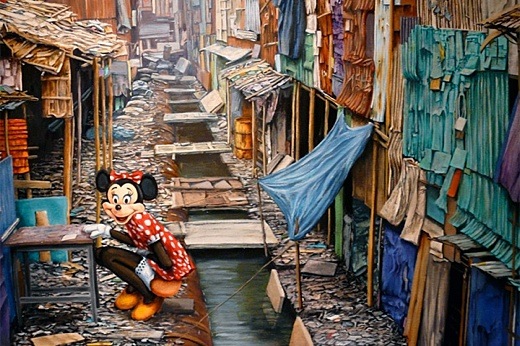
Image above: This is what happens if we miss achieving a acceptable 3rd world economy. Detail of painting by Jeff Gillette in his "Dismayland" series of Daisy Duck taking a dump in a slum sewer. From (http://hypebeast.com/2010/04/jeff-gillette-dismayland-exhibition-recap/).

There’s an interesting divergence between the extreme complexity of the predicament that besets contemporary industrial civilization, on the one hand, and the remarkable simplicity of the failures of reasoning that have sent us hurtling face first into that predicament, on the other. Nearly all of those failures share a common root, which is the inability—or at least the unwillingness—of most people in the modern world to pay attention to the natural cussedness of whole systems.

The example I have in mind just at the moment runs all through one of the most lively nondebates in today’s media, which is about peak oil. I call it a nondebate because those who are trying to debate the issue—that is to say, those people who have noticed the absurdity of trying to extract infinite amounts of petroleum from a finite planet—are by and large shut out of the discussion.

Those who hold the other view, for their part, aren’t debating. With embarrassingly few exceptions, instead, they’re merely insisting at the top of their lungs that peak oil has been disproved by some glossy combination of short term factors, speculative bubbles, and overblown hype about the future, and can we please just get back to our lifestyles of mindless consumption and waste?
Behind the cornucopian handwaving, though, is a real debate, one that those of us who are aware of peak oil need to address. The issue at the heart of the debate is the shape of the curve that will define future petroleum production worldwide, and the reason that it needs to be addressed is that so far, at least, that curve is not doing what most peak oil theories say it should do.
The original version of the peak oil curve, of course, is the one sketched out by M. King Hubbert in his famous 1956 paper. Here it is:

That’s the model that underlies most of today’s peak oil analyses. It’s a good first approximation of the way that oil production normally rises and falls over time on any scale—a well, a field, an oil province, a country—provided that external factors don’t interfere. The problem here, of course, is that oil production doesn’t happen in a vacuum, and so external factors always interfere. It helps to rephrase that last point in systems terms: the production of oil takes place within a whole system and is always influenced by the state of the system.

That’s why at best, the history of oil production from any given well, field, oil province, or country only roughly approximates the ideal shape of the Hubbert curve, and many real-world examples stray all over the map in their wanderings from the zero point at the beginning to the one at the end.
It’s the failure to appreciate this point that has left a good many peak oil analysts flailing when global petroleum production failed to decline according to some predicted schedule. Anyone who’s been following the peak oil blogosphere for more than a few years has gotten used to the annual predictions—they tend to pop up like mushrooms every December—that the year about to begin would finally see rates of petroleum production begin dropping like the proverbial rock.

Tolerably often, in fact, the same predictions get recycled from one year to the next, with no more attention to the lessons of past failure than you’ll find in one of Harold Camping’s Rapture prophecies. Even among those who don’t go that far out on a limb, the notion that global production of petroleum ought to start dropping steeply sometime soon is all but hardwired into the peak oil scene.
The peak of global conventional petroleum production arrived, as I hope most of my readers are aware by now, in 2005. The seven years since then have given us a first glimpse at the far end of Hubbert’s curve, and so far, it’s not following the model. Conventional petroleum production has declined, and the price of oil has wobbled unsteadily up to levels that mainstream analysts considered impossible a decade ago; that much of the peak oil prophecy has been confirmed by events.

Overall production of liquid fuels, though, has remained steady and even risen slightly, as high prices have made it profitable for unconventional petroleum and a range of petroleum substitutes—tar sand extractives, natural gas liquids, biodiesel, ethanol, and the like—to be poured into the world’s fuel tanks.
It’s only fair to note that this was among the predictions made by critics of peak oil theory back when that was still a subject of debate. The standard argument economists used to dismiss the threat of peak oil was precisely that rising prices would make other energy sources economical, following the normal workings of supply and demand. For all its flaws—and I plan on dissecting a few of those shortly—that prediction was rooted in the behavior of whole systems.
The law of supply and demand, in fact, is one manifestation of a basic principle of systems theory, a principle pervasive and inescapable enough that it’s not unreasonable to call it a law. The law of equilibrium, as we might as well call it, states that any attempt to change the state of a whole system will set in motion coutervailing processes that tend to restore the system to its original state. Those processes will not necessarily succeed; they may fail, and they may also trigger changes of their own that push the system in unpredictable directions; still, such processes always emerge, and if you ignore them, it’s a fairly safe bet that they’re going to blindside you.
The law of equilibrium is what’s behind so many of the failures of technological progress in recent years. Decide that you can just go ahead and annihilate pathogenic microbes en masse with antibiotics, for example, and the countervailing processes of the planet’s microbial ecology are going to shift into high gear, churning out genes for antibiotic resistance that spread from one bacterial species to another and render antibiotics less effective with every year that passes.

The same is true of genetically engineered plants—one of the ugly little secrets of the GMO industry is that one insect species after another is doing exactly what Darwinian theory says it should, evolving right around the biotoxins released by Monsanto’s supposedly pestproof Frankencrops, and chowing down on the otherwise unprotected buffet spread for them by unsuspecting farmers—and of any number of equally clueless tinkerings with natural processes that are blowing up in humanity’s collective face just now.
The global industrial economy is also a whole system, and though it’s countless orders of magnitude less complex and sophisticated than the biosphere, it still responds to changing conditions with its own countervailing processes.

That’s what’s been happening with global liquid fuels production. As the rate of conventional petroleum production peaked and began its decline, the countervailing processes took the form of rising prices, which made more expensive sources of liquid fuels profitable, and kept total production of liquid fuels not far from where it was when conventional oil peaked in 2005.

The wild swings in price since then have provided the thermostat for this homeostatic process, balancing the ragged decline of conventional petroleum and the equally ragged expansion of substitute fuels by influencing the profitability of any given fuel over time. In its own way, it’s an elegant mechanism, however much turmoil and suffering it happens to generate in the real world.
Does this mean that peak oil is no longer an issue? Not by a long shot, because the economic shifts necessary to bring substitute fuels into the fuel supply don’t exist in a vacuum, either. They also put pressure on the global industrial economy, and generate countervailing processes of their own. That’s the detail that both sides of the peak oil nondebate have by and large been missing, even as those countervailing processes have been whipsawing the global economy and driving changes that seemed implausible even to most peak oil analysts just a short time ago.
The point that has to be grasped in order to understand these broader effects is that the higher price of substitute fuels isn’t arbitrary. Tar sand extractives, for example, cost more to produce than light sweet crude because pressure-washing tar out of tar sands and converting it to a rough equivalent of crude oil takes much more in the way of energy, resources, and labor than it takes to drill for the same amount of conventional oil.

Each year, therefore, as more of the liquid fuels supply is made up by tar sand extractives and other substitute fuels, larger fractions of the annual supply of energy, raw materials, and labor have to be devoted to the process of bringing liquid fuels to market, leaving a smaller portion of each of these things to be divided up among all other economic sectors.
Some of the effects of this process are obvious enough—for example, the spikes in food prices we’ve been having since 2005, as the increasing use of ethanol and biodiesel as liquid fuels means that grains and vegetable oils are being diverted from the food supply for use as feedstocks for fuel. Many others are less obvious—for example, as energy prices have risen and energy companies have become Wall Street favorites, many billions of dollars that might otherwise have become capital for other industries have flowed into the energy sector instead. Each of these effects, however, represents a drain on other sectors of the economy, and thus a force for change that sets countervailing processes into motion.
Those processes are a good deal more complex than the ones we’ve traced so far, since they involve competition for capital and other resources among different sectors of the economy, a struggle in which political and cultural factors play at least as large a role as economics. Still, one result can be traced in the unexpected decline in petroleum consumption that has taken place in the United States since 2008, and that precisely parallels the similar decline that happened between 1975 and 1985 in response to a similar rise in oil prices.

 To describe this process as demand destruction is an oversimplification; a dizzyingly complex array of factors, ranging from the TSA’s officially sanctioned habit of sexually molesting airline passengers, on the one hand, to shifts in teen fashion that are making driving uncool for the first time in a century on the other, have fed into the decline in oil consumption; still, the thing is happening, and it’s probably fair to say that the increasing impoverishment of most Americans is playing a very large role in it.
Thus the simple model of peak oil that dates from Hubbert’s time badly needs updating. Ironically, The Limits to Growth—the most accurate and thus, inevitably, the most maligned of the various guides to our unwelcome future offered up so far—provided the necessary insight decades ago. By the simple expedient of lumping resources, industrial production, and other primary factors into a single variable each, the Limits to Growth team avoided the fixation on detail that so often blinds people to systems behavior on the broad scale.

Within the simplified model that resulted, it became obvious that limitless growth on a finite planet engenders countervailing processes that tend to restore the original state of the system. It became just as obvious that the most important of those processes was the simple fact that in any environment with finite resources and a finite capacity to absorb pollution, the costs of growth would eventually rise faster than the benefits, and force the global economy to its knees.
That’s what’s happening now. What makes that hard to see at first glance is that the costs of growth are popping up in unexpected places; put too much stress on a chain and it’ll break, but the link that breaks isn’t necessarily the one closest to the source of stress. The economies of the world’s industrial nations are utterly dependent on a steady supply of liquid fuels, and so a steady supply of liquid fuels they will have, even if every other sector of the economy has to be dumped into the hopper in order to keep the fuel flowing.

 As every other sector of the economy is dumped into that hopper, in turn, the demand for liquid fuels goes down, because when people who used to be employed by the rest of the economy can no longer afford to spend spring break in Mazatlan, or buy goods that have to be shipped halfway around the planet, or put gas in their cars, their share of petroleum consumption goes unclaimed.
This process is, among other things, one of the main forces behind the disappearance of "bankable projects" discussed in last week’s post. The reallocation of ever larger fractions of capital, resources, and labor to the production of liquid fuels represents a subtle drain on most other fields of economic endeavor, driving costs up and profits down across the board.

The one exception is the financial sector, since increasing the amount of paper value produced by purely financial transactions involves no additional capital, resources, and labor—a derivative worth ten million dollars costs no more to produce, in terms of real inputs, than one worth ten thousand, or for that matter ten cents.

Thus financial transactions increasingly become the only reliable source of profit in an otherwise faltering economy, and the explosive expansion of abstract paper wealth masks the contraction of real wealth.

When systems theorists explain that the behavior of whole systems can be counterintuitive, this is the sort of thing they have in mind. It’s quite possible that as we move further past the peak of conventional petroleum production, the consumption of petroleum products will continue to decline, so that when the ability to produce substitute fuels declines as well—as of course it will—the impact of the latter decline will be hard to trace.

Ever more elaborate towers of hallucinatory wealth, ably assisted by reams of doctored government statistics, will project the illusion of a thriving economy onto a society in freefall; the stock market will wobble around its current level for a long time to come, booming and crashing on occasion as bubbles come and go; meanwhile a growing fraction of the population will be forced to drop out of the official economy altogether, and be left to scrape together whatever sort of living they can in some updated equivalent of the Hoovervilles and tarpaper shacks of the 1930s.
No doubt the glossy magazines that make their money by marketing a rose-colored image of the future to today’s privileged classes will hail declines in petroleum demand as a sign that some golden age of green technology is at hand, and trot out a flurry of anecdotes to prove it; all they’ll have to do is ignore the hard figures showing that demand for renewable-energy systems is dropping too, as people who have no money find solar panels as unaffordable as barrels of oil.

For that matter, the people who are insisting in today’s media that the United States will achieve energy independence by 2050 may just turn out to be right; it’s just that this will happen because the US will have devolved into a bankrupt Third World nation in which the vast majority of the population lives in abject poverty and petroleum consumption has dropped to a sixth or less of its current level.

.

Letting go

SUBHEAD: Learning of new skills outside my comfort zone, and the embrace of nature is something that I’m ready for.  

By Doug Hanvey on 26 June 2012 for Transition Voice -  
(http://transitionvoice.com/2012/06/letting-go/)  
Image above: Sand escaping through your fingres. From original article.
We spend enormous amounts of time, energy, and treasure in imposing our will on nature … dreaming of permanent solutions, monuments to our ambitions and dreams. But in periods of slack, decline, or collapse, our abilities no longer suffice for all this management. We have to let things go. – Ernest Callenbach
This summer, I’m on an odyssey to five unique intentional communities and ecovillages, including the original hippie commune, Virginia’s Twin Oaks, and two communities in Missouri, Dancing Rabbit Ecovillage and Possibility Alliance. The latter is so off-grid that it doesn’t even have a website.

I’m on a quest for knowledge and experience for my own personal and professional Transition project, the founding of EcoDharma College – which, if all goes as planned, will fuse a Buddhist meditation center, trade school, intentional community, workers’ cooperative, organic farm, and permaculture demonstration site into one organic entity.

The curriculum will blend Buddhist meditation with Transition-related reskilling in a community-building context. Given likely energy depletion, economic contraction and environmental collapse, it seems to me that any attempt to teach spiritual and practical lifestyle skills is worth trying. I also feel that the inner work of “letting go” central to Buddhist practice is an important and as yet unsung accompaniment to Transition and reskilling work.

I’m hoping that my journey will lay to rest one particular question: Do I personally have what it takes to transition away from my comfortable middle class lifestyle?

This is likely to involve much more contact than I’ve yet experienced with the challenges of agriculture and the outdoor life – physical labor, dirt, poison ivy, and my least favorite of nature’s plenitude, ticks.

Put another way, Do I have what it takes to let go?

Industrial civilization is here to stay, right?

Sometimes it seems that, like the evil dwarf Alberich who sets into motion Richard Wagner’s vast opera cycle The Ring of the Nibelung, the movers and shakers of industrial civilization are demonstrating that they too are willing to forswear their own highest human potentials (love, compassion, justice) for power, control, and most of all, money.

For the rest of us, for whom stealing the Rhinegold and forsaking love for absolute world domination is not an option, the world that beckons us during these lazy post-peak oil days is ripe for our spiritual engagement.

In my experience, a spiritual practice can provide a sense of stability and tranquillity in the midst of an increasingly unhinged world. We clever humans tend to misperceive the world, because our perception is distorted by our concepts and beliefs – the shoulds and oughts and will be’s in which we invest so much emotional energy – and which are often at odds with the world as it actually is.
Worse, we become attached to our beliefs, even if it is those beliefs (and nothing else) that make the world seem a crappy, stressful, threatening place. For unknown reasons, it’s the human condition to cling to what we know, rather than to let go into the world as it is, without our beliefs about it, or demands upon it.

Attachment to our beliefs and our way of life defines industrial humans, as it has throughout human history.

What is new, though, is how rapidly our global civilization and natural environment is changing, and therefore how thoroughly we’re being challenged to let go of what we know and what we’re used to.
This, then, is the inner work of Transition: Questioning and letting go of the comfortable beliefs and unquestioned assumptions – conscious or unconscious – that we take as gospel truth, and that cause us so much stress (especially when the dissonance between them and reality-as-it-is becomes too obvious to ignore). For example:
  • Industrial civilization is here to stay.
  • Human progress is unstoppable; technology will save us.
  • For the economy’s sake we must continue to extract and burn fossil fuels.
There are the more personal stories to which we may cling:
  • I must find (or keep) a job in the money economy – if I can’t, I’m doomed and/or a failure.
  • My children need these advantages today, even if they may hurt their futures tomorrow.
  • Why waste time building community and getting to know my neighbors? We probably wouldn’t like each other anyway.
Other assumptions may keep us from changing course, or lead us in increasingly untenable directions:
  • I doubt I have the inner or outer resources it would take to change my circumstances to live more sustainably.
  • I don’t want to look like I’m falling behind, or getting poorer.
  • If I stick to the grind of my job in the mainstream economy, I’ll be able to retire comfortably, like my parents and grandparents.
Since, to anyone paying attention, these stress-provoking beliefs and assumptions are dubious and/or counterproductive to making useful changes in one’s life, might it not be worthwhile to become aware of them, question them (asking, Is this true? Can I really know this is true?), and let them go?

On the farm

It’s my first experience living on a rural, farm-based intentional community (or any farm for that matter). Over the next two weeks I’ll end up learning and working at a variety of mostly manual, sometimes repetitive, occasionally physically arduous tasks, ending up considerably sweatier, dirtier, and more uncomfortable than in work as I’ve known it.

Perhaps, I tell myself, I’ve been habituated by my middle-class existence to take for granted dirt-free floors, shiny bathrooms, and spending my days comfortably sedentary. Perhaps I can let go of my attachments to those things, and get used to considerable physical labor, discomfort, and indoor dirt (though hopefully less dirt than at this particular community!).

Like all industrial humans, I’ve been habituated to artificial environments whose boundaries are defined by how they keep nature (dirt, rain…and ticks) out.

I’ve lived in these environments all my life. What would it be like to relax these boundaries? To allow nature back into my human environment, and to let myself back into nature, as a farmer or even hunter-gatherer (if it came to that)?

The immense financial and material investment required to artificially separate billions of human beings from nature is becoming increasingly difficult to maintain. How much letting go will be asked of us?

Transition is letting go

The practice of religion involves, more often than not, clinging to teachings, sacred texts, and interpretations, moralizations, and beliefs about life, what is good or bad, and what might happen to me after death. The essence of spirituality is much simpler – it’s letting go. One of the first spiritual books I ever read repeated this simple fact ad nauseum, which at the time I found difficult to understand, and unpleasant to contemplate. Wasn’t spirituality about cool transcendent states? Transcendent states were much more appealing than letting go, whatever that was.
Letting go is a scary thing to the mind, the ego, to me as I think of (or think up) myself.

This is peculiar.

We all know that we must let go, eventually, of everything and everyone we know, and finally, of the self we think we are. What are we to do with that knowledge?

The mystic-sages from all the world’s spiritual traditions tell us to let go now, rather than later. Yes, freedom and peace and transcendence – the kind of things I thought spirituality was about – are genuine potentialities within us, but they are only found in letting go.

There’s a common misunderstanding about letting go – that it means renouncing people, things, or lifestyles. We might think that, in Transition terms, letting go means that I must sell my car, leave a relationship with someone who doesn’t get it, or abandon a way of life, middle class or otherwise.
Maybe so.

Transition may require us to give up certain possessions and comforts. Relationships with those who are not on the same page may fracture; new relationships will be born. Yet the real work of letting go happens inside us. I may sell my car yet remain mentally or emotionally attached to it, thinking how nice it would be to have a car again, and of all the conveniences that having a car, my car, would bring me. But I can also do the inner work of letting go of my mental and emotional attachments to having a car before I sell it. Perhaps I’ll discover that it’s the right time to sell it. Or maybe it’s not. Either way, I’ll be a freer human being who has let go just a little bit more.

Can a civilization let go?

Spiritual work is usually perceived as individual work, and from a certain perspective, that’s true. But what if, collectively, enough of us were to let go of the beliefs, assumptions, privileges, demands, and expectations that conceptually hold together so much of our Earth-destroying civilization? What if we did this work together?

What if we questioned the assumption that a decline in material wealth and energy use must lead to a decline in quality of life?

What if we let go of our beliefs about climate change and allowed our body and senses to inform us instead: Does this weather feel normal?

What if, on a planet in which the sustainable carrying capacity for human beings was exceeded long ago (and in which possibly dozens of species are going extinct each day due to our domination of the biosphere), we relinquished the privilege to reproduce ourselves with no thought as to the impact?
What if we let go of the assumption that such a massive transformation can’t possibly happen in time?
What if?

Not for sissies

I’ve decided that life on a farm isn’t for sissies. Fortunately, I think that a life that demands more physical effort, the learning of new skills outside my comfort zone, and the embrace of nature in all its wonder, is something that I’m ready for.

Except, maybe, for ticks.

After two weeks here, I (not without a great deal of mindful caution) have not discovered a single unwanted tourist. My fellow participant, Nick, hasn’t been so lucky. Not only has he found several of the evil things on his body, but one of the bites has developed a ring, a possible sign of Lyme disease. Nick heads to the doctor and returns with a bottle of antibiotics. (Thank you, industrial medicine.)
I ponder my aversion to ticks. What is it about them that’s so disturbing? And then it dawns on me. Of all the creatures that I know – even more than humans – ticks have the hardest time letting go.

.

Time & Tide

SUBHEAD: They wait for no man - or for anything else. Produce - Consume - Collapse - Repeat  

By Mary Logan on 26 June 2012 for A Prosperous Way Down -  
(http://prosperouswaydown.com/time-tides-wait-for-no-man/?utm_source=rss&utm_medium=rss&utm_campaign=time-tides-wait-for-no-man)


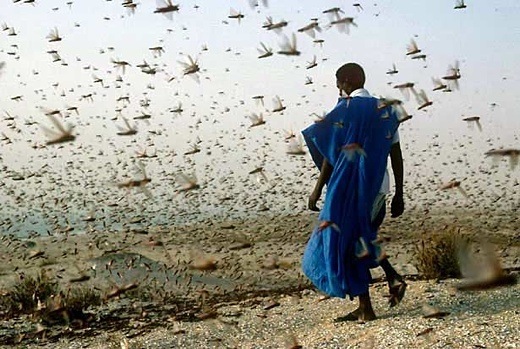
 Image above: Locusts swarming in Africa. From (http://wisdomofthewest.blogspot.com/2008/05/some-swarms.html).
 
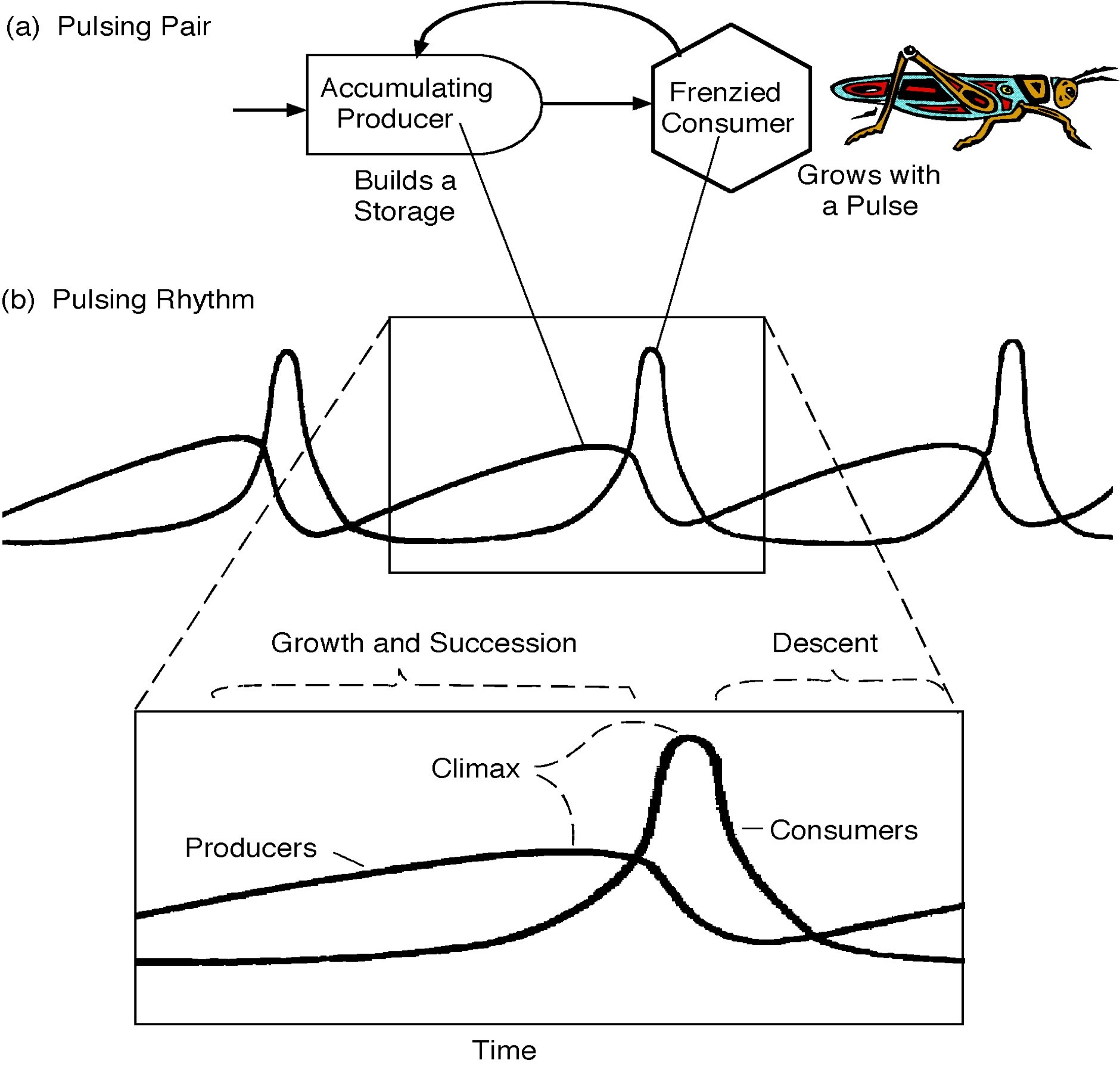
A century of studies in ecology, and in many other fields from molecules to stars, shows that systems don’t level off for long. They pulse. Apparently the pattern that maximizes power on each scale in the long run is a pulsed consumption of mature structures that resets succession to repeat again. There are many mechanisms, such as epidemic insects eating a forest, regular fires in grasslands, locusts in the desert, volcanic eruptions in geologic succession, oscillating chemical reactions, and exploding stars in the cosmos. Systems that develop pulsing mechanisms prevail. The figure above includes the downturn for reset that follows ecological climax. In the long run there is no steady state (Odum, 2007, p. 54).


Image above: Illustration of locust population boom and bust from (http://prosperouswaydown.com/principles-of-self-organization/energy-hierarchy/pulsing-paradigm/).
 
The aspect of resilience and panarchy that is most novel and significant concerns the “back-loop” phase when resisting structures and institutions start to break down or transform, releasing the chance for a renewed system to emerge. The many ecosystem examples are matched by many business examples where technology shapes products from sneakers, to automobiles, to electrical appliances.
At that moment, novelty that had been simmering in the background can emerge and be stimulated. And new associations begin to develop among previously separate innovations. The big influence comes from discoveries that, at that time, emerge from people’s local experiments at small scales, discoveries that can emerge at times of big change, to trigger bigger changes at large scales. That process highlights the keys for the future (Holling, 2009).

As a follow up to Dave Tilley’s article on renewable rhythms, and in celebration of summer solstice, I would like to discuss the idea that fossil fuels have allowed us to suppress or even ignore pulses of Nature and our own biorhythms. We have adopted artificial pulses of industrial production and consumption with attempts to create continuous growth.

Fossil fuels allow us to create a seamlessly, climate-controlled, homogenous monoculture that blurs night into day, and summer into winter. It even homogenizes trends, with everything always improving and going up without a break in the action. This separates us from Nature and creates the impression of invincibility. How does this invisibility present in our dominant culture, and what does it mean as our culture transitions into descent?

Up here in Alaska, the annual pulses are so great that it is hard to escape the reminders. Summer solstice is a special time in Alaska. In Anchorage, the number of daylight hours at solstice peaks at 18 ½ hours. Solstice is a reminder that the days are now getting shorter, and that we need to get a move on with things we plan to accomplish during the summer.

We begin to get 70 degree + days. The vegetables start to produce in the garden. Local markets are full of produce. It is a time of plenty, and comfort, and celebration. Picnics and potlucks abound. After solstice, the urge to go-go-go accelerates for some. Alaskans catch and put away salmon, and by late August the smell of high bush cranberry gives me a sense of restless urgency reflected in outings of berry picking and restless hikes in the high country. The Alaska State Fair in late August demonstrates the power of our summer sun and the prowess of our farmers. Brief fall colors, fall rut, and waning daylight bring the promise of winter. Seasonal pulses in Alaska are big, and there is no steady state. Excess light switches to not enough light very quickly, at a rate of over 5 minutes a day, and moods shift and behaviors change with the seasons.

Historically, seasonal pulses have been symbols of growth, fertility of death in multiple cultures. Older medieval cultures connected melancholy with a complex set of moral, religious, and emotional symbols and associations that created cultural order out of the seasons, and was even treated as a mark of distinction in 16th century Europe (Harrison, 2004). The seasons were connected to human behavior, moods, and rich symbolism regarding life and death in a number of cultures.

Winter was a season for rest, regeneration, and reflection. In the arctic and subarctic, Scandinavians and Alaska Native peoples have a much longer culture of adaptation to long winters than the dominant American culture, and they are much better adapted to the changes in light and the long winters. Diet adaptations to physical changes due to inadequate light include cod liver oil for Scandinavians and a diet of fish and muktuk for Alaska Natives. Calendars were oriented towards harvest, and seasonal harvest celebrations such as Thanksgiving and Christmas celebrated and honored seasonal changes with feasts, candlelight and storytelling. Stuhlmiller (1998) tried to explore Seasonal Affective Disorder (SAD) in Norway, and found that Norwegians did not medicalize their seasons, and considered the behavioral changes that come with the seasons as normal.
Norwegians’ seasonal experiences are embedded in a tradition of specific activities and attitudes, which precluded viewing seasonal change as a potential disorder as some Americans do. Scandinavians accept a certain amount of moodiness and insomnia as a normal seasonal adaptation, for example, and treat it with the cultural adaptation of exercising outdoors in the winter. The joke that Norwegians are born with skis on their feet is accompanied by a “palpable peer pressure to go out in the woods fairly frequently otherwise one is not really Norwegian . . . . If you go on a skiing trip through Norwegian nature, you are a good person. The moral undertone is there and cannot be ignored” (Reed & Rothenberg, 1993, p. 21, in Stuhlmiller (1998)).
Some of that expectation can be seen in Alaska, as some cultural exchange with Scandinavia has occurred. Some of my friends nod in approval when I describe skiing activities outdoors in the winter. Our American fossil-fuel based culture not only smooths out the pulses using fossil fuel means, it medicalizes natural conditions such as seasonal adaptation, demanding that we SAD light our behavioral changes, or medicate them with antidepressants.

Is it prosperity to burn the midnight oil to finish work late into the night, in opposition to our nature? Do we then burn SAD lights or take pills in order to medicate our lack of adaptation to the seasons? Is sadness adaptive in some way, or must we always be happy? I have friends who can’t sleep in our sunlit summers without special darkening shades, eye-shades, and sleep medications. The sleep medications become addicting and can cause rebound phenomena, creating worse insomnia than originally experienced. And shift work is known to cause a number of physical disorders due to the alteration in biorhythms. Our industrial society creates unnatural patterns requiring unnatural treatment with strong medications. On our recent bike trip, headlamps were unnecessary. We naturally fell into rhythms of day and night without watches, alarms, or other digital reminders of sleep/wake aids (oh, except for the coffee).

Fossil fuels allow us to ignore in part the natural lunar, solar, and water driven pulses. Schedules shift from solar/lunar to corporate/quarterly or business weekly/commercial or even political/every four years. In the winter, we light up the night, and create many large heated spaces to carry on activities such as indoor tennis that are perhaps better suited to summer. We ship summer fruits and vegetables from the other hemisphere, or we grow them with the assistance of fossil fuels.

We go to great lengths to clear roads of snow, and cart off the excess to large snow dumps so that we don’t have to modify our winter behaviors in any way. School is morphing into a year-round schedule, without attention to the seasonal calendar. Hot climates are made cool, and cold climates are heated to a homogenous, standard 70 degrees. We control floods and we irrigate droughts. Advanced weather forecasting allows us to safely flee hurricanes and hunker down in tornados or blizzards. We create ski slopes and water parks in the desert, and transmit a mall-oriented homogenous consumer culture to just about everywhere, at least in America. Music, language, food, and culture become uniform to the point of blandness.

The general pace of life is different, too. Just in time supply chains supply our every need whenever we want, quickly and efficiently. Behaviors are transmitted globally via the Internet, causing loss of languages and globalization of corporate culture. The internet also smooths diurnal pulses, creating a never-ending stream of information, extended work days due to connectivity, and no down time/rest/leisure from information streams and digital excess. Speech patterns are rapid and courtesies may be dispensed with in crowded urban settings in comparison to slower, rural cultures.

We escape winter by vacationing thousands of miles away from home, avoiding hardships that might build relationships that could foster community cohesion. We rejoice in uniformity in cruise and jet travel. Fossil fuels have allowed us to live in large populations in places like Phoenix, Dubai and Anchorage using adaptations that allow us to exert high tech control over Nature. Historically, small populations of Alaska Native peoples migrated seasonally in order to adapt to low energy ecosystems with extreme pulses of weather. Now we just apply a dose of fossil fuels to our pulses and smooth them out. One can even wonder at our obsessive focus on climate as a symbolic failure in being able to control the weather.

So what does the importance of pulsing mean in adaptation to descent? Relocalization will mean reinvigoration of regional differences. Alaska will lose its box stores and malls, and will re-acquire local markets, diversified zoning, and better adaptations to winter that are not based on fossil fuels. Places will start to look different economically, socially, culturally, and perhaps also biologically. People who cannot adapt will migrate away or suffer or perhaps die. Areas that were historically sparsely populated due to low resources may lose their populations.

For example, the aged and the young in some of our extreme urban environments such as Las Vegas, Phoenix and Anchorage who are dependent on electricity for cooling and heating will need to adapt in one way or another. As fossil fuels wane, we can adapt by recognizing and following natural pulses and responding to periods of growth, harvest, and regeneration appropriately.

Pulsing does not mean “end to growth” or “steady state” which is what is most often proposed as the alternative to growth. If our pulses stop, we are dead. What goes up must come down. Looking at a pulse and seeing only steady state is either optimistic cognitive dissonance or a bargaining stance of viewing the pulse through a narrow time window where Wile E. Coyote never has to fall. Natural ecosystems are organized around pulses of sun, rain, tides, wind, and storms. Pulses help to mediate predator-prey and host-parasite relationships, and may prevent overgrowth in systems by resetting feedback loops. These paired pulsing populations help to keep populations healthy. Pulsing maximizes power and is adaptive.

With the smoothing of nature’s pulses in industrial society comes complex bureaucratic structure that resists change. Forest fire tinder is allowed to accumulate for fear of fires, and we suppress wildfires because of overpopulated landscapes and the loss of natural ecosystems that would have absorbed these larger pulses from nature. We combat natural cycles such as spruce bark beetles. We channelize rivers to control for flood, and support unsustainable building of houses in floodplains and on barrier islands. We create just-in-time round the clock systems of operation that lack resilience.

We are intolerant of hardship and increasingly resistant to change, which creates more pressure on the existing system. Steady states are not adaptive—all systems pulse. Attempting to circumvent pulsing from systems prevents regeneration, lowers productivity, and creates rigidity and a lack of system responsiveness. We have incrementally added so much complexity while suppressing nature’s rhythms that we are vulnerable at all scales to the impact of large disorganizing societal pulses. Every move that we make towards more centralized, corporate control eliminates competitors and diversity. A system that promotes more and more growth creates overshoot that will be hard to dismantle without collapse.

Perhaps the most important meaning of the change that is required is the emotional acceptance of our renewed loss of control over Nature as complexity wanes in a lower-energy world. The control we have over our culture and the complexity that comes with it has created an obsessive fear of loss of control along with increasing intolerance for change. Our industrial society denies ecological and cultural roots of our behaviors, assigning biochemical causes alone to our behaviors, thus medicalizing what may be normal adaptive behaviors. Since we are separate from Nature, ecological connections and causation are denied. Many previous cultures used the image of the ouroboros snake to represent the cycle of life and the renewal that is necessary to sustain it. The All is One.

The end is the beginning–here is our chance for cultural evolution in our rebirth as we shed our old skins and rise anew. We’ve slid a long way from old cultural values that helped us to live sustainably within nature. We need a new compass to steer by for the dislocation that is to come. Chaucer was right, time and tides wait for no man. We need to regain and honor the rhythm of time and tides in new relocalized agrarian systems. Living in Nature’s pulsing paradigm will be messier, more diverse, less uniform, and more exciting.

Bring it on.

.