Fukushima worse than Chernobyl

SUBHEAD: The radioactivity of irradiated nuclear fuel stored at Fukushima is greater than the molten cores. By Ropert Alvarez on 24 April 2012 for Counter Culture - (http://www.countercurrents.org/alvarez240412.htm) Image above: "Volunteer Firemen" working on the roof of the Chernobyl Reactor in 1986. From (http://imageshack.us/photo/my-images/393/kostin0fj.jpg/). In the aftermath of the world’s worst nuclear power disaster, the news media is just beginning to grasp that the dangers to Japan and the rest of the world posed by the Fukushima-Dai-Ichi site are far from over. After repeated warnings by former senior Japanese officials, nuclear experts, and now a U.S. Senator, it is sinking in that the irradiated nuclear fuel stored in spent fuel pools amidst the reactor ruins may have far greater potential offsite consequences than the molten cores.Fukushima's devastation two weeks after the tsunami.

After visiting the site recently, Senator Ron Wyden (D-OR) wrote to Japan's ambassador to the U.S. stating that, "loss of containment in any of these pools could result in an even greater release than the initial accident."

This is why:

>> Each pool contains irradiated fuel from several years of operation, making for an extremely large radioactive inventory without a strong containment structure that encloses the reactor cores;

>> Several pools are now completely open to the atmosphere because the reactor buildings were demolished by explosions; they are about 100 feet above ground and could possibly topple or collapse from structural damage coupled with another powerful earthquake;

>> The loss of water exposing the spent fuel will result in overheating can cause melting and ignite its zirconium metal cladding – resulting in a fire that could deposit large amounts of radioactive materials over hundreds of miles.

Irradiated nuclear fuel, also called "spent fuel," is extraordinarily radioactive. In a matter of seconds, an unprotected human one foot away from a single freshly removed spent fuel assembly would receive a lethal dose of radiation within seconds. As one of the most dangerous materials in the world, spent reactor fuel poses significant long-term risks, requiring isolation in a geological disposal site that can protect the human environment for tens of thousands of years.

It's almost 26 years since the Chernobyl reactor exploded and caught fire releasing enormous amounts of radioactive debris. The Chernobyl accident revealed the folly of not having an extra barrier of thick concrete and steel surrounding the reactor core that is required for modern plants in the U.S., Japan and elsewhere. The Fukushima Dai-Ichi accident revealed the folly of storing huge amounts of highly radioactive spent fuel in vulnerable pools, high above the ground.

What both accidents have in common is widespread environmental contamination from cesium-137. With a half-life of 30, years, Cs-137 gives off penetrating radiation, as it decays. Once in the environment, it mimics potassium as it accumulates in biota and the human food chain for many decades. When it enters the human body, about 75 percent lodges in muscle tissue, with perhaps the most important muscle being the heart. Studies of chronic exposure to Cs-137 among the people living near Chernobyl show an alarming rate of heart problems, particularly among children.

As more information is made available, we now know that the Fukushima Dai-Ichi site is storing 10,833 spent fuel assemblies (SNF) containing roughly 327 million curies of long-lived radioactivity About 132 million curies is cesium-137 or nearly 85 times the amount estimated to have been released at Chernobyl.

The overall problem we face is that nearly all of the spent fuel at the Dai-Ichi site is in vulnerable pools in a high risk/consequence earthquake zone. The urgency of the situation is underscored by the ongoing seismic activity around NE Japan in which 13 earthquakes of magnitude 4.0 - 5.7 have occurred off the NE coast of Honshu last week in the 4 days between 4/14 and 4/17. This has been the norm since the first quake and tsunami hit the site on March 11th of last year. Larger quakes are expected closer to the power plant. Earlier this month, Tokyo Electric Power Company (TEPCO) revealed plans to remove 2,274 spent fuel assemblies from the damaged reactors that will probably take at least a decade to accomplish. The first priority will be removal of the contents in Pool No. 4. This pool is structurally damaged and contains about 10 times more cesium-137 than released at Chernobyl. Removal of SNF from the No. 4 reactor is optimistically expected to begin at the end of 2013. A significant amount of construction to remove, debris and reinforce the structurally-damaged reactor buildings, especially the fuel-handling areas, will be required.

Also, it is not safe to keep 1,882 spent fuel assemblies containing ~57 million curies of long-lived radioactivity, including nearly 15 times more cs-137 than released at Chernobyl in the The stark reality, if TEPCO's plan is realized, is that nearly all of the spent fuel at the Da-Ichi containing some of the largest concentrations of radioactivity on the planet will remain indefinitely in vulnerable pools. elevated pools at reactors 5, 6, and 7, which did not experience melt-downs and explosions.

The main reason why there is so much spent fuel at the Da-Ichi site, is that it was supposed to be sent to the Rokkasho reprocessing plant, which has experienced 18 lengthy delays throughout its construction history. Plutonium and uranium was to be extracted from the spent fuel there, with the plutonium to be used as fuel at the Monju fast reactor.

After several decades and billions of dollars, the United States effectively abandoned the "closed" nuclear fuel cycle 30 years ago for cost and nuclear non-proliferation reasons. Over the past 60 years, the history of fast reactors using plutonium is littered with failures the most recent being the Monju project in Japan. Monju was cancelled in November of last year, dealing a fatal blow to the dream of a "closed" nuclear fuel cycle in Japan. The stark reality, if TEPCO's plan is realized, is that nearly all of the spent fuel at the Da-Ichi containing some of the largest concentrations of radioactivity on the planet will remain indefinitely in vulnerable pools. TEPCO wants to store the spent fuel from the damaged reactors in the common pool, and only to resort to dry, cask storage when the common pool's capacity is exceeded. At this time, the common pool is at 80 percent storage capacity and will require removal of SNF to make room. TEPCO's plan is to minimize dry cask storage as much as possible and to rely indefinitely on vulnerable pool storage. Senator Wyden finds that TEPCO's plan for remediation carries extraordinary and continuing risk. He sensibly recommends that retrieval of spent fuel in existing on-site spent fuel pools to safer storage in dry casks should be a priority.

Given these circumstances, a key goal for the stabilization of the Fukushima-Daichi site is to place all of its spent reactor fuel into dry, hardened storage casks. This will require about 244 additional casks at a cost of about $1 mllion per cask. To accomplish this goal, an international effort is required – something that Senator Ron Wyden (D-OR) has called for. As we have learned, despite the enormous destruction from the earthquake and tsunami at the Dai-Ich Site, the nine dry casks and their contents were unscathed. This is an important lesson we should not ignore.

• Robert Alvarez an Institute for Policy Studies senior scholar, served as senior policy adviser to the Energy Department's secretary and deputy assistant secretary for national security and the environment from 1993 to 1999.

.

The Simpler Way

SUBHEAD: An outline of a transition to achieving a steady-state no-growth economy without deprivation. By Samuel Alexander on 20 April 2012 for The Energy Bulletin - (http://www.energybulletin.net/stories/2012-04-20/ted-trainer-and-simpler-way) Image above: Illustration by Norman Rockwell "The Philosopher", 1931. From (http://charlemos.foros.ws/t1976/vintage-posters/112/).

1. Introduction

For several decades Ted Trainer has been developing and refining an important theory of societal change, which he calls The Simpler Way (Trainer, 1985; Trainer, 1995; Trainer, 2010a). His essential premise is that overconsumption in the most developed regions of the world is the root cause of our global predicament, and upon this premise he argues that a necessary part of any transition to a sustainable and just world involves those who are overconsuming accepting far more materially ‘simple’ lifestyles. That is the radical implication of our global predicament which most people, including most environmentalists, seem unwilling to acknowledge or accept, but which Trainer does not shy away from and, indeed, which he follows through to its logical conclusion.

The Simpler Way is not about deprivation or sacrifice, however; it is about embracing what is sufficient to live well and creating social and economic systems on that basis. This essay presents an overview of Trainer’s position, drawing mainly on the most complete expression of it in his latest book, The Transition to a Sustainable and Just World (Trainer, 2010a), an analysis which is supplemented by some of his more recent essays (Trainer, 2010b; Trainer, 2011).

My review is designed in part to bring more attention to a theorist whose work has been greatly underappreciated, so the review is more expository than critical. But in places my analysis seeks to raise questions about Trainer’s position, and develop it where possible, in the hope of advancing the debate and deepening our understanding of the important issues under consideration. I begin by outlining the various elements of The Simpler Way and proceed to unpack them in more detail.

2. Outline of The Simpler Way

The premise of Trainer’s position, as noted, is that a necessary part of any transition to a sustainable and just world involves those who are overconsuming accepting far more materially ‘simple’ lifestyles. Given the extent of ecological overshoot (Global Footprint Network, 2012), Trainer argues that there is no way to sufficiently decouple current economic activity from ecological impact in the time available, which necessitates moving away from high impact, Western-style consumer lifestyles without delay.

While Trainer is unreservedly in favour of renewable energy, he presents an evidential case that renewable energy and other ‘tech-fixes’ will never be able to sustain energy and resource intensive consumer societies. This goes against the grain of mainstream environmental thinking which seems to assume that ecological sustainability can be achieved without giving up high consumption, energy-intensive lifestyles.

Trainer also insists that mere ‘lifestyle’ changes are insufficient to achieve sustainability; fundamental structural change is also required. On that basis Trainer proposes that growth-based, consumer capitalism must be replaced with a zero-growth or ‘steady state’ economy. In recent decades many other theorists have also been arguing for a steady state economy (Daly, 1991; Victor, 2008; Jackson, 2009), but Trainer maintains that even most advocates of a steady state economy do not appreciate the radical implications of such an economic framework; most importantly, they do not seem to appreciate that a zero-growth economy implies giving up interest bearing loans, since that mode of financing economic activity requires capital growth in order to pay back the debt plus the interest. Even the Transition and Permaculture Movements (Hopkins, 2008; Holmgren, 2002), which Trainer believes are the most promising eco-social movements at present, are subjected to his sympathetic criticism for seemingly trying to build more resilient and sustainable communities within consumer capitalism, rather than focusing on the more radical project of replacing consumer capitalism.

After presenting his critical analysis of the global situation, Trainer describes his vision of The Simper Way, which is a vision of communities creating highly localised, zero-growth economies, based on far lower resource and energy consumption than what is common in developed nations today, and in which the profit motive has been largely or entirely removed. Since Trainer believes that governments are inextricably intertwined with the economic imperative to grow, his theory of change is fundamentally ‘anarchistic,’ in the sense that he believes that ‘top down’ parliamentary processes cannot be relied on to play any significant role in restructuring society for The Simpler Way.

The change that is needed, he argues, if it is ever to arrive, must be driven by grassroots, community-based action. It is a peaceful revolution that Trainer envisions, but a revolution all the same, and it is one that he believes can be completed in a matter of months (Trainer, 2010a: 14), provided a critical mass of people are prepared to act for its realisation. The problem is not what needs to be done. ‘That’s easy,’ he asserts (Trainer, 2010a: 15). ‘The problem is developing the understandings and values whereby ordinary people will want to design and build the new systems, and will delight in doing so’ (Trainer, 2010a: 15).

3. The Global Predicament

Trainer’s vision of The Simpler Way can only be understood in relation to his diagnosis of the global situation, which arises out of the ‘limits to growth’ analysis (Meadows et al, 2004). He argues that the most serious fault in the existing economy is the commitment to industrialised production, global trade, consumer lifestyles, and limitless economic growth. While the figures and statistics on resource depletion and environmental degradation are well known (MEA, 2005), their significance are not generally acknowledged or fully understood.

Trainer contends that very few people recognise the real extent of ecological overshoot. The global economy, he argues, is far beyond the levels of resource and energy use that can be maintained for much longer, let alone spread to all people. Add to this situation the fact that global population will increase to 9 billion in the next few decades and the magnitude of our problems becomes clear. ‘Our way of life,’ he concludes, ‘is grossly unsustainable’ (Trainer, 2010a: 19).1

• A PDF of the complete 20-page essay is available at The Simplicity Institute or Energy Bulletin.

.

As If Nothing Mattered

SUBHEAD: The lesson in the first quarter of 2012 is that when anything goes, nothing matters. By James Kunstler on 22 April 2012 for Kunstler.com - (http://kunstler.com/blog/2012/04/as-if-nothing-matters.html) Image above: M. C. Escher drawing Number 11 from 1952. Scanned from Harry M. Abrams publication of "M. C. Escher - 29 Master Prints", 1981. The world gave the appearance of doing nothing and going nowhere over the past month - apart from the sensational liaison of Kim Kardashian and Kanye West, which, some believe, augurs a dazzling speed-up of the much prayed-for economic recovery, return to full employment, $2.50 gasoline by summer, and the selection of Jesus Christ as VP running mate by Mitt Romney - but, in fact, so much trouble is roiling under the surface all over the world that it makes you feel seasick on dry land.
It is true that the European financial fiasco is a story of such fantastic mystifying complexity that the public can't possibly be expected to follow each twist of the plotline. But the fact is that nothing was fixed for Greece or after Greece and the hazard of evermore profound wreckage is assured. The only question is how many months before the appearance of normality in financial matters yields to fighting in the streets of supposedly civilized countries.
Spain, it was revealed this week, has turned to a form of finance that could only have been designed by M.C. Escher (see above).
The plan for stabilizing Spain's hemorrhaging insolvency position works as follows: Spain's big banks borrow billions from the European Central Bank (ECB); the Spanish banks then turn around and lend the Spanish government the money to fund a bailout operation for the Spanish banks; the Spanish banks then use the bailout money to buy Spanish sovereign bonds, that is, lend money to the government. The world received news of this dangerous idiocy with a yawn. You'd at least expect a few Germans to choke on a bratwurst here and there.
The idea that shenanigans like this can continue must amuse the historians looking on. But three weeks into April so far nothing has penetrated the stupendous wall of illusion that separates money matters from reality like the one-way mirror in the interrogation chamber of a police precinct where every last officer of the law is on the take.
The lesson in the first quarter of 2012 is that when anything goes, nothing matters. Jon Corzine, chief of the fraudster operation MF Global is still at large how many months after his firm pulled an abracadabra disappearing act on $1.2 billion of segregated customer accounts, many belonging to farmers and ranchers engaged in the normal options trade in commodities prices necessary to their business? Nobody has been fired at the Chicago Mercantile exchange or the Commodities Futures Trading Commission for this, either. No newsman has asked President Obama about any of these things, or how come Jon Corzine is still listed by the re-election campaign as a continuing major contributor. The New York Times, for one, is much more focused on major bullshit propaganda operations, such as its recent giant spread on how America will soon be an energy independent oil exporting nation.
No one in the American media is paying attention to the unfolding tragedy of Japan - and by this I refer not only to the unfinished Fukushima saga, but the parallel story of Japan closing down virtually its entire nuclear power industry necessitating gigantic additional imports of oil and gas to generate electric power - all of which points to the likelihood that Japan will become the first advanced industrial nation to bid sayonara to modernity and return to a neo-medieval socio-economic model of daily life.
The Middle West and North Africa still smolder away like giant root fires. Nothing has been settled politically and the prospects are excellent that Islamic maniacs will shortly be in charge of Egypt and Libya, not to mention Syria, or even America's trillion-dollar battleground of Afghanistan where, after ten years of persistent struggle, we can't control either the terrain or the behavior of the people who dwell on it. Meanwhile, half of Sudan's oil production was blown up over the weekend. And King Abdullah of Saudi Arabia is not getting any younger at 88. Saudi spare oil capacity won't matter so much when the kingdom is up in flames.
What I wonder is how long the American public will remain in its Kardashian trance. At this torpid moment no one believes that any theoretical political cohort in this land - tea-partiers, swindled youth, professional lefties (or what's left of them), or the fugitive thinking centrists (wherever they are) - might bestir themselves to bust up a nominating convention or march on one of many debauched institutions in the nation's capital, from the SEC to the wax museum formally known as the Department of Justice. I think differently, though. I think this grim interval of crisis consolidation is drawing to a close and, like the buds swelling on every tree in New England, events will soon burst into astounding efflorescence.
.

Football Field to Working Farm

SUBHEAD: A Texas college looses its football program and gains a community vocation specialty. By Alex Davies on 22 April 2012 for TreeHugger - (http://www.treehugger.com/green-food/texas-college-converts-its-football-field-working-farm.html) Image above: College football field in Dallas, Texas, converted to farm. Still from video below by Handpicked Nation.

This may come as a shock to fans of Friday Night Lights, but Texas isn't all about football. At least, Paul Quinn College in Dallas isn't. The school took its football field and converted it into a working farm.

The WE Over Me Farm, which covers 57,000 square feet, was a response to the lack of healthy food options in the economically depressed area. Highland Hills, the neighborhood where Paul Quinn is located, is a designated food desert.

In a short film produced by Handpicked Nation, College President Michael Sorrell says the community tried to convince health-minded grocery stores and vendors to come to the area, without success. Finally, they decided to take matters into their own hands. The football program had been cut, so the field wasn't being used. The conversion began in 2010.

The farm, Sorrell says, "challenge[s] the notion of what a field of dreams should look like." And it's more than a farm, it's an "urban food distribution network." It's worked by Paul Quinn students in three different classes and for work study; it produces corn, tomatoes, blueberries, squash, herbs, bees, and greens. The produce goes to the college cafeteria and restaurants around Dallas.

To further improve the community's access to healthy food, the College is creating a Social Entrepreneurship program to teach students how to farm, from testing the soil before planting to harvesting and selling the crops. The WE Over Me Farm is a terrific example of how a community can find a way to feed itself in a healthy, sustainable way, and teach others to do so as well.

Video above: About We Over Me Farm at Paul Quinn Cllege. From (http://vimeo.com/40083937) .

The wisdom of deathbed conversions

SUBHEAD: Out of desperation, many environmentalists converted to the religion of nuclear power after 2008. By Barath Raghavan on 21 April 2012 for Contraposition - (http://contraposition.org/blog/2012/04/21/the-wisdom-of-deathbed-conversion) Image above: Before Fukushima, Japan considered restarting its fourth generation fast breeder Monju reactor in Tsuruga. Note backup generators in lower-left could be overwhelmed by tsunami wave over-topping seawall near reactor. From (http://www.techwireasia.com/2218/japans-12b-monju-fast-breeder-reactor-program-on-hold-after-2-decades-of-devt/).

In 2005 it seemed that everything had changed. And then in 2007 it happened again. All of a sudden the only thing to expect was the unexpected. I'm talking of course about the weather, and the changes due to radiation entrapment. The climate seemed like it was dying.

Out of desperation, many prominent environmentalists converted to the religion of nuclear (fission) power between 2008-2011. Each year the news about the climate was (and still is) getting worse. Nuclear seemed to be the only way out. After the Japanese earthquake and tsunami last year, some hedged and others doubled down. Given that the crisis there is ongoing and possible worsening, maybe this is a good time to rethink those deathbed conversions.

There are two broad reasons why the conversion to nuclear doesn't make sense:

  1. It assumed that nuclear is in fact a safer alternative for current and future energy production.
  2. It assumed that society can't decrease demands.

I'm going to leave the second point alone for now.

To begin with let's look at what British environmental writer George Monbiot said in 2009:

It's true that my position has changed. As the likely effects of climate change have become clearer, nuclear power, by comparison, has come to seem less threatening.

But I have not, as many people have suggested, gone nuclear. Instead, my position is that I will no longer oppose nuclear power if four conditions are met:

1. Its total emissions - from mine to dump - are taken into account. 2. We know exactly how and where the waste is to be buried. 3. We know how much this will cost and who will pay. 4. There is a legal guarantee that no civil nuclear materials will be diverted for military purposes.

None of them are insuperable.

Mark Lynas, author of the excellent book Six Degrees, I was disappointed to discover, took an even bolder stance in How nuclear power can save the planet:

I would take a stronger position myself: that increased use of nuclear (an outright competitor to coal as a deliverer of baseload power) is essential to combat climate change, but clearly there need to be some significant technical advances in nuclear fission if it is to become acceptable to many in the west.

Such "fourth-generation" nuclear power is still a dream, but potentially a much more realistic one than carbon capture and storage. Deployed entirely in tandem with renewables, fourth-generation nuclear could offer a complete decarbonisation of the world's electricity supply - and on the sort of timetable that Dr Hansen and his fellow climatologists demand.

There are many other prominent environmentalists and scientists who've done the same calculation---we need nuclear or we're doomed. Here's one accounting of who's changed their mind on nuclear in the last few years.

For better or worse, when I was in high school I did a summer internship in the nuclear industry, working on a blue sky project (that never ended up becoming reality). I'm not sure that at the time I had strongly held views on the technology, but if nothing else I learned how inordinately complex nuclear power production is; few other human endeavors are of such complexity.

Consider a conventional coal-fired plant. Take some coal, burn it, boil some water, pipe the steam to run a turbine. Afterwards, add more coal.

Consider a conventional nuclear BWR. Take some carefully machined and enriched nuclear fuel, maintain the appropriate level of water moderation, start the reaction, maintain the appropriate level of control, boil some water but not too much water and don't create too many bubbles, pipe the steam to run a turbine. Afterwards, open up the fuel assembly, move the fuel rods into an on-site spent fuel pool with appropriate water cooling for future transport to a reprocessing or long-term storage facility, with all of these steps done with protective gear.

I'm a fan of technologies that fail well. You can just walk away from most other power plants and not much will happen. Stop putting coal into a coal plant, and it will stop. Nuclear isn't quite so simple. As we're seeing with Fukushima, the dangerous plant is the one that wasn't even operating at the time of the disaster---reactor number 4---simply due to the amount of waste that was held there.

A natural response by many nuclear proponents is that modern designs have a much greater margin of safety. No doubt that's the case, though a little known fact is that utility companies regularly go to regulators and ask to do power uprates of their nuclear plants---that is, to run the plants above the original maximum power level, on the theory that the original designers built in a safety margin. Consider the huge number of uprates that the NRC has approved in the last decade. I'm reminded of the tradeoff between resilience and efficiency, and when money is involved people opt for short-term efficiency over long-term resilience.

Despite this, nuclear proponents might still be justified in standing their ground: risk is everywhere, and statistically nuclear is much safer than many other things in industrial society. That is, in ordinary times. And if there's anything that's clear about the combination of global climate change and peak oil and the many other challenges we face, it's that we're not in ordinary times---they are unprecedented in recorded history, and point to harder times ahead.

Specifically, three things strike me as the major reasons to avoid nuclear:

Limits to growth. In a (permanently?) declining global economy, the resources (mostly financial, though military resources are important for nuclear safety) to keep plants well maintained are going to be scarce. Nicole Foss said it well-–-that after studying nuclear safety in Eastern Europe she concluded that nuclear power is incompatible with hard times. It's these hard times that invalidate assumptions about the safety procedures and other risk modeling, for example, that can cause unforeseen cascading accidents.

Waste storage. I think it is possible for us to store waste for the short term. It's the longer term that is a bit more doubtful, and regardless of the duration it's an expensive undertaking. The 2010 documentary Into Eternity on Finland's waste storage plans reminded me of a few things: a) Finland is a small country, and yet the scale of the waste site is huge, b) planning for the 100 years it'll take to finish the waste site is hard enough (will there be the money needed to complete it? how is it possible to plan for 100 years when we can't plan beyond the next congressional election?) let alone the hundreds of thousands of years it needs to survive intact, and c) they've been working on this for a decade already, while no other country has even the beginnings of a solution. (The documentary was a bit sad: Finland has assembled a number of expert, sincere people trying to solve a problem that you sense they realize cannot be solved.)

Scale. Nuclear isn't particularly cheap when you compare it to alternatives (though cost estimates vary wildly) and is difficult to scale up quickly. In my calculations on alternative energy several months back, I found David MacKay's estimate that the peak rate of nuclear power plant construction ever achieved was 30GW of nameplate capacity per year, globally. At that rate we'd only build 0.6TW in 20 years, a drop in the bucket compared to the ~16TW of primary energy we consume globally today.

The combination of these factors, and the fact that it's not a technology that fails well means that even barring a catastrophic failure, at some point the whole plant has to be decommissioned and many of its parts stored as waste, at great expense. The nuclear industry itself is old, and most nuclear engineers are nearing retirement, so a lot of institutional knowledge is about to be lost.

It's for these reasons that I prefer solar thermal power (both for heat and for electricity) for baseload generation. A solar thermal tower with mirrors is about as low-tech as can be. There's little risk of any sort of disaster---the entire system can be passive if it needs to be---and all the parts can be built using ubiquitous materials and simple technology. With heat storage---again, simple technology---solar thermal can provide stable baseload power in a way that most major renewables (other than hydroelectric) can't.

Finally, stepping back for a moment, there's the question of whether it was wise to advocate for a technology from a position of weakness - environmentalists felt they had been backed into a corner, and had to pick something---anything---to get us and the climate out alive. That's not a frame of mind that leads to good decision making. Post-Fukushima, nuclear is off the table in many countries but the pattern that led to that choice is repeating with natural gas, and may keep repeating until we step back from the premise: that we can't use less energy.

.

The Strange Logic of Dreams

SUBHEAD: We pay lip service to the power of reason, but by and large we choose to inhabit a fictional realm.  

By Dmitry Orlov on 19 April 2012 for Club Orlov -  
http://cluborlov.blogspot.com/2012/04/strange-logic-of-dreams.html)

   
Image above: The late Tupac Shakur rose again last Sunday night at the Coachella Valley Music and Arts Festival. The long held rumors that he never died (15 years ago) have been reinforced. This synthetic computer generated Tupac is scheduled for a "live" tour this summer. From (http://mycoachella.com/2012/04/18/tupac-hologram-coachella-technology-mylar-screen-av-concepts/).

 Previously I have raised the question of why it is that, given compelling evidence that action is needed, we fail to act. Are we smarter than yeast? Perhaps not. But perhaps the problem is not with our inability to act but, more importantly, with our inability to think. We pay lip service to the power of reason, but by and large we choose to inhabit a fictional realm where we use abstract symbols to point at invisible objects, which we assign to one in the same realm of consciousness. Could it be that each of us inhabits, at the very least, a separate realm of consciousness, and, more radically, many different realms, in effect dreaming several different dreams, never fully waking up from any of them?
Sigmund Freud conveyed the strange logic of dreams with the following joke:
  1. I never borrowed a kettle from you
  2. I returned it to you unbroken
  3. It was already broken when I borrowed it from you.
This “enumeration of inconsistent arguments,” writes Slavoj Žižek in his Violence, “confirms by negation what it endeavors to deny—that I returned your kettle broken.” Here is an entirely commonplace example: the canonic list of excuses made by a child who neglected to do her homework:
  1. I lost it
  2. My dog ate it
  3. I didn't know it was assigned
A similar triad of counterfactuals seems to recur in many long-running, seemingly insoluble political conflicts. Each counterfactual inhabits a fictional realm of its own (it can be true only in its own parallel universe). The effect of the three disjoint statements taken together is to form a cognitive wedge, which blocks all further rational thought.
Here, for example, is how Žižek casts the way radical Islamists respond to the Holocaust:
  1. The Holocaust did not happen
  2. It did happen, but the Jews deserved it
  3. The Jews did not deserve it, but they have lost the right to complain by doing to the Palestinians what the Nazis did to them
On the other side of the great Arab-Israeli divide, we have a similar triad
  1. There is no God (Israelis are by and large atheists)
  2. We are God's chosen people; God gave Palestine to us
  3. Palestine is ours simply because centuries ago we used to lived there
Please note that I am not bringing this matter up to weigh in on the conflict, but to point out what makes it insoluble: both sides are dreaming not one but several contradictory dreams. No reconciliation is possible unless they awaken, but if they do they will have to abandon their strategic dream-positions and lose any standing they may have had to engage in negotiation. Some day they will awaken, not having noticed when the movie had ended, and their world will be gone.
Closer to home, last year, we were treated to the wonderful spectacle of Occupy Wall Street, with its incoherent “demands” and a lively cacophony of voices. The occupiers demonstrated quite forcefully that they exist, and that they stand apart. It was not a political revolt, but an ontological one: “we are not you.” Thus, making specific demands would have been superfluous. The occupiers could have achieved the same (perhaps even a greater) effect by chanting something rhythmic yet free of meaning:
Blah! Blah! Blah-blah-blah!
In response, the political chattering classes spewed forth the following triad:
  1. The Occupiers lack specific demands
  2. The Occupiers' demands are unreasonable
  3. Meeting the Occupiers' demands would not solve the problem
They were asleep, you see, and dreaming of an occupation. Some day they will awaken, not having noticed when the movie had ended, and their world will be gone.
In the meantime, sweet dreams to you all!
.

Fukushima dangers continue

SUBHEAD: In light of further nuclear risks, economic growth should not be priority for Japan. By Takao Yamada on 2 April 2012 for The Mainichi - (http://mainichi.jp/english/english/perspectives/news/20120402p2a00m0na002000c.html) Image above: The wreckage of Fukushima Daiichi Reactor #4 building on 3/24/12. From (http://pinktentacle.com/2011/04/high-resolution-photos-of-fukushima-daiichi/).

The government continues to take regressive steps in spite of the torrent of criticism it has received and the lessons that should have been learned since the Great East Japan Earthquake and tsunami triggered a nuclear disaster.

This is evidenced in the fact that starting this week, which marks the beginning of a new fiscal year, the Nuclear and Industrial Safety Agency (NISA) and the Nuclear Safety Commission of Japan (NSC) have no budget. The new nuclear regulatory agency that was supposed to begin operations on April 1 in NISA's stead is now floundering amid resistance in the Diet from opposition parties. In other words, government agencies overseeing nuclear power now have an even more diminished presence.

According to Japan's general budget provisions, funds for a new government organization can be diverted to existing government organizations if the money is being used for its original purpose. The situation doesn't do much for morale, however. Back-scratching relationships between government ministries, the indecision of both the ruling and opposition parties, and the unchanging fact that much of the current crisis is still left in the hands of plant operator Tokyo Electric Power Co. (TEPCO) remains the same.

One of the biggest issues that we face is the possibility that the spent nuclear fuel pool of the No. 4 reactor at the stricken Fukushima No. 1 Nuclear Power Plant will collapse. This is something that experts from both within and outside Japan have pointed out since the massive quake struck. TEPCO, meanwhile, says that the situation is under control. However, not only independent experts, but also sources within the government say that it's a grave concern.

The storage pool in the No. 4 reactor building has a total of 1,535 fuel rods, or 460 tons of nuclear fuel, in it. The 7-story building itself has suffered great damage, with the storage pool barely intact on the building's third and fourth floors. The roof has been blown away. If the storage pool breaks and runs dry, the nuclear fuel inside will overheat and explode, causing a massive amount of radioactive substances to spread over a wide area. Both the U.S. Nuclear Regulatory Commission (NRC) and French nuclear energy company Areva have warned about this risk.

A report released in February by the Independent Investigation Commission on the Fukushima Daiichi Nuclear Accident stated that the storage pool of the plant's No. 4 reactor has clearly been shown to be "the weakest link" in the parallel, chain-reaction crises of the nuclear disaster. The worse-case scenario drawn up by the government includes not only the collapse of the No. 4 reactor pool, but the disintegration of spent fuel rods from all the plant's other reactors. If this were to happen, residents in the Tokyo metropolitan area would be forced to evacuate.

Former Minister of Land, Infrastructure, Transport and Tourism Sumio Mabuchi, who was appointed to the post of then Prime Minister Naoto Kan's advisor on the nuclear disaster immediately after its outbreak, proposed the injection of concrete from below the No. 4 reactor to the bottom of the storage pool, Chernobyl-style. An inspection of the pool floor, however, led TEPCO to conclude that the pool was strong enough without additional concrete. The plans were scrapped, and antiseismic reinforcements were made to the reactor building instead.

"Because sea water was being pumped into the reactor, the soundness of the structure (concrete corrosion and deterioration) was questionable. There also were doubts about the calculations made on earthquake resistance as well," said one government source familiar with what took place at the time. "It's been suggested that the building would be reinforced, and spent fuel rods would be removed from the pool under those conditions. But fuel rod removal will take three years. Will the structure remain standing for that long? Burying the reactor in a concrete grave is like building a dam, and therefore expensive. I think that it was because TEPCO's general shareholders' meeting was coming up (in June 2011) that the company tried to keep expenses low."

Promotion of nuclear power is a national policy, and yet the operation of nuclear reactors lies in the hands of private corporations. The government pushes the blame on TEPCO, while TEPCO dodges responsibility with the excuse that nuclear energy promotion is a government policy. This system of irresponsibility hasn't changed.

In the three weeks after the Independent Investigation Commission on the Fukushima Daiichi Nuclear Accident's report became available to the public, 95,000 copies had been sold; this, despite the fact that they run 1,575 yen a piece. It's a testament to the public's thirst for a systematic explanation that is not affected by appearances or interests.

Earthquakes in the neighborhood of level-5 on the seismic intensity scale continue to occur even now in the Tohoku and Kanto regions. We cannot accept the absurd condescension of those who fear the worse-case scenario, labeling them as "overreacting." We have no time to humor the senseless thinking that downplay the risks for the sake of economic growth. See also: Radioactive Waste Specialist: Would be just a few hours before fuel catches fire in Reactor No. 4 pool if cooling water supply was lost April 2, 2012 AP: Integrity of Reactor No. 4 building a major concern among experts — Collapse of spent fuel pool could be even worse than 3 reactor meltdowns February 3, 2012 Major report on plutonium published in Mainichi by expert senior writer December 11, 2021 Grave Danger: Concern over more massive failure of containment systems at Fukushima May 27, 2011 Renewed nuclear chain reaction feared at spent-fuel storage pool: Sunday at 11:15 am ET – Kyodo March 20, 2011 Exposed: Radiation “streaming into atmosphere” after No.4 pool boiled dry in fire – UK Paper March 18, 2011 .

Climate chaos is upon us

SUBHEAD: This is it, so sorry no-one was ready. Will people put the issue first in their priorities? By Jan Lundberg on 26 march 2012 for Culture Change - (http://www.culturechange.org/cms/content/view/832/1/) Image above: Cartoon of flooded buildings with caption, "Ah Hell... C'mon! We had tumble dryers; air conditioning; cheap flights; big cars; free plastic toys with our breakfast cerial... I say it was worth it!" By (www.polyp.org.uk) from (http://peterlachnewinsky.wordpress.com/2012/01/09/climate-chaos-arctic-warming-positive-feedback-tipping-points/). As Roger Waters expressed in the song "Not Now John" on the dark 1981 Pink Floyd album "The Final Cut",
There's too many home fires burning and not enough trees So fuck all that we've got to get on with these cant stop lose job mind gone silicon.
In other words, too many people consuming. It's all becoming obvious. The heat wave called "March summer" registers, to those noticing, like a sentence to be marched off to the ovens. Ecocide = genocide. But many people still do have minds of their own. So it is good news we are all hit with the ultimate wake-up call. Adhering to the status quo, trying to ignore our environment, will give way to taking action and treating the climate carefully. One might even go off in search of water instead of looking at Facebook.

Or one might try to stock up on food, only to find that thousands of other people in the locale had the same idea, stripping the shelves in the markets. An exodus from a large city, on four wheels bearing carbon-emitting fumes to warm the globe further, may be the ironic result of a nasty heat wave and drought. But apart from that scenario, we can confidently expect changed behavior, some of it even pertaining to protecting the climate.

We have been saying for years that massive social upheaval will happen from petrocollapse, brought on by peak oil and a crippling geopolitical event impacting supplies of crude. But we've also noted there is a race between climate change and petrocollapse. Despite the high oil and gasoline prices, it seems the winner is now known: climate change wins; it topples the whole house of cards.

Guy McPherson, former professor turned peak oil blogger, observed on Sunday on Facebook "A two-season climate coming soon to a state near one [you]: nine months of summer and three months of hell," in connection with the shocking news on the unbelievable weather. In case you missed it:

U.S. heat 'unprecedented,' 7,000 records set or tied From India's Yahoo.com edition -- [ article not in the U.S. edition of Yahoo.] WASHINGTON (Reuters) - An "unprecedented" March heat wave in much of the continental United States has set or tied more than 7,000 high temperature records, and signals a warming climate, health and weather experts said on Friday. While natural climate variability plays a major role, it is the addition of human-spurred climate change that makes this particular hot spell extraordinary, the scientists said in a telephone and web briefing.

"This heat wave is essentially unprecedented," said Heidi Cullen of the nonprofit science and communication organization Climate Central. "It's hard to grasp how massive and significant this is."

Since March 12, more than 7,000 high temperature records have been equaled or exceeded, Cullen said, citing figures from the U.S. National Climatic Data Center...

So you thought the economy was bad

Turns out it's bad because we separated it from the ecosystem, in our foolish minds and on corporate balance sheets. And in 5-year Communist state plans. Philosophizing, however, is just about over with. Let us simply recognize that climate disaster has arrived, and a response to it that can be either enlightened or not. Putting a happy face on it is like trying to make one's 24-hour day only a time of mid-morning; no, we cannot deny the overwhelmingly negative status quo that is failing the world so miserably.

The way people really get riled up and rebel is "hunger in the belly." Because of the way climate change is getting out of control, we will be lucky to count on food continuity at all. It's all getting more doubtful. But individual and collective action for the climate is going to come into its own fast.

Walking away abruptly from the global warming treadmill

As I said on Facebook late Sunday night,

Perhaps you'd agree that this [March heat wave] development signals us it's time to walk away from business as usual. I'm glad I've done some permaculture volunteering and wrote a little music the last few days. My point is that whatever one really wants to do that's healthy and liberating from the System, there's no more time to put it off. Clearly. Pass the word if you care. "Breaking daily temperature records..." from Dr. Jeff Masters' WunderBlog: Summer in March, 2012 draws to a close (Weather Underground website)

This is the time. It is here and now. Maybe not quite yet, but there is less and less uncertainty of the shocking upward trajectory of climate disruption and temperature rise. This tragic development may actually translate into mass action. Too late for most people to survive, perhaps, given the wacky weather ahead and the effects on agriculture. But the action that people will be soon be taking, individually and together, could be surprising compared to norms and conventions up to now. Such as, when someone is about to start up a car to take a trip possible by bicycling instead, he or she is now asked by a concerned citizen or neighborhood committee, "Is that really necessary, in light of what the climate is doing spasmodically?"

Higher prices for commodities will run the show to a degree, yes, but that may cease to mean anything if there's no food or water. My main point is that people may see such mind blowing climate change that they will step out of their obedient roles and abandon procrastination on doing natural or creative, imaginative things that were suppressed by $ociety's regimentation.

Most of us would rather concentrate on anything but noticing the climate's going awry. The Occupy movement is a fine example of people finding reason and acting reasonably for the most part. But why the repression and police brutality that has become policy? Is it that the elite and its armed minions want people to keep their nose to the grindstone to continue supporting war? In part, sure. But maybe the repression of Occupy is part of the state's attempt to keep people silent about climate damage and the need to basically shut down the fires of industry. "Oh no, that's non-negotiable," say the powers that be. So, they keep the Occupiers off balance, and do whatever possible to distract the general population from the profitable war on nature.

An example is the crackdown through un-Constitutional legislation at the local level: in Redwood Country, the Humboldt County Board of Supervisors is to challenge the First Amendment. An activist alert hit Facebook Sunday: "Emergency Community Response Necessary!!"

The Humboldt County Board of Supervisors plans to vote away people's constitutional right to expression and assembly at the courthouse. The so-called "emergency ordinance" is on their agenda for Tuesday March 27th and if voted for, would immediately go into effect.

Join a determined movement in opposition to this attack on free speech starting Monday with a breakfast followed by music, and then a dinner at 5PM. Afterwards, feel welcome to attend the Occupy Eureka General Assembly at 6 PM. Later in the night there will be a candlelight vigil for the right to use the traditional space in front of the courthouse. If you can, stay overnight for Tuesday's action. If not, come back Tuesday morning, March 27th: Gather BIG at 8am before the Board of Supervisors meeting, and fill that meeting at 9:00am.

The Tuesday Board of Supervisors' meeting must be greeted by a presence of community opposition. Be there to declare that such attacks on civil liberties will not be tolerated. Martin Luther King Jr. once said, "Our lives begin to end the day we become silent about things that matter." Now is the time to stand up, before standing up is outlawed.

According to this proposed ordinance, no group (Women in Black, Labor Unions, Vets for Peace, CopWatch, Church Groups, Political Parties, etc.) would be allowed to hang their banners, flags or signs. No one would be allowed to put up a temporary wind or rain break. No one would be allowed to put up a temporary stage ("self-standing structure"). No candlelight vigils past 9:30pm. No sharing food. No one could stake a sign or flag in the grass or planter. Would large groups gathered at the courthouse be considered "interfering with the flow of pedestrians"? What if a group wanted to protest on the grass? Would that be considered "damaging the vegetation"? Would putting your purse or backpack or literature down on the bench or ground be considered "illegally storing personal property"?

Link to proposed Emergency Ordinance

Depaver Jan Lundberg's Facebook response was, "Supervisors need to be able to stifle those saying 'the Emperor's wearing no clothes,' i.e., the climate is far gone so we're here to figure out a new way collectively!"

Will people follow reason and put the climate second to none in their priorities? At some point they will be forced to do so, but it might be like some futuristic short story of a revival of simple, tribal living. The question is, is it this year, or in 2017, or...? My hunch is that the tipping point for absolute awareness and sudden action may have arrived.

On the other hand, people may basically want instant gratification, happy to go about consuming, screwing, smoking, whatever, until those options dry up in their face once and for all. All of a sudden, the party's over. Will we discuss what comes next or just find ourselves doing it?

See the 10-point program Culture Change developed in 2000, Pledge for Climate Protection.

"Let the beautiful Earth provide." Here are vital steps to slow global warming and climate destabilization. The pledge, if followed, slashes energy use now instead of relying on a techno-topia of renewable energy for a consumer society. And, the 10 points address petroleum dependence to cope with petrocollapse. Two-for-one, how can you lose?! Gotcha covered in the race to pull the plug on business as usual -- "climate extinction" or petrocollapse. We seem to have both underway. True, but looking up tonight at the planets, moon and stars was at least part of something, for me, that's infinitely larger than all that can be destroyed by stupid men.
.

Why Homeschool?

SUBHEAD: It's not just the Quality of the time with my child. The Quantity matters a lot. By Jennifer Hartley on 20 April 2012 for nature Bats Last - (http://guymcpherson.com/2012/04/why-homeschool/) Image above: Illustration of mother and daughter at home knitting. By F. Sands Bruner, 1946. From (http://www.corbisimages.com/stock-photo/rights-managed/42-18132368/calendar-illustration-of-mother-and-daughter-knitting).

A year ago, Guy invited me to write about my educational philosophy-in-progress and said he would post it on Nature Bats Last. I have been thinking about this invitation and dithering ever since (until now). The invitation gave me much to chew on: how exactly would I go about articulating such a complex thing? Why ARE we homeschooling? The dithering has happened, no doubt, out of fear of judgment and my own perfectionist tendencies.

I had the great pleasure of meeting Guy in person at the Village Church in Cummington, Massachusetts, where he gave a talk. It was bracing to go through the facts, once again, of our collective predicament (climate-wise, energy-wise, killing-the-planet-wise), and to circle around again to the same conclusions: We denizens of Civilization are in for a rough ride in short order. And those of other species, or humans not living in the heart of Empire, have already paid far too great a price for the depredations of Civilization’s greedy hands.

However, what struck me with particular force was not so much the content of Guy’s talk. It was his courage. In the face of being branded with all sorts of unpalatable names, he is willing to take a strong moral stand on behalf of his convictions and throw down a challenge to his readers and listeners: What will you do? How will you respond? How will you not respond?

I decided that the least I could do was make a firm commitment to writing about why we are homeschooling, in the hope that it might provide a speck of inspiration or assumption-questioning to others.

The more I think about why we’re homeschooling, the more I realize it’s tied to why we do anything at all. Underlying values and motivations are threaded through every realm of our lives, not just how one “schools” one’s children, so I hope that those who are not parents or whose children go to school will still have something to glean from this.

A brief caveat: I recognize that there are many different circumstances and beliefs that people are grappling with, and that questioning the architecture of how lives are organized tends to be a hot button issue. My intent is not to sit in judgment, but describe my own process of determining values, assessing our family’s circumstances, and acting accordingly.

I hope that this will be the first essay of several that I write on the topic.

Reason #1 I’m Homeschooling: Time with my kid.

When my daughter was born in 2007, I was a couple years past my “End of Suburbia” moment (as Rob Hopkins has put it) (also known as the crisis period of realizing, holy crap, peak oil is happening, climate catastrophe is happening, we are all screwed, head for the hills, etc.). I have had occasions to grapple with my own mortality, not only during full-on TEOTWAWKI freak-outs, but at various periods in my life. On top of that, my baby’s birth was terrifying and there was concern that she would not be born alive, so I was given a head-start on grappling with her mortality as well. The reality, of course, is that we all end up dead, and we often don’t know how much life we have left. So let’s just plunge into this topic with an existential crisis, shall we?

I believe that this degree of mortality consciousness can be a double-edged sword; in its darkest aspects, it can be wholly debilitating and lead straight to catatonic depression. On the other hand, it can be a huge gift, this knowing that death is coming: We had better make the most of the life we have.

So what does this have to do with homeschooling? A lot, in our family.

While I’m alive, what kind of person do I want to be? What kind of person do I want to encourage my child to be? I want us to be connected. I want us to give and receive love. I want us to show kindness and compassion. I want us to be curious, creative, resilient beings. There is so much I want for both of us.

Most of all, I want us to enjoy each other’s company, while we’re alive. We don’t know how long we have. If I’m attempting to be realistic, based on all the reading and critical thinking I’ve done, I know that the likelihood of us living “long” lives is low. I don’t even know how to define a “long” life at this point. How long is long enough? We don’t get to choose. We especially don’t get to choose when there are so many lethal forces that are out of our control. We can try to prepare durable living arrangements (to use Guy’s words) as much as possible, and we’re certainly in the midst of doing that. I hope we live long, happy lives. But my pragmatic self still insists, “Make life as good as possible, right now, because it could be short.” This doesn’t preclude preparing for a longer life, but it does maintain a constant awareness of mortality.

Enjoying each other’s company, while we’re alive, necessarily means spending time together. I don’t think I have to spend every waking moment with my child; in fact, I think having some space to be alone or with other people is very important. It’s a matter of degree. But the fact remains that if we want to enjoy our relationship, time is an essential ingredient. I’m not sure I really buy the concept of “quality time” — that is, that it’s only the quality of the time spent together, rather than the amount, that counts. That feels like a justification of the manic pace of industrial culture, an excuse on the part of the institutional overlords. I think quantity of time still counts, as well as quality. I don’t intend this to demean people who are enmeshed in the voracious demands of the current economy and culture, who might like to have more time with their kids but feel that they have little choice in the matter. Almost everyone I know is enmeshed in those demands.

By not sending my child to school, there is a lot more time for us to be together. There’s also a lot more opportunity for us to engage with one another and with friends and the community at large. There is time to go outside. There is time to cook together. There is plenty of time to focus on things we both love, like music and reading. There is time to go to the library. We still have ample time with friends of all ages. We have time to learn at a pace that feels comfortable. I get to witness all of this astonishing growth in my child. I feel so lucky that I get to be on this life adventure with one of my favorite people in the world. I feel lucky that in the face of a dire future, my daughter and I are solidifying our bond through shared learning and daily joy.

There is so much more to say on this topic, but I will end here for now.

• Jennifer Hartley is a homeschooling mother, radical homemaker, permaculturally-inspired gardener, and local food activist. She was a founding board member of the non-profit Grow Food Northampton, and lives on a budding, quarter-acre homestead with her family in western Massachusetts. She is also a former reference librarian and still gets excited about connecting people with resources and ideas, helping people evaluate information, and collecting scads of books. These days she and her daughter can be found biking around town, harvesting violets and sprinkling them on salads, reading like mad, inventing songs, attending skillshares at Owl and Raven, studying chicken coop designs, and finding learning opportunities under every rock (literally).

.

Banksters sued by Shareholders

SUBHEAD: Citigroup CEO and Directors sued by shareholders for undeserved executive pay packages. By Reuters Staff on 20 April 2012 in Huffington Post - (http://www.huffingtonpost.com/2012/04/20/citigroup-ceo-directors-sued-pay-packages_n_1440984.html) Image above: Capitalism cartoon by Matt Wuerker. From (http://www.buzzlol.com/capitalism.html). More at (http://www.funnytimes.com/cartoons_tag_result.php?tag=wuerker#.T5MIvY4QJFQ) and (http://www.gocomics.com/mattwuerker). Days after being rebuked by shareholders, Citigroup Inc Chief Executive Vikram Pandit and the bank's directors have been sued for allegedly awarding outsized pay to top executives. The complaint filed Thursday in Manhattan federal court accuses directors of breaching their fiduciary duties by awarding more than $54 million of compensation in 2011 to the executives, including $15 million to Pandit, though the bank's performance did not necessarily justify it. At Citigroup's annual meeting on Tuesday, about 55 percent of shareholders participating in an advisory vote rejected Pandit's pay package. That marked the first time that investors had rejected a compensation plan at a major U.S. bank. That vote "has cast doubt on the board's decision-making process, as well as the accuracy and truthfulness of its public statements," the complaint said. "Absent this (lawsuit), the majority will of the company's stockholders shall be rendered meaningless." Spokeswomen for Citigroup did not immediately respond to requests for comment. Shareholders won the right to vote on executive pay at most public companies under the 2010 Dodd-Frank Act. Many analysts remained skeptical the "say on pay" votes would matter much. Richard Parsons, a Citigroup director retiring as chairman of the New York-based bank, called the rejection of Pandit's pay package a "serious matter" that the board would address. Pandit was paid a symbolic $1 in 2010 and $128,741 in 2009. He had joined Citigroup in 2007 when the bank bought his hedge fund Old Lane Partners for $800 million. Citigroup is the nation's third-largest bank by assets. Thursday's lawsuit was brought by Stanley Moskal, a Citigroup shareholder. It seeks to force Pandit, Parsons and other Citigroup directors to pay damages to the bank, and for Citigroup to bolster internal controls. The case is Moskal v. Pandit et al, U.S. District Court, Southern District of New York, No. 12-03114. .

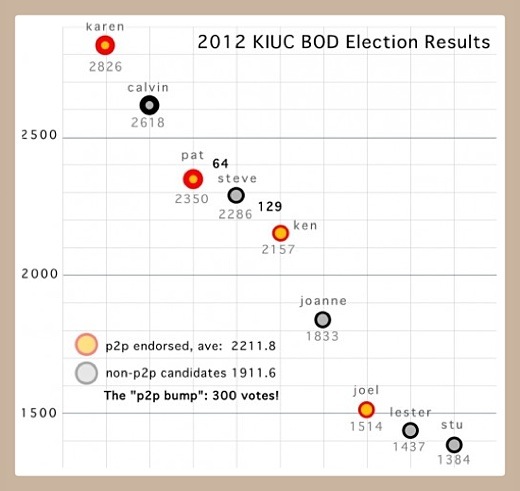
Build a better KIUC

SUBHEAD: What might the people of Kauai do to build a better energy cooperative? By Jonathan Jay on 21 April 2012 for P2PKauai - (http://p2pkauai.org/build-a-better-co-op/) Image above: An overloaded electric strip. From (http://www.123rf.com/photo_7283917_excessive-extension-on-power-outlet-very-dangerous-small-depth-of-field.html). There is a rising desire for real change to begin at KIUC! During the recent election, i kept a running list of things said by frustrated Members of KIUC, and the greater Kaua`i Community. These are some of the desired changes I heard articulated. If you donÊ»t see what you want from KIUC - add your comments. Read down this evolving ‘To Do’ list, reflect and ponder — which are the most critical? What is a sound strategy for passing each of these reforms? What things can members of the community do to help the directors be more successful in making these changes? Is there any thing on this list you disagree with? Your feed back to the above questions is vital in helping these changes become addressed & adopted by the board. Please help us help the directors get it right for Kaua‘i. Through your efforts and others, our community can become a mighty force for change on KauaÊ»i. IMUA! Next KIUC BOD Monthly Meeting: Tuesday, April 24, 2012, Courtyard by Marriott Kauai at Coconut Beach, Chartroom 3:00 p.m.
TO DO LIST FOR THE 2012 KIUC BOD
BRING ELECTRICAL COSTS DOWN
  • Expand assis tance to eco nom i cally vul ner a ble households
  • Cre ate Con ser va tion & Effi ciency Teams to bring bills down
  • Intro duce steeply tiered rates to reward con ser va tion w/savings
  • Offer In Home Dis play “Dash boards” to all. Infor ma tion = Power!
  • Goal of solar hot-water on >90% of all roofs within decade
  • Pass sav ings to Mem bers by reduc ing extrav a gant overhead
  • more ideas?
MAKE KIUC A REAL COOPERATIVE
  • Get new Legal Coun cil that sup ports coop er a tive action
  • Cre ate & Hire a new Coop er a tive Involve ment Department
  • Offer incen tives to vote — Goal: dou ble the turnout in 5 years
  • Recom mit to demo c ra tic pol icy of One Per son, One Vote
  • Expand mem ber ship — offer to all adult Kaua‘i residents
  • Invest in Smart Mem bers — edu ca tion to engage in coop process
  • Safe guard fair debate w/ Co-op resources in Spe cial Elections
  • Get new CEO & Pres i dent that under stands & sup ports coops
  • your ideas?
SMART METERS
  • Work with, not against the mem ber ship and community
  • Do not acti vate the already installed meters of those who wish
  • Pro vide a sim ple, easy, no-cost way for mem bers to Opt-OUT
  • Pro vide a WIRED meter option for mem bers to Opt-IN
  • De-couple In Home Dis play from Smart meter for those who wish
  • more ideas?
REVISE BOARD POLICY
  • Make the 7 Co-operative prin ci ples bind ing on KIUC policy
  • Revise pol icy 1 — expand trans parency to community
  • Revise pol icy 16 — pro vide com plete min utes for BOD committee
  • Make online video record ing of All BOD meet ings for review
  • Roll-call for all votes, on-line avail able for review
  • Revise pol icy 18 — fur ther expand directorÊ»s abil ity to speak freely
  • your ideas?
REVISE ENERGY POLICY & ADOPT STRATEGIC GOALS
  • New Energy Reduc tion Pol icy: Make Less & Reduce Use
  • Goal: reduce typ i cal peak load to below 50 Mw
  • New busi ness model to fos ter the right-sizing of KIUC
  • Keep max i mum energy $Ê»s on-island & inside local economy
  • Include cre ation of living-wage energy jobs on-island
  • Increase strate gic coop er a tion w/County to cre ate more savings
  • Goal: 100% sus tain able local energy pro duc tion before 2030
  • more ideas?
.

Origins of 420

SUBHEAD: Enigma revealed. The real history behind how Weed Day got its name.  

By Ryan Grimm on 20 April 2009 for Huffington Post -  
(http://www.huffingtonpost.com/2012/04/20/420-weed-day-marijuana-april-holiday_n_1437964.html)

 
Image above: Three Waldos -- (from left) Mark Gravitch, Dave Reddix and Steve Capper -- along with friend Patty Young hold the original 420 flag. From original article.
 
[HuffPo editor's note: This article was originally published on April 20, 2009, and has been reposted each year since. This year, it is updated to include the full identities of the men behind the coining of the term "420," as well as additional details. Carly Schwartz contributed to this story.]
Warren Haynes, the Allman Brothers Band guitarist, routinely plays with the surviving members of the Grateful Dead, touring as The Dead. It's the spring of 2009, he's just finished a Dead show in Washington, D.C., and he gets a pop quiz from The Huffington Post.
Where does "420" come from?


He pauses and thinks, hands on his sides. "I don't know the real origin. I know myths and rumors," he says. "I'm really confused about the first time I heard it. It was like a police code for smoking in progress or something. What's the real story?"

Wavy Gravy is a hippie icon with his own ice cream flavor who has been hanging out with the Dead for decades. HuffPost spots him outside the same concert. Asked about the term 420, he suggests it began "somewhere in the foggy mists of time. What time is it now? I say to you, 'Eternity now.'"

Depending on whom you ask or their state of inebriation, there are as many varieties of answers as strains of medical bud in California. It's the number of active chemicals in marijuana. It's teatime in Holland. It has something to do with Hitler's birthday. It's those numbers in that Bob Dylan song multiplied.

The origin of the term 420, celebrated around the world by pot smokers every April 20, has long been obscured by the clouded memories of the folks who made it a phenomenon.


The Huffington Post chased the term back to its roots and was able to find them in a lost patch of cannabis in a Point Reyes, Calif., forest. Just as interesting as its origin, it turns out, is how it spread.

It starts with the Dead.

It was Christmas week 1990 in Oakland. Steven Bloom was wandering through The Lot, that timeless gathering of hippies that springs up in the parking lot before every Grateful Dead concert, when a Deadhead handed him a yellow flyer.

"We are going to meet at 4:20 on 4/20 for 420-ing in Marin County at the Bolinas Ridge sunset spot on Mt. Tamalpais," read the message, which Bloom dug up and forwarded to HuffPost. Bloom, then a reporter for High Times magazine and now the publisher of CelebStoner.com and co-author of "Pot Culture," had never heard of "420-ing" before.

The flyer came complete with a 420 backstory: "420 started somewhere in San Rafael, California in the late '70s. It started as the police code for Marijuana Smoking in Progress. After local heads heard of the police call, they started using the expression 420 when referring to herb -- Let's Go 420, dude!"

Bloom reported his find in the May 1991 issue of High Times, which the magazine found in its archives and provided to HuffPost. The story, though, was only partially right.

The origin of 420 had nothing to do with a police code, though the San Rafael part was dead-on. A group of five San Rafael High School friends known as the Waldos -- by virtue of their chosen hangout spot, a wall outside the school -- coined the term in 1971.

The Waldos never envisioned that pot smokers the world over would celebrate each April 20 as a result of their foray into the Point Reyes forest. The day has managed to become something of a national holiday in the face of official condemnation. Officials at the University of Colorado at Boulder and the University of California, Santa Cruz, which boast two of the biggest "smokeouts," pushed back in 2009 in typical fashion. "As another April 20 approaches, we are faced with concerns from students, parents, alumni, Regents, and community members about a repeat of last year's 4/20 'event,'" wrote Boulder's chancellor in a letter to students. "On April 20, 2009, we hope that you will choose not to participate in unlawful activity that debases the reputation of your University and degree, and will encourage your fellow Buffs to act with pride and remember who they really are."

But the Cheshire cat is out of the bag. Students and locals will show up around four, light up at 4:20 and be gone shortly thereafter. No bands, no speakers, no chants. Just a bunch of people getting together and getting stoned.

THE FIVE WALDOS


Today the code often creeps into popular culture and mainstream settings. Some of the clocks in "Pulp Fiction," for instance, are set to 4:20. A "Price Is Right" contestant won YouTube celebrity by bidding either $420 or $1,420 for everything. In 2003, when the California Legislature codified the medical marijuana law that voters had approved, the bill was named SB 420.

"We think it was a staffer working for [lead Assembly sponsor Mark] Leno, but no one has ever fessed up," says Steph Sherer, head of Americans for Safe Access, which lobbied on behalf of the bill.

California legislative staffers spoken to for this story say that the 420 designation remains a mystery, but that both Leno and the lead Senate sponsor, John Vasconcellos, are hip enough that they must have known what it meant. Vasconcellos says he has no idea how it got the number 420 and wouldn't have known what it meant at the time. (If you were involved with SB 420 and know the story, email me.)

The code also pops up in Craigslist postings when fellow smokers search for "420 friendly" roommates. "It's just a vaguer way of saying it, and it kind of makes it kind of cool," says Bloom, the pot journalist. "Like, you know you're in the know, but that does show you how it's in the mainstream."

The Waldos have proof, however, that they used the term in the early '70s. When HuffPost spoke with the men in 2009, they requested anonymity, preferring to go by the names they call each other -- Waldo Steve, Waldo Dave, Waldo Mark, etc. Pot was still, after all, illegal.

Since then, however, California has decriminalized possession of marijuana so that getting snagged costs little more than a parking ticket. Medical marijuana shops dot the landscape, and the plant has become dramatically more culturally acceptable.

In the spring of 2012, they agreed to go on the record with HuffPost.

"The baby boomers have been taking over. People are dying off. The generations behind them are fine," explains Steve Capper.

"I think I read recently a poll where somewhere like 47 percent of the American public are okay with marijuana," says Dave Reddix. (In March 2012, a Rasmussen poll found 47 percent of Americans support legalization of marijuana.)

Mark Gravitch also agreed to be identified. The other two aren't yet ready.

The Waldos' story goes like this: One day in the fall of 1971 -- harvest time -- the Waldos got word of a Coast Guard service member who could no longer tend his plot of marijuana plants near the Point Reyes Peninsula Coast Guard station. A treasure map in hand, the Waldos decided to pluck some of the free bud.

The Waldos, who were all athletes, agreed to meet at the statue of Louis Pasteur outside the school at 4:20 p.m., after practice, to begin the hunt.

"We would remind each other in the hallways we were supposed to meet up at 4:20. It originally started out 4:20-Louis, and we eventually dropped the Louis," Capper, 57, says.

The first forays were unsuccessful, but the group kept looking for the hidden crop. "We'd meet at 4:20 and get in my old '66 Chevy Impala, and, of course, we'd smoke instantly and smoke all the way out to Point Reyes and smoke the entire time we were out there. We did it week after week," says Capper. "We never actually found the patch."

But they did find a useful codeword. "I could say to one of my friends, I'd go, '420,' and it was telepathic. He would know if I was saying, 'Hey, do you wanna go smoke some?' Or, 'Do you have any?' Or, 'Are you stoned right now?' It was kind of telepathic just from the way you said it," Capper says. "Our teachers didn't know what we were talking about. Our parents didn't know what we were talking about."

WITH A LITTLE HELP FROM THE DEAD


It's one thing to identify the origin of the term. But Wikipedia and Urban Dictionary already included references to the Waldos by 2009, when HuffPost first wrote this account. The bigger question: How did 420 spread from a circle of California stoners across the globe?

As fortune would have it, the collapse of San Francisco's hippie utopia in the late '60s set the stage. As speed freaks, thugs and con artists took over The Haight, the Grateful Dead packed up and moved to the Marin County hills, just blocks from San Rafael High School.

"Marin County was kind of ground zero for the counterculture," says Capper.

The Waldos had more than a geographic connection to the Dead. Mark Gravitch's father took care of real estate for the Dead. And Dave Reddix's older brother, Patrick, managed a Dead sideband and was good friends with bassist Phil Lesh. Patrick Reddix tells HuffPost that he smoked with Lesh on numerous occasions. He couldn't recall if he used the term 420 around Lesh, but guessed that he must have.

The Dead, recalls Dave Reddix, 57, "had this rehearsal hall on Front Street, San Rafael, California, and they used to practice there. So we used to go hang out and listen to them play music and get high while they're practicing for gigs. But I think it's possible my brother Patrick might have spread it through Phil Lesh. And me, too, because I was hanging out with Lesh and his band [as a roadie] when they were doing a summer tour my brother was managing."

The bands that Patrick managed for Lesh were called Too Loose to Truck and Sea Stones; they featured not only Lesh but rock legend David Crosby and acclaimed guitarist Terry Haggerty.

The Waldos also had open access to Dead parties and rehearsals. "We'd go with [Mark's] dad, who was a hip dad from the '60s," says Capper. "There was a place called Winterland, and we'd always be backstage running around or on stage and, of course, we're using those phrases. When somebody passes a joint or something, 'Hey, 420.' So it started spreading through that community."

Lesh, walking off stage after a Dead concert in 2009, confirms that Patrick Reddix is a friend and says he "wouldn't be surprised" if the Waldos had coined 420. He isn't sure, he says, the first time he heard it. "I do not remember. I'm very sorry. I wish I could help," he says.

As the Grateful Dead toured through the '70s and '80s, playing hundreds of shows a year, the term spread though the Dead underground. Once High Times got hip to it, the magazine helped take it global.

"I started incorporating it into everything we were doing," Steve Hager, then editor of High Times, tells HuffPost in 2009. "I started doing all these big events -- the World Hemp Expo Extravaganza and the Cannabis Cup -- and we built everything around 420. The publicity that High Times gave it is what made it an international thing. Until then, it was relatively confined to the Grateful Dead subculture. But we blew it out into an international phenomenon."

Sometime in the early '90s, High Times wisely purchased the web domain 420.com.

The Waldos say that it took just a few years for the term to spread throughout San Rafael and start cropping up elsewhere in the state. By the early '90s, it had penetrated far enough that Dave Reddix and Steve Capper began hearing people use it in unexpected places -- Ohio, Florida, Canada -- and spotted it painted on signs and scratched into park benches.

In 1998, the Waldos decided to set the record straight and got in touch with High Times.

"They said, 'The fact is, there is no 420 [police] code in California. You guys ever look it up?'" Bloom recalls. He had to admit that, no, he had never looked it up. Hager flew out to San Rafael, met the Waldos, examined their evidence, spoke with others in town, and concluded they were telling the truth.

"No one's ever been able to come up with any use of 420 that predates the 1971 usage, which they had established. So unless somebody can come up with something that predates them, then I don't think anybody's going to get credit for it other than them," Hager says.
THEIR 420 STASH
The Waldos have evidence to back up their story, now stashed away in a vault in a San Francisco bank. Reddix, Gravitch, Capper and another high school friend, Patty Young, gave HuffPost a tour of the vault, where they keep a flag with 420 stitched onto it, letters, newspaper clippings and other pieces of memorabilia.

The men remain positively giddy about their impact on an international subculture. "Attention, ladies and gentlemen, the Waldos are here!" exclaims Reddix outside downtown San Francisco's flagship Wells Fargo. He picks up a plastic "Caution, Wet Floor" sign to use as a megaphone. "You are witnessing history!"

And there it all is: A clipping from a 1970s issue of San Rafael High's school newspaper, in which a student claimed the one thing he'd want to say in front of his graduating class was simply "4-20." A letter postmarked 1975, from Waldo Dave to Waldo Steve, rife with 420 references. The official 420 flag, which Young tie-dyed in her art class.

The bank teller watches as the Waldos show off their archives. "Do you know what 420 means?" Capper asks him.

The teller pauses, then grins sheepishly. "Yes, sir," he says.

The Waldos are slightly conflicted about what to do next. Reddix is gung-ho about telling the story widely and publicly. Capper is more circumspect, worried that releasing too much would cost them future commercial possibilities.

The Waldos are considering a documentary, a dictionary of the rest of their slang and whatever else might be out there for five guys who coined the term 420 four decades ago.

"I still have a lot of friends who tell their friends that they know one of the guys that started the 420 thing. So it's kind of like a cult celebrity thing. Two years ago I went to the Cannabis Cup in Amsterdam. High Times magazine flew me out," says Reddix.

But "we never made a dime on the thing," he says, half boasting, half lamenting.

Reddix is now a credit analyst, with a side interest in filmmaking that led to the documentary "Roots Music Americana." He works for Capper, who owns a specialty lending institution and lost money to the con artist Bernie Madoff. When we spoke in 2009, Capper was spending more time composing angry letters to the Securities and Exchange Commission than he did getting high.

The other three Waldos have also been successful, says Capper, who notes he keeps in close touch with them all. One is head of marketing for a Napa Valley winery. Another is in printing and graphics. Gravitch is an operations manager in the construction industry.

"I've got to run a business. I've got to stay sharp," says Capper, explaining why he rarely smokes pot anymore. "Seems like everybody I know who smokes daily or many times in a week, it seems like there's always something going wrong with their life, professionally or in their relationships or financially or something. It's a lot of fun, but it seems like if someone does it too much, there's some karmic cost to it."

"I never endorsed the use of marijuana. But hey, it worked for me," says Reddix;
"I'm sure on my headstone it'll say, 'One of the 420 guys.'"
.

Midway plastic invasion

SUBHEAD: On Midway Island literally every wave washes more plastic onto the beach. By Jaymi Heimbuch on 19 April 2012 for TreeHugger - (www.treehugger.com/ocean-conservation/on-midway-more-plastic-washes-up-with-every-wave-literally.html) Image above: Still frame from video below showing tiny plastic as small as sand creating a new kind of beach. For many photos of beaches see original article.

There is only one beach on Midway that is clean, and it is the one beach that people are allowed to visit regularly. The residents on Midway do a great job keeping the debris that washes up under some control. The other beaches are habitat for the endangered and threatened species of the atoll who need some space away from humans, so they are cleaned only when clear of animals like Hawaiian monk seals and Green sea turtles. There is time, then, for the sand to become rainbow colored, like in the image above.

One group decided to do a beach clean up on Midway and found out what an uphill battle it really is. Even after hours of cleaning up debris, they saw that each wave brought in more plastic, in pieces so small it is impossible to clear them all off the sand.

Video above: "Midway Journey - Plastic Beach". From original articla and (http://vimeo.com/8177268). .