Runoff crucial to ocean life

SUBHEAD: New land ocean connection discovered off Molokai indicating biological dependence on land resources. By Catherine Cluett on 7 march 2012 in the Molokai Dispatch - (http://themolokaidispatch.com/new-land-ocean-connections-discovered-off-molokai/) Image above: Map of ocean floor north of Molokai showing study areas. From original article. Click to enlarge.

The close connection between land and sea is nothing new for Molokai locals. But researchers have taken that connection a step farther and made a groundbreaking discovery along the coast of Molokai: they found that in two submarine canyons off the north shore of the island, ocean animals are relying heavily on resources from the land.

Fabio De Leo, a PhD candidate at University of Hawaii, Manoa Department of Oceanography, and a team of colleagues spent about three weeks a few miles out from Molokai’s north shore. They found that plant material from the forested landscapes of the shoreline, such as decomposing tree trunks, leaves and kukui nuts, feeds a high abundance of invertebrates, like worms, tiny crustaceans and mollusks. These in turn serve as food for larger species, said De Leo.

The plant material piles up in the underwater canyons that connect to the deep river valleys on the north shore.

“Areas surveyed outside the canyons showed very little…plant…material, providing support for our hypothesis that this material is really being channeled and accumulates mostly in the steep topography of the submarine canyons (i.e., a ‘canyon effect’),” said De Leo.

De Leo and his colleagues from the School of Ocean and Earth Science and Technology at UH Manoa used manned submersibles operated by the Hawaii Undersea Research Laboratory to take video in two submarine canyons off Molokai at depths ranging from 350 to 1,050 meters, or about 1,000 to 3,000 feet. This was among the first studies to quantitatively survey fish deeper than about 350 meters around Hawaii, gathering more than 13 hours of video altogether. Among the most abundant species De Leo and his team found were the so-called “rattail” fish (family Macrouridae) and the “eel-like” fish (synaphobranchids and halosaurs).

Giant sharks were also observed but only when the submersible was stationary. De Leo narrates how scary it was when he got “face–to-face” with a 10-foot “sixgill shark” with only the submersible’s porthole separating his from the shark’s nose, as the giant approached the submersible and hit the thick glass window with its face.

“Wow, it was definitely a nerve-wracking sensation,” he said. “I even dropped my video camera while trying to make good footage of the beast.”

Researchers also reported some unexpected results. They found that the “canyon effect” of fish abundances is obliterated at depths around 650 meters, coinciding exactly with the core of an oxygen minimum zone (OMZ) that flows around the Hawaiian archipelago at those depths. An OMZ is a layer of seawater that has depleted oxygen concentrations due to several biological and chemical processes. De Leo said expansion of the OMZ is concerning to scientists because it is thought to be associated with climate change and oceanic warming.

OMZ expansion is mild in Hawaii compared to the west coast of the mainland, and De Leo said it’s nothing to be concerned about in this region. But OMZ was a main topic of conversation at the Ocean Sciences Meeting in Salt Lake City, Utah, which De Leo attended last week.

De Leo’s Molokai research was done on Molokai back in 2006, and results from the data were recently released. De Leo and his colleagues will continue to analyze data from six other submarine canyons they studied around Hawaii in hopes of understanding what other factors lead to an increase in numbers and diversity of marine animals inside these topographical features.

This research was supported by NOAA Ocean Exploration and by the Hawaii Undersea Research Laboratory.

University of Hawaii contributed information for this article.

.

KIUC Voting Results

SOURCE: Ken Taylor (taylork021@hawaii.rr.com) SUBHEAD: The official results of 2012 Board of Directors election from a KIUC press release.  

By Shelley Paik on 24 March 2012 for KIUC -  
(PDF of news release sent by Ken Taylor)
   
Image above: The "ENRON" KIUC logo by Juan Wilson - since they couldn't come up with one of their own. From 
(http://islandbreath.blogspot.com/2009/09/calls-for-kiuc-cost-cutting-instead-of.html).  

[IB Editor's note: Two out of four of the recommendations to the board were elected (Pat Gegan and Karen Baldwin).]

Lihue, Kauai, HI - 3/24/12 – Kauai Island Utility Cooperative (KIUC) announces that Karen Baldwin, Pat Gegen and Calvin K. Murashige have been elected to KIUC’s Board of Directors. These three directors will each serve for a 3-year term ending March 2015. The official results of the 2012 Board of Directors Election are as follows:  

1. Karen Baldwin 2,826 elected
2. Calvin K. Murashige 2,618 elected
3. Pat Gegen 2,350 elected
4. Steve M. Rapozo 2,286
5. Ken Stokes 2,157
6. JoAnne S. Georgi 1,833
7. Joel Guy 1,514
8. Lesther Calipjo 1,437
9. Stewart “Stu” Burley 1,384

 KIUC received 7,145 ballots in this election.

While there were three available director slots to fill, not all voters chose to exercise all three votes on their ballot; therefore, the number of votes may not equal the total number of ballots received. The KIUC Management with the assistance of the California-based Merriman River Group announced the official tally late this afternoon. The newly-elected board members will be inaugurated on Tuesday, March 27 at 1:30 p.m. in the KIUC Main Conference Room, located at 4463 Pahee Street in Lihue.

Following the inauguration, the board will hold its regularly-scheduled meeting of the Board of Directors at 3 p.m.

 .

Oil Sands & Wetlands

SUBHEAD: Scientists doubt aftermath of oil sands mining will result in acceptable fix to wetlands damaged in process. By Andrew Nikiforuk on 14 march 2012 for The Tyee - (http://thetyee.ca/News/2012/03/14/Wetlands-Damage) Image above: The tentacles of the oil mining reach out and wreak havoc and destruction on the environment .From (http://indiancountrytodaymedianetwork.com/photogallery/athabasca-oil-sands-in-all-their-terrible-glory). Contrary to industry and government views, the oil sands industry won't be able to restore valuable wetlands or replace their multi-billion dollar biological services, according to a new study by some of Canada's foremost scientists.

Drawing from environmental reports filed by 10 oil sands mining companies, the Proceedings of the National Academy of Sciences study found that 64 per cent of the mineable landscape, an area the size of Rhode Island, currently supports peatlands.

These valuable and rare landscapes, which take thousands of years to form, filter water, feed caribou (an endangered species in the region), store carbon, concentrate mercury, recharge groundwater, protect biological diversity and act as flood protection.

But data filed by companies now digging up 167,044 hectares of the forest show that industry won't be replacing much of these services after they've mined it.

In particular, reclamation plans from four of 10 mining projects in the region show that industry will replace largely low boreal wetlands with dry man-made highlands. Instead of bogs and fens, the industry will build hills topped by plantation forests and fill large man-made lakes with toxic waste bordered by shrubs and salty marshes.

"It's a completely different landscape," says study co-author Suzanne Bayley, one of Canada's top wetland ecologists and a University of Alberta professor.

The original boreal vegetation will change from tamarack, spruce, sedges and Labrador tea to planted aspen, jack pine, blueberry and low-bush cranberry. The shift to a drier landscape also means more fire hazards.

Reclamation claims 'greenwashing': co-author

The Canadian Association of Petroleum Producers (CAPP), the industry's big lobby group, recently claimed on its website that oil sands companies will "return the land including reclaiming tailings ponds--to a sustainable landscape that is equal to or better than how we found it."

"But that's not possible and it's greenwashing and the company data prove it," adds Bayley. "CAPP changed their website yesterday," she claims.

Natural Resources Canada has made similar statements but hasn't yet removed them.

A 2011 brochure (titled Oil Sands: A Strategic Resource for Canada, North American and the Global Market) says industry will "remediate and reclaim 100 per cent of the land after the oil sands have been extracted so the area can sustain vegetation and wildlife such as that which existed before its development."

The wetlands study, co-authored by Canada's foremost water scientist David Schindler, says that the carbon storing services provided by peatlands will be destroyed forever and not replaced. This loss of carbon storage represents a debt of nearly $2.5 billion.

The study found that carbon released by the destruction of the peatlands could top 174 million tonnes and equal "seven years worth of mining and upgrading emissions at 2010 production levels." (The project, Canada's fastest growing source of atmospheric pollution, now emits 46 million tonnes of greenhouse gases a year or nearly as much as the entire nation of Norway.)

"A Shell television ad infers they are creating good native habitat," adds Bayley. "They are putting in seedlings, no peatlands, poor quality marshes, invasive species and lots of channels to send run-off to these end-pit lakes."

An end-pit lake is an old mining hole filled with acidic waste and then capped with freshwater. It is an untested toxic water disposal scheme.

"They have not been proven as fish replacement habitat," adds study co-author Schindler.

"Despite that, the Alberta government has shamelessly approved 27 without proof they will support fish or other organisms," he told The Tyee.

No compensation policy

Under Alberta law, oil sand companies only have to replace mined out boreal wetlands with something called "equivalent land capability." It has no legal definition.

Unlike most developed countries, Alberta does not require mining companies to pay for the wetlands they destroy by contributing to a special bank that funds wetland restoration somewhere else.

"That's what Exxon Mobile has to do in the United States," says Bayley, who has studied wetlands across the province and in the oil sands. "They have to compensate right there and pay into a fund and not wait for 40 years for something to happen."

Alberta, which has lost 60 per cent of its wetlands in the southern half of the province (that's analogous to an individual losing 60 per cent of their kidney function, says Bayley), currently has no provincial wetland policy. Nor does it have a proper inventory. As a consequence, there is no program to compensate for wetland losses in the oil sands.

"If we sacrifice all the peatlands for revenue and jobs, then the public should know what they are losing," adds Rebecca Rooney, a 28-year-old wetland ecologist who spent weeks trying to find data for the study in government basements. "The public shouldn't be told that there will be no environmental damage."

To date, 104 hectares have been officially reclaimed in the region at a cost greater than $100,000 a hectare. That site, an old soil dump, is not representative of the difficulties associated with reclaiming millions of tonnes of petroleum coke, quicksand-like clays, tailing ponds or billions of barrels of toxic mine waste.

The government's reclamation fund holds a billion dollars. Yet the Pembina Institute, an environmental watchdog and industry consultant service, estimated that it would cost more than $15 billion to reclaim just 68,674 hectares of disturbed land in 2010.

For years, the oil patch and the Alberta Chamber of Resources has fought any wetland policy that would require industry to replace every hectare of wetland lost in oil sands by paying for reclamation elsewhere.

A 2008 letter by CAPP to the Alberta Water Council calculated that restoring wetlands equal to 800 square kilometres to 2,500 km worth of peatlands destroyed by oil sands mining "would exceed billions of dollars."

The CAPP letter also admits that "it is impossible to replace peatlands with peatlands, as these wetland ecosystems depend on slow-growing plant species."

Bayley says that the Alberta government to date has no pilot projects on how to build high-quality marshes to replace peatlands. Because companies don't start reclaiming until they've mined for 40 years, industry is building a "large reclamation debt" and won't be able to tell if their efforts will be successful 50 to 100 years down the road.

Both Rooney and Bayley called for an effective wetland compensation and policy, as well as a better reclamation program based on standardized facts and accurate evaluation of costs and benefits.

"I acknowledge there will be oil sands development," says Bayley. "But if we are going to do it, we should have the best and fastest reclamation efforts."

See also: Ea O Ka Aina: Artificial Wetlands Study 3/20/12 .

Free Seed & Plant Exchange

SOURCE: Richard Diamond (kauaimuse@gmail.com)
SUBHEAD: The 9th biannual exchange is on April 1st at Children of the Land in Kapaa.  

By Jill Richardson on 22 March for Regenerations Botanical Garden 
  (http://ribg.org/regenerations_botanical_garden/Home.html)

 
Image above: Detail of poster for 9th Biannual Seed & Plant Exchange. From original article.  

WHAT:
Free Seed & Plant Exchange. Bring what you grow your plants from and find new seeds and plants for your garden. Most plants are food plants, but others are welcome too.
 

WHEN: Sunday, April 1st 2012 from noon to dark.  

WHERE:
Children of the Land Center Kauai Village Shopping Center
Next to Papaya's Natural Foods
4-831 Kuhio Hwy #332, Kapaa

CONTACT:
Jill Richardson

Email: jr@ribg.org
Regenerations Botanical Garden
Phone: 808-652-4118 
 www.ribg.org

In January Kaua'i Community Seed Bank and the Regenerations office moved to a new home in the Children of the Land Center for Polynesian Culture (Nā Keiki o Ka 'Aina) in downtown Kapa`a. This is a great move for us in a number of ways.

The values and vision of both organizations are in strong alignment, and we're delighted to interact on a daily basis and also work together on various projects and programs. The new seed bank facility has upgraded cold storage equipment and a more functional working space to improve our seed-saving capabilities and better accommodate the processing and cataloging of new accessions.

The new location, next to Papaya's in the Kauai Village Shopping Center in Kapa'a, is more centrally located and accessible to you. We plan to use our new position to facilitate the easy exchange of seed and plant material along with related books, information, and knowledge and ways to share group or individual activities and services.

We look forward to seeing you and welcome your thoughts on the most meaningful way for you to interface with us. How can we best work together to support and inspire the care-taking and cultivation of a diversity of island-adapted plants that will ensure a resilient and healthy future? How can we help you to malama the 'aina?

The seed bank and office are open every Thursday 9am – 5pm. If you have seed material to share please call ahead to ensure we are prepared to receive it and if you would like to volunteer, please call to make arrangements.

To celebrate, we're holding the the 9th Biannual Kaua`i Community Seed and Plant Exchange at the Center on Sunday, April 1st from noon–dark. Admission is free. Participants are asked to bring non-invasive, non-GMO, pre-cleaned, insect and disease free cuttings, potted plants, and seeds to share freely.

Seed and plant check-in is from noon-2pm; presentations on the seed bank will happen from 2-2:45 pm; the pule, and exchange will follow at 3pm. Live music by Malama Pono Alstars from 3-5, then Cook Islands/Tahitian drumming begins at 5, followed by fire dancing and poi ball performance at the Center's outdoor stage. The seed lab will be open with hands-on activities. Come early to enjoy information booths, demonstrations, and live music.

You can download seed & plant check-in cards here to fill out before you arrive.
.

Crime Becoming the Bank

SUBHEAD: The big banks are a keystone in supporting criminal activity all over the world and are financed by us.

By Ashvin Pandurangi on 24 March 2012 for the Automatic Earth - (http://theautomaticearth.org/Finance/becoming-the-bank.html)


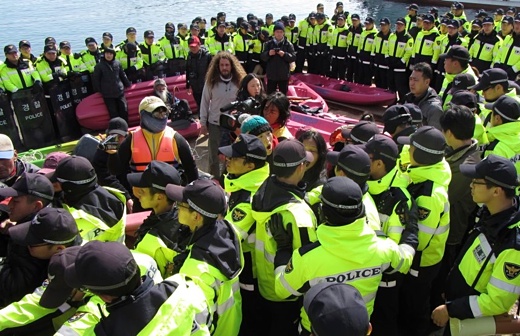
 Image above: From(http://photographywithoutborders.org/news/london-g20-protests-riot-police-rbs).

Both the mainstream and alternative media spend a good amount of time reporting on the excesses of Wall Street, which range from extremely disproportionate levels of compensation to blatantly criminal practices. Whether we are talking about Goldman Sachs defrauding and front-running clients or former New Jersey governor and MF Global CEO Jon Corzine illegally transferring client funds to JP Morgan, there is a certain air of "so whatness" to the entire discussion. How extensive are these occurrences and why should we care?

There is no doubt that these are serious issues/crimes, but, at the end of the day, there is also a limit to how much one can care about extremely rich people stealing money from and screwing over moderately rich people in the markets. Sometimes, there is almost a distracting quality to these discussions, and it helps maintain the tarnished-yet-still-respectable reputation of the major banks. We begin to forget about the systemically cruel ways in which the global banking system affects the lives of billions of innocent people every day.

When high-level drug traffickers have been removed from all contact with operations on the street, including the handling of drugs or any associated violence, they are said to have "become the bank". They simply use their money to finance drug packages while reinvesting profits into real property and legitimate businesses. Once the traffickers reach this point, there is almost no possible way they can catch a charge and be convicted of any serious crime. The legal distance between them and the street-level dealing and violence has grown much too large, even though none of it would be possible without their money.

In that sense, the phrase “become the bank” is a very apt one. This post is not even meant to draw an analogy between high-level narco-traffickers and the TBTF banks, but rather to sketch a portrait of the literal connection that exists. The large banks are the untouchable source of funds behind almost every illegal (yet highly profitable) industry throughout the world, as well as activities that are technically legal, but still very destructive to society. They are sometimes even aided by Western governments and their intelligence apparatuses, which find valuable policy objectives in doing so.

These institutions help traffick billions worth of drugs and illegal weapons across international borders every year. Just last year, it was revealed that Wachovia (now a part of Wells Fargo) had laundered at least tens of billions of dollars for Mexican drug cartels since the escalation of drug-related violence at the US-Mexico border in 2004. This laundered money has gone towards the purchase of everything from the drugs themselves to the planes used the transport them and the weapons used to kill police and civilians alike. Ed Vulliamy produced an in-depth report on this last year for the Guardian.
Big US bank laundered billions from Mexico's murderous drug gangs
During a 22-month investigation by agents from the US Drug Enforcement Administration, the Internal Revenue Service and others, it emerged that the cocaine smugglers had bought the plane with money they had laundered through one of the biggest banks in the United States: Wachovia, now part of the giant Wells Fargo.
The authorities uncovered billions of dollars in wire transfers, traveller's cheques and cash shipments through Mexican exchanges into Wachovia accounts. Wachovia was put under immediate investigation for failing to maintain an effective anti-money laundering programme. Of special significance was that the period concerned began in 2004, which coincided with the first escalation of violence along the US-Mexico border that ignited the current drugs war.
Criminal proceedings were brought against Wachovia, though not against any individual, but the case never came to court. In March 2010, Wachovia settled the biggest action brought under the US bank secrecy act, through the US district court in Miami. Now that the year's "deferred prosecution" has expired, the bank is in effect in the clear. It paid federal authorities $110m in forfeiture, for allowing transactions later proved to be connected to drug smuggling, and incurred a $50m fine for failing to monitor cash used to ship 22 tons of cocaine.
More shocking, and more important, the bank was sanctioned for failing to apply the proper anti-laundering strictures to the transfer of $378.4bn – a sum equivalent to one-third of Mexico's gross national product – into dollar accounts from so-called casas de cambio (CDCs) in Mexico, currency exchange houses with which the bank did business.
"Wachovia's blatant disregard for our banking laws gave international cocaine cartels a virtual carte blanche to finance their operations," said Jeffrey Sloman, the federal prosecutor. Yet the total fine was less than 2% of the bank's $12.3bn profit for 2009. On 24 March 2010, Wells Fargo stock traded at $30.86 – up 1% on the week of the court settlement.
The conclusion to the case was only the tip of an iceberg, demonstrating the role of the "legal" banking sector in swilling hundreds of billions of dollars – the blood money from the murderous drug trade in Mexico and other places in the world – around their global operations, now bailed out by the taxpayer.
Common sense tells us that the first time a bank gets caught in the middle of such a blatantly obvious practice is not its first time around the block. Indeed, the evidence clearly shows that Wachovia executives were previously made aware of the illegal money laundered through their institutions by several different sources and, instead of acting to remedy the situation, sought to bury the whistleblowers six feet under a pile of disinformation and bureaucracy.

That is simply what they do, and they never catch a criminal charge, or anything beyond a symbolic slap on the wrist, for any of it – they are beyond reproach. A couple hundred million dollars in fines to their companies is a cruel joke on the millions of lives that have been destroyed by the drug trade. More importantly, it does nothing to stop these practices from occurring and destroy millions of additional lives in the future.

When it comes to profiting from murderous and destructive activities, though, nothing ranks higher for the banks than the global arms trade. This type of financing can be carried out in the open for the most part, since governments around the world sanction and engage in the export and procurement of weapons manufactured by the leading companies. Of course, everyone knows that these “legal” arms deals are also fueling the rampant armed conflict in poorer parts of the world. A good portion of the “foreign aid” given to developing nations is recycled right back into the coffers of the large weapons manufacturers and their banks.
"Every gun that is made, every warship launched,every rocket fired signifies, in the final sense, a theft from those who hunger and are not fed, those who are cold and are not clothed. This world in arms is not spending money alone. It is spending the sweat of its laborers, the genius of its scientists, the hopes of its children." -Dwight D. Eisenhower
The London-based charitable organization “War on Want” produced a report a few years back highlighting the ways in which major U.K. banks have financed the arms trade through the provision of banking services for the weapons industry, direct investments in arms companies and the provision of credit to these companies through loan syndicates. These include investments in cluster bombs and depleted uranium projectiles, which are universally recognized as inflicting an unacceptably high injury/death toll on civilian populations during and after war.
Banking on Bloodshed
In 2006 the UK government approved sales by UK arms companies to 19 of the 20 countries identified by the Foreign and Commonwealth Office as ‘countries of concern’ for human rights abuses. These countries included Saudi Arabia, Israel, Colombia, China and Russia.21 Colombia, Russia and Israel are also countries in conflict. Deals have been approved in other conflict countries including Algeria, Turkey, Pakistan, Afghanistan, Indonesia and Georgia. In 2007 the UK government, in defiance of an arms embargo, allowed UK companies to sell Zimbabwe £1 million in cryptography equipment and software.
Israel is a regular customer of the UK arms industry, despite its flagrant violations of international law, including the military occupation of the Occupied Palestinian Territories. In 2006 the government approved for sale to Israel a laundry list of military hardware: helicopters, military aircraft cockpit displays, unmanned vehicles, anti-armour missiles and other electronic warfare equipment. BAE Systems makes subsystems, or components, for the F-16 fighter jet, of which Israel has 236. F-16s have been deployed by Israel against civilian populations in both Lebanon and Gaza.
The Iraq and Afghanistan conflicts have been a boon to arms companies in the US and the UK. One UK company that has benefited particularly from the surge in demand from the Iraq war has been Chemring, which manufactures niche products such as missile countermeasures and flares. Profits have risen each year since the start of the occupation in 2003. In 2006 returns were almost 500% higher than in 2002, and share prices have followed.
BAE supplies many weapons to the US and UK that have been used in the Iraq and Afghanistan conflicts, including V-22 guns and armoured fighting vehicles. BAE also recently won a contract from the UK Ministry of Defence to service its Tornado jets in Iraq for £10 million apiece.29 Lockheed Martin also supplies extensively to the US and UK governments to fulfil demand from the ongoing conflicts in Iraq and Afghanistan. These supplies include military ground vehicles and sniper targeting pods for fighter aircraft, amongst other products.
There are some weapons that have come under particular criticism for their toll on civilian life even long after a war has ended. Cluster munitions are one such weapon. They are designed to scatter dozens to hundreds of smaller bomblets over a large area and can cause high levels of civilian casualties both during attacks because of their indiscriminate, wide-area effects, and long afterwards, since unexploded ordnance turns fields, roads and even schools into minefields. One in four cluster munitions victims are children.

The arms trade provides the destructive hardware used in conflicts across the world. This report has exposed, for the first time, the extent to which the five main British high street banks are funding this violent trade. High street banks are using our money to fund companies that sell arms used against civilians in wars across the world, including conflicts in Iraq and Afghanistan. They are financing an industry that sells arms to countries committing human rights abuses such as Israel, Colombia and Saudi Arabia. Money from our savings and current accounts is being used to fund companies that produce pernicious weapons like depleted uranium and cluster bombs.
Faith in the banking sector is already at an all-time low. The revelation that high street banks are investing in weaponry will add to this public mistrust. Barclays, Halifax Bank of Scotland, HSBC, Lloyds TSB and Royal Bank of Scotland are all complicit. Barclays stands out for the sheer scale of its investments. Royal Bank of Scotland is the most active in lending to the arms sector. HSBC shows its glaring hypocrisy by having claimed to divest from the arms trade while actually continuing its holdings.
Whilst the complicity of high street banks is the focus of this report, War on Want believes that the arms trade should ultimately be abolished. However, with governments such as the US and UK determined to pursue military adventures around the world, the arms trade remains big business. War on Want believes that now is the time to act to put an end to high street banks’ support for arms companies.
While Congressional panels hold symbolic hearings about which banks sold what toxic investment to which defrauded clients, or who knew what about which funds were transferred to what location, the systemic financing of death and destruction around the world continues on unimpeded. These activities are not only outside the scope of any serious investigation, they are officially sanctioned and effectively immune from regulation or prosecution.

These are the same institutions which have been granted virtually unlimited backstops by American and European taxpayers, in one form or another. More to the point, they are the institutions which many of us use to store our money, take out loans, invest in markets or make purchases. As long as we continue to do so, we are telling them that we are OK with how they conduct themselves around the world; that we are willing to accept their status as the untouchable elite.

.

KIUC Victory Parade

SUBHEAD: The KIUC voting deadline is at hand. If you have not voted already, please make an effort and take the time. By Jonathan Jay on 23 March 2012 for P2P Kauai - (http://p2pkauai.org/) [IB Editor's note: We agree with the recommendations of www.P2kauai.org (Power to the People Kauai) and advocate voting for three of the four following individuals seeking KIUC board positions (in our preferred order): Pat Gegen, Energy, and Zero Waste Activist, Leader Apollo Kauai; Karen Bald­win Attor­ney at law, for­mer Senior Coun­cil for KIUC; Ken Stokes, Green Econ­o­mist, Blog­ger and Sus­tain­abil­ity ʻguruʻ; Joel Guy, North Shore Com­mu­nity Orga­nizer, for­mer aide to Mina Morita.] Image above: Detail of poster for Victory Parade from original aarrticle. The KIUC voting deadline is at hand. If you have not voted already, please make an effort and take the time. If you need information about the candidates click here (http://p2pkauai.org/change/). In any case, join our Victory Parade beginning at the County Building, Saturday. WHY: For 10 years running - Kauai participation in the KIUC Annual BOD Elections has been abysmal - time has shown: when we all snooze, we all lose!
No MORE - This year, win lose or draw Kauai will set a RECORD for the Most turnout ever! This itself is a tremendous victory well-worth celebrating.
WHO: Everyone who voted, made efforts to encourage others to vote, organized a forum, handed out flyers, posted a blog, or ran for office IS A WINNER!
WHEN: This Saturday, March 24, 2012 from 9:am till NOON deadline --
WHAT & WHERE:
1) Gathering 9:am at Historic County Council Building to make signs to display while ʻparadingʻ
2) Victory Parade! 10:am departure from Historic County Building - route along Kaumualii Highway for maximum visibility
3) Rally 11:am - NOON @ KIUC Headquarters along Kuamualii Highway side to wave signs to GOTV! (get out the vote)
.

Class of 2012 meets 1984

SUBHEAD: Seven steps our nation has taken to achieve the Homeland Security Campus. By Michael Gould-Wartofsky on 22 march 2012 for Tom Dispatch - (http://www.tomdispatch.com/post/175519/tomgram%3A_michael_gould-wartofsky%2C_class_of_2012_meet_the_class_of_1984/) Image above: Lt. John Pike leads SWAT team on UC Davis campus just before he pepper sprayed peaceful students. From (http://occupycolleges.org/2011/11/21/video-police-pepper-spray-uc-davis-student-protesters/). Campus spies. Pepper spray. SWAT teams. Twitter trackers. Biometrics. Student security consultants. Professors of homeland security studies. Welcome to Repress U, class of 2012.

Since 9/11, the homeland security state has come to campus just as it has come to America’s towns and cities, its places of work and its houses of worship, its public space and its cyberspace. But the age of (in)security had announced its arrival on campus with considerably less fanfare than elsewhere -- until, that is, the “less lethal” weapons were unleashed in the fall of 2011.

Today, from the City University of New York to the University of California, students increasingly find themselves on the frontlines, not of a war on terror, but of a war on “radicalism” and “extremism.” Just about everyone from college administrators and educators to law enforcement personnel and corporate executives seems to have enlisted in this war effort. Increasingly, American students are in their sights.

In 2008, I laid out seven steps the Bush administration had taken to create a homeland security campus. Four years and a president later, Repress U has come a long way. In the Obama years, it has taken seven more steps to make the university safe for plutocracy. Here is a step-by-step guide to how they did it.

1. Target Occupy

Had there been no UC Davis, no Lt. John Pike, no chemical weapons wielded against peacefully protesting students, and no cameras to broadcast it all, Americans might never have known just how far the homeland security campus has come in its mission to police its students. In the old days, you might have called in the National Guard. Nowadays, all you need is an FBI-trained, federally funded, and “less lethally” armed campus police department.

The mass pepper-spraying of students at UC Davis was only the most public manifestation of a long-running campus trend in which, for officers of the peace, the pacification of student protest has become part of the job description. The weapons of choice have sometimes been blunt instruments, such as the extendable batons used to bludgeon the student body at Berkeley, Baruch, and the University of Puerto Rico. At other times, tactical officers have turned to “less-lethal” munitions, like the CS gas, beanbag rounds, and pepper pellets fired into crowds at Occupy protests across the University of California system this past winter.

Yet for everything we see of the homeland security campus, there is a good deal more that we miss. Behind the riot suits, the baton strikes, and the pepper-spray cannons stands a sprawling infrastructure made possible by multimillion-dollar federal grants, “memoranda of understanding” and “mutual aid” agreements among law enforcement agencies, counter-terrorism training, an FBI-sponsored “Academic Alliance,” and 103 Joint Terrorism Task Forces (which provide “one-stop shopping” for counterterrorism operations to more than 50 federal and 600 state and local agencies).

“We have to go where terrorism takes us, so we often have to go onto campuses,” FBI Special Agent Jennifer Gant told Campus Safety Magazine in an interview last year. To that end, campus administrators and campus police chiefs are now known to coordinate their operations with Department of Homeland Security (DHS) “special advisors,” FBI “campus liaison agents,” an FBI-led National Security Advisory Board, and a Federal Law Enforcement Training Center, which instructs local law enforcement in everything from “physical techniques” to “behavioral science.” More than half of campus police forces already have “intelligence-sharing agreements” with these and other government agencies in place.

2. Get a SWAT team

Since 2007, campus police forces have decisively escalated their tactics, expanded their arsenals, and trained ever more of their officers in SWAT-style paramilitary policing. Many agencies acquire their arms directly from the Department of Defense through a surplus weapons sales program known as “1033,” which offers, among other things, “used grenade launchers (for the deployment of less lethal weapons)... for a significantly reduced cost.”

According to the most recent federal data available, nine out of 10 campus agencies with sworn police officers now deploy armed patrols authorized to use deadly force. Nine in 10 also authorize the use of chemical munitions, while one in five make regular use of Tasers. Last August, an 18-year old student athlete died after being tased at the University of Cincinnati.

Meanwhile, many campus police squads have been educated in the art of war through regular special weapons training sessions by “tactical officers’ associations” which run a kind of SWAT university. In October, UC Berkeley played host to an “Urban Shield” SWAT training exercise involving local and campus agencies, the California National Guard, and special police forces from Israel, Jordan, and Bahrain. And since 2010, West Texas A&M has played host to paramilitary training programs for police from Mexico.

In October, the University of North Carolina at Charlotte got its very own SWAT team, equipped with MP-15 rifles, M&P 40 sidearms, and Remington shotguns. “We have integrated SWAT officers into the squads that serve our campus day and night,” boasted UNC Charlotte Chief of Police Jeff Baker. The following month, in Chapel Hill, North Carolina, a SWAT team staged an armed raid on an occupied building, pointing assault rifles at the heads of activists, among them UNC students.

3. Spy on Muslims

The long arm of Repress U stretches far beyond the bounds of any one campus or college town. As reported by the Associated Press this winter, the New York City Police Department (NYPD) and its hitherto secret “Demographics Unit” sent undercover operatives to spy on members of the Muslim Students Association at more than 20 universities in four states across the Northeast beginning in 2006.

None of the organizations or persons of interest were ever accused of any wrongdoing, but that didn’t stop NYPD detectives from tracking Muslim students through a “Cyber Intelligence Unit,” issuing weekly “MSA Reports” on local chapters of the Muslim Students Association, attending campus meetings and seminars, noting how many times students prayed, or even serving as chaperones for what they described as “militant paintball trips.” The targeted institutions ran the gamut from community colleges to Columbia and Yale.

According to the AP’s investigation, the intelligence units in question worked closely not only with agencies in other cities, but with an agent on the payroll of the CIA. Police Commissioner Ray Kelly, facing mounting calls to resign, has issued a spirited defense of the campus surveillance program, as has Mayor Michael Bloomberg. “If terrorists aren't limited by borders and boundaries, we can't be either,” Kelly said in a speech at Fordham Law School.

The NYPD was hardly the only agency conducting covert surveillance of Muslim students on campus. The FBI has been engaging in such tactics for years. In 2007, UC Irvine student Yasser Ahmed was assaulted by FBI agents, who followed him as he was on his way to a campus “free speech zone.” In 2010, Yasir Afifi, a student at Mission College in Santa Clara, California, found a secret GPS tracking device affixed to his car. A half-dozen agents later knocked on his door to ask for it back.

4. Keep the undocumented out

Foreign students are followed closely by Immigration and Customs Enforcement (ICE) through its Student and Exchange Visitor Information System (SEVIS). As of 2011, the agency was keeping tabs on 1.2 million students and their dependents. Most recently, as part of a transition to the paperless SEVIS II -- which aims to “unify records” -- ICE has been linking student files to biometric and employer data collected by DHS and other agencies.

“That information stays forever,” notes Louis Farrell, director of the ICE program. “And every activity that’s ever been associated with that person will come up. That’s something that has been asked for by the national security community... [and] the academic community.”

Then there are the more than 360,000 undocumented students and high-school graduates who would qualify for permanent resident status and college admission, were the DREAM Act ever passed. It would grant conditional permanent residency to undocumented students who were brought to the U.S. as children. When such students started “coming out” as part of an “undocumented and unafraid” campaign, many received DHS notices to appear for removal proceedings. Take 24-year old Uriel Alberto, of Lees-McRae College, who recently went on hunger strike in North Carolina’s Wake County jail; he now faces deportation (and separation from his U.S.-born son) for taking part in a protest at the state capitol.

Since 2010, the homeland security campus has been enlisted by the state of Arizona to enforce everything from bans on ethnic studies programs to laws like S.B. 1070, which makes it a crime to appear in public without proof of legal residency and is considered a mandate for police to detain anyone suspected of being undocumented. Many undocumented students have turned down offers of admission to the University of Arizona since the passage of the law, while others have stopped attending class for fear of being detained and deported.

5. Keep an eye on student spaces and social media

While Muslim and undocumented students are particular targets of surveillance, they are not alone. Electronic surveillance has expanded beyond traditional closed-circuit TV cameras to next-generation technologies like IQeye HD megapixel cameras, so-called edge devices (cameras that can do their own analytics), and Perceptrak’s video analytics software, which “analyzes video from security cameras 24x7 for events of interest,” and which recently made its debut at Johns Hopkins University and Mount Holyoke College.

At the same time, students’ social media accounts have become a favorite destination for everyone from campus police officers to analysts at the Department of Homeland Security.

In 2010, the DHS National Operations Center established a Media Monitoring Capability (MMC). According to an internal agency document, MMC is tasked with “leveraging news stories, media reports and postings on social media sites… for operationally relevant data, information, analysis, and imagery.” The definition of operationally relevant data includes “media reports that reflect adversely on DHS and response activities,” “partisan or agenda-driven sites,” and a final category ambiguously labeled “research/studies, etc.”

With the Occupy movement coming to campus, even university police departments have gotten in on the action. According to a how-to guide called “Essential Ingredients to Working with Campus Protests” by UC Santa Barbara police chief Dustin Olson, the first step to take is to “monitor social media sites continuously,” both for intelligence about the “leadership and agenda” and “for any messages that speak to violent or criminal behavior.”

6. Coopt the classroom and the laboratory

At a time when entire departments and disciplines are facing the chopping block at America’s universities, the Department of Homeland Security has proven to be the best-funded department of all. Homeland security studies has become a major growth sector in higher education and now has more than 340 certificate- and degree-granting programs. Many colleges have joined the Homeland Security and Defense Education Consortium, a spinoff of the U.S. Northern Command (the Department of Defense’s “homeland defense” division), which offers a model curriculum to its members.

This emerging discipline has been directed and funded to the tune of $4 billion over the last five years by DHS. The goal, according to Dr. Tara O’Toole, DHS Undersecretary of Science & Technology, is to “leverag[e] the investment and expertise of academia… to meet the needs of the department.” Additional funding is being made available from the Pentagon through its blue-skies research arm, the Defense Advanced Research Projects Agency, and the “intelligence community” through its analogous Intelligence Advanced Research Projects Activity.

At the core of the homeland security-university partnership are DHS’s 12 centers of excellence. (A number that has doubled since I first reported on the initiative in 2008.) The DHS Office of University Programs advertises the centers of excellence as an “extended consortium of hundreds of universities” which work together “to develop customer-driven research solutions” and “to provide essential training to the next generation of homeland security experts.”

But what kind of research is being carried out at these centers of excellence, with the support of tens of millions of taxpayer dollars each year? Among the 41 “knowledge products” currently in use by DHS or being evaluated in pilot studies, we find an “extremist crime database,” a “Minorities at Risk for Organizational Behavior” dataset, analytics for aerial surveillance systems along the border, and social media monitoring technologies. Other research focuses include biometrics, “suspicious behavior detection,” and “violent radicalization.”

7. Privatize, subsidize, and capitalize

Repress U has not only proven a boon to hundreds of cash-starved universities, but also to big corporations as higher education morphs into hired education. While a majority of the $184 billion in homeland security funding in 2011 came from government agencies like DHS and the Pentagon, private sector funding is expected to make up an increasing share of the total in the coming years, according to the Homeland Security Research Corporation, a consulting firm serving the homeland security industry.

Each DHS Center of Excellence has been founded on private-public partnerships, corporate co-sponsorships, and the leadership of “industry advisory boards” which give big business a direct stake and say in its operations. Corporate giants allied with DHS Centers of Excellence include:

*Lockheed Martin at the Consortium for the Study of Terrorism and Responses to Terrorism (START), based at the University of Maryland at College Park.

*Alcatel-Lucent and AT&T at the Rutgers University-based Command, Control, and Interoperability Center for Advanced Data Analysis (CICADA).

*ExxonMobil and Con Edison at the Center for Risk and Economic Analysis of Terrorism Events (CREATE), based at the University of Southern California.

*Motorola, Boeing, and Bank of America at the Purdue University-based Center for Visual Analytics for Command, Control, and Interoperability Environments (VACCINE).

*Wal-Mart, Cargill, Kraft, and McDonald’s at the National Center for Food Protection and Defense (NCFPD), based at the University of Minnesota-Twin Cities.

What’s more, universities have struck multimillion-dollar deals with multinational private security firms like Securitas, deploying unsworn, underpaid, often untrained “protection officers” on campus as “extra eyes and ears.” The University of Wisconsin-Madison, in one report, boasts that police and private partners have been “seamlessly integrated.”

Elsewhere, even students have gotten into the business of security. The private intelligence firm STRATFOR, for example, recently partnered with the University of Texas to use its students to “essentially parallel the work of… outside consultants” but on campus, offering information on activist groups like the Yes Men.

Step by step, at school after school, the homeland security campus has executed a silent coup in the decade since September 11th. The university, thus usurped, has increasingly become an instrument not of higher learning, but of intelligence gathering and paramilitary training, of profit-taking on behalf of America’s increasingly embattled “1%.”

Yet the next generation may be otherwise occupied. Since September 2011, a new student movement has swept across the country, making itself felt most recently on March 1st with a national day of action to defend the right to education. This Occupy-inspired wave of on-campus activism is making visible what was once invisible, calling into question what was once beyond question, and counteracting the logic of Repress U with the logic of nonviolence and education for democracy.

For many, the rise of the homeland security campus has provoked some basic questions about the aims and principles of a higher education: Whom does the university serve? Whom does it protect? Who is to speak? Who is to be silenced? To whom does the future belong?

The guardians of Repress U are uninterested in such inquiry. Instead, they cock their weapons. They lock the gates. And they prepare to take the next step.

• Michael Alexander Gould-Wartofsky is a writer from New York City and a MacCracken Fellow in Sociology at New York University. His writing has received Harvard’s James Gordon Bennett Prize and the New York Times James B. Reston Award, and has appeared in the Nation, the Harvard Crimson, The Huffington Post, and Monthly Review, along with TomDispatch. He is currently writing a book about Occupy Wall Street. His website is http://www.michaelgouldwartofsky.com.

.

Our Oppositional Culture

SUBHEAD: We can only hope the empire crumbles faster than American culture metastasizes yet again. By Ashvin Pandurangi on 22 march 2012 for the Automatic Earth - (http://theautomaticearth.org/Finance/to-where-our-oppositonal-culture-takes-us.html) Image above: A British loyalist being tarred and feathered in Boston in 1774. From (http://fineartamerica.com/featured/0008321-granger.html).

"On approaching the other it has lost its own self, since it finds itself as another being; secondly, it has thereby sublated that other, for this primitive consciousness does not regard the other as essentially real but sees its own self in the other." –Hegel

Morris Berman, in his book Why America Failed: The Roots of Imperial Decline, delves into a very sensitive topic for most Americans. He asks the tough questions about the nature of American culture as it relates to various issues such as slavery, genocide, the corruption of corporate and governing institutions, systemic environmental destruction, imperial warmongering and economic decline. The book focuses not only on some limited time period in recent history, but the course of the new frontier's entire lifetime from colonial settlements to present day.

Some may argue that a straightforward application of Hegel's concept of "negative identity" to American culture is rather simplistic, but I believe Berman provides valuable insights by making such a connection. When he argues that American history has been significantly influenced by our culture's need to define itself in opposition to abstract "others", who are typically viewed as savages, it is difficult to deny the historical evidence that lends its support. It is a history marked by "wars" of all different forms, but with very similar underlying narratives.

It begins with the European colonization of the Americas, and the battle against Native populations for the resources/wealth offered by the new frontier. What our public schools like to present as a cordial day of giving thanks followed by various isolated incidents of confrontation is more accurately summed up as the systematic pillaging, subjugation and genocide of indigenous populations. That was perhaps the most significant factor in shaping our future negative identity as the so-called civilized and liberating force in opposition to savage cultures.

That dynamic, which started with colonial settlers from Europe, maintained itself right through the war for freedom from our "colonial oppressors" in England. A naturally under-emphasized feature of periods before, during and after the Revolutionary War was the extensive harm inflicted on people labeled as "loyalists" or "tories", who comprised about 20-30% of the colonial population. They were constantly harassed, tarred and feathered, beaten and sometimes killed. Many of these "loyalists" included blacks who were promised freedom by both the British and rebel armies, but received it from neither.

About 60 years later, the Americans waged a war against the savage Mexicans populations to the south, who refused to willingly relinquish half their country to us following the forced annexation of Texas. Shortly after, the U.S. Civil War broke out, which Berman describes as a clash of oppositional cultures – on one side was the "slow, easy south" and on the other was the relentlessly expanding north. What resulted from this internal schism was the bloodiest war in American history, and all of that blood was shed without the enslaved African-Americans gaining any real freedom in the process.

The list of cultures which informed the negative identity of Americans obviously keeps growing larger from there. In WWI and WWII, it was the ruthless, war-mongering Germans. After that, it was the brutal Soviets and other Communist nations during the Cold War. Most recently, it has become the Muslim populations and the "insurgent" groups of the Arab world that are villified by the "war on terror". Regardless of what we think about any of those populations and cultures, it is undeniable that much of American society has developed an identity which requires a constant need to define ourselves in opposition to a hostile "other". As Berman says;

"All forms of violence are quests for identity."

Berman presents a very compelling argument and eventually concludes that the historical trends of American culture are bound to continue on for many years into the future until, presumably, our policies lead us straight into a global catastrophe such as wholesale economic and sociopolitical collapse, nuclear war or apocalyptic climate change. He views our destructive mentality as something nearly engrained in our DNA, and tells us that Americans simply "don't have the gray matter" to make any significant changes to their collective mentality in time. It is all a very grim picture, indeed.

On the other hand, he states that the original working title for his book was "Capitalism and Its Discontents", because he wanted to recognize the strains of resistance that have also been present in America. He didn't go with that title because he correctly recognized that those "discontented" strains have never achieved a very significant voice in America, and certainly not one that has been able to reach the masses and make a difference. As much as we would like to believe that we can evolve away from our opposition culture into one that is more comfortable with itself, it is difficult to ignore the momentum of our self-repeating history over a few centuries.

As the American empire comes under increasingly large pressure from economic, financial and environmental limits, how will our negative identity react? On the one hand, we have a federal government and a system of large corporations that are seeking to oppress and enslave a majority of Americans with every chance they get. We see parts of our potential negative identity reacting towards these elite groups through movements such as Occupy, but they still remain a rather ephemeral force. The more forceful divide has, unfortunately, become an internal one between "conservatives" and "liberals"; democrats and republicans.

The next few months before the 2012 elections will perhaps give us a glimpse into which faction of our oppositional identity will take precedence over the others going into the future. Like Berman, I am not very hopeful that Americans will suddenly begin directing their anger, fear and frustration into constructive channels. Rather, it seems likely that they will once again fall into the self-defeating trap of the negative identity that has formed around them since their ancestors first arrived at the shores of North America. One that reacts to the conveniently commercialized, branded and propagandized threats of the ephemeral "other". We can only hope the empire crumbles faster than the American culture metastacizes yet again.

.

KIUC Leader Delirious

SUBHEAD: David Bissell's arrogance demonstrates how out of touch he is with the idea of cooperative.  

By Andy Parx on 20 March 2012 for Parx News Daily -  
(http://parxnewsdaily.blogspot.com/2012/03/delirious.html)

 
Image above: A portrait of David Bissell used in a mashup by Juan Wilson.

We're convinced that somewhere in the bowels of the offices of Kaua`i Island Utilities Coop (KIUC) there exists a manual detailing how to make sure that every single action they take will be done in the most arrogant, nose-thumbing way possible.

Either that or CEO David Bissell has some diabolical plan based on reversing the public's long held beliefs regarding flies, honey and vinegar. We suspect it must be the former because it's not easy to get people to rise up in opposition to innocuous and even beneficial actions and go against their own self-interest.

 Yesterday's KIUC press release on the heels of a federal lawsuit against so-called "smart meters" filed by North Shore taro farmer Adam Asquith (the one who led the effort to put the kibosh on federal control over hydroelectric projects) is nothing if not designed to piss off even those of us who can find no validity to the claims of long-term, cumulative health effects of smart meters' use of low-level "radio frequency" signals. Apparently Asquith is avoiding the health issue though, with the suit citing only "serious security and privacy concerns."

But Bissell, ever tone deaf and oblivious to controversies of his own creation, flipping off the community at every juncture so far, continues on his merry way in the release. He starts by saying he is:
"disappointed that a local smart meter opponent felt the need to resort to the filing of a complaint with the federal court in Honolulu on Friday requesting an injunction to prevent KIUC from moving forward with its rollout of smart meters."
Disappointed? What did he expect after- as has been the case with KIUC since inception- telling opponents to shut up and go away, using incremental changes in policy and claiming that the new policy was always the policy.

While the battle over "opting out" of smart meter programs is not new- with California recently implementing a program where consumers can pay to do so- Bissell's original position was essentially that "we're going to install the meters so shut up and sit down."

Then it was approximately "well if you're home when we come to do it and you can catch us doing it, and you insist,we won't install it that day. But we will come back when you're not there and do it anyway." Now all of a sudden the release says that:

Under the deferred installation plan, each member will receive two weeks' notice prior to installation, and will be given clear instructions for notifying KIUC if they would like to defer. KIUC will take time to assess the situation with the few who defer and determine the most appropriate long-term solution without delaying the efficiency and cost control benefits of this technology to the majority of members
In other words, more "screw you- we're going to do it anyway," but we have developed this fake "deferred installation program"and we're counting on you being too stupid to read critically. But the sheer arrogance veritably reeks off the page with this statement:
While KIUC is committed to the smart meter technology, the cooperative has said it will indefinitely defer installation of smart meters for the small number of members who are opposed to the technology and submit a formal request," Bissell said. "We hoped this deferral program and our many conversations with the community about smart meters would relieve the concerns raised by the plaintiff and prevent this issue from ending up in the courts.
The "small number" contention is galling enough since the number is growing, mostly based on the thought that ""if KIUC is for it, it must be bad- so I'm against it." But the claim that there were "many conversations with the community about smart meters" is yet another of KIUC's signature whole-cloth-fabrications... apparently part of the aforementioned manual. But wait- there's more.
KIUC understands the importance of protecting our members' privacy and security," said Bissell. "It is important for our members to remember that KIUC has been responsible for protecting critical information and systems for years. Smart meters are new, but the duty to protect member privacy and ensure the integrity of our electrical grid is not. The storage, protection and sharing of members' private information is strictly governed by co-op bylaws and policies.
Are you serious? Bissell is actually saying "trust us." And to mention the "co-op by-laws and policies"- which violate the very core principles of co-ops by stripping members of their right to democratically decide all major issues- has to be a joke.

The current election for the board of director has been held out as a chance for a "new majority" to take control, although, as we said earlier this month, we haven't heard anything from candidates about returning control of co-op decision making to the members- or expanding membership to every user on the island- and don't expect a total reorganization to meet the standards of a consumer cop-op, even if the miraculous occurs and that majority come to be.

In the "song" Alice's Restaurant, the sheriff has prepared "twenty seven eight-by-ten color glossy photographs with circles and arrows and a paragraph on the back of each one explaining what each one was to be used as evidence against us."

But to the lawman's chagrin, the judge is blind and isn't going to look at the twenty-seven photos. And like that judge the people of Kaua`i are simply not going to look at the science behind the safety of smart meters or, for that matter, take any claims of adequate security and privacy seriously. It's too late for Bissell's bluster.

We don't want a new board- we want membership control of major decision-making. And nothing less is likely to do. .

Artificial Wetlands Study

SUBHEAD: Artificial wetlands could be affordable method of buffering agricultural runoff and restoring oceans.  

By Derek Markham on 20 March 2012 for TreeHugger -  
(http://www.treehugger.com/ocean-conservation/artificial-wetlands-could-be-affordable-method-buffering-agricultural-runoff.html)


Image above: Aerial view of artificial wetland in study. From original article.

The results of a 15 year study on manmade wetlands suggest that they may be a viable answer to buffering the effects of agricultural fertilizer runoff, which contribute to 'dead zones' in the ocean.
Researchers at Ohio State University created two artificial wetlands in 1994 to investigate whether or not they could replace natural wetlands which have been lost due to environmental degradation. One of the benefits of constructing these artificial wetlands was thought to be in cleaning and filtering polluted water, including mitigating the effects of excess fertilizer runoff, which has been contributing to hypoxic zones in the ocean.
"In the first wetland, Mitsch and his colleagues placed thirteen different types of plants. In the other one they let nature grow by itself, so they could see the difference between naturally grown plants and planted ones. After fifteen years of close inspection, it turned out the planted wetland had a taller plant community, but the unplanted wetland was more productive.
In two years, they ”…saw a pretty significant reduction in phosphorus and nitrate concentrations – close to the kind of decrease we typically see in a natural wetland.” Mitsch emphasizes that artificial wetlands can save money, since they require less investment in water purification systems. Still, while the American Midwest has lost 80 percent of its wetlands in the last two centuries, only 577,000 artificial wetlands have been created. According to Mitsch, 10 to 25 times that many are needed in the Mississippi in order to see a significant improvement in the Gulf’s situation." - NextNature (http://www.nextnature.net/2012/03/the-benefits-of-artificial-wetlands)
According to the study, the wetlands also served as effective carbon sinks:
"The wetlands were effective carbon sinks with retention rates of 1800–2700 kilograms of carbon per hectare per year, higher than in comparable reference wetlands and more commonly studied boreal peatlands."
The researchers also claimed that that creating the wetlands wasn't just effective, it was also fairly simple:
"It was a relatively simple, inexpensive way to create a wetland, and it worked.” - William Mitsch, director of the Olentangy River Wetland Research Park at Ohio State University
Considering that in many areas, natural wetlands have decreased, creating these manmade buffers might be a possible answer to slowing the growth of dead zones, which is expected to increase with the effects of climate change.


.

Solar Energy a Safe Bet

SUBHEAD: Solar energy's 15% return on investment lures money from the likes of Google and Buffett.  

By Christopher Martin on 20 March 2012 for Bloomberg News - 
  (http://www.bloomberg.com/news/2012-03-20/solar-15-returns-lure-investments-from-google-to-buffett.html)

Image above: Roofs of Google Campus provide 1,600kw of power. From (http://inhabitat.com/google-goes-green/).

 U.S. solar developers are luring cash at record rates from investors ranging from Warren Buffett to Google Inc. and KKR & Co. by offering returns on projects four times those available for Treasury securities.

Buffett’s Berkshire Hathaway Inc. together with the biggest Internet search company, the private equity company and insurers MetLife Inc. and John Hancock Life Insurance Co. poured more than $500 million into renewable energy in the last year. That’s the most ever for companies outside the club of banks and specialist lenders that traditionally back solar energy, according to Bloomberg New Energy Finance data. 

Once so risky that only government backing could draw private capital, solar projects now are making returns of about 15 percent, according to Stanford University’s center for energy policy and finance. That has attracted a wider community of investors eager to cash in on earnings stronger than those for infrastructure projects from toll roads to pipelines. 

“A solar power project with a long-term sales agreement could be viewed as a machine that generates revenue,” said Marty Klepper, an attorney at Skadden Arps Slate Meagher & Flom LLP, which helped arrange a solar deal for Buffett. “It’s an attractive investment for any firm, not just those in energy.” 

Jim Barry, the chief investment officer on Blackrock Inc.’s renewable energy team, joins Pensiondanmark A/S Managing Director Torben Moger Pedersen in assessing infrastructure finance in a panel discussion hosted by New Energy Finance in New York today. 
  
Predictable Cash
With 30-year Treasuries yielding about 3.4 percent, investors are seeking safe places to park their money for years at a higher return. Solar energy fits the bill, with predictable cash flows guaranteed by contract for two decades or more. Those deals may be even more lucrative because many were signed before the cost of solar panels plunged 50 percent last year. 

Buffett’s MidAmerican Energy Holdings Co. agreed to buy the Topaz Solar Farm in California from First Solar Inc. on Dec. 7. The project’s development budget is estimated at $2.4 billion and it may generate a 16.3 percent return on investment by selling power to PG&E Corp. at about $150 a megawatt-hour, through a 25-year contract, according to New Energy Finance calculations. It will have 550 megawatts of capacity and is expected to go into operation in 2015, making it one of the world’s biggest photovoltaic plants. 

‘Free Fuel'
“After tax, you’re looking at returns in the 10 percent to 15 percent range” for solar projects, said Dan Reicher, executive director of Stanford University’s center for energy policy and finance in California. “The beauty of solar is once you make the capital investment, you’ve got free fuel and very low operating costs.” 

The long-term nature of solar power-purchase deals make them similar to some bonds. And because a solar farm is a tangible asset, these investments also function much like those for infrastructure projects, with cash flows comparable to toll roads, bridges or pipelines, said Stefan Heck, a director at McKinsey & Co. in New York who leads their clean-tech work. 

Once a project starts producing power, investors can earn a return that’s “higher than most bonds,” he said. “There are a lot of pension funds with long-term horizons that are very interested in this space.”
Governments remain the biggest backers of the solar industry, and President Barack Obama’s administration suffered criticism for investing in Solyndra LLC, a solar manufacturer that went bankrupt last year. 

Biggest Investors
Worldwide, the U.S. Treasury’s Federal Financing Bank was the biggest asset-finance lender for renewable energy companies in the past year, arranging 12 deals worth $11.2 billion, according to New Energy Finance. The Brazilian development bank BNDES, Bank of America Corp. and Banco Santander SA followed. 

In 2009, solar technology was so unfamiliar that few banks would back projects that required billions in upfront investment and wouldn’t begin producing revenue for years, Klepper said. The biggest financiers for the industry that year were Madrid- based Santander, HSH Nordbank AG of Hamburg and Banco Bilbao Vizcaya Argentaria SA of Bilbao, Spain, New Energy Finance said. 

That year, the U.S. Energy Department began funding a program to guarantee loans for solar farms and other renewable energy projects that supported almost $35 billion in financing before winding down in September. 

The government’s endorsement assuaged investors’ concerns and built up a bigger community of people who understand how to make money from solar deals, said Arno Harris, chief executive officer of Sharp Corp.’s renewable power development unit Recurrent Energy. 

‘Bankable’ Solar
“Solar is now bankable,” Harris said. “When solar was perceived as more risky it required a premium,” and now it’s “becoming part of a much broader capital market.” 

Long-term power-purchase contracts are the key to making solar a reliable investment, Harris said. Utilities in sunny states such as California, Arizona and Nevada have agreed to pay premiums for electricity generated by sunshine. 

In California, where the largest plants are beginning to produce power, regulators approved contracts in 2010 for utilities to pay $161 to $232 a megawatt-hour for solar energy. That’s at least four times the $40 average wholesale price in Southern California at the time. Most such contracts are confidential to promote competition. 

Beyond Specialists
Solar investing isn’t just for specialist banks any more. MetLife on Feb. 29 said it purchased a stake in Texas’s largest photovoltaic project, a 30-megawatt plant with a contract to sell the output to Austin’s municipal utility for 25 years. The insurer has put more than $2.2 billion in clean power. 

Google has allocated about $1 billion to renewable energy, including $94 million in December for a portion of four California solar farms and a 37.5 percent stake in a project to build a $5 billion transmission system for wind farms off the mid-Atlantic coast. 

Google plans to invest in the wind project during the development phase, said Parag Chokshi, a spokesman for the company. He said the total renewable energy investment is likely to be short of $1 billion, though costs will fluctuate during the work. 

KKR acquired the remainder through SunTap Energy, a fund it formed in December to invest in solar projects. It committed $95 million to the venture and will use some of that for its share of the four California projects. 

KKR, Google, MetLife, John Hancock and MidAmerican each declined to comment on the returns from their renewable energy investments, citing company policies. 

‘More Investors’
“We’re going to see more and more investors entering this sector,” said Todd Foley, senior vice president of the American Council on Renewable Energy in Washington. “There’s a great opportunity here for institutional investors, insurance companies and pension funds as an alternative to bonds.”
There’s a finite supply of solar projects that make for good investments, Harris said.

Recurrent and other top developers have plans for about 5 gigawatts to 6 gigawatts of projects with power-purchase agreements that guarantee a long- term revenue stream. Smaller developers have another 4 gigawatts to 5 gigawatts of projects that may be traded, he estimated. A gigawatt is enough to power about 800,000 homes. 

A solar farm is “a nice cash-flow instrument,” said Nat Kreamer, chief executive officer of Clean Power Finance in San Francisco, which bundles solar projects to create investment products. “Private equity firms are all over it but you’re also starting to see utilities and insurance companies that want to own the whole thing.” 

Wal-Mart Inc. is the second-biggest buyer of electricity from renewable sources and is also considering buying projects. The steady returns from solar farms may meet the retailer’s threshold, said Greg Pool, Wal-Mart’s renewable energy director. 

“There may come a time when Wal-Mart decides to enter the market as an investor on projects with returns in line with our return requirements,” he said.


.

The Tides of March

SUBHEAD: As we are constantly reminded, the real issue is obtaining of food, water, shelter, security and friendship. By Juan Wilson on 21 March 2012 for Island Breath - (http://islandbreath.blogspot.com/2012/03/tides-of-march.html) Image above: Still image from video below. Yesterday, March 20th, was the Spring Equinox of 2012. Today is a day of respite. According to some. tomorrow is scheduled to be another cosmic disaster in the manner of the Japanese tsunami of March 11, 2011. See videos below for some explanation. There is not a lot you can do about that... except seek higher ground in a cave with suitable radiation shielding. As exciting as all this seems, it is my opinion that individuals need to be responding to what are more clear and present dangers. People seem to be avoiding thinking about what are clear and present dangers, and focusing on issues that they either have little power to influence; or, if influenced, will have little affect on their life situations. An example of the former is spending a great deal of energy on electoral politics; an example of the latter is spending a great deal of time on magical thinking. There are real threats to the status quo in your life. Just take a look at Obama's Executive Order for National Defense Resources Preparedness that was issued on March 15th. The order does not specify the threat(s). They could be anticipating a resource, financial or military crisis. It could be all of the above. One thing is clear, the current US administration is preparing to oversee a very rocky time ahead. A signal in the wind is the intractably rising cost of energy, and the threat it raises on the continuity of business as usual - particularly in the "First World". We have been fixated on this issue since reading Kunstler's "Long Energency" in 2005. The following financial collapse into the Great Recession was to be expected. Over the next year we are likely to see another shoe drop - namely another major step down from the heights of wealth and power achieved at the end of the 2oth Century, just before September 11th, 2001. Since then we have seen power, wealth and freedom eroding. As we are constantly reminded, the real issue to to us all is obtaining of food, water, shelter, security and friendship where ever it is we intend to be when the shit hits the fan. That means investing in self reliance now, while that is still relatively easy. Build yourself a lifeboat before the planks are all gone. Besides having a lifeboat, one needs provisions for it. It will take you time to have passable skills at tending a garden; raising hens; obtaining potable water; fixing your shelter; or mending your wounds. Get cracking! According to the "seers" you've got about nine months. That 39 weeks is the gestation period for a human. Be reborn! Video above: Explanation of disaster coming on March 22nd, 2012, due to alignment of Earth. From (http://youtu.be/c19b5b-5rMU). Video above: "The Twelth Planet". From (http://youtu.be/mYmkophY2Pk). .