The Titanic or Noah's Ark

SUBHEAD: In times like these I'd rather be aboard the Ark than the Titanic. I don't care how good First Class was.  

By Juan Wilson on 4 March 2012 for Island Breath - 
  (http://islandbreath.blogspot.com/2012/03/titanic-or-noahs-ark.html)

 
Image above: Illustration of Noah aboard the ark. From (http://kezi.wordpress.com/2009/02/17/10-life-lessons-from-noahs-ark).

We are coming up on the 100th Anniversary of the spring 1912 sinking of the English ship HMS Titanic. The ship was emblematic of the pride of the fading British Empire. The ship was the most technically advanced and largest passenger liner built, and was considered unsinkable. It was hoped that it would be the fastest vessel to cross the Atlantic.

As you know, it never did cross the ocean. It sank on its maiden voyage. Few events better express the tragedy of early 20th century's social condition than the story of the Titanic: The social class system; the techno-optimism of industrialism; the dismissal of nature's physical reality; the confidence in Anglo-American supremacism. In hindsight the sinking of the Titanic can be been seen as a sign of things to come. A dramatic parable, or moral tale, on the folly of imperial industrialism. Pax Britannia was actually in ashes.

Shortly following the sinking of the Titanic was the unraveling of the social order of Europe that culminated in The World War (WWI); followed by the decade of the Great Depression; followed by the cataclysm of World War Two (WWII) that was punctuated at mid century with the dropping of nuclear weapons on civilian cities. Britain won the war and lost the empire. At mid-century America became the dominant military/industrial powerhouse in the world.

We forgot whatever lesson the Titanic might have taught us about folly. We began building interstate highways for cars and international airports for jets. We had a fifty year run at empire that ended in a head-on with the World Trade Center on 9/11/2001.

Pax Americana was over. What lesson is there? One I keep coming back to is the fragility of those things we put forward as the biggest, the strongest; the most indomitable symbols of our strength. When they are destroyed we aren't - but we are changed. Some of us become more entrenched in the system that is failing us and double-down on a bad bet. Others let go of their binding connections and try to float to the surface of a new world. I believe that the Occupy Wall Street movement has accomplished much in counterpoint to the Tea Party movement. I have admiration for their fearlessness, determination, organization, inclusiveness and more.

However, in a sense I think they're stuck on the Titanic after the first class passengers have taken off with the available lifeboats. The OWS are trying to get out of steerage and divide the ship stores among those still aboard. They should be finding things that float; abandoning ship and paddling for higher ground.

Clues? Increasing CO2 Emissions; Global Warming; Climate Change; Chaotic Weather; Desertification; Seas Rising; Ocean Acidification; Population Growth; Accelerating Extinctions.

Oh! Noah's Ark comes to mind. I'm not trying to be a downer.

It's "The facts mam. Just the facts". [ Joe Friday, in the 1950's tv series "Dragnet"]

As parables with moral lessons go I am turning away from the legend of the Titanic and turning to the story of Noah. I am not a Bible reader. I don't think there is even one in the house, so I had to go online and googled my way to www.biblegateway.com. There I found the story of Noah and the Ark (Old Testament: Book of Genesis; Chapter 6-9). At the site were dozens versions besides the King James in many languages besides English. The easy-to-read English version is here (http://www.biblegateway.com/passage/?search=Genesis+6-9%3A17&version=ERV). We all know the story.
God is sick of humans and what they have done to his creation. They have multiplied and are doing evil things. He decides to rid himself of people, and everything else that's been corrupted in this world. But God is taken with the virtue of the man Noah. He tells Noah of his intent to create a storm to raise the seas and drown all. He warns him to take precautions by building a boat that can save his family and the animals he can bring along. Noah heeds the warning and with his family prepares for the disaster just as God described. Noah brings aboard the animals and birds that he can save before the deluge. The seas rise drowning all alive on the land. After the rain stops and many months afloat, the Ark comes to rest on a mountain. God is pleased. Eventually Noah, his family and the beasts and birds repopulate the world.
The part of the story they don't have in the Bible is that the progeny of Noah screw up just as badly the next time. Who knew? The fact that we screwed up again is not surprising. In fact, we've done it several times. It's just that this time is bigger than the times before. But, that does not mean you should despair. Get your people together and start building the Ark you will need for the future you see. Include as many of the beasts as you can - while you're at it bring along as many plants, bugs, fish, etc.too. The more the merrier.

See also:
Ea O Ka Aina: We are still aboard the Titanic 2/18/12
Ea O Ka Aina: Winter Solstice 2011 12/21/11
Ea O Ka Aina: Top-Down and Bottom Up 10/11/11
Ea O Ka Aina: Infallible, Unsinkable & Inconceivable 2/2/11
Ea O KA Aina: Only one kind of sustainability 2/9/10
Ea O Ka Aina: Welcome Aboard! 12/9/09
Ea O Ka Aina: Here's the Deal 7/5/09 .

Hawaii Senate & Koloa Camp

SUBHEAD: Senate resolution attempts to give Koloa Camp tenants a stay of eviction.  

By Vanessa Van Voorhis on 2 March 2012 for The Garden Island - 
 (http://thegardenisland.com/news/local/senate-tries-to-give-koloa-camp-tenants-stay-of-eviction/article_7a196bf8-6515-11e1-866d-001871e3ce6c.html)

 
Image above: View down the road in Koloa Camp. The way Kauai used to be. See poem below "Eviction Notice" by Rhiannon. From (http://collectionsfrommyheart.blogspot.com/2012/01/eviction-notice.html).

 Hawaii State Senate passed a resolution Friday urging Grove Farm Company to place an immediate stay of eviction and engage in meaningful formal discussions with the 13 tenants of historic Koloa Camp, who are scheduled to be evicted by the company on March 8 to make way for a 50-unit housing development called Waihohonu.

The purpose and intent of the measure is to urge Grove Farm to allow Koloa Camp tenants to remain on the property past the eviction date and assign the tenants affordable housing units once the company’s proposed development project is complete, the measure states.

“We’re just asking Grove Farm to see if there’ s potential to resolve the situation with the tenants,” said Sen. Ronald Kouchi, D-Kaua‘i, Ni‘ihau.

Koloa Camp residents have suggested Grove Farm move its planned 12-acre project to its undeveloped property on the opposite side of Ala Kinoiki (Koloa bypass road).

“It’s zoned ag,” Kouchi said, “but we can help them in that regard. It seems like an interesting opportunity because the project is less than 15 acres, so they can go through county. If it was more than 15 acres, they would have to go through state.”

The resolution was introduced by Kouchi and Sen. Clayton Hee, D-Kahuku, Kane‘ohe.
“Senator Hee talked to me about his concerns and asked if I would sponsor the resolution,” Kouchi said.

Kepa Kruse, son of Koloa Camp resident John Kruse, said Hee was instrumental in getting the resolution passed and giving Koloa Camp “a legislative voice.”

Some camp residents, such as 83-year-old Catherine Fernandez who has lived in Koloa Camp for 57 years, have said they’re not moving despite the March 8 eviction order. Others have said they plan to barricade themselves in their home.

Grove Farm spokeswoman Marissa Sandblom on Friday said in an email that most of the tenants are cooperating and that Grove Farm is working with them toward transitioning elsewhere.

“For the tenants who have taken the initiative to find housing, we have offered to reimburse them for moving expenses up to $3,000,” Sandblom said. “We offered to rent one of our Lihu‘e rental units to multiple Koloa Camp tenants. We are also working with one tenant to move their existing house to another property they own.”

Asked what Grove Farm will do if residents refuse to leave, Sandblom said, “We hope that they honor their agreement with us.”

The resolution will now go to the House for approval.


Eviction Notice By Rhiannon on 7 January 2012 for From the Heart - (http://collectionsfrommyheart.blogspot.com/2012/01/eviction-notice.html)

 
I grew up in the town of Koloa on the island of Kauai.
I feel very fortunate to be able to have been raised the "old style".
We lived in a Plantation Camp.
Life was simple.
We had no traffic.
We knew EVERYBODY in our town.
(and EVERYBODY knew our parents/grandparents)
We never had to lock our doors. Some of us took a bath in outside bathhouses.
Going outside to play marbles meant we would go to the cane field up the road and dig marbles out of the ground to play with.
Baseball was played with a stick from the mac nut tree and rocks from the road.
The road was (and still isnt) paved. It's a gravel road made out of crushed coral.
We rode our bikes and stuck playing cards or our grandpa's old beer cans to the spokes of our bikes to make loud noises.
We played in our neighbors tree houses and knew it best to be home before it got dark or we would get 'lickens'.
Back in November, Grove Farm notified the last of the residents to live in the camp they had 120 days to vacate as they would be demolishing their homes, their lives, all their memories and making room for development and so called 'affordable housing coming from China. China? Really? We have a struggling local economy and they want to bring in prefab homes from China?


The first article came and this article followed. The neighborhood has received amazing support from the community even more so proving we are an Ohana. This past Sunday Lee Cataluna wrote an article in the Honolulu Star Advertiser posted here. Lee Cataluna's parents lived in this very camp. This neighborhood is where I lived up untill I got married. I spent majority of my life there. 

 I work in the construction industry and so I understand very well the importance of development and new construction. Change is inevitable, I get that. What I don't get is how they are evicting these people whom majority of the residents are elderly, who have never lived anywhere else in their life, who live on very strict and limited incomes to make way for development. Money Hungry. For years the camp has been so called 'shut down' so no new residents could move there. 

 At any point if someone would move out or pass away (which remember these are mostly elderly people) the house would be demolished and the lot left empty or leased for agriculture reasons. (Most lots are used to raise fighting chickens) Why they cannot continue to do this, I have no idea. But Grove Farm has decided in this tough economy they want to develop. 

To read more on the issues surrounding everything please take the time to read this blog post and the website Save Koloa Camp which was created by another lifelong resident and my childhood neighbor Kepa Kruse.
 
My question to Grove Farm is touched upon in this article written by Lee Cataluna, who's parents as I mentioned were also residents of the camp. And I have to add the photo in the post, that's my grandparents house where my mom lives till today.

 
The window on the far right was my bedroom I shared with my grandmother.
Grove Farm is proposing this new development and offer affordable homes and the residents that they are evicting will be given first chance at those affordable homes.
Published reports put these affordable homes at around $400,000.
I have two points to make regarding this:

ONE
My husband and I got suckered into purchasing 'affordable housing' 6 years ago at the height of the big real estate boom.
We purchased our home for $420,000 and took out a 30 year mortgage for $400,00 at 5.75% interest.
Our monthly mortgage payment is $2,900. 
My husband and I both have very good jobs and it's a struggle to pay our mortgage every month and make ends meet. We tried to refinance our mortgage but we cannot, why?
Because the market has shifted extremely downwards and now our brand new ocean view home is worth only $320,000 on the HIGH side.
So how is it they figure that $400,000 is fair market value of 'affordable housing' pricing? 
TWO
The rent that these residents are paying currently is $600 & $700.
The residents there are my mom's age and older up to in their late 80's.
Do they think at their age and income these residents are going to first of all qualify for a mortgage and secondly how are they going to afford it? 
Needless to say, my mom and the other residents of Koloa Camp didnt have a great Thanksgiving or end of the year.
It has been however, very encouraging to see the community come out to show their support. Thankfully my mom does have a plan and a place to move when the time comes.
Until then the residents and community is asking for Grove Farm to find another location for their planned development.
(Grove Farm does only own half the friggen island!!)
Ok, I know its been a long post I hope you've stuck around and read all the way through.
Please do take the time to read all the articles I posted links to and also check out Save Koloa Camp.

See also:
Ea O Ka Aina: Koloa Camp Petition 2/23/12
Ea O Ka Aina: Help Preserve Koloa Camp 2/16/12
Ea O Ka Aina: Losing Lifelong Koloa Homes 12/13/11
Ea O Ka Aina: Saving Koloa Camp 1/8/12

 .

Crown Lands & Hawaiians

SUBHEAD: It is Hawaiians and part-Hawaiians who should have jurisdiction and title over Crown lands of Hawaii. [IB Editor's note: The following post was derived from a comment by Kawehi Kanui who authored the Letter of Intervention featured in the article "Claim for Hawaiian Crown Lands". As a "Comment" it was written informally and has been reset and edited as a full post below. For the text of theoriginal comment visit that article.] By Rita Kawehi Kanui-Gil on 20 February 2012 to OHA - (rkanui@yahoo.com) Image above: Tents of the homeless in Waeanae, Oahu, Hawaii. From (http://mizjeannie.hubpages.com/hub/Dark-Side-of-the-Waianae-Coast). Aloha, my name is Kawehi Kanui author of the Letter of Intervention posted on 2/20/12 on IslandBreath. I would like to thank those who put it up on this site. [IB note: It was submitted to us by Laurel Douglass (douglassl001@hawaii.rr.com) in an email.] That article has caused controversy worldwide and now, there are people who want to help us and we welcome the opportunity and challenges that come with this kuleana, As an advocate for over 40 years, our call for independence came before many "leaders" "came on the scene". It is not new to me that many are called but few are chosen...that is the law of relativity and continues to evolve. As an advocate that Hawaii continue to remain a neutral country, it takes creativity and blessings from above to last this long in a movement that sometimes is seen as a negative when really, it is all about being positive and diplomatic at the same time. The present systems are going in the wrong direction, on purpose. The reason I wrote this piece was due to an international attorney's perspective that I write down, to the best of my ability, what happened and title it: "Letter of Intervention"; claiming all Crown Lands for the Hawaiians, part Hawaiians and everybody else who plans to make Hawaii their home. The Letter was written to take care of the inequalities in the system for the people vs "the system" regarding the high cost of living. It was written to achieve justice for large number of Hawaiians who are; prison inmates, homeless, waiting fore houselots, and measured by blood quantum issues. Waimanalo will be the pilot program of HOW to better serve the Hawaiians and part Hawaiians caught up in the imposition of American law. We will use education to share how these laws are a service to mainland Americans and a disservice to the local people in Hawaii.

Now what?

Itʻs time people to do their best in whatever arena they are in until we are united as a people. It's time to move forward not backwards. That is the way of Na Aha Maluhia. It is only through peaceful transition will we succeed as a people on our own homelands.

We are hiring an international attorney to discuss all the FRAUD that has been committed against us since 1893 to the present.

We are concentrating on documenting the FRAUD committed from 1999 to the present. We are identifying individuals and will give notice and orders to cease and desist from "giving" lands that don't belong to the State of Hawaii. They have NO TITLE, "to give" away land and that's the first lesson here

So what did the State give to OHA? Nothing! So why did they call the meeting? To give OHA recognition and to push SB 2783, through their processes BEFORE the hearing of the people.

That is FRAUD, straight up, and people like Malia Kaaihue, Bill Meheula, Randall Sakamoto and other "Executive Team" members who are supposed to be doing closer research did not talk about, "the title" to these Kaka'ako Lands which are Crown Lands.

Those lands cannot be encumbered by the State, or OHA, because they have no genealogy to the title. That is what Liliuokalani was talking about in her, "Red Ribbon Letter". They cannot take away the Jurisdiction and Title to all the Crown Lands. They still remain in the hands of the Hawaiians and Part Hawaiians.

The State just doesn't know it. That's because they have been brainwashed to believe that they are Americans. In fact they remain Hawaiian nationals, with the koko "blood" that connects to the tutu who lived back in the Kingdom. There is no limits as to what we all can do, individually and together

Let's leave it in God's hands to decide what hand he wants to play in the game of life and make sure we live it to the fullest.

With Love and Light I respectfully welcome more support from overseas and sign this letter: Kawehi Kanui, Po'o Na Aha Maluhia (NAM) from the Ahupua'a of Waimanalo.

.

Naomi Klein on Climate Change

SUBHEAD: An interview with Klein that touches on the political and economic forces surrounding Climate Change action. By Staff with Naomi Campbell on 1 March 2012 for Solutions - (http://www.thesolutionsjournal.com/node/1053) Image above: Photograph of Naomi Klein. From original article.

Perhaps one of the most well-known voices for the Left, Canadian Naomi Klein is an activist and author of several nonfiction works critical of consumerism and corporate activity, including the best sellers No Logo (2000) and Shock Doctrine (2007).

In your cover story for the Nation last year, you say that modern environmentalism successfully advances many of the causes dear to the political Left, including redistribution of wealth, higher and more progressive taxes, and greater government intervention and regulation. Please explain.

The piece came out of my interest and my shock at the fact that belief in climate change in the United States has plummeted. If you really drill into the polling data, what you see is that the drop in belief in climate change is really concentrated on the right of the political spectrum. It’s been an extraordinary and unusual shift in belief in a short time. In 2007, 71 percent of Americans believed in climate change and in 2009 only 51 percent believed—and now we’re at 41 percent. So I started researching the denial movement and going to conferences and reading the books, and what’s clear is that, on the right, climate change is seen as a threat to the Right’s worldview, and to the neoliberal economic worldview. It’s seen as a Marxist plot. They accuse climate scientists of being watermelons—green on the outside and red on the inside.

It seems exaggerated, but your piece was about how the Right is in fact correct.

I don’t think climate change necessitates a social revolution. This idea is coming from the right-wing think tanks and not scientific organizations. They’re ideological organizations. Their core reason for being is to defend what they call free-market ideology. They feel that any government intervention leads us to serfdom and brings about a socialist world, so that’s what they have to fight off: a socialist world. Increase the power of the private sector and decrease the public sphere is their ideology.

You can set up carbon markets, consumer markets, and just pretend, but if you want to get serious about climate change, really serious, in line with the science, and you want to meet targets like 80 percent emissions cuts by midcentury in the developed world, then you need to be intervening strongly in the economy, and you can’t do it all with carbon markets and offsetting. You have to really seriously regulate corporations and invest in the public sector. And we need to build public transport systems and light rail and affordable housing along transit lines to lower emissions. The market is not going to step up to this challenge. We must do more: rebuild levees and bridges and the public sphere, because we saw in Katrina what happens when weak infrastructure clashes with heavy weather—it’s catastrophe. These climate deniers aren’t crazy—their worldview is under threat. If you take climate change seriously, you do have to throw out the free-market playbook.

What is the political philosophy that underscores those who accept climate change versus those who deny it?

The Yale cultural cognition project has looked at cultural worldview and climate change, and what’s clear is that ideology is the main factor in whether we believe in climate change. If you have an egalitarian and communitarian worldview, and you tend toward a belief system of pooling resources and helping the less advantaged, then you believe in climate change. And the stronger your belief system tends toward a hierarchical or individual worldview, the greater the chances are that you deny climate change and the stronger your denial will be. The reason is clear: it’s because people protect their worldviews. We all do this. We develop intellectual antibodies. Climate change confirms what people on the left already believe. But the Left must take this confirmation responsibly. It means that if you are on the left of the spectrum, you need to guard against exaggeration and your own tendency to unquestioningly accept the data because it confirms your worldview.

Members of the Left have been resistant to acknowledging that this worldview is behind their support of climate action, while the Right confronts it head on. Why this hesitancy among liberals?

There are a few factors at work. Climate change is not a big issue for the Left. The big left issues in the United States are inequality, the banks, corporate malfeasance, unemployment, foreclosures. I don’t think climate change has ever been a broad-based issue for the Left. Part of this is the legacy of siloing off issues, which is part of the NGO era of activism. Climate change has been claimed by the big green groups and they’re to the left. But they’re also foundation funded. A lot of them have gone down the road of partnerships with corporations, which has made them less critical. The discourse around climate change has also become extremely technical and specialized. A lot of people don’t feel qualified and feel like they don’t have to talk about it. They’re so locked into a logic of market-based solutions—that the big green groups got behind cap and trade, carbon markets, and consumer responses instead of structural ones—so they’re not going to talk about how free trade has sent emissions soaring or about crumbling public infrastructure or the ideology that would rationalize major new investments in infrastructure. Others can fight those battles, they say. During good economic times, that may have seemed viable; but as soon as you have an economic crisis, the environment gets thrown under the bus, and there is a failure to make the connection between the economy and the climate crisis—both have roots in putting profits before people.

You write in your article, “After years of recycling, carbon offsetting, and light-bulb changing, it is obvious that individual action will never be an adequate response to the climate crisis.” How do we get the collective action necessary? Is the Occupy movement a step in the right direction?

The Occupy movement has been a game changer, and it has opened up space for us to put more radical solutions on the table. I think the political discourse in the United States is centered around what we tell ourselves the American public can handle. The experience of seeing these groups of young people put radical ideas on the table, and seeing the country get excited by it, has been a wake up call for a lot of people who feel they support those solutions—and for those who have said, “That’s all we can do.” It has challenged the sense of what is possible. I know a lot of environmentalists have been really excited by that. I’m on the board of 350.org, and they’ll be doing more and more work on the structural barriers to climate action. The issue is why? Why do we keep losing? Who is in our way? We’re talking about challenging corporate personhood and financing of elections—and this is huge for environmental groups to be moving out of their boxes. I think all of the green organizations who take corporate money are terrified about this. For them, Occupy Wall Street has been a game changer.

What comes after communism and capitalism? What’s your vision of the way forward?

It’s largely about changing the mix in a mixed economy. Maybe one day we’ll have a perfect “ism” that’s post-communism and -capitalism. But if we look at the countries that have done the most to seriously meet the climate challenge, they’re social democracies like Scandinavia and the Netherlands. They’re countries with a strong social sphere. They’re mixed economies. Markets are a big part, but not the only part, of their economies. Can we meet our climate targets in a system that requires exponential growth to continue? Furthermore, where is the imperative of growth coming from? What part of our economy is demanding growth year after year?

If you’re a locally based business, you don’t need continual growth year after year. What requires that growth is the particular brand of corporate capitalism—shareholders who aren’t involved in the business itself. That part of our economy has to shrink, and that’s terrifying people who are deeply invested in it. We have a mixed economy, but it’s one in which large corporations are controlled by outside investors, and we won’t change that mix until that influence is reduced.

Is that possible?

It is if we look at certain choke points like corporate personhood and financing, and it makes sense for us to zero in on aspects of our system that give corporations massive influence. Another is media concentration. If you had publicly financed elections, you’d have to require public networks to give airtime to candidates. So the fact that networks charge so much is why presidential elections cost more than a billion dollars, which means you have to go to the 1 percent to finance the elections. These issues are all linked with the idea that corporations have the same free-speech rights as people, so there would also be more restrictions on corporate speech.

Entrepreneur and writer Peter Barnes has argued that what’s missing is adequate incorporation of the “commons sector” in the economy—public goods like natural and social capital. “Capitalism 3.0” he calls it, which we’d achieve not by privatizing these goods but by creating new institutions such as public-asset trusts. What’s your opinion of this approach?

I definitely think it’s clear that the road we’ve been on—turning to the private sector to run our essential services—has proven disastrous. In many cases, the reason why it was so easy to make arguments in favor of privatization was because public institutions were so cut off and unresponsive and the public didn’t feel a sense of ownership. The idea that a private corporation has valued you as a customer was a persuasive argument. Now it turns out both models have failed. So this idea that there is a third way—neither private nor state-run public—is out there.

.

Life in Oceans Threatened

SUBHEAD: Earth's oceans are acidifying faster than any time in the last 300 million years due to CO2. By Alex Morales on 2 march 2012 for Bloomberg News - (http://www.bloomberg.com/news/2012-03-01/oceans-acidifying-fastest-in-300-million-years-due-to-emissions.html) Image above: A non-scientific illustration of a section through ocean. From (http://minibc.deviantart.com/art/Open-Ocean-W-I-P-130224825).

The Earth’s oceans may be acidifying faster than at any point during the last 300 million years due to industrial emissions, endangering marine life from oysters and reefs to sea-going salmon, researchers said.

The scientists found surging levels of carbon dioxide in the atmosphere forced down the pH of the ocean by 0.1 unit in the last century, 10 times faster than the closest historical comparison from 56 million years ago, New York’s Columbia University, which led the research, said yesterday in a statement. The seas absorb CO2 from the atmosphere, forming carbonic acid. The lower the pH level in the seas, the more acidic they are.

Past instances of ocean acidification have been linked with mass extinctions of marine creatures so the current one could also threaten important species, according to Baerbel Hoenisch, the paleoceanographer at Columbia who was lead author of the paper that appeared in the journal Science.

“If industrial carbon emissions continue at the current pace, we may lose organisms we care about -- coral reefs, oysters, salmon,” Hoenisch said.

The UN’s Intergovernmental Panel on Climate Change has said ocean pH may fall another 0.3 units this century, according to Columbia. The closest change to the current pace occurred during the so-called Paleocene-Eocene Thermal Maximum about 56 million years ago, when a doubling of the atmospheric concentration of carbon dioxide may have pushed pH levels down by 0.45 units over 20,000 years, according to the researchers.

Fossil Records

Then, fossil records indicate as many as half of all species of seabed-dwelling single-celled creatures called benthic foraminifers went extinct, suggesting species higher up the food chain may also have died out, they said.

The scientists used fossil records including the preservation of calcium carbonate in ocean sediments and the concentrations of various elements to reconstruct past ocean conditions. Two other mass extinctions about 200 million years and 252 million years ago may also be linked to acidification, though there’s less fossil evidence, according to the study.

“Although similarities exist, no past event perfectly parallels future projections in terms of disrupting the balance of ocean carbonate chemistry -- a consequence of the unprecedented rapidity of CO2 release currently taking place,” the researchers wrote.

Researchers based in the U.S., U.K., Netherlands, Germany and Spain contributed to the study, which was funded by the U.S. National Science Foundation.

.

Modern myths destroying humanity

SUBHEAD: Indeed, the disease is being offered as the cure right now. In the spin rooms, they call it more "growth".  

By Ashvin Pandurangi on 1 March 2012 for the Automatic Earth - 
(http://theautomaticearth.org/Finance/modern-myths-that-destroy-humanity.html)

 
Image above: Satire of WalMart over Chinese propaganda poster. From (http://www.freakingnews.com/Toy-Factories-Pictures-48637.asp).

“All things are subject to interpretation; whichever interpretation prevails at a given time is a function of power and not truth.” –Friedrich Nietzsche
I'd like to take this opportunity to comment on an oldie but a goodie from the Indian environmentalist, Vandan Shiva. In her brief article for Odewire, "Two myths that keep the world poor", Shiva tears apart the logic of Harvard economist and neoliberal (-feudal), economic "shock therapy" advocate Jeffrey Sachs with all the force one would expect from the God of destruction. It was in response to a book written by Sachs called The End of Poverty: Economic Possibilities of Our Time, which featured all the nonsensical arguments that “liberal progressives” like to spout off in magazines and on television these days.

They proffer the same kind of fundamental myth that Nietzsche identified crawling through the bowels of modern religions such as Christianity – if one toils hard enough on Earth, and accepts one’s designated roles in society, he/she will be rewarded in Heaven. If that is God’s [Blankfein’s] given truth, then there is no need to radically alter the system or fight for justice/equality, right? Shiva first explains why global poverty is not a function of people being "left behind", as if they had been ten minutes late to the train station, but rather of people being held up for nearly all their wealth/resources at gunpoint.
Two myths that keep the world poor
But, there is a problem with Sachs’ how-to-end poverty prescriptions. He simply doesn’t understand where poverty comes from. He seems to view it as the original sin. “A few generations ago, almost everybody was poor,” he writes, then adding: “The Industrial Revolution led to new riches, but much of the world was left far behind.”
This is a totally false history of poverty. The poor are not those who have been “left behind”; they are the ones who have been robbed. The wealth accumulated by Europe and North America are largely based on riches taken from Asia, Africa and Latin America. Without the destruction of India’s rich textile industry, without the takeover of the spice trade, without the genocide of the native American tribes, without African slavery, the Industrial Revolution would not have resulted in new riches for Europe or North America. It was this violent takeover of Third World resources and markets that created wealth in the North and poverty in the South.

Shiva introduces the inconvenient history that people like Sachs continue to ignore to this very day, as they demonize the millions of new people slipping into poverty every week and accuse them of not being productive, creative, innovative, responsible or hard-working enough. And perhaps there are elements of truth to it, but it is far from the whole story. That is exactly the dynamic we now see occurring between the EU politicians/bureaucrats, their media spin machines and the peripheral populations.

The Greeks are lazy, unproductive welfare queens, and they must be taught by Germany and their other Western neighbors how to start growing their economy again through a complete gutting of public safety nets, pensions and wage protections. This mentality is at the root of every policy being recommended and pursued by the EU, ECB and IMF. It is the reason why they not only have zero chance of working, but will inevitably make the situation worse for most people involved.

It is not a mentality that is just confined to the elite circles of academics and policymakers, though. Just tell the next person you meet that “economic growth” is not necessarily a solution to our systemic crises (assuming they are even aware of those), and is actually the problem in many ways, and see what kind of reaction you get. Shiva goes on to explain how this deeply-rooted mentality is based on two fundamental myths relating to "growth".
First, the destruction of nature and of people’s ability to look after themselves are blamed not on industrial growth and economic colonialism, but on poor people themselves. Poverty, it is stated, causes environmental destruction.
The disease is then offered as a cure: further economic growth is supposed to solve the very problems of poverty and ecological decline that it gave rise to in the first place. This is the message at the heart of Sachs’ analysis.
The second myth is an assumption that if you consume what you produce, you do not really produce, at least not economically speaking. If I grow my own food, and do not sell it, then it doesn’t contribute to GDP, and therefore does not contribute towards “growth”.
People are perceived as “poor” if they eat food they have grown rather than commercially distributed junk foods sold by global agri-business. They are seen as poor if they live in self-built housing made from ecologically well-adapted materials like bamboo and mud rather than in cinder block or cement houses. They are seen as poor if they wear garments manufactured from handmade natural fibres rather than synthetics.
Yet sustenance living, which the wealthy West perceives as poverty, does not necessarily mean a low quality of life. On the contrary, by their very nature economies based on sustenance ensure a high quality of life—when measured in terms of access to good food and water, opportunities for sustainable livelihoods, robust social and cultural identity, and a sense of meaning in people’s lives. Because these poor don’t share in the perceived benefits of economic growth, however, they are portrayed as those “left behind”.
Indeed, the disease is continuously being offered as the cure right now. On the surface and in the spin rooms, they call it more "growth", more credit availability, more "innovation", etc., but, make no mistake, it is really more wealth extraction, more monopolization/centralization of industry and resources, more unproductive debt burdens, more environmental destruction, more slavery and more genocide. Only those with narrow, goal-seeked or malicious perspectives will fail to see how all of those things are extremely inter-connected.

The "war on poverty", like the "war on drugs" or the "war on terror", is simply another means of keeping people in an habitual system of poverty, disease and war through perception management (propaganda), skewed incentives, economic/physical coercion and structures of inter-dependency. In fact, it has helped ruin the one thing that "poor people" have used to find peace within their materially modest and increasingly uncertain lives – traditional customs/lifestyles structured around a rich natural ecology and environment.
On the other hand, people are poor if they have to purchase their basic needs at high prices no matter how much income they make. Take the case of India. Because of cheap food and fibre being dumped by developed nations and lessened trade protections enacted by the government, farm prices in India are tumbling, which means that the country’s peasants are losing $26 billion U.S. each year.
Unable to survive under these new economic conditions, many peasants are now poverty-stricken and thousands commit suicide each year. Elsewhere in the world, drinking water is privatised so that corporations can now profit to the tune of $1 trillion U.S. a year by selling an essential resource to the poor that was once free.
And the $50 billion U.S. of “aid” trickling North to South is but a tenth of the $500 billion being sucked in the other direction due to interest payments and other unjust mechanisms in the global economy imposed by the World Bank and the IMF.
If we are serious about ending poverty, we have to be serious about ending the systems that create poverty by robbing the poor of their common wealth, livelihoods and incomes. Before we can make poverty history, we need to get the history of poverty right. It’s not about how much wealthy nations can give, so much as how much less they can take.
Privatization and centralization of wealth/resources through all mechanisms available, ranging from "free trade" negotiations to fraud/manipulation, incarceration and military hostility, have been and continue to be the global imperatives of the status quo bankers, politicians, corporate executives, academics and pundits. What’s most frustrating is the way these people act like they are simply trying to help lift world’s populations into some poverty-less utopia through the application of a well-established and legitimate science. That is the quintessence of power shaping prevailing interpretation, because nothing could be further from the truth.

The rhetoric from "respected economists" like Jeffrey Sachs has only escalated since Shiva wrote this article in 2007 and the onset of the global financial crisis, despite the latter being a direct and patently obvious effect of their mentality and their shocking policies. Whether we are talking about the governments of Obama, Cameron, Sarkozy, Merkel, etc., it doesn’t matter. They all fall under the spell of this false science and dangerous mentality in very important ways.

At this point in time, we can only hope that their myths and corresponding policies destroy themselves faster than they can impoverish and subjugate increasing portions of the global population to concentrated, private interests. And before they can take Planet Earth and officially decree it as the filthy landfill of our Solar System. Neitzsche may or may not have been right about Christianity, but his diagnosis was spot on for our modern mythical cults of trade/financial liberalization and never-ending economic growth.
Quotations from The Antichrist
Christianity "...turned every value into an disvalue, every truth into a lie... it created distress in order to eternalize itself."It has "...contempt for every good and honest instinct... and its Beyond is its will to negate every reality..." Nietzsche believed that Christianity is a conspiracy "...against health, beauty, whatever has turned out well, courage, intellect, goodness of the soul, against life itself
.

The Trajectory of Empire

SUBHEAD: The USA is being driven by the same forces imperial bankruptcy and collapse as Rome was.  

By John Michael Greer on 29 February for Archdruid Report - 
  (http://thearchdruidreport.blogspot.com/2012/02/trajectory-of-empires.html)

 
Image above: Cartoon by Matt Weurcker of American Imperialism. From (http://livingtheimpossibledream.com/2012/01/the-american-empire).

The structure of empire anatomized in last week’s post is a source of considerable strength for any imperial nation that manages to get it in place, and a source of even more considerable difficulty for anyone who opposes the resulting empire and hopes to bring it down.

Nonetheless, empires do fall; every empire in history has fallen, with one present day exception, and for all its global reach and gargantuan military budgets, the American empire shows no signs of breaking that long losing streak. Thus it’s important to understand how empires fall, and why. It sometimes happens that the fall of the last major empire in any given civilization is also the fall of that civilization, and a certain amount of confusion has come about because of this.

The fall of Rome, for example, was the end of an empire, but it was also the end of a civilization that was already flourishing before the city of Rome was even founded—a civilization that had seen plenty of empires come and go by the time Rome rose past regional-power status to dominate the Mediterranean world.

The example of Rome’s decline and fall, though, became so central to later attempts to understand the cycles of history that most such attempts in the modern Western world equated empire and civilization, and the fall of the one with that of the other. That’s the principal blind spot in the writings of Oswald Spengler and Arnold Toynbee, the two great theorists of historical cycles the modern Western world has produced.

Both Spengler and Toynbee argued that the natural endpoint of what Spengler called a culture and Toynbee a civilization was a single sprawling empire—a Universal State, in Toynbee’s phrase—in which every previous movement of the culture or civilization that preceded it reached its completion, fossilization, and death.

A barely concealed political subtext guided both authors; Spengler, formulating his theory before and during the First World War, believed that the German Empire would become the nucleus around which Faustian (that is, Western) culture would coalesce into the rigor mortis of civilization; Toynbee, who began his A Study of History in the 1920s and saw its last volumes in print in 1954, believed that an Anglo-American alliance would become that nucleus. In each case, national aspirations pretty clearly undergirded scholarly predictions.

Yet it bears remembering that a Universal State along Roman lines is only one of the options. Plenty of successful civilizations—the ancient Mayans are one example of many—never came under the rule of a single imperial power at all. Others—the civilization of ancient Mesopotamia is an example here—had empires succeeding one another every century or two all through the latter part of its history, so that no one empire put its stamp on the civilization the way that Rome did on the ancient Mediterranean world.

Other civilizations had their own ways of dealing with the phenomenon of empire, and so a distinction needs to be made between the fall of empires and that of civilizations. I’ve argued at length here and elsewhere that the fall of civilizations takes place through a process that I’ve termed catabolic collapse. This unfolds from the inevitable mismatch between the maintenance costs of capital—that is, how much economic activity has to be put into maintaining all the stuff that civilizations create and collect as their history proceeds—and the resource base needed to meet the maintenance costs of capital.

Since capital tends to increase steadily over time, but resources are always subject to natural limits, every civilization sooner or later finds itself with more capital than it can maintain, and that tips it into a maintenance crisis: basically, a loss of capital, usually made worse by conflict over who gets to keep how much of their existing shares. If the civilization relies on renewable resources, it simply has to shed enough capital to get down below the level that it can maintain with the resource flows it has available; this is what drives the sort of repeated collapse and recovery rhythm that can be seen, for example, in the history of China.

If the civilization relies on nonrenewable resources, though, the depletion of those resources triggers a downward spiral—catabolic collapse—in which each round of crisis is followed, not by recovery, but by a brief reprieve before the declining resource base forces another maintenance crisis.

Rinse and repeat, and pretty soon the capital you can’t afford to maintain any longer amounts to everything that’s left. That’s the extreme form of catabolic collapse, and there’s good reason to think that we’re already seeing the early stages of it in modern industrial civilization. Empires suffer from the ordinary form of catabolic collapse, just like any other form of human social organization complex enough to accumulate capital. Still, they have their own far more specific version of the phenomenon, and it’s generally this specific form that brings them crashing down.

To understand how empires collapse, two things have to be kept in mind. The first is the core concept of catabolic collapse just mentioned—the mismatch between maintenance costs and available resources, and the distinction between renewable and nonrenewable resources that determines the outcome of the mismatch.

 The second is the definition of empire introduced two weeks ago—that an empire is a wealth pump, an arrangement backed by military force that extracts wealth from a periphery of subject nations and concentrates it in the imperial core. Imperial rhetoric down through the centuries normally includes the claim that the imperial power only takes a modest fraction of the annual production of wealth from its subject nations, and provides services such as peace, good government, and trade relations that more than make up for the cost. This is hogwash—popular hogwash, at least among those who profit from empire, but hogwash nonetheless. Historically speaking, the longer an empire lasts, the poorer its subject nations normally get, and the harder the empire’s tame intellectuals have to work to invent explanations for that impoverishment that don’t include the reasons that matter.

Consider the vast amount of rhetorical energy expended by English intellectuals in the 19th century, for example, to find reasons for Ireland’s grinding poverty other than England’s systematic expropriation of every scrap of Irish wealth that wasn’t too firmly nailed down. This sort of arrangement has predictable effects on capital and maintenance costs. The buildup of capital in the imperial center goes into overdrive, churning out the monumental architecture, the collections of art and antiquities, the extravagant lifestyles, and the soaring costs of living that have been constant features of life in an imperial capital since imperial capitals were invented.

The costs of building and maintaining all this accumulation, not to mention the considerable maintenance costs of empire itself—the infrastructure of an empire counts as capital, and generally very expensive capital at that—are exported to the subject nations by whatever set of mechanisms the empire uses to pump wealth inward to the center. Over the short to middle term, this is an extremely profitable system, since it allows the imperial center to wallow in wealth while all the costs of that wealth are borne elsewhere. It’s over the middle to long term that the problems with this neat arrangement show up.

The most important of these difficulties is that the production of wealth in any society depends on a feedback loop in which a portion of each year’s production becomes part of the capital needed to produce wealth in future years, and another portion of each year’s production—a substantial one—goes to meet the maintenance costs of existing productive capital.

In theory, an empire could keep its exactions at a level which would leave this feedback loop unimpaired. In practice, no empire ever does so, which is one of the two primary reasons why the subject nations of an empire become more impoverished over time. (Plain old-fashioned looting of subject nations by their imperial rulers is the other.) As the subject nation’s ability to produce and maintain productive capital decreases, so does its capacity to produce wealth, and that cuts into the ability of the empire to make its subject nations cover its own maintenance costs.

A wealth pump is great, in other words, until it pumps the reservoir dry. The wealth of subject nations, in other words, is a nonrenewable resource for empires, and empires thus face the same sort of declining returns on investment as any other industry dependent on nonrenewable resources. It’s thus predictable that the most frequent response to declining returns is an exact analogue of the "drill, baby, drill" mentality so common in today’s petroleum-dependent nations.

The drive to expand at all costs that dominates the foreign policy of so many empires is thus neither accidental nor a symptom of the limitless moral evil with which empires are so often credited by their foes. For an empire that’s already drained its subject nations to the point that the wealth pump is sputtering, a policy of "invade, baby, invade" is a matter of economic necessity, and often of national survival. The difficulty faced by such a policy, of course, is the same one that always ends up clobbering extractive economies dependent on nonrenewable resources: the simple and immovable fact that the world is finite. That’s what did in the Roman empire, for example.

Since it rose and fell in an age less addicted to euphemisms than ours, Rome’s approach to pumping wealth out of subject nations was straightforward. Once a nation was conquered by Rome, it was systematically looted of movable wealth by the conquerors, while local elites were allowed to buy their survival by serving as collection agents for tribute; next, the land was confiscated a chunk at a time so it could be handed out as retirement bonuses to legionaries who had served their twenty years; then some pretext was found for exterminating the local elites and installing a Roman governor; thereafter, the heirs of the legionaries were forced out or bought out, and the land sold to investors in Rome, who turned it into vast corporate farms worked by slaves.

Each of those transformations brought a pulse of wealth back home to Rome, but the income from conquered provinces tended to decline over time, and once it reached the final stage, the end was in sight—hand over your farmland to absentee investors who treat it purely as a source of short term profit, and whether you live in ancient Rome or modern America, the results you’re going to get include inadequate long-term investment, declining soil fertility, and eventual abandonment.

To keep the wealth pump running, the empire had to grow, and grow it did, until finally it included every nation that belonged to the ancient Mediterranean economic and cultural sphere, from the tin mines of Britain to the rich farms of the upper Nile. That’s when things began to go wrong, because the drive to expand was still there but the opportunities for expansion were not.

Attempts to expand northward into Scotland, Germany, and the Balkans ran headlong into two awkward facts: first, the locals didn’t have enough wealth to make an invasion pay for itself, and second, the locals were the kind of tribal societies that fostered Darwinian selection among their young men via incessant warfare, and quickly found that a nice brisk game of "Raid the Romans" made a pleasant addition to the ordinary round of cattle raids and blood feuds. Expansion to the south was closed off by the Sahara Desert, while to the east, the Parthian Empire had an awkward habit of annihilating Roman armies sent to conquer it.

Thus Roman imperial expansion broke down; attempts to keep the wealth pump running anyway stripped the provinces of their productive capital and pushed the Roman economic system into a death spiral; the imperial government stumbled from one fiscal and military crisis to another, until finally the Dark Ages closed in.

The same process can be traced throughout the history of empires. Consider England’s rule over India, once the jewel in the crown of the British empire. In the last years of British India, it was a common complaint in the English media that India no longer "paid her own way." Until a few decades earlier, India had paid a great deal more than her own way; income to the British government from Queen Victoria’s Indian possessions had covered a sizable fraction of the costs of the entire British empire, and colossal private fortunes were made in India so frequently that they gave rise to an entire class of nouveaux-riches Englishmen, the so-called Nabobs. It took the British Empire, all in all, less than two centuries to run India’s economy into the ground and turn what had been one of the world’s richest and most productive countries into one of its poorest.

Attempts to expand the British empire into new territory were ongoing all through the 19th and very early 20th centuries, but ran up against difficulties like those that stymied Rome’s parallel efforts most of two millennia before: those areas that could be conquered—for example, eastern Africa—didn’t yield enough plunder to make the process sufficiently lucrative, while where conquest would have been hugely profitable—for example, China—British imperial ambitions ran up against stiff competition from other empires, and had to settle for a fraction of the take. Neither option provided enough income to keep the British empire from unraveling.

Another example? The short-lived Soviet empire in eastern Europe. In the wake of the Second World War, Russian soldiers installed Marxist puppet governments in every nation they overran, and the Soviet government proceeded to impose wildly unbalanced "trade agreements" that amounted to the wholesale looting of eastern Europe for Russian benefit.

Much of the Soviet Union’s rapid recovery from wartime devastation and its rise to near-parity with the United States can be assigned to that very lucrative policy of pillage. Once the supply of plunder ran short, though, so did the Soviet economy’s capacity to function; efforts to expand into new territory—Afghanistan comes to mind—ran into the usual difficulties; and when the price of oil crashed in the mid-1980s, depriving the Soviet system of much of the hard currency that kept it afloat, collapse followed promptly.

The United States, as I hope to show in upcoming posts, is being driven by the same forces along the same trajectory toward imperial bankruptcy and collapse. Like the empires just described, and many others as well, it’s become economically and politically dependent on a set of unbalanced relationships that extract wealth from much of the world and concentrate it here at home.

The specific form of those relationships unfolds from the unusually complex history of America’s empire; we’ll begin talking about that in next week’s post.

.

Jeju Islanders protests Navy Base

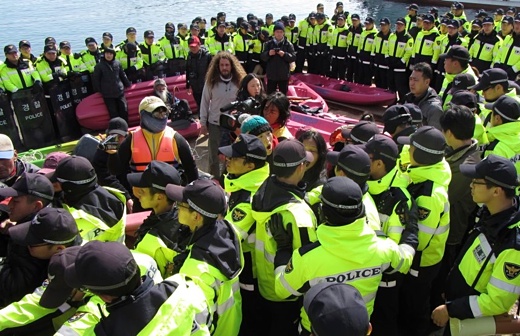
SOURCE: Koohan Paik (kosherkimchee@yahoo.com) SUBHEAD: The right-wing South Korean government will go to any length to bring US Navy base to island. By Bruce K. Gagnon on 26 February 2012 for Space 4 Peace - (http://space4peace.blogspot.com/2012_02_26_archive.html) [IB editor's note: Bruce Gagnon was one of three featured speakers at the Kauai Alliance for Peace conference at the Kapaa Library on 2/21/12.] Image above: Korean national police surround demonstrators at navel base construction site on Jeju island. From original article. It was difficult for all of us to leave Gangjeong village. My last day in the village was filled with horror as the police surrounded the villagers and their kayaks and would not allow them to be put in the water. Four villagers were arrested and a daylong back and forth struggle took place where villagers and supporters would not give up their attempts to pull a kayak free and quickly put them in the water trying to head toward the embattled rocky coastline that is now virtually sealed off with razor wire. Several people were hurt, as the police would swarm over any attempt to remove a kayak. Catholic Father Moon was knocked to the bottom of one scrum along with another revered villager who got his hand cut up. A Frenchman named Benji, who has been in the village for months, was knocked down and repeatedly pounced on by the police. I saw the police push one man off a ramp who was filming the scene. Natasha Mayers (Maine artist) and Global Network board member Sung-Hee Choi were able to get one kayak into the water. Angie Zelter put on a life vest and jumped into the cold water and swam to the rocky coastline. Benji jumped in with half of a wet suit on to make sure she didn't drown. At one point I was asked to help create a diversion by going into the middle of where the police were surrounding the kayaks and attempt to pull a kayak out while others took kayaks from a nearby boat house. This worked and I was exhausted after trying to pull a kayak free from the grips of the police for at least 10-15 minutes during my diversionary attempt. Earlier in the day yesterday about 30 of the villagers and remaining international supporters made the one-hour trip to Jeju City to hold a news conference demanding that the weak-kneed Governor Woo stand up to the Navy and protect the 450-year old village from destruction by the Navy. A large number of media covered the news conference and then we moved across the street to the governor's office building but they locked us out. I've never seen such a thing where taxpaying citizens were locked out of their own government building - especially with the large media throng accompanying them. After much Korean-style yelling and demanding they finally opened the door and allowed Mayor Kang, Dave Webb (UK), Atsushi Fujioka (Japan), me, and a translator to go up and deliver our letter to the governor's office. All day long I couldn't get out of my head the thought that South Korea is absolutely a police state. I think it is a sign of where we in the U.S. are quickly heading. The South Korean people have been dealing with this reality for many years but we in the U.S. are hardly prepared for what this tastes like. I've just arrived at JFK airport in New York City after a 13-hour flight from Seoul. When I checked the Facebook page called No Navy Base on Jeju! I saw a tweet from Father Moon saying, "February 28 Gangjeong port blockade! Today, worse! They surrounded the kayak storage container. Not even allowed to enter the sea, blocking fiercely! SWAT team has been deployed, who was mobilized at that time of Yongsan eviction crack down in 2009 [in Seoul]." The Navy has been bringing police in from Seoul by the hundreds at a time. They have no allegiance to Jeju Island and are conscripts doing their two-years of service. So in the last two days about 30 people have been arrested for trying to protect the sacred coast of Gangjeong village. The villagers tell us that every day is like this - an endless struggle just to be able to stand on their own shoreline or now even have access to the water with a kayak! People keep asking what they can do to help. They should continue to call the South Korean embassy/consulate nearest to you. But most importantly more international delegations are urgently needed in the village. When the international presence is strong the police have to back off some of their more aggressive treatment of the villagers. I can't urge strongly enough for activists around the world to discuss sending 2-3 folks from your community to Jeju for 7-10 days. We can help you make the necessary contacts there. Please discuss this great need in your local community. I can promise you it will be an experience that you will never forget. The villagers are worn out and would be thrilled if you could bring them this kind of support. Bruce K. Gagnon: Coordinator Global Network Against Weapons & Nuclear Power in Space PO Box 652 Brunswick, ME 04011 (207) 443-9502 globalnet@mindspring.com www.space4peace.org http://space4peace.blogspot.com/ (blog) Video above: Al Jazeera documentary on protests against US navel base on Jeju island, Korea. From (http://youtu.be/_aSJgZOkLlU). See also: Ea O Ka Aina: Korean Island of Peace 2/26/12 .
Chinese municiple land grab

SUBHEAD: Chinese central government showdown with municipalities on property speculation bubble.

 By Bonnie Cao on 28 February 2012 for Bloomberg News - (http://www.bloomberg.com/news/2012-02-28/chinese-lawmakers-showdown-over-property-curbs-simmers-after-wuhu-retreat.html)

 
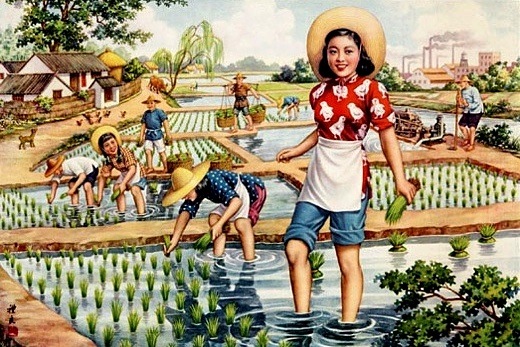
Image above: Chinese poster art "New View in the Rural Village" by Xin Liliang, 1953. From (http://chineseposters.net/posters/e12-527.php).
 
China’s local municipalities will press on with efforts to ease property curbs that have slowed the land sales they rely on for revenue, even after two cities retreated in the face of opposition from the central government.

Wuhu and Foshan, smaller cities that get at least 30 percent of their revenue from selling sites, abandoned attempts to lift some restrictions that have hurt prices and sales. Premier Wen Jiabao has reiterated the government won’t waver from its measures to keep housing affordable.

“The local governments are testing the water, but the central government is saying we are not ready yet,” said Andy Rothman, CLSA Asia-Pacific Markets’ Shanghai-based China macroeconomic strategist, who expects officials in Beijing to start allowing their local counterparts to relax housing enforcements in the second quarter.

That is already happening. The southern city of Zhongshan, the hometown of Sun Yat-sen, the founder of modern China, increased a price cap on residential home sales in January, and the western city of Chongqing last month raised the minimum threshold where a property holding tax kicks in.
Tensions between the two levels of authority will be on show next week as officials gather in Beijing for the annual National People’s Congress starting March 5th.

Land sales fell 13 percent last year from 2010 to 1.9 trillion yuan ($302 billion), according to a SouFun Holdings Ltd. (SFUN) survey of 130 cities, threatening funding for roads, highways and rail lines.

More Complaints
“Smaller cities rely much more on the property industry than big cities, from land sales to deed tax,” said Liu Li-Gang, a Hong Kong-based economist at Australia & New Zealand Banking Group Ltd. “We are probably going to hear a lot of complaints from small-city government officials during the NPC about how much their revenue and economy have suffered.”

China has more than 1,000 county-level governments and hundreds of city and municipal councils that get revenue from local taxes, land sales and central-government transfers because rules bar most of them from selling bonds. Land sales make up 30 percent of local government revenue and in some cities account for more than half, according to a June 2011 report by Zurich- based UBS AG.

Policies related to the property sector -- including whether purchase restrictions in second- and third-tier cities should be relaxed, preferential policies for first-time buyers, and plans to extend the property tax experiment to more cities - - “will surely be debated” at the NPC, according to economists at Bank of America Corp.’s Merrill Lynch unit.

Fine-Tuning
“We believe the central government will not ease its major property tightening measures,” the economists led by Lu Ting wrote in the report. “However, the government could step up its fine-tuning on several fronts.”

Changes may include further lowering mortgage rates and down-payment ratios for first-home buyers and encouraging developers to build smaller homes by providing favorable policies on loans and land, the economists said.

The NPC is legally the highest governmental body in China. While the legislature, with about 3,000 members, is often derided as a rubberstamp parliament, its members are some of China’s most powerful politicians and executives, wielding power in their home provinces and weighing in on proposals such as whether to impose a nationwide property tax.

Wu Yajun, China’s richest woman and chairman of Beijing- based Longfor Properties Co. (960), is a member of the NPC.

Shrinking Revenue
China’s home prices grew 6 percent in 2010 after surging 25 percent the previous year when the government started imposing curbs, according to the National Bureau of Statistics. Home sales rose 10 percent in 2011, the slowest pace in three years.

The government moved to stamp out speculation with measures including raising down-payment and mortgage-rate requirements, imposing property taxes for the first time in Shanghai and Chongqing, and home purchase restrictions in about 40 cities.

The result has been shrinking local government revenue. Land sales in Wuhu, a mid-size industrial city in the east and home to China’s sixth-largest automaker, fell 51 percent last year to 4.64 billion yuan from 2010, while they slumped 60 percent to 5.3 billion yuan in the northeastern industrial city of Dalian, according to SouFun, the nation’s biggest real estate website.

Local governments spearheaded a construction boom under a 4 trillion yuan stimulus program started in November 2008 after global credit markets seized in the wake of the collapse of Lehman Brothers Holding Inc. in September that year.

Backing Down
Property became the pillar industry in most second- and third-tier cities than in Beijing and Shanghai, which have more diversified industries and are considered more affluent, according to Mizuho Securities Asia Ltd.

“Desperate diseases require desperate remedies,” said Shen Jian-guang, a Hong Kong-based economist at Mizuho Securities. “Had the government not introduce the nationwide property tightening, it would be hard to control the risks of asset bubbles. But today smaller cities are feeling the bigger impact from the policies.”

First-tier cities include wealthier Shanghai, Beijing, and Guangzhou and Shenzhen in southern China, according to the statistics bureau. The second tier includes provincial capitals and the third includes smaller cities.

Wuhu in Anhui province had planned to waive a deed tax and subsidize some purchases, becoming the first Chinese city this year to signal its intention to ease property measures. The decision was halted three days after the Feb. 9 announcement, in a move reminiscent of Foshan, in the south, which in October shelved plans to ease limits on home purchases one day after its announcement.

‘A Blind Eye’
China’s home prices in January recorded their worst performance in at least a year, with none of the 70 cities monitored by the government posting month-on-month gains. China stopped releasing national average property prices in favor of individual cities in January 2011.

The eastern city of Wenzhou posted the biggest drop, with home prices declining 7.6 percent in January from the same period last year, according to the statistics bureau. A credit squeeze on smaller businesses in the city prompted a visit and pledge of financial aid from Wen in October.
There are signs the central government may be allowing some modest forms of property curbs relaxation. It “turned a blind eye” in the case of Zhongshan and Chongqing’s “policy fine- tuning,” according to CIMB-GK Securities Research Pte.

Mild Easing Allowed
“Local government officials are trying to read the mind of the central authority,” said Johnson Hu, a Hong Kong-based property analyst at CIMB-GK. “It seems cautious, mild easing moves are allowed, while drastic relaxations are likely to be called off.”

Major Chinese cities also are attempting some form of easing. Shanghai on Feb. 22 reiterated its property curbs remain in place after a newspaper affiliated with the state-run Xinhua news agency reported the city will tweak its definition of locals to allow a broader pool of people to buy second homes.

Shanghai stated yesterday that the definition of locals excludes residence permit holders. That would leave out 671,000 in the city of 20 million who were issued residence permits as of March 2009, China Business News reported.

The measure tracking property stocks on the benchmark Shanghai Composite Index (SHCOMP) fell 3 percent at the close, the most in three months. China Vanke Co. (000002), the biggest listed developer on mainland exchanges, declined 2.8 percent to 8.28 yuan in Shenzhen trading, while its biggest rival Poly Real Estate Group Co. slid 3.3 percent to 11.1 yuan in Shanghai.

No Major Policies
“It’s very unlikely for the housing ministry to make any major policy moves ahead of the NPC, while local governments just can’t wait,” said Peter Bai, a Beijing-based property analyst at China International Capital Corp., the country’s biggest investment bank. The jostling between local and central governments will last for at least half a year, he added.

China’s central bank cut the amount of cash that banks must set aside as reserves for the second time in three months on Feb. 18. It also pledged on Feb. 8 to ensure that “loan demand from first-home families” is met, echoing a housing ministry comment in December that it will prioritize loans for first-home buyers.

“The central government wants to retain control of this easing process; they don’t want each city going off and operating on its own level,” said CLSA’s Rothman. “They need to be convinced that they have enough evidence that policies have worked before they start relaxing them.”


.

Americans can't afford food

SUBHEAD: Study finds a growing number of Americans cannot afford a proper diet. By Alexander Eichler on 29 February 2012 for Huffington Post - (http://www.huffingtonpost.com/2012/02/28/afford-food-hunger_n_1308020.html) Image above: What's for dinner? Top Ramen noodles again. From (http://ramenrater.wordpress.com/2010/03/20/nissin-top-ramen-oriental-flavor).

Here in the United States, growing numbers of people can't afford that most basic of necessities: food.

More Americans said they struggled to buy food in 2011 than in any year since the financial crisis, according to a recent report from the Food Research and Action Center, a nonprofit research group. About 18.6 percent of people -- almost one out of every five -- told Gallup pollsters that they couldn't always afford to feed everyone in their family in 2011.

One might assume that number got smaller wrapped up with the national unemployment rate falling for several consecutive months. In actuality, the reverse proved true: the number of people who said they couldn't afford food just kept rising and rising.

The findings from FRAC highlight what many people already know: The economic recovery, in theory now more than two years old, has done little to keep millions of Americans out of poverty and deprivation. Incomes for many haven't kept pace with the cost of living, and for a large swath of the country, things today are as bad as ever, or worse.

Forty-six million people lived below the poverty line as of 2010, a record number, according to the Census Bureau, and one that's not even as high as some other estimates would have it. Take a further step back and the situation appears even more dire. About 45 percent of people in the U.S. have reported not being able to cover their basic living expenses, including food, shelter and transportation, according to the group Wider Opportunities for Women.

The official poverty rate is about 15 percent, but over two-fifths of Americans have so little saved that one financial emergency is all it would take to put them in poverty, according to the Corporation for Enterprise Development.

These high rates of financial insecurity -- a consequence of the weak job market, and the prevalence of jobs that don't pay very well -- are making themselves felt at the level of everyday spending.

Recently, for example, a Center for Housing Policy study found that a growing number of middle-income owners and renters are paying more than half their earnings just to keep a roof over their heads. And as of 2009, almost one in five Americans over 50 years old were skipping on doctor visits, switching to cheaper medications or forgoing some medicines entirely out of financial necessity, according to a recently published study by the Employee Benefit Research Institute, a think tank.

As for widespread hunger of the kind recorded by FRAC, research shows that the entire country ends up paying one way or another. While the people who can't afford food are obviously suffering the worst, the social costs incurred -- from the money spent to keep food pantries open to the lifelong diminished earning power of impoverished children -- come to about $167 billion a year, or $542 for every man, woman and child in the country.

.

Seattle Permaculture

SUBHEAD: The city’s new park will be filled with edible plants, and everything from pears to herbs will be free for the taking. By Clair Leschin-Hoar on 28 February 2012 for Take Part - (http://www.takepart.com/article/2012/02/21/its-not-fairytale-seattle-build-nations-first-food-forest) Image above: An existing community garden in Seattle, Washington. From (http://www.ourcollectivegood.com/animals-ecology-wildlife/its-not-a-fairytale-seattle-to-build-nations-first-food-forest/).

Seattle’s vision of an urban food oasis is going forward. A seven-acre plot of land in the city’s Beacon Hill neighborhood will be planted with hundreds of different kinds of edibles: walnut and chestnut trees; blueberry and raspberry bushes; fruit trees, including apples and pears; exotics like pineapple, yuzu citrus, guava, persimmons, honeyberries, and lingonberries; herbs; and more. All will be available for public plucking to anyone who wanders into the city’s first food forest.

“This is totally innovative, and has never been done before in a public park,” Margarett Harrison, lead landscape architect for the Beacon Food Forest project, tells TakePart. Harrison is working on construction and permit drawings now and expects to break ground this summer.

The concept of a food forest certainly pushes the envelope on urban agriculture and is grounded in the concept of permaculture, which means it will be perennial and self-sustaining, like a forest is in the wild. Not only is this forest Seattle’s first large-scale permaculture project, but it’s also believed to be the first of its kind in the nation.

“The concept means we consider the soils, companion plants, insects, bugs—everything will be mutually beneficial to each other,” says Harrison.

That the plan came together at all is remarkable on its own. What started as a group project for a permaculture design course ended up as a textbook example of community outreach gone right.

Friends of the Food Forest undertook heroic outreach efforts to secure neighborhood support. The team mailed over 6,000 postcards in five different languages, tabled at events and fairs, and posted fliers,” writes Robert Mellinger for Crosscut.

Neighborhood input was so valued by the organizers, they even used translators to help Chinese residents have a voice in the planning.

So just who gets to harvest all that low-hanging fruit when the time comes?

“Anyone and everyone,” says Harrison. “There was major discussion about it. People worried, ‘What if someone comes and takes all the blueberries?’ That could very well happen, but maybe someone needed those blueberries. We look at it this way—if we have none at the end of blueberry season, then it means we’re successful.”

.

Triumph of the Generalist

SUBHEAD: A overview of attempts at farming & homesteading encyclopedias.  

By Sharon Astyk on 27 February 2012 for Casaubon's Book -  
(http://scienceblogs.com/casaubonsbook/2012/02/triumph_of_the_generalist_read.php)


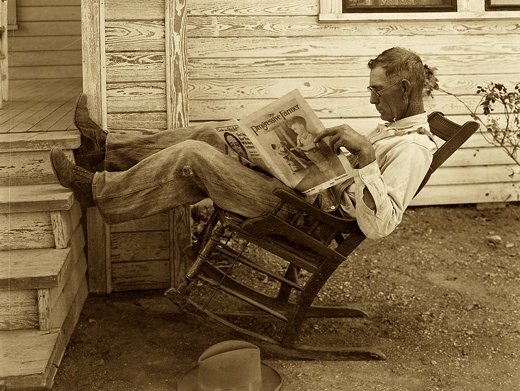
Image above: Photo of farmer reading Progessive Farmer, by George Ackerman, 1931. From (http://en.wikipedia.org/wiki/File:Ackerman_farmer.jpg).
 
I admit it, I'm a generalist in a world of specialists, and I always have been. Looking back on my career history, for example, I see the way I attempted to make the academic model of specialization adapt to my own taste for generalism - my doctoral project was a little bit insane, integrating demography, history, textual analysis and half a dozen other disciplines across a 250 year timeline - just the sort of thing advisers hate to see.

The polite word was "ambitious" but "nuts" is probably more accurate. As you can probably guess from the title of this blog (for those who haven't read George Eliiot, Casaubon is trying to write the ultimate unified theory of everything - and failing miserably), both the joys and dangers of generalism are something I try and keep in mind.

Having left academia behind, it is perhaps natural that I would find myself a career as a generalist- as a writer covering a wide range of subjects and as a farmer, the ultimate generalist. Agriculture requires a wide-ranging set of skills vaster than almost any field I can imagine, and while one becomes deeply expert in some parts of the work, it is still necessary, even imperative, to constantly be gaining some superficial understanding of a host of new things.

The generalist is jack of many trades, but master of few. That's not a criticism. Being good enough at things is often sufficient for most of a life - particularly an agricultural life. I don't need to be able to handle the most complex medical crises in my animals - only able to handle the day to day ones that come up regularly. It is fine with me to call the vet for the hard stuff. I don't need to be able to knit objects of incredible, perfect artistry - only to be able to make enough mittens to keep the kids' hands warm.

I can get a mechanic when something seriously breaks down, but need to keep the tiller in order for most common problems, can propagate most plants, but leave the germination of rosemary seed to others. I can make a passable fruit tree graft, build a bentwood fence that will mostly keep things in or out and produce bread that will never pass for european artisanal, but that tastes awfully good. I'd like to get better at many of these things, but I don't NEED to - the comfortable level of passable generalism is sufficient for much.

Not long ago, I was asked by a publisher if I would consider writing a farming/homesteading encyclopedia, and I declined, although it was an interesting idea. Still, I think much of that ground has been covered or is being covered by others, and I'm working on another project at this moment. It did, however, make me think about the way the ground has been covered in the past.

These overview books on starting up a smallholding/homestead/small farm/urban sustainable oasis are often the first books any of us come to, precisely because we need that encyclopedic breadth so badly - eventually we may need to know more about growing melons or delivering a calf or butchering a rabbit or canning pickles - in fact, most of us end up with specialist books on all these things. But at first the best of these books give you a picture of the whole range of the work you are entering into - and that's what a lot of us need. When they are really good, they also come with enough thoughtful detail that even experienced farmers and homesteaders learn a lot from looking through them.

The criteria I use to evaluate them are these. First, can you follow the instructions enough to actually accomplish the things they show you? Second, do you get misinformation or inadequate information from them - in their attempt to be concise, do they leave critical things out? Next, are they enjoyable to read? Finally, are they books worth buying and having on your shelves - that is, once you move past the beginner stage, will you still go back to them?

 Encyclopedia of Country Living  
(http://www.amazon.com/Encyclopedia-Country-Living-Carla-Emery/dp/1570615535)
Carla Emery's book is, of course, the be-all, end-all of encyclopedic farming, food and homesteading references. Full disclosure - Carla was a personal friend and I was involved in the revisions for the 10th edition (along with a lot of people at the Homesteading Today forums). Even given my bias in Carla's favor, it is the most complete reference out there - if sometimes idiosyncratic. Moreover, its focus on recipes - ie, it will teach you how to make a BLT starting with wheat seeds, a pregnant sow, a hen and a long row of empty garden - really makes the "food to table" connection clear.

That said, this is a BIG book, and a friendly, chatty, idiosyncratic book - one that attempts to do two simultaneous things - talk to you like a neighbor would and cover the landscape. Most encyclopedic texts don't try both - and it can occasionally be hard to find what you are looking for, but the book is so warm and friendly and fun to read or just meander through that I can't wish for less that was personal. It is manifestly possible to do many of the things that Carla suggests with her book - I know people who have butchered their first pig that way, or milked the first goat with the book in one hand. Carla has been helping people actually do for themselves for a long time.

For the 10th edition, Carla attempted to really sort through all the thousands of recipes and update it with a lot of help, and it really is a good job. Still, there are some recipes left that aren't that great and a few incoherencies, but if you were to buy one farming or homesteading book, this would be it.
I wouldn't recommend just one - in fact, I have come to think that Carla's Encyclopedia actually is even better with a companion book, and I know just the book. Carla's book is a product of the fist back-to-the-land movement of the 1970s (in fact it is just about as old as I am) - if there's a new back to the land movement now, as some have claimed,

 The Ultimate Guide to Homesteading
 (http://www.amazon.com/Ultimate-Guide-Homesteading-Encyclopedia-Independent/dp/161608135X)
Nicole Faire's  book is the logical companion to Carla's book. This book filled with pictures (and very, very good pictures at that!) is truly a collection of encyclopedia entries - from "how do I make a homemade tasty toothpaste?" to "how do I thatch a roof?" Everything from first aid for a range of medical conditions to making tools, fiber crafts and food storage is covered here, in brief and with images.

Most of the entries are brief enough that you probably won't use them as a primary reference - for example the explanation of how to knit or crochet is totally inadequate and the pictures don't really even tell you what you are seeing. Some entries are more complete than others and more detailed.
Sometimes you can do things from the book, sometimes all this is is sufficient information to make you want to find a better book. But even someone who has been doing this for more than a decade (me) and counts herself as reasonably famliar with much of this stuff learned new things from this book - and was intrigued enough with the basic explanation to want to follow up with more detail from one of my collection of specialists. This is a good and interesting book, and together with Carla's Encyclopedia, is probably the best two-piece basic reference I can think of.

I love the idea of John Seymour, and I want to use; 


The Self-Sufficient Life and How to Live It
  (http://www.amazon.com/Self-sufficient-Life-How-Live/dp/0789493322)
as a reference, but I find that I rarely turn to it for that - it is more for inspiration. It isn't the Britishness of it - other guides to British-style smallholdings hold my interest, but much as I like Seymour's writing in itself, I find it very hard to follow his instructions for most things - I don't find him clear at all.

He tends to make flat statements like "spray potatoes with bordeaux mixture in April." Why? Why should I spray them? What's bordeaux mixture (ok, I know that, and I can guess why he suggests I spray them, but many beginners won't - and I don't spray my potatoes or need to.) Some sections of the book are excellent (his illustrations of how to fell a tree are better than any encyclopedic book I know, his description of scything is pretty good and almost followable), and the illustrations are visually very appealing.

I know a number of people who have done major homesteading operations from Carla Emery's book - every time I try to follow John Seymour's instructions in the same way in order to butcher, preserve, garden, etc... I find myself wondering "but wait, what about..." I really do like his work, but either British beginners already have a culturally embedded memory of who to cut up a chicken or he leaves a lot of things out. Still, I do refer to it sometimes and I'm glad I own the book - but I don't think I'd list it as truly necessary. I see his books as more useful for conveying a picture of the British farm past than for the homestead present. For this they are deeply enjoyable and very readable.
In the 1980s, Readers Digest put together several books on Homesteading and small farming, all of which are back in print in new editions now

Back to Basics: Traditional American Skills 
 (http://www.amazon.com/Back-Basics-Traditional-American-Skills/dp/0895779390)
being the most famous of them, but there are several related books. These are the opposite of the previous three books, all of which allow the author's personality to shine through - these are true encyclopedias, written in the dry abstract.

That said, they can be useful - they are well illustrated or have good photos and cover a fairly reliable landscape. Want to build a sauna? Make a raft? Graft fruit trees? Make a basket? Braid cornhusks? Learn regional US cooking? Put up fencing? As a straight reference, they give more information and clearer instructions than any of the previous references - you can always pretty much DO what they show you from the instructions. The books lack the chatty personal element, and once you know the basics of these projects, you will surpass them pretty quickly, but the sheer functionality of the books is useful - a great adjunct to some of the others.

Storey's Basic Country Skills
 (http://www.amazon.com/Storeys-Basic-Country-Skills-Self-Reliance/dp/1580172024/ref=sr_1_1)
 is the most boring useful book on the planet - from its visually unappealing cover to its pages with plenty of white space lest your eyes be over-excited by something interesting, it is a hard book to really look at. I don't usually complain about the formatting of books, but this one is so unpleasant to look at and read that I rarely open it, even though there's some good stuff in there.

The book brings in experts to produce each section, and there are some really good people in there. Louise Riotte's Wetland gardening section is something I really have found useful. Stephen Bushway has produced the best section on woodburning and wood heat in any book not wholly about this subject. The range of projects is good, and there's a heavy emphasis on home repair which most of the books lack. If you can get past the fact that it is actively unpleasant to read - as big and heavy as Carla's book with none of the charm and humor - it is a useful thing to have around.
If you are planning on doing this on a smaller scale, either urban or suburban,  
The Backyard Homestead
 (http://www.amazon.com/Backyard-Homestead-Produce-food-quarter/dp/1603421386)
edited by Carleen Madigan has a neat focus - exactly how much can you produce in a small space by optimizing. That said, its focus is also oddly narrow - it doesn't talk about water issues, it says goats can't fit in your backyard (ummm...), and it has I think most of the disadvantages of encyclopedic books, without most of the advantages - it is almost impossible to follow the directions successfully, and it has only enough information to intrigue - but little to offer someone with more advanced knowledge I don't think highly of this volume, even though I want to like it - if all you are interested in is food, however, this is probably a good very basic work, but take it out of the library.

 Integral Urban House  
(http://www.amazon.com/Integral-Urban-House-Self-Reliant-Living/dp/0871562138)
The 1970s-era by the Farallones Institute was re-released in 2008, and in many ways is still a really important book - the focus on urban sustainability was prescient and it is very good in a lot of ways - that said, it is also very dated and could stand to be radically revised and updated. The book is derived from the direct experience of an urban collective, and seems ripe for revision - I'd add this to any urban homesteader's list of important books, recognizing, however, that it is extremely dated. Still, in many ways it has a freshness missing from the more polished but less useful _Backyard Homestead_ book.

The Self-Sufficient-ish Bible  
(http://www.amazon.com/Self-Sufficient-ish-Bible-Eco-living-Century/dp/034095101X)
Andy and Dave Hamilton's is a really nice book, and has a nice, contemporary and thoughtful feel - I love that besides "do it yourself" they include ethical banking and purchasing. freeganism and other ways of economic disconnection. The book is definitely geared to more urban life - community gardening, rather than your own yard, livestock only gets a few pages and focuses on the small,. and the urban low-cost decor section seems a little over-emphasized, but basically it is really nice book with a lovely emphasis on reuse and repurposing. I like it a lot. and I enjoy its aesthetic. When it lists a project, you can always actually do that project from the descriptions here


 Householder's Guide to the Universe
(http://www.amazon.com/Householders-Guide-Universe-Calendar-Basics/dp/0982569157),
If there's a non-rural successor to Carla Emery, it is definitely Harriet Fasenfest. I've written before about how much I like her book, but it deserves a mention here, because it has what Carla's book has - that chatty, funny, "I'm your neighbor and we're talking over the back fence about this stuff that we're trying to figure out" quality. There's a lot here - including both absolute basics for the kitchen and household and also much to make use of for more advanced folks. Following Fasenfest's instructions is a delight - probably no other author here is as clear and complete. If she says you can do it, you can be sure you can.

So which of these books do I need to own? Well, I don't own all of them, but I find that there's a place for half-a-dozen of these books on my shelves - they all have different strengths, because after all, so do their authors. Different authors see different elements as central - ultimately most publishers won't let you publish anything the size of a Britannica, even if (like me) you could write that much - so choices must be made.

More about cows or more about community gardens? More about housebuilding and insulation or more about getting along without money? These are the kind of choices all authors make and ultimately, no one book can cover the landscape for all we'll need - even all we need to begin. There are some that come close, but the happiest outcome are shelves that have a few of these covering a wide range of possibilities.


.