Kukui`ula Ghost Town

SUBHEAD: How a development on Kauai, planned for rich people, became a ghost town.

 By Shawn Langois on 27 September 2011 for Market Watch - 
(http://www.marketwatch.com/story/real-estate-slump-hits-luxury-hawaiian-resort-2011-09-27)

 
Image above: The clubhouse at Kukui’ula, an ocean-view golf course and residential real-estate development on Kauai, Hawaii. From original article.

Ambling into the warm embrace of Kukui’ula’s clubhouse on Kauai’s pristine south shore is to catch a fleeting glimpse into how the other half lives.

Or, more accurately, the other 0.1%. But with the global economy in turmoil and real-estate wounds still festering across the country, there’s trouble in paradise. “We broke ground on the club in 2008 and a month later, Lehman Brothers went down,” said Brent Herrington, Kukui’ula president. “There was a moment there where it felt like the world was going to end,” he said. “But we came together as a partnership and decided to push ahead.” Without a doubt, the expansive 1,000-acre development cutting a vast swath of land across Poipu is mesmerizing. A golf course with sweeping ocean views, a world-class spa, a cascade of pools, a stunning $100-million clubhouse. The ice cubes even match the drink order. What the customer wants, the customer gets.

The draw was compelling enough to attract New Orleans Saints quarterback and Super Bowl MVP Drew Brees to the club’s early membership ranks. His locker is prominently displayed inside the men’s locker room. The staff quips, “Would you like to use Mr. Brees’s bench?” Then why does the resort feel like a vacant city-scape scene out of a zombie flick? While every corner of the property is equipped for a good time, there’s hardly anyone there to enjoy it. At least for now.  

One sale in a year-and-a-half
“I’m still a big believer in the property, and the people that bought for their own use are very happy,” said Becky Supon, Pacific Ocean Properties real-estate agent and former saleswoman at Kukui’ula. “The ones looking to flip for profit, of course, aren’t happy.” Supon said she currently has eight listings from clients trying to unload their property. One customer who bought during the initial sales phase for $1 million just sold his piece of land for about $550,000. “It’s one of the most unique and beautiful developments in all of Hawaii,” Supon added. “But it’s just tough to market it right now and banks aren’t really loaning on second homes.”

It’s not that Alexander & Baldwin (NYSE:ALEX) , who first began zoning the project some 25 years ago, and partner DMB Associates, a renowned golf-community developer from Arizona, aren’t offering up a stellar product. They are. But the market for these kinds of things has been treacherous. All the palm trees and Lomi Lomi massages in the archipelago can’t change that. “The most recent down cycle was one of the worst we’ve seen in Hawaii,” said Honolulu-based real-estate analyst Ricky Cassiday. “Sales have since recovered somewhat, and we are two years out from the bottom, but it is still anemic by historical standards.”

 Recognizing the futility in pushing sales during times as ugly as the past few years, the developers behind Kukui’ula decided to circle the wagons and stop spending on marketing. Of course, while it appears to have been the right move, it also kept a lid on demand. Only one piece of land has sold in the past year-and-a-half after 80 “founder” lots were sold in 2006 for a total of $110 million. Eventually, the project plans to offer a series of price points. On the low end, condos will be available for under $1 million. On the high end, Herrington said he sees custom homes upwards of $20 million.

Cassiday points out that some of Kukui’ula’s best lots have yet to be marketed, which will come in handy when things pick up. “They can pull the ace from the hole any time they want. And at this point, everyone else is dying off,” he said, referring to several other projects in the Islands that have stalled or been halted altogether. “Kukui’ula has enough invested to be the last one standing, and that’s a good thing,” Cassiday said. “A&B and DMB have spent a ton of money here, but the value won’t go away — entitled land in a great place with high barriers to entry is good, especially long-term.”  

Riding out the cycles
Currently, cottages are being rolled out in the $2-million-plus range along with home sites costing between $1 million to $3 million. Then there’s the monthly club dues of $1,000, a required part of any purchase. With almost 90,000 acres, Alexander & Baldwin is one of Hawaii’s biggest landowners, and has been for more than a century. From its legacy sugar-cane business to its Matson Navigation shipping subsidiary, there’s much more to the company than real-estate development. But that doesn’t minimize the importance of Kukui’ula in the grand scheme of things at A&B. The company has already laid out $225 million in cash for its part of the joint venture.

To put that in perspective, A&B posted total revenue of $488.2 million in the most recent quarter, while profit dipped from a year ago to $18.7 million. “Kukui’ula is a significant investment for A&B ... one that we believe will generate tremendous long-term value,” said Chris Benjamin, president of A&B Properties. “The market is recovering, and we have an irreplaceable asset that will perform extremely well in the years ahead as there is no comparable new project in Hawaii, and we do not believe there will a comparable project in the foreseeable future.” Benjamin described Kukui’ula as a “long-life-cycle project,” comparing it to the company’s highly -successful Wailea resort in Maui, which was developed in the 1970s and 1980s. “What’s important is being able to ride through the cycles,” he added. “The project has no debt, and A&B has the ability to sustain the project and benefit greatly in the up cycles.”

Herrington, an employee from the DMB side of the venture, has helped turn some of company’s other high-profile projects into winners, and is quick to point out the overall reception during a recent marketing push has been positive. Yet buyers haven’t responded with open checkbooks. Why? The reasons are clear: It’s a hefty luxury expense during a relentless global downturn that has shown few signs of abating.

 Not budging on pricing
 Larry Leight, who sold his high-end Oliver Peoples sunglasses business to Luxottica Group’s (NYSE:LUX) Oakley subsidiary in 2006, owns a vacation home just down the road from Kukui’ula and has been wooed as a potential member. Watch video on Oliver Peoples.

 Impressed as he is, Leight is having a difficult time justifying that kind of financial commitment right now. “You just can’t find luxury at this level anywhere else, especially in a setting like this. Still, I don’t think we’ve seen the bottom in the market yet,” Leight said. “The current economic condition makes it difficult to purchase such a luxury today, though interest rates and pricing are getting better,” he added. “It might take a while, but I think the project will be a big success.” Pricing, however, is one thing on which Herrington and the top brass plan to stand firm. “We believe the market recovery is still two or three years out, and it could be even longer than that.

Nobody anticipated a downturn as deep and sustained as this one, but we’re prepared to be here,” Herrington said. “We are not going to have a fire sale. This is the last grand-scale luxury development in Hawaii in our lifetime. Maybe forever.” He preaches patience. And that seems to be just fine with those whose fortunes are linked to the project’s long-term success. Mick McGuire, a former analyst at hedge fund giant Pershing Square, is a believer. He now runs the Marcato Capital Management fund, which holds 551,881 shares of A&B while Pershing owns some 3.5 million shares, according to a recent SEC filing.

It doesn’t hurt that Alexander & Baldwin’s stock has rallied 7% in the past year to outpace a volatile stock market. It’s easier to be patient when shareholders are complacent and believe in the project. “It’s a wonderful property in one of the best and last remaining locations on one of the most beautiful Hawaiian islands and those unique characteristics translate into significant value,” McGuire said, adding that he sees “enormous development potential.” For now, much is riding on that potential because the reality is still brutal.

See also:
Ea O Ka Aina: End of Kauai's Economy 7/7/10
Island Breath: Kauai Lagoons - annuls of false advertising 3/18/08
Island Breath: Koloa Landing Scam Development 6/28/07
Island Breath: Koloa Area Development Moratorium 7/23/06
Island Breath: Slow Chaotic Development 5/10/06
Island Breath: Poipu to be buried in development 8 1/05
Island Breath: Kukui`ula to have negative impact on Southside 1/13/04

 .

Goldman Sachs rules the World

SUBHEAD: Goldman Sachs rules the world and the Euro zone is poised to crash, according to trader Alessio Rastani.  

By Staff on 26 September 2011 for Huffington Post - 
  (http://www.huffingtonpost.com/2011/09/26/trader-to-bbc-goldman-sachs-goldman-sachs-rules-the-world_n_981658.html)

 
Image above: Cover of book "Power and Money: How Goldman Sachs came to rule the world" by William D. Cohan. From (http://www.waterstones.com/waterstonesweb/products/william+d-+cohan/money+and+power+28ebook29/8598299/).
 

"This is not a time right now for wishful thinking that governments are going to sort things out," trader Alessio Rastani said on an interview with BBC on Monday morning. "The governments don't rule the world, Goldman Sachs rules the world."

The statement came towards the end of an almost three and a half minute interview in which Rastani warned viewers to "get prepared" for the inevitable: "The savings of millions of people are going to vanish" in less than a year, he said.

"This economic crisis is like a cancer, if you just wait and wait thinking this will go away, just like a cancer it's going to grow and it's going to be too late," he continued.'

Fear over the fragility of the European economy has become pronounced in recent weeks. Prompted in part by concerns that the region could enter recession and affect the global economy, stocks composing the Dow Jones Industrial Average suffered their worst week since 2008 last week, according to Reuters.

In spite of statements like Rastani's, Euro policymakers continue to press ahead with possible reforms. Currently, they are working to bolster their 440 billion-euro rescue fund, after being criticized by leaders from both China and the U.S. for letting Greece's debt crisis already wreak havoc on global stocks, according to Reuters.

But the crash will be good news for traders, Rastani told the stunned BBC anchors.

"For most traders we don't really care about having a fixed economy, having a fixed situation, our job is to make money from it," he said. "Personally, I've been dreaming of this moment for three years. I go to bed every night and I dream of another recession."

Rastani said traders aren't the only ones who can benefit from the crisis.
"When the market crashes... if you know what to do, if you have the right plan set up, you can make a lot of money from this."
 
Video above: Alessio Rastani speaks to BBC about world economy. From (http://youtu.be/aC19fEqR5bA).
 .

Facebook CIA Connection

SUBHEAD: The CIA's invention of Facebook has saved the government millions of dollars.  

By Staff on 26 September 2011 for the Onion News Network -  
(http://www.theonion.com/video/cias-facebook-program-dramatically-cut-agencys-cos,19753)

 
Image above: Brooke Alvarez at the FactZone newsdesk. From (http://www.ifc.com/blogs/ifc-now/2011/09/from-the-onion-news-network-a-2.php).
 
As the host of FactZone, Brooke Alvarez is one of the world's most recognizable news figures. Growing up in Russia, Brooke dreamed of being famous and powerful. She emigrated to U.S., erased all trace of her Russian accent within three weeks, and began her systematic ascent to the top of the news industry. The details of this rapid climb through the various lesser networks to end up at the Onion News Network was the subject of "The Devil Incarnate" a book refuted by Brooke as "the pathetic scrawlings of a bitter and jealous acne-scarred half-reporter."

A prolific Twitter user, Brooke tweets 20 to 40 times a day, often while her guests are talking. She's appeared as herself in more than a dozen motion pictures although there is some debate whether she understood that the words on her teleprompter were fictional and where they would eventually appear. Brooke owns five corgi dogs, her favorite food is kale, and she is married to author Thomas Pynchon.

Brooke is active in charity work, having formed a foundation to teach newscaster dialect to young urban teens. She's politically motivated as well, publicly campaigning against wind farms whenever her schedule allows.

While the media has made much of her long-standing feuds with both Wolf Blitzer and Yo Yo Ma, Brooke insists she is easy to get along with as long as everyone understands their place.

Brooke stays healthy and happy by swimming 20 miles each day in the resistance pool in her office.


Video above: Social networking sites used by Sate Department and CIA. From (http://youtu.be/cqggW08BWO0).

 .

Try Wait

SUBHEAD: The state's solution is to wait until it is an actual emergency and give the finger to due process and transparency.

 By Andy Parx on 22 September 2011 for Parx News Daily - (http://parxnewsdaily.blogspot.com/2011/09/try-wait.html)

 
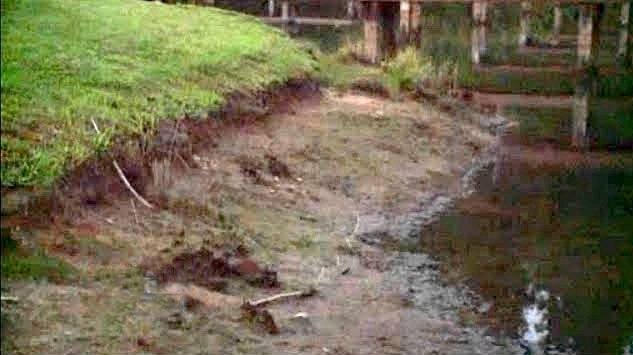
Image above: View east from the old lifeguard tower location on Kekaha Beach... or what was once a beach. Photo by Juan Wilson 9/11/11.

 [IB Editor's Note: Since last February the beach between Kekaha Community Center and the Ditch One relocated lifeguard stand has disappeared. In places it seems 200 feet of sand has been swept away by the ocean. The ocean is now crashing against rocks ten feet away and ten feet below the Kaumualii Highway. A single winter storm could breach the road. If they had not moved the lifeguard tower it would be gone already. Scarey it was so quick.]
 
The kvetch-fest over Governor Neil Abercrombie's "emergency" declarations- and the fact that he failed to tell anyone about one of them for months- suspending environmental and planning laws to clear ordinance from the beaches and oceans and nene from the Kaua`i Airport area would be deafening if it weren't for the paywall blocking the state's "newspaper of record," making it an unproductive endeavor to link to columnist Dave Shapiro’s traditional harangue or, surprisingly, Cynthia Oi's tome on the subject.

But while some debate whether these are in fact emergencies under state law, another "emergency" proclamation by his Governorship has got to be the slowest developing crisis in history showing that if you wait until the molehill becomes a mountain you can create a pressing matter of epic proportions out of anything.

The fact that a stretch of the highway near Lumahai has been falling into the ocean is no surprise to anyone who has driven the stretch in the past decade. But Abercrombie's "emergency declaration" on September 7 would make you believe that rather than it being a result of glacial-paced erosion, some menehune came in last month with pickaxes and chopped away at the coastline all in one night. The fact is that the declaration is the result of almost a decade of trying to get the state to get its act together.

We can remember current State Senator Ron Kouchi as Kaua`i County Council Chair- that would place it before 2003- grilling then County Engineer Cesar Portugal about what was thought to be the imminent loss of the northbound lane of the state highway. What should be a state problem has since been a subject of concern for every council and county engineer ever since. While the county has been making temporary fixes, the state has dragged its feet in moving the highway 40 feet inland- the current "emergency" solution which was first proposed 10 years ago.

But that would have taken due process, pubic hearings and most importantly environmental impact statements, certified shoreline determinations and, quite probably, a plan to be approved by the Army Corps of Engineers, as we heard in council testimony over the years. But noooo. The state's solution is to wait until it is an actual emergency and give the finger to due process, public hearings, transparency and, most importantly, any thoughtful review of the fact that if this section is falling into the ocean, what's next?

That might raise the nasty problem of why we're putting things like bike paths- and even new homes under the county's new process for granting exemption from what had been widely acknowledged to be the strongest shoreline protection law in the country- 10 feet away from the shoreline in an age when climate change could well remove that 10 feet in as many years. Is this the future of how the state's environmental and shoreline protection laws will be handled when the ocean come in to stay? Wait long enough to suspend them?

Apparently.


Image above: Juan Wilson and view east from the old lifeguard tower location on Kekaha Beach on a cloudy day. We were over a 100 feet from the Kaumualii Highway. Photo by Linda Pascatore 2/8/11.

 .

US Paralyzed on Palestine

SUBHEAD: Mamoud Abbas has played the game fair and square and deserves serious consideration on Palestinian nationhood.

 By Robert Naimon on 26 September 2011 for TruthOut - 
(http://www.truth-out.org/mahmoud-abbas-jackie-robinson-palestine/1317045647)

 
Image above: Mamoud Abbas in a reversed baseball cap.
 
On Friday, Mahmoud Abbas - backed by more than 80 percent of Palestinian public opinion in the West Bank, Gaza and East Jerusalem - formally requested full United Nations membership for Palestine.

The logic of turning to the UN is straightforward: the US-sponsored "peace process" - bilateral negotiations between Israel and the Palestinians under US auspices - has failed, because a key premise of that process was that the US government could bring the Israeli government to the table for a serious negotiation that would produce real Israeli compromise necessary for a solution. That premise has turned out to be spectacularly false.

The US hasn't been able to bring the Israeli government to the table for a serious negotiation, not because it would be theoretically impossible to do so, but because "domestic political constraints" - the "Israel lobby" - have prevented the US from exerting effective pressure on the Israeli government to move. Therefore, if the world wants to see resolution of the Israel-Palestine conflict anytime soon, it has to wrest control of the issue from Washington. And that's why moving the arena to the United Nations makes perfect sense.

Former Israeli peace negotiator Daniel Levy summed it up in The New York Times: "The US cannot lead on an issue that it is so boxed in on by its domestic politics," Levy said. "And therefore, with the region in such rapid upheaval and the two-state solution dying, as long as the US is paralyzed, others are going to have to step up."

In his address to the United Nations on Wednesday, French President Nicolas Sarkozy directly challenged US control of the Israel-Palestine issue, explicitly stating French support for upgrading the Palestinians' status at the UN to nonmember observer state and implying that US efforts have totally failed.

You might think: who cares? What is France compared to the US? And in a one-on-one confrontation, you might be right. But this is not a one-on-one confrontation. This is the US against Turkey and Egypt and the Arab and Muslim worlds and most of Latin America and Africa and Asia. And so, for France to throw its weight to the other side is potentially a very big deal. It opens up a broader path for the Palestinians - and the Egyptians and the Turks and everyone else - to contest US-Israeli policy in Europe. And there is no question that there are many levers on the US and Israeli governments in Europe that have not been used.

In September 2010, Israel became a member of the Organization for Economic Cooperation and Development (OECD). Turkey could have vetoed Israel's membership, but it didn't. At the time, if Turkey had decided to take this stand, it might have been isolated. But the world has changed since September 2010; if Israel applied for OECD membership today, the outcome might be different.

In December 2010, a group of 26 former European Union (EU) leaders called for EU sanctions on Israel for settlement construction in the West Bank and East Jerusalem. In response, Catherine Ashton, the EU foreign affairs chief, wrote that the EU's response to Israeli settlement expansion would remain unchanged for the time being. What will happen in the future? The pressure to follow up European words with European action will increase.

UN membership for Palestine - even nonmember observer state status - could broaden the path to the prosecution of Israeli officials at the International Criminal Court for the policies of the occupation. It could enable Palestine to join the Law of the Sea Treaty as a means to challenge the Israeli blockade of Gaza. There are many levers to pursue. But the potential of these levers will depend greatly on governments and public opinion in Europe and elsewhere.

And this is the context - what will Europe and the others do? - in which the diplomatic strategy pursued by the Palestinian leadership makes perfect sense. In recent years, the Palestinian leadership has pursued a "no excuses" policy: not to give the US and Israel any excuse for blocking Palestinian national aspirations, neither by failing to condemn violence, nor by failing to cooperate on issues of security.

This policy has been controversial among Palestinians. Many have basically said: Israel is hitting us - stealing our land, shooting and imprisoning our children - and you're not hitting back; instead, you are cooperating with Israel and the US to prevent others from hitting back.

What's being tested now is this: what is the diplomatic and political fruit of the "no excuses" policy? It certainly hasn't been movement in the Israeli government position; it certainly hasn't been movement in the US government position. But it could be movement in world opinion, it could be movement by European governments, it could be movement by other governments. It could result in greatly increased political, legal and economic pressure on the Israeli government to end the occupation.

Venezuela is probably going to support the Palestinians as much as it can no matter what. Probably, US policy will defer to Tel Aviv for the foreseeable future. But for other countries - like France - what they are going to do is much more of a jump ball. What will they do to stand up to the US? Will they support EU sanctions on Israeli settlement expansion? Will they support Palestine's admission to the Law of the Sea Treaty? Will they support the prosecution of Israeli officials for war crimes at the International Criminal Court?

When Branch Rickey recruited Jackie Robinson to play for the Brooklyn Dodgers, they made a bargain. If Robinson would maintain discipline, standing strong against efforts to provoke him into retaliation with racist taunts and assaults, Rickey would stand strong in fighting efforts to keep Robinson from playing. Mahmoud Abbas has held up the Jackie Robinson side of the bargain. The question now is whether the "international community" will hold up the Branch Rickey side of the bargain..

Get Rid of the Clowns

SUBHEAD: Our present day "democratic" political systems are woefully inadequate to kick out the clowns and replace them with people that make sense.  

By Illargi on 24 September 2011 for the Automatic Earth -  
(http://theautomaticearth.blogspot.com/2011/09/september-24-2011-get-rid-of-clowns.html)

 
Image above: "Clown Eats Boy" photo 1953. From original article.

 Where we find ourselves today has just about all been entirely predictable, as readers of The Automatic Earth know only too well; we've predicted most of what's happening now pretty accurately (going forward, remember what we've said about the dollar and about gold). Not predictions of the exact timing, but that's not the essence, except perhaps when you're a day trader; but even they have children.

The essence is the very simple fact that a debt crisis can't be averted with more debt (again, barring warfare, zero-point energy and meteor strikes). And that a debt crisis of the present magnitude inevitably leads to a credit crunch that paralyzes entire economies, in this case even the whole global economy as we have come to know it.

Once you accept that, measures completely different from what we have seen so far and what is now being touted once more, are called for. But we're not getting these different measures; it's as if those who "lead" the world are able to live and think in two dimensions only, whereas comprehension of a third dimension is needed to understand the issues at hand.

All these so-called leaders refuse to accept the possibility that monetary and fiscal policy may not hold the tools to fix the mess and get back to normal, or whatever passes for it. Yes, there’s a political crisis. But it's not that they can't get their act together to dump more public funds into the alleged right places, it's that dumping public funds is the only measure they can think of.

The underlying idea is that if banks' assets (debts) would be marked to market right now, the banks would be broke. By injecting trillions more, the hope is that asset values will recover. Still, that is not what has happened so far; the opposite has happened. It's the notion that markets are cyclical, hence they must come up again. But even if that's true, cycles can be long, and the banks don't have decades to save themselves.

Short version: by issuing trillions more in debt, governments and central banks -apparently- hope they can turn around financial markets, and have them recover to heights that would turn today's losses into tomorrow’ profits (or at least more bearable losses). There are lots of voices that will tell you that we didn't need to be where we are, that things could have been done: (If Leadership Fails, Prepare for Recession!). They all mean more or less the same things: capital injections into the financial industry.

A financial industry that is by and large broke and now depends on money from governments and their taxpayers all of whom are by and large broke. Amidst all the fear and panic and selling, let me repeat what I've said a thousand times by now: there is no way out of this crisis that does not involve defaults on debt, restructuring of debt and bankruptcies caused by debt. Nothing else will achieve anything other than window dressing. In other words: all we've seen so far has been window dressing, and of a very expensive kind. Yes, it’ll be tough, yes, it’ll be severe, yes, it’ll be brutal.

But isn't it true that nothing's more brutal than having to listen day after day year after year to over-paid clowns lying through their teeth and other body parts and then in in the end still wind up in a situation that's in all likelihood even worse than where you would be if you’d have shut them out from the start? The real problem is not, as a plethora of voices is now proclaiming, that governments have a hard time reaching consensus on recapitalizing the banking system. The real problem is that they are still, despite all the trillions squandered on exactly this approach, even considering doing so.

When we hear Lagarde, or Zoellick, or anyone of the "trusted" media pundits, say that all that's really needed is for "leaders" to "get their act together", what they mean is that a lot more money should be pumped into the financial system, and into broke governments. For people like Paul Krugman and his ilk, there is only one possible problem with stimulus measures: that they're too small. In other words: if a stimulus measure is large enough, it will solve any problem. However, that idea of course carries its own problem: that the agent that does the stimulating will itself get into financial trouble. And who then will bail IT out? These ideas are based on the notion that no amount of debt can be large enough to overwhelm an entire financial system, or economy.

That is not a very intelligent notion, if you ask me. It carries with it the idea that debt can be cancelled out with more debt. The IMF’s Global Financial Stability Report this week suggested that European banks could be "saved" with a capital injection of perhaps around $400 billion. But the IMF, like everyone with a pair of functioning neurons, knows full well that that wouldn't save the banks. It would only and simply allow them to live another day or two. And then the game would start anew, exactly like it has over the past, let's say, 50 months. This is true of all stimulus, all QEs, all of it.

That is, unless a miraculous growth spurt appears out of the blue and against all the odds dictated by reality as we know it today. In other words, more capital injections simply and only mean more double or nothing gambling. We need restructuring, not replenishing. We need to sleep this one off, not get a refill. This is not a simple difference of opinion, where one option is as valid as the other. There is no way the Lagardes and Zoellicks of the world can "know" that what they propose will achieve what they say it will. They refuse to believe - at least in public, let me add-, and therefore even consider, that the banks and indeed the entire system can go belly-up. And they also refuse to believe that throwing more money into the pit will not at some point be enough to fill that pit. We need to get rid of these clowns.

Unfortunately, I have very little faith that we actually will, if only because in the end, as much as our "leaders", we all are the clowns. As the Sondheim song goes: "Don't bother, they're here". Getting rid of the clowns is an almost entirely hypothetical situation, in the exact same way that solving debt with more debt is. What governments need to do at this stage, and it's years overdue, is to ringfence their citizens, in order for them not to lose even more money than they already have. And then to combine that with a massive restructuring, with many defaults and bankruptcies, of the banking system (but without losing citizens' deposits) and the non-banking system that carry too much debt on their books.

Our present day "democratic" political systems are woefully inadequate to kick out the clowns and replace them with people that make sense, and are willing to do so for the masses. But until we get a system that is capable of achieving this, we are in for a whole lot more misery. Behind a painted smile.

 .

Punked World

SUBHEAD: Why are the Nascar morons and Jesus jokers the only people in this country who can mount an aggressive political movement?  

By James Kunstler on 26 September 2011 for Kunstler.com -  
(http://kunstler.com/blog/2011/09/punked-world.html)

 
Image above: Enthusiastic Nascar couple view of the pit. From (http://reallifemoron.com/funny-in-real-life/nascar-fans-are-hardcore).

Europe is a three-card monte game and Greece is the pea and for the moment I'd guess that the pea is under a walnut shell called France. Or the French banks, to be specific. Their vaults are stuffed with Greek bond paper that is giving the whole neighborhood a headache from a stench like unto rotting carp. Everybody else in the neighborhood has their own cache of deliquescing fish-heads, but they pretend the air is fresh and bracing. In fact, so exhilarating that they are avid to dump $3 trillion into a Euro bailout fund that will solve the problem of that fugitive aroma wafting down the boulevards.

Europe can really only put out stories at this point, and the $3 Tril bailout fund is just another story in a tedious string of them. Where are they going to get the money? From the machinists' union in Dusseldorf? The waiters and chambermaids in Munich? There's that rumored swap line opening from the Federal Reserve to the European Central Bank, but that's nothing more than a cheap loan window, and for a measly half a trillion ($500 billion - the late Senator Ev Dirkson is cackling in his grave). And where do those dollars come from anyway?

Who is supposed to pay it back, and how? What kind of collateral is Ben Bernanke going to hold - the contents of the south wing of the Louvre? One hundred million free dinners (wine and tip included) at Taillevent? This game of musical chairs with a hot potato is not fooling anyone, really.
All it's doing is dragging out the process of the civilized world getting right with reality. Reality has a ledger and is calling in its notes. The civilized world can't believe this is happening, so they pretend it isn't, with pompous ceremonials among the highest level banking officials, and hollow declarations of heroic actions that are not the least heroic because all they are designed to do is protect their fellow bankers. It's certainly not for the sake of the nations involved, because the standard of living in all these countries will take a painful hit any way you cut it.
This mummery could dissolve in tears any moment, or it might stretch out one more month, but by going this route the leaders of Europe risk all kinds of pressures in the other seams of the system, namely markets. They are testing a 60-odd years long supply of the one indispensable resource: confidence. They've already probably squandered the little that's left.

All signs point to a mega-Lehman moment when trust has fled and nobody will lend to anybody and business cannot continue. That'll be a freaky-deaky moment and it will be way worse than Lehman was. When it happens, what seemed financial will instantly go political. The rage of millions will shred the trappings of fakery, and for a while things will seem too real. The world has no idea how all this might resolve. What a show.
I can't imagine that the explosion in Europe will not affect the American banks - we've already shoveled hundreds of billions into the Euro bank vaults the past several years, apart from that new swap line. Anyway, Washington has ramped up a new game of charades to divert everyone at this end - another threatened government shut-down. If we don't cut this shit out, some Pentagon general is going to have to ride across the Potomac and call a time-out on the constitution. Financial chaos is not cool. Just so you know the sort of fate we are tempting with our shenanigans.
Speaking of the constitution, I'm getting a little sick of these corporate CEO knuckleheads who come on CNBC and complain that the US Postal Service is running at a loss, and therefore we should abolish it. There is actually little beyond all those post offices that holds the fabric of small town America together anymore.

And anyway, delivering the mail is one of the few actual government services that is spelled out in the US constitution in no uncertain terms in Article One, Section 8. It doesn't say the postal service must run at a profit, by the way. The food stamp program is not spelled out in the constitution and it doesn't run at a profit. Neither does the war in Afghanistan (if you don't count the drug money). Congress runs at a profit, but not in any way that the constitution provides for. Before long, a lot of people are going to want to abolish it.
In the meantime, can anybody answer this question: where is the Tea Party of Progressives? Why are the Nascar morons and Jesus jokers the only people in this country who can mount an aggressive political movement? Will somebody please step up and take the baton?

.

Too much weather, Too many cars

SUBHEAD: New evidence for changing the nature of the Global Economy is mounting.  

By Brent Blackwelder on 19 September 2011 for Culture Change - 
(http://www.culturechange.org/cms/content/view/780/1/)

 
Image above: Mashup of flames and Chinese auto industry by Juan Wilson. From (http://geplife.blogspot.com/2011/05/cars-in-china-are-hot-china-is-largest.html).

Billion-dollar weather catastrophes this year, along with the latest figures on Chinese consumption, emphasize the urgency of a shift in economic thinking.

The National Oceanic and Atmospheric Administration cites 10 massive weather disasters in the U.S. this year, each exceeding a billion dollars. The nine months of unprecedented weather extremes include these estimates of death and damage:
Hurricane Irene: 50 deaths and $7 billion; Upper Midwest flooding along the Missouri River: $2 billion; Mississippi River flooding in spring and summer: $4 billion; Drought and heat waves in Texas and Oklahoma: $5 billion; Tornadoes in the Midwest and Southeast in May: 177 deaths and $7 billion; Tornadoes in the Ohio Valley and Southeast in April: 32 deaths and $9 billion; Tornadoes in Oklahoma and Pennsylvania in April: $2 billion; Tornadoes in the Northeast and Midwest April 8-11: $2.2 billion; Tornadoes in central and southern states April 4-5: $2.3 billion; Blizzard in January from Chicago to the Northeast: 36 deaths and $2 billion.
Although we cannot conclude that any particular event was caused by global warming, climate models predict growing frequency and intensity of storms. The tragic weather events of 2011 could well be due to the accumulation of dangerous levels of greenhouse gases in our atmosphere.

This year’s disasters are sending a powerful signal that the time has arrived for a new economic framework. The current structure of markets puts the wrong prices on goods and services, because it neglects the ecological costs of producing them. This market failure is especially critical in the energy sector, where overconsumption of fossil fuels is driving climate destabilization. Catastrophes

How long can governments keep spending huge amounts to deal with catastrophe after catastrophe? Weather disasters undermine governance in two ways: first, they require large amounts of money and human resources for emergency relief, cleanup and rehabilitation. Second, they impair the ability of governments to provide ongoing public services by diverting revenue and personnel.

At the beginning of summer, New York Times columnist Thomas Friedman pointed to alarming evidence that the human race is consuming at a rate that requires one and a half planet earths to maintain. Friedman describes the consumer-driven growth model as broken and suggests a transition to a “happiness-driven growth model, based on people working less and owning less.” Many of us have been making these very points for some time, but it is noteworthy that a major growth advocate has had a change of thinking. And now there is new data on consumption in China that reinforces our concerns.

In a recent article entitled “Learning from China: Why the Existing Economic Model Will Fail,” Lester Brown provides some sobering statistics. When compared to the U.S., China consumes twice as much meat, three times as much coal, and four times as much steel. The per capita consumption of the 1.2 billion people in China is far below that in the U.S., but it is moving upward and is on track to equal ours in 25 years, Brown notes.

What does such growth in consumption mean if the Chinese embrace the same spending habits as U.S. consumers? Take a look at two factors: paper and automobiles. If the projected 1.4 billion people in China in 2035 consume paper at the American rate, then China itself would consume a quantity equal to four fifths of today’s paper usage. The world’s forests, already under intense pressure, would suffer under this additional onslaught.

Lester Brown considers what would happen if Chinese car ownership in 2035 matched that of the U.S., which currently has three cars for every four people. China would have 1.1 billion cars. Today the world has roughly one billion automobiles. Brown estimates that such a fleet of vehicles would necessitate so many new roads and parking areas, that an area two thirds the size of the acreage now growing rice in China would have to be paved. All these new vehicles would consume about the same volume of gasoline that the entire world auto fleet currently uses each day.

Why are the Obama Administration and Congress so focused on the debt panel when there are such pressing problems with the economy at home and around the world? They are missing the big picture and failing to enact changes that are called for in these perilous times. Now is the time to write letters to the editor about real economic solutions. We don’t need to be slashing government programs; we need to be making progress toward the transition to a steady state economy. .

Local Corruption - Global Corruption

SUBHEAD: An article by Ray Songtree from a new website that covers issues on Kauai and the world at large.  

By Ray Songtree on 16 September 2011 for Kauai Truth -  
(http://www.kauaitruth.com)

 
Image above: A SmartMeter used by the National Rural Electrical Cooperative Association that KIUC is a member of. From (http://www.ect.coop/power-supply/smart-grid/smart-meter-count-hits-two-million/18596).


Corruption increases with scale. The bigger the bureaucracy, the more distant the decision making is from the aina (Earth Mother). The only way to stop corruption in global, federal, state, and even county government is to take control of our own community through education and communication among ourselves. In other words, make big government irrelevant.

For example, if the county will not discuss Peak Oil and Peak Everything, and the coming collapse of tourism, we will.

If the Hawaii Dept of Health won't discuss the fake 2009 H1N1 "pandemic" and the unnecessary and dangerous vaccines they are pushing, we will. (See Womens Page, Catholic Nun Snr. Teresa) Also Sept 20 article on mandatory vaccines for many employees and what independent experts say.

The answer for a better world is not global centralized control which makes everyone a slave of computer models. The positive future is a return to local stewardship which has been called "localism". This is why we must now fight Smart Grid and other global programs.

We cannot trust corporate controlled newspapers or radio or television to educate our families and friends. We see this with the Garden Island News coverage of the 10 year anniversary of 9/11 featuring the official lies of Associated Press writers. The Garden Island Newspaper fails to factor in that the two Co-Chairman of the 9/11 Commission wrote a book in 2006 claiming the 9/11 Commission was consistently lied to, and therefore the report is flawed and the official story is wrong. Why are we honoring a false story on the anniversery of that horrible day? Why is Garden Island Newspaper committed to repeating lies and dumbing us all down instead of being an investigative newspaper that makes people think and question?

Controllers want disparity and ignorance. It is like a bully father who cuffs his kid every single time the child wants to say something until the child is conditioned to not think. This is called mind control. People who get off on being "powerful" and in control do not want us to be educated, strong and to challenge their dominance. They want sheeple that are easily herded. They want us to be dependent and stupid. Controllers thrive on secrecy and disinformation. They really do hide in the dark and they hate discussions like this here.

"Liberty cannot be preserved without a general knowledge among the people." — John Adams Founding Father

“The advancement and diffusion of knowledge is the only guardian of true liberty.”- James Madison Founding Father

We cannot have a democracy unless we are informed. In a democracy we would be given true information, not constant lies such as “Smart Meters pose no health risk” or "vaccines are safe" or "the economy is recovering".

It does appear that Kauai Island Utility "Cooperative" (KIUC), like big government and big business, is trying to dumb us down and not give us all the data so we could make informed choices. It is reprehensible that KIUC would have a 'vote' that is worded in such a way to keep members ignorant of the real protests which had to do with international control of Kauai resources.

Rather than giving us slick answers, citizens should be given a wide range of questions so that critical thinking and community wisdom can be engaged.

How wonderful it would be if KIUC sent out a pamphlet that said "Here are all the questions that the Board at KIUC has about the worth of Smart Grid. What questions do our members have? Lets pool our critical analysis as a true co-op and see if this global program has any value."

KIUC has had meetings but because they hid the controversies, people were not alerted. And their meetings were not for discussion, but designed to sell a program they have already bought into. Now private citizens like you and I have to spend our time and money acting as consumer advocates in a protective mode against KIUC, an adversary to our health and freedom. Their literature deliberately downplays any questions.

This is not respectful. When will government and corporate employees realize that treating everyone as a commodity to be packaged and sold to the highest bidder is like cannibalism? When will we see that efficiency is never more important than integrity?

In facing the present assault by government on our rights and the assault by corporations on our health, we each have the choice to live on our knees, or become responsible adults.

Truth will set us free, but freedom means responsibility.

The first (recent) Kauai "People Power" success was stopping Super Ferry four years ago. Yet, the majority of people didn't protest because they never heard about the issues, and probably to this day don't know why the ferry was unethical. If the Garden Island News had alerted Kauai to a PATTERN of government corruption, crooked deals would be protested, not by hundreds of awake citizens, but by thousands. But Garden Island News keeps us dumb by information screening. This is a second type of mind control.

The next uprising of people power was facing down the bankers wanting to control Kauai 's water. This is an ongoing issue for many people, but KIUC seems to think they have a mandate from the majority of members who "voted" but were never informed about the real issues.

This old habit of trying to control everyone by keeping us uninformed is coming from the very top, and this top is even higher than the visible Federal Government. There are agencies that survive from one administration to another which form a 'shadow' government and some of these agencies have no congressional oversight. There are even parts of military which the top Administration at Pentagon have no security clearance to investigate. What can a President do if the military, for example, has a 20 year grand strategy? Well, we have a President now who has broken every promise and has not challenged any program from the past, so we will have to wait to see if someone with integrity is elected who will expose the shadow agencies.

Thus, from the top, from the shadow government in USA to the UN to the FED to the States to KIUC on little Kauai, the policy is "Don't ask questions. Don't raise questions. Keep everyone blind."

Where ever we see corruption, we must raise questions, and when our questions are ignored, this is absolute proof we have indeed spotted corruption. "If its covered up, it's true."

We are now on to our third community action which will be stopping Smart Meters through the public awareness that:
1) smart meters absolutely are a health risk.
2) smart meters absolutely collect permanent data on individuals which is wiretapping. (see form letter below)
3) KIUC has not acted independently of Dept of Energy or Global Technocrats, but has acted like a hired hand, and we must ask, what were they paid?
4) KIUC has not explained how spending 11 million dollars (half member fees, half from our taxes) benefits anyone on Kauai. It benefits global technocrats at our expense. Humbug.
Will KIUC keep spreading propaganda? Our purpose is not just to stop Smart Meters, but to start creating a habit of critical thinking and ethics, rather than everyone passing along lies from one agency to another and pushing it on public as "the facts".

If policies come from the Great White Father in Washington DC (what Native Americans called the chief of the invading armies 150 years ago), it isn't great, it is probably rotten.

That is what we are learning everyday with one scandal after another. (Please see "Inside Job" video on the Obama Page). Therefore, our CEO of KIUC should not be proud he went to Washington DC recently, which is literally 'sin city', with far more prostitution than Las Vegas. [also here and here]

Will we see KIUC downplay the legitimate concerns brought up around the world about Smart Meters? Will we see another "vote" on smart meters like we saw on Hydro, based on inadequate wording? "Do you support efficient smart meters?" might be the wording of a fake straw vote, as if most members have studied websites like this that educate about the very dangerous privacy and health issues.

Or will a new tone of integrity breath life into KIUC with the realization that our world is dying because of corruption and the buck must stop here.

Love is Respect - Candlelight Vigil

SUBHEAD: Honor victims of domestic violence, sexual assault and teen dating violence at YWCA event, Oct 19.  

By Amy Kurtz on 24 September 2011 for Kauai YWCA -  
(amy.l.kurtz@gmail.com)

 
Image above: A candlelight vigil at the University of Wisconsin against violence in 2008. From (http://www.news.wisc.edu/15015).  

WHAT:
Honor victims and survivors of domestic violence, sex assault and teen dating violence. This year's theme is "Love Is Respect", with additional recognition of violence in relationships among our youth. To raise awareness of the effects of and the efforts to end violence against women and their children, please join us for entertainment and refreshments beginning at 5:00 p.m., program at 6:00 p.m., with candle lighting at 7:00 p.m. Childcare will be provided from 5:45 - 7:00 p.m. Where there is no respect, there is no love. Love is respect.  

WHEN:
Wednesday, October 19, at 5:00pm - 8:00  

WHERE:
St Michael and All Angels Church
4346 Hardy Street
Lihue, Kauai  

SPONSOR:
Sponsored by the YWCA.  

CONTACT: For more information, call 245-8404.

P2P Meeting 9/26

SUBHEAD: A potluck, brainstorm and talkstory event on strategies and tactics for community to better engage with KIUC.  

By Jonathan Jay on 23 September 2011 for Island Breath - 
(http://islandbreath.blogspot.com/2011/09/p2p-meeting-926.html)


Image above: P2P graphic illustration by Juan Wilson.  

WHAT:
A Potluck, Brainstorm and Talkstory event on strategies and tactics for community to better engage with our Kaua`i island Utility. jonathan jay to moderate discussion.

 WHEN:
Monday, 26th September 2011 from 4:30-6:30pm  

WHERE:
Lydgate Park Pavillion (in Lydgate Park, on the south bank of the Wailua River) Eastside, Kauai  

CONACT:
jonathan jay (808) 634-6267  

COST:
Free. Bring food or drink to share with your neighbors SPONSOR: Power to the People of Kaua`i (p2pKauai) . .

The Third Industrial Revolution

SUBHEAD: In the oil era twilight how lateral power is transforming energy the economy and the world.  

By Catherine Hickley on 22 September 2011 for Bloomberg News - 
(http://www.bloomberg.com/news/2011-09-22/oil-era-s-twilight-drives-depression-debt-crisis-rifkin-says-interview.html)

 
Image above: During the First Industrial Revolution we see "Coalbrookdale at Night" by Philipp Jakob Loutherbourg, 1801. After Peak Wood a new economy had to be forged from coal. From (http://quoteflections.blogspot.com/2011/01/greenhouse-gases-at-highest-level.html).

The world economy will face shocks and depressions, punctuated by ever-shorter and weaker recoveries, as long as it relies on outdated fossil fuels, says Jeremy Rifkin, author of “The Third Industrial Revolution.” “There will be cycles of growth, collapse, growth, collapse, every three years or so,” he said in an interview in Berlin, where he was scheduled to speak on a panel about sustainable growth introduced by Chancellor Angela Merkel.

We are on the cusp of a major upheaval as the world switches to renewable energies and our power-distribution networks undergo a transition similar to that experienced by communications systems with the advent of the Internet, he said. Until the “third industrial revolution” is in full swing, debt crises such as those plaguing the euro area will recur, Rifkin said. “The real crisis has been missed,” he said. “It occurred in July 2008, when oil hit $147 a barrel. The whole economic system shut down.

That was the earthquake. The collapse of the financial market 60 days later was the aftershock.” Rifkin’s book is peppered with chats about hydrogen with then-European Commission President Romano Prodi and dinners with Merkel. Clients of his Foundation on Economic Trends include Citigroup Inc., Ford Motor Co., the European Commission and the U.S. Department of Interior.

 Peace Movement
 Rifkin, who is 66, began a career as an activist in the peace movement of the 1960s. He lectures at the Wharton School’s Executive Education Program and has devised a master plan for Rome’s transition to a post-carbon economy. All industrial revolutions occur, he argues, when technological advances in communications and energy converge. The first industrial revolution combined literacy and printing with steam power and rail.

The second brought us the telephone, the internal combustion engine and oil. That era is dying, he said, and it’s not just the economy that is reeling from the carbon age, but the climate and biosphere too. “We are at the beginning of a mass shift in the chemistry of the planet,” he said. “Our species has never experienced anything like this and we’re not grasping it at all.” He doesn’t rule out the end of civilization as we know it, unless we get our act together.  

Energy Revolution
That, he said, means shifting to renewable energy; transforming our homes into mini power-plants; using hydrogen to store intermittent energies such as solar and wind energy; developing a “smart grid” so that small-scale power producers can sell back excess electricity; and switching to electric plug-in vehicles.

The key is to advance all five elements simultaneously. Germany and Europe are leading the way, yet they are still in the early stages, he said. Rifkin’s vision resonates in Germany, which has announced plans for an “energy transition” after deciding to quit nuclear power. “The good thing about the chancellor is that she’s a physicist, she understands all the science,” he said. The U.S., on the other hand, is falling behind, Rifkin argues.

President Barack Obama, who wanted a green economy, spent too much on stand-alone projects that don’t link up to create a new infrastructure, he said. “He’s lost billions,” he said. “The reason is that we have a huge, powerful energy industry that can finance the elections, and they didn’t want to touch this.”  

Future of Utilities
Power companies around the world are reluctant to give up their role as energy providers, Rifkin said. Yet utilities whose executives realize their future is to manage grids and access will survive, he said, in much the same way International Business Machines Corp. made the switch from manufacturing PCs to managing information systems. He views it as a generational question. “When I give talks to executive boards, I can see the 40- year-olds are nodding their heads,” he said. “The 60-year-olds are shaking their heads. There’s a battle going on.”

New sources of energy will lead to an economy where power, in both senses, is lateral rather than vertical, he predicted. “It’s as fundamental as the shift from medieval guilds to a market economy,” he said. “It has enormous opportunities for a world in the doldrums of despair.” So how are we going to pay for all this in an era of mass debt? Rifkin said we have no choice. He doesn’t pretend it’s easy. “The second part of this century is either going to be real hell on this planet, or we’re going to turn it around,” he said. “I think it’s a pretty uphill climb.”  

• “The Third Industrial Revolution: How Lateral Power Is Transforming Energy, the Economy and the World” will be published in the U.S. on Sept. 27 by Palgrave Macmillan (291 pages, $27).

  .

Greece to go down

SUBHEAD: Greece faces imminent default after its first such crisis more than twenty-four centuries ago.  

By Simon Kennedy on 23 September 2011 for Bloomberg News - (http://www.bloomberg.com/news/2011-09-22/greece-on-edge-of-biggest-insolvency-24-centuries-after-first-city-default.html)  
Image above: Architectural elevation of the facade of the Temple of Delos with World Bank logo superimposed by Juan Wilson. From (http://www.astrologicon.org/download/images).

History’s first sovereign default came in the 4th century BC, committed by 10 Greek municipalities. There was one creditor: the temple of Delos, Apollo’s mythical birthplace. Twenty-four centuries later, Greece is at the edge of the biggest sovereign default and policy makers are worried about global shock waves of an insolvency by a government with 353 billion euros ($483 billion) of debt -- five times the size of Argentina’s $95 billion default in 2001. “There is a monstrously large amount of uncertainty and a massive range of possibilities,” said David Mackie, chief European economist at JPMorgan Chase & Co. in London. “A macroeconomic disaster could be averted but only by aggressive policy action” by central banks and governments, he said.

After two international-bailout deals, three years of recession and budget-cutting votes that almost cost him his job, Greek Prime Minister George Papandreou says throwing in the towel now would be a “catastrophe.” Potential consequences of a national bankruptcy include the failure of the country’s banking system, an even deeper economic contraction and government collapse.

 The fallout may echo the days following the 2008 implosion of Lehman Brothers Holdings Inc. when credit markets froze and the global economy sank into recession, this time with the prospect that the 17-nation euro zone splinters before reaching its teens. The International Monetary Fund, whose annual meetings start in Washington today, reckons the debt crisis has generated as much as 300 billion euros in credit risk for European banks.  

Default Risk
Greek two-year yields surged above 70 percent today and credit-insurance prices on Greece indicate the chance of default at more than 90 percent. Investors can expect losses on Greek debt of as much as 100 percent, says Mark Schofield, head of interest-rate strategy at Citigroup Inc. in London. “People, justifiably, think the crisis is what we’re living now: cuts in wages, pensions and incomes, fewer prospects for the young,” Greek Finance Minister Evangelos Venizelos told reporters yesterday in Athens. “Unfortunately this isn’t the crisis.

This is an attempt, a difficult attempt, to protect ourselves and avert a crisis. Because the crisis is Argentina: the complete collapse of the economy, institutions, the social fabric and the productive base of the country.” Even if Greece receives its next aid payment, due next month, default beckons in December when 5.23 billion euros of bonds mature, said Harvinder Sian, senior interest rate strategist at Royal Bank of Scotland Group Plc.

 Too Late
“It’s too late for Greece,” Howard Davies, a former U.K. central banker and financial regulator, told “Bloomberg Surveillance” with Tom Keene and Ken Prewitt. “The Greek situation is tumbling out of hand and I suspect Greece will not be able to avoid a substantial default.” The introduction of the euro and global financial connections mean previous Greek defaults in the 19th and 20th century, most recently in 1932, don’t provide a decent precedent for a failure to satisfy lenders now. “Contagion will be violent” as the price of the two-year Greek note tumbles below 30 cents per euro, predicts Sian. The European Central Bank would be the first responders through purchases of government debt, he says.

 Greek Banks
The country’s banks, of which National Bank of Greece SA is the largest, would be the next dominoes. They hold most of the 137 billion euros of Greek government bonds in domestic hands, a third of the total and three times their level of capital and reserves, says JPMorgan Chase. As those bonds are written down and equity wiped out, banks would lose the collateral needed to borrow from the ECB and suffer a rush of withdrawals that likely triggers nationalizations, said Commerzbank AG economist Christoph Balz. “No banking system in the world would survive such a bank run,” said Frankfurt-based Balz. A hollowed-out banking sector wouldn’t be the only danger to an economy that the IMF says will contract for a fourth year in 2012.

The Washington-based lender said this week that Greece will shrink 5 percent this year and 2 percent next year, reversing a forecast of a return to growth in 2012. Unemployment is set to rise to 16.5 percent this year, and to 18.5 percent next year, the highest in the European Union after Spain and dry kindling for potential social unrest. Even after saving 14 billion euros in debt repayments, much depends on what deal Greece could strike with its creditors.  

Debt Load
To restore market confidence the debt needs to be pared to below 100 percent of gross domestic product, Stephane Deo, chief European economist at UBS AG, said in a July study that noted national default was “invented” in Greece with the Delos Temple episode. At the time, the IMF was projecting the debt to peak at 172 percent next year. The current debt suggests to him a reduction in the face value of outstanding securities -- or haircut -- of about 50 percent, which would pare the burden to around 80 percent of GDP, the same as Germany and France.

Citigroup’s Schofield estimates a writedown of 65 percent to 80 percent, potentially rising as high as 100 percent as the economy slows further. If default is limited to Greece, the fallout may be contained, say Nomura Securities International Inc. strategists including New York-based Jens Nordvig, whose projections allow for an 80 percent haircut. They estimate euro-area banks would lose just over 63 billion euros, with German and French institutions losing 9 billion euros and 16 billion euros respectively. The ECB would face about 75 billion euros in losses on Greek debt it has bought or received as collateral, they say.

 Large Haircuts
Such amounts suggest “the losses from Greece-related exposures in isolation look manageable, even in a disorderly default scenario with large haircuts,” though the ECB would probably require fresh capital from euro-area governments, Nordvig and colleagues said in a Sept. 7 report. A debt exchange that was part of the second Greek bailout approved by European leaders in July would impose losses of as little as 5 percent on bondholders, according to a Sept. 7 report by Barclays Capital analysts.

The risk is that the rot spreads beyond Greece as investors begin dumping the debt of other cash-strapped European nations, said Ted Scott, director of global strategy at F&C Asset Management in London. Portugal and Ireland have already been bailed out, while speculators have also tested Italy and Spain. Italy, the world’s eighth-largest economy, has a debt of almost 1.6 trillion euros, while Spain, the 12th biggest economy, owes 656 billion euros.

 Grand Solution
Those possible ripple effects explain why policy makers won’t let Greece default, said Charles Diebel, head of market strategy at Lloyds Bank Corporate Markets in London. He expects them to strike a “grand solution” in which richer euro countries such as Germany support the weak and begin issuing joint bonds. Policy makers “would only allow a Greek default if they think they can contain the fallout, which is a dangerous presumption,” said Diebel. If Greece, Ireland, Portugal and Spain all impose haircuts, European banks could lose as much as $543 billion with those in Germany and France suffering the most, according to a May report by strategists at Bank of America Merrill Lynch.

Even those figures don’t tell the full story because they omit indirect exposure via derivatives such as credit-default swaps. Economists at Fathom Financial Consulting in London calculated in June that U.K. and U.S. banks hold such insurance on Greek debt totaling 25 billion euros and 3.7 billion euros respectively. Extend that metric to the whole European periphery and U.S. banks have a 193 billion euro exposure.

 Even Worse
Such linkages threaten an “even worse crisis” than the folding of Lehman Brothers, said Scott. “The amount of outstanding debt is more than with Lehman and we don’t know the amount of derivative exposure.” To support the financial system and stave off an economic slump, Carl Weinberg, founder of High Frequency Economics Ltd. in Valhalla, New York, says governments must create a fund to inject capital into banks as the U.S. did with its $700 billion Troubled Asset Relief Program. “If banks fail, or if they fear big losses, they will stop lending,” said Weinberg. “As things stand today, a credit crunch will corset euroland and a depression will ensue when Greece fails and takes out euroland’s banking system.”  

G-20 Signals
Signaling efforts to contain the crisis, European officials including French Finance Minister Francois Baroin yesterday said they may be willing to use leverage to boost the firepower of their 440 billion-euro bailout fund. Group of 20 finance chiefs said after talks in Washington late yesterday that European authorities are willing to “maximize” the fund’s impact by the time the group next meets Oct. 14-15. The ECB may also intensify its own attempts to support growth and ease financial market tensions as early as next month, Governing Council members Ewald Nowotny and Luc Coene said.

Potential measures include the reintroduction of 12-month loans to banks, while JPMorgan Chase’s Mackie said today he expects the central bank to cut its benchmark interest rate of 1.5 percent next month. BofA-Merrill Lynch economist Laurence Boone calculates a disorderly Greek default with spillover into Spain and Italy could mean the euro-area contracts 1.3 percent in 2012, using the Lehman Brothers episode as a benchmark.  

Waiting for Surplus
  Her “high probability” scenario of a Greek restructuring in 2013 when Europe’s permanent crisis resolution mechanism is operational and Greece is closer to having its primary budget in balance suggests growth of 1 percent next year. The “increasingly likely” option of an orderly restructuring at the end of this year would mean expansion of 0.1 percent, she projects. Hanging over the debate is also whether Greece could default and remain a member of the euro area. Nouriel Roubini, co-founder of Roubini Global Economics LLC in New York, proposes that default -- and an end to debt repayments and required austerity measures -- be twinned with an exit from the euro --an approach rejected by European and Greek policy makers -- to restore competitiveness and debt sustainability.  

Rebounds
After shrinking 10.9 percent in 2002 following its decision to default and devalue, Argentina’s economy grew eight years straight, exceeding 8 percent in every year aside from 2008 and 2009. Russia was growing in double digit just two years after defaulting on $40 billion of local debt in 1998. In contrast, facing only hard choices, EU officials have taken half-measures in the hope that the situation would somehow turn around, said Rodrigo Olivares-Caminal, senior lecturer in financial law at the University of London. “What they have done so far is a patchwork approach,” he said. “Now things are much worse. It’s becoming more expensive not only in economic terms but also in social terms for Greek citizens because now there will be redundancies, now there will be more taxes there will be less jobs and things will get worse.”

.

Clarke's Fallacy

SUBHEAD: Anyone who is unable to distinguish between magic and technology, however advanced, doesn’t know much about magic.  

By John Michael Greer on 22 September 2011 for Arch Druid Report - (http://thearchdruidreport.blogspot.com/2011/09/clarkes-fallacy.html)


Image above: Illustration "Oz - Technology & Magic" by Kurt Miller. From (http://www.3dartistonline.com/show_image.php?imageID=7464).

When I commented last week that I was going to have to discuss the intersection of peak oil and magic, I had a pretty fair idea what the immediate response would be, and that duly followed. Before the metaphorical ink on the post was dry, people were already popping up on the peak oil blogosphere to denounce in advance what they were sure I was going to say. For those of us who belong to the small community of people who study and practice magic, this is familiar ground; there’s a wry amusement in watching such antics, but no least trace of surprise. Being an operative mage in the contemporary industrial world, really, resembles nothing so much as being an evolutionary biologist at a convention of Southern Baptists—or, for that matter, an educated theist at a meeting of the more intolerant sort of atheists.

The great majority of the people around you know essentially nothing about the subject that concerns you, though they have an ample fund of misinformation culled from books and websites written and read exclusively by people who share their prejudices. They consider themselves qualified to judge the subject because they’ve lifted some canned polemics from these same books and websites, and if you show them that the canned polemics are riddled with ignorance, irrelevancies, and straw man arguments, they’ll just give you an irritated look and go right back to the canned polemics.

Those of my readers with a background in sociology will have no trouble recognizing this as a textbook case in the sociology of deviance—specifically, the way that human groups use seeming statements of fact the way baboons use bared teeth and threat postures, to stake out territory and drive off outsiders. As far as we know, baboons don’t try to use their territorial displays to make sense of their world, and this is to their credit. Human beings, alas, are not always so clever, and the resulting confusions play a massive though rarely recognized role in mangling communication in any complex society.

Try to talk about magic and this sort of mangled communication shows up early and often, as a recent and topical example shows clearly enough. About the time I started work on last week’s Archdruid Report post, The Oil Drum posted without comment this year’s most serenely idiotic statement about peak oil. The source was investment analyst Porter Stansberry; he was being interviewed about why peak oil isn’t a problem, and his reasoning ran as follows: "[G]eology doesn’t create oil; capital creates oil. The more capital you put toward oil, the more of it there will be." (You can read the whole interview here.) Consider that statement for a good long moment.

It’s not unique to Stansberry; the late Julian Simon used to make essentially the same claim, and you’ll hear it from quite a few economists these days. What Stansberry is saying is that if you have enough money to invest, geological limits to petroleum extraction don’t exist. Money, though, is a symbolic system consisting of abstract representations of wealth, and Stansberry is thus claiming that the manipulation of symbols wields occult powers that can override the laws of nature and conjure up petroleum from the depths of the Earth. Most people would call this an example of magical thinking, and it corresponds very closely to the sort of thing people do in Harry Potter movies and other media portrayals of magic.

 It may be worth noting, though, that this is not what operative mages claim to be able to do. In point of fact, I’ve carried out a very modest survey over the last few years by presenting claims like Stansberry’s to the operative mages I know, and noting their responses. The typical reaction, edited for printability, is on the order of "You’ve got to be kidding. People actually believe that?" What our society calls magical thinking, in other words, is not the kind of thinking that mages actually do, and the frequent denunciations of magical thinking flung at operative mages would be much more sensibly directed at economists. (I suppose there isn’t much hope of getting it renamed "economic thinking," though that’s a more accurate term.)

 This state of affairs unfolds from the very tangled history surrounding magic in the Western world, and is best understood via a thought experiment. Imagine, then, that the cultural struggles of the late Renaissance that launched the scientific revolution and consigned magic to the crawlspaces of our society went the other way, and magic, rather than science, became the core cultural project of the modern world.

You live in that alternate world, and one fine afternoon you step out of a bookstore on a street near the local university and head for the next stop on your list of errands, as carriages rattle over the cobblestones alongside you. It’s graduation day, and students in star-bedecked robes and tall pointed caps pass you on the sidewalk in droves. They’ve just completed degrees in astrology, alchemy, and other serious subjects; some will go on to graduate school, others to jobs—you overhear an excited young astrologer telling his friends that he’s just gotten a position at a brokerage, where he’ll be casting horoscopes to predict stock values. You’re none too interested in the chatter, though, because you’ve just bought a bestselling novel that you’re dying to read—Harry Potter and the Scientist’s Stone.

You already know half the plot, of course, since everybody’s been talking about it since it hit the bookstands. It’s about this orphan kid who’s stuck in this horrible home situation, but it turns out that his parents were actually scientists, and pretty soon a lab assistant comes and takes him away to the mysterious Warthogs Institute where everybody goes around wearing lab coats and muttering algebraic equations.

There he gets to study science, which amounts to chanting chemical formulas and building big clanking machines to cause the changes in consciousness that ordinary people get done by magic. In this alternate world, mind you, there are people who actually try to practice science—this despite the efforts of the Committee for Paranormal Investigation of Claims of the Scientific, whose members go around heaping disdain on anybody who claims to have experienced a repeatable cause and effect relationship. A lot of would-be scientists simply dress up in lab coats, fill their apartments with test tubes and similarly spooky decor, and leave popular books with titles like Secrets of the Physicists Revealed! on the coffee table to impress dates.

Those who get beyond this sort of thing, as often as not, still have a great deal of Harry Potter mixed up with their science, and keep on trying to figure out how to make science do what magic does, with no significant success. It’s only among the more experienced and serious practitioners in this alternate world that you find people who have realized that the difference between science and magic isn’t a difference of means but of ends—that science isn’t about causing changes in consciousness, as magic is, but about learning and then applying the properties of matter and energy on their own terms. In a society that embraces magic as its central cultural project, mind you, most people don’t see much value in this latter endeavor. The irony is that some of the most serious problems facing the alternate world can’t be solved by changes in consciousness.

They could conceivably be solved by using the properties of matter and energy, but if you try telling people that, you’ll get an irritated look, and then a bunch of canned polemics. Step back through the looking glass at this point, and you’ll find that the same situation applies once you reverse all the signs. Science, not magic, became the core cultural project of our civilization, and the things that science and technology can do—learning and applying the properties of matter and energy—are the things we consider important. Popular images of magic thus have it imitating science and technology in one way or another.

The sort of fake magic you get ad nauseam in the Harry Potter franchise is as good an example as any; Harry and his classmates fly around on brooms, zap people with wands, and manipulate matter and energy directly, which is exactly what magic does not do. The apotheosis of this sort of thinking is Arthur C. Clarke’s famous Third Law:
"Any sufficiently advanced technology is indistinguishable from magic."
I mean no disrespect whatsoever to Clarke, who was among the best of SF authors; it’s hardly blameworthy that he shared misunderstandings of magic that were all but universal in his culture. The point remains that since magic does not do what technology does, and vice versa, the Third Law should properly be renamed Clarke’s Fallacy; no matter how advanced a technology may be, it does the kind of thing technologies do—that is to say, it manipulates matter and energy directly, which again is what magic does not do. I’d like to propose, in fact, an alternative rule, which I’ve modestly titled Greer’s Law: "Anyone who is unable to distinguish between magic and any technology, however advanced, doesn’t know much about magic."

 To understand what it is that magic does do, it’s crucial to look at the specific purposes for which magic is used in practice. Since every human culture known to history has practiced magic, this isn’t exactly hard, and the purposes of magic have varied remarkably little over the centuries. Why do people turn to magic? To tilt the odds their way in hunting, gambling, war, and any other activity that combines high uncertainty with high stakes; to establish, improve, and shape the whole range of human relationships; to heal illnesses of body and mind; to integrate the personality and bring it into harmony with the structures of the cosmos, however those are understood; and, not least, to deal with the fact that other people are using magic for these same purposes, and not always with your best interests in mind. What do these things all have in common?

They all deal with mental phenomena, individual or collective. Grasp that, and you start to grasp what magic is all about. Philosophers and psychologists down the centuries have tried to bring our attention to two important but generally neglected facts: we know more than we realize, and we affect more than we realize. Look at the human organism from an evolutionary standpoint and this isn’t hard to understand. Our rational, conscious, symbol-using minds are recent and rather rickety structures built over the top of a superbly adapted mammalian nervous system. The tangled relationship between the two shows up, for example, in the way that athletes have to learn to get their thinking minds out of the way in order to reach peak performance. It’s a dirty trick well known among tennis players to ask your opponent just how he holds his thumb when hitting backhand, knowing that the unwanted awareness will mess up his coordination and quite possibly cost him the game.

The same factors apply in most other aspects of human life. When two people fall in love, for example, their rational minds have little to do with the matter; the same nonrational, nonverbal patterns of mutual communication that handled pair bonding for our prehuman ancestors do the same thing for us, and as often as not our rational minds simply get hauled along for the ride, squawking and complaining all the way. Social status is determined the same way; read up on social hierarchies among baboons and then visit, say, an activist group trying to find consensus, and if you pay attention to body language and other nonverbal cues, you’ll quickly spot identical patterns at work.

In my experience, at least, the more egalitarian a group claims to be, the more completely it depends on baboon politics to maintain group cohesion and direction—though if you mention that in such circles, you’ll get an irritated look followed by canned polemics. I could list any number of other examples, but I trust my readers will have gotten the point: a great deal of what goes on in our lives depends not on our rational, linguistic, symbol-using minds, but on an intricate and richly communicative nonrational substructure inherited from our animal ancestors, most of which we never notice at all and much of which is highly resistant to any kind of conscious control.

The main current of our industrial culture, which has made the rational mind central to its core cultural project and fixates on a particular mode of conscious control—more on that in a later post—has few resources to offer for dealing with that substructure, other than ignoring it, white-knuckling it, or drugging it into temporary submission.

 There are better tools to hand, though: the tools of magic. Consider a healing spell, the sort of thing that shamans, sorcerers, and mages have practiced down through the centuries. Do these work? Quite often, yes, and the mechanism in many cases seems to be what today’s science calls the placebo effect. Today’s science treats the placebo effect as an obstacle to be gotten out of the way, and it’s right to do so. If you’re trying to find out the properties of matter and energy on their own terms, the placebo effect and its kin are major sources of confusion. You need to keep mental phenomena from bollixing up your perception of physical phenomena, or the results aren’t good. What’s an obstacle to the scientist, though, is the mage’s bread and butter. The operative mage doesn’t want to get rid of the placebo effect.

Quite the contrary, he or she wants to amplify it and use it, to direct the body’s healing resources toward a cure. That’s what the psychologically charged symbols, the ritual psychodrama, the emotionally evocative herbs and incenses, and all the other tools of operative magic are there to accomplish. Apply the same logic to the other purposes of magic mentioned above, and the same interpretation applies. We know more than we realize, and affect more than we realize; tapping into that unnoticed knowledge can lead to better choices, just as tapping into that unnoticed ability to affect situations can lead to better outcomes. These two taken together are what’s generally known as "luck."

 But what about the spirits, planes, powers, and all the other metaphysical hardware that fills books on magical theory? Are those real? That’s a very good question with a very complex and uncertain answer.

Anyone who takes up serious magical training will start to experience such things within a year or two of beginning daily practices; the effect is reliable enough that those of us who teach magic all know to expect the panicky phone call or email that comes right after each student has his or her first experience of the kind. The experiences we’re discussing are mental in nature, not physical; they have the appearance of real beings, places, and so on, but then the same thing is true of the people and places encountered in dreams. There’s a lively and continuing debate among operative mages about the ontological status of these things—are they hallucinations? Dissociated complexes?

Archetypes of the collective unconscious? Actual entities existing on a continuum perceived solely by the mind?—but so far, at least, it’s proven wretchedly hard to come up with a verifiable answer. The traditional lore offers useful guidance in how to deal with these experiences while maintaining a state of relative mental balance, and for the time being that’s about all that can be said for certain. The debates over the nature of magical experience stray into some weird territory on occasion.

Still, I’ve been studying and practicing this stuff for more than three decades, and in my experience, the only way an operative mage is going to get a broom to fly is to buy round trip airfare and take the broom as checked baggage. It really is that simple. The same logic applies at least as forcefully to the intersection between magic and peak oil. Porter Stansberry can brandish the arcane symbols of the stock market and intone the ritual gibberish of economic textbooks all he wants; his incantations aren’t going to cause petroleum to materialize in the depleted reservoirs of America and the world.

 Chanting "Drill, baby, drill" may well put the chanters into a trance state—certainly the people who’ve made this their mantra seem to have achieved a blissful unconcern with the realities of petroleum geology—but that’s all it’s going to do. "The planes," to cite a magical maxim, "are discrete and not continuous," which means in ordinary language that petroleum reserves are one thing and daydreams quite another, and trying to insist that the former has to follow the same rules as the latter is a sucker’s game. That being said, there’s another side to the story, because peak oil is not only, or even primarily, a problem of what magical philosophy generally calls the physical plane.

The finite nature of petroleum and other fossil fuel reserves, and the very limited prospects for replacing fossil fuels with anything else, are a function of hard physical limits, of course, but the three decades of bad decisions that have backed America and the industrial world into a corner of their own making, and foreclosed any number of technically feasible responses to the impending end of the age of cheap energy, are not physical in nature. They belong to the plane of consciousness—to the realm of choices and worldviews, of the unrecognized motives and unacknowledged desires that run rampant through our civilization’s profoundly murky inner relationship with its technology and the energy sources that power the latter.

 Over the last decade or so, quite a few people have tried to solve the technical issues of peak oil without grappling with, or even recognizing, the existence of this other dimension of our predicament, and the result has been a great many technically appealing solutions that sit gathering dust on the shelves. (Mention this to those who are busy coming up with new additions to the same dusty shelf and—well, you know what kind of look and response you’ll get.)

The green wizardry of the Seventies, to its credit, went deeper, and attempted—with some success—to address these other issues: issues that could be called cultural, or psychological, or (let’s whisper the word) spiritual. To make sense of their explorations and build on them, though, we’re going to have to go a good deal further into the topic of magic, talk about the black hole in the history of Western philosophy, and—why not?—break out a bottle of Love Potion No. 9. We’ll do that next week.  

.