SUBHEAD: Environmental activist says; "I do not want mercy. I want you to join me."
[CommonDream's note: Tim DeChristopher, who was sentenced Tuesday to two years in federal prison and a $10,000 fine for 'disrupting' a Bureau of Land Management auction in 2008, had an opportunity to address the court and the judge immediately before his sentence was announced. This is his statement]
By Tim DeChristopher on 27 July 2011 for Common Dreams -
(http://www.commondreams.org/view/2011/07/26-13)
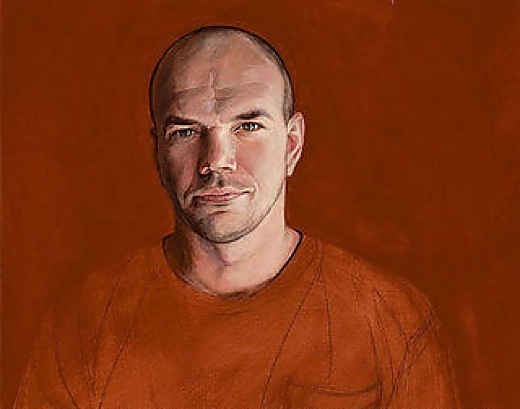
Image above: Detail of portrait by Robert Shetterly (http://www.americanswhotellthetruth.org). From original article.
Thank you for the opportunity to speak before the court. When I first met Mr. Manross, the sentencing officer who prepared the pre-sentence report, he explained that it was essentially his job to “get to know me.” He said he had to get to know who I really was and why I did what I did in order to decide what kind of sentence was appropriate. I was struck by the fact that he was the first person in this courthouse to call me by my first name, or even really look me in the eye. I appreciate this opportunity to speak openly to you for the first time. I’m not here asking for your mercy, but I am here asking that you know me.
Mr. Huber has leveled a lot of character attacks at me, many of which are contrary to Mr. Manross’s report. While reading Mr Huber’s critiques of my character and my integrity, as well as his assumptions about my motivations, I was reminded that Mr Huber and I have never had a conversation. Over the two and half years of this prosecution, he has never asked my any of the questions that he makes assumptions about in the government’s report. Apparently, Mr. Huber has never considered it his job to get to know me, and yet he is quite willing to disregard the opinions of the one person who does see that as his job.
There are alternating characterizations that Mr Huber would like you to believe about me. In one paragraph, the government claims I “played out the parts of accuser, jury, and judge as he determined the fate of the oil and gas lease auction and its intended participants that day.” In the very next paragraph, they claim “It was not the defendant’s crimes that effected such a change.”
Mr Huber would lead you to believe that I’m either a dangerous criminal who holds the oil and gas industry in the palm of my hand, or I’m just an incompetent child who didn’t affect the outcome of anything. As evidenced by the continued back and forth of contradictory arguments in the government’s memorandum, they’re not quite sure which of those extreme caricatures I am, but they are certain that I am nothing in between. Rather than the job of getting to know me, it seems Mr Huber prefers the job of fitting me into whatever extreme characterization is most politically expedient at the moment.
In nearly every paragraph, the government’s memorandum uses the words lie, lied, lying, liar. It makes me want to thank whatever clerk edited out the words “pants on fire.” Their report doesn’t mention the fact that at the auction in question, the first person who asked me what I was doing there was Agent Dan Love. And I told him very clearly that I was there to stand in the way of an illegitimate auction that threatened my future. I proceeded to answer all of his questions openly and honestly, and have done so to this day when speaking about that auction in any forum, including this courtroom.
The entire basis for the false statements charge that I was convicted of was the fact that I wrote my real name and address on a form that included the words “bona fide bidder.” When I sat there on the witness stand, Mr Romney asked me if I ever had any intention of being a bona fide bidder. I responded by asking Mr Romney to clarify what “bona fide bidder” meant in this context. Mr Romney then withdrew the question and moved on to the next subject. On that right there is the entire basis for the government’s repeated attacks on my integrity. Ambition should be made of sterner stuff, your honor.
Mr Huber also makes grand assumptions about my level of respect for the rule of law. The government claims a long prison sentence is necessary to counteract the political statements I’ve made and promote a respect for the law. The only evidence provided for my lack of respect for the law is political statements that I’ve made in public forums.
Again, the government doesn’t mention my actions in regard to the drastic restrictions that were put upon my defense in this courtroom. My political disagreements with the court about the proper role of a jury in the legal system are probably well known. I’ve given several public speeches and interviews about how the jury system was established and how it has evolved to it’s current state.
Outside of this courtroom, I’ve made my views clear that I agree with the founding fathers that juries should be the conscience of the community and a defense against legislative tyranny. I even went so far as to organize a book study group that read about the history of jury nullification.
Some of the participants in that book group later began passing out leaflets to the public about jury rights, as is their right. Mr Huber was apparently so outraged by this that he made the slanderous accusations that I tried to taint the jury. He didn’t specify the extra number of months that I should spend in prison for the heinous activity of holding a book group at the Unitarian Church and quoting Thomas Jefferson in public, but he says you should have “little tolerance for this behavior.”
But here is the important point that Mr Huber would rather ignore. Despite my strong disagreements with the court about the Constitutional basis for the limits on my defense, while I was in this courtroom I respected the authority of the court. Whether I agreed with them or not, I abided by the restrictions that you put on me and my legal team. I never attempted to “taint” the jury, as Mr Huber claimed, by sharing any of the relevant facts about the auction in question that the court had decided were off limits.
I didn’t burst out and tell the jury that I successfully raised the down payment and offered it to the BLM. I didn’t let the jury know that the auction was later reversed because it was illegitimate in the first place. To this day I still think I should have had the right to do so, but disagreement with the law should not be confused with disrespect for the law.
My public statements about jury nullification were not the only political statements that Mr Huber thinks I should be punished for. As the government’s memorandum points out, I have also made public statements about the value of civil disobedience in bringing the rule of law closer to our shared sense of justice. In fact, I have openly and explicitly called for nonviolent civil disobedience against mountaintop removal coal mining in my home state of West Virginia. Mountaintop removal is itself an illegal activity, which has always been in violation of the Clean Water Act, and it is an illegal activity that kills people.
A West Virginia state investigation found that Massey Energy had been cited with 62,923 violations of the law in the ten years preceding the disaster that killed 29 people last year. The investigation also revealed that Massey paid for almost none of those violations because the company provided millions of dollars worth of campaign contributions that elected most of the appeals court judges in the state.
When I was growing up in West Virginia, my mother was one of many who pursued every legal avenue for making the coal industry follow the law. She commented at hearings, wrote petitions and filed lawsuits, and many have continued to do ever since, to no avail. I actually have great respect for the rule of law, because I see what happens when it doesn’t exist, as is the case with the fossil fuel industry.
Those crimes committed by Massey Energy led not only to the deaths of their own workers, but to the deaths of countless local residents, such as Joshua McCormick, who died of kidney cancer at age 22 because he was unlucky enough to live downstream from a coal mine. When a corrupted government is no longer willing to uphold the rule of law, I advocate that citizens step up to that responsibility.
This is really the heart of what this case is about. The rule of law is dependent upon a government that is willing to abide by the law. Disrespect for the rule of law begins when the government believes itself and its corporate sponsors to be above the law.
Mr Huber claims that the seriousness of my offense was that I “obstructed lawful government proceedings.” But the auction in question was not a lawful proceeding. I know you’ve heard another case about some of the irregularities for which the auction was overturned. But that case did not involve the BLM’s blatant violation of Secretarial Order 3226, which was a law that went into effect in 2001 and required the BLM to weigh the impacts on climate change for all its major decisions, particularly resource development.
A federal judge in Montana ruled last year that the BLM was in constant violation of this law throughout the Bush administration. In all the proceedings and debates about this auction, no apologist for the government or the BLM has ever even tried to claim that the BLM followed this law. In both the December 2008 auction and the creation of the Resource Management Plan on which this auction was based, the BLM did not even attempt to follow this law.
And this law is not a trivial regulation about crossing t’s or dotting i’s to make some government accountant’s job easier. This law was put into effect to mitigate the impacts of catastrophic climate change and defend a livable future on this planet. This law was about protecting the survival of young generations. That’s kind of a big deal. It’s a very big deal to me. If the government is going to refuse to step up to that responsibility to defend a livable future,
I believe that creates a moral imperative for me and other citizens. My future, and the future of everyone I care about, is being traded for short term profits. I take that very personally. Until our leaders take seriously their responsibility to pass on a healthy and just world to the next generation, I will continue this fight.
The government has made the claim that there were legal alternatives to standing in the way of this auction. Particularly, I could have filed a written protest against certain parcels. The government does not mention, however, that two months prior to this auction, in October 2008, a Congressional report was released that looked into those protests.
The report, by the House committee on public lands, stated that it had become common practice for the BLM to take volunteers from the oil and gas industry to process those permits. The oil industry was paying people specifically to volunteer for the industry that was supposed to be regulating it, and it was to those industry staff that I would have been appealing.
Moreover, this auction was just three months after the New York Times reported on a major scandal involving Department of the Interior regulators who were taking bribes of sex and drugs from the oil companies that they were supposed to be regulating. In 2008, this was the condition of the rule of law, for which Mr Huber says I lacked respect. Just as the legal avenues which people in West Virginia have been pursuing for 30 years, the legal avenues in this case were constructed precisely to protect the corporations who control the government.
The reality is not that I lack respect for the law; it’s that I have greater respect for justice. Where there is a conflict between the law and the higher moral code that we all share, my loyalty is to that higher moral code. I know Mr Huber disagrees with me on this.
He wrote that “The rule of law is the bedrock of our civilized society, not acts of ‘civil disobedience’ committed in the name of the cause of the day.” That’s an especially ironic statement when he is representing the United States of America, a place where the rule of law was created through acts of civil disobedience. Since those bedrock acts of civil disobedience by our founding fathers, the rule of law in this country has continued to grow closer to our shared higher moral code through the civil disobedience that drew attention to legalized injustice.
The authority of the government exists to the degree that the rule of law reflects the higher moral code of the citizens, and throughout American history, it has been civil disobedience that has bound them together.
This philosophical difference is serious enough that Mr Huber thinks I should be imprisoned to discourage the spread of this idea. Much of the government’s memorandum focuses on the political statements that I’ve made in public.
But it hasn’t always been this way. When Mr Huber was arguing that my defense should be limited, he addressed my views this way: “The public square is the proper stage for the defendant’s message, not criminal proceedings in federal court.” But now that the jury is gone, Mr. Huber wants to take my message from the public square and make it a central part of these federal court proceedings. I have no problem with that. I’m just as willing to have those views on display as I’ve ever been.
The government’s memorandum states, “As opposed to preventing this particular defendant from committing further crimes, the sentence should be crafted ‘to afford adequate deterrence to criminal conduct’ by others.” Their concern is not the danger that I present, but the danger presented by my ideas and words that might lead others to action. Perhaps Mr Huber is right to be concerned. He represents the United States Government. His job is to protect those currently in power, and by extension, their corporate sponsors.
After months of no action after the auction, the way I found out about my indictment was the day before it happened, Pat Shea got a call from an Associated Press reporter who said, “I just wanted to let you know that tomorrow Tim is going to be indicted, and this is what the charges are going to be.” That reporter had gotten that information two weeks earlier from an oil industry lobbyist. Our request for disclosure of what role that lobbyist played in the US Attorney’s office was denied, but we know that she apparently holds sway and that the government feels the need to protect the industry’s interests.
The things that I’ve been publicly saying may indeed be threatening to that power structure. There have been several references to the speech I gave after the conviction, but I’ve only ever seen half of one sentence of that speech quoted. In the government’s report, they actually had to add their own words to that one sentence to make it sound more threatening.
But the speech was about empowerment. It was about recognizing our interconnectedness rather than viewing ourselves as isolated individuals. The message of the speech was that when people stand together, they no longer have to be exploited by powerful corporations. Alienation is perhaps the most effective tool of control in America, and every reminder of our real connectedness weakens that tool.
But the sentencing guidelines don’t mention the need to protect corporations or politicians from ideas that threaten their control. The guidelines say “protect the public.” The question is whether the public is helped or harmed by my actions. The easiest way to answer that question is with the direct impacts of my action.
As the oil executive stated in his testimony, the parcels I didn’t bid on averaged $12 per acre, but the ones I did bid on averaged $125. Those are the prices paid for public property to the public trust. The industry admits very openly that they were getting those parcels for an order of magnitude less than what they were worth. Not only did those oil companies drive up the prices to $125 during the bidding, they were then given an opportunity to withdraw their bids once my actions were explained. They kept the parcels, presumably because they knew they were still a good deal at $125.
The oil companies knew they were getting a steal from the American people, and now they’re crying because they had to pay a little closer to what those parcels were actually worth. The government claims I should be held accountable for the steal the oil companies didn’t get. The government’s report demands $600,000 worth of financial impacts for the amount which the oil industry wasn’t able to steal from the public.
That extra revenue for the public became almost irrelevant, though, once most of those parcels were revoked by Secretary Salazar. Most of the parcels I won were later deemed inappropriate for drilling. In other words, the highest and best value to the public for those particular lands was not for oil and gas drilling. Had the auction gone off without a hitch, it would have been a loss for the public. The fact that the auction was delayed, extra attention was brought to the process, and the parcels were ultimately revoked was a good thing for the public.
More generally, the question of whether civil disobedience is good for the public is a matter of perspective. Civil disobedience is inherently an attempt at change. Those in power, whom Mr Huber represents, are those for whom the status quo is working, so they always see civil disobedience as a bad thing. The decision you are making today, your honor, is what segment of the public you are meant to protect. Mr Huber clearly has cast his lot with that segment who wishes to preserve the status quo.
But the majority of the public is exploited by the status quo far more than they are benefited by it. The young are the most obvious group who is exploited and condemned to an ugly future by letting the fossil fuel industry call the shots. There is an overwhelming amount of scientific research, some of which you received as part of our proffer on the necessity defense, that reveals the catastrophic consequences which the young will have to deal with over the coming decades.
But just as real is the exploitation of the communities where fossil fuels are extracted. As a native of West Virginia, I have seen from a young age that the exploitation of fossil fuels has always gone hand in hand with the exploitation of local people. In West Virginia, we’ve been extracting coal longer than anyone else. And after 150 years of making other people rich, West Virginia is almost dead last among the states in per capita income, education rates and life expectancy.
And it’s not an anomaly. The areas with the richest fossil fuel resources, whether coal in West Virginia and Kentucky, or oil in Louisiana and Mississippi, are the areas with the lowest standards of living. In part, this is a necessity of the industry.
The only way to convince someone to blow up their backyard or poison their water is to make sure they are so desperate that they have no other option. But it is also the nature of the economic model. Since fossil fuels are a limited resources, whoever controls access to that resource in the beginning gets to set all the terms. They set the terms for their workers, for the local communities, and apparently even for the regulatory agencies.
A renewable energy economy is a threat to that model. Since no one can control access to the sun or the wind, the wealth is more likely to flow to whoever does the work of harnessing that energy, and therefore to create a more distributed economic system, which leads to a more distributed political system. It threatens the profits of the handful of corporations for whom the current system works, but our question is which segment of the public are you tasked with protecting. I am here today because I have chosen to protect the people locked out of the system over the profits of the corporations running the system. I say this not because I want your mercy, but because I want you to join me.
After this difference of political philosophies, the rest of the sentencing debate has been based on the financial loss from my actions. The government has suggested a variety of numbers loosely associated with my actions, but as of yet has yet to establish any causality between my actions and any of those figures. The most commonly discussed figure is perhaps the most easily debunked. This is the figure of roughly $140,000, which is the amount the BLM originally spent to hold the December 2008 auction.
By definition, this number is the amount of money the BLM spent before I ever got involved. The relevant question is what the BLM spent because of my actions, but apparently that question has yet to be asked. The only logic that relates the $140,000 figure to my actions is if I caused the entire auction to be null and void and the BLM had to start from scratch to redo the entire auction.
But that of course is not the case. First is the prosecution’s on-again-off-again argument that I didn’t have any impact on the auction being overturned. More importantly, the BLM never did redo the auction because it was decided that many of those parcels should never have been auctioned in the first place.
Rather than this arbitrary figure of $140,000, it would have been easy to ask the BLM how much money they spent or will spend on redoing the auction. But the government never asked this question, probably because they knew they wouldn’t like the answer.
The other number suggested in the government’s memorandum is the $166,000 that was the total price of the three parcels I won which were not invalidated. Strangely, the government wants me to pay for these parcels, but has never offered to actually give them to me. When I offered the BLM the money a couple weeks after the auction, they refused to take it. Aside from that history, this figure is still not a valid financial loss from my actions.
When we wrote there was no loss from my actions, we actually meant that rather literally. Those three parcels were not evaporated or blasted into space because of my actions, not was the oil underneath them sucked dry by my bid card. They’re still there, and in fact the BLM has already issued public notice of their intent to re-auction those parcels in February of 2012.
The final figure suggested as a financial loss is the $600,000 that the oil company wasn’t able to steal from the public. That completely unsubstantiated number is supposedly the extra amount the BLM received because of my actions. This is when things get tricky. The government’s report takes that $600,000 positive for the BLM and adds it to that roughly $300,000 negative for the BLM, and comes up with a $900,000 negative. With math like that, it’s obvious that Mr Huber works for the federal government.
After most of those figures were disputed in the presentence report, the government claimed in their most recent objection that I should be punished according to the intended financial impact that I intended to cause. The government tries to assume my intentions and then claims, “This is consistent with the testimony that Mr. DeChristopher provided at trial, admitting that his intention was to cause financial harm to others with whom he disagreed.”
Now I didn’t get to say a whole lot at the trial, so it was pretty easy to look back through the transcripts. The statement claimed by the government never happened. There was nothing even close enough to make their statement a paraphrase or artistic license. This statement in the government’s objection is a complete fiction.
Mr Huber’s inability to judge my intent is revealed in this case by the degree to which he underestimates my ambition. The truth is that my intention, then as now, was to expose, embarrass and hold accountable the oil industry to the extent that it cuts into the $100 billion in annual profits that it makes through exploitation.
I actually intended for my actions to play a role in the wide variety of actions that steer the country toward a clean energy economy where those $100 billion in oil profits are completely eliminated. When I read Mr Huber’s new logic, I was terrified to consider that my slightly unrealistic intention to have a $100 billion impact will fetch me several consecutive life sentences. Luckily this reasoning is as unrealistic as it is silly.
A more serious look at my intentions is found in Mr Huber’s attempt to find contradictions in my statements. Mr Huber points out that in public I acted proud of my actions and treated it like a success, while in our sentencing memorandum we claimed that my actions led to “no loss.” On the one hand I think it was a success, and yet I claim it there was no loss. Success, but no loss.
Mr Huber presents these ideas as mutually contradictory and obvious proof that I was either dishonest or backing down from my convictions. But for success to be contradictory to no loss, there has to be another assumption. One has to assume that my intent was to cause a loss. But the only loss that I intended to cause was the loss of secrecy by which the government gave away public property for private profit.
As I actually stated in the trial, my intent was to shine a light on a corrupt process and get the government to take a second look at how this auction was conducted. The success of that intent is not dependent on any loss. I knew that if I was completely off base, and the government took that second look and decided that nothing was wrong with that auction, the cost of my action would be another day’s salary for the auctioneer and some minor costs of re-auctioning the parcels.
But if I was right about the irregularities of the auction, I knew that allowing the auction to proceed would mean the permanent loss of lands better suited for other purposes and the permanent loss of a safe climate. The intent was to prevent loss, but again that is a matter of perspective.
Mr Huber wants you to weigh the loss for the corporations that expected to get public property for pennies on the dollar, but I believe the important factor is the loss to the public which I helped prevent.
Again, we come back to this philosophical difference. From any perspective, this is a case about the right of citizens to challenge the government. The US Attorney’s office makes clear that their interest is not only to punish me for doing so, but to discourage others from challenging the government, even when the government is acting inappropriately. Their memorandum states, “To be sure, a federal prison term here will deter others from entering a path of criminal behavior.” The certainty of this statement not only ignores the history of political prisoners, it ignores the severity of the present situation.
Those who are inspired to follow my actions are those who understand that we are on a path toward catastrophic consequences of climate change. They know their future, and the future of their loved ones, is on the line. And they know were are running out of time to turn things around. The closer we get to that point where it’s too late, the less people have to lose by fighting back. The power of the Justice Department is based on its ability to take things away from people.
The more that people feel that they have nothing to lose, the more that power begins to shrivel. The people who are committed to fighting for a livable future will not be discouraged or intimidated by anything that happens here today. And neither will I. I will continue to confront the system that threatens our future.
Given the destruction of our democratic institutions that once gave citizens access to power, my future will likely involve civil disobedience. Nothing that happens here today will change that. I don’t mean that in any sort of disrespectful way at all, but you don’t have that authority. You have authority over my life, but not my principles. Those are mine alone.
I’m not saying any of this to ask you for mercy, but to ask you to join me. If you side with Mr Huber and believe that your role is to discourage citizens from holding their government accountable, then you should follow his recommendations and lock me away. I certainly don’t want that. I have no desire to go to prison, and any assertion that I want to be even a temporary martyr is false.
I want you to join me in standing up for the right and responsibility of citizens to challenge their government. I want you to join me in valuing this country’s rich history of nonviolent civil disobedience. If you share those values but think my tactics are mistaken, you have the power to redirect them. You can sentence me to a wide range of community service efforts that would point my commitment to a healthy and just world down a different path.
You can have me work with troubled teens, as I spent most of my career doing. You can have me help disadvantaged communities or even just pull weeds for the BLM. You can steer that commitment if you agree with it, but you can’t kill it. This is not going away.
At this point of unimaginable threats on the horizon, this is what hope looks like. In these times of a morally bankrupt government that has sold out its principles, this is what patriotism looks like. With countless lives on the line, this is what love looks like, and it will only grow. The choice you are making today is what side are you on.
See also:
Ea O Ka Aina: Prison for Tin DeChristopher 7/26/11 .
[CommonDream's note: Tim DeChristopher, who was sentenced Tuesday to two years in federal prison and a $10,000 fine for 'disrupting' a Bureau of Land Management auction in 2008, had an opportunity to address the court and the judge immediately before his sentence was announced. This is his statement]
By Tim DeChristopher on 27 July 2011 for Common Dreams -
(http://www.commondreams.org/view/2011/07/26-13)
Image above: Detail of portrait by Robert Shetterly (http://www.americanswhotellthetruth.org). From original article.
Thank you for the opportunity to speak before the court. When I first met Mr. Manross, the sentencing officer who prepared the pre-sentence report, he explained that it was essentially his job to “get to know me.” He said he had to get to know who I really was and why I did what I did in order to decide what kind of sentence was appropriate. I was struck by the fact that he was the first person in this courthouse to call me by my first name, or even really look me in the eye. I appreciate this opportunity to speak openly to you for the first time. I’m not here asking for your mercy, but I am here asking that you know me.
Mr. Huber has leveled a lot of character attacks at me, many of which are contrary to Mr. Manross’s report. While reading Mr Huber’s critiques of my character and my integrity, as well as his assumptions about my motivations, I was reminded that Mr Huber and I have never had a conversation. Over the two and half years of this prosecution, he has never asked my any of the questions that he makes assumptions about in the government’s report. Apparently, Mr. Huber has never considered it his job to get to know me, and yet he is quite willing to disregard the opinions of the one person who does see that as his job.
There are alternating characterizations that Mr Huber would like you to believe about me. In one paragraph, the government claims I “played out the parts of accuser, jury, and judge as he determined the fate of the oil and gas lease auction and its intended participants that day.” In the very next paragraph, they claim “It was not the defendant’s crimes that effected such a change.”
Mr Huber would lead you to believe that I’m either a dangerous criminal who holds the oil and gas industry in the palm of my hand, or I’m just an incompetent child who didn’t affect the outcome of anything. As evidenced by the continued back and forth of contradictory arguments in the government’s memorandum, they’re not quite sure which of those extreme caricatures I am, but they are certain that I am nothing in between. Rather than the job of getting to know me, it seems Mr Huber prefers the job of fitting me into whatever extreme characterization is most politically expedient at the moment.
In nearly every paragraph, the government’s memorandum uses the words lie, lied, lying, liar. It makes me want to thank whatever clerk edited out the words “pants on fire.” Their report doesn’t mention the fact that at the auction in question, the first person who asked me what I was doing there was Agent Dan Love. And I told him very clearly that I was there to stand in the way of an illegitimate auction that threatened my future. I proceeded to answer all of his questions openly and honestly, and have done so to this day when speaking about that auction in any forum, including this courtroom.
The entire basis for the false statements charge that I was convicted of was the fact that I wrote my real name and address on a form that included the words “bona fide bidder.” When I sat there on the witness stand, Mr Romney asked me if I ever had any intention of being a bona fide bidder. I responded by asking Mr Romney to clarify what “bona fide bidder” meant in this context. Mr Romney then withdrew the question and moved on to the next subject. On that right there is the entire basis for the government’s repeated attacks on my integrity. Ambition should be made of sterner stuff, your honor.
Mr Huber also makes grand assumptions about my level of respect for the rule of law. The government claims a long prison sentence is necessary to counteract the political statements I’ve made and promote a respect for the law. The only evidence provided for my lack of respect for the law is political statements that I’ve made in public forums.
Again, the government doesn’t mention my actions in regard to the drastic restrictions that were put upon my defense in this courtroom. My political disagreements with the court about the proper role of a jury in the legal system are probably well known. I’ve given several public speeches and interviews about how the jury system was established and how it has evolved to it’s current state.
Outside of this courtroom, I’ve made my views clear that I agree with the founding fathers that juries should be the conscience of the community and a defense against legislative tyranny. I even went so far as to organize a book study group that read about the history of jury nullification.
Some of the participants in that book group later began passing out leaflets to the public about jury rights, as is their right. Mr Huber was apparently so outraged by this that he made the slanderous accusations that I tried to taint the jury. He didn’t specify the extra number of months that I should spend in prison for the heinous activity of holding a book group at the Unitarian Church and quoting Thomas Jefferson in public, but he says you should have “little tolerance for this behavior.”
But here is the important point that Mr Huber would rather ignore. Despite my strong disagreements with the court about the Constitutional basis for the limits on my defense, while I was in this courtroom I respected the authority of the court. Whether I agreed with them or not, I abided by the restrictions that you put on me and my legal team. I never attempted to “taint” the jury, as Mr Huber claimed, by sharing any of the relevant facts about the auction in question that the court had decided were off limits.
I didn’t burst out and tell the jury that I successfully raised the down payment and offered it to the BLM. I didn’t let the jury know that the auction was later reversed because it was illegitimate in the first place. To this day I still think I should have had the right to do so, but disagreement with the law should not be confused with disrespect for the law.
My public statements about jury nullification were not the only political statements that Mr Huber thinks I should be punished for. As the government’s memorandum points out, I have also made public statements about the value of civil disobedience in bringing the rule of law closer to our shared sense of justice. In fact, I have openly and explicitly called for nonviolent civil disobedience against mountaintop removal coal mining in my home state of West Virginia. Mountaintop removal is itself an illegal activity, which has always been in violation of the Clean Water Act, and it is an illegal activity that kills people.
A West Virginia state investigation found that Massey Energy had been cited with 62,923 violations of the law in the ten years preceding the disaster that killed 29 people last year. The investigation also revealed that Massey paid for almost none of those violations because the company provided millions of dollars worth of campaign contributions that elected most of the appeals court judges in the state.
When I was growing up in West Virginia, my mother was one of many who pursued every legal avenue for making the coal industry follow the law. She commented at hearings, wrote petitions and filed lawsuits, and many have continued to do ever since, to no avail. I actually have great respect for the rule of law, because I see what happens when it doesn’t exist, as is the case with the fossil fuel industry.
Those crimes committed by Massey Energy led not only to the deaths of their own workers, but to the deaths of countless local residents, such as Joshua McCormick, who died of kidney cancer at age 22 because he was unlucky enough to live downstream from a coal mine. When a corrupted government is no longer willing to uphold the rule of law, I advocate that citizens step up to that responsibility.
This is really the heart of what this case is about. The rule of law is dependent upon a government that is willing to abide by the law. Disrespect for the rule of law begins when the government believes itself and its corporate sponsors to be above the law.
Mr Huber claims that the seriousness of my offense was that I “obstructed lawful government proceedings.” But the auction in question was not a lawful proceeding. I know you’ve heard another case about some of the irregularities for which the auction was overturned. But that case did not involve the BLM’s blatant violation of Secretarial Order 3226, which was a law that went into effect in 2001 and required the BLM to weigh the impacts on climate change for all its major decisions, particularly resource development.
A federal judge in Montana ruled last year that the BLM was in constant violation of this law throughout the Bush administration. In all the proceedings and debates about this auction, no apologist for the government or the BLM has ever even tried to claim that the BLM followed this law. In both the December 2008 auction and the creation of the Resource Management Plan on which this auction was based, the BLM did not even attempt to follow this law.
And this law is not a trivial regulation about crossing t’s or dotting i’s to make some government accountant’s job easier. This law was put into effect to mitigate the impacts of catastrophic climate change and defend a livable future on this planet. This law was about protecting the survival of young generations. That’s kind of a big deal. It’s a very big deal to me. If the government is going to refuse to step up to that responsibility to defend a livable future,
I believe that creates a moral imperative for me and other citizens. My future, and the future of everyone I care about, is being traded for short term profits. I take that very personally. Until our leaders take seriously their responsibility to pass on a healthy and just world to the next generation, I will continue this fight.
The government has made the claim that there were legal alternatives to standing in the way of this auction. Particularly, I could have filed a written protest against certain parcels. The government does not mention, however, that two months prior to this auction, in October 2008, a Congressional report was released that looked into those protests.
The report, by the House committee on public lands, stated that it had become common practice for the BLM to take volunteers from the oil and gas industry to process those permits. The oil industry was paying people specifically to volunteer for the industry that was supposed to be regulating it, and it was to those industry staff that I would have been appealing.
Moreover, this auction was just three months after the New York Times reported on a major scandal involving Department of the Interior regulators who were taking bribes of sex and drugs from the oil companies that they were supposed to be regulating. In 2008, this was the condition of the rule of law, for which Mr Huber says I lacked respect. Just as the legal avenues which people in West Virginia have been pursuing for 30 years, the legal avenues in this case were constructed precisely to protect the corporations who control the government.
The reality is not that I lack respect for the law; it’s that I have greater respect for justice. Where there is a conflict between the law and the higher moral code that we all share, my loyalty is to that higher moral code. I know Mr Huber disagrees with me on this.
He wrote that “The rule of law is the bedrock of our civilized society, not acts of ‘civil disobedience’ committed in the name of the cause of the day.” That’s an especially ironic statement when he is representing the United States of America, a place where the rule of law was created through acts of civil disobedience. Since those bedrock acts of civil disobedience by our founding fathers, the rule of law in this country has continued to grow closer to our shared higher moral code through the civil disobedience that drew attention to legalized injustice.
The authority of the government exists to the degree that the rule of law reflects the higher moral code of the citizens, and throughout American history, it has been civil disobedience that has bound them together.
This philosophical difference is serious enough that Mr Huber thinks I should be imprisoned to discourage the spread of this idea. Much of the government’s memorandum focuses on the political statements that I’ve made in public.
But it hasn’t always been this way. When Mr Huber was arguing that my defense should be limited, he addressed my views this way: “The public square is the proper stage for the defendant’s message, not criminal proceedings in federal court.” But now that the jury is gone, Mr. Huber wants to take my message from the public square and make it a central part of these federal court proceedings. I have no problem with that. I’m just as willing to have those views on display as I’ve ever been.
The government’s memorandum states, “As opposed to preventing this particular defendant from committing further crimes, the sentence should be crafted ‘to afford adequate deterrence to criminal conduct’ by others.” Their concern is not the danger that I present, but the danger presented by my ideas and words that might lead others to action. Perhaps Mr Huber is right to be concerned. He represents the United States Government. His job is to protect those currently in power, and by extension, their corporate sponsors.
After months of no action after the auction, the way I found out about my indictment was the day before it happened, Pat Shea got a call from an Associated Press reporter who said, “I just wanted to let you know that tomorrow Tim is going to be indicted, and this is what the charges are going to be.” That reporter had gotten that information two weeks earlier from an oil industry lobbyist. Our request for disclosure of what role that lobbyist played in the US Attorney’s office was denied, but we know that she apparently holds sway and that the government feels the need to protect the industry’s interests.
The things that I’ve been publicly saying may indeed be threatening to that power structure. There have been several references to the speech I gave after the conviction, but I’ve only ever seen half of one sentence of that speech quoted. In the government’s report, they actually had to add their own words to that one sentence to make it sound more threatening.
But the speech was about empowerment. It was about recognizing our interconnectedness rather than viewing ourselves as isolated individuals. The message of the speech was that when people stand together, they no longer have to be exploited by powerful corporations. Alienation is perhaps the most effective tool of control in America, and every reminder of our real connectedness weakens that tool.
But the sentencing guidelines don’t mention the need to protect corporations or politicians from ideas that threaten their control. The guidelines say “protect the public.” The question is whether the public is helped or harmed by my actions. The easiest way to answer that question is with the direct impacts of my action.
As the oil executive stated in his testimony, the parcels I didn’t bid on averaged $12 per acre, but the ones I did bid on averaged $125. Those are the prices paid for public property to the public trust. The industry admits very openly that they were getting those parcels for an order of magnitude less than what they were worth. Not only did those oil companies drive up the prices to $125 during the bidding, they were then given an opportunity to withdraw their bids once my actions were explained. They kept the parcels, presumably because they knew they were still a good deal at $125.
The oil companies knew they were getting a steal from the American people, and now they’re crying because they had to pay a little closer to what those parcels were actually worth. The government claims I should be held accountable for the steal the oil companies didn’t get. The government’s report demands $600,000 worth of financial impacts for the amount which the oil industry wasn’t able to steal from the public.
That extra revenue for the public became almost irrelevant, though, once most of those parcels were revoked by Secretary Salazar. Most of the parcels I won were later deemed inappropriate for drilling. In other words, the highest and best value to the public for those particular lands was not for oil and gas drilling. Had the auction gone off without a hitch, it would have been a loss for the public. The fact that the auction was delayed, extra attention was brought to the process, and the parcels were ultimately revoked was a good thing for the public.
More generally, the question of whether civil disobedience is good for the public is a matter of perspective. Civil disobedience is inherently an attempt at change. Those in power, whom Mr Huber represents, are those for whom the status quo is working, so they always see civil disobedience as a bad thing. The decision you are making today, your honor, is what segment of the public you are meant to protect. Mr Huber clearly has cast his lot with that segment who wishes to preserve the status quo.
But the majority of the public is exploited by the status quo far more than they are benefited by it. The young are the most obvious group who is exploited and condemned to an ugly future by letting the fossil fuel industry call the shots. There is an overwhelming amount of scientific research, some of which you received as part of our proffer on the necessity defense, that reveals the catastrophic consequences which the young will have to deal with over the coming decades.
But just as real is the exploitation of the communities where fossil fuels are extracted. As a native of West Virginia, I have seen from a young age that the exploitation of fossil fuels has always gone hand in hand with the exploitation of local people. In West Virginia, we’ve been extracting coal longer than anyone else. And after 150 years of making other people rich, West Virginia is almost dead last among the states in per capita income, education rates and life expectancy.
And it’s not an anomaly. The areas with the richest fossil fuel resources, whether coal in West Virginia and Kentucky, or oil in Louisiana and Mississippi, are the areas with the lowest standards of living. In part, this is a necessity of the industry.
The only way to convince someone to blow up their backyard or poison their water is to make sure they are so desperate that they have no other option. But it is also the nature of the economic model. Since fossil fuels are a limited resources, whoever controls access to that resource in the beginning gets to set all the terms. They set the terms for their workers, for the local communities, and apparently even for the regulatory agencies.
A renewable energy economy is a threat to that model. Since no one can control access to the sun or the wind, the wealth is more likely to flow to whoever does the work of harnessing that energy, and therefore to create a more distributed economic system, which leads to a more distributed political system. It threatens the profits of the handful of corporations for whom the current system works, but our question is which segment of the public are you tasked with protecting. I am here today because I have chosen to protect the people locked out of the system over the profits of the corporations running the system. I say this not because I want your mercy, but because I want you to join me.
After this difference of political philosophies, the rest of the sentencing debate has been based on the financial loss from my actions. The government has suggested a variety of numbers loosely associated with my actions, but as of yet has yet to establish any causality between my actions and any of those figures. The most commonly discussed figure is perhaps the most easily debunked. This is the figure of roughly $140,000, which is the amount the BLM originally spent to hold the December 2008 auction.
By definition, this number is the amount of money the BLM spent before I ever got involved. The relevant question is what the BLM spent because of my actions, but apparently that question has yet to be asked. The only logic that relates the $140,000 figure to my actions is if I caused the entire auction to be null and void and the BLM had to start from scratch to redo the entire auction.
But that of course is not the case. First is the prosecution’s on-again-off-again argument that I didn’t have any impact on the auction being overturned. More importantly, the BLM never did redo the auction because it was decided that many of those parcels should never have been auctioned in the first place.
Rather than this arbitrary figure of $140,000, it would have been easy to ask the BLM how much money they spent or will spend on redoing the auction. But the government never asked this question, probably because they knew they wouldn’t like the answer.
The other number suggested in the government’s memorandum is the $166,000 that was the total price of the three parcels I won which were not invalidated. Strangely, the government wants me to pay for these parcels, but has never offered to actually give them to me. When I offered the BLM the money a couple weeks after the auction, they refused to take it. Aside from that history, this figure is still not a valid financial loss from my actions.
When we wrote there was no loss from my actions, we actually meant that rather literally. Those three parcels were not evaporated or blasted into space because of my actions, not was the oil underneath them sucked dry by my bid card. They’re still there, and in fact the BLM has already issued public notice of their intent to re-auction those parcels in February of 2012.
The final figure suggested as a financial loss is the $600,000 that the oil company wasn’t able to steal from the public. That completely unsubstantiated number is supposedly the extra amount the BLM received because of my actions. This is when things get tricky. The government’s report takes that $600,000 positive for the BLM and adds it to that roughly $300,000 negative for the BLM, and comes up with a $900,000 negative. With math like that, it’s obvious that Mr Huber works for the federal government.
After most of those figures were disputed in the presentence report, the government claimed in their most recent objection that I should be punished according to the intended financial impact that I intended to cause. The government tries to assume my intentions and then claims, “This is consistent with the testimony that Mr. DeChristopher provided at trial, admitting that his intention was to cause financial harm to others with whom he disagreed.”
Now I didn’t get to say a whole lot at the trial, so it was pretty easy to look back through the transcripts. The statement claimed by the government never happened. There was nothing even close enough to make their statement a paraphrase or artistic license. This statement in the government’s objection is a complete fiction.
Mr Huber’s inability to judge my intent is revealed in this case by the degree to which he underestimates my ambition. The truth is that my intention, then as now, was to expose, embarrass and hold accountable the oil industry to the extent that it cuts into the $100 billion in annual profits that it makes through exploitation.
I actually intended for my actions to play a role in the wide variety of actions that steer the country toward a clean energy economy where those $100 billion in oil profits are completely eliminated. When I read Mr Huber’s new logic, I was terrified to consider that my slightly unrealistic intention to have a $100 billion impact will fetch me several consecutive life sentences. Luckily this reasoning is as unrealistic as it is silly.
A more serious look at my intentions is found in Mr Huber’s attempt to find contradictions in my statements. Mr Huber points out that in public I acted proud of my actions and treated it like a success, while in our sentencing memorandum we claimed that my actions led to “no loss.” On the one hand I think it was a success, and yet I claim it there was no loss. Success, but no loss.
Mr Huber presents these ideas as mutually contradictory and obvious proof that I was either dishonest or backing down from my convictions. But for success to be contradictory to no loss, there has to be another assumption. One has to assume that my intent was to cause a loss. But the only loss that I intended to cause was the loss of secrecy by which the government gave away public property for private profit.
As I actually stated in the trial, my intent was to shine a light on a corrupt process and get the government to take a second look at how this auction was conducted. The success of that intent is not dependent on any loss. I knew that if I was completely off base, and the government took that second look and decided that nothing was wrong with that auction, the cost of my action would be another day’s salary for the auctioneer and some minor costs of re-auctioning the parcels.
But if I was right about the irregularities of the auction, I knew that allowing the auction to proceed would mean the permanent loss of lands better suited for other purposes and the permanent loss of a safe climate. The intent was to prevent loss, but again that is a matter of perspective.
Mr Huber wants you to weigh the loss for the corporations that expected to get public property for pennies on the dollar, but I believe the important factor is the loss to the public which I helped prevent.
Again, we come back to this philosophical difference. From any perspective, this is a case about the right of citizens to challenge the government. The US Attorney’s office makes clear that their interest is not only to punish me for doing so, but to discourage others from challenging the government, even when the government is acting inappropriately. Their memorandum states, “To be sure, a federal prison term here will deter others from entering a path of criminal behavior.” The certainty of this statement not only ignores the history of political prisoners, it ignores the severity of the present situation.
Those who are inspired to follow my actions are those who understand that we are on a path toward catastrophic consequences of climate change. They know their future, and the future of their loved ones, is on the line. And they know were are running out of time to turn things around. The closer we get to that point where it’s too late, the less people have to lose by fighting back. The power of the Justice Department is based on its ability to take things away from people.
The more that people feel that they have nothing to lose, the more that power begins to shrivel. The people who are committed to fighting for a livable future will not be discouraged or intimidated by anything that happens here today. And neither will I. I will continue to confront the system that threatens our future.
Given the destruction of our democratic institutions that once gave citizens access to power, my future will likely involve civil disobedience. Nothing that happens here today will change that. I don’t mean that in any sort of disrespectful way at all, but you don’t have that authority. You have authority over my life, but not my principles. Those are mine alone.
I’m not saying any of this to ask you for mercy, but to ask you to join me. If you side with Mr Huber and believe that your role is to discourage citizens from holding their government accountable, then you should follow his recommendations and lock me away. I certainly don’t want that. I have no desire to go to prison, and any assertion that I want to be even a temporary martyr is false.
I want you to join me in standing up for the right and responsibility of citizens to challenge their government. I want you to join me in valuing this country’s rich history of nonviolent civil disobedience. If you share those values but think my tactics are mistaken, you have the power to redirect them. You can sentence me to a wide range of community service efforts that would point my commitment to a healthy and just world down a different path.
You can have me work with troubled teens, as I spent most of my career doing. You can have me help disadvantaged communities or even just pull weeds for the BLM. You can steer that commitment if you agree with it, but you can’t kill it. This is not going away.
At this point of unimaginable threats on the horizon, this is what hope looks like. In these times of a morally bankrupt government that has sold out its principles, this is what patriotism looks like. With countless lives on the line, this is what love looks like, and it will only grow. The choice you are making today is what side are you on.
See also:
Ea O Ka Aina: Prison for Tin DeChristopher 7/26/11 .