Osama Bin Laden Dead

SUBHEAD: American Special Forces team kills Osama Bin Laden in large estate near Islamabad, Pakistan. 

By Staff on 2 may 2011 for Huffington Post -  
 (http://www.huffingtonpost.com/2011/05/02/osama-bin-laden-dead-inside-raid-that-killed-him_n_856158.html)

 
Image above: Osama Bin Laden in life. From (http://grind365.com/news/news-news/breaking-news-osama-bin-laden-is-dead).

Helicopters descended out of darkness on the most important counterterrorism mission in U.S. history. It was an operation so secret, only a select few U.S. officials knew what was about to happen.
The location was a fortified compound in an affluent Pakistani town two hours outside Islamabad. The target was Osama bin Laden.

Intelligence officials discovered the compound in August while monitoring an al-Qaida courier. The CIA had been hunting that courier for years, ever since detainees told interrogators that the courier was so trusted by bin Laden that he might very well be living with the al-Qaida leader.

Nestled in an affluent neighborhood, the compound was surrounded by walls as high as 18 feet, topped with barbed wire. Two security gates guarded the only way in. A third-floor terrace was shielded by a seven-foot privacy wall. No phone lines or Internet cables ran to the property. The residents burned their garbage rather than put it out for collection. Intelligence officials believed the million-dollar compound was built five years ago to protect a major terrorist figure. The question was, who?

The CIA asked itself again and again who might be living behind those walls. Each time, they concluded it was almost certainly bin Laden.

President Barack Obama described the operation in broad strokes Sunday night. Details were provided in interviews with counterterrorism and intelligence authorities, senior administration officials and other U.S. officials. All spoke on condition of anonymity to discuss the sensitive operation.

By mid-February, intelligence from multiple sources was clear enough that Obama wanted to "pursue an aggressive course of action," a senior administration official said. Over the next two and a half months, Obama led five meetings of the National Security Council focused solely on whether bin Laden was in that compound and, if so, how to get him, the official said.

Normally, the U.S. shares its counterterrorism intelligence widely with trusted allies in Britain, Canada, Australia and elsewhere. And the U.S. normally does not carry out ground operations inside Pakistan without collaboration with Pakistani intelligence. But this mission was too important and too secretive.

On April 29, Obama approved an operation to kill bin Laden. It was a mission that required surgical accuracy, even more precision than could be delivered by the government's sophisticated Predator drones. To execute it, Obama tapped a small contingent of the Navy's elite SEAL Team Six and put them under the command of CIA Director Leon Panetta, whose analysts monitored the compound from afar.

Panetta was directly in charge of the team, a U.S. official said, and his conference room was transformed into a command center.

Details of exactly how the raid unfolded remain murky. But the al-Qaida courier, his brother and one of bin Laden's sons were killed. No Americans were injured. Senior administration officials will only say that bin Laden "resisted." And then the man behind the worst terrorist attack on U.S. soil died from an American bullet to his head.

It was mid-afternoon in Virginia when Panetta and his team received word that bin Laden was dead. Cheers and applause broke out across the conference room.

Scene of Attack in Pakistan 

By Kamran Haider on 2 May 2011 for Yahoo News -  
(http://news.yahoo.com/s/nm/20110502/wl_nm/us_binladen_pakistan_scene)

Residents of the Pakistani town of Abbottabad were jolted from their sleep on Sunday night by the boom of explosions, unaware the hunt for the world's most wanted man was coming to a bloody end in their sleepy hills.

Helicopter-borne U.S. forces swooped on a compound on the edge of Abbottabad in the middle of the night and killed al Qaeda leader Osama bin Laden who was hiding there, nearly a decade after he masterminded the September 11 attacks. "We rushed to the rooftop and saw flames near that house. We also heard some gunshots," said Mohammad Idrees, who lives about 400 meters from the compound.

"Soon after the blast, we saw military vehicles rushing to the site."

Pakistani soldiers stopped reporters approaching the compound, which they had cordoned off with a red canvas screen.

A helicopter covered by a tarpaulin sat in a nearby field. Later, Pakistani soldiers dismantled the aircraft and took it away in pieces on trucks. U.S. officials earlier said a U.S. helicopter was lost due to a mechanical problem during the operation but that its crew safely evacuated.

Bin Laden's three-storey residence, called a mansion by U.S. officials, stood fourth in a row of about a dozen houses. A satellite dish could be seen in the compound, which itself was surrounded by high walls.
Television pictures from inside the house showed blood stains smeared across a floor next to a large bed. Nearby, a row of medicine was lined up on a shelf and some shirts hung in a cupboard.

Pakistani TV stations also showed a picture purportedly of bin Laden shot in the head, his mouth pulled back in a grimace. Reuters pictures editors determined the image was a fake after discovering a number of inconsistencies in the picture.

Another resident, Nasir Khan, said commandos had encircled the compound as three helicopters hovered overhead.

"All of a sudden there was firing toward the helicopters from the ground," said Khan, who watched the drama unfold from his roof.
"There was intense firing and then I saw one of the helicopters crash."
U.S. officials in Washington said a small U.S. team conducted a helicopter raid on the compound in Abbottabad, a military garrison town some 60 km (35 miles) north of the capital Islamabad. After 40 minutes of fighting, bin Laden and an adult son, one unidentified woman and two men were dead.

U.S. officials said security measures at the compound included outer walls up to 5.5 meters (18 feet) tall topped with barbed wire and internal walls that sectioned off different parts of the compound.
Fields sprouting green shoots stretched out in front of the compound while hills rose up behind it.
Residents said they were astounded to learn bin Laden had been in their midst. One neighbor said an old man had been living in the compound for the past 10 years.

"He never mixed much, he kept a low profile," said the neighbor, Zahoor Ahmed.
"It's hard to believe bin Laden was there. We never saw any extraordinary movements," said another neighbor, Adress Ahmed.

Abbottabad has long been a cool, leafy retreat from the heat of the Pakistan plains.
It was founded by a British army officer, James Abbott, in the mid-nineteenth century as the British were pushing the bounds of their Indian empire into the northwestern hills inhabited by Pashtun tribes.

Today, the town is home to a Pakistani military academy and its surrounding hills are dotted with summer homes.

Sohaib Athar, whose online profile says he is an IT consultant taking a break from the rat race, sent out a stream of live updates on Twitter about the movement of helicopters and blasts without realizing it was a raid on bin Laden.

When he learnd who had been killed, he tweeted: "Uh oh, there goes the neighborhood."
But it might take more to convince many people that bin Laden is dead.

One soldier on patrol near the compound said there had been talk before of bin Laden's death, only for it to be proven untrue.

"It's not clear if he was killed or not," the soldier said.

DNA test confirm Bin Laden Dead
 
By Pauline Jelenik & Robert Burns on 2 May 2011 for Huffington Post - (http://www.huffingtonpost.com/2011/05/02/osama-bin-laden-dead-dna-test_n_856319.html)
 
The U.S. used multiple means to confirm the identity of Osama bin Laden during and after the firefight in which he was killed, before placing his body in the North Arabian Sea from aboard a U.S. aircraft carrier, senior U.S. officials said Monday.

The al-Qaida leader was identified by name by a woman believed to be one of his wives – bin Laden had several – who was present at his Pakistan compound at the time of the U.S. raid. He also was visually identified by members of the U.S. raid squad, a senior intelligence official told reporters at a Pentagon briefing. Under ground rules set by the Pentagon, the intelligence official and two senior defense officials could not be identified by name.

The intelligence official also said quite a bit of unspecified material was collected by U.S. forces during the raid. Without describing the material, the official said it is being analyzed by a team of people at the CIA.

The officials said bin Laden was killed toward the end of the firefight, which took place overnight Monday in a building at a compound north of Islamabad, the Pakistani capital. His body was put aboard the USS Carl Vinson and placed into the North Arabian Sea.

Traditional Islamic procedures for handling the remains were followed, the officials said, including washing the corpse, placing it in a white sheet. Preparations for at-sea burial began at 1:10 a.m. EDT Monday and were completed at 2 a.m. EDT, one official said.

The intelligence official said the DNA match, using DNA from several family members, provided virtual certainty that it was bin Laden's body.

Officials did not immediately say where or how the testing was done but the test explains why President Barack Obama was confident to announce the death to the world Sunday night. Obama provided no details on the identification process.

Dr. Bruce Budowle, a former senior scientist at the FBI, said DNA confirmation can be achieved quickly under the right circumstances.

Budowle, currently director of the Institute of Investigative Genetics at the University of North Texas Health Science Center at Fort Worth, said using a sample of blood or a cheek swab, "you extract the DNA that day, get the PCR done in the same day, put it on the machine that night... and interpret it the following day." PCR, or polymerase chain reaction, technology allows scientists to rapidly copy a single stretch of DNA using cycles of heating and cooling. Then it's a matter of adding fluorescent dyes to compare specific spots on that chunk of DNA with the relative's sample.

If markers on standard, well-known regions match, they have a positive identification.

The U.S. is believed to have collected DNA samples from bin Laden family members in the years since the 9/11 attacks that triggered the U.S.-led invasion of Afghanistan. It was unclear whether the U.S. also had fingerprints or some other means to identify the body on site.

Bin Laden was shot in the head during the firefight with members of an elite American counter-terrorism unit that launched a helicopter-borne raid on the al-Qaida leader's compound, U.S. officials said. Officials said the U.S. special forces who stormed the compound came face to face with their prey.

U.S. officials also said bin Laden was identified through "facial recognition," a reference to technology for mapping unique facial characteristics, but it was not clear exactly how the Navy SEAL troops performed the comparison.

The body was photographed before being buried at sea, although no images have been released by the Obama administration.

The U.S. official who disclosed the burial at sea said it was not possible to find a country willing to accept the remains. Pressed by reporters to say which countries had been contacted about taking the remains, the official said, "I'm not going into details of those conversations."
Obama said the remains had been handled in accordance with Islamic custom, which requires speedy burial.
An official at Monday's Pentagon briefing said the body, once aboard the USS Carl Vinson, was washed and placed in a white sheet. It was then placed in a "weighted bag," and a military officer read prepared "religious remarks," which were translated into Arabic by a "native speaker" who was not further identified.

The body was then placed on a "prepared flat board, tipped up, whereupon the deceased's body eased into the sea," the official said.

Details on how the body was transported to the ship were not provided.

Positive identification of the remains is considered a critically important part of the U.S. operation, given the symbolic importance of bin Laden's leadership of the Islamic extremist movement that was based in Afghanistan until the U.S. invaded in October 2001.

When al-Qaida's leader in Iraq, Abu Musab al-Zarqawi, was killed in a U.S. airstrike in June 2006, DNA tests were performed by the FBI to positively identify the remains. The U.S. military also performed an autopsy, in part to dispel allegations in the immediate aftermath of the airstrike that the terrorist leader had been beaten or shot by U.S. soldiers while in American custody.

It was not clear Monday whether the Obama administration intended to release its photos of bin Laden's body.

In July 2003, when U.S. forces killed Saddam Hussein's sons, Odai and Qusai, in a gunbattle in northern Iraq, the U.S. military released graphic after-death photographs in an effort to prove to Iraqis that they were dead. Two of the photos showed the first man, identified as Qusai, with bruises and blood spots around his eyes. That face was far more intact than the other, identified as Odai; the mouth was open with the teeth showing.

.

Syria attacks it own people

SUBHEAD: City of Daraa is the center of the revolt against the Assad regime. A nearby resident describes the scene. By Lauren Williams on 1 May 2011 for the Guardian - (http://www.guardian.co.uk/world/2011/may/01/syria-middleeast) Image above: Demonstrators in the city of Daraa, Syria. From (http://www.rferl.org/content/further_unrest_in_yemen_and_syria/3536848.html). There was shooting again last night. It has become routine. We haven't slept more than two hours at a time since the shooting began. It stops and then starts again. There is maybe one hour break between shooting.

We are like hostages in our homes. We are surrounded by tanks.

Yesterday we heard another three were killed. They were trying to go out to support the martyrs from Deraa, and the army shot them. They were only young; 18, 19, 22. There were more injured as well – 16 more from here but I don't know how many more nearby, because we can't communicate.

We are distributing all the injured among the houses because we are not allowed to take them to hospitals. We are trying to treat them for gunshot wounds inside the houses, but we don't have any medical equipment, we don't have any anaesthetics or even enough bandages– just basic first aid. Some of them are critical. There is no medical aid at all, and the doctors who try to treat the wounded are being arrested or shot.

We haven't had any electricity for five days now, and no water. There's no gas. We are living by candlelight at night. We don't have any food. We are surviving on the pickled vegetables that we store over the year, that's all we have left to eat. We had tank water but today we heard the army has shot the tanks.

Yesterday the army came to the houses and ordered the women to come out. They handed them loaves of bread and held guns to their heads then made them hand them to people in front of the state television cameras, so it looked like we had food and that everything is fine here. It's not and we don't have any food. I don't know what happened to the bread.

Anyone here who leaves the house is being shot. There are snipers on every building and the army is in the streets. We are just staying inside now, because you know now that if you try to leave the house, you are already a dead man. They will shoot anything that moves. And if soldiers refuse to fire on people, they are executed. These are all the fourth division soldiers in uniform.

They even shot a little girl, Shiraz. She was just playing in front of her house and they shot her. We still have not been able to bury her because they are shooting at the funerals.

Another pregnant woman was killed. She was in her eighth month and they shot her. She was just trying to get to the doctor. This is how brutal they are.

There are still 37 people that we haven't buried. We have had to store them in refrigerators or in the houses. We can't bury them because they are shooting on the funerals. We can't take them to the cemetery, so we built a small cemetery close to my village here where we are burying some of the dead. I heard that in the town centre there are still corpses in the street.

Today the soldiers have been coming from house to house and arresting a lot of the men. We have nowhere to go.

The kids are not going to school. They are afraid, of course, but I am telling them the truth, that we are doing this for freedom. We have been 40 years without freedom under this regime and we need to fight. This president is worse than Hitler.

It's dangerous for me to talk on the phone, but we need to do this. We will do whatever it takes for the world to hear our stories and hear what is really happening here.

We need people to know that the rumours that the state television is saying, that there are terrorists and Salafi groups are not true. We are all one family here.

There is no difference between us, whether we are Christian, Muslim, Druze, Shia, Sunni, it doesn't matter. We need people to know this – come and see how the army is killing our children, our women and parents. If the rumours were true, why don't they let the world come in and see?

We want to send our message to the whole world to stand with us. They are sending messages from the UN and the EU, and we thank the countries that are standing with the Syrian people for what we are asking for. But we need more help from the Arab leaders to have the courage to stand with us.

We need an investigation into the killing. We need people to see with their own eyes what is happening here.

We want to thank all the European countries and the US and the UK and we ask the Russians not to stand with the regime by supporting them and supplying them with weapons.

We also want to thank the King of Jordan for keeping the mobile phones from Jordan open, which has been the only way we can communicate.

We don't need anything, but a safe passage out of here and for the world to hear the truth. Thank you for listening to our story.

• The resident was speaking via satellite phone to Lauren Williams in Beirut.

.

A Hyper-Wicked Problem?

SUBHEAD: What is a hyper-wicked problem, you ask? You won't know until it's too late. When reality strikes it will be massive.  

[IB Publisher's note: This is a portion of a larger article available at the link below.]  

By Steve Ludlum on 30 April 2011 in Economic Undertow - 
  (http://economic-undertow.blogspot.com/2011/04/bitz-and-pieces-part-two.html
  
Image above: The Wicked Witch give Snow White a gift. From (http://www.google.com/imgres?imgurl=http://images.wikia.com/disney/images/2/24/Snow_white_witch.jpg). 
 
...Let's look at wicked problems: From Wikipedia (http://en.wikipedia.org/wiki/Wicked_problem):
"Wicked problem" is a phrase originally used in social planning to describe a problem that is difficult or impossible to solve because of incomplete, contradictory, and changing requirements that are often difficult to recognize. Moreover, because of complex interdependencies, the effort to solve one aspect of a wicked problem may reveal or create other problems...
Seeking to generalize the concept of problem wickedness to areas other than planning and policy, Jeff Conklin identifies the following as defining characteristics of wicked problems:
  • The problem is not understood until after the formulation of a solution.
  • Wicked problems have no stopping rule.
  • Solutions to wicked problems are not right or wrong.
  • Every wicked problem is essentially novel and unique.
  • Every solution to a wicked problem is a 'one shot operation'
  • Wicked problems have no given alternative solutions.
Problem examples: Classic examples of wicked problems include economic, environmental, and political issues. A problem whose solution requires a great number of people to change their mindsets and behavior is likely to be a wicked problem. Therefore, many standard examples of wicked problems come from the areas of public planning and policy. These include global climate change, natural hazards, healthcare, the AIDS epidemic, pandemic influenza, international drug trafficking, homeland security, nuclear weapons, and nuclear energy and waste. In recent years, problems in many areas have been identified as exhibiting elements of wickedness - examples range from aspects of design decision making and knowledge management to business strategy.
A wicked problem has solutions that are themselves problems, which may be of greater consequence than the original problem ... and there is no way to know if this is so until the solution is attempted. Of course, there may be no solution at all rather an expansion or amplification of the original problem or a cascade of successive unsolvable problems. A hyper-wicked problem is not a large wicked problem but rather one whose existence is not perceived until it is too late for any possible solution to be attempted. Few, outside the Club of Rome in 1970, could have articulated Greer's 'hard fact'. The concept of Americans having to confront some kind of choice existing outside the boundaries of privilege was invisible at the time. It's largely invisible now, which directs a great deal of credit to the observation by Greer:
Americans ... face to face with the hard fact that they could have the comfortable and privileged lifestyles they were used to having, or they could guarantee a livable world for their grandchildren, but they couldn’t do both.
The observation of Greer's insight within our shared present is not a critique of Greer. He brilliantly rearranges the inscrutable past coherently and by doing so exhumes the hyper-wicked in its frightening dimensions. Unfortunately, the dim light of realization has not penetrated much farther than Greer's circle of readers and hard-core anti-establishment cynics like myself. Americans -- and 'American wannabes' worldwide -- are still reaching for the Kool-aid. When reality strikes it will be massive ... and far too late to contemplate solutions outside those the problem itself has already begun to impose. This has to be John Lennon's fault ... Meanwhile, if you haven't already shoot over to The Oil Drum are read Jeremy Grantham's 'Inflection Point' article (http://www.theoildrum.com/node/7853). Grantham is a trend-follower who sees that the road has forked and that the 'old rules' of industrialization do not apply. It IS different this time ...
Time to Wake Up: Days of Abundant Resources and Falling Prices Are Over Forever The purpose of this, my second (and much longer) piece on resource limitations, is to persuade investors with an interest in the long term to change their whole frame of reference: to recognize that we now live in a different, more constrained, world in which prices of raw materials will rise and shortages will be common. (Previously, I had promised to update you when we had new data. Well, after a lot of grinding, this is our first comprehensive look at some of this data.)
It's a grim article. Grantham boots mathematicians, I'm not sure why. Any decent mathematician would understand that 3000 years of 4% annual compounded growth of anything would pretty much fill a large part of the observable universe. Keep in mind that Grantham's insistence on higher prices does not mean inflation. What matters is the cost of fuel versus the return on its use.

.

Decentralized Solar Voltaic

SUBHEAD: Why big solar is a colossally bad idea (10 reasons decentralized solar is much better). By Aaron Fown on 27 April 2011 for Clean Technica - (http://cleantechnica.com/2011/04/27/why-big-solar-is-a-colossally-bad-idea-10-reasons-decentralized-solar-is-much-better/) Image above: Phase II of 3.1 mw solar farm in Fort Collins, Colorado. From (http://chicagosolararchitects.com/wordpress/?p=244).

Of late there has been much talk about moving towards a solar energy future. This is a positive development (albeit one that is almost too late) and has been driven, no doubt, by recent studies that have shown that solar and wind power are now amongst the cheapest forms of power generation, several critical breakthroughs in related fields, and big moves by some major players. However, it seems that a lot of money is being thrown at a particular type of solar power plant; massive centralized solar plants. It is my opinion that this is a massive mistake.

We have an opportunity to build a new power system to replace our failing grid with something more resilient, more efficient and more egalitarian, and if we don’t take this opportunity we will be stuck with mild changes to the old system. I feel that big solar is actually a real threat to our future, or at least our best possible future, and we need to focus a bit on it now before the form of our electrical system is set in stone.

In fairness, centralized solar does have a few benefits, so let’s start with them before I explain why a decentralized system would be a much better choice.

1. A centralized solar plant requires fewer engineers and workers to build and maintain the solar power collectors than a distributed system, on a per megawatt basis. This means there is less up front cost, and you employ fewer people. I guess that might help the stock price, since Wall St. tends to invest against employing people.

2. A large solar installation, or better, many of them spread across many states, provides a consistent money stream for the plant owner, especially after the upfront cost of the plant is paid off.

3. A large solar installation can take the place of a coal or nuclear plant, providing energy without the many downsides of the older technologies.

Notice anything about these benefits? The first two are primarily beneficial to the plant operator, and not to the community that the solar plant is in.

1. A decentralized solar collection scheme is far more energy efficient than a centralized one. More than 30% of our electricity is lost in transmission in our current system, and a centralized solar plant is no different than the current system in this way. A decentralized system can supply power to where it is needed directly most of the time, only using the grid to offload surplus power.

2. A decentralized solar strategy will employ far more people per megawatt than a centralized one, employing small businesses and technicians to maintain and install systems wherever they are needed. We really need jobs right now, so this should be a big selling point.

3. A decentralized solar system will be far more resilient to natural disasters, as there will be no single points of failure that can bring down the whole grid, as there is with centralized power generation. Do you remember the blackout of 2003? A bad solar storm could be far worse.

4. A decentralized solar system utilizes unused space on rooftops and in yards to generate power, whereas a centralized system requires the development of new land, destroying habitats while generating no more power. Indeed, given the amount of unused roof space in the US, you could completely solve our energy issues by covering only a small fraction of it with solar collectors. Add solar collectors built into roads and pathways, and we have all of the space we need to solve the energy crisis for good without clearing any more land.

5. A decentralized solar strategy gives power to the people, in more ways than one. Since the people are generating electricity, they are also generating capital continuously in the form of free electrons. The result is that the community is made richer across the board, by producing a useful, valuable commodity directly under the control of middle and lower class people.

6. A decentralized solar strategy provides market space for lots of technologies to compete directly, without the generally anti-competitive nature of big monolithic construction contracts crowding out the small players. In the short run, this will provide more opportunities for small businesses to grow. In the long run, this enriched competition will produce a more efficient and refined product.

7. Rooftop systems shade the structure underneath, cutting energy usage in the summer months. This is an additional energy savings above and beyond the major issue of transmission losses.

8. A decentralized solar collection strategy preserves a place for things such as solar water heaters, which are a much more efficient way to heat water than generating power miles away, losing a significant portion of it by shoving it through wires, and then heating more wires to heat water. The difference in efficiency for this one task is enormous.

9. A decentralized solar strategy doesn’t require huge governmental loan guarantees to get off the ground. It doesn’t require government help at all, though it would be nice if local governments would get out of the way and let people set up these systems without bureaucratic hassles or ridiculous energy buy back schemes. If the government gets involved, it could be in the form of rebates or tax abatements, which are proven to be a more effective way of distributing public funds into the economy than big monolithic projects. Or it could be in the form of innovative projects that use the acres of rooftops on civic structures to generate power instead of just more heat. Even if you are utterly skeptical of governmental action, you could just think of it as a handy way of reducing the hot air coming out of your local legislative bodies, while finally putting them to some useful work.

10. This one is often missed: the secondary costs of a centralized power system, like beefed up transmission lines, large ugly transformer stations, and so on are rarely calculated into the cost of concentrating lots of megawatts in one place, but all of those expensive accessories are going to have to be paid for somehow.

What about wind? Well, it turns out that wind generators work best when they are spaced out generously, and so the laws of physics are already working against a whole lot of centralization. Many of the early attempts at a highly centralized wind generator were a failure because the closely packed mills created turbulence that reduced efficiency and in some cases caused damage. The closest things out there are some very successful county projects, but in those cases people in rural areas rent out a parcel of their own land for the windmill to be erected on. It works, it’s easy money, and it’s out of the bag. You should assume that everything I am arguing for here can work just fine with all of the wind power we can muster.

Of course, we can’t expect people to build a complete power system themselves. There still needs to be some large scale investment in such a system, and I think there is money to be made while strengthening our communities. A number of corporations, like Boeing, have already seen the value in investing in a form of power that is not tied to the fickle winds of international politics. Decentralized power requires an investment in regional and local power storage devices to hold extra power generated on windy or sunny days and release it back into the system on less active ones. The thing is, our current system really needs such a capability too, as even there is energy lost in off-peak hours by idling generators. Soaking up some of that electricity cheaply and releasing it in peak hours could be a profitable business even now. However, for some reason, I can’t fathom getting financing even for mature and dependable alternative power systems, like geothermal, is extremely difficult. Correcting that lack of foresight on behalf of the credit issuers might require some loud complaining by a lot of people. Indeed, the work that is needed to correct a wide variety of outdated policies is the a greater barrier to the widespread adoption of alternative energy than any technical challenge.

All of the problems that we have with our current, decaying electrical system will need to be fixed, unless we care to look forward to a future of power shortages. It’s going to require a lot of investment, no matter what. We can try to hold together the old system with stopgap measures, but the inherent inefficiency of transporting electricity over long distances simply can not be corrected. If we all take the initiative, we can break up the system into something that is more flexible, and sustainable. One that can stand up to trouble in a way more like the internet than a house of cards. And one that will pay off it’s greater upfront cost by sharing the load of that cost better, and paying off bigger in the long run. But we all have to understand what is at stake, and that positive change is going to be opposed by people who would rather build new monopolies than give (electrical) power to the people.

[Editor's note: One thing not mentioned in this article is quite important to this discussion. It is that if we under deliver on the promise of centralized solar energy production the result will be less usable energy for many more people than when delivering on a widely distributed (house-by-house or neighborhood-by-neighborhood) approach). This is for simple unavoidable reasons. An example is replacing a nuclear reactor that feeds steam to a large scale turbine power generator: you cannot underfeed steam to the generator or it will produce nothing. Likewise, you cannot under feed electricity to the grid the generator feeds (as we have found out in the massive grid failures of the past). On the other hand, the electric power generated by a rooftop solar panel is entirely managed by the end user. If he doesn't have the power available to light the house up he/she can turn off something or simply light a candle, and then there will be no cascading problem next door, or down the street, or throughout the region. Moreover, if there is an economic failure before the large centralized systems are in place there will be little good coming from partially completed projects. Whereas, with decentralized distributed systems every watt put in place will be usable by and end user. This is not to say institutions like universities and hospitals should not have their own solar farms. It is to say that The Grid supplying power hungry consumers with unlimited power 24/7 needs to be rethought. My last thought is that any "Smart Meter" should face inward and not outward: Meaning that it's not as important to tell KIUC what your doing in your house as it is for you to know what it's costing. The end customer should have a real time cost of energy meter (and the current monthly on-going bill reading) displayed in dollars prominently in the kitchen or next to the entertainment system - you pick it! Ka-Ching! This would do wonders for demand destruction... and you'd know what your buying for your money.] .

Prophets of Apocalypse

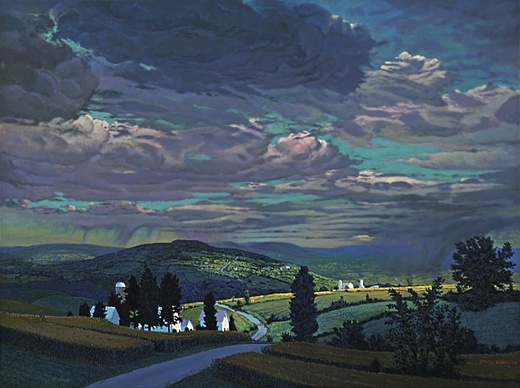
SUBHEAD: The End Is Near! But it is the end of a lifestyle that was weighted down with overconsumption in the first place. By Peter Laarman on 28 April 2011 for Religion Dispatches - (http://www.religiondispatches.org/archive/atheologies/4543/prophets_of_the_environmental_apocalypse) Image above: Photo of rainbow under storm clouds on Nose Hill by marc Shandro. From (http://www.flickriver.com/photos/mshandro/3683093540). Twilight wars in the Middle East, Japan’s nuclear catastrophe, Deepwater Horizon, worldwide crop failures, massive die-offs of long-established species: it’s all so very scary. Looming over all of it is the idea that we foolish humans have triggered some deep-level physical processes (methane gas release, ocean acidification, etc.) that now possess an ominous life of their own.

In these circumstances the word that slides naturally from the tongues of pundits is “apocalyptic.” It strikes many that we are now entering an apocalyptic scenario without precedent in recorded history. My interest here is comparing and contrasting the End Times as envisioned by certain of the faithful and the End Times as conceived by, say, James Hansen—the NASA climate change prophet. I’m interested not only in what the doomsday prophets say but also in how we receive what they say—in the part of ourselves that actually thrills to it.

... Let me be clear: I am not saying that our best environmental prophets—not Jim Hansen, not Bill McKibben, not Wendell Berry, not Vandana Shiva—are “out there” in a way that should give us pause. These are all sober, scientifically-grounded people. But sober and well-grounded people who have seen the future and who are terrified by what they see find it rather difficult to put up with the temporizing and tergiversation that mark the mainstream response to such an overwhelming crisis. Their sense of acute urgency can easily be mistaken for fanaticism. And of course it is precisely that slight edge of hysteria that their well-organized opponents love to seize upon in order to dismiss them as mere cranks.

There are other marked differences between environmental prophets and faith-fueled apocalypticists. One is that the enviros aren’t talking about a single catastrophic moment or event but rather a series of events—albeit rapidly evolving—that will dramatically transform conditions on the planet. Another is that the enviros don’t believe for a minute that after the very bad days there will be some kind of clearing or deliverance in the way that millenarian Christians believe.

A third difference has to do with human agency. Most environmental prophets think it’s still possible—barely—that humans might just rise to the occasion and significantly change their destructive behavior. Most religious doomsayers do not seriously believe that any radical repentance will occur; and they rather hope that it won’t, because they so relish the thought of the wicked being consumed as the cups of divine wrath are poured out.

... Spreading fear can also prompt another unhelpful reaction: what we might call the “fear junky” response in which we actually become attached to the fear and create a whole culture around it, as with the Godzilla cult that grew up in Japan in the wake of Hiroshima and Nagasaki. We see something like that today in the activities of radical environmentalists who don’t actually organize for change but prefer to wallow instead in the pornography of planetary decline and death.

... Here, too, is a clue for our environmental doomsayers: Don’t disdain all economic activity so much, but redirect it toward higher ends. If your only alternative to the Peak Oil economy is a nuts-and-berries economy, you have already lost. Try to show how the sustainability path is a joyful path, not a grim monastic path.

It may be true, as many have said, that the next revolution—the green revolution—will be the first revolution in history that cannot promise material advancement in the same way that people have traditionally construed such advancement. But that does not mean we will be living immaterial lives, or that living much more modestly upon the earth will not prove to be quite sublimely satisfying. Teach that, please! And bring your poets, not your polymaths, to the front lines of the green revolution.

Getting energy from fossil fuels has proved itself to be unsustainable in a big way. Almost everyone gets that now. Do not imagine, however, that human energy can be shut down or thwarted. Learn to view it as William Blake viewed it—as an eternal and irrepressible delight.

Yes, dear ones: The End Is Near! But it is the end of a lifestyle that was weighted down with overconsumption in the first place. No need to be so grim and (dare I say it?) so apocalyptic in our approach to changing it up.

.

Recognition of Native Hawaiians

SUBHEAD: The state of Hawaii's fake sovereignty bill moves through the House and Senate in a stupor of self delusion. 

By Mark Niesse on 29 April 2011 for the Associated Press - 
  (http://www.therepublic.com/view/story/afa90ef9e1d4457db3e1f5f8a14d47f2/HI-XGR--Native-Hawaiians)

  [IB Editor's note: I'd like to know how the illegal entity that is the "State of Hawaii" can register "native Hawaiians" in their future government. The article below goes on to say this process will lead to a "political body overseeing their affairs". What kind of "sovereignty" is this? The article assumes that the Hawaiians have been left out of the great deal North American native people got when they were "recognized". I.m hoping top hear a response from the Hawaiian sovereignty movement on this.]

 
Image above: It's good to be a Native American but don't drink the white man's firewater. One of a selection of flasks of "Firewater" available on the internet. From (http://www.authentichistory.com/diversity/native/is2-drunk/index.html).

Laying the foundation for a Native Hawaiian government, lawmakers agreed on legislation Friday that grants them recognition as the indigenous people of the state.

The bill starts the process of registering Native Hawaiians for their future government, and it could lead to the formation of a political body overseeing their affairs.

The measure unanimously cleared its conference committee Friday and advances to final votes in the House and Senate next week.

"It's sending a message to the indigenous Native Hawaiian population that we recognize you, and you can do whatever it takes to empower yourselves so that you can achieve self-determination," said Sen. Malama Solomon, D-Hilo-Honokaa.

Native Hawaiians are the last remaining indigenous group in the United States who haven't been allowed to establish their own government, a right already extended to many Alaska Natives and Native American tribes.

Federal legislation for Hawaiian recognition hasn't passed despite more than a decade of efforts by Sen. Daniel Akaka, D-Hawaii.

But this state initiative gives Hawaiians a way to organize themselves and decide on their form of government, without having to wait for Congress to act first. It also may spur the federal government to act.

"It really is fundamentally a very significant step for self-determination for Native Hawaiians," said Clyde Namuo, CEO for the state Office of Hawaiian Affairs.

The bill calls for a five-member commission responsible for creating a roll of qualified Native Hawaiians interested in participating in their government.

Those eligible for the roll include Native Hawaiians and others who have maintained significant cultural, social or civic connections to the Native Hawaiian community.

Once the roll is established, they could hold a convention and create founding documents of their Native Hawaiian nation.

"It restores a modicum of dignity to the first people of these islands, whose kingdom was stolen illegally," said Sen. Clayton Hee, D-Kahuku-Kaneohe.

A previous effort by the Office of Hawaiian Affairs, called Kau Inoa, gathered about 110,000 signatures of people showing interest in a Hawaiian governing entity.

The people on the Kau Inoa list could form a starting point for creating the new roll of Native Hawaiians, if they decide to join, Namuo said.

In all, there are about 400,000 Native Hawaiians in the world, with about half of them living in Hawaii.

"The Hawaiian people will have their own destiny they can create for themselves instead of having other people telling them what they need to do," said Rep. Faye Hanohano, D-Pahoa-Kalapana.
Funding of $110,000 over the next two years will be paid by the Office of Hawaiian Affairs, which will administer the roll commission, Namuo said.

The roll commission would be appointed by Gov. Neil Abercrombie, with one commissioner from each of Hawaii's four main counties along with one at-large commissioner.


.

GOP guts Organic Farming School

SUBHEAD: New Republican law closes award-winning high school specializing in organic farming for pregnant teens in Detroit, Michigan. [Editor's note: You can sign petition to the appointed "manager" of Detroit schools here (http://www.grownindetroitmovie.com/index.php).] By Sarah Novak on 29 April 2011 for TreeHugger - (http://www.treehugger.com/files/2011/04/callous-new-law-closes-award-winning-urban-farming-high-school-for-teen-moms.php) Image above: Poster for movie "Grown in Detroit" about high school program to grow organic food in abandoned Detroit. From (http://www.grownindetroitmovie.com/).

If there's ever a story that hit me hard, it was this one. I wrote about Catherine Ferguson Academy last year. It was the subject of the groundbreaking documentary Grown in Detroit. The school is one of only a few left in the country for pregnant girls or girls with children giving them the opportunity to stay in school. More than that, the school has taken advantage of the abundance of vacant land in Detroit by teaching the girls to farm. It's a stable trade which brings local nourishment to a struggling community all with one program. And now thanks to a unilateral decision which according to Civil Eats, "allows Michigan governor Rick Snyder to dismiss locally elected officials and put in place new ones," the school is on the chopping block and will close this summer, leaving the girls with nowhere to go.

The students at Catherine Ferguson Academy turned a small garden on their playground into a sizeable organic plot complete with apple trees, horses, pigs, and goats. In a country where, according to the movie, 90 percent of moms drop out of school because they get pregnant, there are far too few opportunities left for these young moms.

Pregnant Teens With No Place to Turn

These girls, on the other hand, have the opportunity to graduate and go to college. In fact, 90 percent of Catherine Ferguson girls graduate and they are taught with the expectation that they will go to college, according to Civil Eats. It's downright incredible. If this isn't working, than I don't know what is.

Students are taught to harvest, weed, clear a bed, and market the produce that they sell from the farm. See, that's the key. They're not just taught how to grow fruits, vegetables, herbs, and produce honey, they are taught how to market the goods that they grow.

Rachel Maddow reports on new laws which dismiss public officials and replace them without election while closing a school that's working without any push back. And a police department which arrests young pregnant girls protesting and then turns the sirens so loud that reporters can't hear what the girls are saying.

Video above: Rachel Maddow covers threat to Catherine Ferguson High School. From (http://www.youtube.com/watch?v=rBXRnZjYZWU)

Video above: Trailer for "Grown in Detroit" documentary about Catherine Ferguson Academy. From (http://kalamu.posterous.com/video-grown-in-detroit-nature-takes-over-a-ci).

See also: Ea O Ka Aina: GOP style Big Big Government 4/20/11 Ea O Ka Aina: Detroit Comeback 4/9/11 Ea O Ka AIna: Festival of Life in the Cracks 3/17/11

.

Whither Goes the US Economy

SUBHEAD: Who is right? The economists of the American public?

By Raul Ilargi Meijer on 30 April 2011 for The Automatic Earth - 
(http://theautomaticearth.blogspot.com/2011/04/april-29-2011-whos-right-americans-or.html)

 
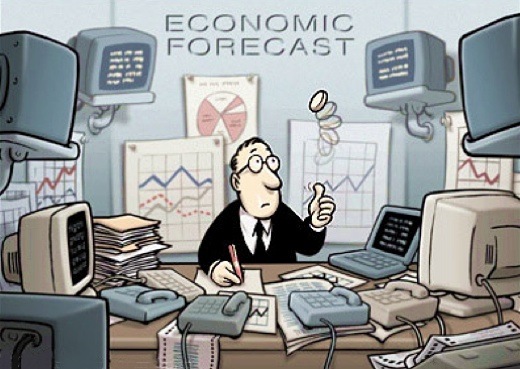
Image above: Cartoon by Clay Bennett on economic forecasting. From (http://filipspagnoli.wordpress.com/2009/09/15/the-recession-the-economics-profession-and-the-prediction-of-the-future).

There appears to be a huge gap between how Americans see the US economy, and how economists do. Indeed, there is such a widening chasm between the two that one could be inclined to think they can't both be taken seriously at the same time.

 An April 20-23 Gallup poll, released April 28, indicates that a full 71%(!) of Americans see the economy as either slowing (16%), in a recession (26%), or even in a depression (29%). Only 27% think the economy is growing. Gallup compares the numbers to those of February and September of 2008, and concludes that today more people think the economy is growing, but that seems a Pyrrhic victory, since the differences are not that great when you look at numbers of people who picked depression or recession:

In February 2008, it was 45%, in September 2008 69% and today 55%. In other words, those who feel the economy is in real trouble, not just a little bit, is still well over 50%. And we have to see that in the light of the fact that many, if not most, would have trouble defining what exactly a recession or depression is, and would therefore be more likely to just fill in "slowing".

Hence, a vast majority of 71%, well over two-thirds of Americans, think the economy is in the doghouse. But most of all, we need to realize that since 2008, over the past 2,5 to 3 years, untold trillions of dollars have been spent, in taxpayer money, to allegedly "save" and/or "lift" the economy. And this is the result.....

 If US party politics is your thing (it definitely ain't mine), Gallup also dove into differences there. And even though 42% of Democrats see a growing economy, vs only 14% of Republicans, what strikes me is that even among Democrats, a 56% majority "voted" either slowing, recession or depression, against a giant 86% of Republicans.

 Somewhat curiously, the richest echelon is almost on par with the average American, with 69% saying either slowing, recession or depression. Now contrast all of this, for a moment, with this week’s Federal Open Market Committee (FOMC) statement that "the economic recovery is proceeding at a moderate pace" (already one notch down from last month's "firmer footing"). Then contrast it with an Associated Press survey of 42 "leading" economists (which was done prior to this week's GDP numbers). And allow me some "live" commentary.
AP survey: Only oil shock can stop economy now
The American economy is now strong enough to withstand Middle East turmoil and the Japanese nuclear crisis. Only a big rise in the price of oil could stop it now. Those are the findings of an Associated Press survey of leading economists, who are increasingly confident in a recovery that is nearly two years old. They expect the economy to grow faster every quarter this year. In part, that's because the economists think Americans will spend more freely in the coming months.
Sorry, can't help you there. Here's what Lucia Mutikani for Reuters said about yesterday's GDP report:
US GDP growth slows to 1.8%, surprise jump in jobless rate
Growth in the first quarter was curtailed by a sharp pull back in consumer spending.
Clear enough, methinks. Back to the AP survey:
Higher stock prices have made people wealthier. [..]
Well, actually, as we saw earlier this month in this Bloomberg graph below, stock prices make less and less people wealthier. According to Gallup, just 54% of Americans own stocks, the lowest percentage since at least 1999. Ironically, 69% of Americans still claim now is a good time to buy a home. Joe and Jane Main Street still have a ways to go towards enlightenment. They clearly see a problem, but by no means all of it.


Less trading and higher prices. The free market laws of supply and demand are broken and violated on a routine basis. And maybe the average American has clued into that more than anyone wishes to acknowledge. Maybe Joe and Jane can still smell a rat even if they can't see it. If you still need proof, here, again, is a graph that Mike Maloney dug up at the St. Louis Fed website, and that makes it very obvious how markets are manipulated:  

Consumer (Individual) Loans at All Commercial Banks - 6 years


My comment then: Apparently, sometime in early 2010 American consumers, virtually overnight, decided to take out 50% more in loans than they already owed. And the banks let them. Right.. Between the two graphs, I think it should be abundantly clear that Joe and Jane do not profit from the market manipulation their taxes are spent on. Yes, higher stock prices have made some people wealthier, that much is obvious. But that's only because the markets they are traded in are being heavily manipulated, using Joe and Jane's money against their own best interest, and even against America's very own real economy. Back to the survey:
The AP survey collected the views of 42 private, corporate and academic economists on a range of indicators. Among their forecasts: • The economy will grow at a 3.2 percent annual rate in this quarter, then 3.4 percent from July through September and 3.5 percent from October to December. That would be stronger than the expected 2.2 percent pace for the first quarter.
As we saw, the first quarter just came in at a lowered 1.8%. We would need one helluvan improvement to get to 3.2% annualized. Keep dreaming.
• Employers will hire more. The unemployment rate, now 8.8 percent, will drop to 8.4 percent by December. That's more optimistic than the economists' view three months ago, when they predicted unemployment would be 8.9 percent by year's end. The economists think employers will create 2.1 million jobs this year, more than double last year's 940,000.
Initial jobless claims were up Thursday, at 429.000. Then again, what could ironically help lower the unemployment rate is the fact that One Million Americans Exhausted All Jobless Benefits in the Past Year. Very conveniently, official statistics now don’t have to count -most of- them anymore as unemployed. According to an April 19 Gallup poll, US unemployment fell to 9.6%, but underemployment rose to 19.2%. Between the underemployed and the 99'ers, we're looking at a truckload and a half full of people who have an awfully hard time paying their daily bills. Added together, that's easily and at the very least 25% of working-age Americans. Include their dependents, and you're eerily close to your run-of-the-mill third world country.
• Average hourly pay, which has not increased fast enough over the past year to keep up with inflation, will rise. A majority of economists think pay will consistently exceed inflation beginning next year at the latest.
We get into dream territory again. Wonder what these guys base their predictions on. Seeing that for instance McDonald's just hired 62,000 people, a rise in average wages seems highly unlikely. Very highly. The trend towards lower paid work, if any is available, continues unabated. I’ll flip your burger if you’ll flip mine. As for benefits, you're pulling my finger, right?
• Consumer spending will grow 2.8 percent this year. That's a bit weaker than economists predicted three months ago. But it's more than last year's 1.7 percent increase, when many Americans were still feeling the effects of the recession. The downturn wiped out $7 trillion in wealth and eliminated 7.5 million jobs.
Yeah, sure. We already saw above that it was the very "sharp pull back in consumer spending" that dragged down GDP. And really, with un(der)employment where it is, and with home prices down another 1.1% in February, we get back to what remains the one biggest undisputed truth we’ve often cited here about the American economy (even if some pundits and experts blame the weather for the recent "disappointing" numbers): With un(der)employment numbers as high as they presently are, and with a housing market still mired in the doldrums and sinking further, an economic recovery in America is simply not possible.

Unemployment will need to go down to 5-6%, and underemployment to 10% or so, because if they don't, you lose far too large a segment of your consumer potential to lay any kind of foundation under that recovery, let alone a solid one. As for housing, the problem is even way more complicated. Real estate prices will need to fall more, and a lot, to make homes affordable again in a time of greatly reduced credit availability, but that same fall in prices will hammer Americans' wealth and consumer spending like there's no tomorrow, which will reduce available credit even more, which will further lower real estate prices and so on and so forth. There is no way to avoid going through this process, called deleveraging. None.

 Relatively high home prices mean lower sales figures, since very few people can afford to buy a home, even if they can get credit (think for a moment of those 26,000 new McDonald's employees).

Still, by the same token, relatively lower home prices mean large scale wealth destruction, even if that wealth is by now mainly virtual, and therefore a strong downward pull on consumer spending. When in the past I have talked about zombie money, it was mostly in connection with large financial institutions and the toxic assets they are allowed to hold in their vaults at 100 cents on the dollar, thanks to FASB 157 fantasy -or zombie- accounting. But of course zombie money exists on a much wider -though not necessarily larger- scale.

Everyone who today holds assets, such as real estate, or stocks, or yes, even gold and silver, will at some point need to acknowledge that the perceived value of what they hold has been hugely propped up by the government's refusal to mark assets to market. That is as true for your assets as it is for those held by the banks. The difference is that these banks have received trillions of dollars of your money in order to make the zombie accounting look at least somewhat credible for a while, while the same government that handed them your funds, has left you to your own means. That is to say, your own means minus what it gave away to the banks.

That part you will need to subtract from whatever it is you think you still own, because it's gone and it will never come back. The banks were bankrupt before and they still are; their losses are far greater than the trillions handed to them, which of necessity serve only to perpetuate an illusion for a limited period of time.

There would need to be spectacular economic growth for years into the future in order to just make a dent into everyone’s debt, be they institutions, governments or individuals. Such growth will not and can not materialize for a long long time if ever. The American economy can't even stand still, let alone grow, without a "healthy" housing market; it's just that big a part of the economy, a home is the biggest asset purchase of their lives for most Americans.

But we have entered a time where prospective buyers can't afford to buy at present prices, and owners can't afford to lose the difference between what they wish their home were worth and what the market will soon tell them it is. The AP survey piece says: "The downturn wiped out $7 trillion in wealth and eliminated 7.5 million jobs." I think those are lowball estimates even today. What's more, I don't see any possibility to prevent another $7 trillion in wealth and another 7.5 million jobs being eliminated.

 We saw this week that a Greek default, or debt restructuring, or pick your favorite term, will force Greek and/or other European banks to mark at least part of their assets to market. That Greek default is inevitable. The same is true for Ireland, Portugal and Spain, though perhaps not all of them this year. The amount of debt for these countries held by the main European banks, like Deutsche, Crédit Agricole, Société Générale, Santander, the Britsh banks, is huge.

Once a forced mark-to-market of assets starts, entire asset classes will be repriced around the globe, way below where their alleged value now stands. And your assets too will follow that downward move. Which means that Americans are right to be very somber about their economy, and that the economists AP surveyed are either incompetent or insincere.

 .

Total takes over SunPower

SUBHEAD: European oil producer buys controlling interest in American solar power manufacturer. 

By Ehren Goossens on 29 April 2011 for Bloomberg News -
  (http://www.bloomberg.com/news/2011-04-28/total-to-begin-friendly-tender-for-up-to-60-of-sunpower-shares.html)

 
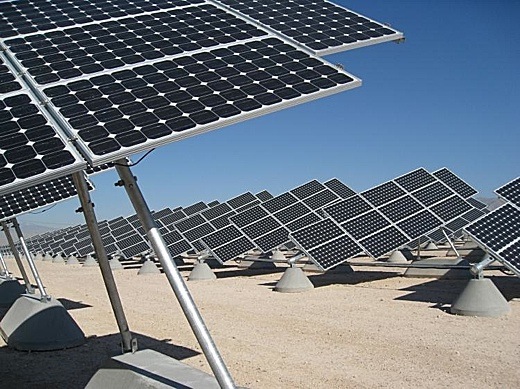
Image above: Solar farm illustrating article about SunPower building an off grid system for the Air Force. From (http://www.theepochtimes.com/n2/content/view/40771/).

Total SA, Europe’s third-biggest oil producer, agreed to buy as much as 60 percent of SunPower Corp. for $1.38 billion, taking advantage of increased global interest in renewable energy. SunPower, the second-largest U.S. solar panel maker, described the acquisition price of $23.25 a share as a “friendly tender offer” in a statement yesterday after the close of regular trading. SunPower surged $6.08, or 38 percent, to $22.20 at 9:32 a.m. on the Nasdaq Stock Market.

The deal for San Jose, California-based SunPower may lead to more solar industry acquisitions as U.S. and European suppliers seek help competing against rival suppliers in Asia, said Kevin Landis, portfolio manager at Sivest Group Inc. “This is exactly what SunPower needed to compete with the Chinese manufacturers that are getting so much support from their government,” Landis said in an interview. “It also allows SunPower to double down on the technology improvements they’ll need to compete in the long run.”

 Sivest, also based in San Jose, held about 17,000 shares of SunPower at the start of the year. The stock has gained 72 percent this year. The takeover may trigger similar acquisitions by oil companies that consider renewable-energy manufacturers a way to improve their clean-energy credentials and may profit when surging crude prices reduce demand for fossil fuels, John Hardy, an analyst at Gleacher & Co. in New York, said in a phone interview.

 Cheaper Borrowing Costs
“This makes a lot of sense for Total, given the global shift to renewable energy, increasing concerns about nuclear power and high natural-gas prices in Europe,” Hardy, who has a “buy” rating on SunPower, said in an interview. “It’s a natural hedge against high oil prices and depleting reserves.” SunPower’s solar power plants become more profitable too because Total has cheaper borrowing costs, Hardy said. Total will also provide SunPower with as much as $1 billion of credit support over the next five years.

 “The fact that a global oil and gas giant like Total has made such a significant investment in a solar company is extremely encouraging for the entire solar industry,” said Shawn Qu, chief executive officer and founder of China-based Canadian Solar Inc. “Total’s investment demonstrates that solar is really coming into its own as a viable energy market, and traditional energy conglomerates want to be part of that burgeoning growth.” Shares of Total, which reported first-quarter earnings today that climbed 35 percent to 3.1 billion euros from a year earlier, rose 0.4 percent to 43.17 euros at 4:15 p.m. Paris time.  

Solar Rally
Jesse Pichel, an analyst at Jefferies Group Inc. in New York, said in an interview that other solar companies may also be acquisition targets. “This group is undervalued and at least some people recognize the value.” Solar firms increased after the announcement, which came six weeks after the nuclear-power accident in Japan. China’s Suntech Power Holdings Co, the world’s largest solar panel manufacturer, rose 2.5 percent to $9.29 and MEMC Electronic Materials gained 6.4 percent to $11.84. Canadian Solar increased 4.7 percent and Tempe, Arizona-based First Solar Inc., the world’s largest thin-film solar panel maker, climbed 3.4 percent.

Total is buying a solar-power company that’s less profitable than most of its peers even after improving margins in the fourth quarter. The company’s operating margin over the last four quarters was 6.3 percent, below the 8.1 percent average and 14.1 percent market-capitalization weighted average of the 37-member Bloomberg Global Leaders Solar Index.  

46% Premium
The offer includes both SunPower’s Class A and Class B shares. It represents a 46 percent premium over the April 27 closing price for SunPower’s Class A common stock and a 49 percent premium for its Class B common stock, and values SunPower’s total equity at $2.3 billion. The transaction is subject to approval from the boards of both companies, and must receive approval from both U.S. and European Union antitrust authorities. SunPower said its current management team will remain intact. Closing is also conditional on Total’s final offer including at least 50 percent of SunPower’s shares, the companies said. Deutsche Bank AG is advising SunPower on the transaction and Credit Suisse Group AG and Messier Maris et Associes are advising Total.

 .

Post Collapse Health Care

SUBHEAD: Without antibiotics and the array of petroleum based health care supplies there will be a lot less medical technology. By Dr. John House on 29 April 2011 for Nature Bats Last - (http://guymcpherson.com/2011/04/health-care-in-a-post-collapse-world) Image above: Civil War surgery table located in the Harper House, Bentonville Battleground, NC. From (http://www.flickr.com/photos/tom1231/2560334640).

I can’t begin to count the times that I’ve thought about the collapse of the industrial economy. Even before I knew that such a thing was not only possible, but probable, I was hoping for collapse, or at least some sort of radical change, every time I saw a poor defenseless little animal dead on the highway or I encountered an otherwise beautiful stream with piles of trash strewn all along its banks.

Now that I realize that collapse is happening, I find that sometimes I actually long for its rapid completion; particularly when I see yet one more example of my species’ wanton destruction of other life forms. Sometimes my longing is more selfish, like when I’ve just wasted several hours of my life dealing with the myriad obfuscations of government medical bureaucracy.

For all my bravado about longing for collapse, I’m well aware that life will be incredibly hard after, if not impossible, and that I’m going to miss all sorts of things, some inconsequential, some life-saving. Like hot showers every morning. My favorite movies on DVD whenever I want them. Chatting online to friends around the world. Ready access to food at the grocery store. Antibiotics. Clean water. The list goes on and on. So, when I wish that the proverbial other shoe would drop, I have to ask the question, “am I really, truly ready for the collapse of all that I’ve known?”

To answer that question accurately is impossible. I won’t know if I’m ready for collapse until after the fact. I’ve never lived without the industrial economy — not even a little bit. So, I can only imagine what it will be like. The ways upon which I’m dependent on this complex, stressful, confusing world we’ve created are almost innumerable.

As I’m a physician and someone who has hypertension (high blood pressure), I also wonder how ready I am to survive collapse when it comes to medical care.

Health care as we know it will not exist in a few years. Once collapse is in full swing health care will disappear almost overnight. Of all the industries in our complex world, medicine has become one of the most energy-intensive, technology-dependent, and thus fragile endeavors that exists.

I am asked from time to time how a person with disease X or malady Z can prepare to survive the loss of essential medicines or therapies provided to us by the industrial economy. In fact, when Guy asked me to write this essay, he suggested that readers might find that particular topic useful. While we may hope that those of us in the medical field will have some really cool herbals and old-time remedies hidden up our sleeves to cure all our infirmities, the reality is not very encouraging, I’m afraid.

To make my point, I analyzed the 25 most common reasons people come to my clinic. Of those, only a few had any kind of treatment that didn’t require some sort of petroleum-derived therapy. It’s important to remember, contrary to what those involved with “alternative medicine” may say, prior to the 20th century, other than opium, there were virtually no medical treatments which were effective with any regularity.

Of those top 25 reasons for seeking medical care, the number one reason — pain — is the one which we will still have the ability to treat post-collapse. Opium, and thus morphine, heroin, and so on, is derived from the poppy. Wikipedia has a wonderful article on this topic and should be required reading for anyone preparing for collapse.

There are many other plant-derived drugs; however, extracting them often requires a good knowledge of organic chemistry as well as a supply of petroleum-derived chemicals. Compounding this difficulty is that many such plants are only grown in certain regions of the world.

If there is any good news in all of this, perhaps it would be that many of those top 25 reasons people come to see me will disappear or at least lessen in severity post-collapse. For example, diseases related to obesity such as diabetes, hypertension, high cholesterol, heart disease, and low back pain should improve significantly. When people are scrounging to grow their own food, obesity-related illnesses will be non-existent.

Gone too will be people needing medicine for their depression, anxiety, and insomnia. I have no doubt that those maladies will still plague us, but I suspect that we will have much more important things to worry about. In fact, in a world where we are trying to protect our family and property from thieves in the night, a little insomnia might serve a useful purpose.

On the flip side is the hard reality that immediately post-collapse there will be outbreaks of all sorts of plagues and diseases which we in the developed world thought were conquered, such as cholera, malaria, measles, starvation, smallpox, polio, tuberculosis … the list goes on and on.

When it comes to preparing for collapse of the health care system, If you are dialysis dependent, or you have hepatitis C or HIV, or survive only with chemotherapy or radiation, the outlook is indeed bleak. For everyone else, there are some things you can do to prepare. I’ve started a short list. I’m sure there are many other things which readers can come up with, but this should get us going:

  1. If you take regular medication which isn’t a controlled substance (like opiods or benzodiazepines) and doesn’t require refrigeration, talk to your doctor about getting a few extra prescriptions “just for emergencies”. He or she may be willing to accommodate your request.
  2. Grow your own poppies. Nobody wants to suffer from severe, long term pain.
  3. Have at least one book which deals with medical emergencies in a wilderness setting.
  4. Take a basic course in first aid.
  5. Avoid the cities at all costs — those outbreaks of once cured diseases will center on large collections of people.
  6. Always wear good foot protection and other protective clothing and eye wear when needed. Remember, antibiotics will be a thing of the past (this is already starting, but that’s a different topic) and even a little cut can lead to death if it gets infected.
  7. Make sure your water supply is not contaminated by feces from humans or any other animals. Many diseases are spread this way.
  8. Wash your hands any time after you come into contact with blood, bodily fluids, or excrement.
  9. Avoid those who are sick. This seems harsh by today’s standards, but this was common practice in times past.
  10. Do your best to eat a wide variety of foods, focusing more on fruits and vegetables with a minimum of red meats.

I wish I had a more encouraging assessment, but as with so many other areas of our complex world, health care is about to go back to the stone age. Best wishes for us all.

• John House MD website (http://www.healthbydrhouse.com) .

Don't move to Pheonix

SUBHEAD: Changes in temperature and precipitation will alter the timing and quantity of stream flows in all Western river basins. By Brian Merchant on 26 April 2011 for TreeHugger - (http://www.treehugger.com/files/2011/04/climate-change-drain-rivers-already-parched-us-southwest.php) Image above: From (http://www.flickr.com/photos/wolfgangstaudt/241486985/#/photos/wolfgangstaudt/241486985/lightbox).

Chalk up another study that presents a grim forecast for the American Southwest -- a report from the Interior department reveals that the three rivers that act as 8 states' lifeblood may shed 8-14% of their volume in coming years. It's worth reiterating here that the Southwest is the fastest-growing region in the nation -- more people are still moving in, exacerbating the situation.

The AP reports:

the Interior Department said annual flows in three prominent river basins -- the Colorado, Rio Grande and San Joaquin -- could decline by as much 8 percent to 14 percent over the next four decades. The three rivers provide water to eight states, from Wyoming to Texas and California, as well as to parts of Mexico ...

The report notes that projected changes in temperature and precipitation are likely to alter the timing and quantity of stream flows in all Western river basins, with increased flooding possible in the winter due to early snowmelt and water shortages in the summer due to reductions in spring and summer runoffs. Changes in climate could affect water supplies to a range of users, from farms and cities to hydropower plants, fish, wildlife and recreation, the report said.

Of course, full-on droughts are increasing in frequency as well, and the physicist climate blogger Joe Romm commonly notes that we're witnessing the Dust Bowlification of the US Southwest. Add to the mix the fact that water will soon be scarcer than ever in the region, and pretty much all I can say is this:

Don't move to Phoenix.

.

Lanai Challenges Big Wind

SUBHEAD: Hawaii state PUC asked to re-open bidding process for Big Wind project by Friends of Lanai. 

 By Scott Foster on 27 April 2011 for Friends of Lanai -  
(http://friendsoflanai.org)

  
 Image above: What twenty huge windmills might look like along the ridge of Lanai looking towards Molokai and Maui. Created by Juan Wilson.

This entire process has been shrouded in secrecy. The Friends of Lana`i (FOL) today petitioned Hawaii's Public Utilities Commission (PUC) to re-open the competitive bidding process for the "Big Wind" project. The PUC has already granted a waiver from their rules for competitive bidding, over a stinging dissent from former Commissioner Leslie Kondo. As a condition of that waiver, two named parties needed to submit completed term sheets by March 18, 2011.

Since only one party timely complied, FOL believes that the waiver is no longer valid, and the competitive bidding process needs to start over," said Isaac Hall, attorney for FOL. "Big Wind" is the State's proposal to build industrial power plants on rural Lāna'i and Moloka`i capable of producing 400 MW of intermittent wind power.

The 170 turbines would produce at best 12% of O`ahu's electrical needs, while consuming – and irreparably altering – significant amounts of land on both islands (25% of Lāna'i, should all 400 MW be sited there). The original agreement between Hawai`i's monopolistic power company Hawaiian Electric (HECO), Castle and Cooke Resorts (C&C) for Lāna'i, and First Wind Hawai`i (FWH) for Moloka`i, called for each of the two wind developers to produce 200 MW, but allowed for one to produce up to 350 MW should the other party fail to perform.

Given FWH's inability to secure land for its project, FOL considers the agreement null and void, despite HECO and C&C “offering“ to share some of C&C's portion with a new developer, Pattern Energy. Pattern Energy is not a party to any PUC Docket, nor party to any agreement with any public agency in Hawai`i. Despite claims to the contrary, FOL believes HECO and C&C have no right – and no authority – to arbitrarily "select" a new developer. "The entire process has been shrouded in secrecy.

 There has been no public discussion of costs, no responsible consideration of other means to meet the non-binding goals of the State's renewable portfolio standards, and no clarity on where the proposed undersea cable might surface on O`ahu. The process hasn't even determined from which islands the wind resources would be harvested. The rush to Big Wind should stop here and now," said Robin Kaye, spokesman for FOL. First Wind filed a letter with the PUC yesterday requesting similar relief.
Video above: Wind Fall-Out provided by Friends of Lāna‘i. From (http://vimeo.com/21933576).
Contact: Friends of Lāna‘i P.O. Box 631739 Lāna‘i City, HI 96763 Friendsoflanai@gmail.com .

Alternatives to Nihilism

SUBHEAD: Part Three - The one option that works is the one next to nobody is willing to talk about - using less. By John Michael Greer on 27 April 2011 for the ArchDruid Report - (http://thearchdruidreport.blogspot.com/2011/04/alternatives-to-nihilism-part-three.html) Image above: Publicity photo of Reagan on horseback - "It's Morning in America". From (http://gazelemsstone.wordpress.com/2010/08/28/ching-ching). A bit of retrospective may be useful at this point, as we close in on the core of the argument I’ve been developing here. The first post in this series, “A Dog Named Boo,” explored the sudden turn toward nihilism that seized America’s culture and public imagination in the wake of the Seventies; the second, “Lead Us Away From Here,” analyzed the fantasy of elite omnipotence and public powerlessness that became conventional wisdom straight across the political spectrum in the wake of that shift. The connection between the shift and the fantasy may not be instantly obvious to all my readers, but it can be made a good deal clearer by looking more closely at what happened as the Seventies ended and our society’s thirty-year vacation from reality began. During the Seventies, a great many Americans came face to face with the hard fact that they could have the comfortable and privileged lifestyles they were used to having, or they could guarantee a livable world for their grandchildren, but they couldn’t do both. The vast majority of them – or, more precisely, of us – chose the first option and closed their eyes to the consequences. That mistake was made for understandable and profoundly human reasons, but it was still a mistake, and it haunts the American imagination to this day. The impact of that choice is perhaps easier to trace on the conservative end of America’s social and political spectrum. Forty years ago, the Republicans had at least as good a record on environmental issues as the Democrats, and the idolatry of the unrestrained free market that pervades the American right these days was a fringe ideology widely, and rightly, considered suspect by most conservatives. For that matter, creationism and speculations about the imminence of the End Times were consigned to the fringes by most American Christians, who by and large considered them irrelevant to the task of living a life centered on the teachings of the Christian gospel. All these things changed in a hurry at the end of the Seventies. Why? Because the attitudes that replaced them – the shrill insistence that the environment doesn’t matter, that the free market will solve every problem, that the world was created in 4004 BCE with as much oil, coal, and gas as God wants us to have, and that the world will end in our lifetimes so our grandchildren won’t have to deal with the mess we’d otherwise be leaving them – are all attempts to brush aside the ugly fact that the choices made at the end of the Seventies, and repeated by most Americans at every decision point since then, have cashed in the chance of a better future for our grandchildren, and spent the proceeds on an orgy of consumption in the present. The squirmings of the leftward end of American culture and politics are a little subtler, since the Left by and large responded to the end of the Seventies by clinging to its historic ideals, while quietly shelving any real attempt to do anything about them. It’s discomfort with this response that leads so many people on the Left to insist angrily that they’ve done all they can reasonably be expected to do about the environment, in the midst of pursuing a lifestyle that’s difficult to distinguish, on any basis but that of sheer fashion, from that of their Republican neighbors. It also drives the frankly delusional insistence on the part of so many people on today’s Left that everyone on Earth can aspire to a middle class American lifestyle if the evil elites already discussed would simply let it happen, and the equally, if more subtly, delusional claim that some suite of technologies currently in the vaporware stage will permit the American middle class to have its planet and eat it too. Look beyond the realm of partisan quarrels and the same deeply troubled conscience appears over and over again in American life. Consider, as one example out of many, the way that protecting children turned from a reasonable human concern to an obsessive-compulsive fixation. Raised under the frantic surveillance of helicopter moms, forbidden from playing outside or even visiting another child’s home except on the basis of a prearranged and parentally approved play date, a generation of American children were held hostage by a galaxy of parental terrors that have only the most distorted relationship to reality, but serve to distract attention from the fact that the lifestyles chosen by these same parents were condemning their children to a troubled and dangerous life in a depleted, polluted, and impoverished world. The irony reached a dizzying intensity as tens of thousands of American parents rushed out to buy SUVs to transport their children to places every previous generation of American children proved perfectly capable of reaching by themselves on foot or on bike. It became the conventional wisdom, during the peak of the SUV craze, that the safety provided to young passengers by these massive rolling fortresses justified their purchase. No one wanted to deal with the fact that it was precisely the lifestyle exemplified by the SUV that was, and remains, the single most pressing threat to children’s long-term safety and welfare. A great many of the flailings and posturings that have defined American culture from the Eighties to the present, in other words, unfolded from what Jean-Paul Sartre called “bad faith” – the unspoken awareness, however frantically denied or repressed, that the things that actually mattered were not things anyone was willing to talk about, and that the solutions everyone wanted to discuss were not actually aimed at their putative targets. The lie at the heart of that bad faith was the desperate attempt to avoid facing the implications of the plain and utterly unwelcome fact that there is no way to make a middle class American lifestyle sustainable. Let’s repeat that, just for the sake of emphasis: there is no way to make a middle class American lifestyle sustainable. That’s the elephant in the living room, the thing that most of a nation has been trying not to see, and not to say, for so many years. The middle class American lifestyle, to borrow and extend Jim Kunstler’s useful decription of suburbia, is an arrangement without a future; it’s utterly dependent on the rapid exploitation of irreplaceable resources, and the longer that it’s pursued, and the more people pursue it, the worse the consequences will be for children now living, and for a great many generations not yet born. It really is as simple as that. Now it’s not at all hard to find books, films, websites, and speakers who say as much, but it’s intriguing to watch how universally these avoid the next logical step. What do you do if you’re pursuing a way of life that has no future? Well, apparently you read books denouncing that way of life, or heap praise on cultures conveniently distant in space or time that you think had or have or will have a different way of life, or engage in token activities intended to show that your heart really isn’t in that way of life, or vent your rage against whoever it is that you blame for your decision to keep on following that way of life, or fixate with increasing desperation on manufactured prophecies insisting that the Rapture or the Singularity or the space brothers or somebody, anybody, will bring that way of life to an end for you so that you don’t have to do it yourself. The one thing you apparently don’t do is the one thing that actually matters, which is changing the way you live here and now. That’s the rock on which the sustainability movement of the Seventies broke, and it’s claimed plenty of victims since then. The climate change movement is a good recent example. Now it’s true that there were plenty of reasons why the climate change movement followed the trajectory it did from apparent unstoppability a decade ago to its current dead-in-the-water status today. The ingenuousness with which climate change activists allowed their opponents to redefine the terms of the debate very nearly at will, and the movement’s repeated attempts to rest its arguments on the faltering prestige of science in an age when most Americans are well aware that scientific opinions can be purchased to order for the cost of a modest grant, did not help the cause any. Still, I’ve come to think that the Achilles’ heel of the entire movement was the simple fact that none of its spokespersons showed any willingness to embrace the low-energy lifestyle they insisted the rest of the world had to adopt. Al Gore, with his sprawling air-conditioned mansion and his frequent jet trips, was the poster child here, but he had plenty of company. It was because climate change activists so often failed to walk their talk, I suggest, that millions of Americans decided they must be making the whole thing up, just as the obvious eagerness of the United States to push carbon limits on every other nation while refusing to accept them at home convinced China among others that the global warming crusade was simply one more gimmick to prop up the crumbling edifice of American hegemony, and brought the movement toward a worldwide carbon treaty to the standstill where it remains today. The same blind spot continues to plague what’s left of the climate change movement. Consider former environmentalist Stewart Brand, who used to edit The Whole Earth Catalog, for heaven’s sake. Brand’s current position, retailed at length in his recent book Whole Earth Discipline, is that we have to run our economy on nuclear power because burning coal is bad for the environment. Now of course this argument is right up there with insisting that shooting yourself through the head is good for your health because it prevents you from dying of a heart attack, but there’s a deeper irrationality here. Ironically, it’s one that most people who had copies of The Whole Earth Catalog on their shelves forty years ago could have pointed out in a Sausalito minute: switching from one complex, centralized, environmentally destructive energy system based on nonrenewable and rapidly depleting resources, to another energy system that can be described in exactly the same terms, is not a useful step – especially when it would be perfectly possible to dispense with both by simply using less energy. Now of course the concept of using less of anything is about as popular in contemporary America as garlic aioli at a convention of vampires. Nobody wants to be reminded that using less, so that our grandchildren would have enough, was the road we didn’t take at the end of the Seventies. Still, the road we did take was always destined to be a dead end, and as we move deeper into the first half of the twenty-first century, the end of that road is starting to come into sight. At this point, we’re faced with the prospect of using less energy, not because we choose to do so but because the energy that would be needed to do otherwise isn’t there any more. That’s the problem with living as though there’s no tomorrow, of course: tomorrow inevitably shows up anyway. This late in the game, our remaining options are starkly limited, and most of the proposals you’ll hear these days are simply variations on the theme of chasing business as usual right over the nearest cliff. Whether it’s Stewart Brand’s nukes, “Drill Baby Drill,” ethanol or algal biodiesel or some other kind of energy vaporware, the subtext to every widely touted response to our predicament is that we don’t need to use less. The same thing’s just as true of most of the ideologies that claim to offer a more global response to that predicament; the one common thread that unites the neoprimitivists who claim to long for a return to the hunter-gatherer life, the conspiracy theorists who spend their days in an increasingly frantic orgy of fingerpointing, and the apocalypticists who craft ever more elaborate justifications for the claim that somebody or other will change the world for us, is that each of these ideologies, and plenty others like them, function covertly as justifications to allow believers to keep on living an ordinary American lifestyle right up to the moment that it drops away from beneath their feet. The one option that doesn’t do this is the one next to nobody is willing to talk about, and that’s the option of using less. Mention that option in public, and inevitably you’ll hear a dozen different reasons why it can’t help and won’t matter and isn’t practical anyway. Can it help? Of course it can; in a time when world crude oil production has been bouncing against a hard ceiling for most of a decade and most other energy sources are under growing strain, any decrease in the amount of energy being wasted on nonessentials makes it a little easier to keep essential services up and running. Will it matter? Of course it will; as we move into a future of hard energy constraints, the faster at least a few people get through the learning curve of conservation, appropriate tech, and simply making do with less, the easier it will be for the rest of society to follow their lead and learn from their experience, if only when all the other choices have been foreclosed. Is it practical? Of course it is; the average European gets by comfortably on one third the annual energy budget as the average American, and it’s been my experience that most middle class Americans can slash their energy use by a third or more in one year by a relatively simple program of home weatherizing and lifestyle changes. I’d like to suggest, in fact, that at this point in the trajectory of industrial civilization, any proposal that doesn’t make using less energy a central strategy simply isn’t serious. It’s hard to think of any dimension of our predicament that can’t be bettered, often dramatically, by using less energy, and even harder to think of any project that will yield significant gains as long as Americans cling to a lifestyle that history is about to relegate to the compost bin. I’d also like to suggest that any proposal that does start out with using less energy should not be taken seriously until and unless the people proposing it actually do use less energy themselves, preferably by adopting the measures they urge on others. That’s how effective movements for social change happen, after all. Individuals start them by making changes in their own lives; as the number of people making those changes grows, networks emerge to share information, resources, and encouragement; the networks become the frame of a subculture, and as momentum builds, the subculture becomes a movement. It’s indicative that the two movements that had the most impact on American culture in the second half of the twentieth century – feminism and Christian fundamentalism – both emerged this way, starting with individuals who changed their own lives, while any number of movements that tried to make change from the top down – again, the climate change movement is a good example – failed to achieve their ends. That’s the core concept behind the “green wizardry” I’ve been discussing here on The Archdruid Report for almost a year now. It’s entirely possible for each of us to kick the process just described into motion by using less energy and fewer natural resources in our own lives. There are proven methods and mature technologies that will accomplish that. It so happens that I learned some of those back in the early 1980s, and have a couple of decades of experience applying them in my own life. That’s been the basis on which I’ve selected the tools and techniques discussed here; for reasons already explained, I don’t think it’s useful to advocate things I haven’t used myself. The one great barrier in the path of starting a movement the right way, beginning on the individual level, is that it requires each person who takes up the challenge to break with the conventional wisdom and do things that others aren’t prepared to do. That’s a lonely journey, no question, and since this series of posts began with a bit of Seventies music, I don’t think it’s out of place to end it with the most famous desert journey from the music of that era "A Horse With No Name".
I've been through the desert on a horse with no name It felt good to be out of the rain In the desert you can remember your name 'Cause there ain't no one for to give you no pain.
Video above: America sings "A Horse With No Name". From (http://www.youtube.com/watch?v=9Y2WlpU8E_A). To borrow a turn of phrase from the song, that loneliness can be a place to remember our names or, more precisely, to recall that we have names other than "consumer" and "victim." It’s my hope that at least some of the people who read this post will rise to that challenge. We’ve got a lot of work to do, and there may not be much time to get it started before conditions become a good deal more difficult than they are right now. I’ll be discussing that last point in more detail in the weeks ahead. See also: Ea o Ka Aina: Alternatives to Nihilism - Part 2 2/10/11 Ea O Ka Aina: Alternatives to Nihilism - Part 1 4/13/11 .