Food Security & Food Culture

SUBHEAD: The ‘fast food culture’ of modern society has distanced most of us from a richness of experience.  

By Matty Lynch on 1 February 2011 in Permaculture Media
  (http://permaculture-media-download.blogspot.com/2011/02/food-security-and-food-culture-by-matty.html

 
Image above: Detail of promotional poster for Morgan Spurlock's movie "Supersize Me". From (http://www.legendarystrength.com/remember-super-size-me).
“Food security has been defined as ...access by all people at all times to sufficient food for an active and healthy life. Food security includes at a minimum: the ready availability of nutritionally adequate and safe foods, and an assured ability to acquire food in socially acceptable ways (without resorting to emergency food supplies, scavenging, stealing and other coping strategies for example).” [(Online), Dieticians Association of Australia, www.daa.asn.au (2006.)]
Food Culture refers to how we experience our food – from field to plate – and how it impacts our health, happiness, and sense of community. Perhaps the best way to explain the impact of food culture upon our wellness is to think of the way you feel, hear, smell, taste, and see another culture when you experience it through their cooking. So much of our cultural values are expressed in the way we grow, prepare, and share food.

Indeed, most of our major holidays and celebrations are centered around the experience of sharing a meal. Food culture and food security are closely linked: threats to one affect, and are affected by the other. A society which marginalizes the importance of celebrating and enjoying its food, also marginalizes the importance and richness of the living systems which support and create food.

The ‘fast food culture’ of modern society has distanced most of us from this richness of experience, with sobering results.

The Slow Food movement was spawned out of a response to the globalization of food production, and promotes sustainable food production by small local businesses to preserve and celebrate local and traditional food cultures. A society which celebrates the importance and richness of its food culture, creates resilient, happy communities: certain data* seems to indicate that average reported happiness is consistently lower in countries with a pervasive fast food culture [such as the USA] than in countries such as Cuba, which embrace and celebrate a locally produced, organic food system.

When a community is unable to provide for its own food needs, individuals are disempowered, despair sets in, and food aid must be imported. The community must be rebuilt with the knowledge and practical skills to produce enough of their own food to meet their needs, or a cycle of dependence can develop.

Agricultural yields are arguably at higher levels than ever in recorded history, yet in our world today, 1 out of 7 people will fall sleep tonight without access to enough food to lead an active and healthy life. A solid understanding of food culture and food security issues are important to a wellness practitioner because it will equip you with a foundation to act on a local scale, and know that you are improving the wellness of humanity on a global scale with your contribution. The long-term impacts of the modern conventional food system, which has only been in existence for the last 40 years or so, are only now starting to become more apparent.

 Obesity levels and diet-related disease are at epidemic levels in the developed world, regional economies are being drained of their livelihoods by big agribusiness, while social and environmental impacts are being reported on by filmmakers, journalists, bloggers and other activists all over the world.

Once we understand the limitations and challenges created by the conventional food system, we can begin to identify opportunities to flourish within, while operating from outside the system: first, by producing enough of our own food to meet our survival needs, then to generate sufficient surplus to share in our local communities. It is here than we can access markets most efficiently, here that we can develop our most loyal customers, and it is here that the economic activities of our enterprise will make the most difference, because money will be cycled around local suppliers, distributors, and sellers to ehance and strengthen our community. ‘Market’ does not mean ‘places where we can sell crap’ to a permaculturist.

 Instead, we view ‘markets’ as a vibrant community of people [think of your local farmer’s market], who share common needs that we can help to meet. When we can identify and meet these needs responsibly, ethically, and sustainably then we are rewarded with surplus cashflows to reinvest into our people, our enterprises, and our community.

For example, we can look for local heritage varieties of crops that have adapted to growing conditions in the area, and develop a niche demand for varieties that are unavailable on supermarket shelves because they may not be suitable for long-term transportation or storage. Or, we can look for high-value crops that can be integrated into our polycultures, increasing the biodiversity and resilience of our system, while increasing the diversity and resilience of our economic yield. Only when when our enterprise is able to competently serve the needs of our local community, should we look to developing our system to generate further surplus.

We expand our operations and systems organically, by careful observation, continuous improvement, and constant adaptation to changing long-term trends; and always, always conduct ourselves with respect to the ethics of permaculture, which underpin all of our work. It is vitally important that we look at what our land offers us, rather than impose our will upon the land.

For example, deciding arbitrarily that ‘I want to grow chamomile’ because there may be a market for it would not be in alignment with the permaculture ethic of Earth Care, while paying our employees less than a living wage would violate our ethical principle of People Care. Finally, hoarding all of our profits and not re-investing surplus back into our local communities not only serves to isolate ourselves from our basic need to connect meaningfully with other human beings around us, it would not honor the third ethical principal of permaculture: Resource Share.

 See also:
Ea O Ka Aina: Permaculture as a Venture 1/25/11 .

The Food Bomb

SUBHEAD: Our leaders are like deer transfixed by the lights of an onrushing truck—they’ve done precious little to avert catastrophe. By Barry Lando on 1 February 2011 in Truthdig - (http://www.truthdig.com/report/item/the_food_bomb_20110131/) Image above: Food market in Kaski, Nepal. From (http://californiaagriculture.ucanr.org/landingpage.cfm?article=ca.v063n04p199&fulltext=yes). On the face of it, the protests currently sweeping across the Arab world have been driven by overwhelmingly leaderless, frustrated, impoverished, unemployed youths battling geriatric dictatorial regimes that are supported by pampered militaries—and the United States. Fueling all these protests, from Egypt to Yemen to Jordan to Tunisia to Algeria, is another common factor, one that also fueled the French Revolution: rocketing food prices. A perfect storm of natural disasters around the globe, rising oil prices and rapacious speculators have produced the current dramatic rise in food prices, but even had these events not occurred, food prices would be spiraling upward, and roiling the planet, no matter who was governing. What is outrageous is that our leaders know this—they’ve known it for years—but, like deer transfixed by the lights of an onrushing truck—they’ve done precious little to avert catastrophe. Indeed, rather than deal with impending disaster, they’ve made the situation even worse. The statistics are stark: Almost 7 billion people currently inhabit this planet, 1 billion of whom are on the brink of starvation. By 2050, the population will be 9.2 billion, including many with higher incomes and thus much larger and demanding appetites. The bottom line is the world will need 70 percent more food in 2050 than it produced in 2000. But at the same time, the resources available are plummeting. The amount of agricultural land per person on the planet will have dropped from 10.6 acres in 1961 to 3.7 acres in 2050. As for water, just to maintain current levels of nutrition—never mind improving things—farmers will need 17 percent more fresh water by 2050. Problem is, 70 percent of the world’s fresh water is already used for irrigation. But instead of investing in agriculture, the world’s leaders and development organizations have been obsessed with industrialization. The statistics are shocking: Development assistance to agriculture, from all sources, went from 20 percent of all aid 25 years ago to only 4 percent today. Developing countries themselves reduced investment in agriculture from 11 percent 25 years ago to 7 percent in 2007. These figures are from Shivaji Pandey, a soft-spoken Indian official I spoke with at the United Nations’ Food and Agriculture Organization (FAO) offices in Rome. First off, he says, food production has to be transformed from a dull, bureaucratic backwater to Page 1 of the international agenda. Seventy-five percent of the world’s hungry and poor still live in rural areas and derive their livelihood from the land. OK. Then I ask: Surely it makes sense to industrialize, get those people good factory jobs and off the overcrowded land, right? Wrong, he says. “Agriculture has been shown to be twice as effective in eliminating hunger and poverty as any other kind of development. There is scientific evidence that every 1 percent increase in crop productivity will reduce the number of poor and hungry by 0.4 percent.” What about the wonders of the “Green Revolution”? “That’s over,” says Pandey. “Sixty years ago, rice, wheat and maize yields in countries like India were dramatically rising at 3 percent a year. No longer. The rate of growth instead is declining, heading for about 1 percent a year by 2050.” It was the soaring food prices of 2007 and 2008 and the radical political unrest they sparked that finally got the world’s leaders to start paying attention. One result was that Pandey was named to head a steering committee under the auspices of the FAO tasked with figuring out how to dramatically increase food production without at the same time destroying the environment. One of the first things he did was to tell his experts to stop their research. “Of course, there are still things to learn,” he says, “but we already know a lot of the answers. We’ve known for decades.” The problem is that the politicians who call the shots have refused to listen. Arguments against protectionism, for example, have gone unheeded. According to Mark Malloch Brown, the former head of the United Nations Development Program, the developed world lavishes a billion dollars a day on subsidies and support prices to protect its farmers, many of them huge agribusinesses. That protection costs developing countries $50 billion in potential lost agricultural exports. The sum is the equivalent of all development assistance to the Third World. Another well-known problem: Since bioenergy became the flavor of the month, almost 5 percent of the world’s cereals are now used not to feed people but to produce 0.3 percent of the world’s energy. One major obstacle, says Pandey, is that many of the new technologies have been developed for rich, large farmers. Governments have generally ignored the 400 million to 500 million farmers across the world who cultivate less than five acres. “They have no strong political voice, but those small farmers produce more than half of the world’s food.” It was small farmers tilling an average 2.7 acres in India’s Punjab who were responsible for the Green Revolution in the 1960s and ’70s, a development that took India from the brink of famine to actually exporting food by 1985. Similarly, the agriculture revolution that has taken place in China in the past 25 years occurred on the backs of farmers with less than half an acre. The “white revolution” that made India the world’s No. 1 milk producer was achieved by farmers with only one or two cows. Says Pandey, “In a country like Madagascar, where 70 percent of the population live on less than one dollar a day, where agriculture is the most important contributor to the GDP, if it is not agriculture that will get them out of their misery, what do the so-called experts propose? So many other countries are in that same situation in Africa. “Certainly some consolidation of small landholdings would be better, but today we can make this world a better place only by making it easier for those who’ve been ignored for so long.” Among the biggest victims of the lack of investment in agriculture are teaching and research. Says Pandey, “Around the globe, many of the so-called ‘agriculture experts’ are less qualified than they were 50 years ago. Many don’t even understand what they’re supposed to be teaching. They don’t even know that they don’t know.” There has also been no investment in infrastructure to aid the farmer—roads, storage, electricity and access to credit. Of course, all that costs money. But some solutions are remarkably—if deceptively—simple. For instance, huge numbers of small landholders across the globe don’t have title to their farms. Says Pandey, “If I don’t own it, I’m not going to invest in it or protect it. So they don’t invest.” In Vietnam in 1989, in the face of a dramatic food crisis, the communist government—which was importing food—gave titles to the peasants. Within just three years, Vietnam became the world’s third-largest rice exporter. “It wasn’t the only factor, but giving those titles had a major impact. Even Cuba now is talking about giving 7,000 square meters of land to [individual] farmers.” Some ways of raising production would actually save money. Thirty years ago, for example, the experts advised farmers to thoroughly plow their land, get rid of all weeds, roughage and waste. Bad advice, says Pandey. Such practices actually destroy the soil. “Now we tell them to till the earth only when and where necessary.” Sounds simple, but there are dramatic side effects. In addition to saving the land, less plowing also means the farmer spends less for tractors and fuel. It also means less greenhouse gas emissions—in two ways: less fuel burned, but also, if the soil isn’t thoroughly plowed, more carbon remains trapped in the earth, as much as 74 kilograms per acre per year. “This reform actually means spending less, and it requires no new technology. It’s just teaching the farmer not to do something,” says Pandey. It all seems obvious, but less than 10 percent of global farmland—largely in North and South America—is under this kind of system. Other reforms—like rotating crops and cutting back on rampant use of pesticides and fertilizers—are nothing new, but they can have a revolutionary impact, often in ways you would never think of, such as teaching farmers not to burn their waste, but to use it as a mulch on their fields. That improves soil quality, but it also means less evaporation, which means farmers will need 30 percent less water. Researchers in Australia found that such mulching also reduces the temperature of the plants by one degree—which could greatly reduce the impact of climate change on crop production. Pandey’s task force will present these and other strategies to agricultural ministers from around the world in Rome in June. “We’re going to boil the thing down to 100 to 120 pages, something that national leaders can digest in a couple of hours while they’re flying from one spot to another.” There’s reason for optimism, says Pandey: “The lessons we have learned in the past 40 to 50 years have taught us now we can produce more on the same amount of land, and can do it in a way that does not destroy the ecosystem.” Problem is, implementation is not in the hands of FAO experts. They have to persuade policymakers to make the reforms, many of which have been proposed for decades. Perhaps the current dramatic wave of unrest will convince at least some leaders they no longer have a choice. See also: Ea O Ka Aina: Philippine Organic Transition 2/1/11 .

Philippine Organic Transition

SUBHEAD: After decades of chemicals, farmers in the Philippines are seeing the benefits of organic farming. But what convinced them to make the switch in the first place? By John Cavanagh & Robin Broad on 31 January 2011 for Yes! - (http://www.yesmagazine.org/blogs/john-cavanagh-and-robin-broad/buying-only-2-percent-of-what-you-eat) Image above: Presentation during an organic farming seminar in Calamba City, the Philippines. From (http://www.sulit.com.ph/index.php/view+classifieds/id/1860306/Organic+Farming+Seminar,+Calamba+City).

We spend an afternoon with Gil and Teresa, who have farmed one and a quarter hectares of non-irrigated land in the southern Philippines since 1973. We walk into their land through a line of young trees, past a row of pineapples, and over a narrow patch of rice. Chickens wander the yard with chaotic authority. We sit on a bench in their front yard, shaded by an impressive diversity of fruit trees: mango, pomelo, and others.

Rice farmers, we discover, are like the rest of us in that they do not like to change their ways unless they are convinced that change will bring tangible benefits. Several families of rice farmers in three Philippine provinces showed us clear evidence that organic rice was better than rice grown with chemical inputs in reducing costs, in improving the health of the farmer and consumer, and in preserving the soil, water, and environment.

But, we wanted to know, what triggered farmers to make the switch from decades of chemical farming to a more “rooted” organic agriculture?

Gil starts their story, with Teresa standing quietly by his side. They farmed with chemicals for over a quarter century until 1999, when Gil, tired of being in debt, went to a training by the Don Bosco Foundation on sustainable agriculture. “I was sick of the loans and the high costs of conventional farming.”

Gil started with a small portion of his land, where he planted “zero-chem” rice in one plot and string beans on two. “I really wanted to try what I learned in the seminar. I wanted to leave chemicals.” His wife Teresa was skeptical: “I thought zero-chem would mean zero-caldero [nothing in the pot].”

According to Gil, Teresa “was very happy because we harvested two big basins of string beans and we were able to earn money even before the rice harvest. It was the string beans that did the trick.” They quickly diversified the farm to other fruits and vegetables so that today, a decade later, they have enough healthy food to feed their family, and they are virtually self-sufficient. According the Gil: “Only about 2 percent of what we eat comes from outside the farm: salt, some cooking oil, spices. That’s it.”

A couple of miles down the road, another couple, Romeo and Elsie, describes their conversion. We join them in an open-air bamboo hut at the side of their home and their 5 hectares of irrigated rice fields. Romeo, quiet with a powerful build, starts in his native language: “Elsie was the key person because she is in charge of the finances on the farm. Already during land preparation, we regularly incurred debts from the middle-men and the lenders. By harvest time, there was very little left, sometimes not even enough to repay the lenders and get new loans for the next cropping. That was the cycle; always lots of debt.”

Elsie continues: “Romeo was no longer inspired [to farm] since nothing was left for us after the harvest. Sometimes he wondered why he was even going through with the harvest.”

So, they too attended a Don Bosco training on sustainable agriculture. This time it was Romeo who was skeptical: “If I’m not going to spray chemicals, how will there be a harvest?” So they compromised. They did a trial on one of their five hectares, the one that Elsie inherited from her father. The result was phenomenal as far as they were concerned: Costs plummeted and the yield was only slightly less. Recalls Romeo: “The experience of that one hectare was more powerful than the training.”

Elsie is now extremely animated as she describes the full conversion of all 5 hectares to organic: “Our debts have been repaid. Our four children have finished their schooling. We can buy used or even new clothing. And, our health has improved.” And, they tell us, two of their children are working, trying to save enough money to buy land so that they too can do sustainable farming.

We want to learn more about the conversion of farmers like Gil, Teresa, Elsie and Romeo, so we visit the director of the Don Bosco Foundation. Betsy Adarna, a petite woman with short, black curly hair and seemingly boundless energy, runs the foundation, which has trained these two couples along with thousands of other farmers in a version of sustainable agriculture called “biodynamic” farming.

In addition to spreading traditional seed varieties and recipes for natural fertilizers and pesticides (more on these “concoctions” in our next blog), biodynamics trains farmers to know the right time to plant and harvest in sync with cycles of the moon: for example, you do not want to harvest in a full moon since it attracts many pests. And, biodynamic farming emphasizes a healthy lifestyle and a reverence of the plants one is growing. “It’s not simply farming,” one farmer explains to us. “It’s healing the earth.”

Betsy is fighting the expansion of banana plantations, which are not only encroaching on rice land, but are also “hijacking” the water needed by rice farmers. And, with financial assistance from Europe, the Don Bosco Foundation helped a group of farmers purchase a large rice mill so that they can maintain their independence from the rice traders and other “middle-men.” Don Bosco also has six retail stores. Betsy and Don Bosco are demonstrating that sustainable farming can work on a large-scale, from farm to retail.

As we learn in the Philippines, a number of nonprofits like Don Bosco are helping speed this transition to organic. The Philippine Rural Reconstruction Movement and other nonprofits, for example, launched a large “Go-Organic” coalition in 2009 that aims to increase organic rice farming to 10 percent of the Philippine’s rice land. A dynamic network of organizations called Rice Watch and Action Network (R1) provides policy ideas to help government, with its army of agricultural extension workers and its key role in upgrading irrigation canals, play a strong role.

But still, the transition occurs farmer by farmer and, at the end of the day, new farmers will make the conversion when they see the real benefits on the ground, as did Teresa and Gil and Romeo and Elsie.

• John Cavanagh and Robin Broad wrote this article for YES! Magazine, a national, nonprofit media organization that fuses powerful ideas with practical actions. Robin is a Professor of International Development at American University in Washington, D.C. and has worked as an international economist in the U.S. Treasury Department and the U.S. Congress. John is on leave from directing the Institute for Policy Studies, and is co-chair (with David Korten) of the New Economy Working Group. They are co-authors of three books on the global economy, and are currently traveling the country and the world to write a book entitled "Local Dreams: Finding Rootedness in the Age of Vulnerability".

.

Obama GMO pressure on Vilsack

SUBHEAD: Media reports suggest White House pressured Vilsack to approve GMO alfalfa. By Tom Philpott on 31 January 2011 for Grist.org - (http://www.grist.org/article/2011-01-31-media-reports-white-house-pressure-stomped-on-vilsack-over-gmo-a) Image above: Cows are being fed ever more alfalfa. One reason is that it reduces them burping up methane that adds significantly to global warming. From (http://weblogs.baltimoresun.com/features/green/2009/06/new_diet_to_control_cow_burpin.html). As I reported last week, the USDA announced late Thursday it would allow the planting of genetically modified alfalfa, the nation's fourth-largest crop, without restriction.

Was the decision based on a careful weighing of the evidence by the USDA -- or on political consideration emanating from the White House?

Two recent media reports strongly suggest the latter. In The Wall Street Journal, Bill Tomson and Scott Kilman -- two well-connected, veteran ag-policy reporters -- directly tied the decision to the White House. Kilman and Tomson wrote:

The Obama administration Thursday abandoned a proposal to restrict planting of genetically engineered alfalfa, the latest rule-making proposal shelved as part of the administration's review of "burdensome" regulation. [Emphasis added.]

And in a recent spirited puff piece on David Axelrod -- until last Friday Obama's top political strategist -- New York Times columnist Maureen Dowd revealed that genetically modified alfalfa got play at the cabinet level. Axelrod, presumably no agronomy expert, evidently argued against placing restrictions on GM alfalfa. "The avid punster offered a parting pun at the 8:30 a.m. meeting," Dowd gushed: Axelrod urged "everyone to 'plow forward' on a plan for genetically produced alfalfa."

If White House political strategists rallied behind deregulated alfalfa, USDA chief Tom Vilsack has been much more ambivalent on the topic. Alfalfa is a prodigious pollinator -- meaning that different varieties can cross-pollinate and transfer genetic material. It's a forage crop for pastured animals, and farmers grow it to store as hay to feed cows in winter months. For organic dairy producers, a steady supply of organic alfalfa -- and organic alfalfa seed -- is crucial for survival.

Vilsack acknowledged as much in a Dec. 30 "Open Letter to Stakeholders" [PDF]. The USDA's own 2,300-page environmental impact statement "acknowledges the potential of cross-fertilization to non-GE alfalfa from GE alfalfa," Vilsack wrote in the letter. Cross-pollination, he added, poses "a significant concern for farmers who produce for non-GE markets at home and abroad." Since that letter, Vilsack had hinted strongly that he favored a policy of "co-existence" -- restrictions on where farmers could plant modified alfalfa to protect organic fields from genetic contamination. The biotech/agrichemical industry shrieked in protest.

With Thursday''s decision, the industry triumphed. Vilsack skulked away from his previous position. Normally, "USDA rolls over for biotech industry" isn't a newsworthy event. Ever since the days of former Vice President Dan Quayle -- intellectual author of official U.S. policy toward GMOs -- the novel crops have benefited from minimal government regulation.

But this time was different: A USDA chief had publicly declared his willingness to defy the industry, and then was seemingly forced by political pressure from above to cravenly abandon that defiance.

Unhappily, the decision falls into line with other Obama administration gestures of fealty to the agrichemical lobby -- like appointments of loyal Monsanto men to key ag-policy posts, and an announcement from the State Department's USAID program that came out the same day as the USDA's alfalfa decsion:

At the annual World Economic Forum (WEF) in Davos, Switzerland USAID Administrator Dr. Rajiv Shah gathered with the CEOs of Unilever and Monsanto to support the launch of WEF's global framework titled "Realizing a New Vision for Agriculture." The show of support emphasizes USAID's leadership in creating synergies between the public and private sectors to meet the global food security challenge.

Other companies involved in the initiative include grain-trading behemoths Archer Daniels Midland, Cargill, and Bunge; agrichemical giants BASF, Syngenta, and Dupont; and industrial "food"/beverage giants Coca-Cola, SABMiller, General Mills, and Kraft Foods.

The Obama administration's emerging vision for agriculture is sounding depressingly old to me. To paraphrase John Updike, I'm haunted by memories of the Clinton and Bush administrations, when ag policymakers more or less religiously walked the Big Food industry line.

.

By what right are you here?

SUBHEAD: Our species has made a terminal mistake. What right do you have to be here on planet Earth? By William Kotke on 30 January 2011 in Speaking Truth to Power - (http://carolynbaker.net/2011/01/30/what-right-do-you-have-to-be-here-on-planet-earth-by-william-kotke/) Image above: Saudi irrigated agriculture is being abandoned as too water insensive. From (http://www.eosnap.com/image-of-the-day/agriculture-in-saudi-arabia-november-7th-2008).

At some point in our lives, most of us realized that there is no place that we could stand on the side of Mother Earth and not be asked, “by what right are you here?” Do we have a rent receipt, a park pass, a ticket, a passport? Even the rare humans in the Amazonian interior cannot get out of Brazil without a passport.

And when I do have a rent receipt, who is it that “benevolently” and tentatively extend those rights to me? An armed gang of thugs who call themselves “civilization” own Mother Earth. This loosely organized gang of thugs are composed, usually, into a male hierarchy, generally referred to as the planetary, military patriarchy. This gender imbalanced, group of fat bankers in business suits, with generals at their side, owns the Earth. These are the descendants of the original patriarchs who began the warfare – looting -death oriented, empire culture, who apparently believed that because males are larger and stronger, they should kill the opposition and loot the earth of material goods, which they call “wealth” and conflate with “power.”

Now, they have done it. They have looted the Earth almost to its death. Babylon ecologically destroyed Iraq, the Indus Empire ecologically destroyed the Indus Valley, the Han Chinese ecologically destroyed China and the Greek and Roman empires ecologically destroyed North Africa and Italy and now the patriarchs are sucking the life force out of the whole Earth. The patriarchs are not standing on the living Earth, they exist in a mentally conditioned bubble that tells them that the more the Earth dies, the better things get. They call it the sacred growth. They babble incessantly about economics, politics, and fast cars. At the universities they have answers to all questions, but the reality here on the Earth is simple.

The Giant Vacuum Cleaner They Call Economics

They have set up a giant vacuum machine that can identify any valuable biological activity on the Earth. Down here on the Earth, the soil community of millions of members slowly builds up surpluses. In optimum ecologies, this community can produce one inch of topsoil in three hundred to nine hundred years. The giant machine identifies the biologically rich areas of soils, fish stocks, forests, grasslands and so forth in which to plug its tentacles. The sucking sound is the life force leaving our planet. Of course, they babble on about their theories of economics and politics as they try to justify their methods of sharing the loot, which they have sucked out of the planet’s life force. In this culturally conditioned reality bubble, we have more regard for the house made of dead trees than we have for the living forest itself.

The industrialists prattle on about value. What is it that makes our loot valuable? The industrial Marxist, in his bubble, says that it is human labor that makes things valuable, the voice from the industrial capitalist bubble says it is whatever people will pay.

Back on the Earth, the life force maintains a web of energy flows. The sunlight is consumed, photosynthesis increases biomass, the leaf falls from the tree, it becomes food for the soil community, which creates fertility for the tree. This exemplifies the vastly more manifold and complex web of life of the Earth. No life form attempts to take over the whole. Each lives according to its nature in dynamic balance with the web of life.

Therefore, each life form that exists in dynamic balance within the web of life has a right to be here on Earth because it’s part of the function. In addition, because the local conditions in the cosmos have created the environment for life to exist on Earth, we can say that the life form has even cosmic rights. Therefore, if you are existing in dynamic balance with the web of life of the planet Earth, YOU HAVE A RIGHT TO BE HERE ON THIS PLANET EARTH, otherwise you and I are biologically illegitimate criminals intent on murdering our mother.

When we examine, say, our own liver, we see a cell community happily cooperating with the body’s design in doing liver things. In some extreme case we might see a small group of cells cancerously declare that they don’t like the cosmic design and they commit to creating a (tumor) body of their own design. They then begin sucking the life force out of the larger body and growing their own tumor body until the larger body dies.

We are now at the crime scene. There are individual life forms loose on the planet that are cancerously sucking the life out of larger benign bodies. We call ourselves, “the civilized.” And how did this criminal enterprise begin?

For several million years our species lived very successfully on the Earth, embedded in the ecological energy flows as forager/hunters. With our encyclopedic knowledge of the living Earth, we knew plants come from seeds and also where the seeds should be planted. Many forager/hunters planted seeds along the foraging routes, to return later. But, at some point, some humans decided that they didn’t like the design of the larger body and began the practice of agriculture as a way of life. This was the fateful decision that has almost sealed the fate of our planet.

What happened on the ground? Those humans stopped the foraging migrations and became embedded in one spot. They began to suck biological surpluses from the soil with farming and grazing. They accumulated food and material objects in their buildings. Because they had “wealth” to protect, a male, military hierarchy was created. They were protecting material goods and thus materialism came into the new culture. The idea of linear increase, growth, progress became imbedded in the culture as the patriarchs began to envision “bigger barns and broader acres.”(1)

Steven Mithen, in his book, After the Ice, describes a neolithic village called Ain Ghazal, in the Mid-East. The archeologists, going down the layers find animal bones and pollen counts that indicate an original luxury of animals and plants, including farm produce. As time went on, the two thousand person town was reduced to zero as the wild game disappeared, the soils were exhausted and eroded and the trees cut down.(2) In some “civilized” cultures the people didn’t disappear, but the problem metastasized. If one sucks the biological energy out of their area, they have to spread out and conquer new soils, forests and grasslands and get on the path toward empire.

From this mix we get “civilization,” a brutish mass of mutant, hyper-male killers who’s culture makes famous mass, serial killers such as Alexander the Great, Caligula, George Bush and Ted Bundy.

Our species made a terminal mistake. We did not observe the first principle of living on the Earth – ECOLOGICAL BALANCE, and the second, LIFE HAS VALUE.

We Are Now Ready To Overthrow The Pathological Patriarch

Millions of us are now ready. They call us “alternatives,” “cultural creatives,” “hippies,” “radicals,” un-Russian, un-British and un-American. Out of the intuition of the masses has come the new culture. The new culture emphasizes gender balance and consensus government. The new culture of non- industrial medical care points to herbal medicine, energy medicine, Reiki, nutrition, naturopathic, yoga, homeopathic, yoga, and much more.

Many have thought we are trying to wear loin cloths and eat roots and berries. Although our forager/hunter ancestors were successful, there have been many human cultures that have existed in ecological balance. It is ecological balance, not loin cloths that we are discussing. The Nabateans of the Negev Desert in the Mid-East, from 200 b.c. to 100 a.d. created a superlative civilization out of a barren desert with human creativity. Anthropologist D.A. Posey describes the Kayapo´ of the Amazon who grow well over 100 different species in their rainforest gardens (which to the uninitiated look like more rainforest) of an acre or less.(3) The Inca Civilization existed without ecological destruction.

We now have Permaculture as a balanced way of getting our nutrition from the Earth. Permaculture is a wholistic body of strategies that seeks to mimic ecological processes and can grow more food per acre than the industrial system while building the soil and providing homes for other creatures.

We now have a huge alternative building movement of straw bale, cob, rammed earth, earth bag, adobe, and much more that rely on local materials. We now have alternative solar homes that can heat and cool themselves without outside energy.

We have the Global Ecovillage Network (4) which has thousands of ecovillage members around the planet all pointed toward self-sufficiency and balance with the life force.

We have “alternative” people who are expanding the human potential by perceiving and communicating with the life force of the planet.(5)

We even have new wave economists who lay out a plan for a new cooperative economy. (6)

People living with nature, on the land, in ecovillages with an artisan economy are the picture of social stability and self-sufficiency. With this means we can establish a culture that can prevent hierarchy and can prevent the creation of surpluses that would support militaries, dictators, emperors, shopping mall addicts and centralized governments.

We are now living out the last gasps of materialistic, industrial civilization and the dying away of the flesh of our planet, with its exploding population and dwindling resources. If there were any maturity in the human societies they would be glad to sponsor experimental communities such as ecovillages. Wouldn’t it be wonderful if the death culture could push through a few surviving ecologically balanced human communities past the apocalypse to become the seeds of the new human culture based on the principles of life?

(1) Chapter 9, The Cultural Dynamics of Empire. The Final Empire: The Collapse of Civilization and the Seed of the Future. Wm. H. Kötke.

(2) After the Ice: A Global Human History, 20,000-5,000 B C. P. 87.

(3)Indigenous Peoples and Tropical Rainforests: Models of Land Use. Cultural Survival Report #27. Jason W. Clay. 1988.

(4)http://www.gen.ecovillage.org

(5)Plant Spirit Healing: A Guide to Working With Plant Consciousness. Pam Montgomery. Bear & Co. 2008.

The Secret Teachings of Plants: The Direct Perception of Nature. Stephen Harrod Buhner. Bear & Co. 2004.

(6)http://www.ied.info/blog/1414/an-understandable-full-and-equal-rights-economy-in-170-words

Razor Blades and Complexity

SUBHEAD: The limits to complexity are related to available energy. PeaksOil will force global society to simplify.

 By Kurt Cobb on 30 January 2011 in Resource Insights -  
(http://resourceinsights.blogspot.com/2011/01/razor-blades-and-limits-of-complexity.html)

 
Image above: Gilette 22 blade razor. From (http://russell.heistuman.com/2010/06/10/random-razor-rant-i-need-more-blades-in-my-razor/).

A friend of mine once remarked that if current trends continue, razor cartridges will have at least 100 blades each by the end of the century. The razor blade wars are among the most visible absurdities illustrating how the limits of complexity clash with our blind faith in the idea that more complexity will always solve our problems or improve our lives.

The race among blade manufacturers has gotten so heated that you can skip right over the now obsolete three-blade models and go directly to one with six blades on each cartridge. And for laughs, you can watch these fake commercials, one for a 7-blade razor and one for an 18-blade razor. My friend, by the way, uses a single-blade safety razor and says he gets a better shave from it than anything else. He just had to learn how to use it correctly, he explained.

And, that may be part of the reason people prefer more complex tools. Using simpler ones requires learning skills that most of us never learned because we never had to learn them. How many people below age 50 even started shaving with an old-style safety razor?

Beyond this there is the historical experience that more complexity does frequently solve problems. Food was being prepared under unsanitary conditions, and so governments began to regulate the way food is made. The air and the water were polluted, so governments added environmental agencies to regulate that pollution. Think about how much more complex automobiles have become in the last quarter century, so much so that fewer and fewer people are able to fix those automobiles themselves. All those electronics were added to solve problems, for example, to enhance safety and comfort.

Today, the average citizen in wealthy countries is obliged to own or have access to computers and know how to use them or miss out on much of what constitutes modern life. We have access to machines that can calculate millions of times faster than we can ever hope to, that can connect us literally to a world of information, and that can allow us to communicate in an instant with people on the opposite side of the globe. And, yet how many of us even understand how those machines work, let alone how the Internet to which they are connected functions?

Our inability to understand the systems we create puts a limit on the level of complexity that is beneficial to us. Recently established and poorly understood systems can bring unwelcome surprises. Witness the financial meltdown of 2008. Up to that point many economists (who were supposedly able to understand the complex global economy) believed that the world's economic planners had mastered the business cycle and created a "Great Moderation" in its volatility and therefore consequences. Joseph Tainter, the great historian of collapse theory, explains in his classic study,

The Collapse of Complex Societies, that increased complexity incurs costs. As complexity increases, costs usually increase faster resulting in diminishing returns and then finally negative returns. (See Tainter's "Complexity, Problem Solving and Sustainable Societies" for a condensed discussion of these ideas.) That we are a society of advanced complexity is a given. That our society is now experiencing negative returns from increasing complexity is not often discussed. For example, we use systemic pesticides--which means they flow from the inside of the plant outward--to kill and repel crop pests and thereby protect yields.

But this new complexity in our food system may be the cause of Colony Collapse Disorder which is wiping out bees at such a fast rate that crops such as nuts and fruits may soon be compromised because there are not enough bees to pollinate them. Glyphosate, known commercially as Roundup (Monsanto brand name), is probably the world's most widely used herbicide. It is particularly well-known for its use with Roundup Ready crops, crops genetically-engineered to be unaffected by glyphosate applications. All this highly complex technology has the benefit of enabling a farmer to weed his or her crop chemically and thus save much labor.

Now it seems that repeated applications of glyphosate to farm fields can disturb the microbial balance in the soil so much that it leads to Sudden Death Syndrome in crops. Using products to enhance yields which actually undermine the fertility of the soil is a strategy that must be categorized as having negative returns.

On the seas ocean-going factory ships have enhanced our ability to catch and process fish for human consumption. But the efficacy of such technology has led to overfishing and the collapse of many fish species.

Wild fish catches have leveled off and don't look like they will turn up soon despite our advanced technology. It's another case of diminishing and probably negative returns if one considers that large predatory fish are now scarce forcing fishing boats to go after species that used to be considered too small to bother with. Genetic diversity and thus survivability among fish species are being threatened as a result. The alternative to scaling the walls of complexity continuously would be to simplify society when the returns on complexity diminish or turn negative. One of the essential inputs for increased complexity is increased energy input, according to Tainter.

Thus, peaks in fossil fuels may force global society to simplify. Why not recognize now that the solution to our problems may not involve higher degrees of complexity? Why not get ready ahead of time and make the transition less painful? I heard Tainter speak at a recent conference, and he was asked a closely linked question: Is there an historical example of a society that reduced its complexity voluntarily before it absolutely had to? He had a one-word answer: "No".

Will that be our answer, too?
.

What is Biodynamic Gardening?

SUBHEAD: Every biodynamic farm or garden I visit is invariably a lush, bountiful paradise full of delicious food. By Sami Grover on 28 January 2011 for Treehugger - (http://www.treehugger.com/files/2011/01/what-is-biodynamic-gardening.php) Image above: Taro growing at Spirit of the Earth biodybamic farm on Kauai. Photo by Juan Wilson.

When I asked how vegetarians can avoid animal-based fertilizers, I noted that some people suggested exploring biodynamics instead of organics. In fact, nothing could be further from the truth. Biodynamic agriculture and gardening rely on a whole host of animal-based products, from manure to bull's horns. But that's just one aspect of biodynamics. From herbal extracts to cosmological planting charts, this method of growing is definitely a little outside the mainstream. A new DVD sets out to explain what it is all about.

Alchemy for the Soil I must admit, as a natural cynic (and someone who very much enjoyed the dressing down of James Delingpole for his attacks on peer-reviewed climate science), I have always had more than a hint of skepticism about biodynamics. I've yet to be confronted with a convincing scientific explanation for why filling the horn of a cow with manure, burying it in the ground over winter, extracting it in Spring, stirring a teaspoon of the contents into water, and then swirling it clockwise and counter-clockwise every second minute makes the slightest bit of difference as a plant feed.

If it Works for Some, Don't Knock It This skepticism has only been somewhat dampened by the fact that every biodynamic farm or garden I visit is invariably a lush, bountiful paradise full of delicious food. Whether you can put this abundance down to the specific methods used, or the enthusiasm and care of the people using them, hardly seems to matter. But if you do want to learn more, get hold of a copy of Biodynamic Gardening: The Tools and Techniques to Nurture Your Garden.

If you have experience of this stuff working, I'd love to hear about it in the comments below. If you have an understanding of why it works I'd be even more delighted!

Video above: "Biodynamic Gardening". From (http://www.youtube.com/watch?feature=player_embedded&v=gHU3KeGlrGY).

See also: Ea O Ka Aina: Kauai Organic Farm Tour 1/18/09 (includes Marie Mauger of The Spirit of the Earth biodynamic farm)

.

Brazil Approves Giant Dam

SUBHEAD: Clearing of square mile of Amazon Forest approved to begin construction of Belo Monte Dam on Xingu River.

By Stephen Messinger on 27 Janaury 2011 for Treehugger - (http://www.treehugger.com/files/2011/01/brazil-approves-clearing-forest-for-belo-monte-dam.php)

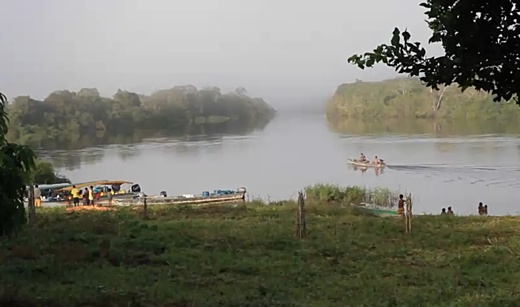
Image above: Jurena people's life of fishing and travel on the Xingu River is threatened by Belo Monte Dam. From video below.

After decades of demonstrations and protests against the building of an enormous hydroelectric dam at Belo Monte in the lush Brazilian rainforest, the government has finally given approval to begin construction. The first stages of development of the controversial project calls for the clearing of nearly 600 acres of forest, to be followed by the flooding of 121,600 more acres once the dam is finished. This important approval not only marks the early stages of its immense environmental impact, but a social one as well. For the nearly 50,000 mostly indigenous people who live in the region, the approval signal a precursor the destruction of their homes and livelihoods.

Despite the controversy surrounding the dam, Brazil's environmental agency, IBAMA, has ultimately given the go-ahead to begin the initial stages of construction at Belo Monte. When completed, it will be the third largest hydroelectric facility in the world, capable of powering 23 million homes.

satallite-belo-monte.jpg

Leading the fight against the Belo Monte dam had been the Brazil's indigenous peoples, who went as far as storming the Capitol to have their voices heard on the issue. Environmentalists have also taken issue with the 11,000-megawatt dam's sprawling footprint in the Amazon.

Even celebrity activists, like Avatar director James Cameron, have joined in the fight against the project, citing its impact on indigenous communities. The involvement of foreign protesters was often irksome for government officials. Last June, former-President Lula slammed "gringos" that "stick their nose where it does not belong."

When I spoke with Brazil's ex-Energy Minister, Márcio Zimmermann, in August, he echoed those sentiments, pointing out that the project had been "widely studied" and would "not flood indigenous reserves."

Image above: Jurena leaders bringing awareness to the international community of their plight. From video below.

Still, Belo Monte has not been without its detractors from within the government. Just last week, IBAMA's president, Abelardo Bayma Azevedo, resigned amid pressures from the Energy Ministry to green-light the project. According to Brazilian media, Azevedo argued that approval could not be granted due to IBAMA's ongoing investigation into the dam's environmental impact. His leaving office apparently helped facilitate the approval needed to move forward.

After decades of debate, the granting of approval for the start to construction won't likely settle the issue for those opposed. Nevertheless, the government sees the project as an important step towards developing the nation's power-grid and fulfilling its goal of ending energy poverty in Brazil.

With the crossing of this hurdle, more remain; actually building the dam itself will require further approvals be granted. Officials hope to have the project completed by 2015.

Video above: Sigourney Weaver narrates story of the social and environmental threat posed by the Belo Monte Dam project. From (http://www.youtube.com/watch?v=K-seAAIsJLQ).

See also: Ea O Ka Aina: Kauai Hydro projects Power Up 1/19/11

Non-Peaking Energy Demand

SUBHEAD: The non-peaking of energy demand is part of our energy ponzi scheme. By Steve Ludlum on 27 January 2011 in Economic Undertow - (http://economic-undertow.blogspot.com/2011/01/looking-at-non-peaking-of-demand.html) Image above: "Modernity is stoking a hot furnace stranded on an ice flow." Mashup by Juan Wilson. Here are some 'first principles' of Economic Undertow:
The 'First Law' of economics is that with all surpluses, management costs rise faster and become greater than the value of the surplus itself. Inflation (and deflation) in the general sense is the inverse value relationship between commerce and the money that leverages it. The road crude oil travels between worthless and worthless is very short.
Oil is worthless in the ground waiting to be pumped away and worthless after it is burned, where its residues loll about in the atmosphere poisoning everything alive. Oil has only days to gain its fleeting value made upon the promise of still more oil pumped out of the ground a few days hence. Its value is continuously 'born anew' days or weeks into an always uncertain future. Much of what billions of humanoids have done over the past 100 years has been to rationalize in the best meaning of that word the value- birthing process. By means of massive public and private works we attempt to convince ourselves that falling forward as we have done for decades is as perpetual and timeless as the Earth itself. Finance requires demand be brought forward into the present. The institutional demands of the throughput mechanism requires the past be brought forward continuously at the same time. Stasis rules: just as we never escape the dead hand of future's onrushing debts we can never put aside the shadowy, twilight illusions of a comforting past. Today's energy use is conceptually identical to 'beneficial' energy use in 1945: making this so gives the energy regime an inexpensive validity it could not otherwise afford. What oil buys with its evanescent value is nothing: a spider's web has more permanence than that 'drive around town'. What endures is oceans filled with unmeasurable masses of ground up plastic and fractious weather. Our stupendous works are monuments to- and enablers of pointless waste. This is the energy ponzi scheme. It can only function with ongoing 'inputs': both the fuel in hand along with the promise of more fuel in the future. At the same time the (increasing) management costs must be amortized. Flows are 'rented' from the future: without the guarantee of future flows at a price low enough to service flows in hand the ponzi breaks down. The people who are leading the unrest in the oil-producing regions are university educated youths who face a non-future. A world economy that orbits around the car-waste of resources is facing the cost consequences of that waste. University educations are implied aggregate claims against resources. The cost the claims represent is now greater than the value of the available resources: this is self-evident. If there were more resources at hand than claims outstanding there would be no disturbances! As resource cost rises the number of payable claims shrinks by way of supply and demand. Right now the claims of expanding modernity are greater than what the shrinking resource base can support. Those holding the claims realize this and are now making a 'run' on the 'modernity bank'. Modernity is in existential conflict with itself. University educations and political liberalism are means to access both resources and the tools to waste them. Attempts to exercise this access push resource costs higher because they render inefficient the flows of both energy and the funds necessary to effect the flows. Modernity cannot conjure resources out of thin air. All modernity can do is pretend to increase throughput claims on resources. It's been able to do this so far because there has been up to now a surplus of energy available at artificially low cost. Highly touted oil and gas production technologies do not create new reserves which have existed for tens of millions of years. Technologies can only extract existing reserves faster at a greater cost. Deciding which reserves are 'recoverable' or not is semantics. The suggestion that reserves are being expanded in some way or another is a fraud. The way to manage the energy surplus costs has been to ration energy demand by policy. Policy doesn't have to work too hard as both commercial and non-commercial economies are not native demand creation engines. Modern commercial economies swap machines for labor (demand) which is then arbitraged against itself. The energy cost of machines is presumed less than the energy costs of human labor. For labor to become energy demand it must first obtain credit, either from its bosses or from the bosses' agents, the banks. Because of inefficiencies in credit throughput the bosses suggest that the demand for energy has 'peaked'. This is even as they suggest the reason for the demand peak is 'greater efficiency'! Efficiency becomes the Establishment's version of Schrodinger's cat, dead and alive at the same time. The non commercial economies do not create many energy-dependent jobs. Large percentages of the populations are unemployed. Policy renders these unfortunates more or less permanently unemployable. This leaves energy balances available for export in return for 'hard' currency. Al Jazeera flirts with making the connections between the endless and pointless Cairo traffic and the current troubles in that country. What is taking place in Egypt and elsewhere is the conflicting claims of humans and their tools which both have large and growing energy appetites. The energy costs of the tools is reaching the level that cannot support both tools and humans efficiently. Here's more on disturbances in Egypt: Video above: Al Jazeera covers Egyptian protests. From (http://www.youtube.com/watch?v=IaxTGZtM3L0) Egypt is an American client as is Saudi Arabia and was Tunisia. The purpose of the relationship is to support the American Way of guzzling waste and a bankrupt business economy that is dependent upon that waste. Fuel prices as 'loss leader' of US commerce treats citizens of producing countries as externalities. The region's governments have had an interest in 'rationing' modernity bought and paid for by returns on Americans' resource waste. The energy demands of modernity come not only from America but also Europe, now China and other developing countries as well as the clients' own citizens. Contrary to petroleum industry apologists, demand is far from peaking. Rather, it has been rationed and the rationing process is in the process of breaking down. The cost implications of this are profound. Energy prices must either rise in consuming nations to pay for 'modernity rationing' at higher cost levels in energy- producing countries or the resulting throughput disruptions caused by newly- militant demand will make fuel unavailable. Modernists in Cairo, Tunis and elsewhere demand their right to waste the same way as the Communist Chinese. That the demand is blatant and paid for with violence bankrupts the notion of 'peak demand'. The demand is everywhere, just confused about how to express itself. There is no organic reason why the Middle East could not have industrialized the same as China, Japan or S. Korea. The obstacles were policy choices by governments which diverted a small fraction of oil revenues to buy off what would otherwise be restive populations. Politicians calculated bribes and foreign controversies were cheaper than the structural changes needed to support commercial economies. Politicians also could not plan a way to merge their anti-modern cultures to the hegemonic American-style anti-culture modernity. The Middle Eastern country with the greatest potential for commercial growth -- Iraq -- was destroyed by wars first with its neighbors then with the US. All were alarmed by Iraqi leadership's stumbling attempts toward modernity which were perceived as existentially threatening. Industrial growth in the Middle East would have increased domestic demand for fuel as it has in China:
Image above: Chart by Jonathan Callahan and Mazama Science. From (http://www.theoildrum.com/node/6276#comment-597084). Producer countries are now confounded by their modernity-rationing policies. On one hand, their OECD patrons require limits on modernity so as to maintain their monopoly access to cheap(er) energy. The depletion-driven rise in energy costs makes it too expensive for producers to keep the lid on their restive populations. There really is no way out of the consumption trap: countries seeking to deliver more modernity to their citizens -- after regime changes -- will see increased fuel demand driving energy costs higher still. This makes modernity even more expensive in a self-amplifying vicious cycle. Costs increase faster than the means to meet them which requires large and expensive structural changes to increase employment and aggregate labor returns. Even the hyper- modern US cannot grasp the fundamental structural reforms required to regain full employment. It cannot do so because the only structural reforms that can pay for themselves are fundamentally anti- modern. The historical verdict is the Luddites were right. It's not the romanticism of their human rights' demands but simple cost-benefit analysis. Modernity has reached the point where it cannot produce promised benefits to any sector other than its energy supply. Meanwhile, there is risk piled on risk: the attempt to change the modernity-rationing process is as risky as a new rationing process would be by itself. Upheaval in Egypt, Oman and Yemen threatens oil supply routes. Disruption increases prices without allowing any greater access to modernity or allowing transition out of it. The process of changing the process has a risk of compounding failure and descent into non-productive chaos. In all directions are feedback loops that trends energy costs higher. Modernity is a stoking hot furnace stranded on an ice flow. One outcome of disruption is a crude price spike caused by massively increased 'Panic' demand along with funds appearing into foreign exchange circulation at once. Some of this panic is being seen already in food markets; its appearance in crude would be reflected in even greater food price increases in yet another self-amplifying cycle. The instant surge in f/X liquidity in fuel markets would cause the same thing excess liquidity caused in 2008: a spike-n-crash 'Volatility Event'. The 'greater' oil market from wellhead to end user's business is in the process of becoming a liquidity/currency trap. Oil prices increase at the expense of profits elsewhere in the energy ambit (circuit) reaching back toward the energy throughput mechanism. Throughput loses the ability to support its own costs. This is fatal ... loss of throughput renders large swaths of modernity pretenders largely penniless. This has happened over and over again beginning in 1973 and the OPEC oil embargo. Every drop of oil pumped is destroyed wastefully at the end of oil's very short road. All money spent on it is also wasted just as it has been wasted since the beginning of the oil age. This is so even as the 'money' still exists post-petroleum as excess claims on nothing. All the newly materializing demand worldwide represents more claims that are impossible to satisfy. The endgame of 'falling forward' is falling on your face. Short of reaching that painful point the reasonable one is to reconcile costs and demand and do so over a meaningful period. This means twenty to fifty years of sharply decreasing energy use until the non-returning wasteful activities are permanently stripped out of economies. It may be too late for that as frustrated citizens throw away their outmoded governments in their frenzy to waste like Americans while they still have the chance. Good grief! .

Post Peak Oil Bee Keeping

SUBHEAD: Bees can be beneficially added to any system, improving pollination of crops and yielding concentrated storable sugar. By David Holmgren on 26 January 2011 in Holmgren Design Services - (http://www.holmgren.com.au/frameset.html?http://www.holmgren.com.au/html/Writings/Writings.html) Image above: Beekeeping on Kauai. From (http://kauaibuzz.blogspot.com/2010/12/kauai-beekeepers-association-meeting.html).

Summer solstice, the social high point of our year is past and I am in reflective mode over the Christmas period (traditionally a quiet one at Melliodora.) Su has decided to open the largest of her 4 bee hives and finds it brim full. Definitely time to extract! She works the bees (by far the most numerous of her “girls” that include goats, chooks and geese). My job is uncapping the frames and spinning them in the extractor.

Uncapping 16 frames full of tagasaste and yellow box honey today gave me time to reflect on the prospects for apiculture (bee keeping) as a sustainable and resilient livelihood in the future.

I have never been a bee keeper (due to adverse reactions to stings) but my enthusiasm for apiculture goes back a long way. Apiculture was one of the cornerstones (along with horticulture, silviculture and aquaculture) of my mid 70’s research of sustainable and resilient land use that informed permaculture.

From a permaculture perspective, bees can be beneficially added to any system, improving pollination of crops while yielding concentrated storable sugar with additional nutritional values, not to mention pollen, bees wax, and other special minor yields. All of this can be achieved without detracting from any other yield or use in the system.

In Permaculture One (published in 1978), Bill Mollison and I suggested extensive planting of bee forage species, not so much to attempt to provide major nectar and pollen sources but more to fill the seasonal gaps for sedentary (permanently located) hives. We recognized that the migratory nature of Australian commercial apiculture was dependent on cheap fossil fuel, while feeding to support sedentary hives through cold winters didn’t inspire us as sustainable either.

In 1979, Haikai Tane, a passionate apiarist (and my second mentor in permaculture) introduced me to his vision of rural resettlement of the New Zealand South Island high country based on bees and trees. The bees foraged the pastoral weeds hated by the graziers, while replanted and wilding trees of mixed food and timber forests would massively expand the resource base. Honey production is one of the few yields that has not significantly increased as a result of the industrialisation of agriculture. The gains in honey yields from sugar feeding, chemical control of pests and diseases and migratory harvesting across whole continents have been neutralized by the loss of forage from forests, wild spaces and pastures combined with the increasing toxicity of agricultural landscapes. In the USA and Europe pollination services for massive monocultures, rather than honey, provide most apiarists with a living.

The exclusion, morbidity and mortality of bees due to the industrialization of agriculture should be seen as “the real canary in the coalmine” warning us that we might be next. One of the most shocking facts revealed in the documentary Honeybee Blues, is that it takes more than half the bee hives in the USA to pollinate the Californian almond crop (50% of world production of almonds) and that it still requires an annual airlift of verroa mite free bees from Australia to complete the job. The arrival of verroa in Australia could see the collapse of almond yields in California (and a consequent spike in the world price of almonds).

In Australia the absence of agricultural subsidies has fortuitously resulted in less chemical drenched agricultural landscapes where most bee keepers still manage to earn a living from honey harvested from crops, pastures, weeds and of course our ubiquitous eucalypts. Our extensive rangelands and forests provide bee forage on a continental scale with minimal toxins to bother the bees.

The downside is our notoriously erratic seasons and ecologies to match with nectar flows that vary massively from season to season and place to place. Migratory apiculture is a fact of life for Australian bee keepers and in some ways this mimics the migratory nature of the indigenous cultures, co-evolved with those ecologies over tens of thousands of years. Bee keepers as a group, are in my experience, excellent observers of nature, something that has been weeded out of almost every other livelihood and activity including farming.

So beyond the immediate threats from the likely arrival in Australia of verroa mite, what place will apiculture occupy in a post peak oil world with contracting economies and climate chaos? My future scenarios work has included discussion of how the energy descent future will drive more localized economies based on land use and livelihoods that make more use of self-renewing and salvaged resources. I have highlighted pastoral farming, forestry, hunting and bee keeping as likely resilient land uses in more severe scenarios.

To understand the attractive prospects for apiculture I need to explain the rather sobering prospects for agriculture more generally.

The permaculture vision of urban and garden agriculture replacing globalized markets for horticultural products is one that has been given a huge boost by understanding the implications of peak oil. Sedentary bee keeping is an obvious element of that vision, but the combination of peak oil, climate change and economic contraction, if not collapse, will generate many challenges for that permaculture vision of an alternative food system. Those challenges could make bee keeping a more important, even central element of garden agriculture for the future.

Extreme weather events and chaotic seasons, without clear patterns, are a greater challenge, than simply a shift to a warmer or even drier climate. Australia’s unreliable climatic patterns combined with chronically infertile soils made agriculture a marginal project, before the arrival of Europeans with several continents worth of cultivated plants and domesticated livestock. The sustainability of this on-going experiment in agriculture remains a moot point, even without climate change. The progressive (or rapid) breakdown of the globalized markets for agriculture and more chaotic seasons adds to the doubts. In general we should expect broadacre crop agriculture to become an increasingly marginal activity.

This thought might make some permie purists feel a little smug as they grind and leach acorns for their daily bread, but the resilience of many of our cherished tree crops to climate chaos is not much better than annual crops, a point made (through gritted teeth) by my good mate Graeme Brookman at the Food Forest. (Lack of winter chill and extreme heat waves are having increasing impact on the yield from mainstay tree crops at the Food Forest.)

Compared with annual crops, one disadvantage of tree crops is vulnerability due to specific seasonal conditions for fruit set and ripening. Long lead times and resources involved in planting and establishment of tree crop species and varieties adapted to emerging climates are also problematic.

Diversity gives us a “hedge” against climate (and market) chaos, with some winners and some losers each season, but this value from diversity is most useful in small scale systems supplying a household rather than market systems where some degree of commitment to scale and specialization is inevitable (even in a more localized world).

Microclimate buffering of extreme weather conditions is another advantage of food forests but much of that buffering of heat scorch, frost, wind damage etc is restricted to the understorey. It is the tree canopy, especially in temperate climate systems, exposed to full sun that provides the greatest yields.

Timber forests are more capable of dealing with the extreme weather and seasonal chaos than food forests. They grow fast when moisture and temperature allow but continue to slowly gain (dense) wood in all but the most extreme seasons. Ironically it is grasslands with grazing animals that might be one of the most resilient systems of land use in the face of climate chaos; these opportunistic systems mostly developed through the pulsing of ice age and interglacial over the last few million years.

Animals represent storages that dampen the pulse while predators act to further moderate and protect the whole system. Hunter/gatherer and nomadic pastoralist cultures (at their best) incorporated this wisdom of nature to survive and thrive harsh climatic transitions of the past.

This interpretation might be a bitter pill to swallow for vegetarian and vegan idealists wedded to the idea that the keeping of livestock represents the most destructive and unethical of our land uses. (They will have to console themselves with the fact that the obscenity of factory farming of pigs, poultry and cattle will be consigned to the rubbish bin of history in a post peak oil world.)

Some of the historical advantages of pastoral farming and even nomadic pastoralism could also be important in the energy descent future. Animals (rather than machines and fossil fuel) do most of the work converting plant biomass into condensed and self-transporting storages of value to people. At the same time, they provide environmental services, such as vegetation management, fertility cycling, transport, companionship and even security.

Now the issue of security is a big one. Many years ago a friend traveling through the Sudan noticed that no one kept chooks (chickens) and that those who could afford to, ate powdered eggs from the EU. When he asked why no one kept chooks, the answer was that someone with an M16 rifle would come along and claim the chook as theirs.

In 1994 on the Amalfi coast, south of Naples I noticed cattle kept in stalls rather than grazing freely on the abundant mountain pastures. When I asked why, people said animals were valuable and someone might steal them. I was skeptical whether this was a real issue but when challenged on this point people referred to the “Saracens” stealing livestock (in the 15th century!).

The security issue was also a factor in rural settlement tending to be in compact and sometimes walled villages, rather than dispersed homesteads. In bad times, tending field crops could be dangerous while war generally led to forests being overcut to support sovereign demands. Compact villages with garden agriculture and livestock combined with opportunistic harvesting of the wild landscape by people and animals is an old pattern that could return in more severe energy descent scenarios.

My future scenarios thinking is not intended to scare people witless. The aim is to encourage strategic and flexible thinking that leads to the development of skills, livelihood and lifestyles that will be most resilient in the diversity of realities that will emerge from energy descent over the next few decades.

So why am I so upbeat about bees and beekeeping in the energy descent future? Firstly, bees are livestock that free range up to 2km from home across all boundaries and barriers, harvesting nectar and pollen sources using their own amazing intelligence and communication. Although we think of insects as being living machines controlled by hard-wired instincts, bees (and other social insects) show a higher form of collective intelligence that far exceeds the modest intelligence of individual bees. This “hive mind” has even been used as a model in understanding the emergence of higher human intelligence (via collective global consciousness) that might yet help save humanity from extinction.

They work when the weather suits and hold large stores to tide them over shortages. It is the very unreliability of nectar flows on top of the unreliability of flowering that has driven the evolution of social bees to “catch and store” large flows of nectar in condensed self preserving honey.

They thrive with a diversity of floral sources typical of wild and minimally managed landscapes that will quickly develop in rural areas as soon as fuel and herbicide become expensive and/or climate chaos accelerates and/or lack of security and markets make farming activities difficult.

Many of the pioneer plants (so called weeds) that take over when human control declines are excellent sources of bee forage. By aiding in pollination bees increase seed set ensuring a resurgence of pioneers if the healing process fails. If succession from pioneers to perennials and trees is successful the bees simply shift to harvesting the tree flowers increasing their flower set and so supporting more life and more abundance for people. This mutualistic relationship between pioneer plants that heal the land and bees that make their living harvesting the floral abundance of pioneers is a model for how we should behave.

Many Australian native species, most noticeably eucalypts, have these same characteristics (weediness and bee forage) as pioneers. In a changing climate, there’s a fair chance that bees will find nectar and pollen.

Sited at homesteads, villages and towns, bees can have access to a wider range of floral forages from gardens to fill in gaps between the main flows from forests, pastures, weeds and field crops. This diversity of nectar and pollen types is believed to be a factor in maintaining healthy hives while it provides variety and spice to our own seasonal harvest.

Honey is a compact, self preserving store of wealth that makes an excellent tradeable surplus in any economy that might survive or emerge in an energy descent future. The fact that bacteria cannot survive in honey make it almost unique amongst natural unprocessed foods. Its density (1.4 kg/litre) is an advantage for storage and transport.

Honey can be used to preserve fruit and other foods from decay and can be fermented to make mead, a common drink in medieval Britain. Haikai Tane claimed Britain was known to the Vikings as the “honey isles”, while my introduction in 1994 to “Ång”, a traditional Scandanavian wood pasture that supported browsing and grazing animals as well as bees had me speculating whether this is why the south of Britain was called “Angland”.

It is likely that the relative cost of industrially produced sugar (whether from cane, corn or beets) will rise along with energy. This could make concentrated sugar a luxury after hundreds of years of cheap industrial sugar. In the energy descent future, satisfying the almost universal sugar addiction could be as difficult as satisfying caffeine addiction. In this situation, locally produced honey will be in high demand so the bee keeper might be everyone’s friend.

As well being sweet enough to satisfy the craving for sweet food, honey has an amazing range of health benefits that make it a super food, especially when cold extracted (slow rather than fast solutions). Pollen and other yields from bees have further nutritional benefits. The shift from sugar to honey will be one from quantity to quality.

In a less secure future, the apiarist might be a target for thieves but at least his livestock, and their housing, complete with some stores of honey will be relatively safe, for fairly obvious reasons. Bees have been bred to be fairly docile to assist in their easy management but it is relatively simple to reverse that selection to breed more aggressive bees to allow the apiarist to keep ahead of opportunistic thieves. Bee keepers develop a calm and deliberate demeanor because they know bees hone in on fear and fussing behavior. Thus bee keeping selects for calm and careful behavior in humans, the very opposite of the bluster and fear that we tend to think of when contemplating a less secure world. While there are no guarantees in an insecure world, bees certainly help.

The only downside I can think of are that the skills and temperament required to be a successful apiarist are more particular than that involved in food gardening, mechanics and many other basic trades that will flourish in the energy descent future. The patience, persistence and capital it takes to build up hives and gather the needed gear, may be hard once economic and social conditions get tough. Getting into that gentle observation of nature and flexible response to constant change that’s needed to be a successful bee keeper could be harder as the energy descent crisis really begins to bite.

So kick the industrial sugar habit by supporting local bee keepers or better still become an amateur apiarist yourself and build reciprocity in your local community with the gift of the gods. Maybe our anglo-celtic culture will have finally found a place in this ancient land when we see it as the honey island continent.

See also: Ea O Ka Aina: Let's Talk Abou Bees 1/18/11 Ea O Ka Aina: Kauai Beekeepers Meetings 11/23/10

.

Third Time's a Charm

SUBHEAD: Price-forecasters are predicting oil at $150/barrel in 2011. That will put the final nail in the U.S. coffin.

By Guy McPherson on 22 January 2011 for Nature Bats Last - (http://guymcpherson.com/2011/01/third-times-a-charm/)

Image above: The last coffin nail? From (http://art-n-pics.blogspot.com/2010/11/creative-photography-typical-life-of.html).

Kurt Vonnegut often described World Wars I and II as western civilization’s first and second attempts, respectively, to commit suicide. He hinted at peak oil as our third attempt in his memoir, Man Without a Country, which was published shortly before his death.

After burying our collective heads in the sand for two years, peak oil has crept back into the margins of the national conversation. But it’s too little, too late. The end of the world as we know it already struck when, in 2008, the price of oil skyrocketed. Keynesian economics forestalled some economic pain in the short term, at huge expense to the living planet, but the music’s about to stop playing. Better grab a chair. And don’t say you didn’t see this coming.

Three of the largest companies in the world — Exxon, Shell, and Aramco — admit we’ve passed the world oil peak. The cat’s out of the bag, though we’re working hard to convince ourselves there are no felines in a world awash with Felis catus while investors are trying to determine how to put some more fiat currency into their safe-deposit boxes as the ship goes down.

To use one example from the big oil companies, former Shell Oil president Jon Hofmeister knows the price of oil is headed much higher in 2011 or 2012. Hofmeister has company, too, in the form of energy guru T. Boone Pickens, who anticipates oil priced at $140/barrel, and soon. In a stunning display of journalism based in reality, even Newsweek admits we’re headed for $150 oil, though speculators are held responsible (as is often the case when people are looking to cast blame).

Even the Wall Street Journal, which bills itself as the most important publication in the world (mipw), claims OPEC should be alarmed at the high price of oil. Although mipw will never admit as much, I’d bet OPEC is well beyond the point of alarm and into the arena of sheer, eyes-as-big-as-dinner-plates, crapping-their-pants terror, if only because there is nothing OPEC can do about high oil prices: The price of oil already has risen too high, too quickly to prevent dire consequences for the industrial economy, but OPEC will not respond, because it cannot respond.

Mother Jones has finally climbed aboard the peak-oil ship, although — as with most mainstream publications — it confuses the notion of “no more cheap oil” with “no more oil.” Still, Mother Jones is ahead of Forbes, which is sticking to the absurd claim that there are no limits to growth. It’s as if Forbes is vying for political office in the U.S. Even Forbes’ second cousin, Foreign Policy, knows the global industrial economy is dead and gone.

The occasional right-wing, windbag, talk-show idiot understands slightly more than the editors at Forbes. Sean Hannity knows the price of gas is going up, so he proposes invading (or re-invading) Iraq and Kuwait to “take all their oil.” If printing money is the last resort of an empire, then occupation must be the first.

Price-forecasting pros are predicting oil priced at $150/bbl by Memorial Day. Or perhaps that price will hold off until October. Either way, $150 oil puts the final nail in the U.S. coffin. In fact, $120 oil probably does the trick, as I wrote nearly 18 months ago. As with the last trip to $140 oil, demand is being driven by China, rather than by the OECD countries still gripped by an economic recession.

There is an alternative trigger, albeit with the same outcome: China’s bubble could pop, thus bringing the age of industry to an end.

If demand for oil continues to climb, then high oil prices will contribute to high food prices, thus triggering further food riots around the world. Some pundits claim food riots are coming to America, whereas others claim the high price of fuel will break out the riot gear.

I’m guessing we can’t be bothered to tear ourselves away from the television screen long enough to notice increasing prices, much less act. After all, we keep ignoring a federal government that throws trillions of dollars at the giant banks while simultaneously denying support to states and main street. We keep ignoring a Federal Reserve bank that has been laughing at us since 2005, and probably much earlier, while the Fed is busy throwing Americans under the bus.

I am not suggesting the ongoing economic collapse will be complete the day the price of oil rises to $120/barrel or higher. Rather, I suspect we’ll witness a series of convulsions similar to those that transpired in the wake of oil rising to $147.27/barrel in July 2008. In the aftermath of that event, the U.S. industrial economy nearly reached its end several times between mid-September 2008 and mid-March 2009.

If we assume a similar series of events in the wake of $140 oil between late May and late October, then western civilization could commit suicide between late July 2011 (two months after late May 2011, analogous to the collapse of Lehman Brothers and the associated near-collapse of the U.S. economy two months after oil hit its record high) and late June 2012 (eight months after late October 2011, analogous to near-capitulation of U.S. stock markets in March 2009 eight months after the price of oil peaked).

In the middle of these dates lies the 14-month-old forecast of Société Générale, and March 2011 is right on line with predictions from the 60 or so people I cited in my recent presentation predicting complete economic collapse before the middle of 2012. Hofmeister’s most conservative forecast of a spike in the price of oil in 2012 buys a little more time for the industrial economy. And if “no limits to growth” Forbes is correct, western civilization will hang on until we commit suicide by climate chaos. The latter option is the one preferred by the world’s governments and most people I know.

But not me. I’m hoping peak oil and the consequent high price of crude oil will spell the long-overdue death of western civilization and the associated liberation, for the living planet, from the oppression of industry. Call me quirky — the government’s term is terrorist — but I’m a fan of life.

.