SUBHEAD: Transition US
is about healing and regenerating community here in America.
By Michael Brownlee on 26 November 2010 in Transition Times -
(http://transition-times.com/blog/2010/11/26/the-evolution-of-transition-in-the-u-s)
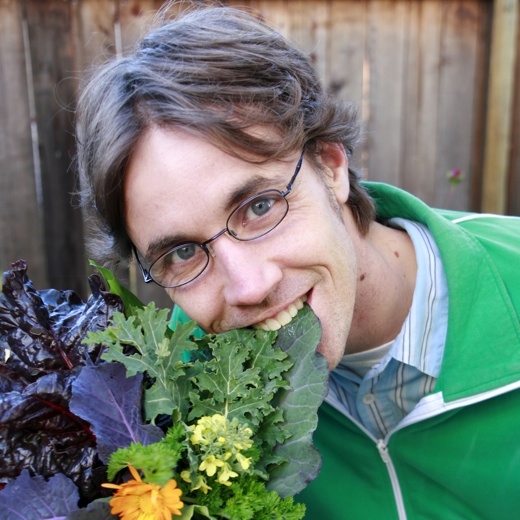 Image above: Trathen Heckman, Transition US board member and gardener chews the scenery. From (http://www.freestonefermentationfestival.com/schedule).
The Backstory
Image above: Trathen Heckman, Transition US board member and gardener chews the scenery. From (http://www.freestonefermentationfestival.com/schedule).
The BackstoryThe emergence of the Transition movement in the last four years or so is one of the most hopeful signs in the early 21st century, and Transition may yet turn out to be one of the fastest-growing, most inspiring, and most significant social change movements we have ever seen.
For those of us who had already been working towards relocalization for some years, the community-wide Transition process that Rob Hopkins and his fellow pioneers began developing in Totnes in 2006 was the very first sign of a clear and replicable pathway to community resilience and self-reliance in the face of the converging global crises of fossil fuel depletion, global warming, and economic collapse.
In Boulder County, we had well understood the urgent need for relocalization since we began in mid-2005. Inspired by Julian Darley’s Post Carbon Institute, then located in Vancouver, we joined the Relocalization Network early on, and did our best to follow the principles and guidelines that flowed from Post Carbon Institute’s Richard Heinberg and the early “Post Carbon Outposts,” most notably in Willits, California. The tag line in those early days was, “Reduce consumption, produce locally.” Some took that as a kind of tough love. This early movement was focused on an understanding of the Peak Oil crisis, and was driven by people who Darley called “the walking worried.”
That primitive relocalization movement grew surprisingly rapidly. At its peak, probably early 2007, there were reportedly some 200 such Post Carbon Outposts in a dozen nations or so, and founder Julian Darley predicted in an interview I did for HopeDance Magazine in July 2006 that the network would continue to grow exponentially. But it didn’t happen. And at the moment Darley was saying this, it was already beginning to collapse. Groups were disbanding, giving up. The Relocalization Network turned out to be unsustainable, partly (perhaps) because it lacked precisely the kind of replicable process for relocalization that Transition provides.
This experience has perhaps provided me a healthy skepticism. But I think it needs to be said that the Relocalization Network was very effective in raising awareness of the implications of the coming calamity that we call Peak Oil.
It also gave us in Boulder County a profound experience of confusion, frustration, disappointment, and sometimes even despair—for while we understood that relocalization urgently needed to happen in our community (and in every other community, of course), we were painfully aware that we certainly didn’t know what we were doing or how to do it. And to our dismay we discovered that no one else knew how to do it either!
As in all relocalization efforts, we had been trying our best to discover the ways to prepare our communities for a crisis that was just over the horizon and had not yet quite arrived, and attempting to do this without being seen as alarmists, doom-and-gloomers, or inciters of fear and anxiety.
Meanwhile, we were watching what was happening in the UK. The earliest indication that something new was brewing came with the Kinsale (Ireland) Energy Descent Action Plan, produced in 2005 by a group of Permaculture students, led by Rob Hopkins, which was ultimately adopted by the town council of Kinsale. But it was essentially a student project.
In 2006, we heard that Hopkins had moved to Totnes, England, where he was prototyping a community-wide process to achieve local resilience and self-reliance. It seemed ambitious, but possible. We eagerly awaited news.
The forthcoming news was very encouraging. A robust, seemingly viral movement was soon underway, and we soon learned that Rob Hopkins was writing The Transition Handbook: From Oil Dependence to Local Resilience to help fuel the movement.
Shortly after it was published, in early 2008, I hurriedly read The Transition Handbook on a plane to the UK, on my way to see for myself if the burgeoning Transitioning movement really lived up to the glowing reports we had been reading on the Internet. I had to know if it was actually working, and to somehow gauge whether the movement could possibly be sustainable.
My first stop was Dundee, Scotland, to take the two-day Training for Transition with Sophy Banks and Naresh Giangrande, two of the co-founders of Transition Town Totnes. I’ll just say that my experience there was entirely unexpected. Somehow Transition just landed in me, in my heart, and I saw that Transition was a living, breathing being. Transition was alive—and alive in me!
Afterwards, I made the long train-trek down to England to make my pilgrimage to the birthplace of the movement, Totnes. And there I was able to spend some time with founder Rob Hopkins and Ben Brangwyn, who headed up the Transition Network. I got to see the movement “on the ground,” not only in Totnes but in several communities in England. I saw that Transition had become a household word in the UK, and that the movement was indeed spreading virally. It looked like this was going to work!
I came back to the states deeply inspired, carrying the fire of Transition, determined to ignite this nation.
Amazingly, both Hopkins and Brangwyn candidly admitted to me that while considering Transition in the U.S., they felt it was too daunting a task. This country seemed unimaginably large to them, and too difficult to deal with. They had figured they would just forget about the U.S.! So there were no plans to bring Transition to the U.S., but I knew it was essential.
On May 1, 2008, our relocalization organization in Boulder County became the first officially recognized Transition Initiative in North America (number 53 in the world, the 5th outside the U.K.), and in September of that year Lynette Marie Hanthorn and I (she’s the co-founder of our organization) held the first Training for Transition, with 61 people participating. That spawned 20-some local initiatives in Colorado, five of which became officially recognized (so far). That spurred us, perhaps a bit prematurely, to become Transition Colorado, the first statewide Transition Hub.
As certified Transition Trainers, Lynette Marie and I have trained hundreds of people all over the country in the Transition process, and have conducted numerous Transition Clinics both online and in person.
I also became part of the original “initiating group” that sought to develop Transition U.S., which was formally birthed in January 2009 with the support of Post Carbon Institute, and served on its board of directors until April of this year.
And of course, through all this we’ve greatly expanded our Transition efforts in Boulder County, primarily focusing on catalyzing something of a revolution in local food and farming. Lately, we’re in the process of launching a Local Food and Farming Enterprise Investment Fund, which has already been seeded by an extraordinary commitment of capital.
Context for Transition
Enough for backstory. What I want to address here is the evolution of the Transition movement, particularly in this nation, and to reflect on where it’s gotten to and where it’s headed.
There are three principal themes I’d like to consider. First of all, the context for Transition (or at least our understanding of it) has changed dramatically since the model was first articulated. In other words, we have a much more sharply defined sense of what we need to be preparing our communities for.
Secondly, the Transition model first emerged from a culture very different from ours. And I think we’ve already seen indications that just transplanting the UK approach to Transition here may not work very well. We will need a uniquely American approach to Transition, and that is just beginning to take shape—but I think it will require that we once again declare our independence from England, and establish our interdependence.
Thirdly, Transition itself is in transition. Transition is a self-organizing, emergent, “open source” movement that is evolving in sometimes unexpected ways (perhaps always in unexpected ways). And this, to me, demonstrates one of the great strengths and resiliencies of the movement, that it is flexible enough to adapt locally and evolve globally. What’s beginning to emerge in the movement, particularly around what we could call the Inner Transition, is of special significance—and it’s here that I would like to go a little deeper, suggesting an approach to Transition that is both uniquely American and that can perhaps breathe new life into the movement here.
To begin, let’s look at the current state of the context for Transition, the reasons why Transition is so needed, so urgent—in other words, what we are preparing our communities for. I’ll try to talk about these things in a very succinct, bottom-line manner, without building the arguments or citing the data—which are now abundantly available.
Peak Oil
First, it’s become quite clear that we must quickly prepare our communities for sharp fluctuations in fossil fuel prices and a general decline in fossil fuel availability. This will plunge our national and local economies into chaos, for they are built on fundamentally wrong (and profoundly unsustainable) premises. In the next few years, give or take, it’s likely that we will all finally come to understand that Peak Oil is upon us.
The hope that we’ll be able to maintain our current way of life by substituting renewable energy for fossil fuels is wildly unrealistic and perhaps even dangerous. We now know that renewable substitutes will not come on line quickly enough or at large enough scale to be able to maintain our current way of life. We’re going to be facing a future with far less energy available to us. So this is not just Peak Oil, but Peak Energy! This is a reality we’re going to have to come to terms with, and we need to allow this to really sink in to our consciousness. It will change everything, and much sooner than we care to think about.
It’s unavoidable that we will be going through a wrenching energy transition—likely beginning in the next couple of years—which will change profoundly how we live, where we live, and even who lives. This tells us that we simply can’t adequately prepare our communities with new technology alone, or with incremental decreases in energy consumption. We will need to live very differently—and we will have to hurry.
Climate Change/Global WarmingThe second thing we need to talk about is that climate change/ global warming is already upon us, and here we are woefully unprepared. Sadly, recent data from the United Nations Environment Programme reveals that we’re unavoidably on track for at least a 6.3-degree Fahrenheit temperature rise globally by the end of the century—even if all governments meet all their most optimistic targets (which is highly unlikely). And this could happen even by mid-century. This will change the face of the planet radically, and the trajectory of human population.
A couple of things became very clear out of the muddle in Copenhagen last December and in the subsequent embarrassing spectacle in our own Congress. First, the scientific consensus is that human-caused greenhouse gas emissions are already having a devastating impact on the ecosphere that supports all life, and this will get very much worse in the future. Secondly, we see now that our governments are simply not going to be able to rise to the occasion in time to mitigate the impacts.
In his recent book, Requiem for a Species: Why We Resist the Truth About Climate Change, Australia’s Clive Hamilton suggests that “We will be powerless to stop the jump to a new climate on Earth, one much less sympathetic to life. The kind of climate that has allowed civilization to flourish will be gone and humans will enter a long struggle just to survive.” This means a very profound shift for human existence, one that we have hardly begun to accept.
So this is not merely climate change we’re talking about, but climate disruption, and it may ultimately give our species the equivalent of a “near death experience.” We know that those who have had near-death experiences or life-threatening illnesses are often transformed, so that they see their previous lives as empty and self-centered. So if we survive as a species, perhaps we will be likewise humbled, and devote the rest of our days to service.
Economic Decline/CollapseThe third area we must talk about is the economy, and this is precisely the arena that the founders of the Transition movement in Totnes have been so skittish about taking on as part of the context for Transition—until very recently, thanks to American Chris Martenson and Canadian Nicole Foss (who writes under the name “Stoneleigh”). Here, we need to know that economic decline will soon accelerate to inevitable collapse. There will be no long-term economic recovery. The underpinnings of modern human society (and the global economy) as we have known it are fundamentally unsustainable, and they are beginning to unravel before our eyes.
This is partly because the entire globalized economy is based on the U.S. dollar, which is based on cheap oil. And now the whole system is beginning to come apart.
When you hear predictions of economic recovery, just remember that those economists and politicians who are making these predictions are the very same ones who were predicting not so long ago that there was virtually zero chance that we could slip into an economic recession—and we now understand they were saying this at a time when we were already at least a year into recession.
We need to recognize these rosy predictions for what they are, and prepare for the end of economic growth as we have known it.
In our lifetime, we will most likely experience roller-coaster periods of global recession followed by weak and partial recoveries; this will ultimately give way to grinding, long-term global depression. In the process, many of the institutions on which we have come to rely as anchors for certainty and normalcy and sanity will surely fail, some of them slowly, some of them suddenly and spectacularly. It will be a chaotic time for the next several decades, and the chaos will prevail long after most of us have left this planet.
Over the last few years I’ve noticed that we tend to think of fossil fuel depletion, climate change, and economic decline as three separate global crises. But of course they are all deeply interrelated. When we say this, it seems so obvious. But we’re just beginning to wake up to this reality: Our growth economy is based on cheap fossil fuels, and burning fossil fuels is obviously dramatically altering our climate. Therefore, economic growth as we have known it cannot and will not continue. Our Industrial Growth Society cannot and will not continue.
This is what James Howard Kunstler has called The Long Emergency. And this is really what we are preparing ourselves and our communities for.
Clearly, we are entering into a prolonged period of profound change, an era of “unintended consequences.” The changes that are coming our way will profoundly alter not only how we live, but even how we conceive of ourselves, how we think about the world, and how we see the future. And not only will we have to learn to cope with severe disruption to our conception of ourselves and the world, but we will also need to forge a new vision of the world that we can live by. Where will that vision come from?
The larger context for the Transition movement, of course, is that all communities are in transition, whether we realize it or not, whether there is a formal Transition Initiative present or not—and so are all cultures, all nations, and all institutions. We are in a transition as a species, even as a planet in a larger Universe. Of course the outcome of this great Transition is profoundly uncertain and unpredictable, perhaps even unknowable. But this is what we’re all preparing for.
Awareness-RaisingWe will need to tell and retell the story of how we got into this predicament. It would be the story of the rise of the Industrial Growth Society, and how it has deeply wounded every single human living today, and how it has devastated the entire biosphere. It would be the story of how we’re learning that the Industrial Growth Society—in the form of economic globalization—is the culprit that has been pushing us to the brink of The Long Emergency, the brink of economic collapse, even the brink of civilization’s collapse.
It is this deeply dysfunctional mindset—insane, really—from which we must all learn to decolonize, recover and heal. That’s a process that’s going to take a while. But it won’t happen at all unless there are those of us who are holding that possibility, holding the space for healing and regeneration.
One of the key roles of Transition that sets it apart from other efforts is a commitment to continually raise awareness about our collective predicament. We’re sometimes criticized for this. I find it very helpful that Gus Speth recounts that in The Death of Environmentalism the authors remind us that Martin Luther King, Jr., did not proclaim, “I have a nightmare.” Speth’s incisive reply to them is that “King did not need to say it—his people were living a nightmare. They needed a dream. But we, I fear, are living a dream. We need to be reminded of the nightmare ahead. Here is the truth as I see it: we will never do the things that are needed unless we know the full extent of our predicament.”
I believe that our Transition initiatives need to be dedicated to informing our communities about the full extent of our predicament, and that we must not shrink from this task.
Towards an American Transition There are now 77 officially-recognized Transition Initiatives in the U.S., along with 17 in Canada (and none in Mexico). But this is a nation of some 300 million people. Canada has about 35 million.
The UK claims 170 officially-recognized Initiatives, with a population of just over 60 million. Granted, the movement in the UK has been ongoing for a couple of years longer than in the U.S., but the rate of adoption does seem noticeably slower here. To approach a similar level, we’d need to somehow get to nearly 400 official Initiatives over the next 18 months. That would be truly extraordinary growth, and I’d really like to see that happen.
Sadly, however, the rate of adoption in the U.S. seems to be slowing. Transition is hardly a household word in this country, and mainstream media have given the movement scant attention. What’s happening here?
I don’t know if ever there will emerge a coherent and robust and truly viral Transition movement in this nation. I do know that we need it urgently. But today the movement here seems to me to be somewhat fragmented. Surely there are very inspiring and important things going on in a number of communities—as in Sandpoint, Idaho—and truly I’m grateful for all of that. But in several other communities, the effort for relocalization has already essentially stalled. For many, it just seems too difficult, too big a challenge.
But we need Transition to work here, especially in this nation—because the U.S. is ground zero for The Long Emergency. We are the world’s largest user of fossil fuels. With less than five percent of the world’s population, we burn about 25 percent of the world’s oil (two-thirds of which we have to import). We are also the largest producer of greenhouse gas emissions, responsible for at least 25 percent of the total. Some would have us believe that China is the biggest contributor of greenhouse gas emissions, but this ignores the fact that much of what China produces is for consumption in the U.S. In fact, one-third of the world’s industrial products come to the U.S.
We are the world’s most significant contributor to fossil fuel depletion, and environmental degradation, and global warming. And now, with the entire globalized economy based on the U.S. dollar, which is based on an abundant supply of cheap oil, we are also the world’s greatest contributor to economic decline—which is likely to soon become economic collapse, or at least long-term economic depression.
Make no mistake, the U.S. is the belly of the beast. Given this situation, it’s hardly surprising that it’s very challenging to get Transition to catch fire here. There may be no other nation on the planet where denial and greed are more deeply rooted.
I appreciate the assessments of David Orr at Oberlin College, who observes, “Conventional wisdom maintains that we are slowly recovering from a recalcitrant recession. As we are now entering at least the third year of real economic contraction, continue to reel from the predations and corruption in a financial sector the federal government treats as sacrosanct, are in the sixth year of a plateau in worldwide oil extraction, and climate change is essentially unmitigated, it should be obvious that American society is arrantly unsustainable—ecologically, fiscally, economically, politically, and ethically… We’ve got a whole culture locked in the first stage of Abraham Maslow’s five stages of human development: infantile self-gratification.”
But we have a unique history and heritage here in the U.S., and in many ways a painful legacy, and all this needs to deeply inform our approach to Transition.
Geologian Thomas Berry helps us to understand our particular predicament here:
When we came to this continent, we saw ourselves as a people with the most sublime spiritual insights… as the most intellectual people of the world… as people with the most human political traditions of the world, with our democratic political commitment; as a people, through our technologies, most able to deal with the daily needs of the world for food, clothing, and shelter. Now, after four centuries we find the North American continent toxic in its air, its water, and its land and gravely diminished in the variety and abundance of its living forms. We must ask ourselves what happened?
The answer is simply that we have lost our awareness that the human community exists only as a component of the larger Earth community. Instead of an intimate presence on an abundant continent that could inspire our minds and imaginations while providing for our practical needs, we became a predator people on an innocent continent.
The North American continent will never again be what it once was. The manner in which we have devastated the continent has never before occurred… It is clear that there will be little development of life here in the future if we do not protect and foster the living forms of this continent. To do this, a change must occur deep in our souls. We need our technologies, but this is beyond technology. Our technologies have betrayed us.
What we are learning is that what has gotten us into our collective predicament is a deep disconnection from the natural world, from life itself. And this separation between humans and the earth and the fundamental processes of life is nowhere more dramatic or more devastating than right here in the U.S.
“You and I are not people who live in communion with the earth,” says Chellis Glendinning. “We exist instead dislocated from our roots by the psychological, philosophical, and technological constructions of our civilization, and this alienation leads to our suffering: massive suffering for each and every one of us, and mass suffering throughout our society.”
As Americans, we will need to come to own all of this, to allow it to sink deep into our conscious awareness, and to learn to heal from it together.
Transition in Transition In his Cheerful Disclaimer, Rob Hopkins candidly and humbly admits that Transition is a massive social experiment and we really don’t know if it will work. Well, with the stakes as high as they are, I think we need to explore finding the ways to help ensure that it will work, especially here in the U.S.
I want to be very clear here. I do think the Transition model or process is a revolutionary development, one of the most important we’ve seen to date. But we should recognize that Transition itself is now undergoing radical change, one that is most especially needed in the U.S.
The important thing to acknowledge here is that Transition is evolving very quickly—based both on what has been experienced in communities all over the world, and on what is seeking to emerge in and through this movement. You could say that Transition is in transition! And perhaps the most visible sign of this evolution is a radical reframing of the Transition model by Rob Hopkins himself.
To his credit, Rob Hopkins was horrified to see that his early attempts to articulate a Transition process became a sort of catechism for emerging Transition Initiatives, so he is now in the early stages of a valiant attempt to sweep away the rapidly-forming accretions of tradition—how is it possible for a movement to establish “traditions” in a scant four years?—and to replace them with a re-conception of Transition as something called “a pattern language,” following the example of famed architect Christopher Alexander.
Shortly before the international Transition Network conference in England in June, Rob sent out this message, which took many by surprise:
In the interests of promoting non-attachment to ideas and enshrining the principle that none of us really know what we are doing, as encapsulated in the ‘Cheerful Disclaimer’, for the Transition Handbook 2.0, I am taking the original Transition model and throwing it up in the air, using ‘A Pattern Language’ as a way of re-communicating and reshaping it.
With some excitement, we had learned early this year that Rob was heading in this direction. And now we see he is slowly writing the Transition Handbook 2.0, pattern by pattern, on his
blog, inviting input and feedback. It’s a very ambitious and creative project. Not everyone is happy about this reframing, however, including some of Alexander’s long-time students—but it’s on its way nonetheless.
What is the meaning of all this? What is emerging in the Transition movement? And what is all this about Pattern Language?
I can only point to this in the briefest way here, but let me give you a few thoughts from Christopher Alexander himself that give us a clue to this very rich understanding. Just let this wash over you—like poetry:
The specific patterns out of which a community is made may be alive or dead. To the extent they are alive, they let our inner forces loose, and set us free; but when they are dead, they keep us locked in inner conflict.
The more living patterns there are in a place, the more it comes to life as an entirety, the more it glows, the more it has that self-maintaining fire which is the quality without a name.
And when a community has this fire, then it becomes a part of nature. Like ocean waves, or blades of grass, its parts are governed by the endless play of repetition and variety created in the presence of the fact that all things pass. This is the quality itself—the quality that cannot be named.
To work our way towards a shared and living language once again, we must first learn how to discover patterns which are deep, and capable of generating life.
We may then gradually improve these patterns which we share, by testing them against experience: we can determine, very simply, whether these patterns make our communities live, or not, by recognizing how they make us feel…
So, pattern language is about discovering the inherent patterns that bring aliveness, wholeness and healing to our communities. This is potentially an extremely potent development for the Transition movement, for underlying the Transition process is the healing impulse. In fact, it’s the same impulse that’s underlying Permaculture.
It’s been hard for us to find the ways to talk about this. But just at the moment we’re exploring a deeper integration between the principles of Permaculture and Transition, we’re discovering just how extraordinary Alexander’s contribution really is. Here’s an excerpt, adapted from
A New Theory of Urban Design:
Let us consider what kind of process might be needed to let a community become gradually whole.
In nature, the inner laws which make a growing whole are, of course, profound and intricate…
What happens in the community, happens to us. If the process fails to produce wholeness, we suffer right away. So, somehow, we must overcome our ignorance, and learn to understand the community as a product of a huge network of processes, and learn just what features might make the cooperation of these processes produce a whole.
We must therefore learn to understand the laws which produce wholeness in the community…
The process is a single process because it has only one aim: quite simply, to produce wholeness, everywhere…
Now all this may seem rather mystical, even spiritual. Well, perhaps it is. We eventually discover that what Alexander is pointing to is that wholeness and connectedness and aliveness and sacredness and holiness are all one seamless unfolding evolutionary process.
In the UK, this bold re-conception is being delivered under the banner of “Assembling Transition” and Hopkins has taken to call the patterns he has identified as “Transition Ingredients”—as if Transition is some sort of recipe to follow, a kind of cake we can just cook up! Unwittingly, Hopkins may be condemning Transition to the same kind of fate that has befallen a mechanistic view of Nature and the Universe.
Language matters here. It’s not trivial. Brian Swimme laughs at earlier scientists who imagined that the Universe had somehow been assembled from parts—and imagined that the human had no integral connection with the process. As I delve deeper into all this, I find myself suspecting that Rob may be ignoring the deeper aspects of Christopher Alexander’s work.
Emergence of Deep Transition One of the core principles of Permaculture has to do with valuing what’s happening at the edges of a system. As David Holmgren says, “The interface between things is where the most interesting events take place. These are often the most valuable, diverse and productive elements in the system.”
For the last two years, we’ve been exploring some of these edges at
Genesis Farm in Northwest New Jersey, where—after thirty years as a center for the study of Earth Literacy and “The Great Work” of Thomas Berry—Sister Miriam MacGillis has opened the door to a profound exploration of how to help foster the Transition movement in this land, how to regain within it with the sense of sacred energy revealed through the story of the emergence of the Universe itself and the evolution of our own Earth, and how to cultivate a truly bioregional context for reinventing and relocalizing our way into the future (in other words, becoming native to our place).
At Genesis Farm, in a rich and deeply supportive environment, working with Miriam MacGillis, Seanna Ashburn (another Transition Trainer), and others, we’ve held dialogues, presentations, and an ongoing series of two- and three-day workshops for Transition leaders.
Out of this exploration, several key themes have emerged:
Seriousness and urgency. First, there is a growing and indisputable recognition that our collective predicament is far more serious and more urgent than many of us had been willing to actively contemplate. This is being increasingly reflected in the larger Transition movement, sometimes to the apparent dismay of its founders. Part of the discomfort, of course, is the unavoidable recognition that, as John Michael Greer tells us, the situation we face is not a problem that can be solved, but a predicament of our own making to which we must now quickly adapt. It’s very important to name our predicament, and to name and express how it’s impacting us, what we are feeling about all this.
And with this comes the realization that while the long-term Energy Descent Action Planning process is essential in our communities, we must also quickly develop short-term plans to respond to likely near-term events—things like breakdowns in food or fuel supply chains, or a sudden collapse of the stock market, or a weather catastrophe, or even a widespread health crisis. Richard Heinberg has been pleading for this kind of emergency planning for years now as a core part of every resilience program. Few in this country have listened, and now time is very short.
Emergence. Second, we’re beginning to learn about Emergence—or what Christopher Alexander calls “Unfolding,” the evolutionary process by which the universe itself self-organizes, finding profound and practical lessons in how to catalyze Transition in our communities. We’re in the process of learning about what is emerging in the Transition movement itself. In our communities, we’re learning about what it is that’s wanting to emerge there, far beyond our hopes and fears and desires. And in ourselves, we’re discovering what it is that’s wanting to emerge in us—and through us.
Self-organization. Third, in a closely-related way, we’re also beginning to learn the meaning of “self-organization,” which is actually a core principle of Transition, though little discussed. We’re discovering that catalyzing self-organization of a community around relocalization or Transition is entirely different from community organizing!
Permaculture principles and ethics. We’re also beginning to understand how essential the principles and ethics of Permaculture are to the Transition process. These have not been translated very explicitly into the Transition literature, and yet they are fundamental to Transition. This translation will become increasingly important over time, because Permaculture is based on a very deep understanding of how life works.
New Cosmology/Universe Story. We’re also diving deep into the story of the evolution of the Universe, of the Earth, and of life itself. As Thomas Berry explains, this New Cosmology “explores the contemporary, scientific story of the origin, nature and function of the Universe from its beginning, through its galactic phase, its supernova events, the shaping of the solar system, Earth, life, human life and self-reflective consciousness as a single, unbroken series of events.” It’s often framed in terms of “Earth Literacy,” because we humans are so illiterate about the place where we live and how we got here. But the New Cosmology is helping us to recover our sense of the sacredness of life itself, and our fundamental connectedness with the processes that make life possible.
When people hear the word “cosmology” they sometimes automatically think that it’s somehow religious. But in reality it’s based on a very deep understanding of science, the story of the evolution of the Universe. And, surprisingly, it brings us to a profound sense of the sacredness of life.
This perspective is even embedded in the Preamble to the Earth Charter, which says: “We are part of a vast, evolving universe. Earth, our home, is alive with a unique community of life.” This is not a mere metaphor.
In an interview with Derrick Jensen, Creation Spirituality’s Matthew Fox says, “I maintain that the best, most profound mystical literature today is coming out of science. The new creation story is that everything—each of us—is mystery. What we’re finding is that the smallest part of the atom is mystery. It’s dancing. And then of course the macrocosm is a mystery. In the previous scientific worldview, mystery was ‘just what we don’t know yet. We’ll solve it.’ It’s not that way. Death is not something you solve. Love is not something you solve. A broken heart is not something you solve. It’s something you experience. It’s Moses on the mountain. Moses had his experience with the burning bush. We’re learning that every bush is a burning bush, burning with photons and photosynthesis and this amazing cosmic process that was invented a few billion years ago, a process that goes back to the original fireball.” This perspective is deeply enlivening!
Pattern Language. As an important adjunct to the New Cosmology, we’re beginning to discover the importance of the patterns of evolution itself—and patterns of wholeness and healing. That’s certainly possible with Rob Hopkin’s infusion of Christopher Alexander’s extraordinary work into the Transition process. We’ll see. What’s happening at Genesis Farm is we’re finding that our understanding of how Transition works and how real community works are being radically reshaped by our understanding of how the Universe itself evolves, how life evolves and how life works.
Inner Transition/Heart & Soul. Finally, we’re beginning to appreciate the centrality of Inner Transition, what is frequently called “Heart & Soul” work in the Transition movement, a recognition that Transition in the outer world cannot occur without an Inner Transition. Holding the space for this—including the psychology of change; the whole broad field of ecopsychology; dealing with grief, anger and despair; and Joanna Macy’s “Work that Reconnects”—is to me one of the most refreshing and endearing aspects of the Transition movement. This may turn out to be a more powerful attractor to the movement than the issues of peak oil, climate change, and economic decline!
As Sophy Banks in Totnes reminds us, “Part of the human condition is an experience of inner woundedness or brokenness. We want to be whole again, and some part of us knows how to do that. We yearn for wholeness and integration.” And her partner, Naresh Giangrande, says, “Transition work is a manifestation of the healing impulse. We’re making a plea to bring love into Transition.” These things are not often openly stated in the Transition movement, but they are being uttered in Heart & Soul groups that are meeting even in the most unexpected places.
It’s a long and intense process, but we’re beginning to see (and communicate) how the New Cosmology, the Universe Story, Permaculture, Heart & Soul, and Christopher Alexander’s work are very closely related—and how they’re just beginning to land together in the Transition movement. What this means, to me, is that we’re finally beginning to understand Transition itself as an evolutionary process, one of the most intriguing and promising processes to emerge on this planet! And it’s all absolutely integral with the 13.7 billion year process of the unfolding of the Universe—which of course is a continuing emergent unfolding.
In short, at Genesis Farm we’re beginning to catalyze the infusion into Transition of new perspectives and leading-edge processes that are absolutely necessary in order for Transition to be ultimately successful. The emergence of these new perspectives is encouraging and inspiring. To me, these are all signs that Transition is working.
Towards Deep Transition Alastair McIntosh gives us some wonderful context for all this in his book, Hell and High Water, where he writes about climate change (but he could just as well be speaking of our total predicament). He says, “To mitigate climate change—and even to adapt to its consequences—without losing our humanity, there needs to be a radical reactivation of our inner lives.”
He continues, “Inner climate affects outer climate because inner hubris drives outer hubris in a spiral of mindless economic frenzy.” That’s very powerful!
“I perversely hold out hope for humanity,” he says, “not in spite of global warming, but precisely because it confronts us with a wake-up call to consciousness. Answering that call of the wild to the wild within us all invites outer action matched by inner transformation.”
And that’s part of what we’ve been attempting to cultivate at Genesis Farm. We’re exploring these things out of a deep and urgent sense that these perspectives, these tools and processes will be absolutely essential for Transition leaders as we move into a very uncertain future.
We’re finding that this perspective about the inner work is fundamental to Transition, and opens the door to what we’ve begun calling Deep Transition.
While these things may not be a “traditional” part of the Transition orientation, Deep Transition represents an opening where breakthrough understandings and processes can readily emerge and make significant contributions. After all, since no one anywhere has yet successfully relocalized a community, it is quite likely that approaches both ancient and new will be needed.
As David Orr says, industrial civilization destroys communities. And at its core, Transition is about healing and regenerating community. This is deep and profound work, and it is the very epicenter of the Transition process, even though we haven’t talked about it publicly very much—yet.
This is what Alistair McIntosh calls the Cycle of Belonging—where we help one another to re-member what has been dismembered, to re-vision how things could alternatively be, and then organize to re-claim what is needed to regenerate and heal community. This Cycle of Belonging offers meaning and direction in generating the responsibility necessary for community regeneration and healing.
But in the long run, I feel our Transition efforts may not be sustainable or resilient or self-reliant unless we place the Sacred at the very core of our work and at the center of all our activities.
For Transition is not a movement for bringing about change. Change is coming, with us or without us, whether we want it or not—profound change. Transition is a movement for preparing our communities for the changes that are coming. And our preparation is likely to crumble unless we are able to connect with and cultivate the aliveness, the wholeness, the healing, and the sacredness that underlies the Transition process.
Buried deep in the Transition literature, there is a reference to core principles that should guide the practice of Permaculture and presumably Transition itself. These are not discussed at any great length, but perhaps we can sense that they are fundamental:
- A sustainable human presence on the planet must align its systems with how life works.
- As long as our human culture is based on unsustainable assumptions, those systems will fail.
- A reinvention of a sustainable human culture must be in alignment with the rest of life.
- The laws of life can be seen and experienced in the natural world and many indigenous cultures.
There is aliveness here, and great wisdom. I propose these as foundational principles for Deep Transition.
I remember Christopher Alexander saying that aliveness and wholeness begin with something small. If it’s authentic, truly alive, it spreads or unfolds—often in mysterious ways. It’s eerily contagious, and uncontrollable. This is not something to be “organized.” Instead, it grows—organically. This is as true for a community as it is for an organism.
The challenge for those of us involved in Transition is to be able to see such pockets of aliveness and wholeness in our communities, and to support them, to protect them, to lovingly shine the light of day on them, to cultivate them, to catalyze their replication—and then to see what’s possible and needed next. This is how communities are healed and ultimately made whole.
We’re learning that none of us can make Transition happen in our communities. But we can surely be a catalyst for this emergence. All it takes is seeing what is possible, and beginning right where we are.
I’d like to close with an authentically American perspective, from the late Floyd Red Crow Westerman, speaking from the Native American tradition:
Time evolves and comes to a place where it renews again. There is first a purification time, and then there is renewal time. We are getting very close to this time now.
We were told that we would see America come and go. And in a sense, America is dying—from within—because we forgot the instructions of how to live on Earth. Everything is coming to a time when prophecy and man’s inability to live on Earth in a spiritual way will come to a crossroad of great problems.
It’s our belief that if you’re not spiritually connected to the Earth and understand the spiritual reality of how to live on Earth, it’s likely you will not make it.
I think that’s true for each one of us, for this nation, and for the Transition movement itself. We need to regain and reclaim the sense, as Red Crow proclaims, that
everything is spiritual, that this planet, this Universe, this continent, and this movement are all about the Sacred. Perhaps this is ultimately the only thing that will truly ignite the Transition movement in America, and the only thing that will enable this land and its people to fulfill our common destiny.
.