Empire of Lies

\SUBHEAD: The only question of economic significance at this point is which event puts the stake in the heart of the industrial economy. Image above: Famous capitalist and banker J. P. Morgan in top hat on Wall Street. From (http://irrationalgeographic.wordpress.com/2009/10/28/the-giant-and-the-midget). By Guy McPherson on 31 October 2010 in Nature Bats Last - (http://guymcpherson.com/2010/10/empire-of-lies)

Benny and the Inkjets are tossing the money around, but it didn’t pump up the industrial economy the last time and QE2 will be no better, even if the next version is expectedly gihugic. He’s destroying the dollar in the process of printing fiat currency, but he cannot keep up with the ongoing economic contraction. Fiat currency is rapidly turning into compost.

Call it Screwflation Nation, for short, and it’s an approach that might lead to a new American Revolution, one that has been criticized even by Peter Orszag, Obama’s former economic adviser. Even McDonald’s is raising prices, for the first time in two decades. And, although government statistics indicate prices are declining, the numbers based on things we actually buy suggest otherwise.

This essay will not go down the rabbit hole of inflation vs. deflation, preferring instead to use the simple, technically incorrect, but well-understood route of equating increasing prices with inflation. The academic ground of inflation vs. deflation has been worked to death with little understanding. If you want to pursue that topic, I encourage you to check in with Mish Shedlock, Nicole Foss, John Embry, Peter Schiff, and Gonzalo Lira (Lira believes hyperinflation has already been triggered).

Rather than chase the tail of terminology, I’ll simply assume that when average folks can no longer afford food and water, economic collapse has occurred. At that point, we needn’t worry about the terms of the debate.

The U.S. industrial economy still faces strong headwinds from the four horsemen of the economic apocalypse: energy, employment, credit, and housing. Ultimately, the U.S. gets to choose from few remaining options. They all spell the end of American Empire: default or hyperinflation seem likely, along with extreme deflation. And although we’re already there, these 23 latter-day doomsayers figured out we’ll be in an economic depression next year.

The oil crunch has arrived, despite OPEC’s lies, and the oil squeeze is running the show. Oil prices are headed up on the perception of global economic growth, according to JP Morgan and a report prepared for the New Zealand Parliament.

Even the International Energy Agency questions whether reserves will fill the gap between supply and demand. They’ve never been so circumspect. Similarly, the United States Geological Survey has infused reality into its estimates by reducing Alaska’s reserves by 90%. Meanwhile, the U.S. military — charged with making sure U.S. consumers have enough crude oil to keep the Hummers running — is feeling the squeeze.

Never mind that we’re still in an economic depression, according to unemployment numbers and other metrics of macroeconomic reality. The United States, and indeed the Organization of Economic Co-Operaton & Development (OECD), is no longer driving the world’s economic bus. And, of course, the entire field of economics is a sham built on a foundation of incorrect assumptions, lies, and misinformation. To call economics the dismal science is to denigrate all legitimate sciences while smearing the word “dismal.”

Is France foreshadowing the rest of the developed world? Will protests in France make it across the pond? Personally, I doubt Americans can be bothered to turn off the television long enough to notice the lies in which they are immersed. But I’ve been wrong a few million times before.

The only question of economic significance now is which event puts the stake in the heart of the industrial economy. At this point, a single tremor, an inopportune echo, an unexpected shift in the winds, and the entire icy edifice will come down like an avalanche.

Will the derivatives explode? They’re still out there, and the exposure of JP Morgan alone exceeds global GDP. Or maybe somebody will notice the actual U.S. government debt is beyond belief, and repayment.

[Boston University economist Laurence Kotlikoff says U.S. government debt is not $13.5-trillion (U.S.), which is 60 per cent of current gross domestic product, as global investors and American taxpayers think, but rather 14-fold higher: $200-trillion – 840 per cent of current GDP. “Let’s get real,” Prof. Kotlikoff says. “The U.S. is bankrupt.” From (http://www.theglobeandmail.com/report-on-business/commentary/neil-reynolds/the-scary-actual-us-government-debt/article1773879/)]

Perhaps the big bank death spiral will get it done. Maybe the ongoing, ever-growing foreclosure crisis will bring it all down. The natives are growing restless about that issue. Perhaps a Keynesian liquidity trap will do the trick — and, by the way, we’re already in that trap, and there’s no way out.

Under this scenario, the monetary authority (in our case, the Fed) loses control because long-term interest rates are very low (we’re stuck at zero for the Fed’s foreseeable future, and even the Fed acknowledges they’ve lost control when — in an act of treason — they defer decisions on monetary policy to banks).

Although Benny Bucks have levitated the stock markets until now the impending collapse of those markets, as foretold by insider trading at a sell to buy ratio of 3177 to 1, might be sufficient to terminate the industrial economy. Most stock trades are done robotically, so don’t think stock prices have anything to do with the worth of a company or that the time-tested buy-and-hold strategy is a safe bet. In fact, regular people have already fled the stock markets because the markets no longer reflect economic reality (although, unlike conspiracy theorists such as Charles Hugh Smith, I don’t believe stock-market movements are engineered).

There’s good news elsewhere, too: We’re blowing bubbles faster than an eight-year-old with a fresh pack of Hubba Bubba, as even historians can see, and the collapse of any of those bubbles could sink the imperial ship. Bonds, anyone? There’s a fiscal train wreck on the way in the bond market. Indeed, Ben Bernanke is acting like a possessed zombie intent on destroying the U.S. economy all by himself, through hyperinflation if necessary. Ben, you’re not alone: I’m here to help.

Non-economic phenomena could bring civilization to its knees, too. Most obviously, the ongoing environmental collapse, including profound rates of extinction, could take us with the rest of the living planet. But an overdue electromagnetic pulse from a solar flare — or a nuclear device — could terminate many of the world’s electronic infrastructure instantly. A sufficiently sophisticated Stuxnet-style cyber-attack could do some serious damage, too. On the other hand, civilization could simply starve itself to death.

If the end of American Empire is the silver lining, then continuation of the empire represents the blackest cloud in world history. If Americans would get off their collective lazy asses, they might start a civil war. That’s a big if, and I’m not willing to bet on it.

Additional imperial news includes war crimes perpetrated by U.S. soldiers and the abject shaming of this country by our naked aggression throughout the world. And then covering up the whole stinking mess, just as the oligarch’s presidential administration continues to cover up the environmental effects of the disaster in the Gulf of Mexico. But those problems are about to take care of themselves in the undertow of economic collapse. And even the silver lining bears its own bad news: Peak oil spells peak human population.

Empires are not benevolent. This world has never had a larger, more effective empire than the current one. If you’re cheering for continuation of the age of industry in an overshot world, you’re cheering for more torture, more human suffering, and more human deaths. Needless to say, we’re on opposite sides of this issue.

And if you’re living that comfortable life in the city, regardless how much you recycle, bicycle to work, and tithe at the altar, you still haven’t figured out the immorality of imperial living. Cities are the nadir of civilization, and they have an increasingly short and burning fuse. Furthermore, nothing about our survival as a species matters if we keep adhering to an irredeemable set of living arrangements, even if your city has “walkable” neighborhoods. Who wants to live as if life has no merit?

See also: Ea O Ka Aina: Grifter Nation 10/19/10

.

Peak Oil is History

SUBHEAD: When faced with insufficient global oil production, an industrialized planet has just one choice: Collapse. Image above: Abandoned gas pump. From (http://www.flickr.com/photos/rezavaziri/3461104197/). By Dmitry Orlov on November 2010 in ClubOrlov - (http://cluborlov.blogspot.com/2010/11/peak-oil-is-history.html) The marketing blurb on the back cover of the first edition of my first book, Reinventing Collapse, described me as "a leading Peak Oil theorist." When I first saw it, my jaw dropped—and remained hanging. You see, if you run through a list of bona fide leading Peak Oil theorists—your Hubberts, your Campbells, Laherrères, Heinbergs, Simmonses and a few others worth mentioning, you will not find a single Orlov among them. In vain would you search the annals and conference proceedings of the Association for the Study of Peak Oil for any trace of your humble author. But now that this howler is in print and circulated in so many copies, I suppose I have no choice but to try to live up to the expectation it set. My disqualifications aside, now does seem to be an auspicious moment to hold forth with a new piece of Peak Oil theory, because this is the year when, for the first time, just about everyone is ready to admit that Peak Oil is real, in essence, though some are not quite ready to call it by that name. Just five years ago everyone from government officials to oil company executives treated Peak Oil theory as the work of a lunatic fringe, but now that conventional world oil production peaked in 2005, and all liquids world production peaked in 2008, everyone is ready to concede that there are serious problems with growing the global oil supply. And although some people still feel skittish about using the term Peak Oil (and a few experts still insist that the peak must be referred to as "an undulating plateau," which, if anything, is a graceful turn of phrase) the differences of opinion now largely stem from a refusal to accept the terminology of Peak Oil rather than the substance of peaking global oil production. This is, of course, quite understandable: it is awkward to suddenly jump from shouting "Peak Oil is bunk!" to shouting "Peak Oil is history!" in a single bound. Such acrobatics are only safe if you happen to be a politician or an economist. Now that the matter has been largely settled, I feel that the time is ripe for me to weigh in on the subject and declare, unequivocally, that Peak Oil is indeed bunk. Not the part about global oil production reaching a peak sometime right around now then declining inexorably: that part seems true enough. Nor the part about oil production in any given province becoming constrained by geology and technology once the peak is reached: that part, under properly designed experimental conditions, seems predictive as well. In fact, the depletion model has been confirmed beautifully by the example of the continental United States minus Alaska since 1970. But the idea that this same depletion model can be applied to the planet as a whole, is, I feel, something that must be rejected as utterly and completely bogus. To see what I mean, look at a typical Peak Oil chart (Fig. 1) that shows global oil production climbing up to a peak and then declining. Image Observe that the upward slope has a lot of interesting structure to it. There are world wars, depressions, imperial collapses, oil embargoes, discoveries of giant oil fields, not to mention the ugly boom and bust cycles that are the bane of capitalist economies (whereas socialist ones have sometimes been able to grow, stagnate and eventually collapse far more gracefully). It is a rugged slope, with cliffs and crevasses, craggy outcrops and steep inclines. Now look at the downward slope: is it not shockingly smooth? Its geologic origin must be completely different from that of the upward slope. It appears to be made up of a single giant moraine, piled to the angle of repose near the top, with some spreading at the base, no doubt due to erosion, with a gradual transition into what appears to be a gently sloping alluvial plain no doubt composed of silt from the runoff, which is then followed by a vast perfectly flat area, which might have been the bottom of an ancient sea. If climbing up to the peak must have required mountaineering techniques, the downward slope looks like it could be negotiated in bathroom slippers. One could do cartwheels all the way down, and be sure of not hitting anything sharp before gently rolling to a stop sometime around 2100. Mathematically, the upward slope would have to be characterized by some high-order polynomial, whereas the downward slope is just e-t with a little bit of statistical noise. This, you must agree, is extremely suspicious: a natural phenomenon of great complexity that, just when it is forced to stop growing, turns around and becomes as simple as a pile of dirt. Where else have we observed this sort of spontaneous and sudden simplification of a complex, dynamic process? Physical death is sometimes preceded by slow decay, but sooner or later most living things go from living to dead in an abrupt transition. They don't shrivel continuously for decades on end, eventually becoming too small to be observable. And so I like to call this generic and widely accepted Peak Oil case the Rosy Scenario. It's the one in which industrial civilization, instead of keeling over promptly, joins an imaginary retirement community and spends its golden years tethered to a phantom oxygen tank and a phantom colostomy bag. The really odd thing is that the Rosy Scenario can be quite accurate, under ideal circumstances, when applied to individual countries and oil-producing regions. For instance, suppose one of the world's largest oil producers, which started out with more oil than Saudi Arabia, reaches Peak Oil in, say, 1970, but then promptly goes off the gold standard, foists its paper currency on the rest of the world by backing it up with the threat of force including the possibility of a nuclear first strike, eventually comes to import over 60% of its petroleum, much of it on credit, and, a few decades later, goes bankrupt. Then, over the intervening decades, its domestic oil production would indeed exhibit this wonderfully gentle geologically and technologically constrained curve—up to the point of national bankruptcy. Image Past the point of national bankruptcy circumstances are bound to become decidedly non-ideal, but the implications of this remain unclear. Will that hapless country still be able continue borrowing money internationally in order to import enough oil to keep its economy functioning, and, if so, under what terms, and for how much longer? It would be nice to know how this story ends ahead of time, but unfortunately all we can do is wait and see. But we do have another example (Fig. 3), which may offer some insights into what we mean when we say that circumstances will be “non-ideal.” The country that is currently the world's largest oil producer reached Peak Oil around 1987. Its sclerotic, geriatric, ideologically hidebound, systemically corrupt leadership was unable to grasp the importance of this fact, and just three years later the country was bankrupt and, shortly thereafter, it dissolved politically. In this case, plummeting oil production became the country's leading economic indicator: it plummeted, then the GDP plummeted, then coal and natural gas production plummeted, and a decade later the economy was down 40%. Behind these numbers was a precipitous drop in life expectancy and a pervasive atmosphere of despair in which many lives were either lost or ruined. Image But as long as no messy internal or external political or economic factors interfere with the natural depletion curve, the après-Peak predictions of Peak Oil theory do seem to hold. (When I say “ideal circumstances,” I suppose that I must mean circumstances that are ideal from the point of view of sentient though irrational hydrocarbon molecules, whose desire is to be pumped out of the ground and burned up as quickly and efficiently as possible, because it is unclear who else ultimately benefits, but let's not quibble.) Since the problem of not having enough oil to go around is known to cause all sorts of nasty political and economic problems, and since this is exactly the problem we should expect to encounter soon after the world reaches Peak Oil, the base assumption on which the predictions of Peak Oil theory for global oil production rest is not realistic. The specialists who are in a position to predict Peak Oil are not able to gauge its economic and political effects, and so all they can do is give us the Rosy Scenario as an ultimate upper bound. However, this caveat is not spelled out as clearly as it should be. The result is that we might as well be working with a theory which predicts that, once global Peak Oil is reached, delicious chocolate petits fours will spontaneously bake themselves into existence and fly into our mouths on dainty gossamer wings of marzipan. The Peak Oil theory-based explanation is that while the upward slope is economically constrained, the downward slope is only constrained by the geology of depleting oil reservoirs and by oil extraction technology, which is subject to thermodynamic limits and cannot improve forever without encountering diminishing, then negative, returns. While the oil supply is growing, oil demand fluctuates, resulting in numerous ups and downs in production superimposed on the overall upward trend as production tries to match demand. But on the downward side, demand permanently exceeds supply, and so every barrel of oil that can be produced at each instant will be produced. When extrapolating the aftermath of local oil production declines to global Peak Oil, the unstated assumption is that the global economy will continue to function with uncanny smoothness at the level of demand that can be met, while unmet demand will be cleanly washed off into the gutter by a strong, steady stream of economic and political nonsense. This will all sort itself out spontaneously with rational market participants responding to price signals and deciding at each instant whether they should: A. continue consuming oil in the manner to which they have become accustomed, or B. quietly wander off and die without calling attention to themselves or making a fuss. Where else have we seen such flawless organization, in situations where a key commodity—like, say, food, or drinking water—becomes critically scarce? Anywhere? Anywhere at all? And I suppose a further unstated assumption is that a shrinking economy (what with all this unmet demand and resulting attrition among market participants) can function much as a growing one does, without suffering a financial collapse. Special financial instruments called credit-default swaps can be used as a hedge against increased counterparty risk from your counterparties dying in droves from self-inflicted wounds, although after a while these instruments would become a bit too expensive. But I don't suppose that much of anything can be done about the economic growth projections baked into every single financial plan at every level. Once these turn out to be unfounded, then all the debt pyramids will come tumbling down. And since a fiat currency (such as the US Dollar) is composed of debt—credit advanced based on a promise of future growth—it is unclear how and with what the remaining oil will continue to be purchased. The end of growth is an imponderable; start talking about it, and everyone suddenly decides that it's lunchtime and starts ordering drinks. At least the French have a proper word for it: décroissance (literally, “de-growth”); here in the anglophone world all we can do is gibber and mumble about “double-dips.” Perhaps Geithner and Bernanke can come up with a dance number to illustrate. Let us look at it another way. As I mentioned, Peak Oil theory has been quite good at predicting the depletion profile of certain stable and prosperous countries and provinces. But these predictions become meaningless when extrapolated to the world as a whole, for one very obvious reason: the world cannot import oil. Let me say it again, this time in title-case, bolded and centered, to emphasize the significance of this statement:
Planet Earth Can't Import Oil
When faced with insufficient domestic oil production, an industrialized country has but two choices: 1. Import oil 2. Collapse But when faced with insufficient global oil production, an industrialized planet has just one choice: Choice Number 2. Some might argue that there is a third choice: start using less oil right away. However, in practice this turns out to be equivalent to Choice Number 2. Using less oil involves making some radical, often technologically challenging, politically unpopular, and therefore expensive and time-consuming changes. These may be as technologically advanced (and unrealistic) as replacing the current motor vehicle fleet with electric battery-powered vehicles and a large number of nuclear power plants to recharge their batteries, or as simple (and quite realistic) as moving to a place that is within walking or bicycling distance from your work, growing most of your own food in a kitchen garden and a chicken coop, and so on. But whatever these steps are, they all require a certain amount of preparation and expense, and a time of crisis (such as when oil supplies suddenly run short) is a notoriously difficult time to launch into long-range planning activities. By the time the crisis arrives, either a country has already prepared as much as it could or wanted to (thereby delaying the onset of collapse) or it has not, bringing the crisis on sooner, and making it more severe. The oft-cited Hirsch Report states that it would take twenty years to prepare for Peak Oil in order to avoid a severe and prolonged shortage of transportation fuels, and so, given that the peak was back in 2005, we now have minus five years left to lollygag before we have to start preparing. According to Hirsch et al., we have failed to prepare already. Some might also wonder why a shortage of oil should automatically trigger a collapse. It turns out that, in an industrialized economy, a drop in oil consumption precipitates a proportional drop in overall economic activity. Oil is the feedstock used to make the vast majority of transportation fuels—which are used to move products and deliver services throughout the economy. In the US in particular, there is a very strong correlation between GDP and motor vehicle miles traveled. Thus, the US economy can be said to run on oil, in a rather direct and immediate way: less oil implies a smaller economy. At what point does the economy shrink so much that it can no longer meet its own maintenance requirements? In order to continue functioning, all sorts of infrastructure, plant and equipment must be maintained and replaced in a timely manner, or it stops functioning. Once that point is reached, economic activity becomes constrained not just by the availability of transportation fuels, but also by the availability of serviceable equipment. At some point the economy shrinks so much as to invalidate the financial assumptions on which it is based, making it impossible to continue importing oil on credit. Once that point is reached, the amount of transportation fuels available is no longer limited just by the availability of oil, but also constrained by the inability to finance oil imports. The initial shortage of transportation fuels need not be large in order to trigger this entire cascade of events, because even a small shortage triggers a number of economically destructive feedback loops. A lot of fuel is wasted by idling in line at the few gas stations that remain open. More fuel is wasted by topping off—keeping the tank as full as possible, not knowing when and where you will be able to fill it again. Even more fuel disappears from the market because people are hoarding it in jerrycans and improvised containers. As the shortages drag on and spread, fuel is hoarded, and a black market for it develops: fuel diverted from official delivery channels and siphoned from gas tanks becomes available on the black market at inflated prices. And so the effect of even a minor initial shortage can easily snowball into an economic disruption sufficient to push the economy over physical and financial thresholds and toward collapse. If at this point you are starting to feel despondent, then—I am sorry to have to say this, but you must be a lightweight, because there is more—lots more to consider. Peak Oil's Rosy Scenario may look pretty, but even a rose has its thorns. And there are a number of other issues which need to be considered and taken into account within a single, integrated view. First, the rosy post-Peak Oil global production profile is based on reserve numbers which have been overstated. Much of the remaining oil is in the Middle East, in OPEC countries, and these countries overstated their reserves by various large amounts during OPEC's “quota wars” back in the 1980s. While other OPEC members sheepishly cooked up bogus numbers that looked vaguely real, Saddam Hussein, who was always a bit of a showboat, rounded up Iraq's reserve numbers up to a nice round number: 100 billion barrels. And so OPEC reserves turn out to have been inflated by some large amount—about a third at a minimum. Nor is OPEC unique in overstating their reserve numbers. Energy companies in the US play much the same game in order to please Wall Street. Set your bathroom slippers aside; to negotiate Peak Oil's downward slope you will need good mountaineering equipment. Second, there is a phenomenon called Export Land Effect: oil-exporting countries, when their production starts to falter, have a strong tendency to cut exports before cutting into domestic consumption. To be sure, there are some countries that have surrendered their resource sovereignty to international energy companies and have lost control over their export policies. There are also some despotic regimes that starve their domestic consumers but to continue to earn the export revenue needed to prop up the regime. But most countries will only export their surplus production. This means that it will become impossible to buy oil internationally long before all the wells run dry, leaving oil importing countries out in the cold. Thus, if you live in an oil-importing country and thought you could negotiate the downward slope of Peak Oil in your hiking boots, put them aside. You will need a parachute. Third, although total quantities of oil produced throughout the world were increasing up until 2005, the amounts of oil-based products (gasoline, diesel, etc.) delivered to their points of use peaked years earlier, in terms of usable energy derived. This was because more and more energy has been required to get a barrel of oil out of the ground and to refine it. Supplies of available crude oil have tended to become harder to extract, heavier, and more sulfur laden, plus the demand for more gasoline (as opposed to distillates or bunker fuels) with less lead for boosting octane add up to more energy being wasted. Energy Returned on Energy Invested (EROEI) went from 100:1 at the dawn of the oil age, when some strong-backed lads could dig you an oil well using picks and shovels, to an average of 10:1, now that oil production requires deepwater platforms (that sometimes blow up and poison entire ecosystems), horizontal drilling and fracturing technology, secondary and tertiary recovery using water and nitrogen injection, oil/water separation plants, and all sorts of other technical complexities which consume more and more of the energy they produce. As EROEI decreases from 10:1 toward 1:1, the oil industry comes to resemble an obese but famished wet-nurse ravenously sucking her own breast at the crib of a starving infant. At some point it will no longer be economically possible to deliver diesel or gasoline to a gas station. When that point comes is not certain, but there are some indications that 3:1 is the minimum EROEI that the oil industry requires in order to sustain itself. The effect of decreasing EROEI is to make the gentle slope of the Rosy Scenario much steeper. The slope no longer looks like a mound of pebbles—more like lava flowing into the sea and solidifying in a cloud of steam. There may be plenty of energy left, but much of it is going to go by the wayside, and you might not be able to get close enough to it to roast your marshmallows. Fourth, we must consider the fact that our modern global oil industry is highly integrated. If you need a certain specialty part for your drilling operation, chances are it can be sourced from just one or two global companies. Chances are this company has some very important, highly technical operations in a country that just happens to be an oil importer. The significance of this becomes clear when one considers what happens to that company's operations once Export Land Effect becomes felt. Suppose you are a national oil company in an oil-rich nation that still has enough oil left for domestic consumption, although it was recently forced to fire all of its international customers. Your oil fields are huge but mature, and you can only keep them in production by continuously drilling new horizontal wells just above the ever-rising water cut and maintaining well pressure by injecting seawater underneath. If you stop or even pause this activity, then your oil, at the wellhead, will quickly change in composition from slightly watery oil to slightly oily water, which you might as well just pump back underground. And now it turns out that the equipment you need to keep drilling horizontal wells comes from one of these unlucky countries that used to import your oil but now cannot, and the technicians who used to build your equipment have given up trying to find enough black-market gasoline to drive to work and are busy digging up their suburban backyards to grow potatoes. A short while later your drilling operations run out of spare parts, your oil production crashes, and most of your remaining reserves are left underground, contributing to an increasingly important reserve category: never-to-be-produced reserves. When these four factors are considered together, it becomes difficult to imagine that global oil production could gently waft down from lofty heights in a graceful smooth and continuous curve spanning decades. Rather, the picture that presents itself is one of stepwise declines happening in more and more places, and eventually encompassing the entire planet. Whoever you are, and wherever you are, you are likely to experience this as a three-stage process: Stage 1: You have your current level access to transportation fuels and services Stage 2: You have severely limited access to transportation fuels and services Stage 3: You have no access to transportation fuels and severely restricted transportation options How long Stage 2 will last will vary from one place to another. Some places may go directly to Stage 3: gasoline tankers stop coming to your town, all the local gas stations close, and that is that. In other places, a thriving black market may give you some access to gasoline for a few years longer, at prices that will allow some uses, such as running an electrical generator at an emergency center. But your ability to successfully cope with Stage 2, and to survive Stage 3, will be determined largely by the changes and preparations you are able to make during Stage 1. It should be expected that the vast majority of people will have done nothing to prepare, remaining quite unaware of the fact that this is something they should have been doing. Quite a few people can be expected to take a few small steps in a sensible direction, such as installing a wood stove, or insulating their home, or in a seemingly sensible but ultimately unhelpful direction, such as wasting their money on a new hybrid car or wasting their energies on trying to form a new political party or to lobby one of the existing ones. Some will buy a homestead, equip it for life off the grid, start growing all their own food (perhaps transporting their perishable surplus to a nearby farmer's market by cargo bicycle or by boat), and home-school their children, putting an emphasis on the classics and on agriculture, animal husbandry and other perennially useful knowledge. Some will flee to a place where transportation fuels are scarce already, and where a moped is considered a labor-saving device—for your donkey or camel. Unfortunately, it is hard to foresee which changes and adaptations will succeed and which will fail, because so much depends on the circumstances, which are sure to be unpredictable and vary from place to place, and on the person or persons involved: the uncertainty is just too great. But there is one thing of which we can be quite sure: that Peak Oil's Rosy Scenario, which projects a long and gradual global oil production decline, is bunk. Knowing this fact should impart a sense of urgency. Whether we use that sense of urgency foolishly or wisely is up to us, and our success may be a matter of luck, but having a sense of urgency is not at all bad. If we wish to prepare, we most likely have a few months, we may have a few years, but we certainly do not have a few decades. Let those who would have you believe otherwise first consider the issues I have raised in this article. .

All Ag Land is Important

SUBHEAD: Every piece of land outside of a current town or city limit on Kaua‘i should be designated as important. Image above: Kauai built out. Illustration by Juan Wilson. From (http://www.islandbreath.org/2007Year/20-HookahiKauai/0720-10Moratoriums.html). By Gordon Oswald on 1 November 2010 in The Garden Island - (http://thegardenisland.com/news/opinion/mailbag/article_09f3b732-e57a-11df-8965-001cc4c002e0.html)

OK, finally I can say I’ve heard it all! The “Stakeholder Committee” has decided there are eight criteria to designate important Agricultural Lands on Kaua‘i. In their highly questionable wisdom they’ve chosen these eight criteria to identify the land we need to protect for Agriculture as: currently in agriculture, of good soil quality, identified by Agricultural Lands of Importance to the State of Hawaii or Land Study Bureau, having Native Hawaiian or unique crops, having sufficient water, being consistent with county plans, contributing to critical land mass, and having access to infrastructure and markets. Are you laughing yet?

There isn’t a semi talented developer in the world or a land owner who graduated from high school that couldn’t eye a piece of land to re-zone for development that couldn’t legally challenge at least one of the scores assigned to a criteria in court and sue to be able to develop any where they want. The dolts on the “Stakeholder Committee” can not possibly be serious about using this kind of system to designate these lands. This is not about growing crops. This is about development and protecting Kaua‘i from becoming another Oahu or Maui, where carving up the natural landscape with heavy equipment and putting up houses surrounded by concrete is king and money is more important than beauty.

There is a General Plan that was enacted many years ago and it should be the Bible of Kaua‘i County. Every piece of land outside of a current town or city limit on Kaua‘i should be designated as important, and developers should not have one chance in a million of developing it. Enough is enough and unless you want to build a four lane highway around this Island, development in any area outside of a current contiguous populated area should be permanently terminated. Agriculture can occur anywhere on this Island, even in the dry and arid climate of the west side. When people are starving every square foot of land is important for agriculture. Just ask the Israelis who turned the desert into a green oasis of Agriculture. Or the farmers in Arizona and Nevada who have done likewise.

Forget about this nonsense of land designation because of potential “Agriculture” use and call a spade a spade. Where land has already been developed in less than one acre plots increase the density and build whatever the Planning Department approves. Where the density is currently one home for more than one acre stop development period. Kaua‘i is what it is because it’s perhaps the most beautiful place on earth. Keep it that way, or lose that designation forever!

See also: Island Breath: On Mayor's Proposed Moratorium on Agland Development 8/9/07

.

Secretive County Council

SUBHEAD: Kaipo Asing and others on the Kauai County Council are preventing us from knowing. Image above: Kaipo Asing keeps secrets and shushes dissent. Mash-up by Juan Wilson. Photo by Dennis Fufimoto for TGI. By Linda Harmon on 1 November 2010 in The Garden Island - (http://thegardenisland.com/news/opinion/mailbag/article_09f3b732-e57a-11df-8965-001cc4c002e0.html) A resolution that would create easy access to county council agenda and supporting documentation on the county web site was introduced by Tim Bynum and was voted on being deferred until December by all the present council except Tim Bynum and Lani Kawahara. This resolution would have enacted procedures common place in municipalities across the country so citizens could access agenda and supporting documentation in a timely manner. Using the petition process provided by council rule # 9 we wrote asking the matter be brought up rsvp, discussed and voted on. The petition was signed by 20 and submitted August 24 . Over a month passed with no reply. When I inquired no reply for another week. I was told by Kaipo Asing at a meet and great the candidates event confidentially that he had received it and it would be taken up in Dec.. He said he would be sending me a full explanation by email. I have yet to receive the email he promised. So petition or no petition the chair has determined we must wait. I'd like to know why bother to have a petition policy if it could so easily be disregarded by the chair. The council and the mayor have a hard copy of the agenda and documentation by the Thurs. before the council meeting of the following Wed. It functions for them. What would need to happen to furnish the public with the same information would be to include the documentation with each agenda item when creating the agenda in the first place. In so doing when one got the agenda one would see the related documentation as well. So availing it to the public wouldn't take much but a procedural change. The chair, Kaipo and the present council members with the exception of Lani and Tim are being obstructionists, dismissing the right of the public to be as informed as possible. He as well as the others on the council who voted to defer it back in June are hampering the public's right to participation in the political process. This is when most other governing bodies across the nation have long ago implemented this procedure. .

Defribulating the Economy

SUBHEAD: The US Federal Reserve will decide our economic fate beginning tomorrow. Let us pray. Image above: Jumpstarting the dollar. By Juan Wilson By Neil Irwin on 1 November 2010 for Washington Post - (http://www.washingtonpost.com/wp-dyn/content/article/2010/10/31/AR2010103103818.html) The Federal Reserve is preparing to put its credibility on the line as it rarely has before by taking dramatic new action this week to try jolting the economy out of its slumber. If the efforts succeed, they could finally help bring down the stubbornly high jobless rate. But should the Fed overshoot in its plan to pump hundreds of billions of dollars into the economy, it could produce the same kind of bubbles in the housing and stock markets that caused the slowdown. Or the efforts could fall short and fail to energize the economy, leaving a clear impression that the mighty Fed is out of bullets - thus adding even more anxiety to an already dire situation. The meeting of Fed policymakers Tuesday and Wednesday is set to be a defining moment of Ben S. Bernanke''s second term as chairman of the central bank. Although he helped win the war against the great financial panic of 2008 and 2009, he now risks losing the peace if he fails to end the protracted economic downturn that followed. Just two years after the world financial system nearly collapsed, it is again gut-check time for Bernanke. "The greatest risk for the Fed in taking this action is that it could extend the economy's funk by giving a sense that either no one is in charge or that the people who are in charge can't get it right," said David Shulman, senior economist at the UCLA Anderson Forecast. "The whole psychology of that could leak back into the economy." Jobs and prices The Fed is charged by Congress with a twin mandate of maintaining maximum employment and stable prices, and it is failing on both counts. The economy isn't in free fall. But as new data on gross domestic product affirmed Friday, the economy is mired in mediocre growth, too slow to bring down the unemployment rate. Inflation, meanwhile, is running about 1 percent, below the rate Fed officials view as optimal. When inflation is a little higher, it encourages consumers and businesses to spend money before it loses value. "Viewed through the lens of the Federal Reserve's dual mandate," William C. Dudley, the New York Fed president, said in a speech early last month, ". . . the current situation is wholly unsatisfactory." When Bernanke was confirmed earlier this year for a second four-year term, the widespread assumption was that his major task would be to decide when and how to move away from the unconventional measures taken during the crisis to boost growth. In reducing its target for short-term interest rates to zero, the Fed had exhausted its normal tool for managing the economy. So the central bank pumped money into the economy by buying vast quantities of bonds - more than $1.7 trillion worth. Now the Bernanke Fed is poised, if not to double down on that earlier bet, at least to up its wager. "Phase one was to avoid a complete market meltdown and something akin to the Great Depression," said Mark Gertler, a New York University economist who has collaborated with Bernanke on academic research. "Phase two begins now and is in some ways trickier. . . . Once again we're in a situation where we have to use policies we haven't really experimented with." The Fed is seeking to avoid the fate of Japan, where falling prices and weak economic growth over the past two decades have created a self-reinforcing economic stagnation. The hope is that by moving aggressively, such a cycle can be averted. Fed watchers expect that the two days of meetings around a giant mahogany table will culminate this week in the announcement of around $500 billion in Treasury bond purchases and perhaps a statement indicating a willingness to make even more. The intended benefits are already being felt. In anticipation of the Fed's action, investors have driven down mortgage rates, creating an extra incentive for people to buy a home. Expectations have also driven the stock market up, making Americans feel wealthier. And the dollar has fallen in value, making U.S. exporters more competitive, as currency investors reacted to an expected decline in U.S. interest rates. But there's a danger that the bond purchases could work too well. For example, while a modest decline in the dollar could be good for the economy, a steep and disorderly drop could be disastrous. And while Fed leaders want the inflation rate to be higher than it is now, if prices were to accelerate rapidly, that would be unwelcome. There's also a risk that investors could view the Fed's program of buying Treasury bonds as a signal that the central bank essentially plans to fund U.S. budget deficits indefinitely by printing money. That could prompt interest rates to rise, stymieing the economic recovery. Thomas M. Hoenig, president of the Kansas City Fed, appears likely to dissent from the Fed's decision this week. He said in October that such measures "could be a very dangerous gamble," given the risk of stoking asset bubbles, for instance in the stock market. If, on the other hand, the efforts to jump-start growth fall flat, the Fed would be confronted with an even knottier quandary: take even bolder steps, such as a trillion-dollar round of bond purchases, or admit that these kinds of measures won't work and stand pat. Encouraging spending Ultimately, the question of whether the Fed can invigorate the economy depends on whether companies, individuals and even the government respond to lower interest rates by spending and investing. Rates have been at exceptionally low levels for more than a year and corporate America is in sound shape financially, yet companies are holding back on hiring more employees and making new investments. Executives say they lack confidence that consumers will boost demand for products, because Americans are busy paying down debts. Some economists argue that the volume of bond purchases needed to jar the economy into motion again is vastly larger than what the Fed has seriously considered. Larry Meyer, a former Fed governor now with Macroeconomic Advisers, estimated last week that it would take more than $5 trillion worth, 10 times what analysts are expecting. Fed leaders deem such gargantuan numbers too risky. Either way, if the Fed overshoots or falls short, it could undermine the faith of the public and the financial markets in the ability of the government to address prolonged high unemployment and the risk of falling prices. At a time when investors are already skittish about gridlock in Washington, such doubts could spook financial markets, creating a self-reinforcing downward cycle in the economy. (By contrast, the U.S. economy flourished from the mid-1980s until 2008 in part because investors and businesses were confident that the Fed would keep the nation on a steady growth path.) A failed effort by the Fed could also prompt renewed calls to limit its authority and independence at a moment when popular discontent over its role in bailing out the financial system has already made the central bank a target for many in Congress. But some partisans of the Fed are urging it take dramatic new steps even if there's a chance they don't work. "I think the public understands that if unemployment remains high, monetary policy isn't going to be the reason," said Victor Li, a Villanova professor and former Fed economist. "No one is going to say the Fed isn't doing everything it can. .

Now What?

SUBHEAD: The mortgage problem is not going away. It is going to paralyze the real estate industry for as far ahead as anyone can see. Image above: Burning house in Australia in 2008. From (http://www.rainbowreporter.com/australian-property-downturn). By James Howard Kunstler on 31 October 2010 in Kunstler.com - (http://kunstler.com/blog/2010/10/now-what.html) On Tuesday, when the Republican Party and its Tea Party chump-proxies re-conquer the sin-drenched bizarro universe of the US congress, they'll have to re-assume ownership of the stickiest web of frauds and swindles ever run in human history - and chances are the victory will blow up in their supernaturally suntanned, Botox-smoothed faces.
But don't cry for John Boehner, Barack Obama.
The President and his Democrats may have inherited this clusterfuck from the feckless George Bush but they flubbed every chance to mitigate any part of it, ranging from their failure to restore the rule of law in banking (by prosecuting the executives of major banks who oversaw the systematic swindle), to mis-directing our dwindling resources toward ends (such as "shovel-ready" new super-highways) that won't promote a credible future for this society, to misleading the public in the fantasy that alt-energy will offset the disruptions of peak oil (and allow us to keep running suburbia, the US Military, and WalMart by other means).
It's really too late for both parties. They're unreformable. They've squandered their legitimacy just as the US enters the fat heart of the long emergency. Neither of them have a plan, or even a single idea that isn't a dodge or a grift. Both parties tout a "recovery" that is just a cover story for accounting chicanery and statistical lies aimed at concealing the criminally-engineered national bankruptcy that they presided over in split shifts. Both parties are overwhelmingly made up of bagmen for the companies that looted America.
Alas, the damage is now so pervasive in money matters that the federal government could be toast as a viable enterprise, even if a new party or two spontaneously rose up out of the ruins of a plundered democracy. Anyway, one of them will not be the Tea Party, with its incoherent agenda and moron cadres who seek to put Jesus back in the US constitution, where he never was in the first place - though they don't know that.
Nor is there any party on the left or even in the center with a clue or a moral compass. Its just one of those tragic moments in history - like 1850s America, when a strange vacuum of thought occupied the heart of political life, and the scene was cluttered up with mere place-holders like Millard Fillmore, Franklin Pierce, and James Buchanan. (Can you state a single idea or position, these political ciphers advanced?)
Where we stand now is on the cusp of another giant step into the abyss, since the latest storm of Foreclosure-Gate suggests pretty strongly that mega-tons of mortgage-backed securities are assured of blowing up, as well as the sundry derivatives of these things (CDOs, CDOs-squared, plus the massive fetid matter infesting the alternative cosmos of credit default swaps). If you follow the media-of-record like The New York Times and the Wall Street Journal, you would have to conclude that there is no extant plausible notion among financial leaders as to how the fiasco of botched mortgage-and-title documentation can be resolved. After three weeks of emerging events around this debacle, the consensus among the power brokers is to pretend that there's no problem, that the issue of missing, forged, post-dated, trashed, or non-existent paper related to claims on property can just be put aside, brushed under the rug, glossed over, ignored.
Let me tell you something: this problem is not going away. At the very least it is going to paralyze the real estate industry for as far ahead as anyone can see. For another thing, it could force the disclosure of what the banks are holding in their vaults in the way of worthless paper and expose their insolvency. For still another thing, it could lead to rafts of lawsuits that would additionally shove the banks toward collapse, demolish the claims that underlie our currency, call into question the meaning of property ownership per se that is the basis of Anglo-American law, and tie up the court system until kingdom come. In any case, every pension fund, state government, and insurance operation would be crippled. I could go on but you get the picture.... This might all sound extreme, but I repeat: nobody with any authority in this land has proposed a plausible way out.
By the way, I haven't even touched on the totally insane but now accepted practices of the Federal Reserve attempting to stage manage the velocity of money by so-called quantitative easing - a.k.a. the US writing checks to itself - because even that nonsense assumes that everything else remains more or less stable.
This is what the two major parties can look forward to as we swing around into the Yuletide season and then into 2011. The proud winners of seats in congress and the senate might as well put on clown suits and little pointed hats on Wednesday morning and drive around the Washington monument in toy cars. There will be a desperate need for a new politics in this country, for people unafraid to tell the truth and act in the genuine public interest. If we can't generate it from the saner quarters of this country where people think thoughts that comport with reality, I'm afraid we could see some generals step into the picture.
I write literally over the middle of the Pacific Ocean, en route from Australia where I spent the past week - not on vacation. It's a reminder that there are a lot of other players in the wide world - not all of them nations on the verge of a nervous breakdown. See also: Ea O Ka Aina: The Tonmstone Blues 10/14/10 .

Chance of Economic Chaos

SUBHEAD:Leaders in Washington DC have consistently chosen to delay climbing down the consumption mountain.

By Juan Wilson on 1 November 2010 for Island Breath -  
(http://islandbreath.blogspot.com/2010/11/chance-of-economic-chaos.html)

 
Image above: "Fantasy Sailing" by Timmy Wang. From (http://media.photobucket.com/image/kauai%20economic%20chaos/timmytwang/FantasySailing.jpg).  

You may have noticed the increase in our blogs focus on the issue of economics. In time like these economics is a canary in the coalmine issue. Generally, reporting on news focuses on events that have happened - the past. Reporting on economics more often focuses on plans and events that have yet to happen - events in the future. In a coalmine the seepage of poisonous gasses will kill a canary before it kills the miners.

That's why in the old days the miners kept a canary in a cage with them and listened carefully for the bird's call. Something big in unfolding again. Here on Kauai, like in 2008 when oil was $147 a barrel we may soon feel the waves of financial instability and chaos washing across the ocean.  

Canary in a Federal Reserve Meeting
In our metaphor the canary is the U.S. Federal Reserve System. The banking consortium has reduced lending rates to its big bank partners to zero and started selling T-bonds to investors at negative interest rates (the price to guarantee protection from inflation).

Besides the Mid Term Election, tomorrow (11/2/10) will be a day that determines another important decision on the nation's fate. The Fed will meet to consider how to salvage the US economy. The Fed is likely to double-down on its $trillion bet on more debt. They will try and jumpstart America's go-go-growth economy with a mammoth purchase of debt with a computer keystroke.

The name for this operation is Quantitative Easing (QE). The QE is likely to begin with a few hundred $billion stimulus, with an option on a $trillion. But there are some critics that see this as an order of magnitude too small to get the job done. This results of this strategy could easily have more impact on Kauai than the results of tomorrow's election. QE is much like using gasoline to start a bonfire in the rain.

If you don't use enough fuel the wood gets wet and you'll never start the fire. If you use too much fuel, or the rain stops, the fire can go out of control and burn down the forest. The Fed's consideration tomorrow will be to make the QE is just right, not too big, not too small. They perceive that too big will lead to uncontrolled inflation, too small to spiraling deflation.

In either case Kauai can expect some transformations. Tomorrow's meeting may be Fed Chairman Ben Bernake's last tweet as economic canary. If the QE fails the Fed will be out of ammo. In a coalmine that means that it's time to get out.  

Mad Hatter at a Tea Party
Tomorrow we go to vote. Most polls predict the Democrats will lose control of the House and possibly even the Senate. A group of conflicted wingnuts and rapacious Republicans will be in charge. The likely leader of the Senate Majority, Mitch McConnell has promised to make priority Number One to wreck everything at hand that might be supporting Barrack Obama's presidency. You might think this would be a problem. Not so.

The Democrats, almost universally, proved to be cowardly and venal, even when leaning in the correct direction on issues. They proved unable to disengage with the old model of "wealth" building - that was growth by debt - and that has failed miserably. We have bumped the ceiling on population and resource extraction. That means we have bumped the ceiling on "useful" debt.

And that means we have climb down the mountain of consumption that has made us fat and passive. To my mind their two ways down from our high perch. One begins sooner than later. It is a gradual grade down to a lower plain where we can find shelter. The other path begins later than sooner and will result in a steep precipitous drop from grace. Economic chaos.

One thing supporters of Democrats might take comfort in is that with the Republicans in charge of Washington, the unfolding round-two of economic collapse will be on their watch. The public will see their buffoonery as reason to throw them out in 2012. The bad news is that the Tea Party will likely be short and ugly. Even after America lost leadership of the oil industry to OPEC in 1974, our leaders in Washington DC have consistently chosen to delay climbing down the consumption mountain.

We have chosen instead to hold a gun to world in order to keep "our share" of world power. That game is coming to a close and the refocus will have to be be on a ground-game at home. I recommend we all start down the mountain now. See you at the bottom.  

.

Kauai Seed & Plant Exchange

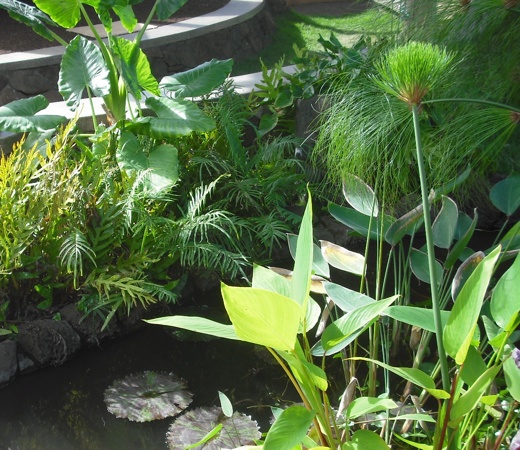
SUBHEAD: Sixth biannual event o be held on Norvember 13th in Hanapepe. Bring plants - Get plants. Image above: The papyrus growing in the Children's Garden of Prace at the Storybook Theatre in Hanapepe. Kauai. Photo by Juan Wilson. By Linda Pascatore on 31 October 2010 - WHAT: Free Event: 6th Biannual Kauai Community Seed and Plant Exchange WHERE: United Church of Christ in Hanapepe (on makai side of Highway, next to Hanapepe Library) WHEN: Saturday, November 13, 12 noon to 6pm SCHEDULE: Registration: 12 noon to 1:30 pm Blessing: 2:00 pm Exchange begins after the group Blessing Special Guest Speaker: 4 pm Film "Malama Haloa - Protecting the Taro, starring Uncle Jerry Konanui WHO: Sponsored by Regenerations Botanical Garden (www.ribg.org), Kauai Community Seed Bank, GMO Free Kauai (gmofreehawaii.org), and Akamai Backyards (akamaibackyard.com). INFORMATION: Call (808) 652-4118 or go to www.ribg.org Bring'em, Share 'em, Grow 'em! Calling all gardeners, planters & farmers! Bring the very best of your Kauai grown seeds, plants & cuttings to share and exchange with others Enjoy educational booths, food, music, and more. Anyone interested in growing plants are invited to attend. Even if you have no plants or seeds to give away, you can take some to grow and share next time. Please take care to bring clean GMO free, non-invasive & pest free plants. See also: Ea O Ka Aina: 5th Kauai Seed & Plant Exchange 5/14/10 Ea O Ka Aina: 4th Kauai Seed & Plant Exchange 10/4/09 .

Twas the Evening of Samhain

SUBHEAD: A poem inspired by "Twas the Night Before Christmas" honoring Samhain in the context of Halloween. Image above: Trick or Treaters at the door. From (http://media.photobucket.com/image/trick%20or%20treat,%20doorway/rosliothman/Selingan/halloween2.jpg). By Cather Steincamp on 31 October 1999 - (http://www.twpt.com/samcatalyst.htm)

'Twas the evening of Samhain, and all through the place

were pagans preparing the ritual space.

The candles were set in the corners with care,

in hopes that the Watchtowers soon would be there.

We all had our robes on (as is habitual)

and had just settled down and were starting our ritual

when out on the porch there arose such a chorus

that we went to the door, and waiting there for us

were children in costumes of various kinds

with visions of chocolate bright in their minds.

In all of our workings, we'd almost forgot,

but we had purchased candy (we'd purchased a LOT),

And so, as they flocked from all over the street,

they all got some chocolate or something else sweet.

We didn't think twice of delaying our rite,

Kids just don't have this much fun every night.

For hours they came, with the time-honored schtick

of giving a choice: a treat or a trick.

As is proper, the parents were there for the games,

Watching the children and calling their names.

"On Vader, On Leia,

On Dexter and DeeDee,

On Xena, on Buffy,

Casper and Tweety!

To the block of apartments

on the neighboring road;

You'll get so much candy,

you'll have to be TOWED!"

The volume of children eventually dropped,

and as it grew darker, it finally stopped.

But as we prepared to return to our rite,

One child more stepped out of the night.

She couldn't have been more than twelve or thirteen.

Her hair was deep red, and her robe, forest green

with a simple gold cord tying off at the waist.

She'd a staff in her hand and a smile on her face.

No make-up, nor mask, or accompanying kitsch,

so we asked who she was; she replied "I'm a witch.

And no, I don't fly through the sky on my broom;

I only use that thing for cleaning my room.

My magical powers aren't really that neat,

but I won't threaten tricks; I'll just ask for a treat."

We found it refreshing, so we gave incense cones,

A candle, a crystal, a few other stones,

And the rest of the candy (which might fill a van).

She turned to her father (a man dressed as Pan)

and laughed, "Yes, I know, Dad, it's past time for bed,"

and started to leave, but she first turned and said

"I'm sorry for further delaying your rite.

Blessed Samhain to all, and a magical night."

See also: Ea O Ka Aina: Frost is on the Pumpkin 10/18/10

Tale of Two Cities

SUBHEAD: On one side of the channel, it is the spring of hope, or so they believe. On the other, it is winter of despair. Image above: Detail Penguin Classic Books cover for "A Tale of Two Cities". By Bill Bonner on 29 October 2010 in Daily Reckoning - (http://dailyreckoning.com/tale-of-two-cities) It was the best of times. It was the worst of times.

It is certainly the best of times for economists with a sense of humor. Absurdity and cupidity are right out in the open where you can laugh at them. Today’s financial events – predictable consequences of clownish meddling and currency debasement – are funny enough. The official reactions practically double us up. Central bankers and finance ministers are proudly doing things that they used to be punished for. Henry II brought his bankers together in 1124. Those found guilty of debasing the coinage – an earlier form of quantitative easing – were either castrated or they had their right hands cut off. What can you say about that kind of monetary policy? It worked.

But as for today’s monetary system…it is the worst of times. Not in 3,000 years, says Nobel prize winner Robert Mundell, have we experienced such “monetary instability.” What? What about when a German Mark lost nearly all its value in a single day? What about when the French replaced the old francs for new francs at 100 to one? What about the Hungarian pengo hyperinflation of 1947? Currency crises come around much more frequently than Mundell, the “father of the euro,” thinks.

In London, England the government of David Cameron has announced the biggest cutbacks since WWII. He’s going to lighten the UK government expense load by 81 billion pounds over the next 5 years. Nearly half a million government employees are to be given the heave-ho. So far, the British public is taking the news like a donkey informed about original sin. “Carry on!” they said to each other as if it were the Blitz, as if there were something vaguely noble at stake.

In Paris, France, the government is implementing pension reforms, the highlight of which is to increase the retirement age for government employees from 60 to 62. This seems like such a timid reform. Anglo Saxons wonder what the frogs are so upset about. But they’ve taken to the streets. Early this week, one out of four French gas stations were out of fuel. Hundreds of autos were torched. Even schoolchildren were on the barricades. At least most of the manifestants were in it for a good reason – to get money. The deluded students thought they were upholding a matter of principle.

On the surface, the two nations seem to be taking two very different approaches to solving a problem. The English buckle down. The French rise up. London submits to reality. Paris sticks to fantasy. In London it is the season of Light. In Paris, Darkness descends before noon.

“What separates civilized man from the wild beasts?” “The English Channel,” comes the reply, followed by a good chuckle. - The Tale of Two cites

On one side of the channel, it is the spring of hope, or so they believe. On the other, it is winter of despair. And yet, they all hope to go to Heaven and sit on the right hand of God. That they are headed in another direction is the point of today’s reflection.

The real problem in both countries is the same. The welfare democracies made promises they can’t keep. “Government can have only two legitimate purposes,” said William Godwin, “the suppression of injustice against individuals…and the common defense against external invasion.” Beyond that the decline in marginal productivity of government spending is remarkably steep. The courts and police protection have real and immediate payoffs.

Retirement, unemployment, bailouts, payoffs, tariffs, subsidies, free food and lodging, committees, councils, regulations – all quickly have perverse outcomes. More and more people switch from producing to conniving and chiseling. The more something for nothing is available from the government, the more people do nothing useful to get it – including getting control over the government itself.

In both England and France, the spending cuts on the table so far are too little, too late. A three percent deficit was regarded as such a serious threat to the financial integrity of the European Union that member states who surpassed that level were supposed to lose their right to vote. France runs a budget deficit of nearly 8% of GDP. Its public expenses are about $1.5 trillion per year. Even if the projected savings of $96 billion by 2018 (when the pension cuts kick in) were realized, the amount is trivial. But so are the savings to be realized by the Cameron government – also trivial, and likewise programmed so the presumed benefits are realized sooner while the costs are suffered later.

But at least give them credit for pretending. Over in the USA, the Obama government shows no interest in jettisoning any of the accumulated ballast of the last half a century of boondoggles, bailouts and bunkum. Instead, with new health care and regulatory programs, it is adding to them. The current budget deficit is close to 10% of GDP, with no plausible plans to reduce it significantly. Instead, the political elite dream that they will “grow their way out” of their financial problems.

They count on stimulus to rev up their economy. But what do they have to “stimulate” with? Only the same quack elixirs that got them into trouble in the first place. The government either spends more money…or creates more of it to spend. More fiscal stimulus is off the table in Britain, and probably in America too. Instead, they both aim to get by with a little help with their friends at their central banks. Ben Bernanke has made it clear that he is ready to provide more unconventional stimulus – via money printing. The smart money is betting that Mervyn King will do the same.

And the really smart money is getting out of town.

Gold Will Outlive Dollar

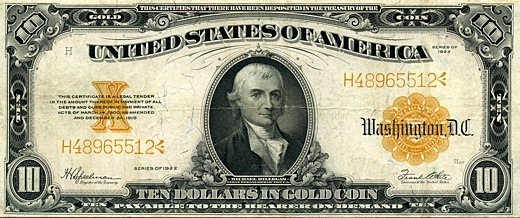
SUBHEAD: The Fed is organizing an attack on the dollar’s value, believing that this is the most expedient way to defuse deflationary market forces. Image above: Face of a 1922 ten dollar U.S. gold note, when our money was backed by the gold in Fort Knox. From (http://www.getmoneyenergy.com/2009/11/reasons-why-price-of-gold-going-up). By John Hathaway ON 28 October 2010 in Bloomberg - (http://www.bloomberg.com/news/2010-10-29/gold-will-outlive-dollar-once-slaughter-comes-commentary-by-john-hathaway.html)

The world’s monetary system is in the process of melting down. We have entered the endgame for the dollar as the dominant reserve currency, but most investors and policy makers are unaware of the implications.

The only questions are how long the denouement of the dollar reserve system will last, and how much more damage will be inflicted by new rounds of quantitative easing or more radical monetary measures to prop up the system.

Whether prolonged or sudden, the transition to a stable monetary system will become possible only when the shortcomings of the status quo become unbearable. Such a transition is, by definition, nonlinear. So central-bank soothsaying based on the extrapolation of historical data and the repetition of conventional wisdom offers no guidance on what lies ahead.

It’s amazing that there is no intelligent discourse among policy leaders on the subject of monetary rot and its implications for the future economic and political landscape. Until there is fundamental monetary reform on an international scale, most economic forecasts aren’t worth the paper on which they are written.

Telltale signs of future trouble aren’t hard to spot. Only a few months ago, Federal Reserve Chairman Ben Bernanke and a chorus of other high-ranking Fed officials were talking about exit strategies from the U.S. central bank’s bloated balance sheet and the financial system’s unprecedented excess liquidity. Now, those same officials are talking about pumping more money into the system to stimulate growth.

Risky Targets

And they’re not alone: Six months ago, the chief economist of the International Monetary Fund, Olivier Blanchard, suggested that raising inflation targets to 4 percent from 2 percent wouldn’t be too risky.

This sort of talk must grate on the nerves of our trading partners, China, India, Russia and others, who have accumulated pyramids of non-yielding Treasury debt. No haven there. Return- free risk may be a better way to put it. And bickering among central bankers over currency manipulation and rising trade tensions doesn’t exactly reinforce one’s confidence in a scenario of sustained economic growth and a return to prosperity.

The prospects for an orderly unwinding of the extreme posture of global monetary policy are zero. Bernanke, Jean- Claude Trichet and Mervyn King, his counterparts in Europe and the U.K. respectively, are huddling en masse upon the most precarious perch in the history of monetary affairs. These alleged guardians of monetary stability, in their attempts to shore up the system, have simply created the incinerator for paper money. We are past the point of no return. Quantitative easing may well become a way of life.

No Freak Occurrence

The consensus investment view seems to be that the credit crisis of 2008 was a freak occurrence, unlikely to repeat. That is wishful thinking. Monetary policy has painted itself into a corner. Based on our present course, there will be more bubbles and more meltdowns.

Financial markets and institutions sense trouble, as reflected in the flight to supposedly safe assets such as Treasuries and corporate-debt instruments with paltry yields, as well as the reluctance to lend by commercial banks. We are stuck in an epic liquidity trap. The irony is, if global central banks succeed in creating inflation, the value of these safe assets will be destroyed. It is a slaughter waiting to happen.

In the pedantic mentality of central bankers, their playbook creates just the right amount of inflation. As inflation accelerates, consumers will spend to get rid of their dollars of diminishing value and spur the economy. Once consumers start spending, it will be time to raise interest rates because a solid foundation for prosperity will have been established, they say.

Slender Thread

But whatever the playbook promises, the capacity of financial markets to overshoot can’t be overestimated. The belief among policy makers and financial markets in the possibility of this sort of fine-tuning is preposterous, but it is the slender thread on which remaining investment and business confidence rests.

The breakdown of the monetary system will be chaotic. When inflation commences, it will be highly disruptive. The damage to fixed-income assets will seem instantaneous. Foreign-exchange markets will become dysfunctional. The economy will become even more fragile and unpredictable.

Gold is an imperfect, but comparatively reliable, market gauge for the extent of current and future monetary destruction. The recent acceleration in the dollar price of the metal to $1,381, a record high in nominal terms, coincided with talk of a new round of quantitative easing and highly visible discord among major nations on trade and currency-valuation issues.

Naysayers’ Bubble

Naysayers point to gold’s price and see a bubble, without understanding that the only acceleration that is taking place is in the rate of decline of paper currency. The Fed is organizing an attack on the dollar’s value, believing that this is the most expedient way to defuse deflationary market forces. The man in the street is unaware, a perfect setup. Inflation can only be successful when the public doesn’t see it coming.

The sudden torrent of commentary on gold isn’t the sign of a bubble. Anti-gold pundits provide a great service to those who grasp this historical moment: They facilitate the advantageous positioning of the one asset most likely to be left standing when the dust settles.

.