Surrealist Vista

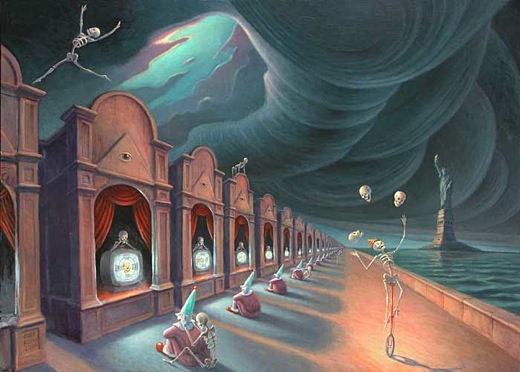
SUBHEAD: Where we stand is something like the doorway of a surrealist painting leading to a blue sky dotted with puffy little clouds.

 
Image above: A "photoshop" entry into Rene Magritte "Golconda"painting derivative contest. From (http://www.freakingnews.com/Rene-Magritte-Paintings-Pictures--2203.asp).  

By James Kunstler on 18 October 2010 in Kunstler.com -  
(http://kunstler.com/blog/2010/10/wait-for-it.html)

Some profound seismic infarction deep in civilization's very soul - brought on, no doubt, by the sludgy buildup of vast swindles and frauds - now propels deadly tsunamis toward the land masses where money dwells. And when they break over the shorelines of banking and capital, little may be left standing.

The latest rogue wave broke about ten days ago, when an orgy of foreclosure revealed massive irregularities in mortgage contracts and property titles, suggesting a slovenliness so arrant and broad that even the states' attorneys general woke from their narcoleptic raptures of golf to shut down transfers of distressed property. But this was only after the banks themselves declared "moratoria" in a perhaps vain attempt to forestall further discovery of their countless misdeeds. And somewhere along in there the title insurance industry had a whack attack.
During this period a new cliché issued from a million pie-holes: the rule of law.

Well, as Joni once sang to we happy Boomers, "...you don't know what you got 'til it's gone...." 
To systematically ignore the niggling, stodgy lawful protocols regarding contract documents - notarization, due diligence, various dotted "i"s and crossed "t"s - was easy on the way up Fraud Mountain. On the ride down, though, it turns out all those niceties comprised the braking apparatus, Now the cargo of swindles is accelerating out-of-control and breaking apart. Suddenly this cliché - the rule of law - begins to assert its meaning for this nation of slobs, morons, and grifters, to the degree that even lawyers begin to understand what's at stake (as opposed to just how much they can get paid), though the bankers may never learn.
The upshot is that the real estate industry is on ice indefinitely. Nobody dares to buy or sell property because there is no way of knowing who actually owns it, whether the chain of title is on-the-level, whether (or not) there is a document somewhere with coffee mug rings and taco sauce stains denoting the past and current owners of, say, a half acre of sawgrass scrub with an abandoned harlequin brick ranch-house full of mold feasting on damp sheet-rock in the unspeakable South Florida humidity.
The US real estate racket was already in enough trouble with the collapse of bubble pricing and then the consequent effect on untold tons of mortgage-backed securities and derivatives of them buried in the vaults of banks, insurance companies, municipal investment accounts, pension funds, and other repositories of trust.

It certainly has been known for years that the value of these clever instruments is somewhere south of where they represent themselves to be - but since the crash of 2008 accounting legerdemain kept a lid on that putrid stew. The new wave of mortgage and title fraud now threatens to drive their value down to zero, that is, quite a bit lower than even the previous worst-feared estimates of mark-to-market apocalypse.
These bundles of bonds of bundled mortgages are now so infected with impropriety that the bundlers themselves might just have to buy them back and eat the losses, and in so doing watch the value of their companies whirl down the drain, and then, after losing their jobs, their incomes, their private jets, and all the other blandishments of the high life, face prosecution and any number of years assigned to a steel slab bed and a ping-pong career in some correctional facility. That is, if we are even able to recover some fragment of the rule of law from the landfill of good intentions.
 
The trouble is, that the damage is so severe through every institution concerned with the operations of money (including the US government) that none of these fatal monkeyshines can be mitigated. Or, to put it as Barack Obama's predecessor did, so neatly, "...this sucker could go down." After all, what are the practical remedies for property the ownership of which can't be established? And upon which are claims and obligations that underlie the very value of money in this society? The rights of property form the basis of Anglo-American law. Subtract them and all bets are off. Literally.
Schemes akin to a debt jubilee are already being floated - which might sound dandy in theory, but would very neatly thrust the USA back to a standard of living equal to that in the year 1690. In other words, you can shake off your debts, but be prepared to spend the rest of your days picking stones out of your daily lentil ration before turning in on a bug-infested straw pallet next to the hog-pen, care of which is your new career.
Or perhaps your idealism runs along a different track and you would prefer to just let the government come in and take ownership of virtually everything and then decide who ends up getting what? While I am personally not tortured by nightmares of what the Tea-baggers imagine "socialism" to be (i.e. fears that the gubment will insert a computer chip in your gonads, confiscate your Go-Go Ultra X Electric Travel Scooter, and restrict your monthly admissions to the Talladega Superspeedway) I can easily see functional limitations on something like the old dictatorship of the proletariat - especially when said proletariat has been reduced in this country to some kind of a lumpen slobeteriat of methadrine-addled, tattooed psychopaths with axes to grind.
Or maybe you prefer the realm of anarchy, where a few plucky souls decide to stop playing ball with their creditors, on the grounds that they can probably get away with it due to all those slip-ups and oversights in contract review... and the idea goes viral across the nation that nobody has to make his or her payments on anything owed... and screw those bankers, anyway. "You want me? Come and get a piece of me!" Well, that route has its disadvantages, too, pretty much quickly resolving in the end-of-civilization-as-we-know-it, since after the first delirious weeks of non-payment everything based on money comes to a halt. Enjoy that one while you can.
In any event, meanwhile, property transfers will cease and the money bound up in them will not circulate, and interest not paid and - well, it's a chain of consequence leading to banks not functioning, businesses going down, people not getting paid, goods not being shipped, and something like a long emergency getting underway. The outcome is not any different from the anarchy option, except you must remember that a lot of the things that end up broken will never be put back together again.
This is therefore what the late, great Eudora Welty might have called... a still moment - the boundless interval of grave recognition that something momentous is occurring. Where we stand is something like the doorway of a surrealist painting leading to a blue sky dotted with puffy little clouds - which is deceptively reassuring, until you realize that the solid earth is nowhere in sight. The truth is, nobody has a clue what happens next, most particularly the folks in charge of things.
All we know in this still moment is that the hoary old rule of law no longer obtains. It's on everybody's lips because everybody knows that some epochal slippage has occurred, and in dark maw exposed by that slippage a lot will be lost.


 .

In the Face of This Truth

SUBHEAD: No political project based on denying reality can be viable for the long term. Image above: Art work titled "The Truth Shall Set You Free". From (http://www.forartssakemedia.com/the-truth-shall-set-you-free/). By Robert Jensen on 17 October 2010 in Yes Magazine - (http://www.yesmagazine.org/issues/a-resilient-community/in-the-face-of-this-truth)

We live in the midst of multiple crises­—economic and political, cultural and ecological—posing a significant threat to human existence at the level we have become accustomed to. There’s no way to be awake to the depth of these crises without emotional reactions, no way to be aware of the pain caused by these systemic failures without some dread and distress.

Those emotions come from recognizing that we humans with our big brains have disrupted the balance of the living world in disastrous ways that may be causing irreversible ecological destruction, and that drastically different ways of living are not only necessary but inevitable, with no guarantee of a smooth transition.

This talk, in polite company, leads to being labeled hysterical, Chicken Little, apocalyptic. No matter that you are calm, aren’t predicting the sky falling, and have made no reference to rapture. Pointing out that we live in unsustainable systems, that unsustainable systems can’t be sustained, and that no person or institution with power in the dominant culture is talking about this—well, that’s obviously crazy.

But to many of us, these insights simply seem honest. To be fully alive today is to live with anguish, not for one’s own condition in the world but for the condition of the world, for a world that is in collapse. What to do when such honesty is unwelcome?

In June 2010, I published a short essay online asking people who felt this anguish to report on their emotions and others’ reactions. In less than a month I received more than 300 messages, and while no single comment could sum up the responses, this comes close:

“I feel hopeless. I feel sad. I feel amused at the absurdity of it all. I feel depressed. I feel enraged. I feel guilty and I feel trapped. Basically the only reason why I’m still alive is because there are enough amazing people and things in my life to keep me going, to keep me fighting for what matters. I’m not even sure how to fight yet, but I know that I want to.”

I didn’t ask for biographical information, so there’s little data on the age, race, or occupation of the respondents. Nor did I ask specifically about political or community activism, but the letters reinforced a gut feeling that dealing openly with these emotions need not lead to paralysis and inaction. People can confront honestly a frightening question—“What if the unsustainable systems in which we live are beyond the point of no return?”—and stay politically and socially engaged.

One respondent, a longtime community organizer, put it succinctly:

"Recently several of our visionary thinkers have moved from the illusion that ‘we have 10 years to turn this around.’ They now say clearly that ‘we cannot stop this momentum.’ It takes courage and faith to speak so plainly. What can we do in the face of this truth? We can sit face to face and find the ways, often beyond words, to explore the reality that we are all refugees, swimming into a future that looks so different from the present. We can find pockets of community where we can whisper our deepest fears about the world. We can remain committed to describing the present with exceptional truth."

What happens when we tell “exceptional truth”?

First, we often feel drained by it. Another respondent observed:

“My personal ambition seems to decrease in proportion to the increase in world suffering. I think that’s part of my emotional reaction to crisis. I don’t think I am fully alive. I’m not depressed, just weirdly diminished.”

Second, we encounter those who don’t want to face tough truths. Many wrote about isolation from family and friends who deny there are reasons to be concerned:

“I’m a drug addict with over 20 years clean, and I know all about using up my future and farting out lame excuses. I promised myself an honest life to stay clean, and the double-edged sword is that I started seeing just how much our culture swims in denial.”

Sometimes people accuse those who press questions about systemic failure and collapse of being the problem:

“People get angry at me for it and call me ‘dark’ and ‘negative’ and ‘sinful,’ telling me to instead move to the ‘light,’ ‘positive,’ and ‘love.’ Whatever.”

Regardless of others’ reactions to talking honestly about collapse, it’s essential we continue; no political project based on denying reality can be viable for the long term. We need not have a crystal ball to recognize, as singer/songwriter John Gorka put it, that “the old future’s gone.” The future of endless bounty for all isn’t the future we face.

How can we open an honest conversation about that future? It isn’t easy, but it starts with telling the truth, from our own experience, like this 70-year-old woman who lives in a rural intentional community:

"I’ve lived long enough now to be very aware of how different the world has become, how the cycles of nature are off kilter, how the seasons and the climate have shifted. My garden tells me that food doesn’t grow in quite the same patterns, and we either get weeks of rain or weeks of heat and drought. This is the second year in a row that our apple trees do not have apples on them. But most people get their food in grocery stores where the apples still appear, and food still arrives, in season and out, from all over the world. This will soon end, and people won’t understand why. They don’t see the trouble in the land as I and my friends do. I grieve daily as I look on this altered world. My grandchildren are young adults who think their lives will continue as they have been. Who will tell them? They can’t hear me. They, and many others, will have to see the changes for themselves, as I have. I can’t imagine that anything else will convince them. My grief for the world, and for them, is compounded by this feeling of helplessness because there is no way we can have the collective action you speak of when the ‘collective’ is still in denial."

The work of breaking out of denial is less about specific actions and more about the habits and virtues we must cultivate. Far from that rural community, a 35-year-old woman working in an office in Chicago summed up the task:

“We really need to take it back to the basics and keep it simple. This reminds me of one of my own quotes I thought of a few months ago—‘be humble or be humiliated.’ I think I’m a simple person. I try to avoid making things more complex than they have to be. I try to focus more on what I need versus what I want. ‘Be humble or be humiliated’ is my own personal reminder.”

Her personal reminder is relevant for us all, individually and collectively. Humanity’s last hope may be in embracing a deep humility, recognizing that our cleverness is outstripped by our ignorance. If we become truly humble, we can abandon attempts to dominate the living world and instead find our place in it.

.

Failure of Green Consumption

SUBHEAD: The answer is not to green consumption, for it won't be a factor as people retrench into their own local communities for subsistence. Image above: Windmill explodes in Europe. From (http://www.destinationknowlton.com/knowlton/2010_02_01_archive.html). By Jan Lumburg on 13 October 2010 in Culture Change - (http://www.culturechange.org/cms/content/view/679/1/) Whether we listen to President Obama, Paul Krugman, Robert Samuelson, the Republicans, Tea Party-ers, or liberal progressives, they all want more “jobs,” a “recovery,” and “prosperity.” As long as lust for “growth” prevails, and the approved social critics also ignore the nature of the system and its collapse, then the runaway train of unprecedented chaos and ecosystem destruction is only accelerating.

We can't afford to cling to the illusions of consumerism's plenty and corporate globalism, for they are fading into history. By now you are either cheering on this radical critique and you stand for fundamental change, or you are perplexed and are asking, “Don't we need more jobs so we can all live decently?”

When one is at the end of one's rope, the answer is not to try to stretch the rope, or, in the real world, attempt to continue the cancer-like endless growth of industrialism that runs on fast dwindling, nonrenewable resources. Still, one asks, “what is the alternative to doing the forever commute, the endless shopping, and trusting the never-ending flow of water, electricity and other services for a huge population disconnected from local ecosystems?” The “alternative” is not really an alternative, but is rather nature's way, the only way, with humans as a cooperative part of it. In truth, the brief fossil-fuel phase and craze of human history is the “alternative,” and it on the way out along with countless species. Still, according to Obama and the rest of the Establishment, the fossil fuel industries and the even more subsidized nuke power crowd are essential and a part of our future. Drill Baby Drill is bipartisan. But whose future is it? What if socioeconomic collapse (petrocollapse) and climate disaster bump aside business-as-usual mega-pollution and maximum consumption?

“Enough!” someone cries, “what can replace the present system? I need to drive a car even if you don't. I need to put my kids through college.” This is all reasonable, but it's obsolete thinking. Imagination has brought about deep questioning and has successfully demonstrated more rational ways of living ever since the hippies went “back to the land.”

Their success was not large-scale, but what has sprouted from that passionate movment flowered into appropriate-tech, permaculture, natural building, bicycle culture, DYI (do it yourself, or anarchism), ecovillages, and campaigns for peace and justice. These components of a sustainable society -- and there are many others such as local currency and depaving -- don't appear yet as a cohesive or growing movement in the eyes of the mainstream. The “green” wing of the mainstream has started to learn about farmers markets, different light bulbs, expensive “clean(er)” cars, organic food, and greater recycling. But the “green” consumer is typically as alienated and isolated as his or her parents were in their middle-class oblivious splendor. U.S. culture centers on materialism and work, with families and friends given mostly lip service.

Yesterday (Oct. 12, 2010) the leaders of U.S. society and their lapdog news media served up three revealing articles in daily newspapers such Portland's Oregonian: “Roads, rails and runways” legislation from the White House, Paul Krugman's column defending Obama and Democrats from the charge of expanding the government, and Robert Samuelson's analysis of the stubborn recession. Despite any truth in this coverage, all three pieces serve to confuse, mislead, and, most insidious, discourage grassroots action to change the system.

Oil reality nowhere to be seen by mainstream

Trying to strengthen the petroleum-oriented infrastructure is folly when we find ourselves at the end of petroleum's capability for economic vitality. And, although rebuilding or repairing roads sounds innocuous enough, much new capacity would be involved such as road widenings -- simply adding to traffic congestion. But a real solution, that of getting people out of their cars, remains the poorest stepchild in politics because “Money talks” (e.g., the U.S. has plenty of corruption and the skids are greased). Obama's not above it, although many would like to think he's above it in his heart. In the transport-jobs article he said enviously, in some longer versions of the story, that China is building "hundreds of thousands of miles of new roads." China endured a nine day traffic gridlock in the summer. This congestion would not happen if the people were still oriented to bicycles. But then there would be no need for the roads, and Obama would not have a shining example of climate-killing development to rave about.

Krugman is a smart economist only in his narrow field of vision. He's typical in holding out for growth and more employment, and he makes it sound believable when he promotes fairness. But what is fair about workers giving their lifetimes for meaningless, hard work, when the future of prosperous retirement will never happen?

Does Krugman himself want to work for someone else and have no say over the work? No; he's above it all, as if we need him to speak down to the masses from his ivory tower with his message of "Work for the capitalists!" Samuelson is less emotional than Krugman, but his journalistic contribution of revealing that the age of growth has given way to cutting back is hardly enlightening. To him we're just in a maybe this, maybe that phase of the economy: less spending by government is important but harmful as well, so we'll just have to see! How a Samuelson's waste of ink and electrons is justified is by pretending that "growth" can return and be endless.

What all three talking heads -- Barack, Paul and Robert -- really stand for, though they may admit things aren't looking bright for total “recovery,” is society's success through greater consuming and generating more wealth and jobs. Population growth? Good, no problem. The greater the consumption and rise in the GDP, the better. Hence, the overt over-consumer is still the coveted hero. He's buying, and we need to pay attention to what he's buying! But he too is an endangered species if we care to face reality.

The answer is not to green consumption, for it won't be a factor as people retrench into their own local communities for subsistence.

The corporate media and the politicians play a cute game that all too many people fall for: posturing that there is a real difference between the “pro-job roadbuilders” (to give them a half-accurate name they would like) and the “pro-profit non-regulators” – the Demopublicans and their Republicrat opponents, respectively. In the real world the progressive-leaning liberals in both politics and business are no more useful than kinder destroyers of Mother Earth, or torturers who do not shock the testicles but only twist arms. Granted, it is easier for the average citizen still eating today to just put up with this system, complain about the truly repugnant, and wait for a better Obama. Or, start forging radical, fundamental change through new relationships, tactics and vision that put people and nature first.

Obama and the corporate columnists have in common that they can only see the perpetuation of capitalism, the corporate model and “innovation!”. Working for others is right for the masses, these bosses say. Gotta maintain the status quo and blame the Republicans or the Chinese. Set up a straw man to knock down, instead of dismantling the lethal system destroying nature and exploiting people. The entire political system's visible face or facade is a straw man. Serving up lies is the job of the dominant mass media, with tidbits of truth thrown in for verisimilitude. As questionable as a manufacturing or pencil-pushing job is when its days are numbered, at least a physical or cubicle job is more honest work than the top job of propping up a facade while refusing to acknowledge collapse and ecocide falling down around our heads.


References:

McClatchy-Tribune news: (in the Oregonian, the bottom 5 paragraphs were cut) Obama presses pitch for $50 billion plan for roads, runways

Washington Post: Welcome to the Age of Austerity, Oregonian and OregonLive.com

New York Times: Hey, Small Spender (in the Oregonian as "That big-government expansion? Never happened")

Is "More Jobs" Sustainable or Necessary in the Post-Peak Oil World? by Jan Lundberg, Culture .

Kipukai Kualii for 7th Place

SUBHEAD: An evaluation by Andy Parx of the race for the seats on the Kauai County Council and a strategy to gain a progressive voice there. Image above: Publicity photo of Kipukai Kualii. By Andy Parx on 15 October 2010 for Parx News Network - (http://parxnewsdaily.blogspot.com/2010/10/plunk-for-kipukai-kualii-for-county.html) We are supporting only one candidate for Kauai County Council- Kipukai Kualii, the self described “passionate community organizer with over 20 years experience in Government, Labor and Non-Profit Administration”. We ask people to “plunk” for Kipukai, a term that means voting for only one or select candidates rather than using all seven votes we’re allotted Not only is he a thoughtful progressive but he is our best chance to make sure that final council spot is not filled by either Kaipo Asing or Dickie Chang who came in seventh and eighth places- about a thousand votes ahead of Kuali`i- in the September preliminary election. While the rest of the candidates have varying degrees of objectionability we cannot in good conscience support any of them. Asing of course has become a caricature of paternalistic, secret governance and petty vindictive leadership since becoming council chair. Once a champion of the people he now champions the corrupt cronyism of the last two administrations in the belief that he must protect Kaua`i from its own people. Chang, the mindless glad-handing sycophant of the tourism industry, has been a disaster as a councilperson having never met a hotel or development- or developer for that matter- he didn’t like and defending Asing and the status quo against any and all reform. The self aggrandizing Chang even had the nerve to promote his TV program on the ballot by claiming “Wala`au” is his actual name. Kualii’s detailed plans for implementing things like agricultural sustainability, green energy and using “Max 3R Zero Waste” concepts to deal with our solid waste crisis set him apart from the rest who give lip service but are betrayed by either their record or their lack of a track record of involvement with the issues they espouse. While, as we said, the rest of the candidates are more and less objectionable to varying degrees, some stand out as downright dangerous. In no particular order, they are: - Jay Furfaro- The pompous self-promoting former Republican has apparently been responsible for every popular action of the council and was not involved in any unpopular one, if you believe his rants on every subject. While Asing genuinely comes by his paternalism Furfaro uses it to deceive and distract. His penchant for promising to support transparency while voting for secrecy is notorious as is his fondness for telling members of the public he will explain things “off camera”- and then never doing so. - Derek Kawakami- Having ingratiating himself with Chair Asing by supporting the chair’s iron-fisted rule and secrecy while giving lip service to transparency and open governance, he is a political climber who bases his votes on the direction of the wind and whatever will promote his political goal of serving in the legislature where his aunt and uncle served. “Mr. Big Save” has consistently voted to water down bills on behalf of his big business cronies when they come into conflict with the good of the people. - Nadine Nakamura- Anyone who raises over $50,000 in their first bid for office is suspect but when combined with her job as a “planner”- one who works for developers and their investors to obtain permits and zoning for projects- it makes her downright dangerous. Though little is known about how she will vote as a councilperson due to the nebulous nature of her campaign positions but remember- people who are planners are naturals at facilitating development, even those who claim to support the now nebulous term “smart growth”. Some of the least objectionable include: - Rolf Bieber who fought for open governance and adherence to high ethical standards as a member of the Board of Ethics before being unceremoniously thrown off the board for “rocking the boat”. Given the state of Kaua`i governance the boat needs rocking now more than ever. We wish he would have concentrated more on running a good campaign rather than talking about "chem trails" and 9/11 conspiracy theories which helped give him less of a chance of election than he went in with. - Ken Taylor who despite his sometimes offensive views on immigration and same gender equality has diligently fought against much of the county council secrecy and corruption by attending meetings and holding their feet to the fire. - What can we say about our old friend JoAnn Yukimura to excuse her recent need to seek “win-win” solutions and compromise away her principles? The only thing recommending her election is that she would supplant some of the more reprehensible voices on occasion, albeit at a length that puts people to sleep. - Tim Bynum’s vote on the TVR bill was inexcusable and showed a distinct lack of understanding of the repercussions of land use legislation and a penchant for being misled by the corrupt county attorneys office- all serious shortcoming. But his quest for open governance and providing the public with public information has been a breath of fresh air. Will he go back to sleep without Lani Kawahara by his side? It’s anybody’s guess. - While Mel Rapozo should not, by all rights, receive any support from anyone due to his “KPD Blue” past and support for Chair Asing- in exchange for protection from himself during the ES-177 fiasco (just to name one incident)- few can deny he will shake things up and perhaps, if he and his cronies are not involved, go after some of the undeniable corruption in the administration. The fact that he appears on a less objectionable list at all says volumes about the rest of those seeking a council seat. As to the rest, in voting for council members generally beware of people who promise to “bring people together”, code for someone who will not fight for the people but will be all too willing to sell us down the river. Beware of those who say they are “business people who will run government like a business”. Government is not business because the bottom line of government is people, not profits. These people have no clue as to what governance is all about and are usually all too willing to be penny-wise and pound-foolish. Watch out for the “motherhood and apple pie” crowd who promise to support “diversified agriculture” or “green energy” without any apparent understanding, almost as a “me too” afterthought. Please plunk for Kipukai Kuali`i on Nov. 2 and help elect a good man with good ideas who has a chance to displace Kaipo Asing and/or Dickie Chang on our county council.

Kawahara vs Asing

SUBHEAD: County Councilwoman Loni Kawahara was abused and bullied by Chairperson Kaipo Asing in 2009. Image above: Lani Kawahara (l) and Kaipo Asing (r). From TGI article. By Leo Azambuja on 15 October 2010 in The Garden Island - (http://thegardenisland.com/news/local/govt-and-politics/article_14d3b7de-d8f9-11df-b10e-001cc4c03286.html) In light of legal settlements regarding workplace violence and sexual harassment involving the County of Kauai, County Councilwoman Lani Kawahara made a surprising statement Wednesday at the council meeting.

“I’ve experienced (harassment) here, on the level of the County Council,” she said.

Calling it a “difficult decision,” and on the brink of tears, Kawahara said she had a choice to remain silent and accept the status quo of the county or to make a statement hoping for a change.

“We have a policy that is a promise to our employees that they will have a safe work place, free from any kind of harassment,” she said. “It’s a promise we haven’t kept.”

Kawahara mentioned two recently settled cases involving harassment, sexual harassment and creation of a hostile workplace, in which the county ended up paying a total of $700,000 in settlements.

But the real shocker was when Kawahara said she had been victimized.

“If you have any wonder about whether these things exist or these things happen ... I can say it does,” she said, holding back tears, to right after disclose that she has even filed a police report last year.

Kawahara said she was making a presentation to the council on July 22, 2009, when a recess was called. During the recess a certain council member requested to talk to her.

“That’s when he did it. If you look at the minutes, it took an hour and a half to come back to the floor,” she said.

Kawahara refused to disclose the alleged harasser. The police report obtained at the Kaua‘i Police Department, however, shows that the other party involved was Council Chair Kaipo Asing, who denies harassing Kawahara.

Harassment report

The July 22, 2009 meeting lasted from 9 a.m. until past 1 a.m., and carried on a heated debate about public documents, polarizing Asing on one side and Councilmembers Tim Bynum and Kawahara on the other.

The KPD report states that during recess Bynum told Kawahara that Asing wanted to talk to her.

When Kawahara met with Asing, he reportedly told her: “You crossed the line.” As Asing spoke, he allegedly ran his index finger across his neck. Kawahara questioned what had she done, and Asing’s answer was: “You know what you did, you crossed the line.” He allegedly repeated the gesture as he said that.

Kawahara said there was another council member present at the scene. She refused to name him, but said he asked Asing to “leave her alone.”

The police report states that Kawahara indicated that Councilman Derek Kawakami was nearby when the alleged harassment occurred.

Responding KPD officer Karen Kapua wrote in the report that “based on the information obtained the element of harassment was not met.” She told Kawahara and advised her that it would be documented as requested.

After filing the report, Kawahara, under advice from County Attorney Al Castillo, requested an executive session to address the issue.

The minutes of that meeting show that Castillo explained to other councilmembers that Kawahara had requested an executive session with the county attorney to discuss the council’s powers, duties, privileges, immunities and liabilities.

At that time, Kawakami had left the meeting to go on an official trip. With six council members left on the floor, a 3-3 vote denied her an executive session.

Kawahara said after that she went into Asing’s office, in the company of Castillo, to talk to him.

“I got screamed out of his office,” said Kawahara, adding that at that time she was scared and worried about losing her job.

Castillo confirmed Kawahara consulted with her that night. But because it was 1:30 a.m., Castillo said that despite vaguely remembering being in Asing’s office with Kawahara, he does not remember being screamed at.

On Sept. 9, 2009, KPD assigned investigator James Kurasaki to the case. In the police report he said he attempted to contact Kawahara by telephone. Two months later she contacted Kurasaki, said Asing had not bothered her since the incident, and then withdrew the complaint, according to the report.

Attorney Michael Soong, representing Asing, said the chair denies ever harassing Kawahara.

“While Mr. Asing is known for being a passionate advocate on issues that are important to Kaua‘i, he has never harassed her nor would he tolerate harassment in his presence,” Soong said in a written statement.

Soong said the complaint was immediately investigated by KPD officers and determined to be unfounded. The harassment did not occur, he said.

Timing

Many have questioned the reason why Kawahara waited well over a year to disclose the incident.

She said she understands that it’s been a while, but she didn’t want it to be a case about herself.

“Regarding the timing of this statement, I brought it up because it was completely germane to our discussion at the time,” Kawahara said in a written statement, adding that Wednesday’s meeting was the first time the council could officially discuss concerns about issues raised by recent sexual harassment and workplace violence settlements that had been publicized in The Garden Island.

“To be clear, my focus at council was the recent settlement amounts of $700,000 in county funds for sexual-harassment and hostile-workplace cases. The $450,000 sexual-harassment settlement of the Kristan C. Hirakawa vs. Kaua‘i County case, and the $250,000 hostile-environment case of Jane Doe vs County of Kaua‘i, EEOC Charge No. 486-2009-00268, indicate that our policies are not working,” she said in the statement.

At Wednesday’s meeting, Bynum read into the record a statement he co-authored with Kawahara, criticizing the county’s response to complaints.

“The Hirakawa case and several others in the last few years lead to the inevitable conclusion that the county of Kaua‘i has repeatedly failed to respond appropriately to allegations of sexual harassment and hostile-workplace environment,” Bynum said.

Despite the criticism, Bynum said the “administration has recognized this problem and the mayor and county attorney are in the process of revamping the county policies and issues of accountability.”

Asing said in the written statement that he is disappointed that the incident with Kawahara, which happened 15 months ago, is being brought up two weeks before the general election.

Soong said Kawahara is trying to “piggyback her false complaint” on another unrelated, legitimate complaint of a county worker who settled a claim against the county.

“We trust the good people of Kaua‘i to see this for what it truly is, an attempt to discredit Mr. Asing, and bolster the political aspirations of others on the eve of the general election,” Soong said.

Training

The county has a policy on sexual harassment, plus a workplace-violence plan. Kawahara said each department head, however, handles the policies differently. “This opens to all kinds of mistakes,” Kawahara said.

On Sept. 28 the Cost Control Commission requested information regarding employee training conducted at the Finance/Risk Management Department, KPD, County Attorney Office, Liquor Control, Kaua‘i Fire Department and Housing Agency.

Those agencies reported back that they had conducted 109 types of training the previous year, none of them involving sexual harassment or workplace violence.

The department that came the closest to offering workplace-violence training was KFD. The county policy was distributed to their employees, but no training was offered.

The majority of the departments, however, prioritized sexual-harassment and workplace-violence training as a type of training that would be beneficial.

County Engineer Donald Fujimoto, head of the Department of Public Works, the county’s largest department in terms of number of employees, appeared before the Cost Control Commission on July 12 to answer questions about consolidating all personnel departments into a county Human Resources department.

Fujimoto said he has seen the merit of having both. “It’s a give-and-take situation,” he said.

Fujimoto said his department, which has some 320 employees, has not had any sexual-harassment cases recently, but has experienced some workplace-violence issues. He said the department does not provide any kind of training relating to sexual harassment and workplace violence.

On July 20 the Civil Service Commission acknowledged receiving a letter from Council Vice Chair Jay Furfaro requesting discussions regarding the human-resources capacity of the Department of Personnel Services.

Kawahara said no large organization lacks a human resources department. The county employs over 1,000 people, but there’s no uniform policy applied equally among the departments, she said.

“What we have is a personnel division that deals mostly with hiring,” she said. “It’s people’s lives we’re talking about.”

Castillo said two weeks ago that he saw flaws in the system shortly after being named county attorney by Mayor Bernard P. Carvalho Jr. two years ago. Those flaws were shortcomings in policies and procedures regarding workplace violence in different county departments, he said.

“We do have policies and procedures that are outdated, we do have a county charter that is many years old, promulgated in 1968,” he said.

The county is currently revising policies, and once workplace-violence and sexual-harassment policies are completed, training will be implemented, said Castillo, adding that the county does go through a lot of training, and for the administration it is important.

County spokeswoman Beth Tokioka said the final draft of the county’s new policy against harassment and discrimination has been completed, and is awaiting approval from Carvalho and the Department of Personnel Services.

“Once approved, the new policy will go out to the unions for their review and comment,” Tokioka said in an e-mail.

The county plans to conduct harassment, discrimination and retaliation training in November and December, said Tokioka. In the meantime, the County Attorney’s office is working closely with all county departments to advise and monitor potentially problematic workplace issues.

The last time the county held sexual-harassment training for its employees was in 2008, and prior to that it was in 2000, said Tokioka.

.

Growth Capitalism or Survival

SUBHEAD: The feast is almost done, watch for the big announcement: The Party is Over!

 
Image above: Strip mining equipment used for mountaitop removal crossing road. Fro (http://forum.rpg.net/showthread.php?t=451892&page=10).  

By Jerry Mander on 15 October 2010 in the Guardian
  (http://www.guardian.co.uk/music/2010/oct/15/climate-change-economic-growth-capitalism)
 
Six weeks from now, in Cancun, Mexico, the world's nations will gather under the auspices of the United Nations (the UNFCCC) to again discuss how to alleviate climate change. They'll try to pick up the broken pieces from last December in Copenhagen, where we witnessed tortured dances by government leaders trying to avoid the realities of our time, and the profound conundrums we face as a society. They accomplished nothing, and may reprise that performance in Cancun.

Take the case of President Obama. He generally signals a serious desire to address climate issues, but, like the leaders of all the developed industrial nations, has been caught in a terrible dilemma. He tries to argue for lower emissions limits, both globally and in the US. But he is simultaneously desperate to revive rapid economic growth and stimulate a sluggish industrial economy hampered by rising costs of energy, rapidly diminishing resources and venal bankers.

So, while Obama talked climate change in Copenhagen, he pushed for accelerated growth and consumption, emphasizing such climate-deadly industries as private automobile production, new road construction, nuclear power generation, and continued coal extraction (including horrendous "mountain top removal") while extolling an entirely theoretical "clean coal".

He was also for expanding manufacture of heavy industrial equipment, and for more export-oriented industrial agriculture, as well as "new housing starts", increased oil drilling in deepwater zones – such as BP's – and for deadly tar sands development, all in hopes of growth, profit and jobs.

Watching his performance from a distance, we really don't know if he understands the contradictions in this pattern, how one goal cancels the other, or if he has simply made a "safer" political choice. If so, it's safer only in the very short run, as the entire economic system, and possibly industrial-consumer society itself, face intrinsic systemic problems, which may not be solvable. Trying to save an old economic model that is near collapse, he may sacrifice the opportunity to mitigate climate change and save the world.

Does Obama know this? If so, wouldn't it be "safer" politically to tell the truth about it? Some enlightened political leadership would be really helpful right now. But for the moment, the main point is this: in a choice between addressing the stresses of the planet and addressing the stresses of corporate capitalism, President Obama chooses the latter, while undermining the former.

Let's be fair. Obama is not alone. The leaders of nearly all governments of the world – and their opposition leaders – exhibited similar internal conflict and timidity in Copenhagen. Even those with true desire to cut carbon felt that their priority was to also stimulate economic growth for their own industries, at all costs. Without growth, big businesses die, and so do national economies, and jobs. The whole system is threatened. That's really all anyone talks about now.

Whether it's the political left or right, Obama, or Cameron, or Sarkozy, or Putin, or Wen, or Harper or Miliband or Gingrich or Palin, or any political candidate for any office, they're all talking about the necessity to stimulate growth. The media does, too, whether it's the Guardian or the Murdoch press, the Financial Times or the New York Times. They all agree on the one thing: growth, growth, growth.

That's the lifeblood of the system. Everyone is hunting the magic elixir to revive rapid growth. How to build and sell more cars? How to increase industrial production, from computers to heavy equipment to industrial agriculture? How to increase exports?

But there's a missing link in the discussion, ignored by nearly everyone in the mainstream debate: nature. They speak about our economy as if it were a separate entity, its own ever-expanding universe, unconnected to any realities outside itself, not embodied within a larger system from which, actually, it emerged and can't escape. Nature cannot be left out of the discussion. It may be the most important detail of the entire conversation. Leaving it out of consideration is, well, suicidal. Here's the point: never-ending growth on a small planet with finite resources is a profound impossibility. It's an absurdity. A fantasy. It's time to wake up.

The missing link

Look around you. The clothes you are wearing, the chair you are sitting in, the implements on the stove, the stove, the floor and walls of your room, its carpet, the lights and the switches, the electrical lines in the walls, your mobile phone, the road outside, the car you drive and all its tires, wires, metals, glass, fabrics, batteries; airplanes, skyscrapers, tanks, missiles, computers ... were all once minerals and metals dug up from the earth, then shipped around the world, transformed, assembled, shipped again to a store near you, and sold.

Or else they were living beings: trees, plants, animals, fibres, corals that had their own independent existence. Even "synthetics" began as natural elements. Is your shirt made of polyester? Polyester is plastic. Plastic is oil. Oil used to be dinosaurs, trees, plants. All of it is nature. The entire material economy began as part of the earth, buried in the ground, or it grew from it, or it was alive before we transformed it. But it's disappearing fast.

The whole situation is something new for capitalism, a shock. For two centuries it's been like a closely guarded secret that the entire economic system we live in, and assumed was forever, is actually part of another larger system, but with only so many resources and dump sites. But the secret is out. We are eating up the materials that sustain us, and the feast is almost over.

During the great heydays of capitalism – the last two centuries of spectacular development and growth – we lived in what the great ecological economist Herman Daly called a "full world" of resources. We thought they were unlimited, some kind of permanent gift to the human race from God, so we could display our stewardship, or something. But it's not a "full world" any more. Somebody should tell our leaders.

In addition to those climate impacts, we now face rapidly diminishing supplies of cheap oil and other fossil fuels. They call it "Peak Oil". This is catastrophic for our system. Cheap fossil fuels were the primary engine that grew our society over the last two centuries. That's soon over, and there is no combination of sustainable alternative replacements capable of maintaining industrial society at nearly its present level.

Perhaps ultimately even more important is the global scarcity of fresh water. The World Bank already predicts the next world war will be over water. Healthy topsoils are also seriously diminished, as are agricultural lands, converted to other uses, and global food supplies, which are ever more expensive.

So are forests and their hundreds of crucial byproducts, as well as biodiversity of every kind, life in the oceans, coral reefs, and key minerals, including coltan (for your mobile phone), lithium, phosphorous, lead, zinc, tin, copper, gold, and hundreds of others. Following two centuries of voracious exploitation of every mineral, metal and biological resource, we will soon be facing what Daly calls an "empty world".

Watch for the big announcement: THE PARTY IS OVER. Without ever-expanding resources, ever-expanding production and consumption, our economic growth model becomes a relic, instantly obsolete. But so far, no one in leadership roles (with one or two exceptions, as we will see) is admitting to that. If they know it, they're too scared to say so.

Deal killers

No individual or group of countries was to blame for the failures of Copenhagen last year. A lot of people accused China of dragging its feet, seeking advantage. Others blamed the G77 poorest countries for demanding partial compensation for prior resource thefts from colonial days, and for having suffered most of the pollution fallout from the over-consuming rich.

Many blamed the richest countries for hanging on to their deadly indulgences and ill-gotten favors. I shared that view. Yet the true deal-killer was ultimately the commitment of nearly all countries to exponential growth everywhere, while simultaneously faking their commitment to emissions cuts. That was the impossible burden of Copenhagen, and the real dead end, and we just might see it all replayed in Cancun next month.

Nowhere among the assembled nations (with the lonely exceptions of Bolivia and Ecuador) has there been national emphasis on "conservation" – that is, advocating less production and less consumption of energy and materials, less global export shipping, "powering down". Less globalization and more localization. More emphasis on regional self-sufficiency, especially in food and energy production and the need for a democratic post-capitalist model, free of a growth imperative, that could live within the carrying capacity of the planet and its atmosphere, while seeking greater equity. Such moves would require economic transformations that few corporate powers, bankers, heads of state can accept.

So, we are left with a profound dilemma: do we serve the short-term interests of profits and growth? Or do we face reality and serve long-term planetary survival? How to solve one problem without exacerbating the other? So far, the decisions have favored the corporate side, as usual. But circumstances may change that.

The rights of nature

Six months after Copenhagen, in April 2010, President Evo Morales of Bolivia convened a meeting in Cochabamba, Bolivia, gathering some 30,000 of the protesters whose viewpoints had been ignored at the UN climate summit. Morales found significant support from other South American countries, many of whom are part of the G77, in attempting to redefine strategies to deal with climate change.

One of those countries, Ecuador, had for several years been arguing in favor of such concepts as "the inherent rights of nature", which was recently added to Ecuador's national constitution amid great fanfare. It also promoted an idea by which poor countries would leave their oil resources in the ground, in exchange for compensation from rich countries. The rich countries declined; they would rather have the oil.

Meanwhile, Morales, the only head of state from an indigenous heritage, made his position clear, first in Copenhagen, and then in Cochabamba: "We have a stark choice between capitalism and survival," he said. "The countries of the world have failed in their obligations … Either capitalism lives or Mother Earth lives."

Morales proposed three ideas:
  1. nature should be granted rights that protect ecosystems from annihilation, under a Universal Declaration of Mother Earth Rights, with enforcement powers;
  2. poor countries should receive compensation for crises they face but had little part in creating, as per the G77 position; and
  3. there should be a continuing "world referendum on climate change", open to all people. Further meetings are ongoing.
Morales also denounced systemic dependency on economic growth and overconsumption as being inherently harmful to the Earth, and he advocated for the economic practices of indigenous peoples. He pointed out that more than 50% of surviving global biodiversity, including forests, is found on indigenous lands. This is not accidental, he argued, but consistent with most indigenous peoples' worldviews over millennia, accepting non-hierarchical, non-exploitative relationships with nature.

Morales's comments received little coverage in mainstream media, except for one lengthy interview on Amy Goodman's Democracy Now, on the Pacifica Network in the US. During the discussion, Goodman asked about lithium mining activities in Bolivia. (Lithium is a crucial ingredient for modern batteries, and Bolivia has the world's largest reserves.)

Those mines, run by Japanese multinational corporations, were subject to protests by indigenous groups during the Cochabamba summit. Morales admitted that he himself is not entirely free from the same conundrums that face other leaders. Bolivia, among the poorest, most exploited nations, desperately needs export cash, Morales said, though he bemoans that need. He committed to studying long-term effects from these mines, and how "to regenerate healthy lands". He also said Bolivia will now demand at least 60% ownership in all such mining operations.

The interview offered few hints as to how Bolivia might balance industrial extraction with protections for nature. Does Morales have new economic structures in mind? How would he provide jobs? Would Bolivia become a mixed economy, accepting corporate participation when desirable, but within a state-controlled framework, like China? Or does he really advocate an eventual return to indigenous economic models? If so, does that imply no modern economic development on any meaningful scale?

 Beginning to answer such questions was the stated mandate of the Cochabamba process. We'll see how it proceeds and if it can influence Cancun, or other meetings.

But the conclusion is clear. From here on, no one gets off easy. Everyone's in the same boat, caught in the same systemic conflict. The conundrums apply as much to Morales as to Cameron and Obama. Growth is over, and they need a real, clear vision of a way forward. That's true for all of us. Surely it's time to agree that the first step is to start drawing curtains on an obsolete, out-of-date system that could kill us all, and to shape a new one. Which brings us to the good news.

Steady state

Already there are many hundreds of groups, from every continent, at work defining the ingredients of an alternative economic system, one that can live within the carrying capacity of the planet. I don't have room to describe their work here, and it varies depending on political orientation. But, a few points.

The universal quest is to define systems that that can deliver economic sufficiency and equity, permanently, while remaining within the carrying capacities of the planet. Most accept that systemic economic growth will soon be over, though growth is encouraged in specific timely activities – for example, certain renewable energy forms, local agriculture practice, sustainable building and the arts. Other ingredients of a new economy that some groups advocate include:
  • Adoption of an international "oil depletion protocol" for an orderly, equitable decline of fossil-fuel use and a transition to less total energy use; a commonly used term for this is "powering down" – that is, aiming at minimum energy for sufficiency and equity.
  • Universal emphasis on conservation and efficiency in all activities.
  • Introduction of "steady state" (no-growth) economic models. Extensive research on global, regional and local carrying capacities.
  • Emphasis on localization not globalization (thus reducing negative impacts of global transport). Local production for local consumption, especially in crucial areas such as food, housing and energy. Restrictions on the conversion of food-growing lands. Emphasis on the revitalisation of sustainable local agriculture systems. On national levels, revival of the "import substitution" model; an emphasis on local production for essential needs, rather than trade. Greater regulation and less movement of capital across borders.
  • Less long-distance shipping, not more.
  • Development of local participatory democracies. Various kinds have been proposed. Many favour the concept of "subsidiarity". Political power moves to the lowest practical level. (Climate change requires international agreement; economic and political rule-making should be local.)
  • Ban privatisation of the "natural commons" – water, forests, genetic structures, medicinal plants, and so on – as well as such public commons as education, health, security, and (some say) media.
  • Legal confirmation for the inherent rights of nature, with a coda and enforcement standards. Universal application of the UN Declaration on the Rights of Indigenous Peoples. Return of indigenous lands expropriated for mining and oil development.
  • End legal "personhood" for corporations; introduction of "site here to sell here" policies; establishment of local boards of directors including significant labour and environmental representation, among other local stakeholders. Encouragement of community-owned and worker-owned enterprises.
  • Introduction of new standards of economic measurement. Elimination of GDP as a measurement of societal success, substituting alternative measurements for human wellbeing and the wellbeing of the natural world. These include such community values as health, education and happiness, rather than wealth accumulation, and full protections for global biodiversity.
  • Advocating for standards of "sufficiency" rather than wealth accumulation.
  • Development of a formal process for the transfer of green technology, and some degree of surplus wealth, from wealthy countries to poor ones, given a planetary framework of reduced economic possibilities. Return of traditional agricultural lands, expropriated during colonial days and during more recent neoliberal globalization.
That is the tiniest sample of what thousands of people are now discussing in various forums, including Cochabamba, World Social Forums and many others. For more information, I suggest internet searches of some of the following:

Post Carbon Institute, Transition Towns movement, Center for the Advancement of the Steady State Economy, New Economics Institute, Global Footprint Network, Ecosocialist International Network, New Economy Working Group, ETC Group, The Story of Stuff, 350.org, left or green biocentrism, Dark Mountain Project, Indigenous Environmental Network, Tebtebba foundation, Food and Water Watch, Navdanya, Third World Network, International Center for Technology Assessment, Global Alliance for Rights of Nature, Rainforest Action Network, Institute for Policy Studies, International Forum on Globalization.
These will doubtless lead to dozens of others.
• Jerry Mander is the founder of the San Francisco-based International Forum on Globalization. His books include Four Arguments for the Elimination of Television, In the Absence of the Sacred, and The Case Against the Global Economy (with Edward Goldsmith) and Alternatives to Globalization (with John Cavanagh. Jerry is also a frequent visitor to Kauai.)


Everybody wants some Hawaii

SUBHEAD: Hawaii’s young people must become the farmers, energy producers, scientists and architects who will redefine our lives.

By Jon Letman on 5 October 2010 for Flux Hawaii - 
(http://fluxhawaii.com/archives/everybody-wants-some)

 
Image above: Romantic nostalgic postcard of Waikiki, Oahu, Hawaii. From (http://designbytanya.com/blog/vintage-hawaiian-postcards).  

 Defined by the precious points of land that rise from the central Pacific like a string of sparkling green gems, Hawai‘i is elevated – exalted even – as a paradise on earth. At times Hawai‘i seems like a starlet that everybody wants a piece of – agribusiness, water, land and energy developers, the tourist industry, Hollywood, the military…

 Hawai‘i’s natural beauty and climate are selling points for professional sports too, particularly golf and the NFL Pro Bowl, which are sought as major events bringing people (and their money) to Hawai‘i. Perhaps Lt. Governor James “Duke” Aiona’s declaration, “Hawai‘i is the Pro Bowl,” was inspired by the $31.5 million in spending and taxes the game generated in 2009.

On the Garden Island, the Kaua‘i Marathon’s slogan is, “Come for the race. Stay for the paradise.” A 2005-2006 newcomer’s guide, “Living in Paradise,” published by the Honolulu Advertiser gushed, “When you mention the Hawaiian Islands to people around the world, they sigh and get a dreamy look in their eyes. Mesmerizing visions of paradise spring to mind.” Clearly Hawai‘i is a hot commodity. Or is it?  

REAL ESTATE VS. HOME
“Often we forget Hawai‘i is a place where people live. Big interests look at Hawai‘i as a place they can make money, but who is Hawai‘i for?” asks Ikaika Hussey, publisher of The Hawai‘i Independent, a locally-owned, online news service. Hussey asks, “Is Hawai‘i for people who live here or the tourist industry, the military, genetically modified agriculture, and all the other interests that are preying and sucking value out of it?

Or as they would say, ‘adding value’? “Tourism is really the new plantation,” he continues. “Multi-national corporations extract profit from natural resources, local labor and culture. It’s someone else’s business even though it’s on our land. This is the commodification of Hawaii.

The problem is not a new one.” Hussey says Hawai‘i’s other major industry, the military, views the islands as real estate on which they can train and base their operations. Another force increasingly shaping Hawai‘i is population replacement. Families that have lived here for generations are being forced into economic exile, often being replaced by new residents who have the wealth needed to live in “paradise.”

Hussey says current lending practices, land speculators, developers and even large land owners like Kamehameha Schools require closer examination and a reassessment of how these forces drive Hawai‘i’s population shifts. “With population replacement we are seeing a loss of heart,” says Hussey. “The people who carry the stories, who have been in Hawai‘i for generations, are leaving. We are losing part of our fabric and that is dangerous.”  

BEACH & CLIMATE
Every day Hawai‘i is marketed through thousands of images of its natural beauty, especially its beaches, observes Professor Chip Fletcher of the University of Hawai‘i Department of Geology and Geophysics. “Ironically, it wasn’t until a few years ago that our beaches were taken seriously as a commodity to be carefully managed,” Prof. Fletcher says.

And though management practices have improved, he says we now face new threats in the form of accelerated sea level rise, decreased rainfall (but increased rain intensity), rising air and ocean temperatures and ocean acidity which may impact plant growth, ground water stores and reef and marine ecosystems. “Developers see land as a commodity,” Fletcher says, “yet we do not compel them to analyze the longer, large scale impacts of development.”

For example, what does paving land do to groundwater recharge? How does it impact polluted runoff or accentuate the tendency for flooding? Fletcher says climate change requires us to re-examine how to manage beaches, reefs, water, land, energy and community structures. Thinking of these as commodities is one legitimate way to think of them, he says, as long as it’s not the only way.

“Let’s be sure that if we think of Hawai‘i as a commodity, that it’s only one thread in the tapestry that guides our overall actions. I tend to think of Hawai‘i as a place that is severely damaged and in need of extraordinary care and management,” says Fletcher. “We understand fairly well the potential impacts of climate change on different commodity sectors. Where is the thinking taking place and the leadership to integrate this understanding with real actions?”

 MARKETING & PRESERVATION
In 2009 the Hawai‘i Tourism Authority (HTA), along with Hawai‘i Visitors & Convention Bureau and its global partners spent $62.4 million marketing Hawai‘i. Winston Welborn, president of Wasabi Marketing Elements in Hanalei, points out that according to HTA’s own research statistics, the actual experience of visiting Hawai‘i, more than any glossy photo or traveling hula performance, is the best way to promote Hawai‘i. “Word of mouth and actual experience make people want to come here,” Welborn says.

Rather that investing tens of millions of dollars in external promotions, he says those financial resources are best used for the preservation of Hawai‘i itself – its open spaces, parks and natural resources. “Imagine if even a portion of that marketing budget was, over the last 20 years, put into improving the situation here for locals and visitors?” Welborn says by improving a visitor’s experience (like investing in comfortable, effective public transport), the experience of discovery will be improved, achieving more than any advertising blitz, while making life better for locals too.  

LAND & CULTURE
Commodity is defined as useful material that can be bought and sold but Sabra Kauka says Hawai‘i is not a place to use, but a place to preserve. “If we understand and practice those conservation methods and values that have supported life here for nearly 2,000 years, we will continue to be able to live not just on these islands, but on this earth,” says Kauka, a Hawaiian educator and kapa artist. As a leading member of the Nāpali Coast Ohana, a volunteer group helping restore natural and cultural integrity to the once populated Nu‘alolo Kai on Kaua‘i’s rugged Nāpali Coast, Kauka knows well the threats Hawai‘i faces. She points to pressures in Hawai‘i stemming from a population increase of more than one-third since 1980. As for tourism’s impact on Hawai‘i, Kauka says, “A lot of people depend on tourism for their income, but we need tourism on our terms. There is a limit to the carrying capacity in the resident and visitor population. We need to be ever-conscious of that.”

 FOOD & ENERGY
On Kaua‘i’s north shore, Keone Kealoha, co-founder and executive director of Mālama Kaua‘i, a non-profit organization working for innovative and sustainable island solutions, looks around and sees a lot of lip service being paid to buzz words like “sustainability” and “energy independence,” but says even positive-sounding approaches to Hawai‘i’s challenges can be misleading. He refers to energy projects like capping Kaua‘i’s landfill to capture methane gas for use at the nearby Pacific Missile Range Facility and an algae research project on Kaua‘i’s Puna moku (east side) that focuses on generating jet fuel.

 “These innovations are less about getting our communities off fossil fuels or moving toward a more equitable society, than supporting tourism as usual and maintaining a military, which recognizes that in a world competing for natural resources, in order to secure Hawai‘i as its mid-Pacific base, they’d better find sustainable energy sources,” Kealoha says. Kealoha does not reject tourism, but says it needs to be reinvented in a way that makes our infrastructure and communities more sustainable while preserving our sacred places. Energy is still viewed in terms in terms of control and a top down approach, Kealoha says.

“If we were really looking to build a more equitable energy future, we would examine other forms of decentralized energy.” He mentions feed and tariff models and also microsolar, microhydro and small wind farms that allow anyone to harness their own energy in a more community-based, truly sustainable manner. “We could be doing this here, but we’re not. There aren’t a lot of incentives for people to do so,” Kealoha says.
In detail he lays out a long list of concrete steps to improve food and energy security, ways of building better, more affordable and aesthetic housing using materials that can be grown in Hawai‘i, supporting student-farmer programs to teach people how to improve the soil and make it more productive. He also talks about Hawai‘i’s one asset (let’s not call them a “commodity”) which may be its most neglected — its youth — today’s students who will be Hawai‘i’s parents, teachers, farmers, and leaders tomorrow.

Kealoha says we need to teach young people how to better understand and preserve Hawai‘i’s natural and cultural resources and foster generations of highly trained, professionals rather than directing them into low-paying non-advancing service jobs or driven out of Hawaii.

 “We have some of the most incredibly diverse ecosystems on the planet and are one of the endangered species capitals of the world. But are we really training young people to be resource managers?” Kealoha asks. Instead of following a business as usual educational model, Kealoha says we should be laying the groundwork to teach Hawai‘i’s young people to become the farmers, energy producers, scientists and architects who will redefine our relationship with the land and sea that is our home.

Dollar Falls Again

SUBHEAD: Fed to increase inflation. Devastating news going forward on the cost of fuel, electricity & tourism to Hawaii. Image above: Pan Am 707 jet returning tourists to mainland flies over Koko Head Crator on Oahu. From (http://www.brianrolandart.com). By AP Staff on 15 October 2010 for Boston.com - (http://www.boston.com/business/markets/articles/2010/10/15/dollar_falls_again_against_euro_yen) The dollar keeps falling against other major currencies because investors expect the Federal Reserve to pump money into the economy next month to try to stimulate growth. Since late summer, when the Fed hinted it would act, anticipation has rippled across the economy: Stock and oil prices have surged. Commodities like gold, silver, and corn have risen. Treasury yields have slid. Mortgage rates have sunk, too, along with yields on money market and CD accounts. The steep decline has even raised worries of a global currency war, with nations competing to keep their currencies from rising as the dollar sags. Yesterday, the dollar fell to a 15-year low against the yen and touched its lowest level against the euro since January. The dollar has slid more than 10 percent against the euro in three months. What does this mean for consumers and businesses? For one thing, imports can cost more. So does travel abroad. Goods from US companies become cheaper for foreigners, and oil tends to cost more. Even the likelihood of some new price bubble in investments, such as stocks or real estate, could rise. But the US economy is so weak the Fed considers a cheaper dollar to be a good thing, especially when interest rates are low, too. Those cheaper rates could help rejuvenate the economy. Consumers and businesses would be more likely to borrow and spend — at least those who are able. The idea is that higher spending would course through the economy, boosting corporate revenue and creating jobs. The Fed is widely expected at its Nov. 2-3 meeting to launch a program to buy more government bonds, which would inject billions into the economy. The question is whether that would actually stimulate the economy. Some warn efforts to shrink interest rates are destined to cause inflation. Eventually, the low dollar should help boost US exports. Yet so far, there’s little evidence it has. The government said yesterday that the US trade deficit shot up in August as a surge in imports outweighed a small gain in exports. .

Fed Versus Fraud

SUBHEAD: The danger here is debt repudiation going viral as borrowers realize there is no end to them being had. Image above: Political cartoon by Craig Bennett for the Chattanooga Times Free Press. By Steve Ludlum on 14 October 2010 in Economic Undertow - (http://economic-undertow.blogspot.com/2010/10/fed-versus-fraud.html) One of the reasons the world's economies haven't disappeared down some alley to an awful fate has been the efforts of the Establishment in all parts of the world to keep 'Key Men' afloat. When a systemically important institution looks like its going to give out and trigger (the final, fatal) disturbance various central banks and political organs rush in with bags of freshly borrowed money. Another teetering 'Key Man' is propped up. Lehman Brothers was a mistake. So was the Great Oil Spike. Never again! Look who gets support? Big Wall Street investment banks, Insurance companies, credit card companies (which turned themselves into street corner banks in order to access the discount window), auto manufacturers, Fannie and Freddie, large manufacturers with bank-like subsidiaries, Greece, Dubai, Latvia, California, Illinois (and a bunch of other US states), various Anglo-Irish banks, French banks, German banks, Chinese banks, most of Japan, Chinese construction companies, Chinese real estate speculators ... US stock speculators, gold speculators, commodities traders ... the list goes on and on! When I grow up I want to be a Key Man! The only growth industries in the world right now are poverty and bailouts. The number of Key Men in trouble threatens to overwhelm the resources left to prop with. Crooks get bailed. The honest get stuck with the bill. This is a characteristic of our post-modern crisis. It's of a piece with its parent, industrialization. Identical promises are made by hopeful promoters: one more bailout, one more taxpayer ruined, one more group of employees fired and the recovery will take place. Just one more sacrifice by someone low to the ground to the interests of the the temporarily discomforted Key Men and recovery - glorious recovery - will spring across this great land like a new dawn! All money creates an equal amount of debt - a bookkeeping entity - contingent to its birth. This debt vanishes by repayment or default. Money tends to remain in circulation for extended periods along with its debt shadow. As business expands more money is lent into existence, at some point the amount becomes unserviceable by business cash flow. The outcome of money/debt creation is periodic deflations where debt is defaulted upon or repaid. Excess debt is destroyed along with money. When debt levels reach the point where they can be serviced by commerce the cycle repeats and debt/money increases again. What is taking place is an attempt to maintain the large level of debt by the Establishment adding new money in an attempt to replace that destroyed by repayment or default. The intention is to support asset price levels so that declines as collateral do not render creditors insolvent. The nation suffers for the sake of bookkeeping entries! At the same time, the establishment seeks to keep funding itself at levels it can afford. So far, this exercise has failed as there is little business activity to support high levels of debt. As fast as fresh funds are shoveled into some rathole, debt is destroyed at a greater rate in other ratholes. Since the wealthiest often possess the greatest debts or have the greatest amounts due them, their claims gain priority. Their credit issues threaten others because they are counterparties to so many. The assets of the 'little people' are dragooned into the socially useful task of servicing or repaying the liabilities of their betters. Usually the government is the agent of the wealthy deadbeats and the 'Key Man' effort becomes political necessity. When the effort fails, the outcome is labeled a 'mistake' and blame is fixed on 'liberals'. Rapidly corroding modernity weighs overwhelmingly upon its forest of creaking props. New Key Men are materializing every other day. The central banks are in a quandary. In order to satisfy all the key men an astounding sum of funds needs to be created - out of whole debt - and turned over to the wealthy. The estimable Ed Harrison writes of Paul Krugman's plan: Krugman: We Need $8-10 Trillion Worth of Quantitative Easing Video above: Warning - advertisement first. Paul Krugman on CNBC. From (http://www.creditwritedowns.com/2010/10/krugman-we-need-8-10-trillion-worth-of-quantitative-easing.html). By Edward Harrison on 13 October 2010 for CreditWritedowns.com - (http://www.creditwritedowns.com/2010/10/krugman-we-need-8-10-trillion-worth-of-quantitative-easing.html)
The interesting thing about this clip is that Paul Krugman is probably right: you need trillions of printed dollars to get the stimulative effect the Federal Reserve is looking for. Ambrose Evans Pritchard was talking about taking the Fed’s balance sheet to $5 trillion in June.
Fed watchers say Mr Bernanke and his close allies at the Board in Washington are worried by signs that the US recovery is running out of steam. The ECRI leading indicator published by the Economic Cycle Research Institute has collapsed to a 45-week low of -5.7 in the most precipitous slide for half a century. Such a reading typically portends contraction within three months or so.
Key members of the five-man Board are quietly mulling a fresh burst of asset purchases, if necessary by pushing the Fed’s balance sheet from $2.4 trillion (£1.6 trillion) to uncharted levels of $5 trillion. But they are certain to face intense scepticism from regional hardliners. The dispute has echoes of the early 1930s when the Chicago Fed stymied rescue efforts.
In the video above, Paul Krugman talks about $8 – $10 trillion of Treasury buying. I think the sum needed to provide the stimulus the Fed wants could be higher still. Krugman doesn’t think this will happen.
Earlier today I picked up on a Reuters piece on this issue at Portfolio.com. It says:
"One should not expect too much from further quantitative or credit easing," said Olivier Blanchard, the chief economist of the International Monetary Fund. "It should be done but the implications for the economy will be limited."
Christina Romer, who recently stepped down as a White House economic adviser, said the Fed is in uncharted waters and it is unclear how much further easing will accomplish.
"There’s a lot of questions about quantitative easing and how it works and how communications policies work, but they need to be tried because this is still a crisis," she said.
My take: monetary policy won’t have much oomph here. Fiscal policy is better and more targeted. But, of course, fiscal policy is off the table except for a re-institution of the Bush tax cuts. So, we’ll see some serious money printing instead – probably not $10 trillion, but a lot.
The Fed is calling the shots - there are no other entities able to produce the appearance of funds so the central banks are in the spotlight by default. They must produce fake currency and endeavor to keep the population of key men afloat. Neat trick if it can be done, as the central bank liquidity illusion is constrained by two opposing sets of circumstances. On one hand, any sum less than $10 trillion will be insufficient to have any effect on declining output. Yet, the Fed cannot create any new money by quantitative easing! 'Funds' created by this means wind up as reserves at the Fed! It's a shell game. Anything shoveled down a rathole is the result of a rathole created elsewhere. Shuffling funds between ratholes creates the Potemkin Economy where asset market reactions are seen as a substitute for productive enterprise. 'Fake', 'Appearance', 'Illusion': QE is Cash For Clunkers Deux, another pitch to put suckers further into debt. Fed and Fraud, one is all the other has left to sell! Finance players are participants in Planet Bernanke's money laundering operation, where worthless finance paper is swapped for cash, both of which are kept out of circulation. What keeps the markets afloat is a Key Man con game; the proposition that traders who are good gurls and don't panic will ultimately be able to swap their assets for cash as have their predecessors. To keep the mechanism working reserves are swapped back into the custody of asset markets. This is a fraud that generates its own hazards. The amounts of finance paper outstanding are massively larger than any amount that the Fed might absorb onto its balance sheet. It is patently obvious that most 'investors' will never be bailed out. As time passes, this puts the entire operation on a knife edge; any change in perception threatens the dynamic and can precipitate a race to the door, to grasp what available cash as can be had. Since quantitative easing represents both favoritism to certain clients and a change in the dynamic, the Fed risks creating the very circumstance - a money panic - it seeks to avoid. No wonder Thomas Hoenig rants in Fed speak:
Hoenig: QE2 adds to uncertainty with few benefits Thomas Hoenig, the president of the Kansas City Federal Reserve Bank, repeated his opposition to another round of bond buying by the central bank. In a speech to the National Association of Business Economists, Hoenig said more quantitative easing only adds to the uncertain climate in financial markets with only few offsetting benefits. He called quantitative easy a "very risky strategy" for the Fed because there would be "no idea" at what level inflation might settle as a result. Hoenig, a voting member of the FOMC this year who has dissented at all six meetings to date, repeated his call for the Fed to lift interest rates off the zero level and to scrap its pledge to keep rates low for an "extended period."
As all this takes place the next decomposing key man shambles into view: the ongoing mortgage industry fraud that threatens to take down the entire constellation of real estate- invested banks. What's at stake is the small matter of whether the real estate business is trustworthy or not. Here's Yves Smith:
The Wheels Are Coming Off in MBS Land: All 50 State AGs Join Probe; Banks Abandoning MERS Foreclosures (http://www.nakedcapitalism.com/2010/10/the-wheels-are-coming-off-in-mbs-land-all-50-state-ags-join-probe-banks-abandoning-mers.html)
I get on an airplane, and there are more dramatic developments by the time I land.
Even though the headline item is the fact that the attorneys general in all 50 states are joining the mortgage fraud investigation, the real indicator that the banks are stressed is that they have started abandoning MERS, the electronic database that passes itself off as a registry for mortgages. JP Morgan has quit using it as an agent on foreclosures; it clearly can’t withdraw from it fully, given that it has become a central information service.
Despite this being treated as a pretty routine event in the JP Morgan earnings call, trust me, it isn’t. The withdrawal of JP Morgan from the use of MERS as the face in foreclosures is a tacit admission that the past practice of using MERS as the stand -in for the trust is problematic. I’ve heard lawyers discuss the possibility of class action litigation to invalidate all MERS-initiated foreclosures in states with strong anti-MERS rulings; this idea no doubt will get more traction given JP Morgan’s move. (An attorney who is in the thick of this situation told me another major bank has made the same move as JPM, but I see no confirmation in the news as of this writing).
The triggers for the sudden escalation appear to have been the release of a research note by Citigroup which included a grim assessment (which we did not consider to be dire enough) by Professor Levitin to Citi clients on likely path of the mortgage crisis. This was no doubt compounded among the cogoscenti by the research note published by Josh Rosner, that most if not all notes (which are the borrower IOU in a mortgage) were endorsed in blank, which creates near insurmountable problems in foreclosure, worse even for the RMBS ownership of them as de facto mere unsecured paper.
The danger here is debt repudiation going viral as borrowers realize there is no end to them being had. Instead of accountability, the establishment rushes in with more props to keep oppressive business entities in positions of supremacy. Nothing gets fixed, only more debt is added requiring more pressure to be put onto borrowers. Analogies to this aren't hard to come by. Events are accumulating faster than the Establishment can muster resources to deal with them. The largest problem is obliviousness to any solution other than bags of money hurled at issues from a distance propping up crooks and charlatans. Holding responsible people responsible would be cost-free and return immediate dividends. The MERS and related foreclosure controversies are represent a paperwork avalanche. The scope of the bubble and the complexity of the mechanism designed to manage it have proven beyond the process- management resources of the companies involved - hence, 'Robo- signers'. What is needed now is assembly lines of government clerks with no other job but to sort and collate the paper trails fixed to a trust mechanism that insures fairness while liquidating what cannot be supported. This could be something along the lines of the Resolution Trust Corporation. Instead the Establishment stands on the sidelines wringing its hands while nothing is done. Shades of 2008; it's a race between past and present, between the Fed and Fraud and there is no doubt who is going to win. .