Mokupuni O Kauai Nei

SUBHEAD: The Kauai Nei island group has been examined for its historical ahupuaa land divisions.
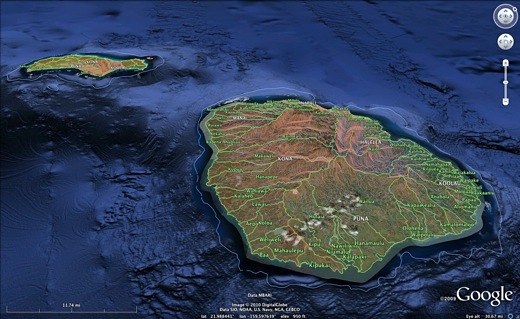
Image above: GoogleEarth screenshot of Maui Nei ahupuaa divisions. Created by Juan Wilson.
By Juan Wilson on 13 September 2010 for Island Breath -
(http://islandbreath.blogspot.com/2010/07/na-mokupuni-o-kauai-nei.html)
Author's Note on 2/1/12: To obtain the most recent ahupuaa and moku maps of Hawiian islands in PDFs of 24x36 plots, PNG files for publication, KMZ files for GoogleEarth or SHP files for GIS systems visit (http://www.islandbreath.org/mokupuni/mokupuni.html)
Links to the the island's Hawaiian land divisions for Google Earth is now available. Download the zip file below and expand it to a KML file. Open the resulting KML file with Google Earth to see the Ahupuaa and Moku of the island. The data includes elevation contour lines and all streams and rivers. The file is large for Google Earth and can take some several minutes to be up and running. Place this file in "MY PLACES" and save to disk:
Image above: GoogleEarth screenshot of Maui Nei ahupuaa divisions. Created by Juan Wilson.
By Juan Wilson on 13 September 2010 for Island Breath -
(http://islandbreath.blogspot.com/2010/07/na-mokupuni-o-kauai-nei.html)
Author's Note on 2/1/12: To obtain the most recent ahupuaa and moku maps of Hawiian islands in PDFs of 24x36 plots, PNG files for publication, KMZ files for GoogleEarth or SHP files for GIS systems visit (http://www.islandbreath.org/mokupuni/mokupuni.html)
Links to the the island's Hawaiian land divisions for Google Earth is now available. Download the zip file below and expand it to a KML file. Open the resulting KML file with Google Earth to see the Ahupuaa and Moku of the island. The data includes elevation contour lines and all streams and rivers. The file is large for Google Earth and can take some several minutes to be up and running. Place this file in "MY PLACES" and save to disk:
Mokupuni O Kauai
(http://www.islandbreath.org/2010Year/09/100915KauaiNei/100915Kauai.zip)
Mokupuni O Niihau
(http://www.islandbreath.org/2010Year/09/100915KauaiNei/100915Niihau.zip)
The following article is a previous revision on ongoing work on traditional Hawaiian land divisions.
(http://www.islandbreath.org/2010Year/09/100915KauaiNei/100915Kauai.zip)
Mokupuni O Niihau
(http://www.islandbreath.org/2010Year/09/100915KauaiNei/100915Niihau.zip)
The following article is a previous revision on ongoing work on traditional Hawaiian land divisions.
Links to the web embedded ahupuaa maps of Kauai and Niihau. Note you may be asked to download a GoogleEarth browser plug-in and that it takes as long as 45 seconds to load the data:
Ea O Ka Aina: Na Mokupuni o Kauai 8/1/10
Ea O Ka Aina: Na Mokupuni o Niihau 8/1/10
For background see:
Ea O Ka Aina: Na Mokupuni o Niihau 8/1/10
For the last few years I, with the help of others, including Jonathan Jay and the late Jean Ileialoha Beniamina, have been trying to identify the names and locations of the historic land divisions in Kauai Nei used by Hawaiians to sustainably manage land for centuries.
Since this spring that work has been expanded to include all the eight main islands in the Hawaiian chain. The Western Pacific Regional Fisheries Management Council has contracted with IslandBreath.org to map the moku (bioregional) and ahupuaa (watershed) divisions throughout the state.
On June 1st, 2010, we completed a submission that included the latest version of our maps of Kauai and Niihau. Since then we have been working on Maui Nei (Maui, Molokai, Lanai, Kahoolawe). On August 1st we will deliver that submission with a newly revised version Kauai and Niihau.
We are scheduled to submit the Big Island of Hawaii on October 1st 2010, and Oahu on December 1st 2010. We will share the results on this website. An interactive GoogleEarth website embed of each island will be provided as well as a reproducible image. Research indicates that historically there have been changes in the mapping of ahupuaa. It depended not only on the cultural, historic and geographic knowledge of the cartographer, but the motivation behind doing the map. It is likely that the need to manage resources increased as they were utilized by an expanding population.
Certainly, over the centuries how they were managed changed. In time kapu (taboo laws) were enactedf and taxes based on ahupuaa resources were collected. After European contact, in the mid 19th century, the concept private property was accepted and it soon secured a foothold for widespread plantation agriculture.
Water was diverted out of the valleys and the ahupua land use concept fell into disuse. In some places, like theMaui's Hamakuapoko Moku (From the airport near Kahaluhi harbor to Haiku) the land was so aggressively managed western plantation owners that ditches dams and reservoirs completely erased original streambeds. Hawaiian place names disappeared and subsequent maps of Maui had no Ahupuaa names.
Instead we have Sprecklesville and Baldwin Avenue. I have attempted to create a set of maps that have moku and ahupuaa covering all of each island. I have tried to use the earliest printed source material available as a foundation. I have tried to eliminate the distortions caused by conquest and war. The boundaries for the land divisions is strictly based on topological features of the land: shorelines, streambeds, and mountain ridges.
Like the informer Deep Throat advised Woodward and Bernstein to the bottom of Richard Nixon's machinations; "Follow the money!" In the case of Ahupuaa that adive would be "Follow the water!" Note: Depending on the island, it may take several seconds to a minute for the data to load. The following is the content of the "splash" page for the Kauai Nei GoogleEarth Maps.
See also:
Ea O Ka Aina: Mokupuni O Hawaii 9/25/10
Ea O Ka Aina: Na Mokupuni O Maui Nei 7/31/10
Ea O Ka Aina: Mokupuni O Oahu 11/16/10
On June 1st, 2010, we completed a submission that included the latest version of our maps of Kauai and Niihau. Since then we have been working on Maui Nei (Maui, Molokai, Lanai, Kahoolawe). On August 1st we will deliver that submission with a newly revised version Kauai and Niihau.
We are scheduled to submit the Big Island of Hawaii on October 1st 2010, and Oahu on December 1st 2010. We will share the results on this website. An interactive GoogleEarth website embed of each island will be provided as well as a reproducible image. Research indicates that historically there have been changes in the mapping of ahupuaa. It depended not only on the cultural, historic and geographic knowledge of the cartographer, but the motivation behind doing the map. It is likely that the need to manage resources increased as they were utilized by an expanding population.
Certainly, over the centuries how they were managed changed. In time kapu (taboo laws) were enactedf and taxes based on ahupuaa resources were collected. After European contact, in the mid 19th century, the concept private property was accepted and it soon secured a foothold for widespread plantation agriculture.
Water was diverted out of the valleys and the ahupua land use concept fell into disuse. In some places, like theMaui's Hamakuapoko Moku (From the airport near Kahaluhi harbor to Haiku) the land was so aggressively managed western plantation owners that ditches dams and reservoirs completely erased original streambeds. Hawaiian place names disappeared and subsequent maps of Maui had no Ahupuaa names.
Instead we have Sprecklesville and Baldwin Avenue. I have attempted to create a set of maps that have moku and ahupuaa covering all of each island. I have tried to use the earliest printed source material available as a foundation. I have tried to eliminate the distortions caused by conquest and war. The boundaries for the land divisions is strictly based on topological features of the land: shorelines, streambeds, and mountain ridges.
Like the informer Deep Throat advised Woodward and Bernstein to the bottom of Richard Nixon's machinations; "Follow the money!" In the case of Ahupuaa that adive would be "Follow the water!" Note: Depending on the island, it may take several seconds to a minute for the data to load. The following is the content of the "splash" page for the Kauai Nei GoogleEarth Maps.
AHA KIOLE ADVISORY COMMITTEE of the Western Pacific Regional Fishery Management Council All rights reserved. © 2010 by the Aha Kiole Advisory Committee & www.IslandBreath.org
• Revision 1.0.0 on 1 August 2010 These Kauai land identifications were delineated and converted to GIS and GoogleEarth KMZ format by: Juan Wilson - Architect/Planner with the assistance of Jonathan Jay
Criteria: Simon Peter Kalama Maps (1837, 1838) of moku and ahupuaa were used as a foundation for these map boundaries. All moku and ahupuaa shown on Kalama maps are included in this project. The source for the 1837 Kalama map was the U.S. Librabry of Congress. The 1838 Kalama map was made available from the British Royal Geographic Society. Note, area names are written without traditional Hawaiian diacritical marks, as was the practice of Kalama. The divisions are based also on traditional descriptions of location, with boundaries modified to follow watershed ridges and streams/rivers from available topography.
Procedure: After identifying Kalama ahapuaa and moko locarions and names the Aha Kiole Advisary Committee Final Report was compared with State of Hawaii DBEDT GIS files (Streams, water bodies and elevation contours) and added to GoogleEarth aerial photography and 3D elevation data to determine final ahupuaa and moku names locations and boundaries.
Sources: A two letter code for the sources of each ahupuaa can be seen when clicking within its boundary. They are: (sk) Simon Peter Kalama "Na Mokupuni O Hawaii Nei" maps printed in 1837 and 1838, (ak) Aha Kiole Advisary Committee Final Report 12/18/08, (gs) United States Geological Survey Maps 7.5º topographic maps), (ab) W. D. Alexander island surveys for the Hawaiian Government, (ib) Island Breath research by Juan Wilson and Jonathn Jay.
See also:
Ea O Ka Aina: Mokupuni O Hawaii 9/25/10
Ea O Ka Aina: Na Mokupuni O Maui Nei 7/31/10
Ea O Ka Aina: Mokupuni O Oahu 11/16/10
Ea O Ka Aina: Kauai & Niihau Mokupuni 4/16/10
Ea O Ka Aina: Kauai Aina Mapping 12/21/09
.
Maui Ahupuaa
SUBHEAD: Traditional Hawaiian land divisions of Maui. About 2 minutes to load.
[IB Publisher's note: Google has announced that The Google Earth API for embedding 3D maps on webpages been deprecated as of December 12th, 2014]
HAWAII•MAUI•MOLOKAI•LANAI•KAHOOLAWE•OAHU•KAUAI•NIIHAU
For background see:
Ea O Ka Aina: Mokupuni O Hawaii 9/25/10
Ea O Ka Aina: Na Mokupuni O Maui Nei 7/31/10
Ea O Ka Aina: Mokupuni O Oahu 11/16/10
Ea O Ka Aina: Na Mokupuni O Kauai Nei 7/31/10
For downloads of latest Ahupuaa-Moku Maps see:
http://www.islandbreath.org/mokupuni/mokupuni.html
[IB Publisher's note: Google has announced that The Google Earth API for embedding 3D maps on webpages been deprecated as of December 12th, 2014]
HAWAII•MAUI•MOLOKAI•LANAI•KAHOOLAWE•OAHU•KAUAI•NIIHAU
For background see:
Ea O Ka Aina: Mokupuni O Hawaii 9/25/10
Ea O Ka Aina: Na Mokupuni O Maui Nei 7/31/10
Ea O Ka Aina: Mokupuni O Oahu 11/16/10
Ea O Ka Aina: Na Mokupuni O Kauai Nei 7/31/10
For downloads of latest Ahupuaa-Moku Maps see:
http://www.islandbreath.org/mokupuni/mokupuni.html
.
Molokai Ahupuaa
SUBHEAD: Traditional Hawaiian land divisions of Mokokai. About 1 minute to load.
[IB Publisher's note: Google has announced that The Google Earth API for embedding 3D maps on webpages been deprecated as of December 12th, 2014]
HAWAII•MAUI•MOLOKAI•LANAI•KAHOOLAWE•OAHU•KAUAI•NIIHAU
For background see:
Ea O Ka Aina: Mokupuni O Hawaii 9/25/10
Ea O Ka Aina: Na Mokupuni O Maui Nei 7/31/10
Ea O Ka Aina: Mokupuni O Oahu 11/16/10
Ea O Ka Aina: Na Mokupuni O Kauai Nei 7/31/10
For downloads of latest Ahupuaa-Moku Maps see:
http://www.islandbreath.org/mokupuni/mokupuni.html
[IB Publisher's note: Google has announced that The Google Earth API for embedding 3D maps on webpages been deprecated as of December 12th, 2014]
HAWAII•MAUI•MOLOKAI•LANAI•KAHOOLAWE•OAHU•KAUAI•NIIHAU
For background see:
Ea O Ka Aina: Mokupuni O Hawaii 9/25/10
Ea O Ka Aina: Na Mokupuni O Maui Nei 7/31/10
Ea O Ka Aina: Mokupuni O Oahu 11/16/10
Ea O Ka Aina: Na Mokupuni O Kauai Nei 7/31/10
For downloads of latest Ahupuaa-Moku Maps see:
http://www.islandbreath.org/mokupuni/mokupuni.html
.
Lanai Ahupuaa
SUBHEAD: Traditional Hawaiian land divisions of Lanai. About 45 seconds load.
[IB Publisher's note: Google has announced that The Google Earth API for embedding 3D maps on webpages been deprecated as of December 12th, 2014]
HAWAII•MAUI•MOLOKAI•LANAI•KAHOOLAWE•OAHU•KAUAI•NIIHAU
For background see:
Ea O Ka Aina: Mokupuni O Hawaii 9/25/10
Ea O Ka Aina: Na Mokupuni O Maui Nei 7/31/10
Ea O Ka Aina: Mokupuni O Oahu 11/16/10
Ea O Ka Aina: Na Mokupuni O Kauai Nei 7/31/10
For downloads of latest Ahupuaa-Moku Maps see: http://www.islandbreath.org/mokupuni/mokupuni.html
[IB Publisher's note: Google has announced that The Google Earth API for embedding 3D maps on webpages been deprecated as of December 12th, 2014]
HAWAII•MAUI•MOLOKAI•LANAI•KAHOOLAWE•OAHU•KAUAI•NIIHAU
For background see:
Ea O Ka Aina: Mokupuni O Hawaii 9/25/10
Ea O Ka Aina: Na Mokupuni O Maui Nei 7/31/10
Ea O Ka Aina: Mokupuni O Oahu 11/16/10
Ea O Ka Aina: Na Mokupuni O Kauai Nei 7/31/10
For downloads of latest Ahupuaa-Moku Maps see: http://www.islandbreath.org/mokupuni/mokupuni.html
.
Kahoolawe Ahupuaa
SUBHEAD: Traditional Hawaiian land divisions of Kahoolawe. About 30 seconds load.
[IB Publisher's note: Google has announced that The Google Earth API for embedding 3D maps on webpages been deprecated as of December 12th, 2014]
HAWAII•MAUI•MOLOKAI•LANAI•KAHOOLAWE•OAHU•KAUAI•NIIHAU
For background see:
Ea O Ka Aina: Mokupuni O Hawaii 9/25/10
Ea O Ka Aina: Na Mokupuni O Maui Nei 7/31/10
Ea O Ka Aina: Mokupuni O Oahu 11/16/10
Ea O Ka Aina: Na Mokupuni O Kauai Nei 7/31/10
For downloads of latest Ahupuaa-Moku Maps see:
[IB Publisher's note: Google has announced that The Google Earth API for embedding 3D maps on webpages been deprecated as of December 12th, 2014]
HAWAII•MAUI•MOLOKAI•LANAI•KAHOOLAWE•OAHU•KAUAI•NIIHAU
For background see:
Ea O Ka Aina: Mokupuni O Hawaii 9/25/10
Ea O Ka Aina: Na Mokupuni O Maui Nei 7/31/10
Ea O Ka Aina: Mokupuni O Oahu 11/16/10
Ea O Ka Aina: Na Mokupuni O Kauai Nei 7/31/10
For downloads of latest Ahupuaa-Moku Maps see:
.
Kauai Ahupuaa
SUBHEAD: Traditional Hawaiian land divisions of Kauai. About 90 seconds to load.
[IB Publisher's note: Google has announced that The Google Earth API for embedding 3D maps on webpages been deprecated as of December 12th, 2014]
HAWAII•MAUI•MOLOKAI•LANAI•KAHOOLAWE•OAHU•KAUAI•NIIHAU
For background see:
Ea O Ka Aina: Mokupuni O Hawaii 9/25/10
Ea O Ka Aina: Na Mokupuni O Maui Nei 7/31/10
Ea O Ka Aina: Mokupuni O Oahu 11/16/10
Ea O Ka Aina: Na Mokupuni O Kauai Nei 7/31/10
[IB Publisher's note: Google has announced that The Google Earth API for embedding 3D maps on webpages been deprecated as of December 12th, 2014]
HAWAII•MAUI•MOLOKAI•LANAI•KAHOOLAWE•OAHU•KAUAI•NIIHAU
For background see:
Ea O Ka Aina: Mokupuni O Hawaii 9/25/10
Ea O Ka Aina: Na Mokupuni O Maui Nei 7/31/10
Ea O Ka Aina: Mokupuni O Oahu 11/16/10
Ea O Ka Aina: Na Mokupuni O Kauai Nei 7/31/10
Niihau Ahupuaa
SUBHEAD: Traditional Hawaiian land divisions of Niihau. About 30 seconds load.
[IB Publisher's note: Google has announced that The Google Earth API for embedding 3D maps on webpages been deprecated as of December 12th, 2014]
HAWAII•MAUI•MOLOKAI•LANAI•KAHOOLAWE•OAHU•KAUAI•NIIHAU
For background see:
Ea O Ka Aina: Mokupuni O Hawaii 9/25/10
Ea O Ka Aina: Na Mokupuni O Maui Nei 7/31/10
Ea O Ka Aina: Mokupuni O Oahu 11/16/10
Ea O Ka Aina: Na Mokupuni O Kauai Nei 7/31/10
For downloads of latest Ahupuaa-Moku Maps see:
http://www.islandbreath.org/mokupuni/mokupuni.html
[IB Publisher's note: Google has announced that The Google Earth API for embedding 3D maps on webpages been deprecated as of December 12th, 2014]
HAWAII•MAUI•MOLOKAI•LANAI•KAHOOLAWE•OAHU•KAUAI•NIIHAU
For background see:
Ea O Ka Aina: Mokupuni O Hawaii 9/25/10
Ea O Ka Aina: Na Mokupuni O Maui Nei 7/31/10
Ea O Ka Aina: Mokupuni O Oahu 11/16/10
Ea O Ka Aina: Na Mokupuni O Kauai Nei 7/31/10
For downloads of latest Ahupuaa-Moku Maps see:
http://www.islandbreath.org/mokupuni/mokupuni.html
.
Mufi, Duke & Evangelism
SUBHEAD: Mufi Hannemann, Duke Aiona, Transformation Hawaii, and evangelism.
By Bruce Wilson on 17 April 2010 for TalkAction.org -
(http://www.talk2action.org/story/2010/4/17/112159/323)
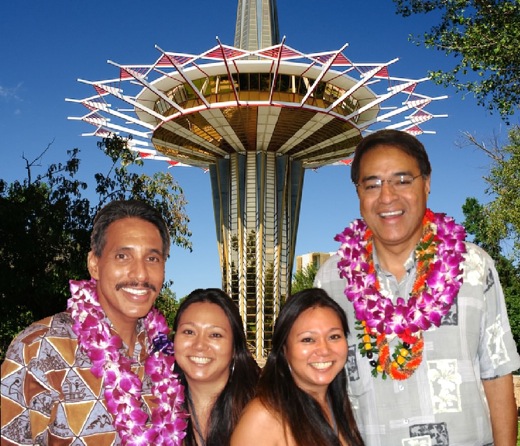
Image above: Distinctly different - Duke Aiona and Mufi Hannemann on vacation at the Oklahoma Prayer Tower at Oral Roberts University. Mashup by Juan Wilson. Click to enlarge.
[IB Editor's note - Know what you're getting into. A common link between Mufi Hannemann and Duke Aiona, is the International Transformation Network. Neil Abercrombie is not a part of it.]
Transforming Hawaii, Part 1
"It doesn't matter if the Republican or the Democratic candidate wins the governorship [of Hawaii]. Either one is already in the kingdom," declared International Transformation Network Founder and CEO Ed Silvoso at the March 4-6 Convergence 2010 conference in Dallas, as Silvoso was announcing the ITN's upcoming 20th International Transformation Network conference, scheduled to be held November 9-14, 2010 at the Hilton Hawaiian Village near Honolulu.
At the ITN's 19th world conference, on November 7, 2009 at the Hilton Hawaiian Village, Hawaii's current Republican Lt. Governor James "Duke" Aiona, running in 2010 to be Hawaii's next governor, repeatedly jabbed his finger at the podium, for emphasis, as he told his audience,
Inside the US, the International Transformation Network is not overtly eliminationist. But ITN faculty members have endorsed the work of church-based, government-backed death squads in Latin America and, in Africa, the ITN is associated with pending legislation apparently aimed at eliminating or imprisoning an entire segment of Ugandan society.
As goes Uganda, so goes Hawaii ?
ITN operatives have played a significant role organizing and inspiring Ugandan legislators who have drafted, cosponsored, and backed the draconian and internationally denounced Anti Homosexuality Bill before Uganda's parliament which would mandate the execution of many HIV positive Ugandans and also require, on pain of three years in prison, that citizens report to the police anyone suspected of being gay. The penalty for being homosexual in Uganda is imprisonment for life.
International Transformation Network leaders such as Ed Silvoso claim homosexuals are possessed by demons, assert that HIV and AIDS can be cured through faith healing and prayer, and decry basic birth control methods. They oppose labor unions and secular public education. ITN ideology targets mainstream Christianity with the charge that Catholics and Protestants who are not "born again" and charismatic are not saved and so will not go to heaven.
The International Transformation Network is part of a global charismatic evangelical movement that seeks to "transform" cities, nations, even whole continents, by purifying the world of perceived evil. As ITN Founder and CEO Ed. Silvoso states in a promotional video, "Jesus designed the church to be his agency on Earth to destroy Satan's empire."
Introducing Duke Aiona's speech, at the 2009 International Transformation Network conference, ITN Chairman and noted Hawaii architect Francis Oda declared, "God is transforming Hawaii... we are the tip of his spear."
After Aiona's speech Francis Oda, his wife Caroline, and ITN Council member Cal Chinen, laid hands on Duke Aiona while Ed Silvoso pronounced, "We are breaking every weapon of the enemy, we are canceling every curse... we are declaring there is an even greater future for the Lt. Governor and his wife."
Then Silvoso called upon God to bless Lt. Governor Aiona while the audience of over 500 delegates from six continents, arms upraised, hands outstretched, swaying back and forth, echoed, in unison, Ed Silvoso's words.
The ITN has concerted "transformation" projects underway across the globe, in Argentina, the Philippines, Uganda, Hawaii, and elsewhere.
By Bruce Wilson on 17 April 2010 for TalkAction.org -
(http://www.talk2action.org/story/2010/4/17/112159/323)

Image above: Distinctly different - Duke Aiona and Mufi Hannemann on vacation at the Oklahoma Prayer Tower at Oral Roberts University. Mashup by Juan Wilson. Click to enlarge.
[IB Editor's note - Know what you're getting into. A common link between Mufi Hannemann and Duke Aiona, is the International Transformation Network. Neil Abercrombie is not a part of it.]
Transforming Hawaii, Part 1
"It doesn't matter if the Republican or the Democratic candidate wins the governorship [of Hawaii]. Either one is already in the kingdom," declared International Transformation Network Founder and CEO Ed Silvoso at the March 4-6 Convergence 2010 conference in Dallas, as Silvoso was announcing the ITN's upcoming 20th International Transformation Network conference, scheduled to be held November 9-14, 2010 at the Hilton Hawaiian Village near Honolulu.
At the ITN's 19th world conference, on November 7, 2009 at the Hilton Hawaiian Village, Hawaii's current Republican Lt. Governor James "Duke" Aiona, running in 2010 to be Hawaii's next governor, repeatedly jabbed his finger at the podium, for emphasis, as he told his audience,
"We're one body of Christ, we're one church and we're all here to disciple the nations, here in Hawaii and everywhere else, and I want you all to know that... May God's grace be with the participants of the International Transformation Network Global conference. Aloha, from myself, Lt. Governor Duke Aiona to all of you but in particular to pastor Ed [Silvoso.]"At the ITN's 18th world conference, held October 2008 in Mar del Plata, Argentina, Silvoso likened opponents of his movement to rats that would be killed when necessary. Silvoso's movement may well be in the forefront of organizing against gay rights globally.
Inside the US, the International Transformation Network is not overtly eliminationist. But ITN faculty members have endorsed the work of church-based, government-backed death squads in Latin America and, in Africa, the ITN is associated with pending legislation apparently aimed at eliminating or imprisoning an entire segment of Ugandan society.
As goes Uganda, so goes Hawaii ?
ITN operatives have played a significant role organizing and inspiring Ugandan legislators who have drafted, cosponsored, and backed the draconian and internationally denounced Anti Homosexuality Bill before Uganda's parliament which would mandate the execution of many HIV positive Ugandans and also require, on pain of three years in prison, that citizens report to the police anyone suspected of being gay. The penalty for being homosexual in Uganda is imprisonment for life.
International Transformation Network leaders such as Ed Silvoso claim homosexuals are possessed by demons, assert that HIV and AIDS can be cured through faith healing and prayer, and decry basic birth control methods. They oppose labor unions and secular public education. ITN ideology targets mainstream Christianity with the charge that Catholics and Protestants who are not "born again" and charismatic are not saved and so will not go to heaven.
The International Transformation Network is part of a global charismatic evangelical movement that seeks to "transform" cities, nations, even whole continents, by purifying the world of perceived evil. As ITN Founder and CEO Ed. Silvoso states in a promotional video, "Jesus designed the church to be his agency on Earth to destroy Satan's empire."
Introducing Duke Aiona's speech, at the 2009 International Transformation Network conference, ITN Chairman and noted Hawaii architect Francis Oda declared, "God is transforming Hawaii... we are the tip of his spear."
After Aiona's speech Francis Oda, his wife Caroline, and ITN Council member Cal Chinen, laid hands on Duke Aiona while Ed Silvoso pronounced, "We are breaking every weapon of the enemy, we are canceling every curse... we are declaring there is an even greater future for the Lt. Governor and his wife."
Then Silvoso called upon God to bless Lt. Governor Aiona while the audience of over 500 delegates from six continents, arms upraised, hands outstretched, swaying back and forth, echoed, in unison, Ed Silvoso's words.
The ITN has concerted "transformation" projects underway across the globe, in Argentina, the Philippines, Uganda, Hawaii, and elsewhere.
Duke Aiona, Mufi Hannemann, Transformation Hawaii, and the ITN
The International Transformation Network's efforts in Hawaii are being coordinated by a 501(c)(3) entity called Transformation Hawaii. For at least three years (from 2005 through 2008) Duke Aiona has been listed as Transformation Hawaii's honorary chairman and since 2007 Transformation Hawaii has been an official chapter of the International Transformation Network making Aiona, in effect, an honorary member of the ITN as well.
Transformation Hawaii is developing the ability to mobilize large numbers of Hawaiian voters and, because Hawaii has historically had a low rate of voter turnout, the organization's ongoing church-based voter registration drive has the potential to significantly impact upcoming elections such as the 2010 Hawaii gubernatorial race.
ITN CEO Ed Silvoso's claim at the Dallas Convergence 2010 conference, that both the Democratic and Republican candidates for governor are "already in the kingdom" is suggestive given Honolulu Mayor Mufi Hannemann's association with Transformation Hawaii.
Hannemann has not yet announced his candidacy but the general assumption is that he will, and the Honolulu Mayor has raised over 2 million dollars - far more than Hannemann's Democratic rival Neal Abercrombie or GOP candidate Duke Aiona.
Even if Abercrombie runs against Hannemann and prevails in a Democratic Party gubernatorial primary battle that will nonetheless take valuable cash resources away from the Abercrombie campaign in the general election. But the odds may well lie with Hannemann. Besides having substantial cash reserves and a bully pulpit as Honolulu's mayor, Hannemann holds at least one major hot button position in common with the Transformation Hawaii movement - opposition to civil unions and gay marriage (Hannemann has so far refused to state his position on abortion). Hannemann's potential Democratic Party adversary Neal Abercrombie supports civil unions.
Because Hawaii's primaries are open, Transformation Hawaii-associated voters who are registered as Republicans or independents can nonetheless vote for Hannemann in the Democratic primary.
If Abercrombie loses in the primary, Hawaiians will have to choose between two candidates both of whom are associated with a religio-political movement that, beyond US shores, is brutally eliminationist.
According to Richard Borreca of the Honolulu Star Bulletin, Mufi Hannemann attended, along with Lt. Gov. Duke Aiona, a May 20-21, 2005 Transformation Hawaii event at the Waikiki Shell of the Neal Blaisdell Center near Honolulu. Leading the event was International Transformation Network CEO Ed Silvoso.
As a 24 minute mini-documentary video produced by the ITN described the event, "In May of 2005, Transformation Hawaii, in partnership with Harvest Evangelism (Ed Silvoso's Argentina ministry) held a statewide conference in Honolulu to train, connect, and commission marketplace ministers."
Silvoso defines the "marketplace" as all sectors of society outside of the church. So the role of "marketplace ministers" is to bring the ITN's version of Christianity into all areas of society including business, government, media, and education.
Towards the close of the event, Silvoso declared, "Let the Lord reveal, supernaturally, that as we leave this arena today, and we begin to speak peace and bless people all over Hawaii, Satan will fall down and his empire will be destroyed."
Duke Aiona starred in a Transformation Hawaii-produced video ad for the event in which Aiona, clearly identified as Hawaii's Lt. Governor, declared,
On 9:00 AM on January 21, 2008 Duke Aiona and Mufi Hannemann shared a stage at the opening ceremonies for a Transformation Hawaii / International Transformation Network "Catch the Wave" two-day conference at the Hawaii Convention Center. At 9:30 AM that morning, in session one, Aiona and Honolulu Councilman Gary Okino shared the stage with top leaders of Transformation Hawaii and the ITN: Ed Silvoso, Cal Chinen, and Francis Oda.
E Pule Kakou & Hawai'i He'e Nalu
One of Transformation Hawaii's spinoff initiatives is E Pule Kakou ("Let us pray"), a Hawaii prayer effort started by Transformation Hawaii's Cofounder and Chairman of the Board of Directors Cal Chinen. E Pule Kakou reports that its 2009 Thanksgiving day prayer event was televised over nine cable networks, and on all major networks in the state of Hawaii, and watched, according to Nielson ratings, by 400,000 people.
Duke Aiona delivered a televised prayer for E Pule Kakou's 2008 Thanksgiving prayer event, in which he proclaimed, speaking as an individual (not in his capacity as Lt. Governor), that "my island is God's island, my state is God's state, and we declare in prayer as God's Ohana that our Hawai'i is God's Hawai'i. In Jesus name we pray, amen."
Ed Silvoso is listed as the featured guest speaker for upcoming April 17 and 24, 2010 E Pule Kakou breakfast meetings and, over the course of the decade, Silvoso has traveled to Hawaii for numerous ITN/Transformation Hawaii events.
Transformation Hawaii has recently been cobranded as Hawai'i He'e Nalu ("Hawai'i Catch the Wave"), whose web site states the effort "doesn't seek to benefit any one religious group or denomination for dominance" and works to address social and economic problems in Hawaii as well as "cultural malaise and social degradation affecting the people and communities within the State."
Hawai'i He'e Nalu's stated vision and purpose is sweepingly grandiose. Besides "embracing and upholding traditional family values" and working to "restore godly principles in our families, to the Islands and to the nations of the world," Hawai'i He'e Nalu "is in such a unique position to change the course of history that it could possibly alter a new reformation" and the effort "could serve as a catalyst for a monumental paradigm shift for the nations of the world."
One of the Transformation Hawaii / Hawai'i He'e Nalu projects has been the so-called "Aloha Card." Lt. Governor Duke Aiona has handed out, with the approval of Hawaii's Department of Education, tens of thousands of the plastic business-card sized cards to students in Hawaii's schools. The cards feature spare aphorisms created by placing attribute words under three header categories - "seed planted," "fruit of seed," and "harvest."
Most of the Aloha card's aphorisms (such as "the seed of forgiveness leads to the fruit of unity and a harvest of joy") might not be controversial anywhere in the United States. Brainchild of Transformation Hawaii President Allen Cardines of Hope Chapel Nanakuli, the Aloha Card project is probably the least controversial of Hawai'i He'e Nalu's spinoff projects.
It is also officially a sub-ministry of Cardines' church operating in partnership with Transformation Hawaii, the Office of the Lt. Governor, elements of the Hawaii National Guard and the Honolulu Police Department, and Cal Chinen's Moanalua Gardens Missionary Church.
That cobranding and co-endorsement is characteristic of Transformation Hawaii's numerous efforts. Although Allen Cardines' and Cal Chinen's sectarian tendency is portrayed as ecumenical and broadly representative of all Christianity, it is anything but and Christianity, in turn, is hardly representative of the beliefs of all Hawaiians.
Church and state, or state church ?
While the Aloha Card project probably does not violate the Establishment Clause provision of the US Constitution (or an identical provision in Hawaii's constitution), Duke Aoina's December 2004 speech, at a Transformation Hawaii-organized event, dedicating Hawaii and its schools to Jesus Christ likely crossed the line.
On December 8th, 2004, at a statewide, telecast Transformation Hawaii prayer event Lt. Gov. Aiona dedicated Hawaii to Jesus declaring, "our school will become God's school, our community will become God's community, our city will become God's city, our Island will become God's island, our state will become God's state, our Hawai'i will become God's Hawai'i. Lord Jesus Christ, as it is in heaven so also in Hawai'i. Let your kingdom come, let your will be done. Amen!"
As Ed Silvoso exulted in the February 2005 report of his Harvest Evangelism ministry,
Reacting to a 24 minute documentary video, commissioned by International Transformation Network CEO Ed Silvoso and produced by Transformation Hawaii Cofounder Cal Chinen, that depicts the history of the Transformation Hawaii effort, Sands states, "if the facts presented in the video are true, Aiona... was acting in his capacity as Lt. Gov." when Aiona proclaimed "Christ as the Light of Hawaii" and invited "the Light of Christ" into Hawaii's public schools.
"This is something that is constitutionally prohibited," according to Sands, "Like all elected officials Aiona took an oath to uphold the constitution. Whether he simply does not understand the constitutional provisions about religion, or willfully defies them, this should be of very serious concerns to voters."
Professor Sands stresses that what's particularly constitutionally problematic is that Transformation Hawaii and the ITN promote a form of Christianity that is anything but generic or representative of religion in general.
"A public official is definitely NOT free to use his elected office to throw government power behind any particular religious viewpoint. There is debate in the judiciary about whether government may support "religion as such" as distinct from particular religious groups or beliefs. However, there is no debate about the fact that government may never support one religion or religious belief over another," Sands states.
Duke Aiona's endorsement of Transformation Hawaii (and by extension the International Transformation Network) would seem to disenfranchise up to one half of Hawaii's entire population according to Sands, who notes that the Transformation Hawaii/ITN religious network "excludes non-Christians [over 30% of Hawaii's population according to one survey]. It even excludes mainline and Protestant orthodox Christians, who do NOT support the establishment of Christianity. [up to 20% of Hawaii's population]"
The most politically controversial aspect, observes Sands, is that,
As Cal Chinen's son Daniel remarked, in the February 20 and 22, 2009 MGMC church newsletter, on the growing politicization of his Maonalua Gardens Missionary Church, "In the last several weeks, here at MGMC, we have been talking a lot about politics, which is unusual for our congregation." The newsletter contained a notice encouraging members of the church to turn out for a February 2009 rally at the Hawaii state capital against the pending civil unions bill before the Hawaii state legislature:
"Please come out to the State Capital to show your support of Traditional Marriage. We want to oppose the Civil Unions HB 444 by showing them God's love and peace. Please wear red clothing." In a subsequent church newsletter Chinen suggested that over 8,000 had turned out for the anti- HB 444 rally in February 2009.
A year later, another anti-HB 444 rally on January 18, 2010, Martin Luther King Day, drew perhaps twice as many protesters.
The January 18th rally at the Hawaii state capital building was attended by Transformation Hawaii president Allen Cardines, Lt. Governor Aiona, and Honolulu mayor Mufi Hannemann - who spoke at the rally, attacking "attempts to distort my message in support of traditional marriage....I believe in the sanctity of marriage between one man and one woman."
As Cal Chinen's church newsletter shows, his church has taken up the project of indoctrinating teenage members of his church in antiabortion politics. As Chinen wrote in the January 30 / February 1, 2009 MGMC newsletter,
Opposition to gay rights and abortion might well be the lesser part of what's notably sectarian about Transformation Hawaii/ITN ideology.
`Spiritual Mapping' the enemies
In urging attendees of the Dallas Convergence 2010 conference to go to the upcoming International Transformation Network conference in Hawaii next November 2010, ITN CEO Ed Silvoso told attendees, "You're going to come to a state where every school has been prayer-walked, every teacher adopted, every student been interceded for..."
Transformation Hawaii's first incarnation, a student effort called United in Prayer in which students formed prayer groups in schools, seemed finely calibrated to walk up to, but not over, the line drawn by the constitution's establishment clause. Nominally student-led, parents and pastors would coach United in Prayer students, right up to school doors. The students themselves would then conduct prayer services in their schools.
That effort, spread statewide, was the backdrop for Duke Aiona's 2004 dedication of Hawaii to Jesus. But what is "prayer walking" ?
Prayer Walking is part of an elaborate new evangelizing paradigm Ed Silvoso helped to create during the late 1980's through the early 1990's. In prayer walking, believers methodically walk cities, towns, and geographical areas, praying for unbelievers but also mapping out areas allegedly infested by demon powers.
The practice was exported globally from Colorado Springs during the 1990's and into the following decade, by Ted Haggard and his close working colleague C. Peter Wagner, a church growth specialist. In 2003 Haggard became head of the 27 million or more strong National Association of Evangelicals and during his brief tenure at the position, before falling from power due to a sex and drugs scandal, claimed to be having weekly conversations with the White House.
Colorado Springs may have been the first US city of any size to be "prayer walked," a practice Ted Haggard referred to a "grid praying." Public radio reporter Alix Spiegel covered the prayer walking and spiritual mapping efforts of Haggard's New Life Church in Colorado Springs, in a 1997 radio segment for This American Life (segment #77, "Pray").
Initially exposed to the benign face of Spiritual Mapping, in which believers "prayer walk" city streets praying for residents and businesses, Alix Spiegel was sympathetic at first until she went out with a New Life Church team that sought to expel demons, from a high school playground, which allegedly had been attracted by the freethinking ways of high school drama students.
The rise of the Spiritual Mapping movement was also noted in a prescient 1999 article by Jane Lampmann of the Christian Science Monitor, "Targeting cities with 'spiritual mapping,' prayer." As Lampmann wrote,
During the 1990's Spiritual Mapping was exported most aggressively from the United States to Africa. In Mali, Dutch missionary Rene Holvast was perplexed and disturbed by the new evangelical paradigm to the point of taking a break from missions work to study and then write a doctoral dissertation [PDF file of dissertation] on Spiritual Mapping, which was updated and published as a book, in November 2008, by Brill: Spiritual Mapping in the United States and Argentina, 1989-2005: A Geography of Fear.
C. Peter Wagner and Cindy Jacobs were, along with Ed Silvoso, two key figures who helped develop the practice of spiritual mapping which Silvoso has since repackaged through the benign-sounding term "prayer evangelism." But the dark side of the practice comes out starkly in a 2003 book by Ed Silvoso's colleague C. Peter Wagner, Breaking strongholds in your city: How to use spiritual mapping to make your prayers more strategic, effective, and targeted.
On page 177 Wagner defines Spiritual Mapping as a practice which "combines research, divine revelation, and confirmatory evidence in order to provide complete and exact data concerning the identity, strategies and methods employed by spiritual forces of darkness to influence the people and the churches of a given region."
On page 229 Wagner details "Non-Christian" influences spiritual mappers (prayer walkers, that is) should make note of: "high places, altars, temples, monuments or buildings associated with witchcraft, occult, fortune-telling, satanism, Freemasonry, Mormonism, Eastern religions, Jehovah's Witnesses and the like."
Wagner also instructs mappers to note, among "Christian" influences, `Where are the churches located ? Which of them would you see as "life giving" churches ?' Typically within Wagner's, Jacobs', and Silvoso's movement mainline Protestant and non-charismatic Catholic churches are defined as non-"life giving."
Wagner's list indicates that he considers non-charismatic Christian churches to be suspect and Mormons and Jehovah's Witnesses not to be Christian at all. Given Peter Wagner's close working relationship with Ed Silvoso, it is unlikely the two men differ on this issue. Like Cindy Jacobs, Ed Silvoso is an apostle in Wagner's International Coalition of Apostles, founded in 2001, and serves with Wagner on that organization's elite Apostolic Council which "provides advice and accountability" for the ICA.
Spiritual Mapping recently came to media notice because of a charismatic evangelical group's "spiritual mapping" activities in Amarillo, Texas. Members of Repent Amarillo have created, using Google Maps, an online "spiritual map" of allegedly demonic institutions in the city of Amarillo. These include Methodist and Episcopal churches that are "gay friendly" and accept homosexuality, Christian Scientist and Unitarian churches, Mosques, Buddhist and Hindu temples, New Age centers, centers where pagans gather, a nature center, porn shops, gay bars, a palm-reading business, and a swinger's club.
As reported in a February 24, 2010 story in the Texas Observer, members of Repent Amarillo have targeted the Amarillo swinger's club with special zeal; "[Repent Amarillo members] have been a near-constant presence. Jobs have been lost, families estranged, assault charges filed and businesses shuttered. So far, no public official has stood up to defend these businesses, which operate legally."
Repent Amarillo's spirit mapping effort is not an anomaly. Based in Austin, Texas, Campus Renewal Ministries is a college and university based ministry which claims to have had spiritual mapping efforts underway on campuses across the US for fourteen years.
As noted author and researcher of conservative Christianity Sarah Diamond described in her 1995 book Roads To Dominion: right-wing movements and political power in the United States, Guatemalan dictator Efrain Rios Montt was converted to charismatic evangelical Christianity when `a group of young California "Jesus freaks" brought their Gospel Outreach church to earthquake-ravaged Guatemala in 1976.'
Demons in human form
During the counterinsurgency campaign in Guatemala in the 1980's thousands of Guatemalan civilians, mostly indigenous Maya, were slaughtered. As Diamond writes,
One of the notable members of Caballeros' affluent El Shaddai megachurch has been Erwin Sperisen, former director of Guatemala's Policia Nacional Civil (National Civilian Police) which has been accused by the press and human rights groups of extrajudical executions of gang members and criminals, a practice known as limpienza social (social cleansing.)
As described by Dennis A. Smith in a paper written for the Latin American Studies Association, in April 2007 Sperisen and Caballeros appeared together on Canal 27, a local Guatemalan television program on a show created by Sperisen to, according to Smith, "provide police officers with the spiritual resources they needed to combat the forces of evil."
As Smith recounts, during the segment Sperisen addressed Caballeros as "The Prophet and Apostle Brother Harold Caballeros," and Caballeros went on to state,
Along with Cindy Jacobs and Ed Silvoso, Harold Caballeros is also a listed member of the International Coalition of Apostles and has also served with Wagner and Jacobs on Peter Wagner's elite Apostolic Council of Prophetic Elders.
Caballeros was listed, along with Cindy Jacobs, as being on the faculty of Silvoso's 2004 ITN conference in Argentina, and in his book Transformation Ed Silvoso lauds Harold Caballeros' enterprise and daring, "His willingness and courage to sail on totally uncharted waters is admirable."
Harold Caballeros sits on an advisory board for a grant from the Templeton Foundation to Harvard and Tufts, and he has spoken at a Templeton-funded academic conference held by the University of Southern California.
Prayer, and "enemy identification," in Newark, NJ
Spiritual Mapping was first applied on a mass scale, by Ed Silvoso, Cindy Jacobs, Peter Wagner and other pioneers of the practice, during the late 1980's in the Argentine city of Resistencia. Along with Cal Chinen's Transformation Hawaii, another ITN initiative showcased at the International Transformation Network's 2008 Argentina conference was PrayforNewark, an effort led in Newark, New Jersey by International Coalition of Apostles member Rev. Bernard Wilks.
PrayforNewark was founded in early 2008, on Martin Luther King Day, by New Jersey resident Lloyd Turner who at the October 2008 Argentina conference told attendees that PrayforNewark could North America's "Resistencia," a prototype for similar efforts that would sweep across the cities and towns of the continent.
PrayforNewark has an ambitious prayer walking / spiritual mapping program that, now claims to have one volunteer covering nearly every single street in Newark, New Jersey's largest city. As if they were working in a political campaign, PrayforNewark's volunteers are organized by Newark city ward.
Literature on the PrayforNewark web site states the effort is working to "transform" Newark according to Ed Silvoso's teachings, and church newsletters from Bernard Wilks ministry have stated, as part of the PrayforNewark effort, the need for "enemy identification." [ PDF file of PrayforNewark's "Benchmarks and Visions ]
PrayforNewark, and the ongoing efforts in Uganda and Hawaii, were all showcased prominently at the 2008 Argentina ITN conference, as "transformation" prototypes.
The personal sway ITN representatives have over national and state leaders came to the fore in a speech, at the 2008 Argentina conference, by the wife of ITN's Africa head Verner Swart, Adele Swart, who described to her audience what seemed to be a close personal relationship with Janet Museveni. As Adele Swart stressed, the relationship with Museveni had the potential of opening the whole continent of Africa to ITN's evangelizing efforts:
"So I want to tell you, we are not just here for a nation. We are not talking about Uganda. We are talking about a continent. You don't understand. God has given us the key in Mama Janet and opened the doors of Africa as a continent."
"Ed Silvoso, my spiritual daddy"
In the state of Hawaii, Cal Chinen, who calls Ed Silvoso a spiritual father, may be playing a roughly analogous role, pastoring powerful politicians in the state.
In the November 15, 2008 newsletter for his Moanalua Gardens Missionary Church, Chinen recounted a conversation with Silvoso. ` "Cal, you will see Satan fall (down) over Hawai'i after E Pule Kakou," Ed Silvoso, my spiritual daddy, encouraged me. But then he became very serious and said, "But the big question is what will you do after he falls down so that he stays down ?" `
While Chinen appears to consider himself to be under Ed Silvoso's spiritual authority, that chain of spiritual command may extend down to Duke Aiona. In several Internet notices advertising International Transformation conferences, one under Ed Silvoso's name, Cal Chinen is described as "shepherding" Lt. Governor Aiona, Honolulu's mayor Mufi Hannemann, and several members of the Hawaiian Congress.
As Chinen described in his November 15th newsletter, Silvoso went on to offer advice for keeping Satan down and then assured Chinen, ` "If you will do that," Daddy Ed Silvoso went on to tell me, then you will see Cindy Jacobs' word of prophecy about Hawai'i fulfilled in 2 years." Cindy Jacobs prophecy was the Hawai'i would become the first Christian state in the Union. It CAN HAPPEN! `
In an October 18-19, 2008 Maonalua Gardens Missionary Church newsletter written immediately after Cal Chinen and his wife Joy returned from the International Transformation Network's 2008 Argentina conference, Joy Chinen wrote,
On Tuesday, October 7, 2008 at the Argentina conference apostle and prophet Cindy Jacobs called for the burning of "idols" and "witchcraft items" and held a mass exorcism to drive out demons of sexual impurity including "homosexual spirits."
Cindy Jacobs describes Jim Garlow, pastor of San Diego's Skyline Wesleyan Church, as a "good friend." By some accounts Garlow led the successful church-based get out the vote effort to pass the anti-same sex marriage Proposition Eight in California in the months leading up to the 2008 election.
Introducing Garlow's talk at the Convergence 2010 conference in Dallas, Cindy Jacobs stated, He's a strong advocate for Biblical marriage. He's probably networked as many pastors for Biblical marriage, to fight for Biblical marriage, marriage between one man and one woman in America, than any person... I know."
Another major force in that effort was Lou Engle's TheCall, which set up eight field offices in California to organize the pro-Prop Eight push and staged the campaign's capstone rally on November 1st, 2008 at San Diego's Qualcomm Stadium. Engle has called San Francisco's Castro district a place where "the homosexuals boast the dominion of darkness." According to Lou Engle, his son Jesse specializes in casting out "homosexual spirits," a practice Engle calls "scary."
Both Cindy Jacobs, Ed Silvoso, Peter Wagner, and Harold Caballeros were listed on the Board of Directors for TheCall's first major event, held in Washington DC in 2000 and the four are also currently listed on the Board of TheCall International, which plans to hold a mass rally May 1, 2010 at Makerere University in Kampala, Uganda.
Continued: This report is split into two parts. Here's Transforming Hawaii Part 2
See also:
"Right-Wing Crazies Who Fight Witchcraft and Demons Are Taking Over a State Near You" by Bruce Wilson AlterNet July 26, 2010
.
The International Transformation Network's efforts in Hawaii are being coordinated by a 501(c)(3) entity called Transformation Hawaii. For at least three years (from 2005 through 2008) Duke Aiona has been listed as Transformation Hawaii's honorary chairman and since 2007 Transformation Hawaii has been an official chapter of the International Transformation Network making Aiona, in effect, an honorary member of the ITN as well.
Transformation Hawaii is developing the ability to mobilize large numbers of Hawaiian voters and, because Hawaii has historically had a low rate of voter turnout, the organization's ongoing church-based voter registration drive has the potential to significantly impact upcoming elections such as the 2010 Hawaii gubernatorial race.
ITN CEO Ed Silvoso's claim at the Dallas Convergence 2010 conference, that both the Democratic and Republican candidates for governor are "already in the kingdom" is suggestive given Honolulu Mayor Mufi Hannemann's association with Transformation Hawaii.
Hannemann has not yet announced his candidacy but the general assumption is that he will, and the Honolulu Mayor has raised over 2 million dollars - far more than Hannemann's Democratic rival Neal Abercrombie or GOP candidate Duke Aiona.
Even if Abercrombie runs against Hannemann and prevails in a Democratic Party gubernatorial primary battle that will nonetheless take valuable cash resources away from the Abercrombie campaign in the general election. But the odds may well lie with Hannemann. Besides having substantial cash reserves and a bully pulpit as Honolulu's mayor, Hannemann holds at least one major hot button position in common with the Transformation Hawaii movement - opposition to civil unions and gay marriage (Hannemann has so far refused to state his position on abortion). Hannemann's potential Democratic Party adversary Neal Abercrombie supports civil unions.
Because Hawaii's primaries are open, Transformation Hawaii-associated voters who are registered as Republicans or independents can nonetheless vote for Hannemann in the Democratic primary.
If Abercrombie loses in the primary, Hawaiians will have to choose between two candidates both of whom are associated with a religio-political movement that, beyond US shores, is brutally eliminationist.
According to Richard Borreca of the Honolulu Star Bulletin, Mufi Hannemann attended, along with Lt. Gov. Duke Aiona, a May 20-21, 2005 Transformation Hawaii event at the Waikiki Shell of the Neal Blaisdell Center near Honolulu. Leading the event was International Transformation Network CEO Ed Silvoso.
As a 24 minute mini-documentary video produced by the ITN described the event, "In May of 2005, Transformation Hawaii, in partnership with Harvest Evangelism (Ed Silvoso's Argentina ministry) held a statewide conference in Honolulu to train, connect, and commission marketplace ministers."
Silvoso defines the "marketplace" as all sectors of society outside of the church. So the role of "marketplace ministers" is to bring the ITN's version of Christianity into all areas of society including business, government, media, and education.
Towards the close of the event, Silvoso declared, "Let the Lord reveal, supernaturally, that as we leave this arena today, and we begin to speak peace and bless people all over Hawaii, Satan will fall down and his empire will be destroyed."
Duke Aiona starred in a Transformation Hawaii-produced video ad for the event in which Aiona, clearly identified as Hawaii's Lt. Governor, declared,
"On May 20th and 21st, people of Hawaii, I invite all of you to come to the Neal Blaisdell Center to experience God's movement here in Hawaii. Transformation Hawaii is truly an experience that you'll never forget. A movement is happening, a movement is going, and we all need to be a part of it."It was not the last of Ed Silvoso's events that Aiona and Hannemann have attended together.
On 9:00 AM on January 21, 2008 Duke Aiona and Mufi Hannemann shared a stage at the opening ceremonies for a Transformation Hawaii / International Transformation Network "Catch the Wave" two-day conference at the Hawaii Convention Center. At 9:30 AM that morning, in session one, Aiona and Honolulu Councilman Gary Okino shared the stage with top leaders of Transformation Hawaii and the ITN: Ed Silvoso, Cal Chinen, and Francis Oda.
E Pule Kakou & Hawai'i He'e Nalu
One of Transformation Hawaii's spinoff initiatives is E Pule Kakou ("Let us pray"), a Hawaii prayer effort started by Transformation Hawaii's Cofounder and Chairman of the Board of Directors Cal Chinen. E Pule Kakou reports that its 2009 Thanksgiving day prayer event was televised over nine cable networks, and on all major networks in the state of Hawaii, and watched, according to Nielson ratings, by 400,000 people.

Duke Aiona delivered a televised prayer for E Pule Kakou's 2008 Thanksgiving prayer event, in which he proclaimed, speaking as an individual (not in his capacity as Lt. Governor), that "my island is God's island, my state is God's state, and we declare in prayer as God's Ohana that our Hawai'i is God's Hawai'i. In Jesus name we pray, amen."
Ed Silvoso is listed as the featured guest speaker for upcoming April 17 and 24, 2010 E Pule Kakou breakfast meetings and, over the course of the decade, Silvoso has traveled to Hawaii for numerous ITN/Transformation Hawaii events.
Transformation Hawaii has recently been cobranded as Hawai'i He'e Nalu ("Hawai'i Catch the Wave"), whose web site states the effort "doesn't seek to benefit any one religious group or denomination for dominance" and works to address social and economic problems in Hawaii as well as "cultural malaise and social degradation affecting the people and communities within the State."
Hawai'i He'e Nalu's stated vision and purpose is sweepingly grandiose. Besides "embracing and upholding traditional family values" and working to "restore godly principles in our families, to the Islands and to the nations of the world," Hawai'i He'e Nalu "is in such a unique position to change the course of history that it could possibly alter a new reformation" and the effort "could serve as a catalyst for a monumental paradigm shift for the nations of the world."
One of the Transformation Hawaii / Hawai'i He'e Nalu projects has been the so-called "Aloha Card." Lt. Governor Duke Aiona has handed out, with the approval of Hawaii's Department of Education, tens of thousands of the plastic business-card sized cards to students in Hawaii's schools. The cards feature spare aphorisms created by placing attribute words under three header categories - "seed planted," "fruit of seed," and "harvest."
Most of the Aloha card's aphorisms (such as "the seed of forgiveness leads to the fruit of unity and a harvest of joy") might not be controversial anywhere in the United States. Brainchild of Transformation Hawaii President Allen Cardines of Hope Chapel Nanakuli, the Aloha Card project is probably the least controversial of Hawai'i He'e Nalu's spinoff projects.
It is also officially a sub-ministry of Cardines' church operating in partnership with Transformation Hawaii, the Office of the Lt. Governor, elements of the Hawaii National Guard and the Honolulu Police Department, and Cal Chinen's Moanalua Gardens Missionary Church.
That cobranding and co-endorsement is characteristic of Transformation Hawaii's numerous efforts. Although Allen Cardines' and Cal Chinen's sectarian tendency is portrayed as ecumenical and broadly representative of all Christianity, it is anything but and Christianity, in turn, is hardly representative of the beliefs of all Hawaiians.
Church and state, or state church ?
While the Aloha Card project probably does not violate the Establishment Clause provision of the US Constitution (or an identical provision in Hawaii's constitution), Duke Aoina's December 2004 speech, at a Transformation Hawaii-organized event, dedicating Hawaii and its schools to Jesus Christ likely crossed the line.
On December 8th, 2004, at a statewide, telecast Transformation Hawaii prayer event Lt. Gov. Aiona dedicated Hawaii to Jesus declaring, "our school will become God's school, our community will become God's community, our city will become God's city, our Island will become God's island, our state will become God's state, our Hawai'i will become God's Hawai'i. Lord Jesus Christ, as it is in heaven so also in Hawai'i. Let your kingdom come, let your will be done. Amen!"
As Ed Silvoso exulted in the February 2005 report of his Harvest Evangelism ministry,

"One of the most significant spiritual acts in modern times took place in Hawaii when on December 8, 2004, Lt. Governor Duke Aiona issued a proclamation... dedicating Hawaii to the Lord Jesus Christ... Never before has such a high official publicly and without reservations turned an entire state over to Jesus !"Interviewed in early 2010, by David Brody for Pat Robertson's Christian Broadcasting Network about his participation in the Transformation Hawaii ceremony dedicating Hawaii to Jesus , Lt. Governor Duke Aiona stated,
"It wasn't in a speech, it wasn't, ah, it wasn't in a cabinet meeting, it had nothing to do [with] when I was the Lt. Governor convening a meeting or making a speech to some rotary club or anything like that - it was in prayer."But Kathleen M. Sands, Associate Professor at the University of Hawaii whose academic specialties include religion and law and who serves on the editorial board of The Journal of Law and Religion, takes constitutional issue with Aiona's claims.
Reacting to a 24 minute documentary video, commissioned by International Transformation Network CEO Ed Silvoso and produced by Transformation Hawaii Cofounder Cal Chinen, that depicts the history of the Transformation Hawaii effort, Sands states, "if the facts presented in the video are true, Aiona... was acting in his capacity as Lt. Gov." when Aiona proclaimed "Christ as the Light of Hawaii" and invited "the Light of Christ" into Hawaii's public schools.
"This is something that is constitutionally prohibited," according to Sands, "Like all elected officials Aiona took an oath to uphold the constitution. Whether he simply does not understand the constitutional provisions about religion, or willfully defies them, this should be of very serious concerns to voters."
Professor Sands stresses that what's particularly constitutionally problematic is that Transformation Hawaii and the ITN promote a form of Christianity that is anything but generic or representative of religion in general.
"A public official is definitely NOT free to use his elected office to throw government power behind any particular religious viewpoint. There is debate in the judiciary about whether government may support "religion as such" as distinct from particular religious groups or beliefs. However, there is no debate about the fact that government may never support one religion or religious belief over another," Sands states.
Duke Aiona's endorsement of Transformation Hawaii (and by extension the International Transformation Network) would seem to disenfranchise up to one half of Hawaii's entire population according to Sands, who notes that the Transformation Hawaii/ITN religious network "excludes non-Christians [over 30% of Hawaii's population according to one survey]. It even excludes mainline and Protestant orthodox Christians, who do NOT support the establishment of Christianity. [up to 20% of Hawaii's population]"
The most politically controversial aspect, observes Sands, is that,
"Transformation Hawaii attempts to "establish" not only particular religious beliefs (e.g. the divinity of Jesus) but also political views about which the country and the state are profoundly torn - for example, their opposition to abortion and gay rights. They are attempting, in short, to commandeer religion for sectarian and partisan purposes. This is, very precisely, what the religion clauses of the constitution were meant to prevent.""Transformation" = opposing gay rights and abortion ?
As Cal Chinen's son Daniel remarked, in the February 20 and 22, 2009 MGMC church newsletter, on the growing politicization of his Maonalua Gardens Missionary Church, "In the last several weeks, here at MGMC, we have been talking a lot about politics, which is unusual for our congregation." The newsletter contained a notice encouraging members of the church to turn out for a February 2009 rally at the Hawaii state capital against the pending civil unions bill before the Hawaii state legislature:
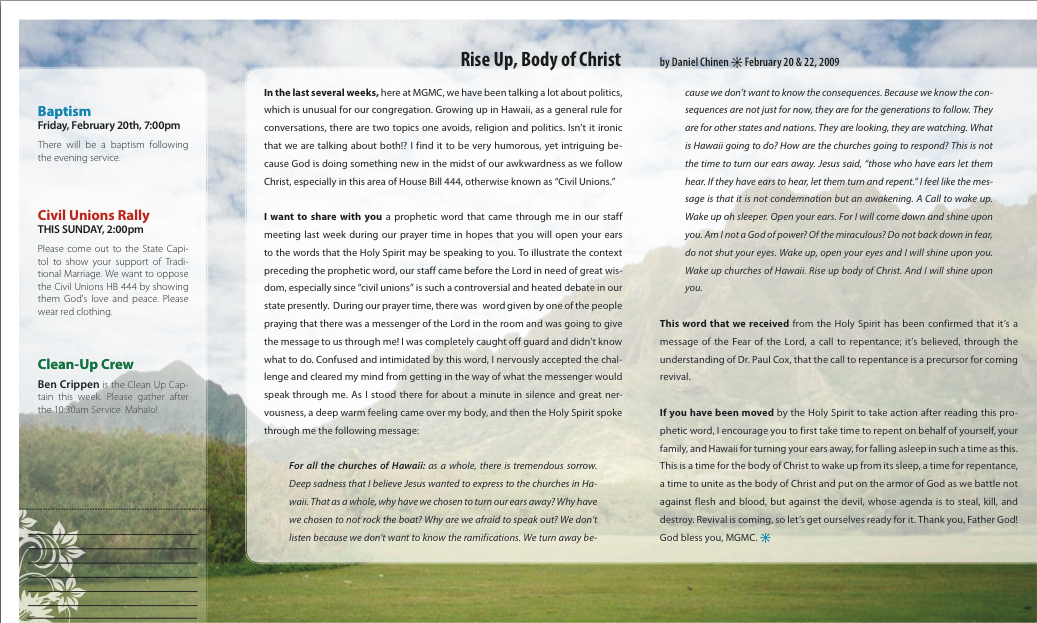
"Please come out to the State Capital to show your support of Traditional Marriage. We want to oppose the Civil Unions HB 444 by showing them God's love and peace. Please wear red clothing." In a subsequent church newsletter Chinen suggested that over 8,000 had turned out for the anti- HB 444 rally in February 2009.
A year later, another anti-HB 444 rally on January 18, 2010, Martin Luther King Day, drew perhaps twice as many protesters.
The January 18th rally at the Hawaii state capital building was attended by Transformation Hawaii president Allen Cardines, Lt. Governor Aiona, and Honolulu mayor Mufi Hannemann - who spoke at the rally, attacking "attempts to distort my message in support of traditional marriage....I believe in the sanctity of marriage between one man and one woman."
As Cal Chinen's church newsletter shows, his church has taken up the project of indoctrinating teenage members of his church in antiabortion politics. As Chinen wrote in the January 30 / February 1, 2009 MGMC newsletter,
` "I'm still struggling with signing that card against furthering abortion rights (the Freedom of Choice Act) that we did in church," some of our young people thought as we passed them out in last week's services. "Isn't it the right of every person to choose whether or not they want to have a baby ?" many asked Pastor Charis as they gathered in their High School Sunday School Class....The life-or-death decisions that force many women to opt for the rare procedure of late-term abortion would not seem, based on Cal Chinen's description, to have been a part of Pastor Charis' antiabortion curriculum.
Pastor Charis lovingly and patiently explained to the young people what abortion really is... in actuality, many are not educated about partial birth abortions and when they understand what it is they are shocked. For example by the end of Charis' explanation the girls were all in tears of repentance and love."
Opposition to gay rights and abortion might well be the lesser part of what's notably sectarian about Transformation Hawaii/ITN ideology.
`Spiritual Mapping' the enemies
In urging attendees of the Dallas Convergence 2010 conference to go to the upcoming International Transformation Network conference in Hawaii next November 2010, ITN CEO Ed Silvoso told attendees, "You're going to come to a state where every school has been prayer-walked, every teacher adopted, every student been interceded for..."
Transformation Hawaii's first incarnation, a student effort called United in Prayer in which students formed prayer groups in schools, seemed finely calibrated to walk up to, but not over, the line drawn by the constitution's establishment clause. Nominally student-led, parents and pastors would coach United in Prayer students, right up to school doors. The students themselves would then conduct prayer services in their schools.
That effort, spread statewide, was the backdrop for Duke Aiona's 2004 dedication of Hawaii to Jesus. But what is "prayer walking" ?
Prayer Walking is part of an elaborate new evangelizing paradigm Ed Silvoso helped to create during the late 1980's through the early 1990's. In prayer walking, believers methodically walk cities, towns, and geographical areas, praying for unbelievers but also mapping out areas allegedly infested by demon powers.
The practice was exported globally from Colorado Springs during the 1990's and into the following decade, by Ted Haggard and his close working colleague C. Peter Wagner, a church growth specialist. In 2003 Haggard became head of the 27 million or more strong National Association of Evangelicals and during his brief tenure at the position, before falling from power due to a sex and drugs scandal, claimed to be having weekly conversations with the White House.
Colorado Springs may have been the first US city of any size to be "prayer walked," a practice Ted Haggard referred to a "grid praying." Public radio reporter Alix Spiegel covered the prayer walking and spiritual mapping efforts of Haggard's New Life Church in Colorado Springs, in a 1997 radio segment for This American Life (segment #77, "Pray").
Initially exposed to the benign face of Spiritual Mapping, in which believers "prayer walk" city streets praying for residents and businesses, Alix Spiegel was sympathetic at first until she went out with a New Life Church team that sought to expel demons, from a high school playground, which allegedly had been attracted by the freethinking ways of high school drama students.
The rise of the Spiritual Mapping movement was also noted in a prescient 1999 article by Jane Lampmann of the Christian Science Monitor, "Targeting cities with 'spiritual mapping,' prayer." As Lampmann wrote,
` Through "spiritual warfare" and an in-depth research effort called "spiritual mapping," they aim to bring people to Christ and, in their words, "break spiritual strongholds" holding communities in their grip, whether they be vices, "false religions," or "territorial spirits." `Exporting demons to Africa
During the 1990's Spiritual Mapping was exported most aggressively from the United States to Africa. In Mali, Dutch missionary Rene Holvast was perplexed and disturbed by the new evangelical paradigm to the point of taking a break from missions work to study and then write a doctoral dissertation [PDF file of dissertation] on Spiritual Mapping, which was updated and published as a book, in November 2008, by Brill: Spiritual Mapping in the United States and Argentina, 1989-2005: A Geography of Fear.
C. Peter Wagner and Cindy Jacobs were, along with Ed Silvoso, two key figures who helped develop the practice of spiritual mapping which Silvoso has since repackaged through the benign-sounding term "prayer evangelism." But the dark side of the practice comes out starkly in a 2003 book by Ed Silvoso's colleague C. Peter Wagner, Breaking strongholds in your city: How to use spiritual mapping to make your prayers more strategic, effective, and targeted.
On page 177 Wagner defines Spiritual Mapping as a practice which "combines research, divine revelation, and confirmatory evidence in order to provide complete and exact data concerning the identity, strategies and methods employed by spiritual forces of darkness to influence the people and the churches of a given region."
On page 229 Wagner details "Non-Christian" influences spiritual mappers (prayer walkers, that is) should make note of: "high places, altars, temples, monuments or buildings associated with witchcraft, occult, fortune-telling, satanism, Freemasonry, Mormonism, Eastern religions, Jehovah's Witnesses and the like."
Wagner also instructs mappers to note, among "Christian" influences, `Where are the churches located ? Which of them would you see as "life giving" churches ?' Typically within Wagner's, Jacobs', and Silvoso's movement mainline Protestant and non-charismatic Catholic churches are defined as non-"life giving."
Wagner's list indicates that he considers non-charismatic Christian churches to be suspect and Mormons and Jehovah's Witnesses not to be Christian at all. Given Peter Wagner's close working relationship with Ed Silvoso, it is unlikely the two men differ on this issue. Like Cindy Jacobs, Ed Silvoso is an apostle in Wagner's International Coalition of Apostles, founded in 2001, and serves with Wagner on that organization's elite Apostolic Council which "provides advice and accountability" for the ICA.
Spiritual Mapping recently came to media notice because of a charismatic evangelical group's "spiritual mapping" activities in Amarillo, Texas. Members of Repent Amarillo have created, using Google Maps, an online "spiritual map" of allegedly demonic institutions in the city of Amarillo. These include Methodist and Episcopal churches that are "gay friendly" and accept homosexuality, Christian Scientist and Unitarian churches, Mosques, Buddhist and Hindu temples, New Age centers, centers where pagans gather, a nature center, porn shops, gay bars, a palm-reading business, and a swinger's club.
As reported in a February 24, 2010 story in the Texas Observer, members of Repent Amarillo have targeted the Amarillo swinger's club with special zeal; "[Repent Amarillo members] have been a near-constant presence. Jobs have been lost, families estranged, assault charges filed and businesses shuttered. So far, no public official has stood up to defend these businesses, which operate legally."
Repent Amarillo's spirit mapping effort is not an anomaly. Based in Austin, Texas, Campus Renewal Ministries is a college and university based ministry which claims to have had spiritual mapping efforts underway on campuses across the US for fourteen years.
"Spiritual mapping is the systematic gathering and evaluation of data through surveys, research, and spiritual perceptions in order to discover the factors, influences and trends that deter or advance God's Kingdom at a particular campus. (Joshua 18; Numbers 13; Nehemiah 2)Outside the United States the Spiritual Mapping movement's campaign against demonic powers and allegedly evil societal influences often picks up violent and even eliminationist overtones. One of the charismatic streams which has fed into Ed Silvoso's ITN, and the wider movement it belongs to, is associated with to some of the worst political violence of the 20th Century.
This data can be used to guide our prayers and and to move us toward practical action. Information helps link our prayers with action.
Discovering tangible and intangible information about what God is doing and what Satan is doing on a campus is crucial to guide our prayers and actions...
We have pioneered spiritual mapping on college campuses in America over the past 14 years.... We would love to consult with you to develop a spiritual mapping survey or other effort for your campus."
As noted author and researcher of conservative Christianity Sarah Diamond described in her 1995 book Roads To Dominion: right-wing movements and political power in the United States, Guatemalan dictator Efrain Rios Montt was converted to charismatic evangelical Christianity when `a group of young California "Jesus freaks" brought their Gospel Outreach church to earthquake-ravaged Guatemala in 1976.'
Demons in human form
During the counterinsurgency campaign in Guatemala in the 1980's thousands of Guatemalan civilians, mostly indigenous Maya, were slaughtered. As Diamond writes,
`some Gospel Outreach members reportedly took part in the regime's espionage and torture-interrogation operations. Entire villages were annihilated, while Rios Montt's U.S. backers justified the "scorched Earth" campaign in religious terms. In one interview a Gospel Outreach pastor defended the killings:Along with Silvoso, Jacobs, and Wagner, another of the originators of Spiritual Mapping ideology and practices is Guatemalan lawyer and megachurch founder Harold Caballeros, who ran in 2007 for the Guatemalan presidency and has been credited, probably more than any other evangelist, with the rapid spread of charismatic evangelicalism in Guatemala.
"The army doesn't massacre the Indians. It massacres demons, and the Indians are demon-possessed; they are communists. We hold brother Efrain Rios Montt like King David of the Old Testament. He is the king of the New Testament." ` (page 238)
One of the notable members of Caballeros' affluent El Shaddai megachurch has been Erwin Sperisen, former director of Guatemala's Policia Nacional Civil (National Civilian Police) which has been accused by the press and human rights groups of extrajudical executions of gang members and criminals, a practice known as limpienza social (social cleansing.)
As described by Dennis A. Smith in a paper written for the Latin American Studies Association, in April 2007 Sperisen and Caballeros appeared together on Canal 27, a local Guatemalan television program on a show created by Sperisen to, according to Smith, "provide police officers with the spiritual resources they needed to combat the forces of evil."
As Smith recounts, during the segment Sperisen addressed Caballeros as "The Prophet and Apostle Brother Harold Caballeros," and Caballeros went on to state,
` The death squads that still function within the PNC and the Ministry of Government are a holy enterprise that is organized by agents and personnel from Evangelical churches that know our obligations to society. . . I must recognize that the story published in the New York Times on March 5 of this year is true; the "social cleansing" that, together with Carlos Vielman as Minister of Government we carried out in the institution, had to be done and must continue, as I understand has been ordered to the new authorities. . . `Smith observes in his paper,
"Spiritual warriors understand that the worlds we inhabit, both physical and spiritual, are fraught with real danger. Who can deny the demonic character of the social devastation wrought by drug traffickers and youth gangs? Confronted by a culture of violence and impunity, some spiritual warriors have come to the conclusion that extreme measures are justified."But Caballeros' concerns extend far beyond the criminal realm. As Dennis Smith and Rudy Nelson wrote in a February 4, 2004 article in The Globalist, "Harold Caballeros, the popular pastor of an upscale neo-Pentecostal church, insists that Guatemala's problems can be traced back to Mayan pacts with the devil. He has retaliated with a campaign of "spiritual warfare" to defeat this evil."
Along with Cindy Jacobs and Ed Silvoso, Harold Caballeros is also a listed member of the International Coalition of Apostles and has also served with Wagner and Jacobs on Peter Wagner's elite Apostolic Council of Prophetic Elders.
Caballeros was listed, along with Cindy Jacobs, as being on the faculty of Silvoso's 2004 ITN conference in Argentina, and in his book Transformation Ed Silvoso lauds Harold Caballeros' enterprise and daring, "His willingness and courage to sail on totally uncharted waters is admirable."
Harold Caballeros sits on an advisory board for a grant from the Templeton Foundation to Harvard and Tufts, and he has spoken at a Templeton-funded academic conference held by the University of Southern California.
Prayer, and "enemy identification," in Newark, NJ
Spiritual Mapping was first applied on a mass scale, by Ed Silvoso, Cindy Jacobs, Peter Wagner and other pioneers of the practice, during the late 1980's in the Argentine city of Resistencia. Along with Cal Chinen's Transformation Hawaii, another ITN initiative showcased at the International Transformation Network's 2008 Argentina conference was PrayforNewark, an effort led in Newark, New Jersey by International Coalition of Apostles member Rev. Bernard Wilks.
PrayforNewark was founded in early 2008, on Martin Luther King Day, by New Jersey resident Lloyd Turner who at the October 2008 Argentina conference told attendees that PrayforNewark could North America's "Resistencia," a prototype for similar efforts that would sweep across the cities and towns of the continent.
PrayforNewark has an ambitious prayer walking / spiritual mapping program that, now claims to have one volunteer covering nearly every single street in Newark, New Jersey's largest city. As if they were working in a political campaign, PrayforNewark's volunteers are organized by Newark city ward.
Literature on the PrayforNewark web site states the effort is working to "transform" Newark according to Ed Silvoso's teachings, and church newsletters from Bernard Wilks ministry have stated, as part of the PrayforNewark effort, the need for "enemy identification." [ PDF file of PrayforNewark's "Benchmarks and Visions ]
PrayforNewark, and the ongoing efforts in Uganda and Hawaii, were all showcased prominently at the 2008 Argentina ITN conference, as "transformation" prototypes.
The personal sway ITN representatives have over national and state leaders came to the fore in a speech, at the 2008 Argentina conference, by the wife of ITN's Africa head Verner Swart, Adele Swart, who described to her audience what seemed to be a close personal relationship with Janet Museveni. As Adele Swart stressed, the relationship with Museveni had the potential of opening the whole continent of Africa to ITN's evangelizing efforts:
"So I want to tell you, we are not just here for a nation. We are not talking about Uganda. We are talking about a continent. You don't understand. God has given us the key in Mama Janet and opened the doors of Africa as a continent."
"Ed Silvoso, my spiritual daddy"
In the state of Hawaii, Cal Chinen, who calls Ed Silvoso a spiritual father, may be playing a roughly analogous role, pastoring powerful politicians in the state.
In the November 15, 2008 newsletter for his Moanalua Gardens Missionary Church, Chinen recounted a conversation with Silvoso. ` "Cal, you will see Satan fall (down) over Hawai'i after E Pule Kakou," Ed Silvoso, my spiritual daddy, encouraged me. But then he became very serious and said, "But the big question is what will you do after he falls down so that he stays down ?" `

While Chinen appears to consider himself to be under Ed Silvoso's spiritual authority, that chain of spiritual command may extend down to Duke Aiona. In several Internet notices advertising International Transformation conferences, one under Ed Silvoso's name, Cal Chinen is described as "shepherding" Lt. Governor Aiona, Honolulu's mayor Mufi Hannemann, and several members of the Hawaiian Congress.
As Chinen described in his November 15th newsletter, Silvoso went on to offer advice for keeping Satan down and then assured Chinen, ` "If you will do that," Daddy Ed Silvoso went on to tell me, then you will see Cindy Jacobs' word of prophecy about Hawai'i fulfilled in 2 years." Cindy Jacobs prophecy was the Hawai'i would become the first Christian state in the Union. It CAN HAPPEN! `
In an October 18-19, 2008 Maonalua Gardens Missionary Church newsletter written immediately after Cal Chinen and his wife Joy returned from the International Transformation Network's 2008 Argentina conference, Joy Chinen wrote,

"The whole conference was attended by 300 people from 20 nations of the world! Some of them were from Singapore, Hong Kong, South Africa, Uganda, Japan, Okinawa, Philippines, Germany, England, Spain, Malaysia, Indonesia, Thailand, and the USA... On the first night the Hawaii team was called forward to receive a blessing and a confirmation that Hawaii will be the first Christian state."Of `Demons' and `Biblical Marriage'
On Tuesday, October 7, 2008 at the Argentina conference apostle and prophet Cindy Jacobs called for the burning of "idols" and "witchcraft items" and held a mass exorcism to drive out demons of sexual impurity including "homosexual spirits."
Cindy Jacobs describes Jim Garlow, pastor of San Diego's Skyline Wesleyan Church, as a "good friend." By some accounts Garlow led the successful church-based get out the vote effort to pass the anti-same sex marriage Proposition Eight in California in the months leading up to the 2008 election.
Introducing Garlow's talk at the Convergence 2010 conference in Dallas, Cindy Jacobs stated, He's a strong advocate for Biblical marriage. He's probably networked as many pastors for Biblical marriage, to fight for Biblical marriage, marriage between one man and one woman in America, than any person... I know."
Another major force in that effort was Lou Engle's TheCall, which set up eight field offices in California to organize the pro-Prop Eight push and staged the campaign's capstone rally on November 1st, 2008 at San Diego's Qualcomm Stadium. Engle has called San Francisco's Castro district a place where "the homosexuals boast the dominion of darkness." According to Lou Engle, his son Jesse specializes in casting out "homosexual spirits," a practice Engle calls "scary."
Both Cindy Jacobs, Ed Silvoso, Peter Wagner, and Harold Caballeros were listed on the Board of Directors for TheCall's first major event, held in Washington DC in 2000 and the four are also currently listed on the Board of TheCall International, which plans to hold a mass rally May 1, 2010 at Makerere University in Kampala, Uganda.
Continued: This report is split into two parts. Here's Transforming Hawaii Part 2
See also:
"Right-Wing Crazies Who Fight Witchcraft and Demons Are Taking Over a State Near You" by Bruce Wilson AlterNet July 26, 2010
.
Soot is half of Climate Change
SUBHEAD: Controlling soot might quickly reverse a century of climate change.
By Brandon Keim on 29 July 2010 in Wired Magazine -
(http://www.wired.com/wiredscience/2010/07/soot-control)

Image above: Carbon soot being released from industrial plant. Form (http://www.civilianism.com/futurism/?p=1160).
By Brandon Keim on 29 July 2010 in Wired Magazine -
(http://www.wired.com/wiredscience/2010/07/soot-control)
Image above: Carbon soot being released from industrial plant. Form (http://www.civilianism.com/futurism/?p=1160).
A massive simulation of soot’s climate effects finds that basic pollution controls could put a brake on global warming, erasing in a decade most of the last century’s temperature change.
Compared to the larger, longer term task of getting greenhouse-gas pollution under control, limiting soot wouldn’t be hard. Unlike new energy technology and profound changes in lifestyle, the tools — exhaust filters, clean-burning stoves — already exist.
“Soot has such a strong climate effect, but it has a lifetime in the atmosphere of just a few weeks. Carbon dioxide has a lifetime of 30 to 50 years. If you totally stop CO2 emissions today, the Arctic will still be totally melted,” said Stanford University climate scientist Mark Jacobson. If soot pollution is immediately curtailed, “the reductions start to occur pretty much right away. Within months, you’ll start seeing temperature differences.”
Jacobson’s simulation, currently in press at the Journal of Geophysical Research-Atmospheres, is the latest in a line of studies showing a powerful climate role for fine soot, also known as black carbon. (That’s a somewhat misleading appellation, since some carbon is brown, and the pollution in soot contains a host of other compounds.)
Soot comes from the incomplete combustion of fossil fuels, and also from the burning of wood or dung for fuel. Crop residue and forest-burning are another major source. When aloft, the dark particles absorb sunlight, raising local temperatures and causing rain clouds to form, which in turn deprive other areas of moisture. When soot lands on snow or ice, its effects are magnified, because melts reveal fresh patches of heat-absorbing dark ground.
In 2003, a NASA simulation blamed soot for 25 percent of the past century’s observed warming. A study last year suggested that soot was responsible for almost half of a 3.4-degree Fahrenheit rise in average Arctic temperatures since 1890 — a greater rise than anywhere else on Earth.
Soot also appears to be a culprit in drastic melts of Himalayan glaciers which provide water to much of South Asia, and in disrupting the monsoon cycles on which the region’s farmers rely. The United Nations puts the soot-related death toll at 1.5 million people annually.
Jacobson’s simulation, the culmination of 20 years of research on the dynamics of soot and its interaction with local, regional and global climate dynamics, reinforces those findings. It also studies a question implicit in the earlier studies, but not yet modeled: What would happens if soot pollution stopped?
Jacobson simulated the effects of curtailing soot from fossil-fuel emissions, something that’s already possible with tailpipe and smokestack filters. He simulated the effects of replacing wood- and dung-burning cookfires with clean-burning stoves. And he simulated both advances simultaneously.
If soot disappeared overnight, average global temperatures would drop within 15 years by about 1 degree Fahrenheit, maybe a little more. That’s about half the net warming — total global warming, minus cooling from sun-reflecting aerosols — experienced since the beginning of the industrial age. The effect would be even larger in the Arctic, where sea ice and tundra could rapidly refreeze.
“It will take some decades to phase down fossil-fuel emissions, so reducing dirty aerosols [soot] while we are doing that may help retain Arctic sea ice,” said NASA climatologist James Hansen, one of the first researchers to study soot dynamics. But he emphasized that soot control is only a stopgap measure. “We should reduce soot for several reasons, especially its health effects, but it is only a modest help in controlling global warming,” he said.
Nevertheless, soot could ease the delay between controlling greenhouse gas emissions and cooling. It might also help “avoid tipping points — nonlinear, abrupt and potentially irreversible climate change, especially in the Arctic,” said Erika Rosenthal, a climate policy expert at the progressive nonprofit Earthjustice.
Soot-control policy, however, is scattered. According to Jacobson, climate policymakers have paid little attention to soot. Compared to well-studied greenhouse gases, its climate role is new and unfamiliar. “There are international efforts to limit greenhouse gases, but they completely ignore soot as something to control from a climate perspective,” said Jacobson.
The draft international climate treaty negotiated last year in Copenhagen doesn’t contain soot-specific provisions, but the United Nations Environmental Program is meeting in February to discuss policy options on soot. A relatively little-known U.N. effort called the Convention on Long-Range Transboundary Air Pollution has also established a black-carbon working group.
In the United States, a rare bipartisan environmental bill sponsored in 2009 by climate skeptic James Inhofe (R-Oklahoma) and environmentalist Barbara Boxer (D-California) foundered after its inclusion in massive energy legislation that recently died in Congress. It would have required the EPA to study and possibly regulate black-carbon emissions.
In anticipation of these legislative difficulties, the EPA was charged this year with launching a black-carbon study. More immediately, Congress is now debating reauthorization of the Diesel Emissions Reduction Act, a federal program that pays for putting clean tailpipes on diesel-fuel–burning automobiles, a prime source of black carbon. According to Rosenthal, the program has been fantastically successful, with retrofit requests exceeding available funds by $2 billion.
Controlling crop and forest burns isn’t so easy, but clean stoves could be provided to the developing world for relatively little money. “We have the technology now. It’s a matter of implementing it,” said Rosenthal.
Compared to the larger, longer term task of getting greenhouse-gas pollution under control, limiting soot wouldn’t be hard. Unlike new energy technology and profound changes in lifestyle, the tools — exhaust filters, clean-burning stoves — already exist.
“Soot has such a strong climate effect, but it has a lifetime in the atmosphere of just a few weeks. Carbon dioxide has a lifetime of 30 to 50 years. If you totally stop CO2 emissions today, the Arctic will still be totally melted,” said Stanford University climate scientist Mark Jacobson. If soot pollution is immediately curtailed, “the reductions start to occur pretty much right away. Within months, you’ll start seeing temperature differences.”
Jacobson’s simulation, currently in press at the Journal of Geophysical Research-Atmospheres, is the latest in a line of studies showing a powerful climate role for fine soot, also known as black carbon. (That’s a somewhat misleading appellation, since some carbon is brown, and the pollution in soot contains a host of other compounds.)
Soot comes from the incomplete combustion of fossil fuels, and also from the burning of wood or dung for fuel. Crop residue and forest-burning are another major source. When aloft, the dark particles absorb sunlight, raising local temperatures and causing rain clouds to form, which in turn deprive other areas of moisture. When soot lands on snow or ice, its effects are magnified, because melts reveal fresh patches of heat-absorbing dark ground.
In 2003, a NASA simulation blamed soot for 25 percent of the past century’s observed warming. A study last year suggested that soot was responsible for almost half of a 3.4-degree Fahrenheit rise in average Arctic temperatures since 1890 — a greater rise than anywhere else on Earth.
Soot also appears to be a culprit in drastic melts of Himalayan glaciers which provide water to much of South Asia, and in disrupting the monsoon cycles on which the region’s farmers rely. The United Nations puts the soot-related death toll at 1.5 million people annually.
Jacobson’s simulation, the culmination of 20 years of research on the dynamics of soot and its interaction with local, regional and global climate dynamics, reinforces those findings. It also studies a question implicit in the earlier studies, but not yet modeled: What would happens if soot pollution stopped?
“If you just eliminate soot, you get a significant climate benefit, and you can do it on a short time period, because soot has a life of just a few weeks,” said Jacobson. “You don’t get the full response for a while, as there are deep ocean feedbacks that take a long time, but it’s a lot faster than controlling CO2.”
Jacobson simulated the effects of curtailing soot from fossil-fuel emissions, something that’s already possible with tailpipe and smokestack filters. He simulated the effects of replacing wood- and dung-burning cookfires with clean-burning stoves. And he simulated both advances simultaneously.
If soot disappeared overnight, average global temperatures would drop within 15 years by about 1 degree Fahrenheit, maybe a little more. That’s about half the net warming — total global warming, minus cooling from sun-reflecting aerosols — experienced since the beginning of the industrial age. The effect would be even larger in the Arctic, where sea ice and tundra could rapidly refreeze.
“It will take some decades to phase down fossil-fuel emissions, so reducing dirty aerosols [soot] while we are doing that may help retain Arctic sea ice,” said NASA climatologist James Hansen, one of the first researchers to study soot dynamics. But he emphasized that soot control is only a stopgap measure. “We should reduce soot for several reasons, especially its health effects, but it is only a modest help in controlling global warming,” he said.
Nevertheless, soot could ease the delay between controlling greenhouse gas emissions and cooling. It might also help “avoid tipping points — nonlinear, abrupt and potentially irreversible climate change, especially in the Arctic,” said Erika Rosenthal, a climate policy expert at the progressive nonprofit Earthjustice.
Soot-control policy, however, is scattered. According to Jacobson, climate policymakers have paid little attention to soot. Compared to well-studied greenhouse gases, its climate role is new and unfamiliar. “There are international efforts to limit greenhouse gases, but they completely ignore soot as something to control from a climate perspective,” said Jacobson.
The draft international climate treaty negotiated last year in Copenhagen doesn’t contain soot-specific provisions, but the United Nations Environmental Program is meeting in February to discuss policy options on soot. A relatively little-known U.N. effort called the Convention on Long-Range Transboundary Air Pollution has also established a black-carbon working group.
In the United States, a rare bipartisan environmental bill sponsored in 2009 by climate skeptic James Inhofe (R-Oklahoma) and environmentalist Barbara Boxer (D-California) foundered after its inclusion in massive energy legislation that recently died in Congress. It would have required the EPA to study and possibly regulate black-carbon emissions.
In anticipation of these legislative difficulties, the EPA was charged this year with launching a black-carbon study. More immediately, Congress is now debating reauthorization of the Diesel Emissions Reduction Act, a federal program that pays for putting clean tailpipes on diesel-fuel–burning automobiles, a prime source of black carbon. According to Rosenthal, the program has been fantastically successful, with retrofit requests exceeding available funds by $2 billion.
Controlling crop and forest burns isn’t so easy, but clean stoves could be provided to the developing world for relatively little money. “We have the technology now. It’s a matter of implementing it,” said Rosenthal.
“It’s low-hanging fruit,” said Jacobsen. “It’s straightforward to address, and it can be addressed.”
Citation: “Short-term effects of Controlling Fossil-Fuel Soot, Biofuel Soot and Gases, and Methane on Climate, Arctic Ice, and Air Pollution Health.” By Mark Jacobson. -Journal of Geophysical Research-Atmospheres
.
Citation: “Short-term effects of Controlling Fossil-Fuel Soot, Biofuel Soot and Gases, and Methane on Climate, Arctic Ice, and Air Pollution Health.” By Mark Jacobson. -Journal of Geophysical Research-Atmospheres
.
Raise awareness • Inspire change
SUBHEAD: Questioning GMO use and supporting sustainability, food seed sovereignty and a clean environment.

Image above: A caravan of ox drawn carts carrying varieties of indigenous seeds of Indian grain to a biodiversity festival supporting food sovereignty in Andhra Pradash, India, in 2007. From (http://www.grain.org/pe/?id=116).
By Staff on 28 July 2010 for Hawaii Seed -
Two day event
GMO Free Kauai will host a two day event, "Raise Awareness, Inspire Change" on Friday night August 13 and Saturday August 14 in Kapaa at the All Saints Church Gym (the Red Barn). Our special guest speaker on both days will be Walter Ritte from Molokai. Friday night we will premiere the new movie "Malama Haloa" about taro identification specialist Jerry Konanui.
We invite all the amazing volunteers and growers on Kauai to celebrate and inspire our shared visions for a self sustaining Kauai. These events are free and will include locally grown, gmo free pupus, dinner and music on both nights. Bring your creativity and ideas to share. For more information please call Mi-Key at 651 9603 or visit hawaiiSEED.org.
Guest Walter Ritte
Special guest Walter Ritte Jr. will be speaking. Walter was involved in stopping the bombing by the US Navy of the Hawaiian Island of Kahoolawe. Ritte was one of the Kahoolawe Nine who made the first protest landing on Kahoolawe on January 4, 1976. Ritte returned less than two weeks later, joined by his wife, sister, and Dr. Emmett Aluli.
Ritte was charged with trespassing on the island after being warned not to return, but was acquitted by federal Judge Samuel P. King. He also served in the 1978 Hawaii State Constitutional Convention which established the recognition of Hawaiian Gathering Rights.
Walter was also one of the first elected trustees to the Office of Hawaiian Affairs. He is also a voice of opposition to the Molokai Ranch Master Plan that envisions luxury homes at La'au Point. Ritte is married with four children and seven grand children from the island of Molokai, Hawaii. Walter is a hunter and Hawaiian Activist now working on the restoration of traditional fishponds and educational programs based Hawaiian culture.
Friday night
Raise Awareness, Inspire Change: a free community event for sustainability, food and seed sovereignty and a clean environment. Join us at the All Saints Church Gym (the Red Barn) in Kapaa for the free movie premiere of "Malama Haloa" and special guest speaker Walter Ritte on Friday, August 13 at 7pm. Come be inspired to lead and take action for a healthier Kauai. Seed exchange depot by Regenerations Botanical. Enjoy live music with Mike Young. For more information please phone GMO Free Kauai at 651 9603 or visit hawaiiSEED.org.
Saturday afternoon and evening
Raise Awareness, Inspire Change: a free community event for sustainability, food and seed sovereignty and a clean environment. Join us at the All Saints Church Gym (the Red Barn) in Kapaa for our special guest speaker Walter Ritte from Molokai. This event will begin at noon on Saturday August 14. Other community leaders will also speak.
Come be inspired to lead and take action for a healthier Kauai. We will have a community brainstorm, seed exchange depot by Regenerations Botanical, sign making, sign waving, dinner potluck, music and dancing. For more information please phone GMO Free Kauai at 651 9603 or visit hawaiiSEED.org.
.
Image above: A caravan of ox drawn carts carrying varieties of indigenous seeds of Indian grain to a biodiversity festival supporting food sovereignty in Andhra Pradash, India, in 2007. From (http://www.grain.org/pe/?id=116).
By Staff on 28 July 2010 for Hawaii Seed -
Two day event
GMO Free Kauai will host a two day event, "Raise Awareness, Inspire Change" on Friday night August 13 and Saturday August 14 in Kapaa at the All Saints Church Gym (the Red Barn). Our special guest speaker on both days will be Walter Ritte from Molokai. Friday night we will premiere the new movie "Malama Haloa" about taro identification specialist Jerry Konanui.
We invite all the amazing volunteers and growers on Kauai to celebrate and inspire our shared visions for a self sustaining Kauai. These events are free and will include locally grown, gmo free pupus, dinner and music on both nights. Bring your creativity and ideas to share. For more information please call Mi-Key at 651 9603 or visit hawaiiSEED.org.
Guest Walter Ritte
Special guest Walter Ritte Jr. will be speaking. Walter was involved in stopping the bombing by the US Navy of the Hawaiian Island of Kahoolawe. Ritte was one of the Kahoolawe Nine who made the first protest landing on Kahoolawe on January 4, 1976. Ritte returned less than two weeks later, joined by his wife, sister, and Dr. Emmett Aluli.
Ritte was charged with trespassing on the island after being warned not to return, but was acquitted by federal Judge Samuel P. King. He also served in the 1978 Hawaii State Constitutional Convention which established the recognition of Hawaiian Gathering Rights.
Walter was also one of the first elected trustees to the Office of Hawaiian Affairs. He is also a voice of opposition to the Molokai Ranch Master Plan that envisions luxury homes at La'au Point. Ritte is married with four children and seven grand children from the island of Molokai, Hawaii. Walter is a hunter and Hawaiian Activist now working on the restoration of traditional fishponds and educational programs based Hawaiian culture.
Friday night
Raise Awareness, Inspire Change: a free community event for sustainability, food and seed sovereignty and a clean environment. Join us at the All Saints Church Gym (the Red Barn) in Kapaa for the free movie premiere of "Malama Haloa" and special guest speaker Walter Ritte on Friday, August 13 at 7pm. Come be inspired to lead and take action for a healthier Kauai. Seed exchange depot by Regenerations Botanical. Enjoy live music with Mike Young. For more information please phone GMO Free Kauai at 651 9603 or visit hawaiiSEED.org.
Saturday afternoon and evening
Raise Awareness, Inspire Change: a free community event for sustainability, food and seed sovereignty and a clean environment. Join us at the All Saints Church Gym (the Red Barn) in Kapaa for our special guest speaker Walter Ritte from Molokai. This event will begin at noon on Saturday August 14. Other community leaders will also speak.
Come be inspired to lead and take action for a healthier Kauai. We will have a community brainstorm, seed exchange depot by Regenerations Botanical, sign making, sign waving, dinner potluck, music and dancing. For more information please phone GMO Free Kauai at 651 9603 or visit hawaiiSEED.org.
.
Subscribe to:
Posts
(
Atom
)