Time to Bury the Dead

SUBHEAD: Don’t look away from the television now, but the post-industrial Stone Age is coming into full view. Image above: Painting by Mark Bryan of the "Republic of Amnesia", 2009. From (http://www.artofmarkbryan.com/Republic_of_Amnesia.html) By Guy McPherson on 10 May 2010 in Nature Bats Last - (http://guymcpherson.com/2010/05/time-to-bury-the-dead)

The final nail in the global financial coffin was hammered into place this morning by the masters of the Eurozone. The trillion-dollar bailout Ponzi scheme to save Greece is yet another example of kicking the proverbial can down the road, hoping the taxpayers fail to notice the 800-pound gorilla fighting its way out of the can.

And, because the taxpayers are so easily swindled by The-Powers-That-Be, there is little doubt they will fail to notice or, more likely, will believe the inflation-induced salvation of Greece is a brilliant move by the Economists In Charge. Judging from today’s explosive jump in stock markets, the swindle worked brilliantly.

But volatility in the stock markets is back, so today’s huge gain will be wiped out by week’s end, perhaps in a ten-minute spasm subsequently blamed on a computer glitch that cannot be rationally explained. Glitch? If you believe that, then I’ve sell you some ocean-front property in Arizona. Well, it’s not ocean-front property yet. But we’re certainly headed in that direction.

But let’s go back to that coffin. Following the lead of the last remaining hyper-power, Europe is generating a mountain of debt so high it cannot be imagined, and therefore cannot be dealt with.

The black hole of debt has gone global. We’ll never pay off the debt because it cannot be paid off. But the average American believes every word that ends with illion is the same as every other word that ends with illion, so he goes back to the television while sucking down cheap beer and cheese doodles.

Failing to recognize the effects of debt for him and his equally ignorant children, he keeps cheering on the military while booing the politicians, gleefully following American Idol while bitching about the quality of the public schools, bemoaning those poor fishermen in the Gulf of Mexico while filling up his SUV with gasoline and blaming Obama for not fixing the deep-sea oil gusher, blaming his elected representatives for high taxes (sic) while demanding eternal solvency of Social Security and Medicare, and calling Barack Obama a socialist even as the president nominates a fascist to the Supreme Court.

Citizens have become consumers. (Ben Franklin: “It is the first responsibility of every citizen to question authority.”) We have abandoned the pursuit of inquiry, thus trading skepticism for suckerism. (One every minute is a massive underestimate from people who cannot distinguish millions from trillions.) We traded in our union cards for the promise of free money without reading the fine print. Having thoroughly fucked the planet and ourselves, we’re all playing extend and pretend, wishing for economic growth for our own generation (while willingly shit-canning future generations, as we’ve always done).

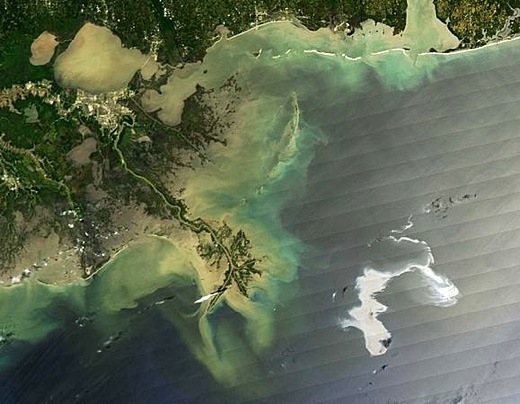
Eyjafjallajökull blowing smoke, ice melting at an accelerating rate from Antarctica, oil covering the Louisiana coast, biodiversity taking the fast track to oblivion at our oil-soaked hand, and on and on until the real news becomes so sickening we readily, eagerly, happily turn to reality TV (sic) or other mind-altering substances to get us through the week. If I weren’t a rationalist, I’d swear the third rock from the sun was trying to even the score with its most clever species.

Fortunately, even Ben Bernanke knows the odds are dimming on an orderly collapse. Don’t look away from the television now, but the post-industrial Stone Age is coming into full view.

Will it arrive in time to save the last remnants of the living planet? Will it arrive in time to save our species? Considering the planet’s atmosphere currently holds 387 ppm carbon dioxide, with 350 ppm the likely upper limit humanity can tolerate for an extended period, I have my doubts. Toss in methane, which is far more powerful than carbon dioxide as a greenhouse gas, and we’re currently experiencing the equivalent of 460 ppm carbon dioxide.

If that seems problematic to you, perhaps you’re numerate enough to distinguish between millions and trillions. Consider yourself a rare industrial human.

.

Money For Nothin'

SUBHEAD: The European Union pulls a trillion-dollar rabbit out of its hat. Will it fool anybody? By James Kunstler on 109 May 2010 in Kunstler.com - (http://kunstler.com/blog/2010/05/and-chicks-for-free.html)
Now that ain't workin' that's the way you do it, You play the guitar on the MTV. That ain't workin' that's the way you do it, Money for nothin' and your chicks for free. Money for nothin' and chicks for free. - last verse to "Money for Nothing" by Dire Straights
Image above: Cover of "Money for Nothin' album by Dire Straights released in 1985. From (http://new.taringa.net/posts/musica/1308444/Dire-Straits--Money-for-Nothing.html) The European Union came up with a trillion dollar bail-out for itself at the dawn's early light. Plus, each member gets a Latvian prostitute, gratis. The Germans will love this. The plan has already goosed the Euro back above $1.30 -- just when they hoped a lower Euro would help them move a few more export goods off the shelves. I expect that Mrs Merkel is already catching an earful. A few hours earlier, her coalition of Christian Democrats and free Democrats got their joint ass kicked in a North Rhine - Westphalia local election....
I mention these events reluctantly, knowing how averse we Americans are to news out of Old Europe, that boring backwater of sclerotic cafe lay-abouts, socialistic train service, and less-than man-sized portions of things that real men don't eat anyway.
The question begging itself here, of course, is how Europe intends to come up with roughly a trillion in bail-out money. Sell Portugal to China? Cut Greece up into bait and catch whatever fish are left in the Mediterranean Sea? Frankly, I'm stumped. Talk about robbing Peter to pay Paul.... All the European nations are already so hopelessly enmeshed in chains of unfulfillable counter-party obligations that the bail-out might as well be a game of musical chairs played in the Large Hadron Particle Collider, set to the tunes of Karlheinz Stockhausen. The European bail-out is, in fact, an absurdity. I predict that the effect of the announcement will last all of one trading day on the stock markets.
The truth is that the imbalances of global finance are so grotesque now that the whole money system is hanging together with nothing but spit and prayer. I get rafts of e-letters every week warning of a supposedly-coming global currency -- a companion idea to the notion of a one-world government. Both are idiotic fantasies. Events are taking the nations of the world in the other direction: towards break-up, down-sizing, down-scaling. Likewise, if major currencies such as the Euro and the dollar blow up, they're much more likely to be replaced by more local bank-notes backed by gold than by some hypothetical Amero or Globo-buck.
At seven a.m. Eastern time, the European stock markets were zooming, and Bloomberg even carried a wonderfully mysterious headline saying Greek Bonds Rally. That was especially rich -- like, who in the fuck is going to load up on Greek bonds now? Is there a pension fund somewhere run by such dimwits that they would sell their positions in the Goldman Sachs issued Timberwolf CDO in order to get in on the new bargain in ten-year Greek sovereigns? I hope those pensioners are prepared to spend what remains of their lives selling chestnuts from pushcarts on the streets of Oslo, because they sure won't be clipping coupons in front of any World Cup telecast.
As if life in the USA wasn't surreal enough last week. Once upon a time, the stock market was a place where people with capital went to look for productive activity to invest in -- say, a company devoted to making soap flakes, an underpants factory. Now the market is a robot combat arena where algorithms battle for supremacy of the feedback loops. Thursday's still-baffling fifteen-minute "crash" was an excellent demonstration of the diminishing returns of technology. People too-clever-by-half, aided greatly by computers, have now gamed the investment indexes so successfully that these markets no longer have anything to do with investment -- they're just about shaving micro-points of profit at high volumes by micro-milliseconds off mere differentials in... math! This is truly quant heaven, a place where only numbers matter and there is no correspondence to anything in the real world. In other words, last Thursday's bizarre action was a warning that the American stock markets have flown up their own aggregate ass.
These algo-robots may be elegantly complex, but they are really no more than triggering mechanisms, and Thursday's -- whatever it was -- glitch, let's say, ought to be regarded as a mere preview of coming attractions for a full-on feature clusterfuck in which the putative contents of these stock markets get sucked into a black hole so vast that the trading desks will have to find a way to arbitrage infinity to ever again catch a glimpse of America's receding wealth. And it could all happen in a finger-snap.
Why would anybody not heavily medicated stay invested in the stock markets? Well, the answer must be that they're not. The few still hanging around are the institutionals with nowhere else to go, the pitiful pension funds or the pathetic college endowment funds desperately chasing "yield" in a world where once-sturdier instruments yield zirp-o -- and these poor chumps are getting played and played out. The only other remaining marketeers are -- you guessed it -- the too-big-to-fail banks, the Federal Reserve, and possibly the US Treasury itself playing front-running games and algo stunts and black box buy-ups, and carry-trade rackets, and -- let's not forget -- outright swindles.
We tend to forget that all this hugger-mugger once had a relation to real economies. The basic truth about real economies -- at least the industrial-strength ones -- is that they cannot be successfully managed on the basis of revolving debt in the context of no growth -- and no growth is exactly the bottom line of the peak oil story so revolving debt is finished for now. Speaking of oil, the Deepwater Horizon disaster (still ongoing) has gotten so boring to the editors of The New York Times that further news about it has been banished from the front page of the paper. Too depressing, I guess.
In the meantime, though, rest assured that whatever else is going on out there, credit default swaps never sleep. .

Eyewitnesses to Gulf Inferno

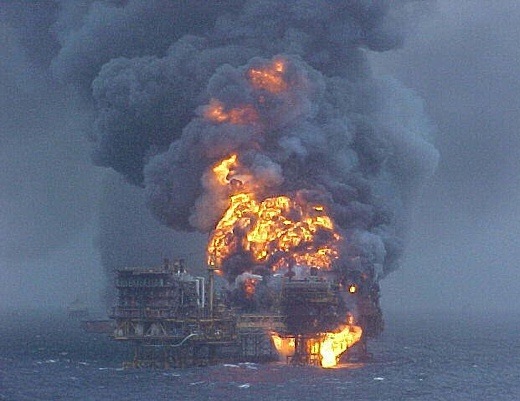
SUBHEAD: Personal recounting of Deepwater Horizon explosion and the immediate aftermath. Image above: BP's Deepwater Horizon listing and in uncontrollable burn, before sinking. From (http://commons.wikimedia.org/wiki/File:Deepwater_Horizon_offshore_drilling_unit_on_fire.jpg). By Allen Breed & Kevin McGill on 10 May 2010 in Huffington Post - (http://www.huffingtonpost.com/2010/05/09/deepwater-horizon-explosi_n_569522.html) Oleander Benton was chatting with a friend in the laundry when the lights went out. The other woman had just gotten up to find a maintenance person when the deep-sea oil rig shook with an ear-shattering "BANG," followed by a long, loud "hisssss." Benton's safety training kicked in. The cook hit the floor as ceiling tiles and light fixtures came crashing down on her head and back. The concussion had blown a door off its hinges and pinned her friend to the floor. "My leg! My leg!" the woman screamed. Benton rose to her feet, and stepped over the debris, but she couldn't move the door. She told her friend to lie flat and slide herself out, and the two made their way into the darkened hallway, where a man in a white T-shirt appeared out of the swirling dust and beckoned. "Come on, Miss O!" he shouted. "Go this way. This is the real deal! This is the REAL DEAL!" After a "carnival funhouse" journey through halls illuminated only by "EXIT" signs, and clogged with dazed and injured people, Benton emerged onto the deck of the Deepwater Horizon. Fire and mud were spewing from the rig's shattered 242-foot derrick. People with ghastly head wounds were scrambling about. Many had been asleep when the blast occurred, and wandered the slick, debris-strewn deck shoeless, clad in little more than their orange lifejackets, their bare skin speckled with bits of white insulation from blown-out walls. Benton slipped and stumbled as she headed for her assigned lifeboat. As a worker checked off names, Benton was transported back five years to Hurricane Katrina. She had spent five hellish days in the swelter of the Louisiana Superdome. That was the last time she had felt this kind of heat, this kind of terror. It was April 20 – Benton's 52nd birthday. With its complement of 126 riggers, contractors and support personnel, the Deepwater Horizon – floating 48 miles out in the Gulf of Mexico – had a population larger than that of at least a half-dozen Louisiana towns. This "floatel" had a gymnasium, movie theater, lounge, helicopter pad – just about everything a small city would need. April 20 was a big day for BP PLC and the rig's inhabitants. The day before, contractors from Halliburton Energy Services Inc. had finished cementing the well's pipes nearly 5,000 feet below the water's surface. Workers were busy setting a second seal at the well head, one of the last steps before the rig could move off, and the exploration well – in an area of the Gulf known as Mississippi Canyon Block 252 – could make the transition to a production well. BP executives were on board to celebrate that milestone and another achievement – Deepwater Horizon was the first rig to go seven years without a lost-time accident. They were gathered in the living quarters just below the working deck when an enormous bubble of explosive methane gas erupted from the sea floor and rocketed up the drill pipe's 21-inch metal sheath toward the surface. It was around 10 p.m. Crane operator Micah Sandell, 40, of Leesville, La., was in the cab 30 feet off the deck when he saw the water and mud shoot up and out of the derrick. He knew immediately it was a blowout, and he got on the radio to tell the crew to move to the front of the rig. When the gushing stopped after a few minutes, Sandell took a deep breath. "Oh, good," he said to himself. "They got it under control." Suddenly, vapor and spray began shooting out of a goosenecked pipe on the starboard side of the deck, followed by thick, black smoke. Sandell quickly shut off his air conditioner to avoid sucking any noxious fumes into the cab. Then something exploded. Sandell was knocked to the floor, and fire engulfed the cabin. Certain he was about to die, the devout Baptist clapped his hands over his head and cried, "Oh, God. No." But after a few seconds, he stood up and realized the fireball had passed him over. He made it halfway down the stairs before another blast occurred, throwing him 15 feet to the steel deck. He got up again and ran, feeling his way along the deck rail around the port side toward the lifeboats. Marine biology student Albert Andry III and three high school buddies had come to the Deepwater Horizon for a couple leisurely days of tuna fishing and beer drinking. It turned out to be anything but leisurely. The group had left Venice around 3 p.m. in Andry's 26-foot catamaran, the Endorfin, and had spent the afternoon fishing for blackfin near BP's Amberjack Rig 109 near the South Pass of the Mississippi River. Andry's radar had been stolen recently, so when they'd landed enough fish, the 23-year-old from Mandeville, La., headed for the Deepwater Horizon, where they would idle overnight. The men arrived at sunset. The water was smooth as glass and teeming with jellyfish, their translucent blue and white "sails" erect in the light breeze. They were fishing for bait under the lip of the platform when water began raining down from the rig's network of pipes – so much that Andry thought the crew was dumping the bilges to keep the Deepwatwer Horizon from sinking. Andry's eyes began to burn, and buddy Wes Bourg – who had worked on offshore rigs – told the skipper they needed to get out of there. Fast. "Go, go, go, go, GOOOOO!" Bourg shouted. With no radar and only the light of a crescent moon to see by, Andry pointed the bow north, gunned the twin 140-horsepower Suzuki outboards and hit the deck. They were about 100 yards from the Deepwater Horizon when the lights went out, and the first of a series of massive booms shook the rig. The lifeboats hanging off the side of the rig were covered and could hold up to 50 people each. Crew members with clipboards called out names as people clambered aboard. As Sandell stood in line awaiting his turn, panicked workers were screaming to get the boats in the water, even though they were not yet full. "Drop them off!" "Get them away!" Some couldn't wait any longer, and jumped. It was 80 feet to the water. A person falling from that height would take about 2.25 seconds to hit the water and experience about 20 Gs – roughly the same force as a car hitting a brick wall at 55 mph. In Port Fourchon harbor, the service vessel Joe Griffin was tied up at the Halliburton slip. Capt. Nate Foster was standing on the bridge shortly before 11 p.m. when the radio crackled to life. "We need you to get out there as fast as you can," the dispatcher barked. "We have people in the water." The orange-hulled vessel is primarily a supply ship, and much of its 280-foot length is comprised of open deck space. But the Joe Griffin is also equipped with two water cannons, each capable of shooting 5,000 gallons of water per minute. Foster picked up the ship's phone and called the engine room. "I want the engines started," the 37-year-old Montanan told the oiler. "We need 'em NOW. Don't let them warm up." Then he got on the radio to the crew. "Get ready to cast off right now," he said. "We need to leave immediately." A process that normally takes 20 minutes was accomplished in fewer than five. The Joe Griffin backed out of the slip and steamed out of the harbor at 10 knots – more than double the normal speed. As the vessel entered open water, Foster opened the throttle all the way, to 12 knots. At that speed, it would take nine and a half hours to reach the Deepwater Horizon. Foster knew he'd be thinking the whole time of people in the water. The 260-foot Damon B. Bankston, a black-hulled cargo vessel, was tethered to the Deepwater Horizon. That day, it had been pumping drilling mud from the rig for use at the next job. The first explosion threw Seaman Elton Johnson of Bunkie, La., about seven feet into an engine-room door, temporarily knocking him unconscious. When he came to, he staggered to the deck and looked over the rail to see people floating in the water. Like the rest of the crew, Johnson began fishing out survivors. By the glow of the inferno, Andry could see people swimming and motoring toward the Bankston. He got on his radio and asked whether he could approach the rig and join in the rescue effort. "Negative. Negative," came the reply. Bourg said there could be damaged pipes under the water. So the group decided to back off a mile to wait, and watch. On the Deepwater Horizon, deck pusher Bill Johnson, supervising operations on the deck, worked his way across the rig, acrid smoke burning his lungs. He ushered two members of his crew into a lifeboat and shoved off, but there was one man missing. Crane operator Aaron Dale Burkeen of Philadelphia, Miss., had relieved Sandell for dinner. The starboard crane had been down. He finished changing out the cable and began making up for the lost time. The 37-year-old father of two had just recently received his 10-year certificate from Transocean, the rig's owner (BP was its operator). April 20 was his and wife Rhonda's eighth wedding anniversary; his birthday was four days away. When the first concussion hit, he began the process of lowering his crane's 150-foot boom into its cradle and locking it down. He got it to about a 30-degree angle when he decided to make a run for it. He was about halfway down the spiral staircase when a massive explosion occurred. Johnson – who was not just Burkeen's direct supervisor, but also one of his best friends – watched helplessly from the rocking boat as the whole starboard side of the rig erupted in a cloud of smoke and flame. Burkeen just vanished. Andry had lingered at the site, sweeping the water with his flood lights for survivors. After about four hours and running low on fuel, he decided to head back to port. The Joe Griffin was still 35 miles out when the crew saw it – a glow on the horizon like a mini-sunrise. Twenty minutes out, Capt. Foster ordered the crew to fire up the water cannon pumps. When the vessel arrived at the scene around 8:30 a.m., flames were shooting several hundred feet into the air, and oil was raining down on the two-dozen or so boats trying to fight the fire and ferry survivors. The rig was engulfed and listing to one side. The Deepwater Horizon was not anchored to the bottom with cables, but was "dynamically positioned" – held in place by eight 7,375-horsepower thrusters that worked in a computer-coordinated water ballet to keep her above the well head nearly a mile below. With no power and no people to operate the thrusters, the drill pipe and its casing were the only things holding the rig in place. The Deepwater Horizon was at the mercy of the wind and waves, and Foster and the other rescue boat captains had to perform evasive maneuvers to keep from being rammed by the flaming hulk. Even through the glass windows and protective shell of the bridge, First Mate Doug Peake could feel the inferno's heat on his skin. As he trained the cannon on the fire, he thought to himself: "This is a lost cause." A little way off, Sandell stood on the Bankston's plank deck and watched the rig that had been his home for the past eight years pitch and burn. Back in his room on the Deepwater Horizon was the white gold wedding band his wife Angela slipped on his finger 17 years ago. He wanted desperately to call home and tell his wife and their three children that he was alive. There were satellite phones on board, but the workers were not allowed to use them. Finally, at 11:30 a.m. on Tuesday, the Bankston headed back to port. Sandell closed his eyes and said a prayer. When Sandell arrived at Port Fourchon early the next morning, he still hadn't slept. Eleven rig workers were unaccounted for, including Aaron Dale Burkeen. Even as the Deepwater Horizon was in its last throes before sinking beneath the Gulf, speculation was already rampant about what had caused the explosion. Was it negligence? A freak accident? Foul play? Sandell and the others just wanted to go ashore and call loved ones. But there was one more thing to do next. As he debarked, he noticed some Coast Guard and company officers sitting at a table, a row of portable toilets behind them. Before they left the docks, the workers would have to be drug tested. Tired and angry, Sandell stood in line and filled out forms. When his turn came, he took the plastic cup, stepped inside one of the outhouses, and closed the door behind him. .

The Way of All Empires

SUBHEAD: Review of Michael C. Ruppert "Confronting Collapse: The Crisis of Energy and Money in a Post Peak Oil World".

 
Image above: Detail of painting of the sacking of Rome by the Visogoths on 24 August 410AD by J. N. Sylvester in 1890. From (http://commons.wikimedia.org/wiki/File:Sack_of_Rome_by_the_Visigoths_on_24_August_410_by_JN_Sylvestre_1890.jpg).  

By Rob Williams 4 May 2010 in Vermont Commons -
(http://www.vtcommons.org/journal/2010/04/ian-baldwin-free-vermont-media-way-all-empires-us-eve-peak-oil)
 
For me, Michael Ruppert is the Paul Revere of our present moment in history. Revere risked his life to carry news and vital communiqués to the leaders of the burgeoning secessionist movement in Boston all the way southward to New York and Philadelphia. On his historic night of “alarming” the countryside en route to the Lexington homes of the secessionist leaders Samuel Adams and John Hancock, a sentry confronted him and asked Revere not to make so much noise. “Noise!” exclaimed Revere, “you’ll have noise enough before long.”

Like Revere before him, Ruppert is a dedicated, hard-riding messenger, who has risked his life to bear news vital to the survival of a society grown suddenly global. Of course, Ruppert’s message is not about the dreaded approach of the redcoats, but a far larger, far more formidable, and yet strangely less visible “enemy” known to some by the name of Peak Oil. Or, perhaps more accurately, Peak Oil and Peak Money. Ruppert describes his purpose as an activist-writer thus:
“To impart to as many individual human beings as possible the gut-level awareness of the magnitude of the crisis we face, and to enable those who do understand to prepare to face it, free of denial and with open eyes.”
It is fortuitous a filmmaker of Chris Smith’s consummate skill has given us a riveting hour-and-twenty-minute window into Ruppert’s mind and soul in "CoLLapse", which began as a project about Peak Oil and ended up as a film featuring the man who made the subject his cause célèbre.

Although he may not yet be a household name, Michael C. Ruppert’s first book, "Crossing the Rubicon: The Decline of the American Empire at the End of the Age of Oil" (2004), a complex and labyrinthine tour of the multi-chambered basement of imperial power, sold more than 100,000 copies and was for many months among amazon.com’s top 50 sellers. Rubicon became the Rosetta Stone for those who sought to deconstruct the most impenetrable, disguised machinations of power on the global stage, and provided its readers with a veritable Map of the Post-9-11 World.

The phenomenon of Peak Oil has only recently gained consensus among a broad range of experts, despite being discussed and argued about for at least two decades. It is not about running out of oil, a common misconception. It is about running out of cheap oil. That is the peg on which the Peak Oil story hangs.
And it is quite a story. Ruppert writes early on in Confronting Collapse:

“The edifice of human civilization…is built upon cheap oil... There is no combination of alternative energies anywhere…that will sustain the structure built by [cheap] oil and fossil fuels.”
It turns out the American Dream is negotiable after all. (Or soon will be.)
Unlike money, or credit, which may be and is being loaned into limitless existence by the central bankers 24-7, energy sources are bounded. And yet, as Ruppert insists, “Money has no value without energy to back it up.” This essential and exquisite insight into the relationship between energy and money is either ignored or glossed over by nearly every economist who advises hapless governments, national and local. “Energy, not money,” claims Ruppert, “is the root of all economic activity…the equivalent of free slave labor for industrial civilization.”

And what a source of “free” labor it has been for those of us who have lived and live in the last and present centuries! One $2.69 gallon of gasoline yields us 500 slave hours of work, or the equivalent of owning three weeks’ of slave labor. Anyone who commandeers the energy equivalent of a barrel of oil, for the moment priced at about $80, gets the energy-equivalent work of a human slave for two to three years — 23,200 hours worth. Talk about cheap!

However messy or proximate these slave-work analogies may be, they signify one thing for sure: cheap oil has meant boom times, and no nation has sucked up more of the black gold and enjoyed its oomph more than the United States.

EROEI: the ratio of collapse
Ruppert and other Peak Oil students believe that in 2005 the world economy climbed to the top of the bell-shaped curve that describes the useful life of oil (and practically any other non-renewable resource located on Earth). We humans now live atop The Bumpy Plateau, where global supply cannot be much expanded regardless of demand expressed by oil’s price. The bumps on the world economy’s road consist of price-driven dips down (aka recessions caused by “demand destruction”) and rises (a.k.a. faux “recoveries,” caused by massive inputs of central bank fiat money) that overall are making for a rocky ride for anyone who’s not an investment banker.

The ride, and its eventual destination, matter not much to those Lords of the Universe who inhabit the warrens of Goldman Sachs, J.P. Morgan Chase, Citibank, the Federal Reserve, and the U.S. Treasury (as well as TBTF banks elsewhere on the planet), for whom the laws of economic growth are more certain and reliable than the Laws of Thermodynamics (or any other science whose laws govern life), and who in the end are principally concerned to “Make money on the way up and make money on the way down.” In "Confronting Collapse", Ruppert reminds us more than once during the course of his terse deconstruction of Peak Oil, that “Until we change the way money works, we change nothing”. In the interim, we bear witness to the ravishment of our own wealth as ordinary Americans.
“Simply put, more money can be made – more quickly – by accelerating decline, bankrupting the country, starving people, and selling off assets than by investing it in rebuilding under a new economic paradigm or by trying to soften the crash… Financial markets have no long-term vision in the infinite growth paradigm… The current economic paradigm will find that it uses less energy to make more money by driving things [assets, such as housing] down than by building them up.”
At this juncture the hard facts of energy returned on energy invested (EROEI) raise their stony heads. According to Ruppert, “EROEI is at the heart of what sustainability means,” the litmus test all new energy sources must pass (and few do). The search for the hard-to-find-and-hard-to-produce oil and other fossil sources of energy has already begun in earnest, albeit amidst confusing price signals. Demand decreases in the OECD countries (Organization for Economic Cooperation and Development), but rises in massive nations like China, India, and Brazil, as well as in oil-dense nations such as the Arab Gulf states, yielding a relentless net upward pressure on price.

EROEI now guides the calculus of energy enterprises and governments. If you have to invest $100 to get an $80 barrel of oil, are you going to do it? Not likely, even on spec. As for the oil fields already drilled, “Once it takes more than one barrel of oil …to extract one barrel of oil, an oil field is considered dead” (Confronting Collapse).

More than 96 percent of all the oil used in the world to date has been used since the United States entered World War II. Earlier in the last century, when the oil boom started in earnest, one barrel of energy-equivalent oil yielded an astonishing 100 barrels returned. Kaboom! That same barrel of oil invested today yields a meager three barrels here in the U.S. In Saudi Arabia, where one quarter of all the world’s oil is estimated to lie, and whose reserves are a closely guarded state secret, drilling offshore has begun (despite Saudi assurances its on-shore storehouse is practically limitless). As for oil produced from shale, tar sands, and coal, from deep beneath the Arctic and other oceans, off Brazil’s coast and in the Gulf of Mexico, such wished-for bonanzas are likely to yield EROEIs of 2:1 or less.
A world built on such expensive energy will be profoundly, comprehensively different from the one built on 100:1 energy.

Transition time
Entry onto The Bumpy Plateau has given us precious “transition time” to “power down” while not-yet-too-expensive energy reserves are available to repair and maintain the infrastructure that “lies at the heart of complex civilizations . . . without which civilization starts to break down.” Plugging the leaks in the dikes that are our infrastructure gives us time to start the work of re-localizing our economies, plural. Make no mistake, Ruppert is “alarming” us, as did Revere in a similarly life-threatening situation 235 years ago, to re-localize our food and energy systems now, without delay. We must come to understand that “globalization,” a term for the American Dream gone viral, “will die with ever-increasing [fossil] fuel costs.”

Some Peak Oil analysts believe The Bumpy Plateau — our final breathing space or “transition-time” — may last for one or two decades, to 2015 or 2025 (or possibly longer). Ruppert is not among this sanguinary lot. In a personal communication he has told me 2010 could be the year when the global economy “goes over the cliff.” I myself am agnostic on the timing, if not about the event itself. “The United States,” he told me, “will be impossible to govern as a single nation… There are only 13 combat brigades in the U.S. and these will not be enough to prevent chaos.”

Like Rome was, the U.S. will be caught with its troops scattered over the face of the Earth fighting perpetual imperial wars on multiple frontiers where the last sweet crude still flows in a world grown ravenous for every last drop. In a recent Foreign Affairs essay, “Complexity and Collapse: Empires at the Edge of Chaos,” the historian Niall Ferguson suggests that empires are complex systems that “operate somewhere between order and disorder – on the edge of ‘chaos.’”

Following the theory of complex systems, Ferguson reminds readers just how fast actual civilizations do in fact collapse, contrary to the ex post facto narratives of professional historians. Rome – that is, the Western Roman Empire – fell “within the span of a single generation.” That was long time ago, when transportation and communication systems were almost infinitely slower than they are today.
 
The incomparable 300-year old Ming Dynasty’s fall “from equipoise to anarchy took little more than a decade.” The relatively modern Hapsburg, Ottoman, Romanov, and British empires all ceased to be empires swiftly. Closer in time to our own era was the former Soviet Union. “If ever an empire fell off a cliff, rather than gently declining — it was the one founded by Lenin,” Ferguson notes. He concludes his essay by observing that, like it or not, the collapse of empires (and the civilizations they embody) “is sudden.”

Ruppert thus hardly stands alone in his assessment of the precarious condition of the United States, and indeed of the whole of industrial civilization. Written in 2008, his new book contains many very specific and useful recommendations whose chances for adoption are now less than what they were when “change we can believe in” was a slogan that energized a plurality of voting Americans. However, in light of his ruthlessly sober observation that “recovery is what will kill us,” do we have a choice – and a chance? We do.

We must confront the truth of Peak Oil and begin the long march toward radical re-localization of fundamental life-supporting economic enterprises such as agriculture, energy, credit and currency, education, security, and health, and toward the creation of a new economic paradigm that permits us to live in equilibrium with our natural Earth-given endowments, both renewable and non-renewable, wherever we ourselves are located. And become sovereign in our own local domains.

Just as “union” was once necessary for nations, including our own, to survive and flourish in the wide-open, expansive energy era of the mid-19th and early 20th centuries, today’s conditions, which are being determined by Peak Oil-driven collapse, make secession the new survival zeitgeist, as inevitable as “union” was 150 years ago. Survival won’t be in empires or regional hegemons but in the locales where we live as flesh-and-blood beings, growing our own food (no thank you, Monsanto), making our own energy (no thank you, ExxonMobil), assuring our own security (no thank you, Pentagon), making our own currency (no thank you, Federal Reserve), and issuing our own credit (no thank you, Goldman Sachs).

And thereby secede. Secede from the old paradigm and all that it enables, preeminently the thievery, murder, and wanton destruction of empire itself.


.

Will Katla blow next?

SUBHEAD: A ripple effect would occur through the already teetering economies of the world if Iceland's Katla volcano erupts. Image above: Katla Volcano in Iceland erupts in 1918. Photo by K. Gudmunsson. From (http://www.acsys.it/volume/php/home.php?&id=8). By Lauren & Ken on 8 May 2010 in Modern Survival Blog - (http://modernsurvivalblog.com/natural-disasters/will-katla-volcano-blow-next)

Each time following an eruption of Iceland’s Eyjafjallajokull volcano, it’s mighty neighbor, Katla, has erupted shortly afterward. Eyjafjallajokull and Katla are separated by 27 km (17 mi) and are thought to have interconnecting magma channels. Eyjafjallajokull erupted on April 14, 2010.

Katla (named after an Icelandic witch) is known to have erupted 16 times since 930, the last time during 1918. Since then, Katla has been quiet for the longest duration on record. It is overdue, and now that it’s little sister Eyjafjallajokull has erupted, it’s just a matter of time.

katla-volcano-iceland

Katla itself is 30 km (19 mi) in diameter reaching a height of 1,500 meters (4,900 feet), while the 10 km (6 mi) crater of the volcano lies up to 500 meters (1,600 feet) beneath the Myrdalsjokull glacier on the southern edge of Iceland. Iceland sits directly on top of a split in the earth’s crust of two tectonic plates on the Mid-Atlantic ridge and is a hot spot for volcanic activity with 35 volcanoes around the island.

An eruption of Katla would likely be 10 times stronger than the recent eruption of Eyjafjallajokull and could be disastrous to Iceland with raging floods from the melting Myrdalsjokull glacier, immense depths of volcanic ash, and climate change to regions of the world.

katla-eyjafjallajokul-volcano-iceland-map

If the eruption is long enough and high enough, ash could be blasted 20 km (12 mi) into the stratosphere and circle the globe blotting out part of the sun from penetrating to earth, and reduce temperatures worldwide. The big question of course is how big would the eruption be and to what extent the global climate change.

We know that when Katla erupted in 1700, the Mississippi River froze just north of New Orleans for example. When Mount Pinatubo erupted in 1991 for 2 days, it dropped temperatures 4 degrees worldwide for a year. Katla on average erupts for 50 days, although the cumulative severity over that time period depends on the force of the eruptions lifting ash high into the atmosphere. We won’t know until it happens.

katla-eyjafjallajokull-iceland-location

Although the magnitude of disaster would not be that of a super volcano such as Wyoming’s Yellowstone, the potential is there for a global catastrophe from a worldwide extended deep freeze. Huge crop failures would translate to starvation for some and very high food prices for others. A ripple effect would occur through the already teetering economies of the world.

Since the potential exists for a major Katla eruption, we should prepare ourselves as best we can, knowing how modern society is so very fragile from disruptions (just look at what happened to worldwide air travel and the economic impact from the small eruption of Eyjafjallajokull).

A first and best course of preparedness action is to begin with the basics of human survival by storing extra food and water. Food storage is a financially sound thing to do as food prices will not be going down in the future. Buy and store extra of the foods that you normally eat, and begin using and rotating your stock. Even if disaster does not strike, you will benefit from peace of mind and saving money.


Every Business Needs a 'Plan V'

SUBHEAD: Everyone and every company should have backup plans, contingency plans, and worst-case-scenario plans.

By Harold L. Sirkin on 7 May 2010 in Businessweek - (http://www.businessweek.com/managing/content/may2010/ca2010057_992978.htm)

Nine months ago when my wife, son, and I went hiking on the glacier covering Eyjafjallajokull, the Icelandic volcano that recently blew its top—shutting down transatlantic and European airline travel—little did we imagine. And that's the problem: Little did anyone imagine.

When transoceanic travel was limited to the high seas, the eruption of Eyjafjallajokull didn't matter. Today it does. As a result of the volcano, more than 100,000 airline flights were canceled over the course of a week, costing the financially hurting airline industry more than $1.7 billion, according to reports. As of this writing, some airports in the U.K. and Ireland are closed due to the latest ash cloud.

The ripple effects were significant as well. Almost a million air travelers were left wilting at airports, as were millions of dollars worth of fresh produce bound for Europe and the U.S. In Kenya alone, according to news reports, some 10 million flowers, mostly roses, had to be discarded.

And what if the volcano, after a brief respite, cranks up the ash again? This is not an unprecedented event. When it last erupted, in 1821, it continued to rumble for another two years. And a neighboring, much bigger volcano—Katla—has historically erupted soon after Eyjafjallajokull. As Olafur Ragnar Grimsson, Iceland's president, put it last month: "What we have seen now is a small rehearsal of what would happen—I don't say if but I say when—Katla will erupt."

Continuity Planning

The Pentagon and its equivalent in other countries have made contingency plans for almost any scenario or combination of scenarios imaginable (especially during the Cold War). Businesses typically have a Plan B.

But this is no longer adequate. As the 2001 terrorist attacks, the 2004 tsunami, the 2008-2009 Great Recession, and the recent volcanic eruption all make clear, business continuity planning needs to extend all the way to Plan V—be that for volcano or victory—in the interconnected global economy.

We may or may not see more such disruptions; who knows? What we do know is that any disruption that does occur will have far more serious ripple effects than anything seen in the past. That's what happens when companies from everywhere are competing for everything with companies from everyplace else.

What if the next big "event"—manmade or act of nature—destroys some substantial portion of China's manufacturing infrastructure or cripples Los Angeles' harbor? What if there's a global flu pandemic? What if Iran goes berserk? What if a computer virus—like the feared Y2K gremlin that never came—disrupts worldwide communication and navigation? What if we fall back into recession and Greece and several other European countries are declared insolvent? What if several such things happen simultaneously?

Consider the extraordinary events of 9/11. Within minutes of the terrorist attacks on Washington and the World Trade Center towers, U.S. airspace was closed, grounding all planes in the U.S. as well as those coming into the U.S. It was unprecedented.

Obviously, that was the right choice, but nobody knew what to do next. As a general rule, planes were ordered to land as quickly as possible at the nearest available airport, regardless of their planned destination. The resulting random and chaotic organization of the airlines' respective fleets bore no resemblance to the usual dispersal of aircraft, with early-morning flights typically "overnighting" at their departure airports so they're ready to go in the morning. Other issues aside, the airlines faced a monumental management challenge: restarting a system that had never before been totally shut down.

How do you plan for such scenarios?

As the world gets more interconnected with global communications networks and global supply chains moving information and goods to customers everywhere, business as usual won't do. Too many things can go wrong and problems half a world away can cause chaos at home.

Elements of Plan V

So what should companies do? What should Plan V look like?

First, manufacturing firms with a Plan V should have multiple manufacturing locations, each with the capability to produce a wide range of the company's products. There are good reasons for doing so anyway, such as proximity to customers and the ability to customize products for local and regional consumers. Add to that: the possibility of crippling supply-chain disruptions, as Africa's flower growers now realize and as we saw several years ago when there was gridlock at America's primary West Coast port just before the Christmas holiday, preventing Asian imports from reaching retailers' shelves. The key here is flexibility.

Second, and as a corollary to this, manufacturers and retailers should maintain strategic inventories of their most popular and/or profitable products close to their best customers: the ones they "have to" supply to keep their factories going so that their competitors don't gain market share in a crisis. This is like America's Strategic Petroleum Reserve, an emergency supply of crude oil stored in underground caverns: You have it there just in case.

Third, companies should develop alternative distribution networks. If you can't air-ship your flowers to London or Frankfurt and from there to Chicago or New York, you should have plans in place to ship them to Johannesburg and from there to Miami. The rules are simple: When perishable products meet delay, the products perish. Always have alternatives available to quickly salvage their value.

Fourth, think of your key people as international troubleshooters—and make sure they understand this additional duty. In an emergency, they may need to be dispatched to another location on very short notice. Prepare them for this in advance. They should know where they will go under what circumstances and what their duties will be when they get there.

Remember, you don't have to be perfect; you just have to be better than your competitors. Customer satisfaction is everything. Customers don't want excuses. The purpose of Plan V is to keep them happy—so they can keep their customers happy. And everyone in the chain can keep their shareholders happy.

Every company should have backup plans, contingency plans, worst-case-scenario plans; call it what you want. To paraphrase the late actor Karl Malden: In our global economy, "don't be caught without it."

.

OHA against Lepeuli changes

SUBHEAD: The Office of Hawaiian Affairs has joined the Sierra Club in questioning the permit to cut off Lepeuli access by rancher Layman. Kauai rep Ron Agor's support for Laymon was in fact the deciding factor for approval according to minutes of the BLNR.

By Andy Parx on 4 May 2010 in Parx Daily News -  
(http://parxnewsdaily.blogspot.com/2010/03/pnn-oha-joins-fray-in-questioning.html)


Image above: GoogleEarth view of Kauai shoreline showing 3 ahupuaa (l. to r.) Kaakaaniu, Lepeuli and Waipake in green. Red lines are traditional paths from USGS maps. Tan lines are property bounds and yellow lines are archeological sites. Blue lines are streambeds. Map by Juan Wilson. Click to enlarge.  

The movement to reverse a Conservation District Use Permit (CDUP) issued by the Department of Land and Natural Resources (DLNR) to Waioli Corporation lessee Bruce Laymon, one which would cut off traditional access to Lepeuli (Larsen's) Beach and potentially pollute the reef by allowing cow grazing just above the beach, has another ally.

The Office of Hawaiian Affairs’ (OHA) Clyde Namu‘o has joined the Sierra Club in questioning the permit and, in a letter to Tiger Mills of the state Office of Conservation and Coastal Land, points out the shoddy nature of the application and process in granting the permit, asking pointed questions as to what much of the permit was based on.

While the Sierra Club letter- which we posted in full a week ago Monday- detailed the specific discrepancies and deficiencies Namu’o simply puts the onus on Laymon and the DLNR to fully explain themselves focusing on the cultural, access and gathering rights issues involved.

 “We have concerns that the project will impact constitutionally-protected traditional and customary Native Hawaiian rights. We note that the project site is located near the shoreline where Native Hawaiians engage in a number of traditional and customary practices, such as fishing and gathering” the letter states.

He asks how, as the permits states, the ranching operation will get rid of “nude sunbathers” but not “Native Hawaiians exercising their traditional and customary rights along the shoreline (who) will be impacted by this project in the same way nude sunbathers will be affected.”

He also questions the contention in the application that that "there is no record of native Hawaiian usage" of the area which, he says, is contrary to the statements of people in the area and he puts the onus on Laymon to substantiate his statements. In his application and testimony before the Board of Land and Natural Resources (BLNR) Laymon and his attorney Lorna Nishimitsu tried to create confusion over where the traditional “alaloa” in the area actually runs saying opponents should prove that it runs across the fenceline that would cut off the trail that’s been used for as long as people in the area can remember. But Namu’o says “It is our understanding that traditional use of this trail has never ceased. We fear that the proposed fence will disrupt our beneficiaries' use of the trail and impact the trail itself. Moreover, there seems to be disagreement between the applicant and the community regarding the exact location of the alaloa and the Ko`olau Road. We request that state officials and the applicant consult with the community and OHA to discuss appropriate measures to mitigate the impacts this project will have on cultural sites and traditional and customary Native Hawaiian practices.” Laymon’s has a history of environmental degradation and Waioli has seemingly turned a blind eye to what he’s doing on their land as we detailed last October. But despite promises from Kauai BLNR representative Ron Agor to recognize the issues and try to block the permit, his support for Laymon was in fact the deciding factor according to minutes of the BLNR meeting at which the pertinent was granted. The following is the text of OHA’s letter in full:
February 9, 2010 Tiger Mills Office of Conservation and Coastal Land Department of Land and Natural Resources P.O. Box 621 Honolulu, HI 96809 RE: Paradise Ranch LLC, Hanalei, Kam TMK: (4) 5-1-003: 003. Aloha e Tiger Mills, The Office of Hawaiian Affairs (OHA) received your letter requesting comments on the above-mentioned project. Paradise Ranch LLC proposes to construct a fence for pasture purposes that will run parallel to the sea, 100 feet from the shoreline. OHA has reviewed the project and offers the following comments. We have concerns that the project will impact constitutionally-protected traditional and customary Native Hawaiian rights.
We note that the project site is located near the shoreline where Native Hawaiians engage in a number of traditional and customary practices, such as fishing and gathering. The applicant states on page 5 of the CDIJA that the fence project will bring its ranching operation close enough to the beach to impact "nude sunbathers." However, the applicant states that its operations will not impact fishers or other beachgoers.
The applicant must explain why its ranching operation will impact nude sunbathers but not other users. We suspect that if the ranching operation affects one user, it will likely affect all users in the same way. We assume then that Native Hawaiians exercising their traditional and customary rights along the shoreline will be impacted by this project in the same way nude sunbathers will be affected. The applicant must fully explain these impacts and offer mitigation measures.
Page 6 of the application states that "there is no record of native Hawaiian usage" on the property since the 1850s. We ask to review the records the applicant used to arrive at this conclusion. Further, OHA is troubled by the applicant's suggestion on page 6 that the state "should not take any action to establish any protection" of traditional and customary Native Hawaiian rights.
The Hawai`i Constitution specifically asserts that the state must protect Native Hawaiian rights. In addition, the Hawai`i Supreme Court ruled that the state must assess the impacts its actions will have on Native Hawaiian resources and rights (See the three-part test the court established in Peakai O Ka `Aina v. Land Use Comm'n, 94 Haw. 31, 47 (2000)) OHA has specific concerns regarding the project's impact on area trails, particularly the alaloa, which is designated as State of Hawai`i Historic Site No. 50-30-04-1033.
It is our understanding that traditional use of this trail has never ceased. We fear that the proposed fence will disrupt our beneficiaries' use of the trail and impact the trail itself. Moreover, there seems to be disagreement between the applicant and the community regarding the exact location of the alaloa and the Ko`olau Road.
We request that state officials and the applicant consult with the community and OHA to discuss appropriate measures to mitigate the impacts this project will have on cultural sites and traditional and customary Native Hawaiian practices. In addition, the historic, archaeological and cultural sites section of this CDUA is incomplete as no sites are listed, not even the alaloa, which as mentioned earlier is a state historic site. Please note that the applicant must identify and submit management plans for historic, archaeological and cultural sites located not only within the subject parcel but also near it.
We request the applicant's assurances that should iwi kapuna or Native Hawaiian cultural or traditional deposits be found during the construction of the project, work will cease, and the appropriate agencies will be contacted pursuant to applicable law. The applicant states on page 5 that the proposed fence will bring the applicant's ranching operations closer to the beach. The applicant must explain the impact this will have on the marine resources of the area.
Many of our beneficiaries' traditional practices rely on these marine resources. The applicant also must explain how the expansion of its ranching operation will affect endangered and threatened species such as monk seals and green sea turtles. These animals may be impacted in the same way as the nude sunbathers. Thank you for the opportunity to comment.
If you have further questions, please contact Sterling Wong by phone at (808) 594-0248 or e-mail him at sterlingw@oha.org.
'O wau iho no me ka `oia’i’o,
Clyde . W. Namu‘o
Chief Executive Officer
|C: OHA Kaua`i CRC Office

Industrial society's imminent collapse

SUBHEAD: The human population will be shrinking considerably from its present numbers and living a less complicated life. Image above: The Dark Age Society at Danelaw Village, in York, England is practicing for the Dark Ages. From (http://www.darkagessociety.co.uk/Gyork.html) By Peter Goodchild on 9 May 2010 in CounterCurrents - (http://www.countercurrents.org/goodchild090510.htm)

The collapse of modern industrial society has 14 parts, each with a somewhat causal relationship to the next. (1) Fossil fuels, (2) metals, and (3) electricity are a tightly-knit group, and no industrial civilization can have one without the others. The decline in fossil-fuel production is the most critical aspect of the collapse, and most of the following text will be devoted to that topic.

As those three disappear, (4) food and (5) fresh water become scarce; grain and wild fish supplies per capita have been declining for years, water tables are falling everywhere, rivers are not reaching the sea.

Matters of infrastructure then follow: (6) transportation and (7) communication - no paved roads, no telephones, no computers. After that, the social structure begins to fail: (8) government, (9) education, and (10) the large-scale division of labor that makes complex technology possible.

After these 10 parts, however, there are four others that form a separate layer, in some respects more psychological or sociological. We might call these “the four Cs.” The first three are (11) crime, (12) cults, and (13) craziness - the breakdown of traditional law; the ascendence of dogmas based on superstition, ignorance, cruelty, and intolerance; the overall tendency toward anti-intellectualism; and the inability to distinguish mental health from mental illness. There is also a final and more general part that is (14) chaos, resulting in the pervasive sense that “nothing works any more.”

These are cascading dominoes; all parts of the collapse have more to do with causality than with chronology, although there is no great distinction to be made between the two. If we look at matters from a more purely chronological viewpoint, however, we can say that there is a clear division into two time periods, two phases. The first phase will be merely economic hardship, and the second will be entropy.

In the first phase the major issues will be inflation, unemployment, and the stock market. The second phase will be characterized by the disappearance of money, law, and government. In more pragmatic terms, we can say that the second phase will begin when money is no longer accepted as a means of exchange.

The Triad

Modern industrial society is composed of a triad of fossil fuels, metals, and electricity. The three are intricately connected. Electricity, for example, can be generated on a global scale only with fossil fuels. The same dependence on fossil fuels is true of metals; in fact the better types of ore are now becoming depleted, while those that remain can be processed only with modern machinery and require more fossil fuels for smelting. In turn, without metals and electricity there will be no means of extracting and processing fossil fuels. Of the three members of the triad, electricity is the most fragile, and its failure will serve as an early warning of trouble with the other two. [Duncan (a), (b)]

Often the interactions of this triad are hiding in plain sight. Global production of steel, for example, requires 420 million tonnes of coke (from coal) annually, as well as other fossil fuels adding up to an equivalent of another 100 million tonnes. [Smil] To maintain industrial society, the production of steel cannot be curtailed: there are no “green” materials for the construction of skyscrapers, large bridges, automobiles, machinery, or tools.

But the interconnections among fossil fuels, metals, and electricity are innumerable. As each of the three members of the triad threatens to break down, we are looking at a society that is far more primitive than the one to which we have been accustomed.

Fossil Fuels

The entire world's economy is ultimately based on oil and other hydrocarbons. These provide fuel, fertilizer, pesticides, lubricants, plastic, paint, synthetic fabrics, asphalt, pharmaceuticals, and many other things. On a more abstract level, we are dependent on hydrocarbons for manufacturing, for transportation, for agriculture, for mining, and for electricity.

Oil is the lifeblood of our civilization. Even a bicycle, that ultimate symbol of an “alternate lifestyle,” requires oil for lubrication, for paint, and for plastic components. The vehicle that delivers the bicycle runs on oil, over asphalt that is a form of oil. “Rubber” tires are often made of oil.

Oil is everything: that is to say, everything in the modern world is dependent on oil. As the oil disappears, our entire industrial society will go with it. There will be no means of supporting the billions of people who now live on this planet. Above all, there will be insufficient food, and the result will be terrible famine.

A good deal of debate has gone on about “Peak Oil,” the date at which the world's annual oil production will reach (or did reach) its maximum and will begin (or did begin) to decline. The exact numbers are unobtainable, mainly because individual countries give rather inexact figures on their remaining supplies. The situation can perhaps be summarized by saying that at least 20 or 30 major studies have been done, and the consensus is that the peak is somewhere between the years 2000 and 2020. Within that period, a middle date seems rather more likely. [Campbell (a), (b); Gever; Simmons; Youngquist (a), (b)]

One reasonable description of past and future global oil production is Campbell and Laherrére's 1998 Scientific American article, “The End of Cheap Oil,” which serves as a sort of locus classicus. Their main chart seems to indicate an annual rate of increase of about 4 percent from the year 1930 to 2000, and an annual rate of post-peak decline of slightly over 3 percent, which would mean that around 2030 oil production will be down to about half of the peak amount. [Campbell and Laherrère] The chart is based partly on the bell-shaped curves that M. King Hubbert used in the 1950s when making accurate predictions of American and global oil decline. [Hubbert]

More-recent predictions of the annual rate of post-peak decline tend to range from about 4 to 9 percent. [Foucher, Höök, Poston] Starting at a peak of 30 billion barrels in 2010, a decline of 9 percent would mean dropping to half of that amount in 7 years - hardly enough time to blink. The most likely figure might be 6 percent, and even that is ominous, resulting in a fall to half of peak production in 11 years.

These predictions of larger decline rates take into consideration the fact that advanced technology is used to maximize productivity, which in turn has the ironic result that when the decline actually occurs it is swift. It is not the gentle slope depicted in Campbell and Laherrére's article, but something that looks more like a cliff.

From a broader perspective it can be said that, as oil declines, more energy and money must be devoted to getting the less-accessible and lower-quality oil out of the ground. [Gever] In turn, as more energy and money are devoted to oil production, the production of metals and electricity becomes more difficult. One problem feeds on another. The issue can also be described in terms of money alone: When oil production costs about 5 percent of the economy, the latter begins a downward spiral. [Lardelli]

It should also be mentioned that the above-mentioned quest for the date of Peak Oil is in some respects a red herring. In terms of daily life, it is important to consider not only Peak Oil in the absolute sense, but Peak Oil per capita. The date of the latter was 1979, when there were 5.5 barrels of oil per person annually, as opposed to 4.5 in 2007. [BP]

In 1850, before commercial production began, there were about 2 trillion barrels of oil in the ground. By about the year 2010, half of that oil had been consumed, so about 1 trillion barrels remain ? which may sound like a lot, but isn't. At the moment about 30 billion barrels of oil are consumed annually, and that is probably close to the maximum that will ever be possible. When newspapers announce the discovery of a deposit of a billion barrels, readers are no doubt amazed, but they are not told that such a find is only two weeks' supply.

As the years go by, new oil wells have to be drilled deeper than the old, because newly discovered deposits are deeper. Those new deposits are therefore less accessible. But oil is used as a fuel for the machinery and for the exploration. When it takes an entire barrel of oil to get one barrel of oil out of the ground, as is increasingly the case with new wells, it is a waste of time to continue drilling.

The problem of the world's diminishing supply of oil is a problem of energy, not a problem of money. The old bromide that “higher prices will eventually make [e.g.] shale oil economically feasible” is meaningless. This planet has only a finite amount of fossil fuel. That fuel is starting to vanish, and “higher prices” will be quite unable to stop the event from taking place.

Much of modern warfare is about oil, in spite of all the pious and hypocritical rhetoric about “the forces of good” and “the forces of evil.” [Klare] The real “forces” are those trying to control the oil wells and the fragile pipelines that carry that oil. A map of recent American military ventures is a map of petroleum deposits. When the oil wars began is largely a matter of definition, though perhaps 1973 would be a usable date, when the Yom Kippur War — or, to speak more truthfully, the vulnerability resulting from the decline in American domestic oil — led to the OPEC oil embargo.

Coal and natural gas are also disappearing. Coal will be available for a while after oil is gone, although previous reports of its abundance in the US were highly exaggerated. [Rebecca Smith] Coal, however, is highly polluting and cannot be used as a fuel for most forms of transportation; the last industrial society will be a bizarre, crowded, dirty, impoverished world. Natural gas is not easily transported, and it is not suitable for most equipment.

The problem of the loss of fossil fuels will, of course, be received in the same manner as other large-scale disasters: widespread denial, followed by a rather catatonic apathy. The centuries will pass, and a day will come when, like the early Anglo-Saxons, people will look around at the scattered stones and regard them as “the work of giants.”

Global Energy and Electricity

Global production of energy for the year 2005 was about 500 exajoules (EJ), most of which was supplied by fossil fuels. This annual production of energy can also be expressed in terms of billion barrels of oil equivalent (bboe) [BP; Duncan (a), (b); EIA (c)] In 1990 this was 59.3 bboe and in 2005 it was 79.3, an increase of 34 percent.

However, the use of electricity worldwide rose from 11,865.4 terawatt-hours in 1990 to 18,301.8 in 2005 [BP], an increase of 54 percent. Since the use of electricity is rising much more quickly than the production of energy, it is uncertain whether in the future there will be sufficient energy to meet the demand for electricity. If not, there could be widespread brownouts and rolling blackouts. [Duncan (a), (b)] When electricity starts to go, so will everything else.

Alternative Energy

Alternative sources of energy will never be very useful, for several reasons, but mainly because of a problem of “net energy”: the amount of energy output is not sufficiently greater than the amount of energy input. [Gever] With the problematic exception of uranium, alternative sources ultimately don't have enough “bang” to replace 30 billion annual barrels of oil ? or even to replace more than the tiniest fraction of that amount.

At the same time, alternative forms of energy are so dependent on the very petroleum that they are intended to replace that the use of them is largely self-defeating and irrational. Petroleum is required to extract, process, and transport almost any other form of energy; a coal mine is not operated by coal-powered equipment. It takes “oil energy” to make “alternative energy.”

The use of unconventional oil (shale deposits, tar sands, heavy oil) poses several problems besides that of net energy. Large quantities of conventional oil are needed to process the oil from these unconventional sources, so net energy recovery is low. The pollution problems are considerable, and it is not certain how much environmental damage the human race is willing to endure. With unconventional oil we are, quite literally, scraping the bottom of the barrel.

More-exotic forms of alternative energy are plagued with even greater problems. Fuel cells cannot be made practical, because such devices require hydrogen derived from fossil fuels (coal or natural gas), if we exclude designs that will never escape the realm of science fiction; if fuel cells ever became popular, the fossil fuels they require would then be consumed even faster than they are now. Biomass energy (from corn, for example) requires impossibly large amounts of land and still results in insufficient quantities of net energy, perhaps even negative quantities. Hydroelectric dams are reaching their practical limits. Wind and geothermal power are only effective in certain areas and for certain purposes.

Nuclear power presents significant environmental dangers, but the biggest constraints involve the addition of new reactor capacity and the supply of uranium. Peak production of uranium ore in the United States was in 1980. Mainly because the US was the world's largest producer, the peak of global production was at approximately the same date. [Energy Watch Group, Storm van Leeuwen]

Statements that uranium ore is abundant are based on the falsehood that all forms of uranium ore are usable. In reality, only high-quality ore serves any purpose, whereas low-quality ore presents the unsolvable problem of negative net energy: the mining and milling of such ore requires more energy than is derived from the actual use of the ore in a reactor. The world's usable uranium ore will probably be finished by about 2030, and there is no evidence for the existence of large new deposits of rich ore.

Claims of abundant uranium are generally made by industry spokespersons whose positions are far from neutral, who have in fact a vested interest in presenting nuclear energy as a viable option. [Storm van Leeuwen] One must also beware, of course, of the myth that “higher prices” will make low-grade resources of any sort feasible: when net energy is negative, even an infinitely higher price will not change the balance. For all practical purposes, the nuclear industry will come to an end in a matter of decades, not centuries.

The current favorite for alternative energy is solar power, but proponents must close their eyes to all questions of scale. The world's deserts have an area of 36 million km 2 , and the solar energy they receive annually is 300,000 EJ, which at a typical 11-percent electrical-conversion rate would result in 33,000 EJ. [Knies]

As noted above, annual global energy consumption in 2005 was approximately 500 EJ. To meet the world's present energy needs by using solar power, then, we would need an array (or an equivalent number of smaller ones) with a size of 500/33,000 x 36 million km 2 , which is about 550,000 km 2 - a machine the size of France. The production and maintenance of this array would require vast quantities of hydrocarbons, metals, and other materials ? a self-defeating process. Solar power will therefore do little to solve the world's energy problems.

The Problem of Infrastructure

Most schemes for a post-oil technology are based on the misconception that there will be a technological infrastructure for such future gadgetry, similar to that of the present day. Modern equipment is dependent on specific methods of manufacture, transportation, maintenance, and repair. In less abstract terms, this means machinery, motorized vehicles, and service depots or shops, all of which are generally run by fossil fuels. In addition, one unconsciously assumes the presence of electricity, which energizes the various communications devices, such as telephones and computers; electricity on such a large scale is only possible with fossil fuels.

To believe that a non-petroleum infrastructure is possible, one would have to imagine, for example, solar-powered machines creating equipment for the production and storage of electricity by means of solar energy. This equipment would then be loaded on to solar-powered trucks, driven to various locations, and installed with other solar-powered devices, and so on, ad absurdum and ad infinitum. Such a scenario might provide material for a work of science fiction, but not for genuine science.

The technological infrastructure will no longer be in place: oil, electricity, and asphalt roads, for example. Partly for that reason, the social structure will also no longer be in place. Without the technological infrastructure and the social structure, it will be impossible to produce the familiar goods of industrial society.

Without fossil fuels, the most that is possible is a pre-industrial infrastructure, although one must still ignore the fact that the pre-industrial world did not fall from the sky as a prefabricated structure but took uncountable generations of human ingenuity to develop. The pre-industrial world also did not include feeding 7 billion people. For both reasons, we cannot suddenly step back into Jane Austen's day, when the population was a mere billion. The next problem is that a pre-industrial blacksmith was adept at making horseshoes, but not at making or repairing solar-energy systems; those who expect to conquer the future with space-age technology will have to pray that nothing goes wrong with toys that were invented at a time of abundant petroleum and the machinery that went with it.

Other Minerals

Global depletion of minerals other than petroleum and uranium is somewhat difficult to determine, partly because recycling complicates the issues, partly because trade goes on in all directions, and partly because one material can sometimes be replaced by another. Figures from the US Geological Survey, however, indicate that within the US most types of minerals are past their peak dates of production. Besides oil, these include bauxite (peaking in 1943), copper (1998), iron ore (1951), magnesium (1966), phosphate rock (1980), potash (1967), rare earth metals (1984), tin (1945), titanium (1964), and zinc (1969). [USGS] The depletion of all minerals in the US continues swiftly in spite of recycling. Rare-earth minerals pose a special problem because so much of the more-advanced technology is dependent on them, and because nearly all of them now come from China. [Adams]

Iron ore may seem infinitely abundant, but it is not. In the past it was ores such as natural hematite (Fe 2 O 3 ) that were being mined. For thousands of years, also, tools were produced by smelting bog iron, mainly goethite, FeO(OH), in clay cylinders only a meter or so in height. Modern mining must rely more heavily on taconite, a flint-like ore containing less than 30 percent magnetite and hematite. [Gever]

Iron ore of the sort that can be processed with primitive equipment is becoming scarce, in other words, and only the less-tractable forms such as taconite will be available when the oil-powered machinery has disappeared — a chicken-and-egg problem. With the types of iron ore used in the past, it would have been possible to reproduce at least the medieval level of blacksmithing in future ages. With taconite it will not.

Grain

Annual world production of grain per capita peaked in 1984 at 342 kg. [Earth Policy (a)] For years production has not met demand, so carryover stocks must fill the gap, now leaving less than two months' supply as a buffer. Rising temperatures and falling water tables are causing havoc in grain harvests everywhere, but the biggest dent is caused by the bio-fuel industry, which is growing at over 20 percent per year. In 2007, 88 million tons of US corn, a quarter of the entire US harvest, were turned into automotive fuel.

Fish

The world catch of wild fish per capita peaked in 1988 at 17 kg; by 2005 it was down to 14 kg. [Earth Policy (b)] The fishing industry sends out 4 million vessels to catch wild fish, but stocks of the larger species are falling rapidly, so the industry works its way steadily down the food chain. Janet Larsen notes in particular that “over the past 50 years, the number of large predatory fish in the oceans has dropped by a startling 90 percent. Catches of many popular food fish such as cod, tuna, flounder, and hake have been cut in half despite a tripling in fishing effort.”

The losses in the production of wild fish are made up by aquaculture (fish farming), but aquaculture causes its own problems: inshore fish farms entail the destruction of wetlands, spread diseases, and deplete oxygen. Although her study is otherwise excellent, Larsen omits the fact that millions of tonnes of other fish must be turned into food every year for use in aquaculture. The FAO, with its usual pro-industry stance, labels these as “low-value/trash fish.” [UN Food and Agricultural Organization]

Fresh Water

Fresh water is declining in many countries around the world, particularly Mexico, the western US, North Africa, the Middle East, Pakistan, India, China, and Australia. If a population crash does not occur in the next few years, by the year 2025 about 2 billion people will be living with extreme water scarcity, and about two-thirds of the world will be facing water shortages to some extent. [UN Environment Program] In Saudi Arabia and the adjacent countries from Syria to Oman, the annual water supply per capita fell from 1,700 m 3 to 907 m 3 between 1985 and 2005. In the countries of the Gulf Cooperation Council, most fresh water is supplied by desalination plants.

The diversion of water for agriculture and municipal use, combined with the effects of global warming, is causing rivers to run dry. The Colorado, the Ganges, the Nile, and the Indus are now all dry for at least part of the year before they reach the sea. In previous years, this was also true of China 's Yellow River ; whether better management will prevail remains to be seen. The Amu Darya, once the largest river flowing into the Aral Sea, now runs dry as its water is diverted for the cultivation of cotton. [Mygatt]

Most countries with water shortages are pumping at rates that cannot be maintained. The shallower aquifers could be replenished if pumping were reduced, but the deeper “fossil” aquifers cannot be rejuvenated when their levels are allowed to fall. Among the latter are the US Ogallala aquifer, the Saudi aquifer, and the deeper aquifer of the North China Plain. [Brown]

Agriculture uses more than 70 percent of the world's fresh water and is mainly responsible for the depletion of aquifers of both types. [UN Environment Program] World grain harvests tripled between 1950 and 2000, but only with increases in irrigation. The US depends on irrigation for a fifth of its grain production; in parts of the grain-producing states of Texas, Oklahoma, and Kansas the water table has fallen more than 30 meters, and thousands of wells have gone dry. [Brown] The situation is worse in China, where four-fifths of the grain harvest depends on irrigation. The fossil aquifer of the North China Plain maintains half of China's wheat production and a third of its corn. As a result of the depletion of water, Chinese annual grain production has been in decline since 1998.

All this excess use of water is leading to political strife. While the seas have long been generally subject to international laws, it is only in recent decades that there have been major international problems with the world's fresh water. Because of falling water levels, new wells are drilled to greater depths than the old, with the result that the owners of the old wells are left without water. The result is a cycle of competition in which no one wins.

A similar competition exists with the world's rivers. Sixty percent of the world's 227 largest rivers have numerous dams and canals, and there are not many other rivers that are free from such obstructions. [UN Environment Program] Most countries sharing a large river with others are in the midst of violent struggle or about to become so. For example, India's Farakka Barrage, completed in 1975, diverts water from the Ganges into its Indian tributary, thereby depriving Bangladesh of water. [Dan Smith] Egypt and Sudan signed a treaty in 1959 allocating 75 percent of the Nile's water to the former and the remainder to Sudan , with no provisions for the other countries through which the river flows, and Egypt has threatened military action against any of those countries if their irrigation projects reduce the flow. [Elhadj]

It is not only military strength that settles issues of water distribution: countries with more water can produce more grain and thus influence the economies of less fortunate countries. It takes a thousand tonnes of water to produce a tonne of grain. In the short term it may therefore seem more sensible for water-poor countries to stop depleting their water by producing grain, and instead buying it from water-rich countries. [Brown, UN Environment Program] Between 1984 and 2000, at a cost of about $100 billion, Saudi Arabia foolishly tried to produce its own grain but then gave up and switched to importing it. Buying grain has its own negative side-effects, however, in terms of national security, foreign exchange, and lost local employment. [Elhadj] The biggest question of national security may be: What will happen when the grain-exporting countries themselves start running out of both grain and water?

Arable Land

With “low technology,” i.e. technology that does not use fossil fuels, crop yields diminish considerably. David Pimentel explains that the production of so-called field or grain corn (maize) without irrigation or mechanized agriculture is only about 2,000 kilograms per hectare. That is less than a third of the yield that a farmer would get with modern machinery and chemical fertilizer. [Pimentel; Pimentel and Hall; David Pimentel and Marcia H. Pimentel]

Yields for corn provide a handy baseline for other studies of population and food supply. At the same time, corn is an ideal crop for study because of its superiority to others: it is one of the most useful grains for supporting human life. For the native people of the Americas, it was an important crop for thousands of years. [Weatherwax] Corn is high-yielding and needs little in the way of equipment, and the more ancient varieties are largely trouble-free in terms of diseases, pests, and soil depletion. If it can't be done with corn, it can't be done with anything. Of course, in reality no one would live entirely on corn; the figures here serve merely as a basis of comparison with other crops in a mixed diet.

A hard-working (i.e. farming) adult burns about 1 million kilocalories (“calories”) per year. The food energy from a hectare of corn grown with “low technology” is about 9 million kilocalories. [Pimentel] Under primitive conditions, then, 1 hectare of corn would support only 9 people.

Even those figures are rather idealistic. We are assuming that people will follow a largely vegetarian diet; if not, they will need even more land. We need to allow for fallow land, cover crops, and green manure, for inevitable inequities in distribution, and for other uses of the land. We must account for any rise in population. Finally, most other crops require more land than corn in order to produce the same yield. On a global scale, a far more realistic ratio would be 4 people to each hectare of arable land.

The average American house lot is about a tenth of a hectare, including the land the house is sitting on. Those who expect to get by with “victory gardens” are unaware of the arithmetic involved. Perhaps some of the misunderstanding is due to the misconception that humans live on “vegetables” in the narrow sense of the word (e.g., in the sense of “green vegetables”). In reality, it is not “vegetables” but grains that are the foundation of human diet. Thousands of years ago, our ancestors took various species of grass and converted them into the plants on which human life now depends. Wheat, rice, corn, barley, rye, oats, sorghum, millet — these are the grasses people eat every day. It is members of the grass family that are used in raising the pigs and cows that are killed as other food. A diet of green vegetables would be slow starvation; it is grains that supply the thousands of kilocalories that keep us alive from day to day.

In the entire world there are 15,749,300 km 2 of arable land. [CIA] This is 11 percent of the world's total land area. The present world population (in 2010) is about 6.9 billion. Dividing the figure for population by that for arable land, we see that there are about 440 people per km 2 of arable land. On a smaller scale that means about 4 people per hectare. Only about a third of the world's 200-odd countries are actually within that realistic ratio of 4:1. In other words, we have already reached the limits of the number of people who can be supported by non-mechanized agriculture.

The UK, for example, has a population-to-arable ratio of slightly more than 10 people per hectare. What exactly is going to happen to the 6 people who will not fit onto the hectare? But many countries have far worse ratios.

Overpopulation

The world's population went from about 1.7 billion in 1900 to 2.5 in 1950, to nearly 7 billion in 2010. It has been said that without fossil fuels the population must drop to about 2 or 3 billion. [Youngquist (a)] The above figures on arable land indicate that in terms of agriculture alone we would not be able to accommodate the present number of people.

Another calculation about future population can be made by looking more closely at the rise and fall of oil production. The rapid increase in population over the last hundred years is not merely coincident with the rapid increase in oil production. It is the latter that has actually allowed (the word “caused” might be too strong) the former: that is to say, oil has been the main source of energy within industrial society.

It is only with abundant oil that a large population is possible. It was industrialization, improved agriculture, improved medicine, the expansion of humanity into the Americas, and so on, that first created the modern rise in population, but it was oil in particular that made it possible for human population to grow as fast as it has been doing. [Catton] If oil production drops to half its peak amount, world population must also drop by half.

Of course, this calculation of population on the basis of oil is largely the converse of the calculation on the basis of arable land, since in industrial society the amount of farm production is mainly a reflection of the amount of available oil.

If we look further into the future, we see an even smaller number for human population, still using previous ratios of oil to population as the basis for our figures. But the world a hundred years from now might not be a mirror image of the world of a hundred years in the past. The general depletion of resources might cause such damage to the structure of society that government, education, and intricate division of labor will no longer exist. In a milieu of social chaos, what are the chances that the oil industry will be using extremely advanced technology to extract the last drops of oil? Even then we have not factored in war, epidemics, and other aspects of social breakdown. The figure of 2 to 3 billion may be wildly optimistic.

Overpopulation is the overwhelming ultimate cause of systemic collapse. All of the flash-in-the-pan ideas that are presented as solutions to the modern dilemma — solar power, ethanol, hybrid cars, desalination, permaculture — have value only as desperate attempts to solve an underlying problem that has never been addressed in a more direct manner. American foreign aid has always included only trivial amounts for family planning [Spiedel]; the most powerful country in the world has done very little to solve the biggest problem in the world.

The reasons for this evasion of responsibility are many, including the influence of certain religious groups with the misnomer of “pro-life”; the left-wing reluctance to point a finger at poor people, immigrants, or particular ethnic groups; the right-wing reluctance to lose an ever-expanding source of cheap labor (and a growing consumer market); and the politicians' reluctance to lose votes in any direction. [Kolankiewicz]

Overpopulation can also be seen in terms of the distribution of resources: there is some validity to the argument that imposing family planning on poor countries is unfair if rich countries consume far more resources per capita. That argument, however, can be countered by the statement that overpopulation in one country leads to immigration, which in turn leads to overpopulation in another country; the onus of responsibility therefore lies on poor countries, not rich ones. It is also countered by the simple statement that people should not have children if they have no means of feeding them. And in any case, spreading the misery out universally can hardly be considered a solution, no matter how anyone tries to juggle the figures.

Overpopulation can always be passed off as somebody else's problem. It is the fundamental case of what Garrett Hardin calls “the tragedy of the commons” [Hardin (a), (b)]: although every oversize family knows the world will suffer slightly from that fecundity, no family wants to lose out by being the first to back down. Without a central governing body that is both strong and honest, however, the evasion is perpetual, and it is that very lack of strength and honesty that makes traditional democracy an anachronism. For all that might be said against their politics and economics, it is the Chinese who have made the greatest effort at dealing with excess numbers, although even their efforts can hardly be considered a success.

Discussion of overpopulation is the Great Taboo. Politicians will rarely touch the issue, although we no longer hold our breaths waiting for such people to speak the truth about anything. Even the many documents of the United Nations merely sidestep the issue by discussing how to cater to large populations, in spite of the fact that such catering is part of the problem, not part of the solution.

To speak against overpopulation is an exercise in futility. How likely is it that the required massive change in human thinking will ever take place? For such a thing to happen, it would be necessary for a large percentage of the human race to become literate, to read books, and to understand difficult scientific abstractions, scholarly entanglements which are neither comic nor tragic but simply unpropitious. Yet that is precisely the opposite of how most people behave. To broach the topic of overpopulation is only to invite charges of racism and elitism. Instead of dreaming of ways to reduce a population of several billion to a reasonable number overnight, therefore, it might be more sensible to think in terms of the medical system of triage: let us save those who can be saved.

Like so many other species, humanity expands and consumes until its members starve and die. The two basic, reciprocal problems of human life have still never been solved: overpopulation and the over-consumption of resources. As a result, the competition for survival is intense, and for most people life is just a long stretch of drudgery followed by an ignoble death. It is ironic that birth control, the most important invention in all of human history, has been put into practice in such a desultory manner. There is still no intelligent life on earth.

In view of the general unpopularity of family-planning policies, it can only be said euphemistically that nature will decide the outcome. Even if his words owe as much to observation of the stages of collapse as to divine inspiration, it is St. John's Four Horsemen of war, famine, plague, and death who will signify the future of the industrial world. Nor can we expect people to be overly concerned about good manners: although there are too many variables for civil strife to be entirely predictable, if we look at accounts of large-scale disasters of the past, ranging from the financial to the meteorological, we can see that there is a point at which the looting and lynching begin. The survivors of industrial society will have to distance themselves from the carnage.

The need for a successful community to be far removed from urban areas is also a matter of access to the natural resources that will remain. With primitive technology, it takes a great deal of land to support human life. What may look like a long stretch of empty wilderness is certainly not empty to the people who are out there picking blueberries or catching fish. That emptiness is not a prerogative or luxury of the summer vacationer. It is an essential ratio of the human world to the non-human.

Famine

Humanity has struggled to survive through the millennia in terms of balancing population size with food supply. The same is true now, but population numbers have been soaring for over a century. Oil, the limiting factor, is close to or beyond its peak extraction. Without ample, free-flowing oil, it will not be possible to support a population of several billion for long. Famine caused by oil-supply failure alone will probably result in about 2.5 billion above-normal deaths before the year 2050; lost and averted births will amount to roughly an equal number.

In terms of its effects on daily human life, the most significant aspect of fossil-fuel depletion will be the lack of food. “Peak oil” basically means “peak food.” Modern agriculture is highly dependent on fossil fuels for fertilizers (the Haber-Bosch process combines natural gas with atmospheric nitrogen to produce nitrogen fertilizer), pesticides, and the operation of machines for irrigation, harvesting, processing, and transportation.

Without fossil fuels, modern methods of food production will disappear, and crop yields will be far less than at present. Crop yields are far lower in societies that do not have fossil fuels or modern machinery. We should therefore have no illusions that several billion humans can be fed by “organic gardening” or anything else of that nature.

The Green Revolution involved, among other things, the development of higher-yielding crops. These new varieties could be grown only with large inputs of fertilizer and pesticides, all of which required fossil fuels. In essence, the Green Revolution was little more than the invention of a way to turn petroleum and natural gas into food.

Over the next few decades, therefore, there will be famine on a scale many times larger than ever before in human history. It is possible, of course, that warfare and plague will take their toll to a large extent before famine claims its victims. The distinctions, in any case, can never be absolute: often “war + drought = famine” [Devereux], especially in sub-Saharan Africa, but there are several other combinations of factors.

Although, when discussing theories of famine, economists generally use the term “neo-malthusian” in a derogatory manner, the coming famine will be very much a case of an imbalance between population and resources. The ultimate cause will be fossil-fuel depletion, not government policy (as in the days of Stalin or Mao), warfare, ethnic discrimination, bad weather, poor methods of distribution, inadequate transportation, livestock diseases, or any of the other variables that have often turned mere hunger into genuine starvation.

The increase in the world's population has followed a simple curve: from about 1.7 billion in 1900 to about 6.1 billion in 2000. A quick glance at a chart of world population growth, on a broader time scale, shows a line that runs almost horizontally for thousands of years, and then makes an almost vertical ascent as it approaches the present. That is not just an amusing curiosity. It is a shocking fact that should have awakened humanity to the realization that something is dreadfully wrong.

Mankind is always prey to its own “exuberance,” to use Catton's term. That has certainly been true of population growth. In many cultures, “Do you have any children?” or, “How many children do you have?” is a form of greeting or civility almost equivalent to “How do you do?” or, “Nice to meet you.” World population growth, nevertheless, has always been ecologically hazardous. With every increase in human numbers we are only barely able to keep up with the demand: providing all those people with food and water has not been easy. We are always pushing ourselves to the limits of Earth's ability to hold us. [Catton]

Even that is an understatement. No matter how much we depleted our resources, there was always the sense that we could somehow “get by.” But in the late twentieth century we stopped getting by. It is important to differentiate between production in an “absolute” sense and production “per capita.” Although oil production, in “absolute” numbers, kept climbing — only to decline in the early twenty-first century — what was ignored was that although that “absolute” production was climbing, the production “per capita” reached its peak in 1979. [BP]

The unequal distribution of resources plays a part. The average inhabitant of the United States consumes far more than the average inhabitant of India or China. Nevertheless, if all the world's resources were evenly distributed, the result would only be universal poverty. It is the totals and the averages of resources that we must deal with in order to determine the totals and averages of results. For example, if all of the world's arable land were distributed evenly, in the absence of mechanized agriculture each person on the planet would still have an inadequate amount of farmland for survival: distribution would have accomplished very little.

We were always scraping the edges of the earth, but we are now entering a far more dangerous era. The main point to keep in mind is that, throughout the twentieth century, oil production and human population were so closely integrated that every barrel of oil had an effect on human numbers. While population has been going up, so has oil production.

Future excess mortality can therefore be determined ? at least in a rough-and-ready manner ? by the fact that in modern industrial society it is oil supply that determines how many people can be fed. An increase in oil production leads to an increase in population, and a decrease in oil production leads to a decrease in population.

In round numbers, global oil production in the year 2008 was 30 billion barrels, and the population was 7 billion. The consensus is that in the year 2050 oil production will be about 2 billion barrels. The same amount of oil production occurred in the year 1930, when the population was 2 billion. The population in 2050 will therefore be the same as in 1930: 2 billion. The difference between 7 billion people and 2 billion is 5 billion, which will therefore be the total number of famine deaths and lost or averted births for that period.

We can also determine the number of famine deaths and lost or averted births on an annual basis. From 2008 to 2050 is 42 years. The average annual difference in population is therefore 5 billion divided by 42, which is about 120 million.

Many of those annual 120 million will not actually be deaths; famine will cause a lowering of the birth rate. [Devereux, Ó Gráda] This will sometimes happen voluntarily, as people realize they lack the resources to raise children, or it will happen involuntarily when famine and general ill health result in infertility. In most famines the number of deaths from starvation or from starvation-induced disease is very roughly the same as the number of lost or averted births. In Ireland's nineteenth-century famine, for example, the number of famine deaths was 1.3 million, whereas the number of lost births was 0.4 million. The number of famine deaths during China's Great Leap Forward (1958-1961) was perhaps 30 million, and the number of lost births was perhaps 33 million.

The “normal,” non-famine-related, birth and death rates are not incorporated into the above future population figures, since for most of pre-industrial human history the sum of the two — i.e. the growth rate — has been nearly zero. If not for the problem of resource-depletion, in other words, the future birth rate and death rate would be nearly identical, as they were in pre-industrial times. And there is no question that the future will mean a return to the “pre-industrial.”

Nevertheless, it will often be hard to separate “famine deaths” from a rather broad category of “other excess deaths.” War, disease, global warming, topsoil deterioration, and other factors will have unforeseeable effects of their own. Considering the unusual duration of the coming famine, and with Leningrad [Salisbury] as one of many precursors, cannibalism may be significant; to what extent should this be included in a calculation of “famine deaths”? It is probably safe to say that an unusually large decline in the population of a country will be the most significant indicator that this predicted famine has in fact arrived.

These figures obliterate all previous estimates of future population growth. Instead of a steady rise over the course of this century, as generally predicted, there will be a clash of the two giant forces of overpopulation and oil depletion, followed by a precipitous ride into the unknown future.

The Passage

What seems the best general concept of human society later in this century is not easy to formulate. The only keyword that seems applicable is “survivalist,” although for various reasons even that name is rather clumsy. With a slightly optimistic view of the future, one can say that a few people will succeed, and that such people will generally be those who have the skills to do so, even if there will be other people who stay alive by sheer chance. The greatest “resource” of all will be the knowledge inside one's own head. People with the information and skills required for supplying themselves and their community with food and shelter, however, can certainly be called survivalists, even if there should be a better label.

The trouble with the term “survivalist” is that it is often more suited to people who have been brought up on purely fictional accounts of Armageddon, as churned out by Hollywood film studios. The pleasure derived from watching such depictions of violence is not as innocent as it seems.

Watching a movie is only one step removed from watching gladiators in an amphitheater hacking each other to pieces. In both cases our moral sensibilities are dulled: we fail to disapprove of the behavior we are observing. In both cases, also, the underlying message is that violence is the quick road to success. In the real world of the future, however, such forms of behavior might be of questionable value in the long run.

The problem with cycles of revenge is that there is often no obvious distinction to be made between the “good” and the “bad.” Bloodshed will be no more a lasting solution in the future than it was in Viking times. We must not forget that even in the Dark Ages there were many who sought a better way of life.

We must also keep in mind that as the centuries unfold the human world will always be much smaller than it is today. It may seem odd to speak of the social implications of hematite versus taconite, for example, but what we are really examining is a human population that will be shrinking considerably from its present numbers and living a less complicated life.

The world will not be smaller in the sense of the "Global Village” with its rapid communication and transportation, but smaller in almost the opposite sense: that each person's life will be lived within a smaller geographic range than today, and that the total of human numbers will be small.

That smallness will be repeated mile by mile, league by league: people will be counted in groups of hundreds rather than billions, and the kingdoms of the distant future will be the size of our present counties.

Other than the numbers and the technology, that future way of life may remain somewhat of a mystery for now. We might think of the Dark Ages of Europe, as previously mentioned. But then we must also consider scenarios of the past that are more pleasant ? for example, the first people to cross the Bering Strait, many thousands of years ago, discovered two entire continents entirely uninhabited by humans. What they found must have been an absolute paradise, or so it may seem us in our crowded day. Of course the difference between AD 1000 and 10,000 BC is obvious: at the earlier time, there was an excellent ratio between population and resources.

References

Adams, Mike. Global Supply of Rare Earth Elements Could Be Wiped Out by 2012. Natural News. 26 January 2010. http://www.naturalnews.com/028028_rare_earth_elements_mining.html

BP Global Statistical Review of World Energy . Annual. http://www.bp.com/statisticalreview

Brown, Lester R. Plan B: Mobilizing to Save Civilization . New York: Norton & Co., 2008.

Campbell, Colin J. (a) Colin Campbell's Response to the Guardian IEA Reporting. The Oil Drum. 16 November 2009. http://www.theoildrum.com/node/5970

-----. (b) The Coming Oil Crisis . Brentwood, Essex: Multi-Science Publishing Company, 2004.

-----, and Jean H. Laherrère. The End of Cheap Oil. Scientific American , March 1998. http://www.dieoff.org/page140.htm

Catton, William R., Jr. Overshoot: The Ecological Basis of Revolutionary Change . Champaign, Illinois: University of Illinois Press, 1982.

CIA World Factbook . Annual. US Government Printing Office. http://www.cia.gov/library/publications/the-world-factbook

Devereux, Stephen. Famine in the Twentieth Century. IDS Working Paper 105. http://www.dse.unifi.it/sviluppo/doc/WP105.pdf

Duncan, Richard C. (a) The Olduvai Theory: Energy, Population, and Industrial Civilization. The Social Contract, Winter 2005-2006. http://www.thesocialcontract.com/pdf/sixteen-two/xvi-2-93.pdf

-----. (b) The Peak of World Oil Production and the Road to the Olduvai Gorge. Geological Society of America , Summit 2000. Reno, Nevada, 13 November 2000. http://www.dieoff.org/page224.htm

Earth Policy Institute. (a) Earth Policy Indicators. 15 June 2006. Grain Harvest: http://www.earth-policy.org/index.php?/indicators/C54/

-----. (b) Earth Policy Indicators. 22 June 2005. Fish Harvest. http://www.earth-policy.org/index.php?/indicators/C55/

EIA (Energy Information Administration), US Department of Energy. World Consumption of Primary Energy by Energy Type and Selected Country Groups. Annual. http://www.eia.doe.gov/pub/international/ iea lf/table18.xls

Elhadj, Elie. Dry Aquifers in Arab Countries and the Looming Food Crisis. The Middle East Review of International Affairs , 12:3, September 2008. http://www.meriajournal.com/en/asp/journal/2008/december/elhadj/index.asp

Energy Watch Group. December 2006. Uranium Resources and Nuclear Energy. EWG-Series No. 1, 2006. http://www.energywatchgroup.com/fileadmin/global/pdf/EWG_Report_Uranium_3-12-2006ms.pdf

Foucher, Sam. Analysis of Decline Rates. The Oil Drum. 25 February 2009. http://iseof.org/pdf/theoildrum_4820.pdf

Gever, John, et al. Beyond Oil: The Threat to Food and Fuel in the Coming Decades . 3rd ed. Boulder, Colorado: University Press of Colorado, 1991.

Hardin, Garrett. (a) Living within Limits: Ecology, Economics, and Population Taboos . New York: Oxford University Press, 1995.

-----. (b) The Tragedy of the Commons. Science . 13 December 1968. http://www.sciencemag.org/cgi/content/full/162/3859/1243

Klare, Michael T. Resource Wars: The New Landscape of Global Conflict . New York: Henry Holt and Company, 2002.

Knies, Gerhard. Global Energy and Climate Security through Solar Power from Deserts. 2006. Trans-Mediterranean Renewable Energy Cooperation in co-operation with The Club of Rome. http://www.desertec.org/downloads/deserts_en.pdf

Kolankiewicz , Leon , and Roy Beck. Forsaking Fundamentals: The U.S. Environmental Movement Abandons U.S. Population Stabilization . http://www.cis.org/articles/2001/forsaking/forsaking.pdf

Lardelli, Michael. The Oil-Economy Connection. Online Opinion. 25 November 2009. http://www.onlineopinion.com.au/view.asp?article=9694&page=0

Mygatt, Elizabeth. World's Water Resources Face Mounting Pressure. Eco-Economic Indicators. 26 July 2006. http://www.earth-policy.org/index.php?/indicators/C57/

Ó Gráda, Cormac. Making Famine History. Journal of Economic Literature , March 2007. http://www.ucd.ie/economics/research/papers/2006/WP06.10.pdf

Pimentel, David. Energy Flows in Agricultural and Natural Ecosystems. CIHEAM (International Centre for Advanced Mediterranean Agronomic Studies). 1984. http://ressources.ciheam.org/om/pdf/s07/c10841.pdf

-----, and Carl W. Hall, eds. Food and Energy Resources . Orlando, Florida: Academic Press, 1984.

-----, and Marcia H. Pimentel. Food, Energy, and Society . 3rd ed. Boca Raton, Florida: CRC Press, 2007.

Salisbury, Harrison E. The 900 Days: The Siege of Leningrad . Cambridge, Massachusetts: Da Capo Press, 2003.

Simmons, Matthew R. Twilight in the Desert: The Coming Saudi Oil Shock and the World Economy . Hoboken, New Jersey: John Wiley & Sons, 2006.

Smil, Vaclav. The Iron Age & Coal-based Coke: A Neglected Case of Fossil-fuel Dependence. Master Resource. 17 September 2009. http://masterresource.org/2009/09/a-forgotten-case-of-fossil-fuel-dependence-the-iron-age-requires-carbon-based-energy-like-it-or-not/

Smith, Dan, and Janami Vivekananda. A Climate of Conflict: The Links between Climate Change, Peace and War. International Alert. November 2007. http://www.international-alert.org/pdf/A_Climate_Of_Conflict.pdf

Smith, Rebecca. US Foresees a Thinner Cushion of Coal. Wall Street Journal. 8 June 2009. http://online.wsj.com/article/SB124414770220386457.html

Spiedel, J. Joseph et al. Making the Case for US International Family Planning Assistance. United States Agency for International Development. http://jhsph.edu/gatesinstitute/_pdf/publications/MakingtheCase.pdf

Storm van Leeuwen, Jan Willem. Nuclear Power ? the Energy Balance. February 2008. http://www.stormsmith.nl/

UN Environment Program. Global Environment Outlook 4 . 2007. http://www.unep.org/geo/geo4/report/GEO-4_Report_Full_en.pdf

UN Food and Agricultural Organization. The State of World Fisheries and Aquaculture 2006. http://www.fao.org/docrep/009/A0699e/A0699E00.htm

USGS ( United States Geological Survey). Historical Statistics for Mineral and Material Commodities in the United States . Data Series 140. http://minerals.usgs.gov/ds/2005/140/

Weatherwax, Paul. Indian Corn in Old America . New York: Macmillan, 1954.

Youngquist, Walter. (a) Alternative Energy Sources. Oil Crisis. October 2000. http://www.oilcrisis.com/youngquist/altenergy.htm

-----. (b) Geodestinies: The Inevitable Control of Earth Resources over Nations and Individuals . 2nd ed. Portland, Oregon: National Book Company, Education Research Assoc., 2008.

Peter Goodchild is the author of Survival Skills of the North American Indians, published by Chicago Review Press. His email address is odonatus [at] live.com