Republican ahead of Democrats

SUBHEAD: Charles Djou ahead. Ed Case and Colleen Hanabusa split the Democratic vote.

By Elyse Siegel, Nico Pitney &on 27 April 2010 in Huffington Post - (http://www.huffingtonpost.com/2010/04/21/hawaii-special-election-2_n_546702.html#s87152)

  
Image above: Left to right - Republican Charles Djou, Democrats Ed Case & Colleen Hanabusa. From source article.  

[IB Editor's note: The following is a medley of political comments on the race for Neil Abecrombie's congressional seat in District One (Honolulu)] 
 A new poll from the Honolulu Advertiser finds Republican candidate Charles Djou leading Democratic contenders Ed Case and Colleen Hanabusa by eight points in the special election for Hawaii’s first district congressional seat.

The survey shows Djou ahead of the pack with 36 percent of the vote, Case behind the Honolulu City Councilman with 28 percent, and Hanabusa trailing her opponents with 22 percent. Thirteen percent of likely voters remain undecided on which candidate to support. The unusual circumstances in the upcoming special election could give Republicans an opportunity to capture the Honolulu-area seat, which has been firmly held by Democrats since 1990.

It is clear from the Honolulu Advertiser poll that the district leans blue; however, the way in which Case and Hanabusa ultimately split the Democratic vote could provide Djou with a path to victory. "Today's poll validates what we have thought all along," Djou wrote in an e-mail message to supporters. "Our message of fiscal responsibility resonates with Hawaii voters."

 The poll comes at a crucial moment in what has become a highly competitive race. Last week, officials began distributing ballots to Hawaii’s first district voters in advance of the all-mail special election on May 22. Republican candidate Charles Djou released a new ad on Monday morning.

 Nowhere in the spot is it mentioned that Djou is a Republican -- hardly a surprise in this heavily Democratic district where Djou's only chance at victory comes from having the two Democratic candidates split the Dem vote. Indeed, Djou's ad highlights the fact that one of the Democrats in the race, Ed Case, spent time attacking Hawaii's popular Democratic Senator Daniel Akaka.

In 2006, Case unsuccessfully challenged Akaka in a Senate primary. A Tea Party-affiliated group is airing a radio ad touting Republican City Councilman Charles Djou in his race for Hawaii's vacant U.S. House seat. The ad, commissioned by Liberty First Political Action Committee, says Djou has never voted for a tax increase while on the council and asks listeners to send in their ballots in the all-mail election.

 Voters should begin receiving ballots next week, and have until May 22 to return them to the state Office of Elections. Liberty First describes itself as particularly opposed to incumbents who support "dangerous far-left healthcare legislation." Djou has voiced adamant opposition to the health care reform law recently signed by President Barack Obama.

While national Democrat groups like the DCCC have made (rather expensive) moves to air their own brand of political advertisements to try to sway voters away from the Republican hopeful, Charles Djou, the NRCC seems to be doing the opposite. According to GOP consultant John Peschong, attack ads can be politically risky because they detract from a sense of friendliness and community, traits that Hawaiians wants to see embraced. “People want candidates that embody that sense of ‘Aloha,’ that sense of love for one another...it’s a little tough for local people to vote for someone who gets really negative,”

Peschong told CQ Politics. With less than a month to go in the hotly contested race, the three major candidates for Hawaii's vacant congressional seat and their allies are sharpening their attacks on each other. The competition between Republican Charles Djou and Democrats Colleen Hanabusa and Ed Case began as a cordial affair. But the "aloha" tone is hardening now in television ads, an indication that a race with high symbolic value for both parties is so closely divided.

University of Hawaii political scientist Neal Milner says the rhetoric has ratcheted up because the special election is so close and because national Democratic leaders are petrified that a Republican will win the seat in President Barack Obama's home territory. Republicans believe they've seen this movie before: Campaign ads blanketing the airwaves. Money from national political parties flowing in.

And polls showing their candidate virtually tied with the competition. The plot played out in another Democratic stronghold, Massachusetts, in January with the election of a little-known Republican state senator to the late Ted Kennedy's Senate seat. The GOP hopes it can build on that win in Hawaii's upcoming special election for the 1st Congressional District seat representing urban Honolulu — President Barack Obama's hometown.

"The people of Hawaii have this clear opportunity to speak to the American people about whether or not we're satisfied with the status quo in Congress," Honolulu councilman and Republican candidate Charles Djou said. Democrats believe the May 22 election to serve the remainder of the term of U.S. Rep. Neil Abercrombie, who resigned to run for governor, will end as it has here for 20 years — with a Democratic victory.

The three major candidates for Hawaii's vacant U.S. House seat have met several times so far to debate the great issues of the day. Those are, in order: the economy, the economy and the economy. In the closely contested special election campaign for the 1st Congressional District seat, once hot-button controversies over abortion, gay rights, gun control and the like have taken a back seat to economic concerns.

"When you have a (national) unemployment rate of 10 percent, one of the worst recessions since the Great Depression, that's going to be the issue," said Dan Boylan, a history professor at the University of Hawaii at West Oahu. That was not the case six years ago, when social issues were a dominant theme in many contested congressional races around the country. An Asian American political group last Thursday warned the Democratic Congressional Campaign Committee not to take sides in the special election for Hawaii’s vacant 1st Congressional District seat.

The Asian American Action Fund, a self-described Democratic political action committee, says it would be unseemly for the DCCC to favor former Rep. Ed Case over state Senate President Colleen Hanabusa. Case is Caucasian and Hanabusa is Japanese American. Both are Democrats. Honolulu Councilman Charles Djou is the lone major Republican in the race.

“What we’re saying is that Hawaii is a state that’s 58 percent Asian American and the DCCC should be very sensitive to that fact,” Gautam Dutta, executive director of the action fund, said in an interview. “What if this [was] an African American district and you had one white candidate and one African American candidate?” Dutta said. “Obviously, folks would think very carefully before they decided to weigh in in a contested party primary.

The situation is analogous here.” Andrew Stone, a spokesman for the DCCC, issued a statement in response, “The DCCC is focused on Charles Djou and making sure voters in Hawaii know about his record of supporting corporate special interests over the needs of families in Hawaii, like his attempts to eliminate taxes on big insurance companies and his opposition to tax cuts for middle class families in Hawaii.”

 Hanabusa and her allies have spent several days fighting off reports that the DCCC favors Case as more electable in the winner-take-all election. Case has not addressed the reports. The Democratic committee’s first ad, which began airing Tuesday, mostly aimed at a no-new-taxes pledge that Djou signed. But the use of a gender-specific term in the ad’s concluding statement — “We need a congressman on our side’’— added fuel to speculation about the DCCC. Dutta called the ad’s conclusion “very insensitive.”

Stone said Wednesday that there was no significance to the gender-specific term. Dutta also contended Hanabusa has more support than Case from prominent Hawaii Democrats, labor unions, and other organizations, and has raised more money.

U.S. Sens. Daniel Inouye and Daniel Akaka (D-Hawaii) are backing Hanabusa. Voters will begin receiving ballots in the all-mail special election in early May. They are due on May 22. Former Republican presidential candidate Mitt Romney has endorsed Honolulu Councilman Charles Djou in the race for Hawaii's vacant 1st Congressional District seat.

 Romney is the former governor of Massachusetts who lost the GOP nomination for president in 2008 but is considered a likely candidate for the party's nod in 2012.

Romney also said in a statement Monday that his political action committee is making a $2,500 contribution to the Republican councilman's campaign. The Democratic Congressional Campaign Committee called on Djou to reject Romney's aid.

A DCCC spokesman noted that Djou recently said it was an "outside intrusion" for the group to air a television ad critical of him.

.

Civil-Unions bill gets House OK

SUBHEAD: Thanks in part to Kauai's Mina Morita, the good guys got to win this one.

By Andy Parx on 30 April 2010 in Parx News Daily - 
(http://parxnewsdaily.blogspot.com/2010/04/let-good-guy-win-every-once-in-while.html)


Image above: Representative Hermina Morita speaks out on civil rights and right to privacy at Hawaii State House on 1/22/10 on anniversary of Roe vs Wade Supreme Court decision. From (http://repmorita.wordpress.com/2010/01/22/upholding-the-constitution).  

The “last minute” maneuver in the state house to pass the civil-unions bill- HB 444- was still quite a shock to the system despite the fact that we’d heard that a massive push was underway by civil rights activists in Honolulu including some pretty intense one-on-one lobbying of house members by those with access. Process geeks like us can check out Derrick DePledge’s blow by blow live twittering to find out how it came down.

It was aided by, if there’s such a thing within a legislative body, a grassroots effort by a handful of house members that greased the skids on promoting access and putting their own time and effort into convincing their colleagues to force the vote.

 Next time you see Mina Morita give her a hug. But what strikes us is the brilliant political move of the activists in letting the sleeping dog lie, as the session wore on, suckering the bigots and religious zealots into complacency and then doing their work under the radar.

Now for the next six months we’re going to hear the big lie that’s becoming the popular rallying cry for many of the wing-nuts and, well, nut-case groups in general... that they are some kind of overwhelming majority even when their ranks are far outnumbered.

Whether it’s the same 18% (in a NY Times poll) of the populace that makes up the tea partiers, the same percentage that supported the war criminals by the end of the last administration, who bafflingly maintain they speak for the majority or the dog ladies on Kaua`i who claim “everybody” wants to engage their dirty smelly mutts when they go down to the ocean (and designed a push survey to prove it) it’s the latest in bogus lobbying through lies.

 If you don’t have the majority on your side, just say you do over and over and get the press to report that you said it in their “he said she said” coverage. Which is why we’ve got to make sure that if the homophobic lobby is going to try to make the November election about this we’ve gotta make sure we turn out and both support those who supported civil rights and replace those who didn’t- or keep those new candidates who don’t on the outside.

Here on Kaua`i the no votes came from the always bigoted Jimmy Tokioka and his west side cohort Roland Sagum. We can only hope good candidates will come forward to challenge them. But assuming a Lingle veto- meaning we’d have to start from scratch in 2011- we’re going to need someone to sign the bill next year and that leaves only Neil Abercrombie.

Most know that Duke Aiona is generally one of the worst religion-addled ass-wipes around.

But fewer know that the corrupt Mayor of Honolulu Mufi Hannemann opposes civil unions too. Candidates aside our most daunting task will be to make sure that the other big lie, that civil unions are somehow related to same gender marriage, is put to rest by November... and that includes whenever some well meaning pea-brains like Jerry Burris conflates them as he did in today’s Honolulu Advertiser... just as columnist Dave Shapiro did as we mentioned last week.

Whatever Ms. Ding-a-Lingle decides to do we’ve go our work cut out for us on this one. .

Unabated Gulf Oil Geyser

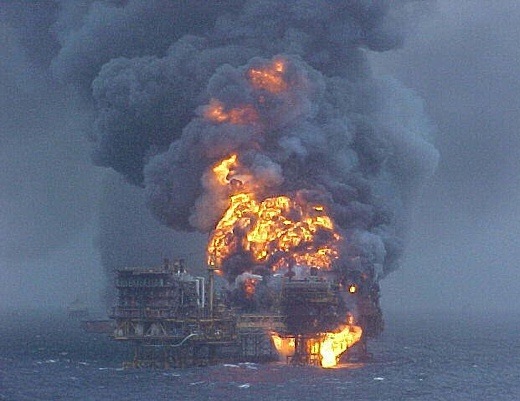
SUBHEAD: "My kids will be talking about the effect of this when they're my age," said 41-year-old Venice charter boat captain Bob Kenney. Image above: The BP Deepwater Horizon oil rig burns out on 4/22/10 in Gulf of Mexico. Oil slick ensues. From (http://www.texarkanagazette.com/news/WireHeadlines/2010/04/23/burning-oil-rig-sinks-dimming-chances-fo-31.php). By Holbrook Mohr and Allen Breed on 3 May 2010 in AP - (http://www.google.com/hostednews/ap/article/ALeqM5gIXWYBTpLtSayJtg41LKXpxSxVPAD9FF7IO03)

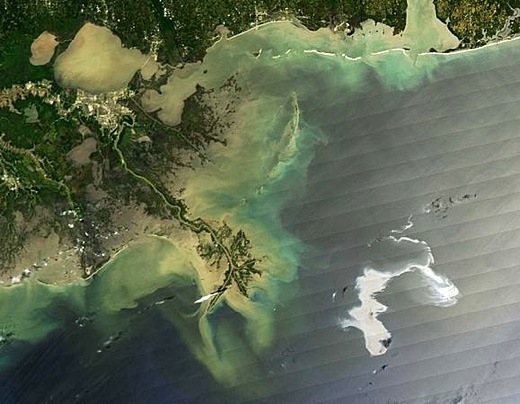
Another week of oil pouring from the seafloor. That is the best-case scenario for the Gulf Coast, where dead sea turtles washed ashore and a massive rust-colored slick continued to swell from an uncontrolled gusher spewing into the water.

BP PLC was preparing a system never tried before at such depths to siphon away the geyser of crude from a blown-out well a mile under Gulf of Mexico waters. However, the plan to lower 74-ton, concrete-and-metal boxes being built to capture the oil and siphon it to a barge waiting at the surface will need at least another six to eight days to get it in place.

Crews continued to lay boom in what increasingly feels like a futile effort to slow down the spill, with all ideas to contain the flow failing so far.

"I've been in Pensacola and I am very, very concerned about this filth in the Gulf of Mexico," Florida Gov. Charlie Crist said at a fundraiser for his U.S. Senate campaign Sunday night. "It's not a spill, it's a flow. Envision sort of an underground volcano of oil and it keeps spewing over 200,000 gallons every single day, if not more."

Fishermen from the mouth of the Mississippi River to the Florida Panhandle got the news that more than 6,800 square miles of federal fishing areas were closed, fracturing their livelihood for at least 10 days and likely more just as the prime spring season was kicking in. The slick also was precariously close to a key shipping lane that feeds goods and materials to the interior of the U.S. by the Mississippi River.

Even if the well is shut off in a week, fishermen and wildlife officials wonder how long it will take for the Gulf to recover. Some compare it to the Hurricane Katrina that Louisiana is still recovering from after nearly five years.

"My kids will be talking about the effect of this when they're my age," said 41-year-old Venice charter boat captain Bob Kenney.

At BP's Houston offices, dozens of engineers and technicians were cloistered on the third floor, working 12-hour shifts round-the-clock to come up with a solution.

"It's probably easier to fly in space than do some of this," Charlie Holt, BP's drilling and completion operations manager in the Gulf of Mexico, said Sunday.

Everything engineers have tried so far has failed. After the April 20 oil rig explosion, which killed 11 people, the flow of oil should have been stopped by a blowout preventer, but the mechanism failed. Efforts to remotely activate it continue to prove fruitless, weather has hampered plans to burn the oil and is making booms all along the coast ineffective.

Teams working to contain the spill have had limited success using airplanes to drop chemical dispersants meant to break up the oil, and rough seas have prevented ships from skimming crude from the surface. The oil probably will keep gushing for months until a second well can be dug to cut off the first.

Besides the immediate impact on Gulf industries, shipping along the Mississippi River could soon be limited. Ships carrying food, oil, rubber and much more come through the Southwest Pass to enter the vital waterway.

Shipment delays — either because oil-splattered ships need to be cleaned off at sea before docking or because water lanes are shut down for a time — would raise the cost of transporting those goods.

"We saw that during Hurricane Katrina for a period of time — we saw some prices go up for food and other goods because they couldn't move some fruit down the shipping channels and it got spoiled," PFGBest analyst Phil Flynn said.

The Port of New Orleans said projections suggest the pass will be clear through Tuesday.

President Barack Obama toured the region Sunday, deflecting criticism that his administration was too slow to respond and did too little to stave off the catastrophe.

A piece of plywood along a Louisiana highway had these words painted on it: "OBAMA SEND HELP!!!!"

The blessing of the boats is normally a joyous kickoff to the spring fishing season in St. Bernard Parish. But this year, it had more the air of a funeral.

Some years, as many as 200 craft, most of the working boats, lined up at the Gulf Outlet Marina to be sprinkled with holy water by a priest. On Sunday, only four boats floated by — and not one a commercial vessel.

Capt. Doogie Robin, 84, sat at a bar, sipping a Budweiser from the jaws of an alligator-head beer cozy. He runs eight oyster boats.

"Katrina really hit us hard," he said. "And this here, I think this is going to finish us now. I think this will wipe us off the map."

The Coast Guard and BP have said it's nearly impossible to know exactly how much oil has gushed since the blast, though it has been roughly estimated to be at least 200,000 gallons a day.

At that rate, it would eclipse the 1989 Exxon Valdez tanker spill — which dumped 11 million gallons off the Alaska coast — as the worst U.S. oil disaster in history in a matter of weeks.

"None of us have ever had experience at this level before. It ain't good," said Bob Love, coastal and nongame resources administrator with the Louisiana Department of Wildlife and Fisheries.

Even if the oil stays mostly offshore, the consequences could be dire for sea turtles, dolphins and other deepwater marine life — and microscopic plankton and tiny creatures that are a staple of larger animals' diets.

Moby Solangi, director of the Institute for Marine Mammal Studies in Gulfport, Miss., said at least 20 dead sea turtles were found on the state's beaches. He said it's too soon to say whether oil contamination killed them but that it is unusual to have them turning up across such a wide stretch of coast, nearly 30 miles.

None of the turtles have oil on them, but Solangi said they could have ingested oily fish or breathed in oil on the surface.

The situation could become even more grave if the oil gets into the Gulf Stream and flows to the beaches of Florida — and potentially whips around the state's southern tip and up the Eastern Seaboard. Tourist-magnet beaches and countless wildlife could be ruined.

Crist has declared a state of emergency for six counties in Florida. Louisiana also has declared an emergency.

Obama has halted any new offshore drilling projects unless rigs have new safeguards to prevent another disaster. On Sunday he called the spill a "massive and potentially unprecedented environmental disaster," and made clear that he was not accepting blame.

"BP is responsible for this leak. BP will be paying the bill," he said.

The containment boxes being built were not part of BP's original response plan. The approach has been used previously only for spills in relatively shallow water. Coast Guard Adm. Thad Allen said engineers are still examining whether the valves and other systems that feed oil to a ship on the surface can withstand the extra pressures of the deep.

If the boxes don't work, BP also has begun work on its only other backup plan: two relief wells that will take as long as three months to drill.

"What BP's doing is throwing absolutely everything we can at this," said Bob Fryar, senior vice president for BP in Angola. "We certainly want to do everything we can, everything we can possibly think of, as a company, as an industry."

BP has not said how much oil is beneath the seabed the Deepwater Horizon rig was tapping when it exploded. A company official, speaking on condition of anonymity because he was not authorized to discuss the volume of reserves, confirmed reports that it was tens of millions of barrels. Fryar said any numbers being thrown out are just estimates at best. The rig was operated by BP and owned by Transocean Ltd.

Peter Young has spent the better part of 18 years earning a living as fishing guide and he's afraid his way of life may be slipping away. The government has overreacted by shutting down vital fishing areas in the marshes before the oil has posed a threat, he said.

Until he sees oil himself, Young will keep fishing the closed areas.

"They can take me to jail," he said. "This is our livelihood. I'm not going to take customers into oil, but until I see it, I can't sit home and not work.

"I've got customers that are canceling because they're scared, and I don't know what to tell them."

.

Don't Look - Don't Find

SOURCE: Sharon Rudolph (shannonkona@gmail.com)
SUBHEAD: Comments on "Hawaii DU Plan Useless" from Martin Callamore in Tacoma, Washington.

By Martin Collamore on 2 May 2010 in Island Breath -
(http://islandbreath.blogspot.com/2010/05/dont-look-dont-find.html)

 
Image above: DU munition found at Schofield Barracks on Oahu. From (http://www.islandbreath.org/2006Year/03-environment/0603-20SuperFerryMilitary.html)

[IB Publisher's note: In response to the statement "Five-micron size [particles] would fall out within a mile," he said. "Smaller sizes may be carried by the wind." He recommended .45-micron filters."]  

I hope the NRC goes to the mat on this. The Army's testing plan certainly gives "military intelligence" a newer meaning. As a scientist, not to have a background baseline for comparison is literally shooting in the dark. The reference to an inadequate sampling frequency and sample locations are certainly troublesome and would skew any results, a concept that sounds like the Army version of three-card-monte.

And the 0.45 micron filter is the standard for microbial testing. A 5 micron filter would be like trying to catch BBs with a tennis racket. ' The army needs an independent consulting group to do anything statistically relevant for this question to be put to bed.

As for actual heath effects, that would be another conundrum as the data would be harder to determine and labor intensive to gather for rational conclusions. Wind patterns, medical records, dates, etc., would require a massive compilation to be definitive.

My comments were primarily directed at the sampling regime, which didn't sound robust or adequate. I've spent the better part of the last 40 years involved in some manner of environmental sampling, If the sampling wasn't done correctly, the data is compromised and any results obtained suspect.  

• Martin Collamore, the last 16 years or so before retirement, was the City of Tacoma Washington, Public Works Department, Environmental Services and Engineering Division, Laboratory Supervisor.
See also:
Island Breath: Superferry, Stryker, Depleted Uranium 1/6/06 .

Militarization of American Life

SUBHEAD: Will we have to have a military coup to the save the nation?

By Kurt Cobb on 2 May 2010 in Resource Insights -  
(http://resourceinsights.blogspot.com/2010/05/oil-spills-crime-waves-and-increasing.html) 


Image above: In 1968 uniformed and armed National Guard troops guard intersections in Wilmington, Delaware, during a summer for national unrest and urban rioting in America. From (http://www.oldwilmington.net/oldwilmington/photos_old.htm).  

Three recent developments are just the latest examples of the increasing militarization of American life:

1) The National Guard will now assist in the cleanup of the oil spill created in the aftermath of the explosion and subsequent sinking of a deepwater drilling platform off the Louisiana coast.

 2) Several members of Congress are asking for a deployment of the National Guard along the U.S.-Mexican border.

3) Two Chicago area state legislators are now calling for the Illinois National Guard to assist Chicago police to quell a supposed wave of violent crime. At first blush readers might accept that these problems are all worthy of military intervention and perhaps beyond the capability of civil authorities to handle on their own.

The response to the growing oil slick in the Gulf of Mexico now includes U. S. Coast Guard vessels and equipment and two cargo planes provided by the U. S. Department of Defense. British Petroleum (BP), the oil giant that operated the rig, seems overwhelmed. The damage to Gulf Coast habitat, fisheries and tourism seems potentially catastrophic.

And, the accident itself raises serious questions about the safety of offshore oil exploration, especially in deep waters. No wonder Homeland Security Secretary Janet Napolitano declared the spill to be of "national significance." The spill seems a natural candidate for military intervention. And, after all, the military has personnel and equipment that no other entity, public or private, has. As for border security, there have been periodic calls for a National Guard presence at the Mexican border.

Few people will deny that the borders of the United States are very easy to cross and therefore an invitation to those wishing to come into the country. Whether the National Guard could be effective in doing anything about this is an open question. A guardsman commenting on the most recent call doubts it. (See Havoc29 from Kansas).

Nevertheless, policing the borders is essentially a federal responsibility, so why not involve soldiers? Less clear cut is the case for involving National Guard units in the policing of the nation's communities.

The Illinois state legislators who are calling for National Guard intervention on the streets of Chicago failed to mention that deaths from violent crime this year are running only slightly ahead of last year. And yet, with municipalities facing increasing budget pressures, it seems inevitable that police officers and patrols will be cut, perhaps significantly in the coming years.

 I'm skeptical that we are now in a sustained economic recovery, and fully expect a second leg down that will leave the world economy in perhaps a decade-long funk. If I'm right, that would mean continuing cuts at all levels of government leading to further problems which will then lead to increasing calls for military assistance for a variety of tasks including those related to public safety and infrastructure repair.

Along the border the National Guard has, in fact, been providing support for a long time as the Guard proudly declares on its website: "The National Guard has provided engineering, counterdrug and other support to [U. S. Customs and Border Patrol] for more than 20 years and will continue to do so."

The military's Joint Task Force North founded in 1989 has been helping to interdict drugs and fight terrorism as well. The Army Corps of Engineers has long been party to many projects that are clearly civilian in nature. Abroad, the U. S. military has often performed tasks not directly related to combat such as humanitarian and peacekeeping missions.

The involvement of the military in many of these missions seems in some ways logical. But that is just the problem.

We are shaping public policies and priorities so that the resources to perform these tasks are increasingly unavailable to the civilian federal agencies or to the state and municipal governments responsible for those tasks. Starved of tax revenue or congressional appropriations, these entities have turned to the military for help. In part, this is because the country's politicians have convinced the public that much of government is wasteful and even useless with one very important exception: the military.

The lavish funding heaped on the military is not, however, a reflection of the return American society is getting from that funding. Rather it is a consequence of the powerful military-industrial complex that President Eisenhower warned the country against in 1960.

The dangers of this mission creep were evident as far back as 1992 when a prescient U. S. Air Force lieutenant colonel, Charles J. Dunlap Jr., wrote an essay entitled, "The Origins of the American Military Coup of 2012" (PDF). Dunlap foretold that U. S. military involvement in the kinds of activities discussed above would expand with deleterious effects on the ability of the military to fight effectively.

 The involvement of military personnel in civilian activities, he warned, would also lead to their increasing politicization. Military officers are not used to taking orders from seemingly inefficient, democratically elected bodies which are often slow to act to address even urgent problems.

Those officers may seek to circumvent such bodies when they appear to be impeding action on challenges that seem to call out for quick responses. Dunlap even predicted a second, but this time disastrous engagement in the Middle East, the result of a military scattered in its focus and mission. He guessed the confrontation would be with Iran rather than Iraq, but results are roughly what I think he foresaw.

With the dangers to the world economy increasing yearly from oil depletion, climate change, mountainous public and private debt and myriad other challenges, it seems likely the United States (and the world) will face continuing economic difficulties including declining or stagnant revenues for government at all levels.

With economic difficulties ongoing and the needs of public intensifying, it will be all too tempting to ask the institution likely to suffer the least from funding cuts, namely, the U. S. military, to step in and address problems that overwhelmed local, state and federal governments and agencies cannot. This is why Dunlap imagined that there will ultimately be little opposition to a military coup if it arrives.

After all, by then the military will be performing so many tasks in civilian life that taking direct command of government may well seem the next logical and necessary step to the save the nation.

 .

RIMPAC to return in 2010

SOURCE: Sharon Rudolph (shannonkona@gmail.com) SUBHEAD: The Navy has conducted RIMPAC since 1971. The use of mid and low frequency sonar kills thousands of fish and sea mammals each exercise. Image above: The USS Chung Hoon, an Arleigh Burke-class Aegis destroyer, at sea during RIMPAC 2006. From (http://commons.wikimedia.org/wiki/File:USS_Chung-Hoon_%28DDG-93%29_RIMPAC.jpg) By Erin Miller on 30 April 2010 in West Hawaii Today - (http://www.westhawaiitoday.com/articles/2010/04/30/local/local05.txt) West Hawaii residents may see American and foreign ships off the Big Island’s coast, as well as military jet flights, sometime this summer. The state will be hosting, for the 22nd time, the biennial Rim of the Pacific war games, known as RIMPAC, U.S. Navy 3rd Fleet Public Affairs Office Commander Greg Hicks said. More details about the joint international operation will be available next week, Hicks added. In the past, West Hawaii residents have reported being alarmed by jet flyovers at relatively low altitudes or in routes not typically prescribed by the Federal Aviation Administration for commercial flights. “There are approved routes that aircraft can take during the exercise,” Hicks said, adding the routes could be low level. The U.S. Pacific Fleet hosts the exercises in Hawaiian waters, typically during June and July. The event helps countries’ military participants see how they work together, Hicks said. The Navy has conducted RIMPAC since 1971. In 2008, 35 ships, six submarines, more than 150 aircraft and 20,000 sailors, airmen, marines, soldiers and Coast Guardsmen participated. In addition to U.S. participants, units from Australia, Canada, Chile, Japan, the Netherlands, Peru, the Republic of Korea, the United Kingdom and Singapore were included in the exercises. See also: Island Breath: Judge restricts sonar off California 08/07/07 Island Breath: RIMPAC 2008 uses destructive sonar 4/22/08 Island Breath: RIMPAC 2006 sonar use feared 5/23/06 Island Breath: RIMPAC 2006 sonar compromise 7/9/06 Island Breath: RIMPAC 2004 Strands whales in Hanlei 09/02/04 .

Worse than 1789

SUBHEAD: This summer in the Hamptons where, like Versailles in 1789, the elite mega-wealthy of today cavort shamelessly. By August, it's possible that the entire country except for the editorial board of the New York Times will be members in good standing of the Tea Party.

By James Kunstler on 2 May 2010 for Kunstler.com -
(http://kunstler.com/blog/2010/05/worse-than-1789.html)

 
Image above: An estate in along the beach in South Hampton, Long Island. From (http://sumanandsharmila.wordpress.com/2009/09/21/the-hamptons/).  

Senator Levin pretty much had Goldman Sach's Lloyd Blankfein dead in a casket with that now-notorious email from GS's head of sales and trading, Tom Montag, describing one of their billion-dollar investment "products" as "one shitty deal." Levin seemed to delight in crossing the boundary into the realm of the unspeakable, knowing that even the so-called "family" newspapers and cable TV networks would have to report it.

And just to make sure nobody missed the point, the senator repeated that phrase at least twenty times before the day was over. It was like the climactic scene in that old Hammer Films classic, The Horror of Dracula, where Professor Van Helsing moves from coffin to coffin pounding stakes through the hearts of Drac and all his fellow bloodsuckers.

It's hardly the climax of our story, though. Ours has barely started. It seems to me lately that the crack-up we've entered is liable to play out more gruesomely for our privileged elites than the orgy of bloodletting that attended the French Revolution. That historical moment was a sharp transition between old, settled social relations and the new political realities of imminent industrialization and a rising middle class.

The elites in charge of things to that moment, an ossified aristocracy, responded to rising discontent with utter feckless stupidity. To make matters worse, a great many of them were hunkered down in the fantasy-land Royal Palace of Versailles, enjoying what was for practical purposes a non-stop mega house party. They must have thought they were safe twelve miles outside Paris.

The French Revolution actually got off to a better start than it is remembered for. A progressive opposition put together a new legislature, the National Assembly. They undertook the writing of a constitution.

But it all fell apart rather quickly since the dim-witted King and his cohorts didn't really get into that old changing times spirit and their lack of cooperation -- not to mention their decadence -- provoked the more violent factions of the common people to form that kraken of politics, the mob.

What a god-damned mess it turned into -- a revolving cast of mob masters, each worse than the last, whipping up the crowds to ever more horrible enormities of human vivisection -- a political process that had gone hopelessly out of control.

Despite the agile precedent of their friend, the new USA, quickly resolving its own rebellion into a functioning government of law, France opted for a bloody clusterfuck -- which went on for eight more years.

The France of 1789 and the USA of today have a few important elements in common: a striking inability to sort out any national problems, an arrogant, depraved ruling elite resistant to reform, and an intellectual underclass motivated by blind fury. Some signal differences: most of our even theoretically best-intentioned "leaders" -- i.e. elected officials, business, education, and media figures -- are unable to articulate the problems we face, which go way beyond the mere distribution of political power or even wealth.

In fact much of the so-called Left, especially the faculty intellectuals, are preoccupied with esoteric sideshows around wealth, power, and the ridiculous "politics" of gender. Paul Krugman and David Brooks have no more of a clue about the implications of Peak Oil than Rush Limbaugh and Sarah Palin.

The resounding message of Senator Levin's hearings on Goldman Sachs last week is that Wall Street is a shitty deal for America. Okay, now everybody knows it. Nobody has an excuse for not knowing it. The machinations ongoing over a financial reform bill seem to be leading to a rather feeble outcome. The only people who are excited by it are -- surprise! -- a bunch of economists, who will soon be relegated to the dumpster of discredited professions along with necromancers, alchemists, and magnetic mesmerists.

My guess is that something lame will pass, it will be instantly denounced as yet another fraud, and then the next move is probably the stock market's. A return of volume will signal a return of cratering equities as all the indexes give up their hallucinated gains of the past year, and all the pension funds and college endowments and banks who flocked there in the desperate search for yield will find that they were hosed.


By August, it's possible that the entire country except for the editorial board of the New York Times will be members in good standing of the Tea Party, and it will have split into a dozen warring factions. By then, too many other destabilizing events will be in motion. The hangover of the British election will reveal the fatal insolvency of the UK, torpedoing the pound -- a huge event that would certainly trigger a cascading fiasco of credit default swap obligations. I don't see how the global financial system emerges from that in any form recognizable to someone watching the scene in the first week of May, 2010.

In the background of all this, something wicked this way comes in the matter of oil prices and availability. The eco-disaster underway from the Deepwater Horizon oil spill is looking every hour more like an event horizon that will rock the whole industry and, with it, the developed world. At the moment, oil is over $86 a barrel (and gasoline over $3 for regular at the pumps).

I continue to wonder how it will all go down this summer in the Hamptons where, like Versailles in 1789, the elite mega-wealthy of today cavort shamelessly in a semi-private fantasy-land of status vamping for the Vanity Fair shutterbugs.

The Hamptons are not defensible -- unless you count privet hedge as an effective fortification. Any bloody-minded gang of unemployed, grievance-maddened mudlarks can creepy-crawl down the Sunrise Highway to Gin Lane with firearms bought at the WalMart (and modified to full-automatic in the garage).

What if hundreds -- thousands! -- of them get the same idea? Louis XVI and his homeys probably never thought the mobs would scale the ha-has of his fabulous estate, either.

.

What Happened in Greece Today?

SUBHEAD: Videos of May Day observations in Greece include large protests and some violence.

By Barnaby Phillips on 1 May 2010 for Al Jazeera TV


Image above: In Athens a Greek riot policeman kicks demonstrator on back during protest on May 1st 2010. From (http://www.google.com/hostednews/afp/slideshow/ALeqM5iqfuc-JaC6u23azhuAmv1FMpqxnA?index=1).  
 
Nearly 10,000 people have taken to the streets in major cities across Greece to protest against the government's plan to tackle its economic problems. In the capital, Athens, the May Day rally on Saturday was marred by violence as groups of angry rioters clashed with police. At least one officer was set on fire when protesters hurled Molotov cocktails at security forces. The protesters were demonstrating against a government plan to impose tough spending cuts, as it seeks a financial rescue package from the European Union and the International Monetary Fund (IMF).

 
Video above: Thousands of angry Greeks march against austerity. From (http://www.youtube.com/watch?v=x6Wbk5EDMXI)

 
Video above: Molotov cocktail hits police during May Day protest. From (http://www.youtube.com/watch?v=ak1Vg0oNLjw)


 .
 

Save rural Waimea Valley

SUBHEAD: Oahu's Ahko Property Inc requests Zoning Change to make money off rural Waimea lowland. Change of Open Space to R4 Urban Residential zoning detrimental to residents and nature of valley.

By Julia McGovern of Waimea Valley on 30 April 2010 in Garden Island - (http://thegardenisland.com/news/opinion/mailbag/article_7bdbf464-54f6-11df-901f-001cc4c03286.html)


Image above: Kauai County Council Meeting on 14 April 2010 when Ahko Inc. property was brought up as agenda item. Photo by Juan Wilson.

 [IB Publisher's note: Walton Hong is a lawyer who has represented some of the most venal and insensitive land speculators that have done business on Kauai. Almost four years ago this Waimea land issue was raised and enough public outcry went up that Hong decided to withdraw the zoning appeal he was making for his client Oaho's Ahko Inc., and wait for another time to strike. Hong tried on 4/14/10 before the Kauai County Council and there was public present that testified against the change in zoning. The matter was postponed. Walton Hong will strike again on May 5th 2010 at the County Council meeting. Be there!]  

No residential zoning in Waimea flood plain 
I have lived on Maile Road for 20 years. Here in Waimea, on Menehune Road, adjacent to Ching Park and my back yard, is a property once filled with trees and birds. Home to kiawe and a variety of birds including pueo.

In 2006 this Open District land was back-hoed barren by its three-generation owners who live off island. I still grieve the loss of this beauty. The owners of this lot (TMK: (4)-1-6-05:18) sought to amend the zoning in 2006 to R6. Meeting with great neighbor and county resident opposition (a petition of 130 names and concerned-public testimony) Ahko Inc. withdrew their request to amend the zoning.

As an “O” zoned property (open district), the owners built a single dwelling last year on this now-cleared land which they rent to one tenant and the weed-filled portion to someone with horses.

On Wednesday May 5, Ahko Inc.’s attorney will appear before the (Kaua‘i County Council) Planning Committee to again petition to amend this “0” zoning to R4, Bill No. 2350. Now I am concerned about the repercussions for everyone and everything around this property, if this critical flood plain is lost forever.

The property is zoned open district for a very good reason. Bordered by Keali‘i Ditch and sitting on former rice farms, it has always been a place for waters to rise and recede. When heavy rains and back flow from Waimea River during high tides and ocean swells cause the ditch to overflow, its soil (and once vegetation) is an essential “green space” to ameliorate flooding of all surrounding properties.

Moreover, according to the county wastewater department, Keali‘i Ditch is a protected waterway under the Federal Clean Water Act because it discharges into the Waimea River which discharges into the ocean.

Before any zoning is amended or permit is issued a watershed-engineering analysis of the area must be done. A watershed plan must be created and adhered to for the health and safety of the land and people.

What to do with these flood waters is currently addressed as a crisis without a preventative watershed plan in place. The Keali‘i Ditch has had trees chopped from its banks, weeds sprayed with Round-Up and back-hoes dredging it, possibly without the necessary state permits.

This is no way to treat a waterway that should be maintained as a functioning watershed. Residents such as myself have to call the police to dredge open the Waimea river mouth when the ditch backs up onto the roads and into our yards.

Not long ago, a back-hoe was sent to dredge the ditch, causing severe erosion of my property. These are crisis responses that do harm; we need to act preventively in caring for these green spaces.

We must heed our “General Plan” which states that Waimea remain rural.

Adding housing, condos, concrete, asphalt, sidewalks, driveways and the like that come with R4 zoning in such a watershed/green space would be a grave mistake for our neighborhood, making a problem we already have a much larger one.

Deny Ahko Inc. Zoning Change in Waimea Valley  

By Linda Harmon of Hanapepe Valley on 30 May 2010 - 

  I am against any ordinance change at the Ahko Inc. property in Waimea Valley from open space usage to R4. The owners tried to change the ordinance back in 2006 but withdrew their request when they were faced with possible rejection.

The owners would like to increase the value by a stroke of council approval so they can build condominiums for sale to the detriment of the valley residents. This change would be significant to the rural character of the valley which the Kauai General Plan enacted after much citizen participation in the year 2000.

The valleys of Kauai have been dedicated to agrarian use throughout its past in part because of good soil for growing and rural life style due to the potential for flooding. Now that the levee has failed to meet new certification requirements residents will have to pay flood insurance or risk having to pay out of pocket expenses for damages due to flooding.

Putting more buildings and paving over a good portion of the lot will increase the likelihood of flooding and costly rebuilding in the area. The Kauai General Plan is our guidance in planning buildings for the long term.

 It calls for the valleys to remain rural in character. It calls for the low laying land adjoining the park that includes a natural drainage for the surrounding area to remain open with buildings on no more than 15% of the property.

Military Brass on Climate Change

SUBHEAD: Thirty-three US Generals & Admirals state Climate Change threatens American security. Image above: The US military is the biggest fossil fuel consumer. They know of the difficulties ahead. From Treehugger article.

By Briant Merchant on 29 April 2010 for Tree Hugger - (http://www.treehugger.com/files/2010/04/33-us-military-generals-admirals-climate-change-threatening-america.php)

The Pentagon has already made it well known that it considers climate change a grave national security threat, and recently the US military already pointed out that the world may face severe oil shortages as soon as 2015. But now, in what's being hailed as an "unprecedented" show of support for climate action, 33 retired US military generals and admirals have united to alert the public and our legislators that "climate change is making the world a more dangerous place." They should know -- they've seen its effects firsthand. Here's their full announcement:

Dear Senate Majority Leader Harry Reid and Senate Minority Leader Mitch McConnell,

Climate change is threatening America's security. The Pentagon and security leaders of both parties consider climate disruption to be a "threat multiplier" - it exacerbates existing problems by decreasing stability, increasing conflict, and incubating the socioeconomic conditions that foster terrorist recruitment. The State Department, the National Intelligence Council and the CIA all agree, and all are planning for future climate-based threats.

America's billion-dollar-a-day dependence on oil makes us vulnerable to unstable and unfriendly regimes. A substantial amount of that oil money ends up in the hands of terrorists. Consequently, our military is forced to operate in hostile territory, and our troops are attacked by terrorists funded by U. S. oil dollars, while rogue regimes profit off of our dependence. As long as the American public is beholden to global energy prices, we will be at the mercy of these rogue regimes. Taking control of our energy future means preventing future conflicts around the world and protecting Americas here at home.

It is time to secure America with clean energy. We can create millions of jobs in a clean energy economy while mitigating the effects of climate change across the globe. We call on Congress and the administration to enact strong, comprehensive climate and energy legislation to reduce carbon pollution and lead the world in clean energy technology.

Part of me wishes I could write "If you don't believe that climate change is a threat, you're un-American" with a straight face. But that's just the part of me that's so sick of hearing the mis- and disinformation so prevalent in the climate policy debate. So I'll stick to saying that from a national security perspective, these US military men are absolutely correct -- continued dependence on foreign oil is unstable, and we certainly can kick-start a clean energy revolution. The first US offshore wind farm to be approved yesterday is proof.

We just need good energy policy -- one that puts a price on carbon -- to get us moving in high gear. Kudos to these generals for taking a bold stand furthering that aim. I wonder if even Inhofe can call all 33 of them desperate attention seekers this time. I think not.

Here's the full release in its original form (pdf)

.

Square Coke Bottle

SUBHEAD: We are no fans of corn-syrup based soft drinks, but industrial design can matter.

By Pete Scholtus on 29 April 2010 in Tree Hugger -  
(http://www.treehugger.com/files/2010/04/andrew-kim-s-square-coke-bottle-design.php)


Image above: Packaging for proposed design for square soft drink container. From (http://designfabulous.blogspot.com/2010/03/eco-coke-bottle-design.html).
 
Maybe not as radical as square watermelons, but still quite progressive is Andrew Kim's square Coke bottle design. It definitely raised the question whether or not all bottles and containers should be square from an environmental point of view. Of course aesthetics, identity and function are also important, but it's surprising how much we could lower the environmental impact of distributing goods by stopping to transport air!


Andrew Kim proposed a bottle that is still 100% recyclable, and:

• with a 25% slimmer cap (saving lots of material)
• 27% more efficient (more bottles fit into a smaller space saving on packaging and transportation)
• collapsible design (for more efficient transportation after its use)
• 100% plant based (made from sugar cane byproducts)
• stackable design (even more efficient transport)

 
Image above: Square bottle is designed to be crushed before recycling. (http://designfabulous.blogspot.com/2010/03/eco-coke-bottle-design.html).
 
By making the bottle square, one can fit more Coke into a container, and less air! Kim calculated that a shipping container fits 3949 additional bottles if they are square, which is cost-saving too.

Of course this is only a concept design at this stage (pretty impressive for a midterm project by an 18-year-old) and one has to look into costs, functionality and other issues with this new design, but we believe it is a good reminder to question the shape of things and to work on minimizing the environmental footprint of transportation in general.

 .

Volcanoes are Toxic Smokestacks

SUBHEAD: High concentrations of sulfur dioxide drive a caustic chemistry that degrades the atmosphere and attacks the respiratory system.

 By Dr. Douglas Fields on 30 April 2010 in The Huffington Post -  
(http://www.huffingtonpost.com/dr-douglas-fields/volcano-eruption-volcanoe_b_551586.html)


Image above: An eruption of Kilauea volcano on the Big Island of Hawaii in 1924. From (http://www.unige.ch/sciences/terre/mineral/volcano/Recherche/keanakakoi.html)


If powerful jet engines of a 747 jumbo jet can be choked to death in an instant by inhaling volcanic ash, what about delicate lungs of human beings? The sudden termination last week of all trans-Atlantic air flights to avoid the catastrophe of aircraft plummeting to earth from an encounter with volcanic ash from Iceland's Eyjafjallajokull, dramatically illustrates the fragile relationship between man and the environment.

Especially on Earth Day, when we renew our enlightened understanding that industrial activities can poison our environment, it is sobering to realize that Nature does not revolve around an imperative to maintain Earth's environment for the health and welfare of human beings. The largest point source of sulfur dioxide in the United States is the Kilauea Volcano in Hawaii. Try fitting a catalytic converter to this "polluter."

Hot volcanic gases are extremely chemically reactive. Bromine released in a volcanic plume causes extensive ozone destruction. Ozone is the atmospheric gas that allows life on this planet to flourish by shielding organisms from the sun's deadly ultraviolet radiation. High concentrations of sulfur dioxide drive a caustic chemistry that degrades the atmosphere and attacks the respiratory system. Mercury and fluoride in the air and water can rise to toxic levels from volcanic eruptions. Fine particles of silica and other residues in volcanic ash pollute the air, block out sun stifling plant growth, and attack lungs. Respiratory infections increase sharply in people living in the vicinity of volcanoes, especially among children.

The Kilauea Volcano in Hawaii has been erupting continuously since 1983. In the Ka'u District of Hawaii, indoor sulfur dioxide concentrations are above the World Health Organization recommendations, raising special concern for indoor air quality in hospitals and schools. Studies of medical records and emergency room visits in nearby communities show that local residents have elevated incidence of bronchitis, increased prevalence of cough, phlegm, runny nose, sore throat, sinus congestion, wheezing and eye irritation.

A study in the aftermath of the Mount Asama eruption in Japan on September 1, 2004 found increased asthma in people living in affected areas. The risk of bronchitis doubled compared to unexposed communities, suggesting communities continuously exposed to sulfurous volcanic air pollution may have a higher risk of bronchitis across the life span. A review of mergency room visits after the Guagua Pichincha volcanic eruption in April 2000 in Quito, Ecuador found elevated rates of acute upper and lower respiratory tract infections, and asthma, especially in children. The rate of asthma doubled during the period of volcano activity.

Studies in experimental animals show that in addition to causing respiratory and cardiac illness, sulfur dioxide is a neurotoxin. Inhaled sulfur dioxide destroys DNA and protein by chemical oxidation causing systemic damage to the body's cells. The cellular destruction can be seen under a microscope in heart tissue, lung, liver, cerebral cortex of the brain, kidney and testes. Chemical analysis shows a dose-dependent increase in DNA damage in all cells of mice examined after inhaling sulfur dioxide. Damage to genetic material would fuel increased genetic mutation, cancer and have other destructive consequences.

Not only atmosphere, but water is also polluted by volcanoes. The water of Kagoshima Bay in Japan, which has a highly active volcano in its center, has dangerously elevated levels of mercury. People living in the Isparta Province of Turkey have mottled tooth enamel from high levels of fluoride leached from volcanic rocks into drinking water.

Clinging to this crust floating like slag on the Earth's molten core it is remarkably easy to forget that volcanoes have been shaping the geology and biology of this evolving planet for eons. This process began long before humans entered the scene and doubtlessly volcanoes will continue to do so long after homo sapiens succumbs to the same fate as dinosaurs, trilobites and the other marvelous biological creatures that have had their day on this third planet from the sun.
.

Adam Harju dies in Cambodia

SOURCE: Koohan Paik (kosherkimchee@yahoo.com)
SUBHEAD: Adam Harjou, former managing editor of the Garden Island News, is found dead in Cambodia street.  

[IB Publisher's note: Warning. A graphic photo of Adam Harju laying dead in the street in Cambodia is at the bottom of this article. Do not scroll to the bottom of this post if you wish to avoid it. Although our home page contained a warning about the image, those linking directly to this page may not have been aware of the warning. We apologize for having published the image at the top of this article when it was first posted.]

 
Image above: Adam in happier days on Kauai.
 

By Juan Wilson on 30 April 2010 for Island Breath -
(http://islandbreath.blogspot.com/2010/04/adam-harju-dies-in-cambodia.html)

Adam Harju was found dead in the streets of Phnom Penh, Cambodia in front of an apartment building he lived in at Street 118. He apparently suffered a massive head trauma. There have been rumors that it was not a suicide, as was officially reported. Some have suggested that he may have not been alive when he went through a fifth floor window, and even thought his criticism of the Cambodian government could have been a factor.

 Others point to evidence it may have been a tragic accident. For more details on the subject the following are blog posts that first reported his death in: "Khmer 440: Cambodia From The Inside" (http://www.khmer440.com/chat_forum/viewtopic.php?t=14348&sid=e4997aef21e464dff2092c2a034c7294)

Posted: Tue Apr 27, 2010 8:15 pm Post subject: foreigner died on st136? - anyone know? I heard a rumour that last night an american man fell from a building on st136, and died at the scene. can anybody confirm?

Posted: Tue Apr 27, 2010 8:32 pm Post subject: Reply with quote It was 118 and supposedly it wasn't an accident.

Posted: Tue Apr 27, 2010 8:40 pm Post subject: Reply with quote From what I've heard, he's a (perhaps former) writer for the Cambodia Daily (CD).

Posted: Tue Apr 27, 2010 8:45 pm Post subject: Reply with quote Was it suicide? Boy, the place really is turning into Pattaya. There aren't any good places to jump from on St. 118 are there? Most of the buildings in that area are no more than four stories tall. Was it a homicide?

Posted: Tue Apr 27, 2010 9:44 pm Post subject: Reply with quote From what I can understand.. The headline says it was suicide. (som-lup kloo-un). But I might be wrong. My Khmer reading isn't very good. Not easy to see from the picture where on st.118 it is either. As usual it's not in the English speaking news blogs/papers. (Yet..)

Posted: Tue Apr 27, 2010 9:57 pm Post subject:
Quote: (from Adam Harjou's blog:) unedited now - Journal - The going gets weird ... we are professionals The newspaper that I now work for — The Cambodia Daily — is a remarkably astounding place. ... Adam Harju uneditednow.squarespace.com/.../the-going-gets-weird-we-are-professionals. html -
From a former CDer, RIP Adam.

Posted: Tue Apr 27, 2010 10:03 pm Post subject: Reply with quote http://khmernz.blogspot.com/2008/12/harju-heads-west-to-cambodia.html
Quote: (from Adam Harjou's blog:) I have been apartment hunting and getting settled in. I am happily ensconced on Street 118 two blocks from the Mekong River in a fifth floor apartment in Phnom Penh. I can see the great river from the hammock strung on my veranda. http://uneditednow.squarespace.com/
Looks like he lived in Street 118. Sadly enough it seems it could have been a suicide. R.I.P. Mr. Harju. (His brother confirms his passing away on the blog.)

Posted: Tue Apr 27, 2010 11:13 pm Post subject: Reply with quote Yeah. This happened mid yesterday and we didn't put it on here because we heard conflicting stories of the guy's demise and we didn't want to rush into the story and get it wrong.
The one inescapable fact is that he went out of a window of a small three story building in the old town and hit the deck dead. Apparently his body sat there for 5 hours before it was taken away. If anybody is interested, the side angle is that some folks (maybe CSI fans) believe that he was dead before he went out of the window.

Tue Apr 27, 2010 11:29 pm Post subject: Reply with quote Reading his blog it does seem like he was a tormented soul- I guess its the countries tragic history that attracts such types. He also wrote some stuff critical of the goverment so that should stoke the conspiracy flames.

PostPosted: Wed Apr 28, 2010 10:20 am Post subject: Reply with quote Quote: There goes KiR's "losing the plot" theory. This guy had a day job that presumably required him to be up in the morning. Yet still a sad ending. I don't think he did have a day job anymore. Therefore, my thesis still stands.
Those of us with gainful employment that requires us to be in bed for before midnight and up again not long after dawn, drastically reduce our chances of going sketchy in the tropics.

PostPosted: Wed Apr 28, 2010 7:56 pm Post subject: Reply with quote my khmer girlfriend says the article states he had been drinking heavily and then jumped hence the suicide headline but perhaps he was drunk and fell, no suicide note seems to have been left.

SUBHEAD: Below is an enry to Adam's blog postings in Unedited Now  

Cambodia Redux
By Adam Harju on 6 April 2010 in Unedited Now - 
  (http://uneditednow.squarespace.com/journal/2010/4/6/cambodia-redux.html)

Anyone who has hung on this long to this blog is a true friend. I started it over a year ago when I left Kauai for Cambodia after a fucked up divorce. Personal issues got in the way in Cambodia and I returned to the states to get over them.

But I have exorcised that mental baggage and am again making a go of it in this steamy corner of the world. Nothing terribly exciting to report yet as I have been apartment hunting and getting settled in. I am happily ensconced on Street 118 two blocks from the Mekong River in a fifth floor apartment in Phnom Penh.

I can see the great river from the hammock strung on my veranda. Old friends are filtering back into my life and I am increasingly realizing I made a wise choice. I scared the shit out of my family though when I announced my departure, but if they would come visit me would realize their fears are silly.

I plan a writing and photo trip to Rattanakirri, the Three Corners region and Preah Vihear. I have an interpretor who will work for me for free because when I left before I sold him my $450 moto for $150 and gave him my phone and furniture. The bastard owes me and he knows it... free labor.

All I have to do is pay his bus ticket and lodging. In this corner of the world that amounts to nothing. So I promise here shortly updated photos and more interesting posts. If you have hung on this long, I think you can wait a little more.


Image above: The Body of Adam Harjou lies for five hours in front of Street 118 in Phnom Penh, Cambodia. From (http://kohsantepheapdaily.com.kh/article/20100426-030657.html)

Sadly, that is not true. We won't ever read those posts or see those photos. Goodnight Adam.

 .
Warning Shots

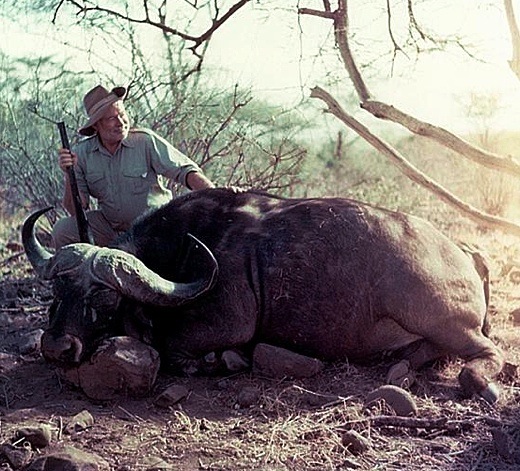
SUBHEAD: Better days lie ahead for those of us who desire to see the living planet make a comeback. Image above: Writer Ernest "Poppa" Hemingway with water buffalo he shot. He once said - “The world is a fine place and worth the fighting for and I hate very much to leave it.” Later he shot himself. From (http://johncaswell.com/blog/?p=23). By Guy McPherson on 29 April 2010 in Nature Bats Last - (http://guymcpherson.com/2010/04/warning-shots)

How many do you need?

I still keep hearing, “If things get bad, I’ll move to ….” And then fill in the blank with your favorite fantasy or nightmare, including these and many more:

“My sister-in-law’s property in Kansas”

“Mexico”

“The wilderness”

“A central America country”

“Southern Europe”

“Che coast”

First, let’s consider how “bad” things have to get. The first significant warning shot came in the 1970s, when people in the industrialized world felt the impacts of the U.S. losing its status as the world’s swing producer of crude oil. We were visited by expensive gasoline and long lines at the pumps, simultaneous inflation and economic contraction, a president who encouraged conservation, and many other consequences of relying heavily on crude oil for economic growth.

More recently, we’ve witnessed a housing crash, bank failures, oil priced at nearly $150/bbl, near-collapse of the industrial economy, sovereign debt crises throughout the industrialized world, and hundreds of other symptoms of passing the world oil peak.

If you keep your eyes closed, you’re going to run off the road. This society has already driven into a ditch, but you are not required to join the crash. Again, then: How many warning shots do you need?

We could spend a lot of time pointing out the lunacy of all the safe havens listed above. Moving in with the in-laws? Have you even asked? Isn’t there a reason you don’t live with them already? Have you discussed economic collapse with them, or do you continue to ignore the most important topic in the history of western civilization, opting instead for polite conversation?

"How ’bout them Red Sox? Nice weather we’ve been having, doncha think?"

Stop me if I’ve mentioned this one before: If you keep your eyes closed, you’re going to run off the road.

And Mexico? Do you speak Spanish? Fluently? Do you think you’ll be welcome there, gringo? Do you think continuing our history of occupation is a good idea, even at the personal level? Again, as before, why don’t you live there already, if it’s such a great place to be?

The wilderness? Really? Without a grocery store?

And so on, down the list of ludicrous options.

Here’s a thought: How about starting to prepare for a world without ready access to cheap fossil fuels? That would entail securing a personal supply of water and food for you and your family. For the rest of your life, and theirs. If that’s simply too daunting a task for your lizard-like brain, you can take the route pursued by about half the people to whom I speak:

“I’ll save a bullet for myself.”

Really? Evolution suggests otherwise. I foresee a lot of my “friends” showing up at the mud hut, unprepared and unrepentant, but too consumed with personal survival to take the promised Hemingway out. A friend in need...

Better days lie ahead for those of us who desire to see the living planet make a comeback. But if you believe life is not worth living in the absence of empire — in the absence of our unrelenting intent and ability to destroy every non-industrial culture and non-human species — why wait? Why not take the Hemingway out now, while you still can get a decent imperial funeral?

.

No, We Can't Have It All

SUBHEAD: We can have civilization with "progress" and history, or we can have sustainability.

By Derrick Jensen on 23 April 2010 in Common Dreams -
An Excerpt from 'Endgame, Vol. 1: The Problem of Civilization'  
(http://www.commondreams.org/view/2010/04/23-4)

 
Image above: Cover art for video game "Sid Meier's Civilization IV- Warlords". From (http://jogaste.com.br/pc/civilization-iv-warlords/caixa/)  


We all face choices. We can have ice caps and polar bears, or we can have automobiles. We can have dams or we can have salmon. We can have irrigated wine from Mendocino and Sonoma counties, or we can have the Russian and Eel Rivers. We can have oil from beneath the oceans, or we can have whales. We can have cardboard boxes or we can have living forests.

We can have computers and cancer clusters from the manufacture of those computers, or we can have neither. We can have electricity and a world devastated by mining, or we can have neither (and don't give me any nonsense about solar: you'll need copper for wiring, silicon for photovoltaics, metals and plastics for appliances, which need to be manufactured and then transported to your home, and so on. Even solar electrical energy can never be sustainable because electricity and all its accoutrements require an industrial infrastructure).

We can have fruits, vegetables, and coffee brought to the U.S. from Latin America, or we can have at least somewhat intact human and nonhuman communities throughout that region. (I don't think I need to remind readers that, to take one not atypical example among far too many, the democratically elected Arbenz government in Guatemala was overthrown by the United States to support the United Fruit Company, now Chiquita, leading to thirty years of U.S.-backed dictatorships and death squads.

Also, a few years ago I asked a member of the revolutionary tupacamaristas what they wanted for the people of Peru, and he said something that cuts to the heart of the current discussion [and to the heart of every struggle that has ever taken place against civilization]: "We need to produce and distribute our own food. We already know how to do that. We merely need to be allowed to do so."

We can have international trade, inevitably and by definition as well as by function dominated by distant and huge economic/governmental entities which do not (and cannot) act in the best interest of communities, or we can have local control of local economies, which cannot happen so long as cities require the importation (read: theft) of resources from ever-greater distances.

We can have civilization -- too often called the highest form of social organization -- that spreads (I would say metastasizes) to all parts of the globe, or we can have a multiplicity of autonomous cultures each uniquely adapted to the land from which it springs. We can have cities and all they imply, or we can have a livable planet. We can have "progress" and history, or we can have sustainability. We can have civilization, or we can have at least the possibility of a way of life not based on the violent theft of resources.

This is in no way abstract. It is physical. In a finite world, the forced and routine importation of resources is unsustainable. Duh.

Show me how car culture can coexist with wild nature, and more specifically, show me how anthropogenic global warming can coexist with ice caps and polar bears. And any fixes such as solar electric cars would present problems at least equally severe. For example, the electricity still needs to be generated, batteries are extraordinarily toxic, and in any case, driving is not the main way a car pollutes: far more pollution is emitted through its manufacture than through its exhaust pipe. We can perform the same exercise for any product of industrial civilization.

We can't have it all. The belief that we can is one of the things that has driven us to this awful place. If insanity could be defined as having lost functional connection with physical reality, to believe we can have it all -- to believe we can simultaneously dismantle a world and live on it; to believe we can perpetually use more energy than arrives from the sun; to believe we can take more than the world gives willingly; to believe a finite world can support infinite growth,much less infinite economic growth, where economic growth consists of converting ever larger numbers of living beings to dead objects (industrial production, at core, is the conversion of the living -- trees or mountains -- into the dead -- two-by-fours and beer cans) -- is grotesquely insane.

This insanity manifests partly as a potent disrespect for limits and for justice. It manifests in the pretension that neither limits nor justice exist. To pretend that civilization can exist without destroying its own landbase and the landbases and cultures of others is to be entirely ignorant of history, biology, thermodynamics, morality, and self-preservation. And it is to have paid absolutely no attention to the past six thousand years.

One of the reasons we fail to perceive all of this is that we -- the civilized -- have been inculcated to believe that belongings are more important than belonging, and that relationships are based on dominance -- violence and exploitation. Having come to believe that, and having come to believe the acquisition of material possessions is good (or even more abstractly, that the accumulation of money is good) and in fact the primary goal of life, we then have come to perceive ourselves as the primary beneficiaries of all of this insanity and injustice.

Right now I'm sitting in front of a space heater, and all other things being equal, I'd rather my toes were toasty than otherwise. But all other things aren't equal, and destroying runs of salmon by constructing dams for hydropower is a really stupid (and immoral) way to warm my feet. It's an extraordinarily bad trade.

And it's not just space heaters. No amount of comforts or elegancies, what that nineteenth-century slave owner called the characteristics of civilization, are worth killing the planet. What's more, even if we do perceive it in our best interest to take these comforts or elegancies at the expense of the enslavement, impoverishment, or murder of others and their landbases, we have no right to do so. And no amount of rationalization nor overwhelming force -- not even "full-spectrum domination" -- will suffice to give us that right.

Yet we have been systematically taught to ignore these trade-offs, to pretend if we don't see them (even when they're right in front of our faces) they do not exist. Yesterday, I received this email:
"We all face the future unsure if our own grandchildren will know what a tree is or ever taste salmon or even know what a clean glass of water tastes like. It is crucial, especially for those of us who see the world as a living being, to remember.
I've realized that outside of radical activist circles and certain indigenous peoples, the majority has completely forgotten about the passenger pigeon, completely forgotten about salmon so abundant you could fish with baskets. I've met many people who think if we could just stop destroying the planet right now, that we'll be left with a beautiful world. It makes me wonder if the same type of people would say the same thing in the future even if they had to put on a protective suit in order to go outside and see the one tree left standing in their town.
Would they also have forgotten?
Would it still be a part of mainstream consciousness that there used to be whole forests teeming with life?
I think you and I agree that as long as this culture continues with its preferred methods of perception, then it would not be widely known to the majority. I used to think environmental activists would at least get to say, ‘I told you so' to everyone else once civilization finally succeeded in creating a wasteland, but now I'm not convinced that anyone will even remember.
Perhaps the worst nightmare visions of activists a few hundred years ago match exactly the world we have outside our windows today, yet nobody is saying, ‘I told you so.'"

I think he's right. I've long had a nightmare/fantasy of standing on a desolate plain with a CEO or politician or capitalist journalist, shaking him by the shoulders and shouting, "Don't you see? Don't you see it was all a waste?" But after ruminating on this fellow's email, the nightmare has gotten even worse. Now I no longer have even the extraordinarily hollow satisfaction of seeing recognition of a massive mistake on this other's face. Now he merely looks at me, his eyes flashing a combination of arrogance, hatred, and willful incomprehension, and says, "I have no idea what you're talking about."

And he isn't even entirely lying.

Except of course to himself..

Hawaii DU Plan Useless

SUBHEAD: Nuclear Regulatory Commission to US Army - DU monitoring plan in Hawaii won't work.

By Alan D. McNarie on 28 April 2010 in Big Island Weelky -
 
   
Image above: US Army training at Pohakuloa Training area on Big Island has employed DU munitions. From original article.

The U.S. Army's plan to monitor the air over Pohakuloa Training Area for depleted uranium has drawn sharp criticism from some Native Hawaiians, environmentalists, activists and independent experts. Now the Army has gotten an admonishment from the Nuclear Regulatory Commission.

 "We have concluded that the Plan will provide inconclusive results for the U.S. Army as to the potential impact of the dispersal of depleted uranium (DU) while the Pohakuloa Training Area is being utilized for aerial bombardment or other training exercises," wrote Rebecca Tadesse, Chief of the NRC's Materials Decommissioning Branch, in a recent letter to Lt. General Rick Lynch, who heads the Army's Installation Management Command.

Tadesse and her staff reached that conclusion after reviewing the draft plan proposed by the Army and ORISE, the Oak Ridge Institute for Science and Education, which would conduct the monitoring for aerial DU contamination at Pohakuloa and at various other locations around the island.

The NRC experts concluded that the plan was inadequate in several areas: the number of air samples planned was "insufficient," optimum locations for monitoring needed to be determined and established, and "Continuous monitoring should be performed during the testing and also prior to and following testing to determine background conditions," so that the army would have a basis for comparison with any high readings.

The letter also noted that the army proposed to conduct its air monitoring specifically during live firing exercises -- even though the Army had told the NRC that it would not "use high explosives and bombs in areas where DU is present." "If that is true, why would there be an expectation that DU might be dispersed during such training exercises?" Tadesse asked.

The Army's handling of the DU issue at Pohakuloa is also drawing fire from some independent experts, including retired army doctor Lorrin Pang, Los Alamos National Laboratory consultant Dr. Marshall Bland, and Dr. Michael Reimer, a retired geologist with a background in radiation monitoring. And Sierra Club researcher Cory Harden has used recently released Army documents to challenge the Army's own estimates of how much DU may have been released into the environment at Pohakuloa.

 "The NRC review seems to vindicate Dr. Pang and myself for claiming that the monitoring was insufficient," Reimer told BIW. According to the NRC's Greg Pukin, his agency doesn't generally have jurisdiction over weapons, but does have authority over DU and other radionuclides.

The Army has applied to the NRC for a permit to possess DU at Pohakuloa -- a permit that, if granted, could allow the recently discovered remains of depleted uranium spotter rounds from the Army's cold-war-era Davy Crockett nuclear howitzer on site at the training area -- spotter rounds whose presence in Hawaii the army had denied until a citizen's group unearthed an e-mail about their discovery in 2006.

A group of local residents, including Harden, antiwar activist Jim Albertini, and native Hawaiian activist Isaac Harp had filed a challenge to the Army's application on the grounds that its monitoring and clean-up plans were inadequate, but were recently denied standing by the NRC. Harp has appealed that denial.

Both Pang and Reimer testified as experts on April 14 at an NRC phone conference to consider Harp's complaint. In addition to noting Tadesse's criticisms, Reimer observed that the 5-micron filters that the army planned to use to capture possible DU particles for monitoring were a bit on the coarse side.

"Five-micron size [particles] would fall out within a mile," he said. "Smaller sizes may be carried by the wind." He recommended .45-micron filters. Pang also challenged the army's general credibility by citing a number of former army statements about DU that Pang said simply weren't true.

"The Army stated to the Deptartment of Health Environmental Chief that inhaled DU (from exploding weaponry) was not a worry since DU is heavier than air and would not become airborne, therefore not inhaled," he noted, for example.

He testified that Army consultants, when discussing the amount of DU needed to produce radiation readings reported by civilian monitors at Pohakuloa, had held out their hands to indicate chunks the size of basketballs. Pang also claims that an Army study setting human safety thresholds for DU inhalation was scientifically flawed.

"That study has been widely, publicly debunked by the scientific community," he said. "The Army investigators did not count effects like tumors (both malignant and benign) in the exposed group."

 "The kind of air monitoring that the Army is using, they'll never find it," commented Harden at the conference call. Harden also challenged an Army estimate that about 700 Davy Crocket spotter rounds may have been fired at Pohakuloa. "To back up their claim they quoted from a report, which I only managed to obtained after ten months of repeated requests," testified Harden.

Their quote for the lower number does not match my copy of the report.... For soldiers to follow training manual requirements of that time, about 2,000 spotting rounds would have been needed at Pohakuloa. Now the Army didn't find 2,000 spotting rounds recently at Pohakuloa Training Area, only four fragments. They speculate that range clearance may have been done, but offer no evidence to support this theory."

 Based on the discrepancies, the Army's critics argued that the NRC simply couldn't trust what the Army said about DU in Hawaii - nor could the public. "Since we can't rely on the military to shine their light on the hazards its left behind, we need help from NRC," Hardin concluded.

 See also:
Island Breath: Superferry, Stryker Brigade & DU 11/1/06
Island Breath: DU detected at Big Island Gun Range 5/1/07
Island Breath: Army Confirms DU at Pohakuloa 8/21/07

 .