 Image above: Workers in a banana chip factory in Tagum, capital city of Davao del Norte.
From (http://blogs.stylebible.ph/rajosblog/2009/07/27/tagum-2).
By John Michael Greer on 31 March 2010 in The Archdruid Report -
(http://thearchdruidreport.blogspot.com/2010/03/riddles-in-dark.html)
Any number of metaphors might be used for the predicament today’s industrial societies face as the age of cheap energy stumbles to its end, but the one that keeps coming to mind is drawn from a scene in one of the favorite books of my childhood, J.R.R. Tolkien’s "The Hobbit". It’s the point in the story when Bilbo Baggins, the protagonist, gets lost in goblin-tunnels under the Misty Mountains and there encounters a gaunt, slippery, cannibalistic creature named Gollum.
That meeting was not exactly full of bonhomie. Gollum regarded Bilbo in much the way a hungry undergraduate regards the arrival of takeout pizza, but Bilbo was armed and alert. To put his intended meal off his guard, Gollum challenged Bilbo to a riddle contest. So there they sat, deep underground, challenging each other with the hardest riddles they could think of.
I sometimes think the rock around Gollum’s lair must have been a Jurassic sandstone full of crude oil; if Gollum were around nowadays, equally, I suspect he would be shilling for Cambridge Energy Research Associates, purveying energy misinformation to the media, and his “Preciousss” would be made of black gold. Certainly, though, the world’s industrial societies right now are in much the same predicament as Bilbo, fumbling in the dark for answers to riddles that take on an increasingly threatening tone with each moment that passes.
I’d like to talk about three of those riddles now. None of them are insoluble, but they point to a profoundly unwelcome reality that will play a major role in shaping the economics of the age dawning around us right now – and unlike characters in a children’s novel, we can’t count on being bailed out of our predicament, as Bilbo was, by the unexpected discovery of a magic ring. Here they are:
First:
It is the oldest machine in the world; it has raised the world’s greatest monuments and destroyed most of them, saved lives by the millions and killed them in like number; and when it is not in use, no one can see it. What is it?
Second:
There is a thoroughly proven, economically viable way to use solar energy that requires no energy subsidy from fossil fuels at all, and every mainstream economist thinks that getting rid of it wherever possible is the key to prosperity. What is it?
Third:
Two workers in different countries work in identical factories, using identical tools to make identical products. One of them makes twenty dollars an hour plus a benefit package; the other makes two dollars a day with no benefits at all. Why is that?
The last one is the easiest, though you’ll have a hard time finding a single figure in American public life who will admit to the answer. It’s not considered polite these days to talk about America’s empire, despite the fact that we keep troops in 140 other countries, and the far from unrelated fact that the 5% of Earth’s population that live in the US use around a third of the world’s resources, energy, and consumer products.
Like every other empire, we have a tribute economy; we dress it up in free-market drag by giving our trading partners mountains of worthless paper in return for the torrents of real wealth that flow into the US every day; but the result, now as in the past, is that the imperial nation and its inner circle of allies have a vast surplus of wealth sloshing through their economies. Handing over a little of that extra wealth to the poor and the working class has proven to be a tolerably effective way to maintain some semblance of social order.
That habit has been around nearly as long as empires themselves; the Romans were particularly adept at it -- “bread and circuses” is the famous phrase for their policy of providing free food and entertainment to the Roman urban poor o keep them docile. Starting in the wake of the last Great Depression, when many wealthy people woke up to the fact that their wealth did not protect them against bombs tossed through windows, most industrial nations have done the same thing by ratcheting up working class incomes and providing benefits such as old age pensions. No doubt a similar logic motivated the recent rush to force through a national health care system in the US, though the travesty that resulted is likely to cause far more unrest than it quells.
More generally, what passes by the name of democracy these days is a system in which factions of the political class buy votes from pressure groups by handing out what the political slang of an earlier day called by the endearing name of “pork.” The imperial tribute economy provided ample resources for political pork vendors, and the resulting outpouring of pig product formed a rising tide that, as the saying goes, lifted all boats. The problem, of course, is the same problem that afflicted Britain’s domestic economy during its age of empire, and Spain’s before that, and so on down through history: when wages in an imperial nation rise far enough above those of its neighbors, it stops being profitable to hire people in the imperial nation for any task that can be done outside it.
The result is a society in which those who get access to pork prosper, and those who don’t are left twisting in the wind. Arnold Toynbee, whose monumental study of the rise and fall of empires remains the most detailed examination of the process, calls these latter the “internal proletariat”: those who live within an imperial society but no longer share in its benefits, and become increasingly disaffected from its ideals and institutions. In the near term, they are the natural fodder of demagogues; in the longer term, they make common cause with the “external proletariat” – those nations outside the imperial borders whose labor and resources have become essential to the imperial economy, but who receive no benefits from that economy – and play a key role in bringing the whole system crashing down.
One of the ironies of the modern world is that today’s economists, so many of whom pride themselves on their realism, have by and large ignored the political dimensions of economics, and retreated into what amounts to a fantasy world in which the overwhelming influence of political considerations on economic life is denounced as an aberration where it is acknowledged at all. What Adam Smith and his successors called “political economy” suffered the amputation of its first half once Marx showed that it could be turned into an instrument for rabblerousing.
Thus the economists who support the current versions of "bread and circuses" labor to find specious economic reasons for what, after all, is a simple political payoff. Meanwhile, those who oppose them have lost track of the very real possibility that those who are made to go hungry in the presence of abundance may embrace options entirely outside of the economic realm, such as the aforementioned bombs through windows.
This irony is compounded by the fact that very nearly every economist in the profession, liberal or conservative, accepts certain presuppositions that work overtime to speed the process by which the working class becomes an internal proletariat in Toynbee’s sense, hastening the breakdown of the society these economists claim to interpret. It takes a careful ear for the subtleties of economic jargon to understand how this works. Economists talk constantly about efficiency and productivity, but they rarely say in so many words is what these terms mean.
A glance inside any economics textbook will clue you in. By efficiency, economists mean labor efficiency – that is, how much or little of human labor is needed for any given economic task. By productivity, in turn, economists mean labor productivity – that is, how much value is created per unit of labor. Thus anything that decreases the number of employee hours needed to produce a given quantity of goods and services counts as an increase in efficiency and productivity, whether or not it is efficient or productive in any other sense.
There’s a reason for this rather odd habit, and it points up one of the central issues of the industrial world’s present predicament. In the industrial world, for the last century or more, labor costs have been the single largest expense for most business enterprises, in large part because of the upward pressure on living standards caused by the tribute economy. Meanwhile the cost of natural resources and energy have been kept down by the same imperial arrangements.
The result is a close parallel to Liebig’s Law, one of the fundamental principles of ecology. Liebig’s Law holds that the nutrient in shortest supply puts a ceiling on the growth of living things, irrespective of the availability of anything more abundant; in the same way, our economics have evolved to treat the costliest resource to hand, human labor, as the main limitation to economic growth, and to treat anything that decreases the amount of labor as an economic gain.
Even when the energy needed to power machines was still cheap and abundant, this way of thinking was awash with mordant irony, because only in times of relatively robust economic growth did workers who were rendered surplus by such “productivity gains” readily find jobs elsewhere. At least as often, they added to the rolls of the unemployed, or pushed others onto those rolls, fueling the growth of an impoverished underclass that formed the seed of today’s rapidly growing internal proletariat. With the end of the age of cheap energy, though, the fixation on labor efficiency promises to become a millstone around the neck of America’s economy and, from a wider perspective, that of the world as a whole.
A world that has nearly seven billion people on it and a rapidly dwindling supply of fossil fuels, after all, has better ways to manage its affairs than those based on the assumption that putting people out of work and replacing them with fossil fuels is the way to prosperity. This is one of the unlearned lessons of the global economy that is now coming to an end around us.
While it was billed by friends and foes alike as the final triumph of corporate capitalism, globalization can more usefully be understood as an attempt by a failing system to prop up the illusion of economic growth by transferring the production of goods and services to economies that are, by the standards just mentioned, less efficient than those of the industrial world. Without the distorting effects of an imperial tribute economy, labor proved to be enough cheaper than energy that the result was profitable, and allowed the world’s industrial nations to maintain their exaggerated standards of living for a few more years.
At the same time, the brief heyday of the global economy was only made possible by a glut of petroleum that made transportation costs negligible. That glut is ending as world oil production begins to slip down the far side of Hubbert’s curve, while the Third World nations that profited most by globalization cash in their newfound wealth for a larger share of the world’s energy resources, putting further pressure on a balance of power that is already tipping against the United States and its allies. As this process continues, the tribute economy will be an early casualty. The implications for the lifestyles of most Americans will not be welcome.
I have suggested in previous posts that one useful way to think about the transformations now under way is to see them as the descent of the United States to Third World status. One consequence of that process is that most Americans, in the not very distant future, will earn the equivalent of a Third World income. It’s unlikely that their incomes will actually drop to $2 a day; far more likely is that the value of the dollar will crumple, so that a family making $40,000 a year might expect to pay half that to keep itself fed on rice and beans, and the rest to buy cooking fuel and a few other necessities.
It’s hard to see any way such a decline in our collective wealth could take place without political explosions on the grand scale. Still, in the twilight of the age of cheap energy, the most abundant energy source remaining throughout the world will be human labor, and as other resources become more costly, the price of labor – and thus the wages that can be earned by it – will drop accordingly.
At the same time, human labor has certain crucial advantages in a world of energy scarcity. Unlike other ways of getting work done, which generally require highly concentrated energy sources, human labor is fueled by food, which is a form of solar energy. Our agricultural system produces food using fossil fuels, but this is a bad habit of an age of abundant energy; field labor by human beings with simple tools, paid at close to Third World wages, already plays a crucial role in the production of many crops in the US, and this will only increase as wages drop and fuel prices rise.
The agriculture of the future, like agriculture in any thickly populated society with few energy resources, will thus use land intensively rather than extensively, rely on human labor with hand tools rather than more energy-intensive methods, and produce bulk vegetable crops and relatively modest amounts of animal protein; the agricultural systems of medieval China and Japan, chronicled by F.H. King in "Farmers of Forty Centuries", are as good a model as any. Such an agricultural system will not support seven billion people, but then neither will anything else, and a decline in population as malnutrition becomes common and public health collapses is a sure bet for the not too distant future.
For similar reasons, the economies of the future will make use of human labor, rather than any of the currently fashionable mechanical or electronic technologies, as their principal means for getting things done. Partly this will happen because in an overcrowded world where all other resources are scarce and costly, human labor will be the cheapest resource available, but it draws on another factor as well.
This was pointed out many years ago by Lewis Mumford in "The Myth of the Machine". He argued that the revolutionary change that gave rise to the first urban civilizations was not agriculture, or literacy, or any of the other things most often cited in this context. Instead, he proposed, that change was the invention of the world’s first machine – a machine distinguished from all others in that all of its parts were human beings. Call it an army, a labor gang, a bureaucracy or the first stirrings of a factory system; in these cases and more, it consisted of a group of people able to work together in unison. All later machines, he suggested, were attempts to make inanimate things display the singleness of purpose of a line of harvesters reaping barley or a work gang hauling a stone into place on a pyramid.
That kind of machine has huge advantages in an world of abundant population and scarce resources. It is, among other things, a very efficient means of producing the food that fuels it and the other items needed by its component parts, and it is also very efficient at maintaining and reproducing itself. As a means of turning solar energy into productive labor, it is somewhat less efficient than current technologies, but its simplicity, its resilience, and its ability to cope with widely varying inputs give it a potent edge over these latter in a time of turbulence and social decay.
That kind of machine, it deserves to be said, is also profoundly repellent to many people in the industrial world, doubtless including many of those who are reading this essay. It’s interesting to think about why this should be so, especially when some examples of the machine at work – Amish barn raisings come to mind – have gained iconic status in the alternative scene.
It is not going too far, I think, to point out that the word “community,” which receives so much lip service these days, is in many ways another word for Mumford’s primal machine. For the last few centuries, we have tried replacing that machine with a dizzying assortment of others; instead of subordinating individual desires to collective needs, like every previous society, we have built a surrogate community of machines powered by coal and oil and natural gas to take care, however sporadically, of our collective needs.
As those resources deplete, societies used to directing nonhuman energy according to scientific principles will face the challenge of learning once again how to direct human energy according to older and less familiar laws. This can be done in relatively humane ways, or in starkly inhuman ones; what remains to be seen is where along this spectrum the societies of the future will fall. That riddle neither Bilbo nor Gollum could have answered, and neither can I.
Publisher's opinion: I think the answers to the riddles are:
First: "Community"
Second: "Subsistence Farming"
Third: "Imperialism"
.
Image above: Workers in a banana chip factory in Tagum, capital city of Davao del Norte.
From (http://blogs.stylebible.ph/rajosblog/2009/07/27/tagum-2).
By John Michael Greer on 31 March 2010 in The Archdruid Report -
(http://thearchdruidreport.blogspot.com/2010/03/riddles-in-dark.html)
Any number of metaphors might be used for the predicament today’s industrial societies face as the age of cheap energy stumbles to its end, but the one that keeps coming to mind is drawn from a scene in one of the favorite books of my childhood, J.R.R. Tolkien’s "The Hobbit". It’s the point in the story when Bilbo Baggins, the protagonist, gets lost in goblin-tunnels under the Misty Mountains and there encounters a gaunt, slippery, cannibalistic creature named Gollum.
That meeting was not exactly full of bonhomie. Gollum regarded Bilbo in much the way a hungry undergraduate regards the arrival of takeout pizza, but Bilbo was armed and alert. To put his intended meal off his guard, Gollum challenged Bilbo to a riddle contest. So there they sat, deep underground, challenging each other with the hardest riddles they could think of.
I sometimes think the rock around Gollum’s lair must have been a Jurassic sandstone full of crude oil; if Gollum were around nowadays, equally, I suspect he would be shilling for Cambridge Energy Research Associates, purveying energy misinformation to the media, and his “Preciousss” would be made of black gold. Certainly, though, the world’s industrial societies right now are in much the same predicament as Bilbo, fumbling in the dark for answers to riddles that take on an increasingly threatening tone with each moment that passes.
I’d like to talk about three of those riddles now. None of them are insoluble, but they point to a profoundly unwelcome reality that will play a major role in shaping the economics of the age dawning around us right now – and unlike characters in a children’s novel, we can’t count on being bailed out of our predicament, as Bilbo was, by the unexpected discovery of a magic ring. Here they are:
First:
It is the oldest machine in the world; it has raised the world’s greatest monuments and destroyed most of them, saved lives by the millions and killed them in like number; and when it is not in use, no one can see it. What is it?
Second:
There is a thoroughly proven, economically viable way to use solar energy that requires no energy subsidy from fossil fuels at all, and every mainstream economist thinks that getting rid of it wherever possible is the key to prosperity. What is it?
Third:
Two workers in different countries work in identical factories, using identical tools to make identical products. One of them makes twenty dollars an hour plus a benefit package; the other makes two dollars a day with no benefits at all. Why is that?
The last one is the easiest, though you’ll have a hard time finding a single figure in American public life who will admit to the answer. It’s not considered polite these days to talk about America’s empire, despite the fact that we keep troops in 140 other countries, and the far from unrelated fact that the 5% of Earth’s population that live in the US use around a third of the world’s resources, energy, and consumer products.
Like every other empire, we have a tribute economy; we dress it up in free-market drag by giving our trading partners mountains of worthless paper in return for the torrents of real wealth that flow into the US every day; but the result, now as in the past, is that the imperial nation and its inner circle of allies have a vast surplus of wealth sloshing through their economies. Handing over a little of that extra wealth to the poor and the working class has proven to be a tolerably effective way to maintain some semblance of social order.
That habit has been around nearly as long as empires themselves; the Romans were particularly adept at it -- “bread and circuses” is the famous phrase for their policy of providing free food and entertainment to the Roman urban poor o keep them docile. Starting in the wake of the last Great Depression, when many wealthy people woke up to the fact that their wealth did not protect them against bombs tossed through windows, most industrial nations have done the same thing by ratcheting up working class incomes and providing benefits such as old age pensions. No doubt a similar logic motivated the recent rush to force through a national health care system in the US, though the travesty that resulted is likely to cause far more unrest than it quells.
More generally, what passes by the name of democracy these days is a system in which factions of the political class buy votes from pressure groups by handing out what the political slang of an earlier day called by the endearing name of “pork.” The imperial tribute economy provided ample resources for political pork vendors, and the resulting outpouring of pig product formed a rising tide that, as the saying goes, lifted all boats. The problem, of course, is the same problem that afflicted Britain’s domestic economy during its age of empire, and Spain’s before that, and so on down through history: when wages in an imperial nation rise far enough above those of its neighbors, it stops being profitable to hire people in the imperial nation for any task that can be done outside it.
The result is a society in which those who get access to pork prosper, and those who don’t are left twisting in the wind. Arnold Toynbee, whose monumental study of the rise and fall of empires remains the most detailed examination of the process, calls these latter the “internal proletariat”: those who live within an imperial society but no longer share in its benefits, and become increasingly disaffected from its ideals and institutions. In the near term, they are the natural fodder of demagogues; in the longer term, they make common cause with the “external proletariat” – those nations outside the imperial borders whose labor and resources have become essential to the imperial economy, but who receive no benefits from that economy – and play a key role in bringing the whole system crashing down.
One of the ironies of the modern world is that today’s economists, so many of whom pride themselves on their realism, have by and large ignored the political dimensions of economics, and retreated into what amounts to a fantasy world in which the overwhelming influence of political considerations on economic life is denounced as an aberration where it is acknowledged at all. What Adam Smith and his successors called “political economy” suffered the amputation of its first half once Marx showed that it could be turned into an instrument for rabblerousing.
Thus the economists who support the current versions of "bread and circuses" labor to find specious economic reasons for what, after all, is a simple political payoff. Meanwhile, those who oppose them have lost track of the very real possibility that those who are made to go hungry in the presence of abundance may embrace options entirely outside of the economic realm, such as the aforementioned bombs through windows.
This irony is compounded by the fact that very nearly every economist in the profession, liberal or conservative, accepts certain presuppositions that work overtime to speed the process by which the working class becomes an internal proletariat in Toynbee’s sense, hastening the breakdown of the society these economists claim to interpret. It takes a careful ear for the subtleties of economic jargon to understand how this works. Economists talk constantly about efficiency and productivity, but they rarely say in so many words is what these terms mean.
A glance inside any economics textbook will clue you in. By efficiency, economists mean labor efficiency – that is, how much or little of human labor is needed for any given economic task. By productivity, in turn, economists mean labor productivity – that is, how much value is created per unit of labor. Thus anything that decreases the number of employee hours needed to produce a given quantity of goods and services counts as an increase in efficiency and productivity, whether or not it is efficient or productive in any other sense.
There’s a reason for this rather odd habit, and it points up one of the central issues of the industrial world’s present predicament. In the industrial world, for the last century or more, labor costs have been the single largest expense for most business enterprises, in large part because of the upward pressure on living standards caused by the tribute economy. Meanwhile the cost of natural resources and energy have been kept down by the same imperial arrangements.
The result is a close parallel to Liebig’s Law, one of the fundamental principles of ecology. Liebig’s Law holds that the nutrient in shortest supply puts a ceiling on the growth of living things, irrespective of the availability of anything more abundant; in the same way, our economics have evolved to treat the costliest resource to hand, human labor, as the main limitation to economic growth, and to treat anything that decreases the amount of labor as an economic gain.
Even when the energy needed to power machines was still cheap and abundant, this way of thinking was awash with mordant irony, because only in times of relatively robust economic growth did workers who were rendered surplus by such “productivity gains” readily find jobs elsewhere. At least as often, they added to the rolls of the unemployed, or pushed others onto those rolls, fueling the growth of an impoverished underclass that formed the seed of today’s rapidly growing internal proletariat. With the end of the age of cheap energy, though, the fixation on labor efficiency promises to become a millstone around the neck of America’s economy and, from a wider perspective, that of the world as a whole.
A world that has nearly seven billion people on it and a rapidly dwindling supply of fossil fuels, after all, has better ways to manage its affairs than those based on the assumption that putting people out of work and replacing them with fossil fuels is the way to prosperity. This is one of the unlearned lessons of the global economy that is now coming to an end around us.
While it was billed by friends and foes alike as the final triumph of corporate capitalism, globalization can more usefully be understood as an attempt by a failing system to prop up the illusion of economic growth by transferring the production of goods and services to economies that are, by the standards just mentioned, less efficient than those of the industrial world. Without the distorting effects of an imperial tribute economy, labor proved to be enough cheaper than energy that the result was profitable, and allowed the world’s industrial nations to maintain their exaggerated standards of living for a few more years.
At the same time, the brief heyday of the global economy was only made possible by a glut of petroleum that made transportation costs negligible. That glut is ending as world oil production begins to slip down the far side of Hubbert’s curve, while the Third World nations that profited most by globalization cash in their newfound wealth for a larger share of the world’s energy resources, putting further pressure on a balance of power that is already tipping against the United States and its allies. As this process continues, the tribute economy will be an early casualty. The implications for the lifestyles of most Americans will not be welcome.
I have suggested in previous posts that one useful way to think about the transformations now under way is to see them as the descent of the United States to Third World status. One consequence of that process is that most Americans, in the not very distant future, will earn the equivalent of a Third World income. It’s unlikely that their incomes will actually drop to $2 a day; far more likely is that the value of the dollar will crumple, so that a family making $40,000 a year might expect to pay half that to keep itself fed on rice and beans, and the rest to buy cooking fuel and a few other necessities.
It’s hard to see any way such a decline in our collective wealth could take place without political explosions on the grand scale. Still, in the twilight of the age of cheap energy, the most abundant energy source remaining throughout the world will be human labor, and as other resources become more costly, the price of labor – and thus the wages that can be earned by it – will drop accordingly.
At the same time, human labor has certain crucial advantages in a world of energy scarcity. Unlike other ways of getting work done, which generally require highly concentrated energy sources, human labor is fueled by food, which is a form of solar energy. Our agricultural system produces food using fossil fuels, but this is a bad habit of an age of abundant energy; field labor by human beings with simple tools, paid at close to Third World wages, already plays a crucial role in the production of many crops in the US, and this will only increase as wages drop and fuel prices rise.
The agriculture of the future, like agriculture in any thickly populated society with few energy resources, will thus use land intensively rather than extensively, rely on human labor with hand tools rather than more energy-intensive methods, and produce bulk vegetable crops and relatively modest amounts of animal protein; the agricultural systems of medieval China and Japan, chronicled by F.H. King in "Farmers of Forty Centuries", are as good a model as any. Such an agricultural system will not support seven billion people, but then neither will anything else, and a decline in population as malnutrition becomes common and public health collapses is a sure bet for the not too distant future.
For similar reasons, the economies of the future will make use of human labor, rather than any of the currently fashionable mechanical or electronic technologies, as their principal means for getting things done. Partly this will happen because in an overcrowded world where all other resources are scarce and costly, human labor will be the cheapest resource available, but it draws on another factor as well.
This was pointed out many years ago by Lewis Mumford in "The Myth of the Machine". He argued that the revolutionary change that gave rise to the first urban civilizations was not agriculture, or literacy, or any of the other things most often cited in this context. Instead, he proposed, that change was the invention of the world’s first machine – a machine distinguished from all others in that all of its parts were human beings. Call it an army, a labor gang, a bureaucracy or the first stirrings of a factory system; in these cases and more, it consisted of a group of people able to work together in unison. All later machines, he suggested, were attempts to make inanimate things display the singleness of purpose of a line of harvesters reaping barley or a work gang hauling a stone into place on a pyramid.
That kind of machine has huge advantages in an world of abundant population and scarce resources. It is, among other things, a very efficient means of producing the food that fuels it and the other items needed by its component parts, and it is also very efficient at maintaining and reproducing itself. As a means of turning solar energy into productive labor, it is somewhat less efficient than current technologies, but its simplicity, its resilience, and its ability to cope with widely varying inputs give it a potent edge over these latter in a time of turbulence and social decay.
That kind of machine, it deserves to be said, is also profoundly repellent to many people in the industrial world, doubtless including many of those who are reading this essay. It’s interesting to think about why this should be so, especially when some examples of the machine at work – Amish barn raisings come to mind – have gained iconic status in the alternative scene.
It is not going too far, I think, to point out that the word “community,” which receives so much lip service these days, is in many ways another word for Mumford’s primal machine. For the last few centuries, we have tried replacing that machine with a dizzying assortment of others; instead of subordinating individual desires to collective needs, like every previous society, we have built a surrogate community of machines powered by coal and oil and natural gas to take care, however sporadically, of our collective needs.
As those resources deplete, societies used to directing nonhuman energy according to scientific principles will face the challenge of learning once again how to direct human energy according to older and less familiar laws. This can be done in relatively humane ways, or in starkly inhuman ones; what remains to be seen is where along this spectrum the societies of the future will fall. That riddle neither Bilbo nor Gollum could have answered, and neither can I.
Publisher's opinion: I think the answers to the riddles are:
First: "Community"
Second: "Subsistence Farming"
Third: "Imperialism"
.
Riddles in the Dark

SUBHEAD: The end of tribute economy will not be welcome in the lifestyles of most Americans.
Image above: Workers in a banana chip factory in Tagum, capital city of Davao del Norte.
From (http://blogs.stylebible.ph/rajosblog/2009/07/27/tagum-2).
By John Michael Greer on 31 March 2010 in The Archdruid Report -
(http://thearchdruidreport.blogspot.com/2010/03/riddles-in-dark.html)
Any number of metaphors might be used for the predicament today’s industrial societies face as the age of cheap energy stumbles to its end, but the one that keeps coming to mind is drawn from a scene in one of the favorite books of my childhood, J.R.R. Tolkien’s "The Hobbit". It’s the point in the story when Bilbo Baggins, the protagonist, gets lost in goblin-tunnels under the Misty Mountains and there encounters a gaunt, slippery, cannibalistic creature named Gollum.
That meeting was not exactly full of bonhomie. Gollum regarded Bilbo in much the way a hungry undergraduate regards the arrival of takeout pizza, but Bilbo was armed and alert. To put his intended meal off his guard, Gollum challenged Bilbo to a riddle contest. So there they sat, deep underground, challenging each other with the hardest riddles they could think of.
I sometimes think the rock around Gollum’s lair must have been a Jurassic sandstone full of crude oil; if Gollum were around nowadays, equally, I suspect he would be shilling for Cambridge Energy Research Associates, purveying energy misinformation to the media, and his “Preciousss” would be made of black gold. Certainly, though, the world’s industrial societies right now are in much the same predicament as Bilbo, fumbling in the dark for answers to riddles that take on an increasingly threatening tone with each moment that passes.
I’d like to talk about three of those riddles now. None of them are insoluble, but they point to a profoundly unwelcome reality that will play a major role in shaping the economics of the age dawning around us right now – and unlike characters in a children’s novel, we can’t count on being bailed out of our predicament, as Bilbo was, by the unexpected discovery of a magic ring. Here they are:
First:
It is the oldest machine in the world; it has raised the world’s greatest monuments and destroyed most of them, saved lives by the millions and killed them in like number; and when it is not in use, no one can see it. What is it?
Second:
There is a thoroughly proven, economically viable way to use solar energy that requires no energy subsidy from fossil fuels at all, and every mainstream economist thinks that getting rid of it wherever possible is the key to prosperity. What is it?
Third:
Two workers in different countries work in identical factories, using identical tools to make identical products. One of them makes twenty dollars an hour plus a benefit package; the other makes two dollars a day with no benefits at all. Why is that?
The last one is the easiest, though you’ll have a hard time finding a single figure in American public life who will admit to the answer. It’s not considered polite these days to talk about America’s empire, despite the fact that we keep troops in 140 other countries, and the far from unrelated fact that the 5% of Earth’s population that live in the US use around a third of the world’s resources, energy, and consumer products.
Like every other empire, we have a tribute economy; we dress it up in free-market drag by giving our trading partners mountains of worthless paper in return for the torrents of real wealth that flow into the US every day; but the result, now as in the past, is that the imperial nation and its inner circle of allies have a vast surplus of wealth sloshing through their economies. Handing over a little of that extra wealth to the poor and the working class has proven to be a tolerably effective way to maintain some semblance of social order.
That habit has been around nearly as long as empires themselves; the Romans were particularly adept at it -- “bread and circuses” is the famous phrase for their policy of providing free food and entertainment to the Roman urban poor o keep them docile. Starting in the wake of the last Great Depression, when many wealthy people woke up to the fact that their wealth did not protect them against bombs tossed through windows, most industrial nations have done the same thing by ratcheting up working class incomes and providing benefits such as old age pensions. No doubt a similar logic motivated the recent rush to force through a national health care system in the US, though the travesty that resulted is likely to cause far more unrest than it quells.
More generally, what passes by the name of democracy these days is a system in which factions of the political class buy votes from pressure groups by handing out what the political slang of an earlier day called by the endearing name of “pork.” The imperial tribute economy provided ample resources for political pork vendors, and the resulting outpouring of pig product formed a rising tide that, as the saying goes, lifted all boats. The problem, of course, is the same problem that afflicted Britain’s domestic economy during its age of empire, and Spain’s before that, and so on down through history: when wages in an imperial nation rise far enough above those of its neighbors, it stops being profitable to hire people in the imperial nation for any task that can be done outside it.
The result is a society in which those who get access to pork prosper, and those who don’t are left twisting in the wind. Arnold Toynbee, whose monumental study of the rise and fall of empires remains the most detailed examination of the process, calls these latter the “internal proletariat”: those who live within an imperial society but no longer share in its benefits, and become increasingly disaffected from its ideals and institutions. In the near term, they are the natural fodder of demagogues; in the longer term, they make common cause with the “external proletariat” – those nations outside the imperial borders whose labor and resources have become essential to the imperial economy, but who receive no benefits from that economy – and play a key role in bringing the whole system crashing down.
One of the ironies of the modern world is that today’s economists, so many of whom pride themselves on their realism, have by and large ignored the political dimensions of economics, and retreated into what amounts to a fantasy world in which the overwhelming influence of political considerations on economic life is denounced as an aberration where it is acknowledged at all. What Adam Smith and his successors called “political economy” suffered the amputation of its first half once Marx showed that it could be turned into an instrument for rabblerousing.
Thus the economists who support the current versions of "bread and circuses" labor to find specious economic reasons for what, after all, is a simple political payoff. Meanwhile, those who oppose them have lost track of the very real possibility that those who are made to go hungry in the presence of abundance may embrace options entirely outside of the economic realm, such as the aforementioned bombs through windows.
This irony is compounded by the fact that very nearly every economist in the profession, liberal or conservative, accepts certain presuppositions that work overtime to speed the process by which the working class becomes an internal proletariat in Toynbee’s sense, hastening the breakdown of the society these economists claim to interpret. It takes a careful ear for the subtleties of economic jargon to understand how this works. Economists talk constantly about efficiency and productivity, but they rarely say in so many words is what these terms mean.
A glance inside any economics textbook will clue you in. By efficiency, economists mean labor efficiency – that is, how much or little of human labor is needed for any given economic task. By productivity, in turn, economists mean labor productivity – that is, how much value is created per unit of labor. Thus anything that decreases the number of employee hours needed to produce a given quantity of goods and services counts as an increase in efficiency and productivity, whether or not it is efficient or productive in any other sense.
There’s a reason for this rather odd habit, and it points up one of the central issues of the industrial world’s present predicament. In the industrial world, for the last century or more, labor costs have been the single largest expense for most business enterprises, in large part because of the upward pressure on living standards caused by the tribute economy. Meanwhile the cost of natural resources and energy have been kept down by the same imperial arrangements.
The result is a close parallel to Liebig’s Law, one of the fundamental principles of ecology. Liebig’s Law holds that the nutrient in shortest supply puts a ceiling on the growth of living things, irrespective of the availability of anything more abundant; in the same way, our economics have evolved to treat the costliest resource to hand, human labor, as the main limitation to economic growth, and to treat anything that decreases the amount of labor as an economic gain.
Even when the energy needed to power machines was still cheap and abundant, this way of thinking was awash with mordant irony, because only in times of relatively robust economic growth did workers who were rendered surplus by such “productivity gains” readily find jobs elsewhere. At least as often, they added to the rolls of the unemployed, or pushed others onto those rolls, fueling the growth of an impoverished underclass that formed the seed of today’s rapidly growing internal proletariat. With the end of the age of cheap energy, though, the fixation on labor efficiency promises to become a millstone around the neck of America’s economy and, from a wider perspective, that of the world as a whole.
A world that has nearly seven billion people on it and a rapidly dwindling supply of fossil fuels, after all, has better ways to manage its affairs than those based on the assumption that putting people out of work and replacing them with fossil fuels is the way to prosperity. This is one of the unlearned lessons of the global economy that is now coming to an end around us.
While it was billed by friends and foes alike as the final triumph of corporate capitalism, globalization can more usefully be understood as an attempt by a failing system to prop up the illusion of economic growth by transferring the production of goods and services to economies that are, by the standards just mentioned, less efficient than those of the industrial world. Without the distorting effects of an imperial tribute economy, labor proved to be enough cheaper than energy that the result was profitable, and allowed the world’s industrial nations to maintain their exaggerated standards of living for a few more years.
At the same time, the brief heyday of the global economy was only made possible by a glut of petroleum that made transportation costs negligible. That glut is ending as world oil production begins to slip down the far side of Hubbert’s curve, while the Third World nations that profited most by globalization cash in their newfound wealth for a larger share of the world’s energy resources, putting further pressure on a balance of power that is already tipping against the United States and its allies. As this process continues, the tribute economy will be an early casualty. The implications for the lifestyles of most Americans will not be welcome.
I have suggested in previous posts that one useful way to think about the transformations now under way is to see them as the descent of the United States to Third World status. One consequence of that process is that most Americans, in the not very distant future, will earn the equivalent of a Third World income. It’s unlikely that their incomes will actually drop to $2 a day; far more likely is that the value of the dollar will crumple, so that a family making $40,000 a year might expect to pay half that to keep itself fed on rice and beans, and the rest to buy cooking fuel and a few other necessities.
It’s hard to see any way such a decline in our collective wealth could take place without political explosions on the grand scale. Still, in the twilight of the age of cheap energy, the most abundant energy source remaining throughout the world will be human labor, and as other resources become more costly, the price of labor – and thus the wages that can be earned by it – will drop accordingly.
At the same time, human labor has certain crucial advantages in a world of energy scarcity. Unlike other ways of getting work done, which generally require highly concentrated energy sources, human labor is fueled by food, which is a form of solar energy. Our agricultural system produces food using fossil fuels, but this is a bad habit of an age of abundant energy; field labor by human beings with simple tools, paid at close to Third World wages, already plays a crucial role in the production of many crops in the US, and this will only increase as wages drop and fuel prices rise.
The agriculture of the future, like agriculture in any thickly populated society with few energy resources, will thus use land intensively rather than extensively, rely on human labor with hand tools rather than more energy-intensive methods, and produce bulk vegetable crops and relatively modest amounts of animal protein; the agricultural systems of medieval China and Japan, chronicled by F.H. King in "Farmers of Forty Centuries", are as good a model as any. Such an agricultural system will not support seven billion people, but then neither will anything else, and a decline in population as malnutrition becomes common and public health collapses is a sure bet for the not too distant future.
For similar reasons, the economies of the future will make use of human labor, rather than any of the currently fashionable mechanical or electronic technologies, as their principal means for getting things done. Partly this will happen because in an overcrowded world where all other resources are scarce and costly, human labor will be the cheapest resource available, but it draws on another factor as well.
This was pointed out many years ago by Lewis Mumford in "The Myth of the Machine". He argued that the revolutionary change that gave rise to the first urban civilizations was not agriculture, or literacy, or any of the other things most often cited in this context. Instead, he proposed, that change was the invention of the world’s first machine – a machine distinguished from all others in that all of its parts were human beings. Call it an army, a labor gang, a bureaucracy or the first stirrings of a factory system; in these cases and more, it consisted of a group of people able to work together in unison. All later machines, he suggested, were attempts to make inanimate things display the singleness of purpose of a line of harvesters reaping barley or a work gang hauling a stone into place on a pyramid.
That kind of machine has huge advantages in an world of abundant population and scarce resources. It is, among other things, a very efficient means of producing the food that fuels it and the other items needed by its component parts, and it is also very efficient at maintaining and reproducing itself. As a means of turning solar energy into productive labor, it is somewhat less efficient than current technologies, but its simplicity, its resilience, and its ability to cope with widely varying inputs give it a potent edge over these latter in a time of turbulence and social decay.
That kind of machine, it deserves to be said, is also profoundly repellent to many people in the industrial world, doubtless including many of those who are reading this essay. It’s interesting to think about why this should be so, especially when some examples of the machine at work – Amish barn raisings come to mind – have gained iconic status in the alternative scene.
It is not going too far, I think, to point out that the word “community,” which receives so much lip service these days, is in many ways another word for Mumford’s primal machine. For the last few centuries, we have tried replacing that machine with a dizzying assortment of others; instead of subordinating individual desires to collective needs, like every previous society, we have built a surrogate community of machines powered by coal and oil and natural gas to take care, however sporadically, of our collective needs.
As those resources deplete, societies used to directing nonhuman energy according to scientific principles will face the challenge of learning once again how to direct human energy according to older and less familiar laws. This can be done in relatively humane ways, or in starkly inhuman ones; what remains to be seen is where along this spectrum the societies of the future will fall. That riddle neither Bilbo nor Gollum could have answered, and neither can I.
Publisher's opinion: I think the answers to the riddles are:
First: "Community"
Second: "Subsistence Farming"
Third: "Imperialism"
.
Image above: Workers in a banana chip factory in Tagum, capital city of Davao del Norte.
From (http://blogs.stylebible.ph/rajosblog/2009/07/27/tagum-2).
By John Michael Greer on 31 March 2010 in The Archdruid Report -
(http://thearchdruidreport.blogspot.com/2010/03/riddles-in-dark.html)
Any number of metaphors might be used for the predicament today’s industrial societies face as the age of cheap energy stumbles to its end, but the one that keeps coming to mind is drawn from a scene in one of the favorite books of my childhood, J.R.R. Tolkien’s "The Hobbit". It’s the point in the story when Bilbo Baggins, the protagonist, gets lost in goblin-tunnels under the Misty Mountains and there encounters a gaunt, slippery, cannibalistic creature named Gollum.
That meeting was not exactly full of bonhomie. Gollum regarded Bilbo in much the way a hungry undergraduate regards the arrival of takeout pizza, but Bilbo was armed and alert. To put his intended meal off his guard, Gollum challenged Bilbo to a riddle contest. So there they sat, deep underground, challenging each other with the hardest riddles they could think of.
I sometimes think the rock around Gollum’s lair must have been a Jurassic sandstone full of crude oil; if Gollum were around nowadays, equally, I suspect he would be shilling for Cambridge Energy Research Associates, purveying energy misinformation to the media, and his “Preciousss” would be made of black gold. Certainly, though, the world’s industrial societies right now are in much the same predicament as Bilbo, fumbling in the dark for answers to riddles that take on an increasingly threatening tone with each moment that passes.
I’d like to talk about three of those riddles now. None of them are insoluble, but they point to a profoundly unwelcome reality that will play a major role in shaping the economics of the age dawning around us right now – and unlike characters in a children’s novel, we can’t count on being bailed out of our predicament, as Bilbo was, by the unexpected discovery of a magic ring. Here they are:
First:
It is the oldest machine in the world; it has raised the world’s greatest monuments and destroyed most of them, saved lives by the millions and killed them in like number; and when it is not in use, no one can see it. What is it?
Second:
There is a thoroughly proven, economically viable way to use solar energy that requires no energy subsidy from fossil fuels at all, and every mainstream economist thinks that getting rid of it wherever possible is the key to prosperity. What is it?
Third:
Two workers in different countries work in identical factories, using identical tools to make identical products. One of them makes twenty dollars an hour plus a benefit package; the other makes two dollars a day with no benefits at all. Why is that?
The last one is the easiest, though you’ll have a hard time finding a single figure in American public life who will admit to the answer. It’s not considered polite these days to talk about America’s empire, despite the fact that we keep troops in 140 other countries, and the far from unrelated fact that the 5% of Earth’s population that live in the US use around a third of the world’s resources, energy, and consumer products.
Like every other empire, we have a tribute economy; we dress it up in free-market drag by giving our trading partners mountains of worthless paper in return for the torrents of real wealth that flow into the US every day; but the result, now as in the past, is that the imperial nation and its inner circle of allies have a vast surplus of wealth sloshing through their economies. Handing over a little of that extra wealth to the poor and the working class has proven to be a tolerably effective way to maintain some semblance of social order.
That habit has been around nearly as long as empires themselves; the Romans were particularly adept at it -- “bread and circuses” is the famous phrase for their policy of providing free food and entertainment to the Roman urban poor o keep them docile. Starting in the wake of the last Great Depression, when many wealthy people woke up to the fact that their wealth did not protect them against bombs tossed through windows, most industrial nations have done the same thing by ratcheting up working class incomes and providing benefits such as old age pensions. No doubt a similar logic motivated the recent rush to force through a national health care system in the US, though the travesty that resulted is likely to cause far more unrest than it quells.
More generally, what passes by the name of democracy these days is a system in which factions of the political class buy votes from pressure groups by handing out what the political slang of an earlier day called by the endearing name of “pork.” The imperial tribute economy provided ample resources for political pork vendors, and the resulting outpouring of pig product formed a rising tide that, as the saying goes, lifted all boats. The problem, of course, is the same problem that afflicted Britain’s domestic economy during its age of empire, and Spain’s before that, and so on down through history: when wages in an imperial nation rise far enough above those of its neighbors, it stops being profitable to hire people in the imperial nation for any task that can be done outside it.
The result is a society in which those who get access to pork prosper, and those who don’t are left twisting in the wind. Arnold Toynbee, whose monumental study of the rise and fall of empires remains the most detailed examination of the process, calls these latter the “internal proletariat”: those who live within an imperial society but no longer share in its benefits, and become increasingly disaffected from its ideals and institutions. In the near term, they are the natural fodder of demagogues; in the longer term, they make common cause with the “external proletariat” – those nations outside the imperial borders whose labor and resources have become essential to the imperial economy, but who receive no benefits from that economy – and play a key role in bringing the whole system crashing down.
One of the ironies of the modern world is that today’s economists, so many of whom pride themselves on their realism, have by and large ignored the political dimensions of economics, and retreated into what amounts to a fantasy world in which the overwhelming influence of political considerations on economic life is denounced as an aberration where it is acknowledged at all. What Adam Smith and his successors called “political economy” suffered the amputation of its first half once Marx showed that it could be turned into an instrument for rabblerousing.
Thus the economists who support the current versions of "bread and circuses" labor to find specious economic reasons for what, after all, is a simple political payoff. Meanwhile, those who oppose them have lost track of the very real possibility that those who are made to go hungry in the presence of abundance may embrace options entirely outside of the economic realm, such as the aforementioned bombs through windows.
This irony is compounded by the fact that very nearly every economist in the profession, liberal or conservative, accepts certain presuppositions that work overtime to speed the process by which the working class becomes an internal proletariat in Toynbee’s sense, hastening the breakdown of the society these economists claim to interpret. It takes a careful ear for the subtleties of economic jargon to understand how this works. Economists talk constantly about efficiency and productivity, but they rarely say in so many words is what these terms mean.
A glance inside any economics textbook will clue you in. By efficiency, economists mean labor efficiency – that is, how much or little of human labor is needed for any given economic task. By productivity, in turn, economists mean labor productivity – that is, how much value is created per unit of labor. Thus anything that decreases the number of employee hours needed to produce a given quantity of goods and services counts as an increase in efficiency and productivity, whether or not it is efficient or productive in any other sense.
There’s a reason for this rather odd habit, and it points up one of the central issues of the industrial world’s present predicament. In the industrial world, for the last century or more, labor costs have been the single largest expense for most business enterprises, in large part because of the upward pressure on living standards caused by the tribute economy. Meanwhile the cost of natural resources and energy have been kept down by the same imperial arrangements.
The result is a close parallel to Liebig’s Law, one of the fundamental principles of ecology. Liebig’s Law holds that the nutrient in shortest supply puts a ceiling on the growth of living things, irrespective of the availability of anything more abundant; in the same way, our economics have evolved to treat the costliest resource to hand, human labor, as the main limitation to economic growth, and to treat anything that decreases the amount of labor as an economic gain.
Even when the energy needed to power machines was still cheap and abundant, this way of thinking was awash with mordant irony, because only in times of relatively robust economic growth did workers who were rendered surplus by such “productivity gains” readily find jobs elsewhere. At least as often, they added to the rolls of the unemployed, or pushed others onto those rolls, fueling the growth of an impoverished underclass that formed the seed of today’s rapidly growing internal proletariat. With the end of the age of cheap energy, though, the fixation on labor efficiency promises to become a millstone around the neck of America’s economy and, from a wider perspective, that of the world as a whole.
A world that has nearly seven billion people on it and a rapidly dwindling supply of fossil fuels, after all, has better ways to manage its affairs than those based on the assumption that putting people out of work and replacing them with fossil fuels is the way to prosperity. This is one of the unlearned lessons of the global economy that is now coming to an end around us.
While it was billed by friends and foes alike as the final triumph of corporate capitalism, globalization can more usefully be understood as an attempt by a failing system to prop up the illusion of economic growth by transferring the production of goods and services to economies that are, by the standards just mentioned, less efficient than those of the industrial world. Without the distorting effects of an imperial tribute economy, labor proved to be enough cheaper than energy that the result was profitable, and allowed the world’s industrial nations to maintain their exaggerated standards of living for a few more years.
At the same time, the brief heyday of the global economy was only made possible by a glut of petroleum that made transportation costs negligible. That glut is ending as world oil production begins to slip down the far side of Hubbert’s curve, while the Third World nations that profited most by globalization cash in their newfound wealth for a larger share of the world’s energy resources, putting further pressure on a balance of power that is already tipping against the United States and its allies. As this process continues, the tribute economy will be an early casualty. The implications for the lifestyles of most Americans will not be welcome.
I have suggested in previous posts that one useful way to think about the transformations now under way is to see them as the descent of the United States to Third World status. One consequence of that process is that most Americans, in the not very distant future, will earn the equivalent of a Third World income. It’s unlikely that their incomes will actually drop to $2 a day; far more likely is that the value of the dollar will crumple, so that a family making $40,000 a year might expect to pay half that to keep itself fed on rice and beans, and the rest to buy cooking fuel and a few other necessities.
It’s hard to see any way such a decline in our collective wealth could take place without political explosions on the grand scale. Still, in the twilight of the age of cheap energy, the most abundant energy source remaining throughout the world will be human labor, and as other resources become more costly, the price of labor – and thus the wages that can be earned by it – will drop accordingly.
At the same time, human labor has certain crucial advantages in a world of energy scarcity. Unlike other ways of getting work done, which generally require highly concentrated energy sources, human labor is fueled by food, which is a form of solar energy. Our agricultural system produces food using fossil fuels, but this is a bad habit of an age of abundant energy; field labor by human beings with simple tools, paid at close to Third World wages, already plays a crucial role in the production of many crops in the US, and this will only increase as wages drop and fuel prices rise.
The agriculture of the future, like agriculture in any thickly populated society with few energy resources, will thus use land intensively rather than extensively, rely on human labor with hand tools rather than more energy-intensive methods, and produce bulk vegetable crops and relatively modest amounts of animal protein; the agricultural systems of medieval China and Japan, chronicled by F.H. King in "Farmers of Forty Centuries", are as good a model as any. Such an agricultural system will not support seven billion people, but then neither will anything else, and a decline in population as malnutrition becomes common and public health collapses is a sure bet for the not too distant future.
For similar reasons, the economies of the future will make use of human labor, rather than any of the currently fashionable mechanical or electronic technologies, as their principal means for getting things done. Partly this will happen because in an overcrowded world where all other resources are scarce and costly, human labor will be the cheapest resource available, but it draws on another factor as well.
This was pointed out many years ago by Lewis Mumford in "The Myth of the Machine". He argued that the revolutionary change that gave rise to the first urban civilizations was not agriculture, or literacy, or any of the other things most often cited in this context. Instead, he proposed, that change was the invention of the world’s first machine – a machine distinguished from all others in that all of its parts were human beings. Call it an army, a labor gang, a bureaucracy or the first stirrings of a factory system; in these cases and more, it consisted of a group of people able to work together in unison. All later machines, he suggested, were attempts to make inanimate things display the singleness of purpose of a line of harvesters reaping barley or a work gang hauling a stone into place on a pyramid.
That kind of machine has huge advantages in an world of abundant population and scarce resources. It is, among other things, a very efficient means of producing the food that fuels it and the other items needed by its component parts, and it is also very efficient at maintaining and reproducing itself. As a means of turning solar energy into productive labor, it is somewhat less efficient than current technologies, but its simplicity, its resilience, and its ability to cope with widely varying inputs give it a potent edge over these latter in a time of turbulence and social decay.
That kind of machine, it deserves to be said, is also profoundly repellent to many people in the industrial world, doubtless including many of those who are reading this essay. It’s interesting to think about why this should be so, especially when some examples of the machine at work – Amish barn raisings come to mind – have gained iconic status in the alternative scene.
It is not going too far, I think, to point out that the word “community,” which receives so much lip service these days, is in many ways another word for Mumford’s primal machine. For the last few centuries, we have tried replacing that machine with a dizzying assortment of others; instead of subordinating individual desires to collective needs, like every previous society, we have built a surrogate community of machines powered by coal and oil and natural gas to take care, however sporadically, of our collective needs.
As those resources deplete, societies used to directing nonhuman energy according to scientific principles will face the challenge of learning once again how to direct human energy according to older and less familiar laws. This can be done in relatively humane ways, or in starkly inhuman ones; what remains to be seen is where along this spectrum the societies of the future will fall. That riddle neither Bilbo nor Gollum could have answered, and neither can I.
Publisher's opinion: I think the answers to the riddles are:
First: "Community"
Second: "Subsistence Farming"
Third: "Imperialism"
.
Judge strikes fear into biotech
SUBHEAD: Judge strikes fear into biotech industry with nullification of patents on human genes BRCA1.
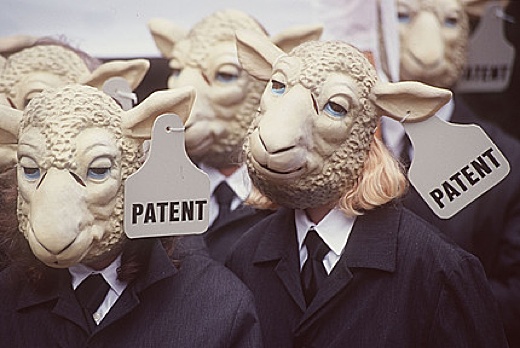 Image above: Masked Greenpeace activists protest against patents of life in front of the European Patent office in 2000. From (http://www.greenpeace.org/international/photosvideos/photos/masked-greenpeace-activists-pr?mode=send)
By Mike Adams on 1 April 2010 in NaturalNews.com -
(http://www.naturalnews.com/028492_BRCA1_human_genes.html)
As NaturalNews readers already know, corporations and universities right now claim intellectual property ownership over roughly twenty percent of your genetic code. This absurdity has occurred due to bizarre operations of the U.S. Patent and Trademark Office which has handed corporations intellectual property monopolies over everything ranging from human genes to animals and seeds. Monsanto's "ownership" of genetically modified seed crops, for example, was only made possible by the patent office's willingness to grant the corporation intellectual property ownership over seeds.
I have long argued that granting patents on seeds, genes and medicines is a violation of natural law. In 2007, for example, I wrote an article entitled "Corporate Greed, Intellectual Property Laws and the Destruction of Human Civilization" (http://www.naturalnews.com/022096.html) in which I argued that the granting of such patents is a threat to not just human freedom but also the future of life on earth.
What happens when corporations, for example, wish to start collecting royalties on the human genes that you are copying when you reproduce by having children? The mere act of conceiving a child makes you a patent law violator... a criminal engaged in genetic piracy under U.S. law. This may sound patently absurd, if you'll excuse the expression, but it is precisely what has been held as true under current U.S. patent law.
You can't patent things created by Mother Nature
Fortunately, things are beginning to shift. Earlier this week, a federal judge struck down patents on the BRCA1 and BRCA2 genes. These are the genes used by many doctors to attempt to predict breast cancer risk. Of course, the very idea that genes alone can determine your cancer risk is provably false, but that's another story altogether. For the point of this story, just keep in mind that lots of women have their DNA tested for the presence of these BRCA genes in order to (they think) determine their breast cancer risk.
But one corporation called Myriad Genetics holds seven patents on these genes. Although the patents are shrouded in lawyer's language, this company essentially claims to own these genes as if it had invented them! Furthermore, this company held that the mere act of testing for these genes was a violation of their patents.
Now, a more sensible person might instantly recognize that your genes existed long before Myriad Genetics came around. Depending on your frame of belief, your genes were either created by God or by Mother Nature, and to grant monopoly intellectual property ownership over those genes to a corporations seems absurd beyond all reason.
But no: This corporation and its lawyers argued with a straight face that they alone effectively owned your BRCA genes and that no one could even test for the presence of those genes without paying them a royalty!
United States District Court Judge Robert W. Sweet disagreed with the patents in his 152-page decision (see NY Times PDF file at http://graphics8.nytimes.com/packages/pdf/national/20100329_patent_opinion.pdf) which strikes down seven patents formerly belonging to Myriad Genetics. This victory was achieved, in part, by the American Civil Liberties Union which helped challenge the BRCA patents last year. The ACLU argued (quite correctly, in my view) that human genes are products of nature and should never be owned by Man.
As state in a New York Times article (source below), an ACLU lawyer explained it like this: "The human genome, like the structure of blood, air or water, was discovered, not created. There is an endless amount of information on genes that begs for further discovery, and gene patents put up unacceptable barriers to the free exchange of ideas."
Striking back at biotech
If this decision stands, the resulting consequences could be hugely damaging to the biotech and pharmaceutical industries, both of which depend on government-granted monopolies (patents) to lock in their corporate profits. Biotech companies have been ramping up research on gene-based diseases for a decade or more, hoping to cash in on the genetic monopolies that would guarantee them profits for all sorts of human diseases that they could tie to "genetic disorders."
The idea that "your genes made you sick" is a very seductive (and profitable) concept for the biotech and pharmaceutical industries because it implies that patients have no role in their own health. Genes determine your future, you're told, so eating right and taking nutritional supplements is useless, they insist. Because your genes have already determined what diseases you'll get, the only thing you can do is take their patented chemicals that target those genes or their symptoms. Merely being screened for these "diseases" earns these corporations a royalty, by the way, since they owns the patents on the genes themselves.
This "Great Lie" of the biotech industry, of course, depends entirely on being able to procure intellectual property monopolies over human genes. And that's why this week's decision by judge Sweet is sending shockwaves through the biotech industry. They are now concerned that they won't be able to attract investors to develop more gene-targeted "therapies" (yeah, right) because they will no longer be granted patent monopolies through which they can make obscene profits by scaring patients into expensive gene therapies.
Biotech, pharmaceutical and agricultural corporations, you see, are some of the most arrogant and dangerous organizations on the planet. They believe that they alone have the right to monopolize your genes, your seeds, your food and your medicine. Anything that they don't control and profit from is attacked or destroyed. The FDA's pharma-inspired attacks on nutritional products is a great example of this monopoly profiteering in action. It's the same story with Monsanto's legal assaults on farmers who refuse to plant genetically modified seeds.
That's why these corporations will be lobbying hard to reverse this decision by judge Sweet, forcing a reversal that would lock in their monopoly ownership over genes, seeds and medicines. These corporations want to own the world and control everyone and everything in it. And while they can't necessarily own all the physical objects in the world, if they can achieve ownership over most of the intellectual property, they can come pretty close to ruling the world.
Think about it: If they own your genes, your food crops and your medicines, they effectively control virtually everything you depend on to stay alive. It's not out of the realm of possibility to suppose that in the near future, you will not be allowed to have a baby without paying royalties to the biotech corporations that "own" your human genes. Making a baby, after all, does involve copying your genes, you pirate!
That's why granting corporations over genes, seeds or medicines is so dangerous to the future of humanity: It concentrates power over the world into the hands of the few. If that sounds like Monsanto's corporate motto, that's because Monsanto is the perfect example of a company that literally seeks to control the entire world and everything in it, and if they can exploit U.S. patent law to assert that control over the people, they will almost certainly take every opportunity to do so.
Allow me to share something about large corporations. Corporations have people, money, lobbyists and lots of power. But corporations do not have morals or ethics or human compassion. Corporations are granted all of the rights of the People (free speech rights, for example) and yet they have none of the compassions or sensibilities of people. Corporations consistently endanger and even sacrifice human lives in order to maximize their profits.
Want examples? Union Carbide in Bhopal, India. See the horrifying pictures of "the children of Dow's Chemicals" here: http://www.bhopal.org
Or review the story of Enron and how that company turned off power plants in California, killing senior citizens in the high heat in order to make more money selling emergency electricity back to the State of California.
Or look at the drug companies that manufacture and push deadly cholesterol and heart drugs that are killing people, even while burying the clinical trial evidence that proves those drugs to be extremely dangerous.
The list of corporate crimes against humanity is far too long to cover right here, but if you want a good overview of the situation, pick up some books by author John Perkins who wrote Confessions of an Economic Hit Man. I recently interviewed John Perkins by phone and will be posting that here on NaturalNews in the near future.
Watch this interview with John Perkins here: http://www.youtube.com/watch?v=A9QEhxypDZE
The important point here is simply this: If you grant corporations intellectual property ownership over your genes, foods, seeds and medicines, they will use that power to enslave you.
That's what corporations do: They inherently seek to create high-profit monopolies that limit consumer choice and force consumers to pay monopoly prices for all their goods and services, all to the benefit of the corporate shareholders. This simple truth is, in fact, the entire point of having a corporation in the first place: To make as much money as possibly by any means possible within the law. So if patent law grants monopolies over human genes, then it's only a matter of time before corporations will exploit that to own and dominate human reproduction involving those genes!
Patent reform is crucial to freedom
This is why I believe that judge Sweet's decision to deny patent ownership over the BRCA genes was hugely important to the future of freedom for humankind. If these intellectual property monopolies are allowed to stand, they will only grow ever more powerful and dangerous to the freedoms of populations around the world. If they are not struck down, these corporate monopolies will inevitably result in the outright enslavement of humankind to the corporatocracy -- a situation that many would agree we are dangerously close to right now.
So watch this situation carefully. You can bet that behind closed doors, judge Sweet is right now being pressured and perhaps even threatened if he does not reverse his decision. Or members of a higher court are being lobbied to overturn it for him.
One thing I've learned in my years of being the editor for NaturalNews is that corporations will do anything -- absolutely ANYTHING -- to protect their profits. This includes doing things that are far outside U.S. law and that endanger the lives of individuals or groups of people who stand in the way of a particular corporate agenda. Individual freedom has no value whatsoever in the eyes of these corporations, especially if it interferes with their profits. So send some good vibes over to judge Sweet and ask that he be protected right now for having the courage to boldly state the obvious: Corporations should not own human genes!
And don't be surprised to see the corporations in the biotech industry pulling out all the stops to try to get this decision reversed. Their very future depends on dominating humankind through legal monopolies known as patents, and anyone who threatens that profit model will be targeted by the biotech industry in more ways than one.
Sources for this story include:
NY Times
http://www.nytimes.com/2010/03/30/business/30gene.html?src=me
Fierce Biotech
http://www.fiercebiotech.com/story/experts-fear-gene-patent-rulings-impact-biotech/2010-03-31
.
Image above: Masked Greenpeace activists protest against patents of life in front of the European Patent office in 2000. From (http://www.greenpeace.org/international/photosvideos/photos/masked-greenpeace-activists-pr?mode=send)
By Mike Adams on 1 April 2010 in NaturalNews.com -
(http://www.naturalnews.com/028492_BRCA1_human_genes.html)
As NaturalNews readers already know, corporations and universities right now claim intellectual property ownership over roughly twenty percent of your genetic code. This absurdity has occurred due to bizarre operations of the U.S. Patent and Trademark Office which has handed corporations intellectual property monopolies over everything ranging from human genes to animals and seeds. Monsanto's "ownership" of genetically modified seed crops, for example, was only made possible by the patent office's willingness to grant the corporation intellectual property ownership over seeds.
I have long argued that granting patents on seeds, genes and medicines is a violation of natural law. In 2007, for example, I wrote an article entitled "Corporate Greed, Intellectual Property Laws and the Destruction of Human Civilization" (http://www.naturalnews.com/022096.html) in which I argued that the granting of such patents is a threat to not just human freedom but also the future of life on earth.
What happens when corporations, for example, wish to start collecting royalties on the human genes that you are copying when you reproduce by having children? The mere act of conceiving a child makes you a patent law violator... a criminal engaged in genetic piracy under U.S. law. This may sound patently absurd, if you'll excuse the expression, but it is precisely what has been held as true under current U.S. patent law.
You can't patent things created by Mother Nature
Fortunately, things are beginning to shift. Earlier this week, a federal judge struck down patents on the BRCA1 and BRCA2 genes. These are the genes used by many doctors to attempt to predict breast cancer risk. Of course, the very idea that genes alone can determine your cancer risk is provably false, but that's another story altogether. For the point of this story, just keep in mind that lots of women have their DNA tested for the presence of these BRCA genes in order to (they think) determine their breast cancer risk.
But one corporation called Myriad Genetics holds seven patents on these genes. Although the patents are shrouded in lawyer's language, this company essentially claims to own these genes as if it had invented them! Furthermore, this company held that the mere act of testing for these genes was a violation of their patents.
Now, a more sensible person might instantly recognize that your genes existed long before Myriad Genetics came around. Depending on your frame of belief, your genes were either created by God or by Mother Nature, and to grant monopoly intellectual property ownership over those genes to a corporations seems absurd beyond all reason.
But no: This corporation and its lawyers argued with a straight face that they alone effectively owned your BRCA genes and that no one could even test for the presence of those genes without paying them a royalty!
United States District Court Judge Robert W. Sweet disagreed with the patents in his 152-page decision (see NY Times PDF file at http://graphics8.nytimes.com/packages/pdf/national/20100329_patent_opinion.pdf) which strikes down seven patents formerly belonging to Myriad Genetics. This victory was achieved, in part, by the American Civil Liberties Union which helped challenge the BRCA patents last year. The ACLU argued (quite correctly, in my view) that human genes are products of nature and should never be owned by Man.
As state in a New York Times article (source below), an ACLU lawyer explained it like this: "The human genome, like the structure of blood, air or water, was discovered, not created. There is an endless amount of information on genes that begs for further discovery, and gene patents put up unacceptable barriers to the free exchange of ideas."
Striking back at biotech
If this decision stands, the resulting consequences could be hugely damaging to the biotech and pharmaceutical industries, both of which depend on government-granted monopolies (patents) to lock in their corporate profits. Biotech companies have been ramping up research on gene-based diseases for a decade or more, hoping to cash in on the genetic monopolies that would guarantee them profits for all sorts of human diseases that they could tie to "genetic disorders."
The idea that "your genes made you sick" is a very seductive (and profitable) concept for the biotech and pharmaceutical industries because it implies that patients have no role in their own health. Genes determine your future, you're told, so eating right and taking nutritional supplements is useless, they insist. Because your genes have already determined what diseases you'll get, the only thing you can do is take their patented chemicals that target those genes or their symptoms. Merely being screened for these "diseases" earns these corporations a royalty, by the way, since they owns the patents on the genes themselves.
This "Great Lie" of the biotech industry, of course, depends entirely on being able to procure intellectual property monopolies over human genes. And that's why this week's decision by judge Sweet is sending shockwaves through the biotech industry. They are now concerned that they won't be able to attract investors to develop more gene-targeted "therapies" (yeah, right) because they will no longer be granted patent monopolies through which they can make obscene profits by scaring patients into expensive gene therapies.
Biotech, pharmaceutical and agricultural corporations, you see, are some of the most arrogant and dangerous organizations on the planet. They believe that they alone have the right to monopolize your genes, your seeds, your food and your medicine. Anything that they don't control and profit from is attacked or destroyed. The FDA's pharma-inspired attacks on nutritional products is a great example of this monopoly profiteering in action. It's the same story with Monsanto's legal assaults on farmers who refuse to plant genetically modified seeds.
That's why these corporations will be lobbying hard to reverse this decision by judge Sweet, forcing a reversal that would lock in their monopoly ownership over genes, seeds and medicines. These corporations want to own the world and control everyone and everything in it. And while they can't necessarily own all the physical objects in the world, if they can achieve ownership over most of the intellectual property, they can come pretty close to ruling the world.
Think about it: If they own your genes, your food crops and your medicines, they effectively control virtually everything you depend on to stay alive. It's not out of the realm of possibility to suppose that in the near future, you will not be allowed to have a baby without paying royalties to the biotech corporations that "own" your human genes. Making a baby, after all, does involve copying your genes, you pirate!
That's why granting corporations over genes, seeds or medicines is so dangerous to the future of humanity: It concentrates power over the world into the hands of the few. If that sounds like Monsanto's corporate motto, that's because Monsanto is the perfect example of a company that literally seeks to control the entire world and everything in it, and if they can exploit U.S. patent law to assert that control over the people, they will almost certainly take every opportunity to do so.
Allow me to share something about large corporations. Corporations have people, money, lobbyists and lots of power. But corporations do not have morals or ethics or human compassion. Corporations are granted all of the rights of the People (free speech rights, for example) and yet they have none of the compassions or sensibilities of people. Corporations consistently endanger and even sacrifice human lives in order to maximize their profits.
Want examples? Union Carbide in Bhopal, India. See the horrifying pictures of "the children of Dow's Chemicals" here: http://www.bhopal.org
Or review the story of Enron and how that company turned off power plants in California, killing senior citizens in the high heat in order to make more money selling emergency electricity back to the State of California.
Or look at the drug companies that manufacture and push deadly cholesterol and heart drugs that are killing people, even while burying the clinical trial evidence that proves those drugs to be extremely dangerous.
The list of corporate crimes against humanity is far too long to cover right here, but if you want a good overview of the situation, pick up some books by author John Perkins who wrote Confessions of an Economic Hit Man. I recently interviewed John Perkins by phone and will be posting that here on NaturalNews in the near future.
Watch this interview with John Perkins here: http://www.youtube.com/watch?v=A9QEhxypDZE
The important point here is simply this: If you grant corporations intellectual property ownership over your genes, foods, seeds and medicines, they will use that power to enslave you.
That's what corporations do: They inherently seek to create high-profit monopolies that limit consumer choice and force consumers to pay monopoly prices for all their goods and services, all to the benefit of the corporate shareholders. This simple truth is, in fact, the entire point of having a corporation in the first place: To make as much money as possibly by any means possible within the law. So if patent law grants monopolies over human genes, then it's only a matter of time before corporations will exploit that to own and dominate human reproduction involving those genes!
Patent reform is crucial to freedom
This is why I believe that judge Sweet's decision to deny patent ownership over the BRCA genes was hugely important to the future of freedom for humankind. If these intellectual property monopolies are allowed to stand, they will only grow ever more powerful and dangerous to the freedoms of populations around the world. If they are not struck down, these corporate monopolies will inevitably result in the outright enslavement of humankind to the corporatocracy -- a situation that many would agree we are dangerously close to right now.
So watch this situation carefully. You can bet that behind closed doors, judge Sweet is right now being pressured and perhaps even threatened if he does not reverse his decision. Or members of a higher court are being lobbied to overturn it for him.
One thing I've learned in my years of being the editor for NaturalNews is that corporations will do anything -- absolutely ANYTHING -- to protect their profits. This includes doing things that are far outside U.S. law and that endanger the lives of individuals or groups of people who stand in the way of a particular corporate agenda. Individual freedom has no value whatsoever in the eyes of these corporations, especially if it interferes with their profits. So send some good vibes over to judge Sweet and ask that he be protected right now for having the courage to boldly state the obvious: Corporations should not own human genes!
And don't be surprised to see the corporations in the biotech industry pulling out all the stops to try to get this decision reversed. Their very future depends on dominating humankind through legal monopolies known as patents, and anyone who threatens that profit model will be targeted by the biotech industry in more ways than one.
Sources for this story include:
NY Times
http://www.nytimes.com/2010/03/30/business/30gene.html?src=me
Fierce Biotech
http://www.fiercebiotech.com/story/experts-fear-gene-patent-rulings-impact-biotech/2010-03-31
.
Image above: Masked Greenpeace activists protest against patents of life in front of the European Patent office in 2000. From (http://www.greenpeace.org/international/photosvideos/photos/masked-greenpeace-activists-pr?mode=send)
By Mike Adams on 1 April 2010 in NaturalNews.com -
(http://www.naturalnews.com/028492_BRCA1_human_genes.html)
As NaturalNews readers already know, corporations and universities right now claim intellectual property ownership over roughly twenty percent of your genetic code. This absurdity has occurred due to bizarre operations of the U.S. Patent and Trademark Office which has handed corporations intellectual property monopolies over everything ranging from human genes to animals and seeds. Monsanto's "ownership" of genetically modified seed crops, for example, was only made possible by the patent office's willingness to grant the corporation intellectual property ownership over seeds.
I have long argued that granting patents on seeds, genes and medicines is a violation of natural law. In 2007, for example, I wrote an article entitled "Corporate Greed, Intellectual Property Laws and the Destruction of Human Civilization" (http://www.naturalnews.com/022096.html) in which I argued that the granting of such patents is a threat to not just human freedom but also the future of life on earth.
What happens when corporations, for example, wish to start collecting royalties on the human genes that you are copying when you reproduce by having children? The mere act of conceiving a child makes you a patent law violator... a criminal engaged in genetic piracy under U.S. law. This may sound patently absurd, if you'll excuse the expression, but it is precisely what has been held as true under current U.S. patent law.
You can't patent things created by Mother Nature
Fortunately, things are beginning to shift. Earlier this week, a federal judge struck down patents on the BRCA1 and BRCA2 genes. These are the genes used by many doctors to attempt to predict breast cancer risk. Of course, the very idea that genes alone can determine your cancer risk is provably false, but that's another story altogether. For the point of this story, just keep in mind that lots of women have their DNA tested for the presence of these BRCA genes in order to (they think) determine their breast cancer risk.
But one corporation called Myriad Genetics holds seven patents on these genes. Although the patents are shrouded in lawyer's language, this company essentially claims to own these genes as if it had invented them! Furthermore, this company held that the mere act of testing for these genes was a violation of their patents.
Now, a more sensible person might instantly recognize that your genes existed long before Myriad Genetics came around. Depending on your frame of belief, your genes were either created by God or by Mother Nature, and to grant monopoly intellectual property ownership over those genes to a corporations seems absurd beyond all reason.
But no: This corporation and its lawyers argued with a straight face that they alone effectively owned your BRCA genes and that no one could even test for the presence of those genes without paying them a royalty!
United States District Court Judge Robert W. Sweet disagreed with the patents in his 152-page decision (see NY Times PDF file at http://graphics8.nytimes.com/packages/pdf/national/20100329_patent_opinion.pdf) which strikes down seven patents formerly belonging to Myriad Genetics. This victory was achieved, in part, by the American Civil Liberties Union which helped challenge the BRCA patents last year. The ACLU argued (quite correctly, in my view) that human genes are products of nature and should never be owned by Man.
As state in a New York Times article (source below), an ACLU lawyer explained it like this: "The human genome, like the structure of blood, air or water, was discovered, not created. There is an endless amount of information on genes that begs for further discovery, and gene patents put up unacceptable barriers to the free exchange of ideas."
Striking back at biotech
If this decision stands, the resulting consequences could be hugely damaging to the biotech and pharmaceutical industries, both of which depend on government-granted monopolies (patents) to lock in their corporate profits. Biotech companies have been ramping up research on gene-based diseases for a decade or more, hoping to cash in on the genetic monopolies that would guarantee them profits for all sorts of human diseases that they could tie to "genetic disorders."
The idea that "your genes made you sick" is a very seductive (and profitable) concept for the biotech and pharmaceutical industries because it implies that patients have no role in their own health. Genes determine your future, you're told, so eating right and taking nutritional supplements is useless, they insist. Because your genes have already determined what diseases you'll get, the only thing you can do is take their patented chemicals that target those genes or their symptoms. Merely being screened for these "diseases" earns these corporations a royalty, by the way, since they owns the patents on the genes themselves.
This "Great Lie" of the biotech industry, of course, depends entirely on being able to procure intellectual property monopolies over human genes. And that's why this week's decision by judge Sweet is sending shockwaves through the biotech industry. They are now concerned that they won't be able to attract investors to develop more gene-targeted "therapies" (yeah, right) because they will no longer be granted patent monopolies through which they can make obscene profits by scaring patients into expensive gene therapies.
Biotech, pharmaceutical and agricultural corporations, you see, are some of the most arrogant and dangerous organizations on the planet. They believe that they alone have the right to monopolize your genes, your seeds, your food and your medicine. Anything that they don't control and profit from is attacked or destroyed. The FDA's pharma-inspired attacks on nutritional products is a great example of this monopoly profiteering in action. It's the same story with Monsanto's legal assaults on farmers who refuse to plant genetically modified seeds.
That's why these corporations will be lobbying hard to reverse this decision by judge Sweet, forcing a reversal that would lock in their monopoly ownership over genes, seeds and medicines. These corporations want to own the world and control everyone and everything in it. And while they can't necessarily own all the physical objects in the world, if they can achieve ownership over most of the intellectual property, they can come pretty close to ruling the world.
Think about it: If they own your genes, your food crops and your medicines, they effectively control virtually everything you depend on to stay alive. It's not out of the realm of possibility to suppose that in the near future, you will not be allowed to have a baby without paying royalties to the biotech corporations that "own" your human genes. Making a baby, after all, does involve copying your genes, you pirate!
That's why granting corporations over genes, seeds or medicines is so dangerous to the future of humanity: It concentrates power over the world into the hands of the few. If that sounds like Monsanto's corporate motto, that's because Monsanto is the perfect example of a company that literally seeks to control the entire world and everything in it, and if they can exploit U.S. patent law to assert that control over the people, they will almost certainly take every opportunity to do so.
Allow me to share something about large corporations. Corporations have people, money, lobbyists and lots of power. But corporations do not have morals or ethics or human compassion. Corporations are granted all of the rights of the People (free speech rights, for example) and yet they have none of the compassions or sensibilities of people. Corporations consistently endanger and even sacrifice human lives in order to maximize their profits.
Want examples? Union Carbide in Bhopal, India. See the horrifying pictures of "the children of Dow's Chemicals" here: http://www.bhopal.org
Or review the story of Enron and how that company turned off power plants in California, killing senior citizens in the high heat in order to make more money selling emergency electricity back to the State of California.
Or look at the drug companies that manufacture and push deadly cholesterol and heart drugs that are killing people, even while burying the clinical trial evidence that proves those drugs to be extremely dangerous.
The list of corporate crimes against humanity is far too long to cover right here, but if you want a good overview of the situation, pick up some books by author John Perkins who wrote Confessions of an Economic Hit Man. I recently interviewed John Perkins by phone and will be posting that here on NaturalNews in the near future.
Watch this interview with John Perkins here: http://www.youtube.com/watch?v=A9QEhxypDZE
The important point here is simply this: If you grant corporations intellectual property ownership over your genes, foods, seeds and medicines, they will use that power to enslave you.
That's what corporations do: They inherently seek to create high-profit monopolies that limit consumer choice and force consumers to pay monopoly prices for all their goods and services, all to the benefit of the corporate shareholders. This simple truth is, in fact, the entire point of having a corporation in the first place: To make as much money as possibly by any means possible within the law. So if patent law grants monopolies over human genes, then it's only a matter of time before corporations will exploit that to own and dominate human reproduction involving those genes!
Patent reform is crucial to freedom
This is why I believe that judge Sweet's decision to deny patent ownership over the BRCA genes was hugely important to the future of freedom for humankind. If these intellectual property monopolies are allowed to stand, they will only grow ever more powerful and dangerous to the freedoms of populations around the world. If they are not struck down, these corporate monopolies will inevitably result in the outright enslavement of humankind to the corporatocracy -- a situation that many would agree we are dangerously close to right now.
So watch this situation carefully. You can bet that behind closed doors, judge Sweet is right now being pressured and perhaps even threatened if he does not reverse his decision. Or members of a higher court are being lobbied to overturn it for him.
One thing I've learned in my years of being the editor for NaturalNews is that corporations will do anything -- absolutely ANYTHING -- to protect their profits. This includes doing things that are far outside U.S. law and that endanger the lives of individuals or groups of people who stand in the way of a particular corporate agenda. Individual freedom has no value whatsoever in the eyes of these corporations, especially if it interferes with their profits. So send some good vibes over to judge Sweet and ask that he be protected right now for having the courage to boldly state the obvious: Corporations should not own human genes!
And don't be surprised to see the corporations in the biotech industry pulling out all the stops to try to get this decision reversed. Their very future depends on dominating humankind through legal monopolies known as patents, and anyone who threatens that profit model will be targeted by the biotech industry in more ways than one.
Sources for this story include:
NY Times
http://www.nytimes.com/2010/03/30/business/30gene.html?src=me
Fierce Biotech
http://www.fiercebiotech.com/story/experts-fear-gene-patent-rulings-impact-biotech/2010-03-31
.
Plant a Breadfruit Tree
SUBHEAD: Breadfruit may once again need to become a sustainable food for the masses.
By Roger Harris & Diane Koerner on 31 March 2010 in Big Island Weekly - (http://www.bigislandweekly.com/articles/2010/03/31/read/lifestyle/lifestyle04.txt)

Image above:A root-cutting starter Breadfruit tree planted in Hanapepe Valley on State DLNR agland. Photo by Juan Wilson.
Literally a fabric of Pacific Islanders' lives for 3,000 years, the beautiful 'ulu or breadfruit tree and its wide-spreading green canopy may be an appropriate symbol for the sustainability efforts of modern Hawaiians. Staple starches like yams, taro and breadfruit may once again need to become food for the masses, when, not if, a natural disaster, lack of petroleum or martial conflict cuts off Hawaii from its imported food sources.
On April 10, you can enjoy a Hawaiian dinner featuring breadfruit ($15 fee) and a talk by Diane Ragone, PhD, director of the Breadfruit Institute at the National Tropical Botanical Garden on Kauai, at the Kona Outdoor Circle Education Center. "I'll be speaking about breadfruit, its rich history and importance on the Big Island, and the work of the Breadfruit Institute," said Dr. Ragone. Space is limited; for reservations, call Chris McCullough, president of Hawaii Island Landscape Association at 938-3695.
Island Breath: Ulu - The Breadfruit Tree 12/31/06
Ea O Ka Aina: Peak Macadamia Nut 9/22/09
Ea O Ka Aina: Green Turtle Mango 10/13/09
Ea O Ka Aina: Green Papaya Sauerkraut 10/14/09
.
By Roger Harris & Diane Koerner on 31 March 2010 in Big Island Weekly - (http://www.bigislandweekly.com/articles/2010/03/31/read/lifestyle/lifestyle04.txt)
Image above:A root-cutting starter Breadfruit tree planted in Hanapepe Valley on State DLNR agland. Photo by Juan Wilson.
Literally a fabric of Pacific Islanders' lives for 3,000 years, the beautiful 'ulu or breadfruit tree and its wide-spreading green canopy may be an appropriate symbol for the sustainability efforts of modern Hawaiians. Staple starches like yams, taro and breadfruit may once again need to become food for the masses, when, not if, a natural disaster, lack of petroleum or martial conflict cuts off Hawaii from its imported food sources.
On April 10, you can enjoy a Hawaiian dinner featuring breadfruit ($15 fee) and a talk by Diane Ragone, PhD, director of the Breadfruit Institute at the National Tropical Botanical Garden on Kauai, at the Kona Outdoor Circle Education Center. "I'll be speaking about breadfruit, its rich history and importance on the Big Island, and the work of the Breadfruit Institute," said Dr. Ragone. Space is limited; for reservations, call Chris McCullough, president of Hawaii Island Landscape Association at 938-3695.
Island Breath: Ulu - The Breadfruit Tree 12/31/06
Ea O Ka Aina: Peak Macadamia Nut 9/22/09
Ea O Ka Aina: Green Turtle Mango 10/13/09
Ea O Ka Aina: Green Papaya Sauerkraut 10/14/09
.
Hawaii style economic recovery
SUBHEAD: What indigenous economies can teach us about abundance.
 Image above: Taro field in Hanalei, Kauai, Hawaii. Photo "Kauai Morning" by Patrick Smith from (http://photo.net/photodb/photo?photo_id=3442594&size=lg)
By Lurline Wailana McGregor on 29 March 2010 in Yes Magazine -
(http://www.yesmagazine.org/new-economy/economic-recovery-hawaiian-style)
Image above: Taro field in Hanalei, Kauai, Hawaii. Photo "Kauai Morning" by Patrick Smith from (http://photo.net/photodb/photo?photo_id=3442594&size=lg)
By Lurline Wailana McGregor on 29 March 2010 in Yes Magazine -
(http://www.yesmagazine.org/new-economy/economic-recovery-hawaiian-style)
Image above: Taro field in Hanalei, Kauai, Hawaii. Photo "Kauai Morning" by Patrick Smith from (http://photo.net/photodb/photo?photo_id=3442594&size=lg)
By Lurline Wailana McGregor on 29 March 2010 in Yes Magazine -
(http://www.yesmagazine.org/new-economy/economic-recovery-hawaiian-style)
There was once enough for everyone. That was before Captain Cook “discovered” our Hawaiian islands on his way to find a northwest passage, before the missionaries came to save our heathen ancestors and before the American businessmen called in the U.S. Navy to protect their land investments. For centuries before western contact, the Hawaiian people flourished. There was no disease, no hunger, no homelessness, no economic recession. That was then. Today, we who call Hawai‘i home are mostly mainstream Americans, often holding two or more jobs just to survive, and we are dependent on the outside world for virtually everything, even bottled water.
When Captain Cook arrived on our shores in 1778, the population was somewhere between 400,000 and a million. Complex agricultural systems, sophisticated fishing laws and a deep spirituality that was at the heart of government and community life were all evidence of a highly advanced people who had been living throughout the islands for many hundreds of years.
Hawaiians knew when to fish and when to plant according to seasons and the phases of the moon; they knew what herbs and prayers to use to cure illnesses and broken bones; they had names for everything. Our ancestors had highly developed arts and leisure time. They spoke in poetry and metaphor and had great oratorical skills. They could trace their genealogies back to a time when gods and humans lived freely among each other.
In the Hawaiians’ worldview, everything was connected, including the trees, the stones, the birds, the stars. As humans, their role, or kuleana, was to be the guardians, to maintain the balance and harmony of all things. To help carry out these responsibilities, Hawaiians were born with spiritual powers, or mana. Any abuse or misuse of these powers would result in a loss of one’s mana, as in leaders who showed greed or who did not act in the best interests of the people. Mana could also grow in those who demonstrated exceptional skills, whether it was in fishing, healing, canoe making, and so on. Great warriors and leaders were revered as having very powerful mana.
The cultural practices of the people assured that food would always be abundant and that the earth, in its bounty, would provide for everyone. These practices were based on taking only what one needed and only when those things were plentiful. When fishermen had successful catches they fed their families, then the community. They would trade with farmers for taro and other staples. Nothing was wasted.
After over two hundred years of western influence and immigration to our islands, our sovereign government is long gone, mana has no correlation to leadership and the global market now dictates the success of our tourism-based economy. In the mainstream, we are like most other Americans, bombarded by slick ads and peer pressure to buy large screen televisions, bigger cars to protect ourselves from everyone else’s big cars, and more food on our plates than we can—or should—eat.
We are encouraged to buy things we can’t afford and don’t need. Natural resources are being depleted faster than they can be renewed to keep up with this compulsory demand, a trend that is making our land and water toxic and has contributed to our islands’ loss of sustainability.
High fuel costs and the downturn in the national economy have taken an enormous toll on our state. Fewer visitors to our islands have caused businesses to close and new construction to be delayed, which in turn has increased unemployment and is draining the state treasury.
Our government leaders’ response to this economic crisis has been to raise local taxes, decide which government programs to cut, and whether to furlough or lay off state employees. These quick-fix choices do not present courageous or visionary solutions to this or future recessions, instead they only serve to reinforce how dependent we have become on the outside world for survival and what little control we as individuals have over our own lives.
While analysts predict that recovery is around the corner, they caution that the economy will not likely return to the high growth rates of the past few years, at least not anytime soon. This contention is supported by the ongoing instability of foreign governments, the aging of our own American population, now increasingly concerned about having money for retirement, and in the longer term, the effects of global warming on the environment. Although we are gaining confidence that it is safe to spend again, we would be well served to take the experts’ warnings as an opportunity to rethink the economic philosophies that guide our country, our state, and most importantly, our own ways of thinking.
Although much in Hawaii has changed, the values of our culture have been passed down to us, and by looking both backward and forward, we can forge real solutions that will improve our sustainability now and in the future. Growth in our Western economic system is based on increased consumption. This is a contradiction to the most basic precept that our ancestors passed down to us: take only what you need. If this idea can be at the heart of decisions that leaders, corporate executives and even consumers make, then economic crises will become obsolete.
We do not have to stop consuming or abandon our western lifestyles to achieve sustainability, nor does the gross national product need to grow at high rates every year to maintain a stable economy. If we consume only what we need, even when we are not in a recession, the economy will eventually adjust downwards and stabilize. This would decrease the power of the multinational corporations and the volatility and impact of global economics on our local communities. To think, this could all happen because we stopped buying things we don’t need, or at the very least, started buying less of what we don’t need!
The Earth and the economy are inextricably tied together. As we deplete our natural resources we can expect that there will be increasingly less of everything in the future unless we think in terms of using less and replenishing what we take. This idea is consistent with the Hawaiian concept of kuleana, that is, taking personal responsibility to be sure that what we take is not more than we need and that we replace or compensate for what we take so as not disturb the balance of all things. We adopted the ways of the colonizers in order to survive. In spite of the decimation of our populations, we are still here, and we still carry the DNA of our ancestors who understood the rhythms of nature and lived in harmony with the earth.
Americans are starting to lose confidence that past solutions to our economic problems will continue to be effective. Our system may eventually collapse if we do not fix what’s really wrong. As Native people we are in a position to help shift the paradigm of western economic thinking by leading through example—consuming less and taking only what we need. The more we take responsibility for our own actions and support leaders whose policies are in our best interests, the sooner the changes can start to be made that will assure the survival of our grandchildren, their descendants, and, most importantly, our beloved Earth.
.
Future at the end of the Oil Age
SUBHEAD: Building resilience in a resource-constrained world at the end of the Oil Age.
[Publisher's note: The following article is the text version extracted from an online "slide" presentation by Dmitry Orlov. Slide 1 is the title page.]
By Dmitry Orlov on 25 March 2010 in ClubOrlov -
(http://cluborlov.blogspot.com/2010/03/our-future-and-end-of-oil-age-building.html)
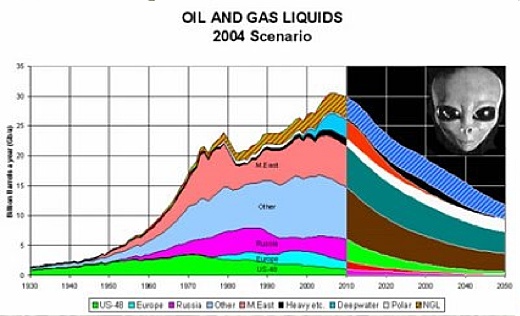 Image above: detail of chart from Slide 4 "HOPE: for an alien intervention?"
[Publisher's note: The following article is the text version extracted from an online "slide" presentation by Dmitry Orlov. Slide 1 is simply the title page. See online version below.]
Slide 2: Peak Oil Theory vs. Reality
Theory
Image above: detail of chart from Slide 4 "HOPE: for an alien intervention?"
[Publisher's note: The following article is the text version extracted from an online "slide" presentation by Dmitry Orlov. Slide 1 is simply the title page. See online version below.]
Slide 2: Peak Oil Theory vs. Reality
Theory
Image above: detail of chart from Slide 4 "HOPE: for an alien intervention?"
[Publisher's note: The following article is the text version extracted from an online "slide" presentation by Dmitry Orlov. Slide 1 is simply the title page. See online version below.]
Slide 2: Peak Oil Theory vs. Reality
Theory
- Global oil production peaks and declines gradually; slow growth.
- Alternative and renewable energy ramps up to compensate
- Challenging economic environment, many social and political problems.
- Massive spikes in oil prices crash financial markets and kill growth.
- No money for alternatives or further oil exploration and production.
- Financial, commercial, political collapse followed by something completely different.
- Peak Oil models work well for individual countries. Prima facie: most of USA peaked in 1970 (Alaska peaked later).
- Individual countries compensate by importing oil from countries that have not peaked yet.
- When the entire planet peaks, there is nobody left to import from - except aliens from outer space, of course!
- Industrial economies cannot grow without increasing fossil fuel consumption (empirical result).
- Without growth, debts go bad, economic and political problems mount, and economies collapse.
- Energy Returned on Energy Invested has gone from 100:1 to 10:1 and is heading down.
- We are using up the dregs: deep offshore, heavy/sour crude, tar sands, arctic oil.
- Oil consumers will run out of money before oil companies run out of places to drill
- The agony of the industrial age can be prolonged by destroying what's left of the biosphere.
- Net Energy = Usable Acquired Energy / Energy Expended
- The US has to import over 2/3 of its transportation fuels.
- High oil prices mean extra revenue for oil exporters.
- Oil exporters invest that money in their domestic economy.
- Their domestic oil consumption increases.
- Consequently, there is less oil for them to export.
- Net exporters become net importers even while they are still pumping some oil (just as the USA did in 1970).
- Many oil importers end up left out in the cold.
- Oil importers who ride scooters and use kerosene lamps do a lot better than oil importers who drive SUVs.
- This is not a contest for who can use the most oil.
- This is a contest for who can grow their economy using the least amount of oil.
- The aliens better bring us some money too...High energy prices cut into personal budgets, making individuals unable to service their debts.
- Banks are burdened with nonperforming loans, toxic assets, foreclosed properties.
- Governments step in to bail out banks.
- Fractional reserve banking? Volcker: 12:1, Greenspan: 30:1, Bernanke: infinity to 1.
- Economy continues to shrink, job losses mount, tax revenues collapse.
- Who bails out the governments? Why, aliens from outer space, of course!We have already lost; let's regroup and try again.
- "You see, the flow of credit is the lifeblood of our economy." - Obama SOTU speech, February 2009
- According to Treasury data, the long-term trend is that by 2015 an additional dollar of debt will produce zero additional GDP growth.The short-term trend is that debt is rising rapidly as the economy is continuing to shrink (so we may be there already!)
- The economic patient is hemorrhaging too fast for the transfusion to work
- The Treasury borrows trillions from the Federal Reserve and promises to repay this debt with even more debt.
- Everyone is supposed to believe that this activity is somehow meaningful.
- Actually we are just writing ourselves IOU's and periodically moving them from one pocket to another (not convincing)
- A system that evolved in conditions of continuous growth of material resources cannot shrink controllably.
- The key ingredient is confidence; once faith in the future is lost, everyone's behavior changes radically.
- Everyone at the top already knows that this show cannot go on and are (attempting to) plan accordingly, for themselves.
- The name of the game is "Keep the rest of them fooled for as long as possible".
- People are still paying down their mortgages, putting money in their retirement accounts, etc.
- Being fooled this way can make people very angry.
- Joseph Tainter, in his "Collapse of Complex Societies", pointed out that social complexity increases until further investment in complexity becomes counterproductive.
- He also pointed out that complex systems do not self-simplify; they collapse catastrophically and are eventually replaced with much simpler systems.
- Diminishing returns are observable and measurable.
- Diminishing returns cannot be explained using the internal logic of the systems involved.
- The people involved in maintaining these systems struggle along, but are eventually forced to give up.
- Each additional dollar of debt causes the economy to shrink even faster.
- Each additional dollar of defense spending makes the country less safe.
- Each additional dollar spent on health care makes the country sicker.
- Each additional dollar spent on education makes the people more ignorant.
- Each additional dollar spent on the justice system increases injustice.
- Each additional dollar spent on job creation increases unemployment.
- Lower your official exposure/profile
- Decrease your environmental footprint and burn rate
- Avoid financial arrangements and legal documents
- Rely on personal connections and relationships
- Avoid the mainstream, look for fertile margins, fringes, niches
- Be hard to classify (use the SEP field to your advantage)
- Each additional dollar contributed to a political campaign makes the people even more powerless
- Money will not be very common or useful (government defaults, growing joblessness, savings wiped out or taxed away, access to imports lost, etc.).
- As the US loses ability to import 3/4 of transportation fuels, economy will stall and population will become stranded.
- Political system will maintain appearances as long as possible - "Proud and Purposeful Paralysis".
- Many local authorities will fail (close police stations and fire departments, stop supplying sewer, water and garbage removal services).
- Other local authorities will try to charge confiscatory rates, and fail just a little bit later.
- Various officious busybodies will have a hard time figuring out whose side they are on, and will probably need help.
- Cars and trucks
- Municipal water supplies
- Municipal sewage
- Trash removal
- Garbage removal
- Fast food
- Supermarkets
- Hospitals
- High Schools
- Colleges
- Office work
- Bicycles, boats, 2 feet
- Rainwater collection, wells
- Composting toilets
- Local junkyards, incinerators
- Local compost piles
- Community kitchens
- Open-air markets
- Local clinics
- Home Schooling
- Apprenticeships
- Physical labor
- Each resident of North America employs the equivalent of 100 "energy slaves": services provided by machinery that runs on fossil fuels. But emancipation is at hand!
- People do not like to be persuaded by fact or logical argument.
- People like their comforts: cars, HVAC, etc.
- People are seduced by TV, consumerism.
- Manual labor and farming are low-status activities.
- People lack the skills to lead a non-mechanized existence.
- It is almost impossible to convince people to do what will be necessary - until it becomes necessary.
- It will be almost impossible to do what is necessary without a significant amount of preparation.
- Those who take the trouble to prepare will be a tiny minority.
- Food
- Water
- Shelter
- Lighting and communications
- Medical care
- Transportation
- Security
- Without access to savings,
- Without a positive cash flow,
- Without an official economy.
- Enough food to feed a family can be grown on 2000-3000 sq. feet (It takes a bit of practice to get this going.)
- Some foodstuffs (cooking oil, grains, wine, coffee, chocolate) need to be "imported" somehow.
- A lot of wild foods can be gathered (berries, mushrooms, roots & shoots, nuts, [white] acorns.
- "Edible Forest Gardens" can be planted on public lands - useful plants surrounded by thorny thickets.
- Community kitchens are more efficient than personal ones.
- Eliminate all food waste: chickens, rabbits, guinea pigs, carp, catfish, crayfish - something out there will eat it all up.
- Nanny goats can provide milk for infants/children.
- Seasonal migration out to the land to grow food.
- Harvests have to be "floated out" (road transport expensive).
- Municipal water = bad risk.
- Flushing with potable water = insanity!
- Many grades: drinking water, washing water, irrigation water, gray water, "lively" water.
- Sewage is a very bad idea; composting much better.
- Roof rainwater collection, barrels, filters for drinking water.
- Swales dug into hillsides can boost groundwater.
- Hot water for washing: rocket stoves fed by brush piles.
- Passive irrigation systems instead of pumps and hoses.
- Runoff from disused parking lots and other structures can be saved in cisterns.
- Flat roofs can be planted with sod to soak up water and keep buildings cool.
- Proper placement of shade trees and evaporation pools can make air conditioning unnecessary.
- Single-family dwellings are no longer affordable for nuclear families; single-family dwellings become extended-family GULAGs where the residents eventually go insane.
- There is a lot of unused commercial real estate that will belong to nobody in particular once all parties are bankrupt.
- There are a lot of unused shipping containers that are very easy to customize for a wide variety of uses.
- Large structures are cheaper and easier to retrofit for off-grid use than small ones.
- Transportation needs are much reduced if the entire town relocates into the shopping mall and the office park.
- Basements of demolished suburban houses can be flooded and used for aquaculture, or for tree nurseries, etc.
- Freed-up land can be used for community agriculture.
- Relying on the electric grid - a high-risk, high-cost proposition.
- Keeping the existing system running through "renewable" means is not achievable, sustainable or renewable.
- Using wind/solar/micro-hydro to power to run AC appliances is an expensive proposition - not affordable.
- All it takes is 100-200W of solar and/or wind to power a few LED lights, radio, laptop, 2-way radio, cell phone charger, etc. That's something that can be put together for a few thousand dollars.
- It's all made in China! Yikes! Get yours now! (Install it later).
- 12V batteries, alternators and voltage regulators will come from scrapped cars/trucks - then what? (Food for thought).
- Stay healthy: eat little, mostly vegetables, avoid exercise, but do some physical labor, sleep plenty and get lots of rest, avoid stress, have a sense of humor.
- Avoid doctors and hospitals (they prescribe toxic drugs, spread disease and deplete family savings).
- Know how to treat/cure yourself and the people around you - good hygiene, herbs, massage, rest & TLC.
- For serious medical needs, have a medical evacuation plan in place - to a country with a functioning medical system (Canada, Mexico, Cuba, Russia...).
- Know when it's time for you to go (your life isn't worth half a million to extend by a year or two, no matter who you are - the country can't afford it).
- Avoid American medical "care" if at all possible.
- Making a profit off of sick people is deeply unethical.
- Health is not insurable. If all houses burned down, there would be no fire insurance. Nobody dies healthy.
- Resist efforts to tie you to a "job" by the threat of cutting off your access to medical "care".
- Resist efforts to force you or your family into medical bankruptcy through medical extortion.
- You have no choice of doctor who isn't an American doctor and violates the Hippocratic oath by putting financial and legal considerations ahead of what's good for the patient.
- And now, you have no choice but to buy federally mandated private health insurance.
- To recap: 2/3 of transportation fuels are imported, and these entire 2/3 are going away.
- Daily trips to town by private motor-car will once again be reserved for the aristocracy (chauffeur not included).
- There is not much hope for continuation of air travel, air freight or interstate trucking.
- Rail freight could actually be revived at very little cost (much more cost-effective than road freight).
- Water freight is supremely efficient, especially if by sail.
- Our harbors, bays, sounds, estuaries, rivers and canals are our prime regional transportation assets.
- Many people will be delighted to once again be able to make a living on the water.
- One happy family: former military, former prisoners, former police, former government spooks, plus some drug lords.
- An "online community" is a hacker's playground.
- Easy pickings: loaners (armed or not), people who can be tracked using their GPS cell phones and other gizmos.
- Hard nuts to crack: cohesive communities that deal face to face and are electronically "dark".
- Having a lot of witnesses about makes crime more difficult.
- A 24/7 watch/patrol is an excellent idea.
- Surround yourself with people you know.
- Mistrust electronic communications.
- Cultivate friendships in places high and low.
- Many people can't be persuaded by either fact or reason. Let's hope you are not one of them.
- Running out the clock on our current living arrangement is a bad idea: the longer you wait, the fewer options you will be left with.
- A rather exciting time to be alive, wouldn't you say?
That Which May Be Gained
SUBHEAD: In spite of the gun of reality to our head we must return to scale, community, and morality.
 Image above: A graphic freo m the movie "The Deer Hunter", 1978.
From (http://www.impawards.com/1978/deer_hunter_xlg.html)
By Dan Allen on 30 March 2010 in Energy Bulletin -
(http://www.energybulletin.net/52210)
Image above: A graphic freo m the movie "The Deer Hunter", 1978.
From (http://www.impawards.com/1978/deer_hunter_xlg.html)
By Dan Allen on 30 March 2010 in Energy Bulletin -
(http://www.energybulletin.net/52210)
Image above: A graphic freo m the movie "The Deer Hunter", 1978.
From (http://www.impawards.com/1978/deer_hunter_xlg.html)
By Dan Allen on 30 March 2010 in Energy Bulletin -
(http://www.energybulletin.net/52210)
SUMMARY: Bound by the tangled cord of its own sins, Industrial Civilization sits immobilized -- with the gun of reality pressed to its temple. Monumental changes are imminent – probably (hopefully) a swirling mix of both bad and good. In order to maintain our present sanity and maximize chances for the best possible futures, we need to both envision and embody the positive change we wish to see in the coming post-carbon era. As such, I suggest the following as a worthy set of goals for the coming post-carbon future: a return to life at a proper ‘human’ scale, the reclamation of functional human communities, and the widespread internalization and application of a true morality. Heck, it’s worth a shot. Hey-ho, let’s go!
STARING DOWN THE BARREL OF A GUN...WITH A PIANO FALLING OVERHEAD Click…click…click…click…The hammer keeps falling on an empty chamber, but the inevitable bullet slowly advances.
Bound by the tangled cord of its own sins, Industrial Civilization sits immobilized -- with the gun of reality pressed to its temple. Any of the following might suffice for the kill shot: a surge in oil prices; a national debt default; a rapid devaluation of the dollar; an outburst of violence in the simmering Middle East ; a terrorist strike on some key national infrastructure; a monstrous storm or other natural disaster. There are other possibilities of course. Take your pick.
And this next shot just might be the one that undermines its foundations and topples it into catastrophic collapse. …Or it may just mark the next leg down – another mortal wound; the next morbid installment of our socio-enviro-economic Long Emergency. But in the tenuous final months (years?) of our industrial civilization, I brace myself every single day as I open the paper: Is today the day? Is today the day the gun goes off? Is today the day we’re forcibly wrenched off of our industrial teat? Is today the day we’re on our own?
But, of course, it’s not only that.
This grim economic drama is played out against a backdrop of an even more ominous environmental degradation – the metaphorical ‘falling piano’ of climatic destabilization. Profound disturbances to our planet’s energy balance threaten to, at best, slowly erode the stability of the climate system over the next century – and at worst, devolve catastrophically in the span of perhaps a few decades or so to a new (and quite probably human-unfriendly) stable state.
Meanwhile, the CO2 rises, the planet warms, the ice-caps and mountain-glaciers melt, the oceans acidify, the permafrost destabilizes and begins to de-gas, the species blink out at an increasing rate, the droughts and storms intensify, and the seas rise steadily towards our coastal cities, aquifers, and farmland.
For as we dither and deceive, the entropic arrow of time marches steadily onward.
Tick, tick, tick, tick…
GOOD AND BAD IN A SWIRLING MIX It was, of course, all foreseen long ago. We were warned. (See, for example, the interview with David Orr at http://www.energybulletin.net/node/52016)
But we chose the easy path – the childish, impulsive, arrogant, blithely-limitless, material-worshiping path. We followed our worst instincts as a species and have ended up facing the worst of all predicaments.
It will not be surprising when it comes to a head – economically or environmentally -- yet we will certainly feign surprise. We will gnash our teeth and curse our perceived enemies. We will fire our missiles and expand the detention camps. We will be uprooted and tossed about like rag dolls. We will continue to choose the easy path; the path of comforting lies; the wrong path. And we will reap the bitter fruits we have sown for two centuries.
Or maybe not.
Maybe it’ll all just fizzle out. Maybe the industrial economy will just recede away from us like water draining from a tub – leaving us dripping cold and naked; on our own. Maybe then we’ll lock the missile silos and reactors; open the prisons; empty the shopping malls, supermarkets, and office buildings; abandon our cars in the driveways; take a walk around the neighborhood; knock on our neighbor’s door; and get down to work.
And maybe we – or some of us, at least – will find it possible to follow the righteous path; the path of reorienting our species with biophysical reality; the path of hard, honest work and reverent spirituality. And we can then perhaps – even a little bit (maybe?) – taste the sweet fruits of peace and community.
Who knows? Maybe it’ll be a schizophrenic mix of both good and bad in a swirling mix in time and place. Or maybe there’s something I’m missing. If somebody (me included, of course) tells you they know for sure – good or bad -- you can be sure they’re wrong.
SO...WHY AM I NOT DEPRESSED? So where does that leave us? It leaves us in limbo -- in excitement and dread; in serenity and restlessness; elated and despondent; reaching out and withdrawn; good-humored and angry; purposeful and tentative.
A student came to me the other day and asked me, in light of all that was wrong, how she could maintain her cheerfulness and positive outlook. She didn’t want to lose it and was confused. And she had trouble reconciling the things I was saying and writing with my generally-cheery and positive personality.
She didn’t ask this next question, but I asked it of myself, “Why am I not depressed about all this?”
Because she certainly has a point. It’s some pretty horrible stuff. Monumental change of any sort is scary as hell, and this is about as monumental as it gets -- the collapse of the largest, most complex civilization in the history of the planet; and perhaps even ultimately the collapse of the biosphere itself. This could quite possibly be a bona fide horror show. And perhaps we have every reason to dread the future and crawl into our dark holes of self-pity and grim survivalism.
So why the heck am I NOT depressed? Why am I cautiously optimistic about the future?
Am I unable or unwilling to grasp the true magnitude of the change that’s coming? Am I naively discounting or unfeeling of the suffering that will certainly accompany it? What’s WRONG with me? Do I WANT the suffering to occur? Because if industrial civilization tanked, all my hand-wringing would finally be proven right. “Ha hA ha HA – See everybody, I’m not a kook! I was right! I was right!” Am I a monster or something?
Well I certainly hope not. And I don’t think so.
I think perhaps the explanation for my curious lack of dread comes down to this: a sort of mental weighing-out of the things that may and will be lost in the coming times versus things that may and will be gained. And I think I have already, to some degree at least, reconciled some of the losses and envisioned the possible gains. In my mind, I have already gone through some degree of mourning for our past, present, and future losses and emerged into some partial form of acceptance.
And I have also consciously begun working towards laying the groundwork for the envisioned gains. Futile efforts? Perhaps. But maybe not. Maybe crucial.
THAT WHICH HAS BEEN, MAY BE, AND WILL MOST CERTAINLY BE LOST So what have I mourned for – in part, at least? I can think of a few things.
Firstly (of course) I have mourned for myself. I have let go of the notion that my Industrial Civilization® membership card entitles me to live essentially forever outside of biological reality – to replace my malfunctioning organs with synthetic or borrowed ones as needed; to vanquish, at a moment’s notice and with potent synthetic chemicals, the countless microorganisms who desire to eat my flesh. I accept that I really have no right to live past the functioning life of my body – whatever that turns out to be. I have no right to immortality. That wish was a ridiculous industrial fantasy – part of the fundamental disconnect between the industrial version of our species and the Earth. I am ready to go when called. I don’t want to, of course – I love this Earth -- but I’m reconciled to it. I have already mourned for my lost industrial pseudo-immortality.
And I have already mourned, in part, for the countless species that have been exterminated forever from this planet – and for those whose termination is already guaranteed by the coming climate catastrophe; changes that have already been set in motion and cannot be stopped. I cannot, of course, name even a small fraction of the already-departed and the walking-dead -- but as Derrick Jensen movingly writes, they are all our kin. We have been killing ourselves. It does not matter if they are familiar or nameless, great or tiny, in our yards or out of sight – they are our kin and we have killed them. We ARE killing them. They are blinking out now… and now… and now... and now… and now…
And I have mourned, to some small degree at least, for those of my own species – perhaps those of my own family – who will not make it through the changes ahead. I have only seen pictures of war but it feels like war is coming. Isolated or nation-wide, skirmishes or conflagrations, remote or in my very house -- I don’t know. But war, when it comes, may take many of us. It may even take most of us. It is, of course, by no means a stranger to our nation. And it is part of our very nature as a species. But we have not addressed it honestly and critically when we could have; when we had the resources to do so. We have not nurtured the safeguards against it. So it will be here again.
There are other things, of course, that have been and will be lost, but that is enough.
THAT WHICH MAY BE GAINED So I have already mourned – in some fashion, at least -- for these things. But again, I don’t ONLY see what has been, is being, and will be lost. That would surely be the end of me.
My seemingly-incongruous optimism, I think, comes from also seeing what MIGHT be – what COULD be. And it comes from perhaps seeing some ways we might get there. I think I can see some of these things – through the guidance of many brilliant, beautiful people, of course -- and I think that’s what keeps my heart afloat. THAT’S why I’m not depressed – why I am even hopeful.
(As an aside, I suspect that it is the lack of the appropriate mental tools needed to envision some livable post-carbon future that traps many people in the other less-productive ‘camps’ of futurism: the techno-utopians, the ammo-and-canned-soup survivalist doomers, and the head-in-the-sand neo-optimists. For others, I suppose, the reason is just flat-out greed for short-term profits – i.e. the inability to imagine ANY future beyond the next ‘take’. But I digress.)
So in this ‘hope for the future’ I possess, what might we make of a new post-carbon world? What COULD it be? And how might we get there?
I’ll elaborate a little bit on this now – on some things that might be gained as we move beyond industrial civilization.
There are many possibilities, of course, but in the interest of space, I’ll discuss just three here: (1) a return of the human sphere to its proper scale, (2) the profoundly uplifting promises of genuine community, and (3) the possible reclamation of morality from its industrial sewer.
These are my seeds of hope in an industrial climate reeling with loss and despair. These are the ideas that put a glimmer in my eye and a smile on my face even when confronted daily with the toxic depredations of my civilization.
THE INDUSTRIAL PERVERSIONS OF SCALE, COMMUNITY, AND MORALITY But before I outline more fully these ‘seeds of hope’, I want to give a very brief overview of their current perversions at the hands of industrial civilization. I do this to underscore both the imposing magnitude of our reclamation tasks – i.e. what we’re up against as a starting point – and the profound importance that such a reclamation succeeds. For it MUST succeed if we wish to create (in James Kunstler’s phrasing) ‘lives worth living and places worth caring about.’
Let’s begin with our civilization’s gross perversion of scale, since that has perhaps influenced all else.
It was, of course, our easy access to rivers of concentrated ancient sunlight (i.e. fossil fuels) that enabled industrial civilization to expand its scale far beyond anything imaginable to other human civilizations. These great rivers of energy made it possible to (temporarily) beat back the universal tide of entropy and construct physical and bureaucratic entities of dizzying organizational and technological complexity. And these entities were then assembled to access and unleash even more of this fossil energy; doing work of astonishing magnitudes on the lithosphere, oceans, atmosphere, and biosphere of our planet – and altering it to a huge, sometimes-almost-unrecognizable degree in the process.
But this exponential expansion of the scale at which we have operated has had profound negative impacts on the Earth’s biosphere, our human communities, and our very thought patterns.
For one thing, we have turned out to be famously poor ecosystem managers on a planetary scale. We absurdly misidentified both resource pools and waste sinks as effectively infinite. We ignored -- and even worked actively to obscure(!) -- the flashing red warning signals offered by the planetary biogeochemical system. Ecologically speaking, we tragically projected the wasteful, early-successional program of our industrial civilization onto the larger planetary scale. We were never able to approach, or even TRY to approach, something resembling a mature, steady-state approach to ecosystem management.
A quick scan of the scientific literature, of course, will show that the ecological chickens from this delusional industrial program are starting to come home to roost -- in spades, unfortunately.
Our human communities were another grim casualty of the industrial program. The industrial program of ‘biggering’ everything (see Seuss’ The Lorax) – approaching its fruition now in the form of industrial globalization – has been utterly toxic to the functioning of traditional human communities. While the pressures of increasing economic scale undermined the economic foundations of these human communities, the ideology of predatory consumerism eroded their social fabric. The once-numerous, economically-vibrant, semi-self-sufficient, culturally-rich communities across the US have now been largely replaced with their polar opposite: economically-morbid, global-supply-chain-dependent residences of dispirited and atomized consumers.
The slowly-creeping, seemingly-optional spread of this cultural cancer has rendered it -- largely in the span of just six decades -- the ‘new normal.’ It is a deep credit to the dark skill of our corporate spin-masters that we don’t even collectively realize the extent of our profound degradation as a culture over this relatively short time period. And under all of this, it is not surprising that these massive ecological, economic, and social degradations have corrupted our very thought patterns as a civilization. The traditional moralities of honesty, forgiveness, respect for tradition, cooperation, charity, thrift, and reverence for That Which is Beyond Our Comprehension have been neglected (and even mocked!) to the point of irrelevance and scorn. These ‘old-fashioned’ moralities, being incompatible with the industrial economic program, really stood no chance of survival. The ‘new morality’, which can be obtained readily from any of the various mass-media spigots, glorifies in day-glo colors the dubious standards of artifice, vengeance, novelty, hyper-individualism, greed, conspicuous consumption, and a crude cartoonish combination of bravado and hubris.
Oh, how far we have fallen!
It literally breaks my heart every day to watch, largely helpless, as my children and students sink powerlessly into this seductive immoral cesspool our culture has become.
EYES ON THE PRIZE: SCALE, COMMUNITY, AND MORALITY So -- that little review was maybe a bit unpleasant, huh? Well it should be. It’s the anatomy of a planetary-scale train-wreck; a tragedy of monumental proportions.
But I think that we can do better. I know we can.
I have a deep hope that we can not only recover what has been lost and reclaim what has been perverted, but that we can maybe make something better than before. That’s what sustains me -- what keeps me going. That’s what allows me to stare straight-on at a very unsettled and unsettling future and not curl up into a little whimpering ball on the rug.
Now of course, I realize that there is a distinctly non-zero chance that we may be headed down a far darker road than we hope: disastrous climatic tipping points may have already been passed; the snap-back from ecological overshoot may be more severe than we wish to imagine; our shredded social fabric may be tattered beyond repair for the foreseeable future. In other words, highly unfavorable alternate stable states may already be in the cards environmentally, economically, politically, and socially.
But to be debilitated by such grim possibilities only makes them more likely. And should they occur, there would be no preparing for them anyway. The only truly constructive path – the only path that perhaps offers us at least SOME chance of success on the treacherous road ahead – is to keep our ‘eyes on the prize’ and keep working for something good; something great, even.
And in order to do so, we must be able to visualize and articulate ‘the prize’ we are reaching for.
As such, I suggest the following as a worthy set of ‘prizes’ and goals for the coming post-carbon future: a return to life at a proper ‘human’ scale, the reclamation of functional coherent communities, and the widespread internalization and application of a true morality.
Now, some of these ‘prizes’ are almost guaranteed in some form. Others will only be obtained with effort. But all are crucial to fashioning livable civilizations from the ashes of the current one. These are things that we must strive for.
A RETURN TO SCALE In a thermodynamic sense, we obviously have no choice but contraction of scale in the coming post-carbon era. As fossil fuels begin their imminent nose-dive, the net-energy needed to maintain the absurdly-huge current industrial scale simply won’t BE there. And despite the likely-violent convulsions that will almost certainly accompany such a monumental contraction, the smaller ‘human’ scale towards which we are returning may be beneficial in many ways.
Firstly, we simply won’t have the massive power to damage the biosphere as extensively and rapidly as we have. While our ecological depredations will almost certainly continue at some level, smaller scales of human activity will limit these depredations to a similarly-smaller scale. Our depredations will likely also be more separated in time and space -- giving ecosystems less extensive damage to mend and more time to mend it. Gaia, so to speak, may again have the time and resources to heal her inevitable wounds.
Secondly, there is more of a chance that even local occurrences of ecological degradation can be vastly minimized at smaller scales of societal organization. For example, the latest Nobel award in economics was (refreshingly) presented for studies on how communication within a community – something facilitated by smallness of scale – has the potential to prevent the ‘Tragedy of the Commons’ syndrome associated with many human ecological-management failures.
And another more personal example: I know from my own farming/gardening experience, that I simply am able to treat the soil much better when I operate on a smaller scale; I can pay much closer attention to closing the cycles of the matter and energy changes I’m orchestrating. While maintaining adequate productivity on such a reduced scale often requires more holistic knowledge and thought-patterns – really, a richer multi-way communication between humans and their ecosystem -- the potential benefits to all involved parties are great indeed.
The noble discipline of Permaculture speaks eloquently to the practical skills and thought patterns required here.
A smaller scale will also perhaps encourage a return towards greater personal responsibility for our actions – and thus a higher quality of work. The impetus for this greater responsibility would be a more intimate connection with the results of our work at a smaller scale. No longer will we be able to destroy distant landscapes or communities from afar by remote control. Any destructive activities will be felt close to home. Thus, the blame will be more transparent – and the necessary safeguards and justice maybe more readily enacted.
And finally, perhaps one of the more edifying personal benefits of the coming reduced scale may be the opportunity to ‘more fully inhabit’ our own lives – to feel truly human again. The increasingly huge scale and accompanying dizzying pace of industrial civilization has left a frighteningly large percentage of us almost numb to our true biological and community-based origins as a species. Our lives have increasingly been patterned on the cold logic of the machine: efficiency, speed, multi-tasking, compartmentalization, impersonal-electronic interactions, and a profound disconnect form the glorious complexity of Nature.
These trends will necessarily reverse as our scale diminishes. No longer will we be the increasingly frantic, detached avatars bouncing around in the cold realm of cyberspace. We will again reclaim our identities as living organisms enmeshed within a living biosphere. Our species will again become, necessarily and non-optionally, part of the Great Whole – with all the benefits and dangers that such membership confers.
We were meant to live slowly and intimately among other organisms, and so again we shall. I don’t think it is wrong to look forward to this.
Now, as I alluded to earlier, this return to scale will require a wide range of mental and physical skills no longer collectively possessed in this country. So much has been lost in the past 60 years. Thus, it is required that as many of us as possible work hard to reclaim these skills – and NOW, in this pre-collapse period where the fossil-fuel safety net is still largely intact. Skills like gardening, woodworking, metal-working, conflict resolution, natural building, animal husbandry, garment-making, and so many more will be essential to making life work on a smaller scale. The more of these skills we can bring into the coming turbulence, the better the ride we may hope to have.
A RETURN TO COMMUNITY Just as we face the compulsory return of our lives to a smaller scale in the post-carbon era, I think we are destined also to return to tight local communities. And I think that’s an overwhelmingly good thing – something to really look forward to; something to make us atomized industrial consumers smile as we gaze into the otherwise uncertain future.
And by ‘communities’ here, I mean REAL communities – collections of inter-dependent, cooperating neighbors working together to fashion meaningful lives. These won’t be the superficially-connected, nebular entities we call ‘communities’ today. We won’t be able to afford those shallow luxeries anymore -- video-gaming ‘communities’; internet ‘friends’ lists; corporate ‘families’; ‘communities’ of fellow teachers and administrators in a school district; geographic neighborhood ‘communities’ composed of rank strangers, etc. And good riddance to that fake nonsense – Kurt Vonnegut’s ‘granfalloons’.
The post-carbon communities will be REAL communities working together on real, fundamental problems -- like building functioning local economies with resilient local food, water, transportation, and manufacturing systems; like building rich networks of deep face-to-face social interactions; like ensuring that our lives are consistent with the demands and limitations of finite local material and energetic resources.
I think there are several reasons why the return to ‘real’ communities is non-optional. The first reason comes from the fact that our minds – like the rest of our physical selves – have been shaped by the marathon genetic-kneading of evolution. The success of our species over the past 200,000 years has been, from my understanding of cultural anthropology, due in a large part to the survival benefit of community organization; through the whole-is-greater-than-the-sum-of-its-parts benefits of neighbors helping neighbors.
In other words, it is very probable that gathering together into coherent communities is an inherently human trait. Insightfully, Dmitry Orlov wrote (in an excellent essay at http://www.energybulletin.net/node/51224) that industrial civilization (i.e. the corporate nexus) has needed to expend vast amounts of energy to not only break apart pre-existing communities, but to KEEP them apart. And I think the historical record clearly backs this up. (For example, see Chomsky’s extensive chronicling of shameful corporate-backed anti-community ‘mischief’ in Central America. Or, closer to home, just trace the 60-year history of ANY small town in the US.)
Another reason for the non-optional return of community is the fact that there will just be (in the poetic phrasing of Will Oldham) ‘no one what will take care of us’ once our industrial corporate masters and fossil-energy security blankets are gone – and they WILL be gone shortly. We will simply NEED each other more than ever -- for we have barely retained any of the necessary low-energy-requiring, pre-industrial skills we’ll desperately require to thrive in a post-carbon economy.
And again, I think this return to community is one of the main reasons to – dare I say – look forward to the coming post-carbon era. Because I think that we are not only pre-disposed towards community organization, but our mental health crucially DEPENDS on it. In other words, humans apparently NEED rich community structures to lead fulfilling lives. In the most basic sense, community gives true meaning to our evolution-shaped minds, and this sense of meaning is a pre-condition for true happiness.
So, I know this will sound overly-generalizing, but I think it’s worth a gamble. I’m going to present here something like a universal equation for our species:
‘Community = happiness’
OK, OK, I know that’s too simplistic, but in the larger sense, I think it’s perhaps a fundamental, evolutionarily-engrained truth of our species; a truth both sadly neglected and often purposely perverted by our corporate masters.
For after economically crushing our communities, our corporate masters substituted the lost happiness-potential of these disbanded communities with a crude form of shallow, base amusement. And, of course, there is a profound difference between a real, deep human happiness and this crude amusement dispensed to atomized consumers by the corporate entertainment/diversion complex.
If you’ll allow me an analogy here: this industrial version of ‘amusement’ is the high-fructose corn syrup to the nutritious greens of real community ‘happiness’ – more appealing at first, but fundamentally of a much lower quality and destructive to overall health.
Our minds are literally sick with an excess of industrial amusement and literally starving for real happiness. As Roger Waters intones, we are literally ‘amusing ourselves to death.’
Now, obviously not every member of a community is happy at a given time, nor is every community necessarily in a ‘happy place’ given certain unfavorable external circumstances. But, I think it is true that the existence of real communities certainly provides the best environment for the POTENTIAL attainment of real human happiness. And I think that’s perhaps reason enough to welcome the return of real community, in spite of all its potential imperfection and the other nasty stuff that’s headed our way.
One big problem with all this return-to-community stuff, perhaps, is the dearth actual functioning communities to hold up as examples – to help us better envision what we should expect and/or hope for. At this late stage if the anti-community industrial program, real communities are indeed few and far between. So as an alternative of necessarily-lesser quality, I highly recommend Wendell Berry’s fiction as essential reading towards better understanding the potential benefits, challenges, imperfections, and contradictions inherent in real functioning communities. It’s good stuff indeed.
A RETURN TO MORALITY? The issue of morality is perhaps more problematic than the issues of scale and community – and thus more crucial to our present situation -- because I think we can be even less sure of a positive outcome here.
The return of our lives to a proper, human-sized scale and real community is, I think, inevitable in light of the low-energy reality of the coming era. And, as discussed above, both of these changes have large potential ‘up-sides’ to them. But I can certainly imagine things going horribly wrong in spite of this positive potential.
Historically, there have been very good communities and very nasty communities. In our long, pre-fossil-fuel history, we have been angels and we have been monsters. Real communities have shown great feats of goodness and perpetrated unimaginable atrocities.
This is due, of course, simply to the maddening duality of the human mind – we have both good and bad inside us. Either one can grow to overshadow the other given the proper nourishment. The good is nourished by good, and the bad is nourished by bad.
So the key question, perhaps, of our post-carbon transition is this: How might we best nourish the good in us so that an admirable morality can largely govern our thoughts and actions? In other words, how can we establish a noble traditional morality as part of our daily thought patterns?
In short, how do we get our post-carbon communities to be good?
I can think of three ways.
The first is simply by not glorifying badness -- as has, in fact, been the fervid mission of the modern corporate nexus. As a review of successful late-20th century business models shows, selling badness is far more profitable than selling goodness. As such, the corporate mind-benders have worked overtime to make “bad the new good” – to blatantly turn true morality on its head for the sake of maximizing short-term profit. As soon as we open our eyes in the morning, soul-killing, immoral sludge can be found gushing like a fire-hose from every radio, TV, magazine, billboard, t-shirt, computer, movie screen, and ipod within sensory reach.
We are told to seek consumption and treat thrift as shameful; to seek vengeance and treat forgiveness as traitorous; to seek domination and treat compassion as weakness; worship the novel and disdain the traditional; to idolize the fortunate and blame the unfortunate; to worship appearance and dismiss substance; to eschew honesty and just get away with anything we damn well can. I could go on and on, but you get the idea.
It’s beyond messed up -- and it’s all that a lot of kids (and even adults) have ever known.
Now, I certainly don’t mean to come off like some über-moralist firebrand preacher here (or some hypocritical neo-conservative hack, for that matter), but I think it’s past-time time to honestly assess just how morally debased our civilization has become and how purposely we have been shepherded here by our corporate masters.
But we have a break here: the morality-perverting influence of the corporations will shortly be gone – as the global corporations wither and die for lack of essential fossil energy inputs. This, of course, does not mean that they will be replaced by agents of impeccable moral standards – what follows may indeed be more morally debased than what we have now. But the salient point here is that a true morality simply has no chance of establishment as long as our current, profoundly-immoral civilization persists. So the demise of industrial civilization at least gives us a CHANCE at morality.
The second way we can perhaps coax our post-carbon communities into being ‘good’ is by consciously incorporating this morality directly into our economic structures. If you create an economic system that rewards waste, greed, and violence to communities, then that’s obviously what you’ll get. That’s, of course, what we have now. However, if our necessarily-local post-carbon economies reward thrift, generosity, and community-building -- then THAT’s what we’ll get.
Exactly how these goals can be accomplished will depend on how each local economy is structured – but the key point here is that a foundation of economic morality needs to be a conscious goal of each economy, not just a happy accident should it happen to occur. It needs to be talked about explicitly and actively monitored by community leaders. The well-developed (but, tragically, as-yet unimplemented) discipline of Steady-State Economics speaks eloquently to this need.
The third way of maximizing the chances for post-carbon ‘goodness’ is simply by being good ourselves. Goodness can breed goodness, and by demonstrating impeccable moral standards ourselves – especially in the face of adversity – we can perhaps have a crystallizing influence on those around us; on the ‘goodness’ of our larger community.
And we should TALK about it. We should be discussing what sort of morals are good and WHY they are good; what sorts of behavior patterns are good and WHY they are good. Moral goodness and badness should be talked about – not in the hypocritical, self-aggrandizing, pseudo-political manner of the modern neo-conservatives and their big-box churches – but openly and honestly among regular people in our everyday lives.
Obviously our organized religions can have an important role here, but we need not (and should not) rely solely on a formal religious setting for our discussions of morality. These discussions should happen in schools, at the dinner table, in the garden, at work, and in the bedroom. We can no longer afford to leave morality as just one of the myriad happy, comforting, superficial lies we collectively tell ourselves once a week to justify and ameliorate the guilt for our real-life depredations. We need to make morality a real part of our lives and treat each other and the Earth accordingly.
A POST-CARBON TRANSITION MANTRA: "SEE THE CHANGE, BE THE CHANGE" So…all that went on longer than I had planned. (Is anyone still here?)
But seriously, would that perhaps be a reasonable answer to a kid (or adult) who wanted something to look forward to in the coming times? Would it foster at least some hope for the post-carbon future? Would it flesh out some of the key things we may be able to look forward to: a proper scale, community, and morality? Would that give us something to work towards in these uncertain times?
I, of course, hope so -- because it definitely helps me. I’m certainly not immune to waves of despair in these uncertain and troubled times, and it’s nice to have a couple of key ideas to anchor my mind in the constructive realm.
So perhaps these ideas can be part of some core message we can tell the exceptional kids (and exceptional adults) who are not afraid to look a profoundly troubling reality directly in the face and work to make a positive difference in their communities.
Perhaps the core message would include something like this:
First, we need to SEE the change we want; to identify and define the important things we want to preserve or create in the coming post-carbon era. I suggested above that these might include (1) ecological health resulting from lives lived on a proper scale, within biophysical limits of the planet, (2) richly inter-linked human communities, and (3) an inspiring moral standard of thought and conduct.
Next, we need to BE the change we want.
For example, if we want ecological health, we need to pattern our daily physical routines so that they align within the material and energetic limits of our community – so that they operate on the appropriate scale. We need to work towards trying not to overstep our ecological bounds AT ALL. This is obviously a tall task – especially as we are still mired in the era of relatively cheap, scale-distorting fossil energy -- but it’s a goal to which we should continually strive.
If we want community, we need to seek out our neighbors and work to pattern our local economies in a way that encourages and nourishes inter-personal ties and dependencies within our community. Rob Hopkins’ Transition program exemplifies this goal (--see www.transitionus.org). Strive to be, in his phrasing, the ‘seed crystal’ of community in your town – something for the necessary larger community structures to build around. And really any community-related activity is a step in the right direction. Start small if you wish, but keep trying for more.
And finally, if we want our community to exemplify a strong, honest morality, we need to hold ourselves to these firm (but appropriately-forgiving) moral standards. And we should do this in neither a threatening, do-as-I-do-or-else manner or in a holier-than-though manner, but simply as an example to others who might wish to emulate these admirable qualities. The learned guidance of our religions and exemplary moral teachers will, of course, be indispensable here – but it should also be an every-day thing – something we all talk about during our normal lives.
So in spite of the proverbial gun of reality to the head of our current civilization and the proverbial environmental piano falling above us, we STILL might have a chance to make something really good from all of this.
I certainly think there will be both good and bad coming our way -- but, by our thoughtful actions, we can perhaps try to steer things more towards the good and better support each other better through the inevitable bad.
The key for our current transition efforts is to figure out what 'thoughtful actions' are most appropriate and how best to get them out there -- and that's pretty much a key focus of my life right now.
And, you know, it’s actually kind of fun.
Subscribe to:
Posts
(
Atom
)