The New Dust Bowl

SUBHEAD: In the 1930s, Okies saw California's Central Valley as a Garden of Eden. Now it's dying of thirst.  

By Josh Harkinson on 9 November 2009 in Mother Jones -
http://www.motherjones.com/environment/2009/11/new-dust-bowl

 
Image above: Dying fruit orchard along Highway 5 in Great Central Valley of California. From http://beetlebabee.wordpress.com/2009/06/01/dead-and-dying-californias-central-valley-dust-bowl
 
When I meet Javier Vaca on a dusty strip of blacktop, he's been walking for three days. The skinny 18-year-old is being carried along in a procession of 7,000 farmworkers and farmers as it crosses California's Central Valley, his baggy jeans and hoodie standing out amid the work boots and button-downs. He's been told only one thing that matters: Marching 50 miles might earn him a job.

"I don't want to jack nobody," Vaca says, as though the thought had crossed his mind. When the housing boom imploded last year, he lost a $14-an-hour construction job, a job that had allowed this son of farmworkers to drop out of high school, buy a car, and rent an apartment for his young wife and baby in Fresno. It took him a month to find more work, this time picking peaches at less than half his previous wage.

Then the worst drought in more than a decade hit, a court order to protect an endangered fish cut off water to the valley's farmers, and an area larger than Los Angeles went fallow. Vaca now works one day a week while his family survives on welfare and food stamps. "It's hard, man," he says. "Everybody's broke."

The spring morning chill becomes a broil as Vaca and his fellow marchers slowly follow a two-lane road through parched hills. A man squatting next to an ice chest on the median doles out carne asada burritos. "I'm hungry," Vaca says with a wan smile as he stuffs one into his pants pocket and bites into another. He passes an ATV draped in an American flag, where Sharon Wakefield, an almond farmer, is resting her feet.

She says she believes that the Mexicans and Central Americans who have joined the California March for Water are basically no different from her mother, who fled Oklahoma during the Great Depression to earn a pittance harvesting hay and cotton in the valley. Except this time, the state has even less to offer them: "We've got no water, no food, no future," she says.

The Central Valley, the thin, fertile band running down the middle of California, has long boasted the world's richest agricultural economy, reliably producing more than a quarter of the nation's fruits, nuts, and vegetables. But it's done so in defiance of ecological reality. The 70-year-old irrigation system that has pumped water into the otherwise arid valley is proving increasingly vulnerable to shifting weather patterns.

It now appears that water rich, 20th century California was an anomaly - a relatively wet period in the midst of a historical cycle of severe drought. And the changing climate will only magnify the problem. By the end of the century, scientists predict, Central California could experience temperatures rivaling Death Valley's and face the loss of 90 percent of the Sierra Nevada snowpack, the region's main water source.

"Business as usual won't work in the future," says Eike Luedeling, an expert in plant sciences at the University of California-Davis, whose research shows that higher temperatures will likely decimate the state's $10 billion fruit and nut industry. "Especially for tree crops, adapting will require huge investments that probably a lot of small guys can't make anymore."

The sudden collapse of the Central Valley's economy illustrates how climate change can push a fragile region over the edge. Already vulnerable from rampant housing speculation and a dependence on industrial agriculture, the valley never prepared for a prolonged spate of bad weather. In 2008, local bankruptcy filings jumped 74 percent—from about 15,300 to 27,000—a rate of increase twice the national average.

Three of the valley's counties were among the nation's six worst for foreclosures, with nearly 85,000 houses lost. The drought is expected to dry up a billion dollars in income and 35,000 jobs, adding to a statewide unemployment rate that recently hit 11.9 percent—the highest since the eve of World War II. Gov. Arnold Schwarzenegger has asked the federal government to declare the region a disaster area.

On the west side of the valley, which is often last in line for deliveries from federal water projects, farmers are selling prized almond trees for firewood, fields are reverting to weed, and farmworkers who once fled droughts in Mexico are overwhelming food banks. In short, the valley is becoming what an earlier generation of refugees thought they'd escaped: an ecological catastrophe in the middle of a social and economic one—a 21st century Dust Bowl.

 
Image above: Space photo of Central Valley with snow in Sierra Nevada Mts., and fog in the San Joaquin Valley.
 
If one community can illustrate all that's going wrong in the Central Valley, it's Mendota, a town of 9,000 midway up its west side. In the past year, its unemployment rate hit 41 percent, very close to being the highest in the nation.

In Hacienda Gardens, a subdivision on the edge of town, farmworkers and truck drivers once jumped at cheap credit and moved into brand-new $250,000 houses. On a block where about a third of those houses are vacant, I step past a pile of shattered auto glass and enter a well-kept yard where a young girl is playing. Her father, a truck driver named José Quinteros, tells me he hasn't worked for three months for lack of produce to haul. He doesn't know how he'll make his $1,675 house payments.

Yet he can't stand to sell his home for what it's currently worth—half what he paid for it three years ago—much less abandon it to the local gangs, which have been gutting the street's empty houses. "I can't say anything to them," he says. "They might shoot something—my house or my car."

Until recently, Mendota's building boom was a small bright spot amid decades of hard times. The town calls itself the "Cantaloupe Center of the World," though the packing plant downtown went bust about 10 years ago when growers began boxing melons in the fields using cheaper migrant labor. During the melon, tomato, and almond harvests, farmhands used to pack into backyard shacks and threadbare motels.

"The conditions weren't good, so we felt we'd go out and push for development," Mayor Robert Silva explains as we drive in his pickup through cookie-cutter neighborhoods of new single-family homes—more than 100 were built in the town since 2007. "All this used to be cotton." Now it is driveways and front yards overgrown with weeds.

Silva turns down Mendota's main drag, where men mill about on every street corner, waiting for work. The most desperate will accept as little as $2 an hour. "These people are hurting big time," says Terry Ince, an unemployed forklift operator who lives in a mobile home across the street from the old sugar-beet plant, which shut down in January.

He and his girlfriend have been making ends meet by selling off their furniture and eating wild boar shot by a neighbor. "What do we have to do, put an Ethiopian baby out there with a distended tummy?" he asks. "We are in dire straits."

The sidewalk is as crowded as the stores are empty. Silva heads into Westside Grocery, where owner and former mayor Joseph Riofrío tells me, "I need to get bailed out, man." Riofrío's general store, which has been in his family since the 1940s, has become little more than an occasional stoop for penniless mariachis and a collection agency for the electric company.

He pulls out a stack of energy bills that customers have brought to his register and says, "Look at what they owe, and look at what they are paying." On a $1,000 bill, $300 had been paid; on $1,200, nothing.

Late that night, Riofrío, affectionately called "El Güero"—"Whitey"—by the farmworkers, leads me down the alley behind his store, using an open cell phone to light the way. Large dogs yelp at us through backyard fences as he points out clusters of sheds and garages—rented units, "all illegal," with as many as 20 boarders crammed inside. He waves his hand in a circle, his voice rising in frustration: "Every block in Mendota! Every single block."

Down the street from Westside Grocery is a boxing gym, a brick building filled with old punching bags. When I visit the next morning, volunteers have moved aside the ring to make room for 800 frozen chickens. West Side Youth, the local charity that runs the gym, is one of the only sources of free food for the western valley's undocumented immigrants—many of whom came north to escape water scarcity and crop failure back in Mexico. Today, the monthly giveaway is scheduled for 2:oo p.m. By 12:30, a line of people is wrapped around the building and halfway down the block.

The wait for a chicken, a small bag of potatoes, and some vegetables is about three hours. West Side Youth's director, Nancy Daniel, tries to shift the elderly and disabled into a shorter line—at the last giveaway, a frail man collapsed. Her move sets off a war of elbows and shouts: "We belong over there!" "You don't have any right to be there!" Two months earlier, a hungry crowd broke the front door in a jostle to get inside before supplies ran out.

Farther down the treeless sidewalk, Rito Sanchez waits patiently. The 30-year-old hasn't worked since January but doesn't have the papers to qualify for unemployment, welfare, or food stamps. And yet life was harder back in Acapulco, where "there's no hope of anything to eat."

Standing nearby in a tight blue-jean skirt, Marina Calixto says that picking grapes in the valley pays more than 10 times what she earned at a maquiladora near Mexico City, where she manufactured bras and underwear that she later saw for sale at Costco and Wal-Mart on this side of the border. She's worked only two weeks in the past six months and can no longer send money home to her five daughters. "I don't want anything but to work," she says.
Farmworkers like Calixto and Sanchez "don't want to realize that where an employer used to hire fifty, they are now only gonna hire five," explains Candie Caro, service center manager for Proteus Inc., a state-funded nonprofit that assists farmworkers with food and rent while they're retrained in trades such as truck driving. Yet most farmworkers can't even qualify for Caro's programs because they don't have papers.
The most she can give them is about $300 in subsidized food and rent—the only source of direct government assistance to Fresno County's undocumented farmhands other than the Community Food Bank, where demand has more than doubled this year. "Someone who comes into the office and cries because they don't know where their next meal is going to come from or how they are going to feed their kids—I've seen that," Caro says.
"You don't know what to do. I wish we had more."
By five in the afternoon, West Side Youth is down to its last few boxes of food. Daniel shuts the front door, cutting off 15 people still in line. A few minutes later, a haggard man in a snakeskin belt emerges with the last box and climbs into a crowded van.

That night, a West Side Youth food box sits in Alejandro Roman's rented home, a converted barbershop on the main street where he lives with his wife, Marta, and their two teenagers. In their tiny living room, Alejandro gnaws at a toothpick as Marta knits. She is recovering from breast cancer and can't work; he's lost 15 percent of his hours at an almond orchard. After paying rent, utilities, and medical bills, the family lives on less than $125 a week.

The orchard will probably lay off the rest of its workers if its wells fail. But the Romans, who obtained green cards several years ago, remain hopeful. "This country has given us a lot," Marta says, setting down her needles and clasping her heart as her voice trembles. "This country, the future it has given us, is beautiful."
 
Image above: Sign on Highway 5 south of Mendota in Central Valley, California. From http://beetlebabee.wordpress.com/2009/06/01/dead-and-dying-californias-central-valley-dust-bowl
 
A few miles south of Mendota, a sign along the freeway proclaims, "Congress Created Dust Bowl." The land around it had been green with wheat sprouts before the spring rains petered out. Then pumping restrictions put a stop to water deliveries from the federal Central Valley Project, and farmer Joe Martini gave up on harvesting a once fertile 2,300-acre hillside.

Now it is nothing but powdery dirt. Martini blames the government, which has cut off water to farmers while still supplying coastal cities and maintaining water levels in the Sacramento River Delta, home to the federally protected delta smelt. "We're not gonna survive," he says. "We're gonna collect some insurance this year, and then maybe next year there is no insurance and we're done. We'll just let it die."

Farmers on the valley's west side have long known that their water supply could disappear at any time, but counted on it anyway. "The dollar signs overwhelmed the warning signs," says Richard Walker, an economic geography professor at the University of California-Berkeley and an expert on the Central Valley's economy. "It's the phenomenon of collective madness, collective belief, which is no different from Wall Street or American car companies."

Some farmers cling to the hope that an ever drier California will be forced back into the business of building massive water projects. "With California's booming population, and with the impact that global warming will cause to our snowpacks, we need more infrastructure," Gov. Schwarzenegger said in 2007, announcing a $4.5 billion proposal for new canals, dams, and reservoirs that he claimed would help restore the ailing Sacramento delta.

This summer, Democratic lawmakers sponsored a package of water bills that emphasized conservation over construction. The governor criticized the bills, even though they would allow him to appoint a panel with the authority to approve a controversial canal that would carry more water to the Central Valley and Southern California.

Standing in front of the bathtub rings of the shockingly empty San Louis Reservoir oustide Mendota, the governor quiets a cheering crowd of 10,000 at the conclusion of the four-day California March for Water. He was invited by the California Latino Water Coalition, the group of farmers and Latino politicians who organized the march to create pressure for new water projects.

"Cesar Chavez knew the power of a good march," Schwarzenegger declares, not mentioning that the United Farm Workers, which Chavez founded, boycotted the march, calling it a front for anti-union growers. "He led by example and he never stopped trying until he found a way. And this is exactly what we are going to do."

The desperate men and women who marched for days through the dust and heat see a quick solution to their woes: an executive order by Schwarzenegger or a deal with the Obama administration to create a to-hell-with-the-smelt exemption from the Endangered Species Act that would flood the fields again. There is little talk of the thirsty years ahead or what will have to be done to prepare for them.

Someone holds a sign that says, "Don't be a girlie man, be a governor—turn the pumps on." Cheers break out as Schwarzenegger proclaims that he will "not quit until we get the water," though he stops short of saying how he'll make it happen fast enough to stave off the drought. (The State Water Project has said it will provide farmers with 40 percent of their normal water allotment for the rest of the year; the federal Bureau of Reclamation has been providing just 10 percent.)

Afterward, Joseph Riofrío shakes the governor's hand and presses him for more details, but comes away discouraged. "I was expecting something bigger," the former mayor admits. "But it doesn't appear that a switch is going to be turned on."


How do we fix it?

SUBHEAD: Take care of yourself and your loved ones as best you can. Forget the rest. By Image above: A rammed-earth Fujian Tolou residence of the Hakka people in Southwestern China. From http://en.wikipedia.org/wiki/Fujian_Tulou.

How do we fix it? This is a question I hear over and over again. People want to know what regulatory reform to take, what laws to pass, what criminals to prosecute, all in order to "fix" the system. Another variant to this question is "How do we undo the damage done so far?" Each of these questions assumes that the system continues as-is, that is to say, broken, or that the system gets fixed. In posing the question, the biases of the questioner are exposed. I'm not suggesting malicious intent on the part of those asking these questions, but rather culturally imparted ignorance of the alternatives.

Here is wisdom for those who would listen - as far as the system goes, the nation, the culture around you, do nothing! The unspoken alternative that cultural conditioning tries to eradicate from our thinking is collapse. When we say collapse too many ignorant yahoos think Mad Max. Collapse, as defined by Tainter is the unplanned move from a higher level of complexity to a lower level of complexity. Tainter does note that very rarely throughout history there have been a few voluntary moves from higher complexity to lower complexity. But the reality is that most of the time humans will not willingly choose to lower the complexity of their cultures. Thus the most common historical occurrence is collapse.

What does collapse mean in practical terms? For an example of a nearly fully collapsed state, look at Somalia. You can also look at Argentina and several other nations that are partly collapsed. As Tainter notes, when there is a large polity whose vested interest is in maintaining the status quo, the other states in the polity that have not yet experienced collapse will not allow a neighboring state to collapse completely. Yet as the limits of complexity along one path of development are reached, the neighboring states find themselves unable to restore a partially collapsed neighbor to its former glory either. Thus we enter the discussion of catabolic collapse, a stair step process over some period of time where states collapse to slightly lower levels of complexity, stabilize for a period, then repeat, all the way down until they reach a truly stable condition.

So we come back to the question of "How do we fix it?" The answer is that we do not fix it. It's not fixable. There are ecological and resource based reasons that collapse is occurring and will continue to occur globally. This process will press onward until industrial civilization as we know it is gone. The only hope for industrial civilization is a move to even higher levels of complexity but technology is being rude to us and not delivering the promised manna that will save us. Thus the move to a higher level of complexity is unlikely to occur. It's not impossible, of course, but right now it looks highly improbable.

There is something else to take to your friends when they ask the question "How do we fix it?" That something else is to educate them on the willful blindness inherent in that question. It's a bad question. The proper question would be "What are the possible outcomes of the current situation?" When you phrase it like that it's no longer broken-business-as-usual versus fixing the broken system. Suddenly the possibilities broaden and the possibilities include an unlikely move to higher complexity preserving the existing system, continuation of the existing system as-is, and either a planned or unplanned move to lower complexity. It is important to get past the cultural blinders that our society attempts to bolt to the sides of your head. Once you do that, you can begin to think "out of the box" and assess issues in terms that relate to true survival.

Note that I am not arguing that you do nothing. No, I am not arguing that at all. What I am arguing is that you do nothing to try to fix the global system. Let it fall. Your task, the one that the evolution of homo sapiens places squarely on your shoulders, is to take care of yourself and your loved ones as best you can. If you want ideas on how to start, I suggest getting out of debt, acquiring practical skills, and storing food and tools for the future.

If you are already at that point and want to think further, try studying the Afghan mud-and-straw Qalat or the Chinese rammed-earth Fujian Tulou. These are communal, defensible, high energy efficiency structures that can act as home, fortress, and workplace. My preference is the Fujian Tulous, but the qalat may be easier to build as society collapses around you. The lone ranch/farm idea will only go so far once we descend down the slopes of collapse. The structures mentioned above have been used for centuries to organize small communities and defend those communities as well.

Good luck! You're going to need it, especially when so many people are asking what you now know is the entirely wrong question.

Life on Severance

SUBHEAD: Comfort, then crisis: the lies people tell themselves about their situation. By Mary Pilon 11 November 2009 in The Wall Street Journal - http://online.wsj.com/article/SB125780714976639687.html?mod=WSJ_hps_MIDDLEForthNews Image above: Box of game "Go For It!" by Parker Brothers "the game where you can have it all". From http://www.brandedinthe80s.com/index.php?post_id=225373

Paul Joegriner hasn't worked since March 2008, when he was laid off from his $200,000-a-year job as chief executive officer of a small bank. But you wouldn't know it by appearances.

His wife, Marzena, shuttles their two young children to private school every morning. The family recently vacationed in Virginia Beach, Virginia, and likes to dine on Porterhouse steaks. Since losing his job, Mr. Joegriner, 44 years old, has had several offers. He's turned each down in hopes of landing a position comparable to what he held before.

The family's lifestyle over the past year and a half has been propped up by a $200,000 severance package and another $100,000 in savings -- funds the family has burned through rapidly. By Mr. Joegriner's own calculations, the family will be out of money in six months if he doesn't find work.

"It will be D-Day," he says. "But on the outside, no one has any idea that we're in trouble."

Mr. Joegriner is a member of what might be called the severance economy -- unemployed Americans who use severance pay and savings to maintain their lifestyles. Many lost their jobs in 2007 and 2008, and thought they'd soon find work. Now, they're getting desperate. Last week, lawmakers passed a bill extending unemployment benefits up to 20 weeks. Unemployment benefits, which typically last about 26 weeks, were expected to run out for 1.3 million people by the end of the year, according to the National Employment Law Project.

All of this is happening as the long-term jobless rate hits its highest point on record. More than a third of those who are out of work have been looking for more than six months, making this category of unemployed the biggest since the Bureau of Labor Statistics began tracking it in 1948.

Overall, companies have been eliminating or trimming severance packages. For those who do receive severance, the median pay allotted is 12.5 weeks' salary, down from 21.8 weeks a decade ago, according to outplacement firm Challenger, Gray & Christmas.

But this downturn has brought heavy layoffs to the financial and auto industries, two places where generous exit packages remain more common. The dramatic changes in such sectors mean that many of the eliminated jobs will never come back. Some workers may suffer a permanent hit to their standard of living.

Those affected often have trouble accepting their diminished prospects. Hefty severance packages, while intended as a safety net, can lull the unemployed into a false sense of security. Some people continue spending as before.

"There is an end date when that severance is going to run out," says Ellen Turf, chief executive of the National Association of Personal Financial Advisors. "At that point, the only life preserver is unemployment or getting another job....It's an awful situation."

When Michelle Patterson was laid off as an executive director of marketing for a publishing company in January, she figured she could subsist comfortably, at least for a while, on the $20,000 she had reserved from her savings and severance combined. She continued to eat out regularly and made daily Starbucks runs.

"It made me feel like I was still at work," says the 41-year-old resident of Newark, N.J. She spent as much as $250 a week on networking meals and drinks with contacts. Some days, she scheduled up to four coffee meetings a day, picking up the tab most of the time. She also spent $30 a month for pedicures and $150 on her hair.

The reckoning came in August, when she examined her finances. Her condo had been on the market for six months but she'd yet to receive a single offer. Her severance and savings were nearly gone.

She finally cut her spending. She doesn't dine out anymore. Gone are the fancy salon visits; Ms. Patterson sips Starbucks just once a week. She downgraded her cable TV to basic channels, saving $8 a month.

Ms. Patterson sometimes wishes she had cut her spending earlier. But the money spent networking and socializing, she says, has "helped [me] keep sane." Like many of the long-term unemployed, she surfs sites like Monster.com and is a "serial résumé sender" -- emailing at least 10 résumés a day. Still, "I keep running into dead ends," she says.

Coming to terms with the new job math hasn't been easy. Ms. Patterson's old salary was $140,000 a year. Now she is targeting jobs paying about half that. She recently turned down a per-diem arrangement earning $250 a week, or a mere $13,000 a year, selling education software.

After working for more than a decade in New York ad shops, Chuck Hipsher moved to Detroit in 2005. He took a position at the Campbell-Ewald agency, where he helped launch the Chevrolet Silverado campaign. Raised riding in the back of his grandfather's Chevy pickup in Iowa, Mr. Hipsher, 50, says he was "elated" at the opportunity.

He met his wife at the ad agency, and the two had a $40,000 wedding. Kelly Hipsher, 32, was laid off in October 2007 and found out she was pregnant in February 2008. A week later, Mr. Hipsher's pink slip followed. Two months after that, the out-of-work couple moved to Greenville, S.C., to be closer to family and get a fresh start. Together, they had received about $60,000 in severance. "Now we have $600 to our name," says Mr. Hipsher.

Although their rent was cheaper, Mr. Hipsher says the family continued to spend like before. They moved with three cars -- two BMWs and a Chevy Silverado. They continued to buy cases of $36-a-bottle wine. They spent $250 a month on a cleaning lady, and Mr. Hipsher dropped $50 a week on flowers for his wife. The couple still dined out regularly.

"We were stupid," he says. "You become accustomed to a certain lifestyle. When your world changes and things dictate that you change, you're pretty stubborn to give things up."

He sold the BMWs and voluntarily turned in his beloved Silverado to avoid the repo man. "It was heartbreaking," he says. He replaced the fancy wheels with a Chrysler minivan.

Before the layoffs, the Hipshers had no debt. Today, they owe about $70,000 -- including money borrowed from family members and $31,000 in credit-card debt. To hold off the collection companies that call daily, Mr. Hipsher says he is doing his best but is also considering filing for personal bankruptcy.

After a stint selling new and used BMWs on a lot in Greenville, Mr. Hipsher recently began consulting for free for a small marketing firm, "to stay busy."

In September, a Web solutions company hired him as a marketing director. Between salary and commission, he thought he could match half his old income. But so far, he says he's only received about $1,220. Tight for cash recently, he pawned his wife's $12,000 wedding ring for a $2,000 loan. He has until Dec. 28 to pay back the principal, plus $500 in interest -- or else he forfeits the ring.

Looking back, he kicks himself for failing to enforce financial discipline right after losing his job in Detroit. "That precious nest egg is gone," he says.

Mr. Joegriner began his career in banking more than 20 years ago, starting out as a part-time teller in Chevy Chase, Md. Even though he was still in college, his goal was to be a CEO. He took night classes to enhance his knowledge of banking.

Mr. Joegriner says he never craved a lavish lifestyle. When the first of their two children was born in 2000, his wife left her $50,000-year-job as a paralegal.The family settled in Silver Spring rather than pricier communities nearby. Instead of tailored suits for $1,000, he bought off-the-rack styles for $300. Mr. Joegriner purchased a Mercedes five years ago, but at auction.

After losing his job, Mr. Joegriner expected to land on his feet within six months, he says. In that time, he turned down three job offers to be a chief financial officer, either because he didn't like the salary or the description of duties, and thought he could do better. One was nearby; the others would have required the family to move out of state. All paid somewhat less than he had previously earned.

While he says he's "not a bean counter," Mr. Joegriner now has mixed emotions about turning down the jobs. He estimates he has sent out about 3,000 copies of his résumé thus far. His severance package included the services of an outplacement firm, but he didn't find it helpful. "Unemployed people networking with other unemployed people has little value," he says.

After years of being a chief executive and hiring people, it's been a tough adjustment. Recently, he began shooting off his résumé for mid- and senior-level positions "just to try and land something." No replies.

Mr. Joegriner's mornings now start with a coffee run to the nearby 7-Eleven six days a week. While pouring his regular brew and a cup to take home to his wife, he calculates that by recycling the cups, he receives a 32-cent discount per $1.37 serving. That's a savings of $3.84 a week, he reckons -- even though this small "luxury" for the two of them still costs a total of about $655 a year.

Next, he typically spends a couple of hours doing home repairs. Since his layoff, he's installed a retaining wall, put under-cabinet lights in the kitchen and tiled a kitchen backsplash for a friend. "It's my Zen," he says. He's holding off outfitting a bathroom sink with a marble countertop.

By late morning, he launches into job-hunt mode. While trolling job web sites, Mr. Joegriner toggles to a multicolored, multitabulated Excel spreadsheet that calculates the household budget, as well as the "burn rate" through the family's dwindling savings.

Mr. Joegriner goes grocery shopping in the afternoon. Armed with coupons collected in a shoebox above the fridge, he strides down the aisles, striking out items from his wife's list with a black pen as he goes. His brow furrows reading the fine print on a cereal coupon his wife handed him. "It says $1.50 off cereal," he says. "But that's only if you buy three. So, really, it's only 50 cents off."

He pushes his grocery cart on a Friday afternoon through the full parking lot. "Sometimes I look at all this and think, 'Are we the only ones struggling?' You look around and see all these cars, it's like there's no recession."

Cutting expenses for their children, Ian and Skye, has been particularly tough, the couple says. Piano lessons are no more and birthday parties are small and held at home. Next year, private-school tuition, which costs $13,000 for the two children, will get the ax.

Mr. Joegriner doesn't use the word "unemployed" in front of his children, ages 9 and 6, preferring to say that he's a consultant and that income is patchy. Rough times have even moved him to contemplate seasonal employment this winter, "a stopgap job," while he continues his executive job search. "Maybe something at night stocking shelves," he says. "That way people wouldn't have to see me."

Mrs. Joegriner recently began looking for work as a paralegal. But finding an employer who can accommodate her schedule with the children, she says, has been difficult.

The Joegriner's four-bedroom residence is currently worth less than their $460,000 mortgage, but they're still making monthly payments of $2,400.

The couple is also saddled with two former residences -- which they once considered investment properties. While both are income-producing, low rents and declining real-estate values mean that they barely break even. At this point, any sale would likely result in a loss.

Originally committed to staying in the Washington, D.C., area, Mr. Joegriner expanded his search. In September, the family flew to tiny Gillette, Wyoming, where Mr. Joegriner was in the final interview stages for a CEO position at a credit union. The salary was $60,000 less than what he earned before, and uprooting his family from Maryland would be difficult. But they all seemed excited about a possible move.

A few days later, Mr. Joegriner received an offer and a contract. Despite the earlier enthusiasm, doubts began to surface. "What if we went all the way out there and they laid me off?" After fruitless negotiations, he turned down the job. The reason: The position didn't include a guarantee of severance pay. Says Mr. Joegriner: "I just couldn't take the risk."

Kaakaaniu Beach in Danger

SOURCE: Hope Kallai (lokahipath2@live.com) SUBHEAD: The private owners of land mauka of "Larson's Beach" propose changes that will restrict access across Lepeuli Ahupuaa. image above: View from path to Ka`aka`aniu Beach (Larson's Beach) on Kauai's north shore. Source Hope Kallai. By Juan Wilson on 9 November 2009 (revision 091111) - [Author's note: Rayne Raygush has corrected our statement that restricting access to Ka`aka`aniu Beach will damage access to Ka`aka`aniu ahupuaa. The ahupuaa the beach is in is Lepeuli. Ka`aka`aniu ahupuaa is to the south bordering Larson's Road. She aslo added that Steve Case owns Grove Farm Co. Inc.Waioli Corporation does own Grove Farm Homestead Museum which Grove Farm Co. has nothing to do with. Other minor changes have been made on comments we received from Hope Kallie. Mahalo all.] This issue is huge and a repeat of access lost to other vital beaches. Bruce Laymon, of Paradise Ranch, is a lessee of land owned by Waioli Corporation. Waioli Corporation is a 501.c.3 non-profit that owns Grove Farms Homesteads Museum. Laymon has filed a Conservation District Use Application (CDUA) to relocate fencing that would cut off the current access to Kaakaaniu Beach (Larson's Beach) and force those going to the beach down a steeper and longer alternative. Laymon says the fences are in the wrong place. He says the county access easement is not in same place as trail. Sound familiar? This is how the public lost the traditional access to Papa`a Beach just a few years ago. Bruce Laymon has made many unproved complaints about public use of area. He has shown nothing documenting all the "trouble" with Police Log calls on beach activity. the Department of Health found no proof of alleged widespread human manure there... . There is no evidence a current hippie habitation... nobody is living there. Lately, it is true, Ka`aka`aniu Beach has had more than its share of nudists. These naked people are mostly foreign seniors that don't speak English. Larsen's has gotten noticed in European nudie resort magazines. For this should our community stands to have restricted access to Ka'aka'aniu Beach? image above: GoogleEarth view of Kaakaaniu Beach access. Green is existing footpath to sandy beach. Blue are Na Ala Hele & Na Alaloa paths (l. and r.). Yellow is existing cattle fence above the albatross nesting areas. Source Juan Wilson. Historic/Cultural Ignorance Note that in the application someone "erased" the kuleana information from all the maps. Contiguous parcels have `iwi kupuna and trail and cultural sites back to over 1000 years ago. One of highest concentrations of social infrastructure (school and church and cemetery and registered kuleana) in area are there yet the application has no history or prehistory. Among other things, the old maps show the traditional access systems to mountain and shore. Even in recent history the old cultural trails were intact and widely used. Na Ala Hele and Na Alaloa are paths that are part of a chain of trails (like the rim of a wheel) around the island that connect the "spoke" trails for access to mauka and makai. A generation ago Kauai residents walked and rode horse around the shore of the island with little restriction. That's because it was mostly conservation and agricultural land. This lateral trail system would be cut off be the new fence line. This was what nearby Moloaa Ranch attempted to do on nearly adjacent land and were denied (with a great deal of compromise). To deny these traditional trails is to deny Hawaiian culture. Some land owners and developers have shown sensitivity to historic and cultural reality. Falko Partners, developers next door in Waipake ahupuaa, wants to deed the conservation easement of the trail to the county. They have honored archeological relics discovered on site used environmentally smart fencing and maintained the Hawaiian trail through their section of property. Environmental Ignorance Laymon intends to fence off all the "private property" for cattle ranching. Local ranchers say there have never been cows on that slope unless the neighboring fences went down. It is widely known that there are Laysan albatross nesting on the slopes above the beach. For the CDUA paperwork the wildlife biology information has been left up to the applicant and his lawyer to determine. If Laymon got his way there will be cows on top of albatross nests. It is obvious that the new fence, closer to shore than the existing, will create closer proximity of cattle waste run-off to the reefs of Ka`aka`aniu Beach. Brenda Zaun, Zone Biologist / Invasive Species Strike Team Coordinator, has indicated that cattle will destroy native plant species growth and are not compatible with albatross nesting. She adds that any fence improvement, regardless of where, must be dog proof, not just barbed-wire strands for cattle. image above: GoogleEarth view of proposed Kaakaaniu Beach access. Red is new steeper footpath entering on rocks. Traditional paths are gone. Orange is proposed cattle fence below the albatross nesting areas 150 feet from beach. Source Juan Wilson. A Pattern of Take Take Take We have seen this pattern over and over. The private owner of large parcels wants to expand activities at the expense of traditional pubic use and access. It complains about bad behavior of the public. In the case of Moloaa Bay Ranch access, the owner, Tom McClosky, complained in its Conservation District User Permit application that "trespassers" that picnicked and flying kites on that hillside were reasons why this perimeter security fence was needed. See Island Breath: Moloaa Bay Ranch Access 2/13/08. McClosky was found to have illegally grubbed, cut down trees, built unpermitted structures and an illegal reservoir. Who is protecting what? Usually these kind of "expanded activities" ignore the impact on cultural heritage and environmental damage they will cause. When movie mogul Peter Guber, of Mandalay Productions, was consolidating 192 acre property for his Tara plantation he "forgot" to show the public easement for Papa`a Bay Road leading to the traditional public access to Papa`a Beach. The county missed this detail on the applications Guber filled out. In 2004 things came to a head with arrests of four members of the public trying to access the beach. After years of wrangling a federal court gave our beach away. When Guber had Tara up for sale for $40 million he boasted it had a "private beach". For a history of this sorry issue see Island Breath: Court Denies Access to Papa`a Bay 2/16/07. These attitudes and strategies are typical of property owners that see the land as a commodity with which to make money, and not the very source of our lives. It's time to take that attitude about "private property" behind the barn and put it down. [Author's note: email me at JuanWilson@mac.com and I will return a .KMZ file with the paths and fences as shown on images above to be displayed by GoogleEarth. Or click on http://www.islandbreath.org/2009Year/2009-11/091110Kaakaaniu.kmz] see also: Ea O Ka Aina: Kaakaaniu Beach Access 10/28/09

Aquaponics - A Primer

SUBHEAD: This new e-book tells you everything you need to know about raising fish and vegetables for the table at home in an ingenious, ecological way. Image above: "Green" house of Aquaranch. See video below for details. From http://www.organicnation.tv/blog/photos-from-aquaranch-in-flanagan-il.html By Mark Anslow on 20 October 2009 in the Ecologist - http://www.theecologist.org/reviews/books/340941/the_aquaponics_guidebook_by_bevan_suits.html

Earlier this year, I visited Jimmie Hepburn on his carp fish farm in Devon earlier this year to interview him for the Ecologist’s ‘Visionaries’ issue. Hepburn’s setup involved a series of earth-dug ponds filled with carp, which were fed on a combination of manure (to stimulate algal growth), organic cereals and worms raised on scraps from a local veg-box scheme. ‘Whole system farming’ was what the ecology degree-holding farmer called it. Part of Hepburn’s operation was a consultancy that encouraged people to start farming fish for food at home. I accepted at the time that the concept was possible, but, given the scale (and unfavourable economics) of Hepburn’s own farm, I couldn’t quite see how it could stack up in the suburban back garden. Reading Bevan Suits’ new e-book, The Aquaponics Guidebook, has convinced me otherwise. Proving in a single stroke the relevance, readability and usefulness of the e-book format, Suits’ guide is the ultimate inspiration for anyone interested by the idea of producing vegetables and raising fish on a micro-scale and in a sustainable way. Although the book is intensely practical, the philosophy behind it is very clear. ‘We have only a vague idea what’s in our food, where it comes from, who grows it or who pockets the profits,’ Suits writes. ‘This uncertainty is what drives our interest in creating local, decentralised agricultural economies. We have become a culture of 99 per cent consumption, 1 per cent production when it comes to food. The more we grow our own food, the better it is for everyone.’ And with that, The Aquaponics Guidebook launches into a fascinating world of linking ecosystems, using the nutrients in fish waste to grow plants, which in turn act as a filtration system, cleaning the water.

The fish (Suits recommends tilapia, which are omnivorous, hardy and palatable) can grow from tiny fingerlings to 500g, table-ready specimens in just eight months. At the other end of the ecosystem, with the right amount of light, plants such as basil and lettuce can be grown in the nutrient-rich water. Suits says that they can go from seedlings to harvest-size in six weeks. They are impressive claims, but the book is at pains to stress that aquaponics is a scalable solution – it can go from a setup with a footprint not much bigger than a couple of washing machines to huge, polytunnel enclosed solutions over several acres. ‘Find what works best for you and don’t let all the details and discussions prevent you from getting your hands wet,’ Suits writes. ‘It’s hard to screw up a small system.’ Beyond simply growing food in a local, nutrient-efficient and sustainable way, the book puts forward the idea that farming like this might even be a form of education: ‘Learning aquaponics is really learning to manage an ecosystem. The cycle of life/death/rebirth is right there. Yet it’s not a completely closed loop, as nature is. We still have to maintain it and feed the fish. For children, this is a great lesson in how everything is connected. About 500 schools in the US are using aquaponics or aqua-culture in their curriculum.’ [including Kauai's Island School] The acknowledgement that aquaponics ‘is not a completely closed loop’ is important, and not something Suits tries to hide. Various inputs are required for a successful system, including some form of fish feed (although this can, the book says, involve home-grown duckweed and worms), electricity for pumps, heat, and possibly some supplementary nutrients for the plants (fish waste is high in nitrogen, but can be deficient in potassium and phosphorus). Although no pesticides are used, the system isn’t organic: as it involves no soil, it doesn’t really stand much chance of a Soil Association stamp. Whether it produces plants as nutritious as soil-grown crops is a matter to be decided by plant scientists – time will hopefully tell. Part of the charm of this book lies in Suits’ effortless transitions from grand philosophical visions – ‘we could be inventing a new economy built on fish and vegetables’ – to sage, practical wisdom – ‘Do not give [the fish] names. It’s easier that way at harvest time’. It’s an approach that helps makes this book accessible to all – which is exactly what it needs to be. The future of food will very much be dictated by our attitude to protein: if we continue along the intensively reared, high-meat course set by the West in the last few decades, it’s difficult to see how any serious greenhouse gas reduction targets can be met. If, on the other hand, we are prepared to embrace ecosystem-mimicking attitudes to farming, such as those described by Suits and practised by Hepburn, then there’s just a chance we may be able to have our fish and eat it. Click here to find out how to buy The Aquaponics Guidebook.

What's Good About Aquaponics

http://sunnypetropoullakis.blogspot.com/2008/09/aquaponics-in-hawaii.html · Save The Planet: This system uses 70% LESS energy than farming in the ground (either conventional OR organic), to produce an equivalent amount of vegetables. Instead of being petrochemical based, the energy is all electrical, which means it can be run from alternate energy systems such as solar panels, wind turbines, and hydro electric. This is the first and only farming system in the world that doesn't require petrochemical energy. It's also organic. In fact, it doesn't allow the farmer to cheat at all, because any pesticide or chemical applied to the vegetables goes to the fish next and kills them. The fish are the canary in the coal mine and force the farmer to farm organically. · Save The Planet Again: With the addition of a catchment tank and a pump, the system supplies all of its own water in any region with more than 50 inches of rain a year. Even if you don't install the catchment option, the system only uses 1,500 gallons of water for a vegetable production of 1,500 pounds per month. Help conserve valuable water resources. · For Those Of You Who Are Already Farmers: There are no weeds. There are no soil pathogens or pests. There is no: tilling, cultivating, fertilizer spreading, compost shredding, manure spreading, plowing cover crops in, irrigating, or tractor shed required. For that matter, there is no tractor, tiller, fertilizer spreader, compost shredder, etc. There is also no dirt needed: it works just as well on pahoehoe lava graded flat with a D9 as on fertile soil. Seeding and a large part of harvesting labor can be done sitting in the shade, in a Costco tent, or if you prefer, standing and working at waist level. The only consumable inputs to this farming system are fish food, fish fry, seeds, and potting media. · It's Easy and Simple: My wife Susanne and I have never farmed before (only small home gardens), and are now producing 4,200 pounds of vegetables and 600 pounds of fish a month from the three systems we've built in the last year. We've looked for why this is "too good to be true", and in an entire year of operation, haven't found it. This really works. · Movable Feast/ Movable Farm: The whole system can be disassembled and moved to a new location. For the first time ever, the farm is movable and not tied to a specific piece of land. This means you don't need to own the land or even have a traditional long-term lease in order to farm profitably. Although longer term leases are desirable, you could make money even if you had to move the operation every few years. It is much easier to lease a piece of land for 5 years than 25. Owners like to make money off the land, but don't like long leases that won't allow them to sell the land if they need to. The short-term lease will allow them to do this and lease the land to you. And in the meantime, you may earn enough off the farm to buy the land it's on. · It's Fun: We've had the time of our lives planning, building, operating, and talking about our aquaponics systems. They're hip, slick, and cool. They're sustainable. Be the first on your block to have one. Imagine the crowd surrounding you at parties to hear about your cool, sustainable, energy-efficient aquaponics system. And the fish and vegetables you farm and bring to a potluck will disappear before anything else does.

video above: "What is Aquaponics?" film 4:47 minutes featuring Myles Harston's Aquarnach From http://www.youtube.com/watch?v=DqS9ZXUPz2k see also: Ea O Ka Aina: Fish, Worms & Poop 4/15/09

Oil Projections Distorted

SUBHEAD: Watchdog IEA's estimates of world oil reserves are inflated, says top official. By Terry Macalister on 9 November 2009 in the Guardian - http://www.guardian.co.uk/environment/2009/nov/09/peak-oil-international-energy-agency
Image above: Grangemouth oil refinery in Scotland. Photograph: Murdo Macleod

The world is much closer to running out of oil than official estimates admit, according to a whistleblower at the International Energy Agency who claims it has been deliberately underplaying a looming shortage for fear of triggering panic buying.

The senior official claims the US has played an influential role in encouraging the watchdog to underplay the rate of decline from existing oil fields while overplaying the chances of finding new reserves.

The allegations raise serious questions about the accuracy of the organisation's latest World Energy Outlook on oil demand and supply to be published tomorrow – which is used by the British and many other governments to help guide their wider energy and climate change policies.

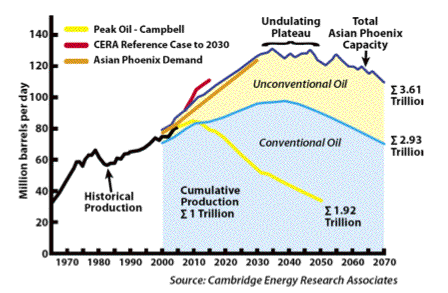
In particular they question the prediction in the last World Economic Outlook, believed to be repeated again this year, that oil production can be raised from its current level of 83m barrels a day to 105m barrels. External critics have frequently argued that this cannot be substantiated by firm evidence and say the world has already passed its peak in oil production.

Now the "peak oil" theory is gaining support at the heart of the global energy establishment. "The IEA in 2005 was predicting oil supplies could rise as high as 120m barrels a day by 2030 although it was forced to reduce this gradually to 116m and then 105m last year," said the IEA source, who was unwilling to be identified for fear of reprisals inside the industry. "The 120m figure always was nonsense but even today's number is much higher than can be justified and the IEA knows this.

"Many inside the organisation believe that maintaining oil supplies at even 90m to 95m barrels a day would be impossible but there are fears that panic could spread on the financial markets if the figures were brought down further. And the Americans fear the end of oil supremacy because it would threaten their power over access to oil resources," he added.

A second senior IEA source, who has now left but was also unwilling to give his name, said a key rule at the organisation was that it was "imperative not to anger the Americans" but the fact was that there was not as much oil in the world as had been admitted. "We have [already] entered the 'peak oil' zone. I think that the situation is really bad," he added.

The IEA acknowledges the importance of its own figures, boasting on its website: "The IEA governments and industry from all across the globe have come to rely on the World Energy Outlook to provide a consistent basis on which they can formulate policies and design business plans."

The British government, among others, always uses the IEA statistics rather than any of its own to argue that there is little threat to long-term oil supplies.

The IEA said tonight that peak oil critics had often wrongly questioned the accuracy of its figures. A spokesman said it was unable to comment ahead of the 2009 report being released tomorrow.

John Hemming, the MP who chairs the all-party parliamentary group on peak oil and gas, said the revelations confirmed his suspicions that the IEA underplayed how quickly the world was running out and this had profound implications for British government energy policy.

He said he had also been contacted by some IEA officials unhappy with its lack of independent scepticism over predictions. "Reliance on IEA reports has been used to justify claims that oil and gas supplies will not peak before 2030. It is clear now that this will not be the case and the IEA figures cannot be relied on," said Hemming.

"This all gives an importance to the Copenhagen [climate change] talks and an urgent need for the UK to move faster towards a more sustainable [lower carbon] economy if it is to avoid severe economic dislocation," he added.

The IEA was established in 1974 after the oil crisis in an attempt to try to safeguard energy supplies to the west. The World Energy Outlook is produced annually under the control of the IEA's chief economist, Fatih Birol, who has defended the projections from earlier outside attack. Peak oil critics have often questioned the IEA figures.

But now IEA sources who have contacted the Guardian say that Birol has increasingly been facing questions about the figures inside the organisation.

Matt Simmons, a respected oil industry expert, has long questioned the decline rates and oil statistics provided by Saudi Arabia on its own fields. He has raised questions about whether peak oil is much closer than many have accepted.

A report by the UK Energy Research Council (UKERC) last month said worldwide production of conventionally extracted oil could "peak" and go into terminal decline before 2020 – but that the government was not facing up to the risk. Steve Sorrell, chief author of the report, said forecasts suggesting oil production will not peak before 2030 were "at best optimistic and at worst implausible".

But as far back as 2004 there have been people making similar warnings. Colin Campbell, a former executive with Total of France told a conference: "If the real [oil reserve] figures were to come out there would be panic on the stock markets … in the end that would suit no one."

Dreams Die Hard

SUBHEAD: History is reality's big brother. It is taking us someplace that we don't want to go, dragging us there kicking and screaming. image above: 'View from Tent City, U.S.A." near Nashville, Tennessee From http://homelessness.change.org/blog/view/the_view_from_tent_city_usa By James Kunstler on 9 November 2009 in Kunslter.com - http://kunstler.com/blog/2009/11/dreams-die-hard.html In The Long Emergency (2005, Atlantic Monthly Press), I said that we ought to expect the federal government to become increasingly impotent and ineffectual - that this would be a hallmark of the times. In fact, I said that any enterprise organized at the colossal scale would function poorly in years ahead, whether it was a government, a state university, a national chain retail company, or a giant midwestern farm. It is characteristic of the compressive contraction our society faces that giant hypercomplex systems will wobble and fail. We should expect this.
It's tragic that the avatar of hopefulness himself, Barack Obama, stepped into his role at exactly the moment when this set of conditions was getting traction. It is sure to get worse, and there are going to be a lot of disappointed people out there who will be suffering terrible losses and real pain in daily life. Societies don't do well when the public falls into the broad despair that is the opposite of hope. That's when the long knives and the tribal animosities come out and things get smashed.
Within the context of conventional party politics - the kind that has been baseline "normal" in the USA for a long time - we see this playing out in two factions that are increasingly out-of-touch with reality. The Obama government has made itself hostage to a toxic form of pretense and lying. In order to sustain the wish for "hope" - if not hope itself - the President and his White House advisors along with his cabinet appointments, are pretending that the historical forces of compressive contraction are not underway. They're flat-out lying about the employment figures issued in the government's name. They're willfully ignoring the comprehensive bankruptcy gripping government at all levels. They refuse to bring the law to bear against "the malefactors of great wealth." They appear to not understand the epochal energy scarcity problem the whole world faces, or its implications for industrial economies. Most of all, they persist in promoting the lie that this economy can return to the prior state of reckless debt accumulation (a.k.a "consumerism") that has made us so ridiculous and unhealthy.
The trouble with self-delusion, either in a person or a society, is that reality doesn't care what anybody believes, or what story they put out. Reality doesn't "spin." Reality does not have a self-image problem. Reality does not yield its workings to self-esteem management. These days, Americans don't like reality very much because it won't let them push it around. Reality is an implacable force and the only question for human beings in the face of it is: what will you do? In other words, it's not really possible to manage reality, but you can certainly choose to manage your affairs within reality. We won't do that because it's too difficult. This harsh situation leaves the public increasingly with little more than bad feelings of discouragement and persecution. It's astonishing that all the smart people around the president don't get this.
Reality unfolds emergently, and this ought to interest us. For instance, I have maintained for many years that we are approaching the twilight of the automobile age - and the implications of this for daily life in the USA are pretty large. For a long time, I had assumed that this change of circumstances would proceed from our problems with the oil supply. But reality is sly. It has thrown two new plot twists into the story lately. America's romance with cars may not founder just on the fuel supply question. It now appears that our problems with capital are so severe that far fewer people will be able to borrow money from banks to buy cars at the rate, and in the way, that the system has been organized to depend on. Our problems with capital are also depriving us of the ability to pay to fix the hypercomplex system of county roads, interstate highways, and even city streets that make motoring possible. What will we do?
For now, a cashless government gives out cash-for-clunkers, which is basically a self-esteem building program designed to make the government feel better about itself because it is ostensibly taking 11-miles-per-gallon cars off the road and replacing them with 27-miles-per-gallon cars, thus forestalling scary problems with climate change. It's dumb of course, but the failure of leadership is comprehensive. Even the elite environmentalists at the Aspen Institute are preoccupied with finding new "green" ways to keep all the cars running. They put zero effort into the idea of walkable communities, or restoring the railroad system, which will be the reality-based remedies for the car-dependency problem.
The Republican right wing is, if anything, even more childishly delusional. For Glen Beck and Sarah Palin it comes down to "drill, baby, drill." They know nothing about the geology of oil - they don't even believe that the earth is more than six-thousand years old, meaning they don't believe in geology, period - but they are inflamed with the faith of eight-year-old children that we must have a lot more oil in the ground because this is America and God loves us more than people in other parts of the planet so it must be there. As their disappointment mounts, their childish ideas will turn cruel and sadistic. They'll seek to punish anybody who believes that the earth is more than six thousand years old. The catch is, If they get into power in the election cycles ahead, they'll be impotent and ineffectual even at persecuting their enemies.
In the meantime, American life will just wind down, no matter what we believe. It won't wind down to a complete stop. Its near-term destination is to lower levels of complexity and scale than what we've been used to for a long time. People will be able to drive fewer cars fewer miles. The roads will get worse. They'll be worse in some places than others. There will be fewer jobs to go to and fewer things sold. People who live in communities scaled to the energy and capital realities of the years ahead are liable to be more comfortable. We're surely going to have trouble with money. Households will drown in debt and lose all their savings. Money could be scarce or worthless. Credit will be scarcer.
Both factions of American political life indulge in the fiction of control. History is reality's big brother. It is taking us someplace that we don't want to go, so it will probably have to drag us there kicking and screaming. For starters, both reality and history will probably take us out to some woodshed of the national soul and beat the crap out of us. That could be a salutary thing, since the crap consists of all the lies we tell ourselves. Once we're rid of all that, we may rediscover a few things left inside our collective identity that are worth regarding with real self-respect.

GUAM - Another Strategic Island

SUBHEAD: Japan says "Don't expect a deal on Okinawa-Guam transfer during Obama's trip later this week". Image above: B-2 bomber, flanked by F-15 fighters, over Andersen AFB in Guam in 2005 From http://www.mahalo.com/answers/social-science/does-russia-want-to-become-a-superpower-like-it-was-in-the-cold-war Tip of the Spear - Pacific Island Produced by SBS/Dateline. Distributed by Journeyman Pictures See video: http://www.youtube.com/watch?v=fTrDl8k9CEM Last year the Bush Administration announced that Guam would be the site of 'the largest military build-up in the history of the US'. Locals say that the communities indigenous to this small Pacific island will not survive. Guam is a political anomaly: A US territory where citizens do not have US voting-rights and where island politics are controlled by Washington. The indigenous population, the Chamarro, live in poverty and preserving their traditional way of life is a struggle. 'We are certainly on the endangered species list', says Chamorro leader Debbie Quintana. Now the US plans to make Guam the lynchpin of its military strategy in the western Pacific, and the mood in Guam is of anger and disbelief. 'We are a strategic location, a possession, a bounty of war', Quinata says. 'And if we don't like it, tough'. By Jeff Marchesseault on 8 November 2009 in Guam News Factor - http://guamnewsfactor.com/200911081467/Top-Stories/Japan-Says-Don-t-Expect-A-Deal-On-Okinawa-Guam-Transfer-During-Obama-s-Tokyo-Trip-Later-This-Week.html Less than a week before President Obama's scheduled visit to Tokyo, Japan's foreign minister is warning U.S. officials not to expect any answers on where Japan may allow the Marine Corps to relocate its air base within Okinawa. According to GulfNews.com, Katsuya Okada says no deal can be expected during President Barack Obama's visit. Guam's mostly-Marines buildup hinges on the timely and successful relocation of Futenma Air Station from crowded Ginowan to remote Nago, both of which are in Okinawa. Eight thousand U.S. Marines and their families would relocate to Guam as part of the troop realignment. Guam's related military buildup is due to get underway in the summer/fall of 2010, but Japan's new government has yet to commit to a 2006 American-Japan accord spelling out the details of the realignment. In fact, in the not-so-distant past, Prime Minister Yukio Hatoyama has gone as far as opposing a U.S. air base anywhere in Okinawa. see also: Ea O Ka Aina: Diego Garcia - Another stolen island 11/6/09 Ea O Ka Aina: DARPA & Super-Cavitation on Kauai 3/24/09 Island Breath: RIMPAC 2008 - Navy fired up in Hawaii 7/2/08 Island Breath: Navy Plans for the Pacific 9/3/07 Island Breath: RIMPAC 2006 - Impact on oceani 5/23/06 Island Breath: RIMPAC 2004 - Whale strandings on Kauai 9/2/04

Immigration and our Ecological Predicament

SUBHEAD: A decline in carrying capacity is one of the key drivers of mass migrations. Image above: Miniature recreation of migration of illegals entering native American territory. From http://garytangeman.wordpress.com/2008/07/26/scenes-of-the-old-west By Kurt Cobb on 8 November 2009 in Resource Insights - http://resourceinsights.blogspot.com/2009/11/immigration-and-our-ecological_08.html

Whenever the word immigration is mentioned, two polarized camps almost immediately emerge. One camp considers new residents an asset, bringing new ideas and entrepreneurial zeal to a society, while the other considers immigration a bane, bringing crime, disease, poverty and culturally disruptive practices.

Only very rarely mentioned by those opposing immigration is a concern that the host country has run out of carrying capacity and cannot afford to feed, clothe, educate and keep healthy any more people. Immigration opponents may claim that their home country cannot afford additional people. But, by this they do not ordinarily mean that the population and the economy of the country should cease to grow. They simply mean they do not wish to share any growth with newcomers. The carrying capacity of many industrialized nations was probably reached several decades ago. If a country imports critical resources--oil and food come to mind--then it has in all likelihood overshot its carrying capacity. So, while lack of carrying capacity has some validity as an argument against immigration, it is difficult to apply in a globalized economic environment. This is because most wealthy countries import a significant portion of their carrying capacity. The destruction resulting from this importation takes place "over there" where the forests are leveled, the land is eroded, the mines are depleted and the rivers are poisoned. Those in the importing country simply do not feel the effects of that undermining of world carrying capacity and therefore assume that carrying capacity has not been reached or at least that it has not been impaired by the standard of living in the importing country. The usual retort is that the water and air are cleaner today than they were 30 years ago in the importing country. What's not mentioned, of course, is that the damage the importing country is doing through its consumption has simply been shifted elsewhere. Now, if we reframe the issue not as one of immigration, but rather as one of mass migration, we will complicate things even further. For much of the migration we are seeing today is from countries which export resources to wealthy nations. In other words, we are seeing mass migrations from resource exporting countries where carrying capacity is being systematically undermined toward countries that are importing that carrying capacity. One concrete example is Mexico which has been exporting its carrying capacity in the form of oil for decades. It has also been exporting other minerals and foodstuffs as well. As oil production plummets in Mexico, the ability of the nation to function has become impaired. The government is having trouble keeping its population safe from drug cartels which now control a significant share of the country. Jeff Vail, a contributor to The Oil Drum and a former U. S. Air Force intelligence officer wrote in 2007 that he believed that Mexico was already on the path to collapse. He updated his views earlier this year and sees the process is actually further along. What this means is that the already substantial flow of immigrants from Mexico into the United States is likely to turn into a torrent as economic opportunities and personal safety decline in Mexico. A government that relies on oil profits for 40 percent of its budget will be hard pressed to provide the economic activity and the social services to satisfy all of its population as oil profits continue to decline with oil production. As similar dramas unfold elsewhere--Vail mentions Nigeria and Iraq--we can expect a rise in the tempo of migrations from countries that are exporting their carrying capacity to countries that are importing it. This will no doubt be accompanied by calls to limit immigration. If the flow becomes great enough, it might result in military action to close borders, at least temporarily. If policymakers do not recognize that the decline in carrying capacity is one of the key drivers of contemporary mass migrations, they cannot hope to address the situation. And, simply shutting the borders when the flow of people becomes too great may turn out to be problematic for those wealthy countries that currently import a substantial share of their carrying capacity. How will they maintain an orderly flow of imports while at the same time exclude people who are not legally allowed to enter? It would be felicitous if new policies were enacted to raise carrying capacity by drastically reducing consumption in wealthy countries and gradually reducing population everywhere. As long as consumption in wealthy countries remains at or near its current levels, those countries will continue to be on a collision course with mass migrations born of ecological overshoot and skewed trade relations--trade relations which have for so long allowed the wealthy to export their environmental degradation elsewhere and saddle the poor with the consequences.

Wind Flutter Generator

SUBHEAD: Alternative wind generation with simpler technology than turbines... one moving part.  

[Editor's note: Elegant and simple. The question is how long will any material last as a ribbon vibrating in variable wind circumstances? Replacement might be cheap and easy... but how frequently?]

 By Mack on 15 September 2008 at 37Signals.com -  
(http://37signals.com/svn/posts/1238-turning-aeroelastic-flutter-into-third-world-power)

 
Image above: Shawn Frayne and his aeroelastic electric generator. From http://thebreakthrough.org/blog/2008/03/the_answer_is_blowin_in_the_wi.shtml

Working in Haiti, Shawn Frayne, a 28-year-old inventor based in Mountain View, California, saw the need for small-scale wind power to juice LED lamps and radios in the homes of the poor. Conventional wind turbines don’t scale down well—there’s too much friction in the gearbox and other components.

“With rotary power, there’s nothing out there that generates under 50 watts,” Frayne says. So he took a new tack, studying the way vibrations caused by the wind led to the collapse in 1940 of Washington’s Tacoma Narrows Bridge (aka Galloping Gertie).

Frayne’s device, which he calls a Windbelt, is a taut membrane fitted with a pair of magnets that oscillate between metal coils. Prototypes have generated 40 milliwatts in 10-mph slivers of wind, making his device 10 to 30 times as efficient as the best microturbines. Frayne envisions the Windbelt costing a few dollars and replacing kerosene lamps in Haitian homes.


Video above: Demonstration of inexspensive non-spinning wind generator. From http://www.youtube.com/watch?v=paxI4y_WmZI

  .

Organoponico! Cuba's food security

SUBHEAD: Cuba is no democratic paradise, but the country could certainly teach the west a thing or two about sustainable, secure food production, as this new film demonstrates.

By Claire Birch on 6 November 2009 in The Ecologist - 
http://www.theecologist.org/tv_and_radio/tv/344450/organoponico_cubas_response_to_food_security.html


image above: An example of organoponico garden bed. Low concrete wall, organic material, drip system. From http://www.organoponico.com 
 
Organoponico! begins with a summary of life after the start of the Special Period. In Cuba, the Special Period refers to the period of economic crisis that began in 1991 after the collapse of the Soviet Union. It was defined primarily by severe shortages of oil derivatives and imports, leading to widespread famine. 
 From this desperate need for food came the establishment of small organic farms, making use of any available space, from disused car parks to road-sides. The result is not just highly productive, but also attractive - splashes of lush green space within urban environments: flourishing gardens, grown without any pesticides, offering an oasis of calm amongst the busy Havana streets.  

Community  
The six minute film demonstrates the strong sense of cooperative spirit provided by the organoponicos, organised, as they are, 'by the neighbours of the community, to produce food for the community'. Government subsidies allow the organic produce to be sold at often half the price of conventionally farmed produce, making the enterprises economically viable too. 

 
Video above: "Organoponica!", a six minute film in Spanish with subtitles (5/9/2009) From http://www.youtube.com/watch?v=JIWsxo5nNgg 

One of Organoponico!'s strengths is that its story is told entirely by workers, painting a realistic picture of working life for those who tend organoponicos, illustrating that although the work is intensive, employees enjoy good conditions and pay. The food security created by the system is highly valued: Cuba’s 7000 organoponicos supply 90 per cent of the country's fruit and vegetables, and have helped lift Cuba from the poverty of the Special Period. 

Peak oil 
Although born out of necessity, organoponicos have proven that an oil-scarce society can survive, if not thrive. Many environmentalists have seen the Cuban experience as something of a model for how to survive peak oil. Because of this, other countries have attempted to replicate it, although results have been variable. 

The film ends with some startling facts about the state of the food industry here in the UK. Currently we import 95 per cent of our fruit and 50 per cent of our vegetables. Since consensus is forming around the possibility of an oil supply crunch within the next decade, perhaps the time to start reclaiming the UK's urban landscape is now. 

Organoponic Raised Bed Gardening was created in Cuba and was born from the crisis the Cubans experienced after the collapse of the Soviet Union and this crisis was deepened by the strengthening of the American Trade Embargo An Organoponico simply consists of low level concrete walls filled with organic matter and soil, with a couple of lines of drip irrigation laid on the surface of the growing media.  

Cuba
The concrete sided beds are called “Cantero” in Spanish and the organic matter is usually “Bagasse” which is the waste left over from crushing sugar cane. Normally the ratio between soil and organic matter is 50%:50%. Sometimes every 7th bed is used for worm farming and the resultant vermicast is an important contributor to the fertility, especially for nitrogen and microorganisms. So it is obvious where the “organo” part of organoponic comes from but why call it “ponic” ?

Well it just so happens that the Cubans had installed an hydroponic operation just before the crisis which quickly became defunct, but because they liked the hi-tech sound of that term and probably because the new gardens incorporated the use of drip irrigation they coined the term organoponic, which transformed into the generic name for these type of gardens, Organoponico.

 I have adopted this word for my garden beds because the garden beds are highly amended with organic materials and also I believe in using the drip irrigation system for fertigation with both organic and chemical fertilisers. In fact the high organic matter levels in the beds provides a excellent buffer for the input of regular small doses of chemical fertilisers either through the irrigation or lightly sprinkled on the surface by hand. This is because chemical fertilisers are by nature very acidic and salty and the nutritive elements are present in a very concentrated form which can easily get out of balance and do harm to soil and plants, but a very high organic matter content in the soil can to a large extent buffer and balance all that.  

Zen Concrete
 If a Hydroponic Glasshouse operation is one extreme of the vegetable growing spectrum and a Large-Scale Open-Field Market Garden is the other end, then what we are trying to create here is something in between. In the Cuban Capital of Havanna there are 200 large Organoponicos providing a city of 2.2 million people with 50% of their vegetable supplies.

See also: Ea O Ka Aina: How Cuba Survived Peak Oil 2/25/09