Suburban Survivalists

SUBHEAD: Recession prompts fear of economic collapse, spurs breed of 'suburban survivalists'.  

By Gillian Flaccus on 25 May 2009 in Yahoo Finance
http://finance.yahoo.com/news/Crisis-spurs-spike-in-apf-15339847.html?sec=topStories&pos=2&asset=&ccode

  
Image above: Detail of cover from "Fallout Shelter Handbook" by Chuck West in 1962. Note the casual behavior of the family in the fallout shelter as they anticipate the nuclear destruction about to rage above their heads. From (http://www.nerdcore.de/wp/tag/retro/page/7)
  
Six months ago, Jim Wiseman didn't even have a spare nutrition bar in his kitchen cabinet. Now, the 54-year-old businessman and father of five has a backup generator, a water filter, a grain mill and a 4-foot-tall pile of emergency food tucked in his home in the expensive San Diego suburb of La Jolla. Wiseman isn't alone. Emergency supply retailers and military surplus stores nationwide have seen business boom in the past few months as an increasing number of Americans spooked by the economy rush to stock up on gear that was once the domain of hardcore survivalists.

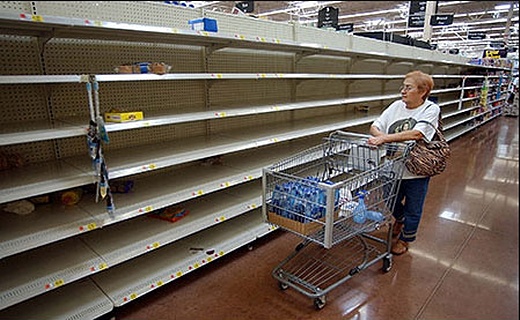
These people snapping up everything from water purification tablets to thermal blankets shatter the survivalist stereotype: they are mostly urban professionals with mortgages, SUVs, solid jobs and a twinge of embarrassment about their newfound hobby. From teachers to real estate agents, these budding emergency gurus say the dismal economy has made them prepare for financial collapse as if it were an oncoming Category 5 hurricane. They worry about rampant inflation, runs on banks, bare grocery shelves and widespread power failures that could make taps run dry.

 For Wiseman, a fire protection contractor, that's meant spending roughly $20,000 since September on survival gear -- and trying to persuade others to do the same. "The UPS guy drops things off and he sees my 4-by-8-by-6-foot pile of food and I say 'What are you doing to prepare, buddy?'" he said. "Because there won't be a thing left on any shelf of any supermarket in the country if people's confidence wavers." The surge in interest in emergency stockpiling has been a bonanza for camping supply companies and military surplus vendors, some of whom report sales spikes of up to 50 percent.

These companies usually cater to people preparing for earthquakes or hurricanes, but informal customer surveys now indicate the bump is from first-time shoppers who cite financial, not natural, disaster as their primary concern, they say. Top sellers include 55-gallon water jugs, waterproof containers, freeze-dried foods, water filters, water purification tablets, glow sticks, lamp oil, thermal blankets, dust masks, first-aid kits and inexpensive tents.

 Joe Branin, owner of the online emergency supply store Living Fresh, said he's seen a 700 percent increase in orders for water purification tablets in the past month and a similar increase in orders for sterile water pouches. He is shipping meals ready to eat and food bars by the case to residential addresses nationwide. "You're hearing from the people you will always hear from, who will build their own bunkers and stuff," he said.

"But then you're hearing from people who usually wouldn't think about this, but now it's in their heads: 'What if something comes to the worst?'" Online interest in survivalism has increased too.

The niche Web site SurvivalBlog.com has seen its page views triple in the past 14 months to nearly 137,000 unique visitors a week. Jim Rawles, a self-described survivalist who runs the site, calls the newcomers "11th hour believers."

He charges $100 an hour for phone consulting on emergency preparedness and says that business also has tripled. "There's so many people who are concerned about the economy that there's a huge interest in preparedness, and it pretty much crosses all lines, social, economic, political and religious," he said. "There's a steep learning curve going on right now."

Art Markman, a cognitive psychologist, said he's not surprised by the reaction to the nation's financial woes -- even though it may seem irrational. In an increasingly global and automated society, most people are dependent on strangers and systems they don't understand -- and the human brain isn't programmed to work that way.

"We have no real causal understanding of the way our world works at all," said Markman, a professor at the University of Texas, Austin. "When times are good, you trust that things are working, but when times are bad you realize you don't have a clue what you would do if the supermarket didn't have goods on the shelves and that if the banks disappear, you have no idea where your money is."

Those preparing for the worst echo those thoughts and say learning to be self sufficient makes them feel more in control amid mounting uncertainty -- even if it seems crazy to their friends and families. Chris Macera, a 29-year-old IT systems administrator, said he started buying extra food to take advantage of sales after he lost his job and he was rehired elsewhere for $30,000 less. But Macera, who works in suburban Orange County, said that over several months his mentality began to shift from saving money to preparing for possible financial mayhem. He is motivated, too, by memories of the government paralysis that followed Hurricane Katrina.

He now buys 15 pounds of meat at a time and freezes it, and buys wheat in 50-pound bags, mills it into flour and uses it to bake bread. He checks survivalist Web sites for advice at least once a day and listens to survival podcasts. "You kind of have to sift through the people with their hats on a little bit too tight," said Macera, who said his colleagues tease him about the grain mill. "But I see a lot of things (on the Web) and they're real common sense-type things." "I don't want to be a slave to anybody," he said.

"The more systems you're dependent on, the more likely things are going to go bad for you." That's a philosophy shared by Vincent Springer, a newcomer to emergency preparedness from the Chicago area. Springer, a high school social studies teacher, says he's most worried about energy shortages and an economic breakdown that could paralyze the just-in-time supply chain that grocery stores rely on.

In the past few months, Springer has stockpiled enough freeze-dried food for three months and bought 72-hour emergency supply kits for himself, his wife and two young children. The 39-year-old is also teaching himself to can food. "I'm not looking for a retreat in northern Idaho or any of that stuff, but I think there's more people like me out there and I think those numbers are growing," he said.

Moloaa Stream Complaint

SUBHEAD: Efforts are moving forward to restore Moloaa Stream waters within its ahupuaa (watershed). By Andy Parx on 22 May 2009 in Parx News Network http://parxnewsdaily.blogspot.com/2009/05/pnn-dlnr-complaint-seeks-restoration-of.html Image above: The scene of the crime. The Kaloko Reservoir Puu is the nexus of several water courses with four ahupuaa and four properties bordering it. Graphic by Juan Wilson with GoogleEarth. Hope Kallai of Malama Moloa`a has filed a detailed complaint with the state Commission on Water Resources Management (CWRM), a division of the Department of Land and Natural Resources (DLNR), providing evidence and documentation and that she hopes will lead to investigation and the restoration of water illegally diverted from Moloa`a Stream. The complaint and it’s 77 endnoted exhibits detail the history of the Moloa`a Ditch from the sugar cane era through the illegal diversion that occurred apparently about 10 years ago and which increased the amount of water supplied to Ka Loko Reservoir and other lands owned by Jimmy Pflueger and the Mary Lucas Estate causing Moloa`a stream slow to a virtual trickle. After reviewing the voluminous files contained in the state ordered Godby Report and it’s extensive document appendix (compiled after the 2006 Ka Loko dam break that killed seven people), a recent county funded report on the Kilauea area irrigation systems and other documents, the complaint details the apparent theft of Moloa`a water that has caused wells to run dry and farmers to cease operations in the valley since the illegal diversion was completed. The complaint clears up the history of the Moloa`a Ditch saying There were previously 2 historic Moloa`a ditches. In the late 1890’s, the original Moloa`a Ditch carried a minimal amount of water from a high contour ditch to Waipake. The second historic Moloa`a ditch followed easement “W-11” and was used from the 1920’s to about 1965-1968 to carry high rain runoff to Ka Loko ditch near the Parshall Flume, mainly during the winter months. According to Jack Gushiken, this ditch was not used during the summer during sugar plantation days because Pu`u Ka Ele ditch had plenty water. In the late 1960’s insignificant water flow led to no maintenance which lessened flow to non-existent. The Moloa`a ditch was non-functional before the demise of Kilauea Sugar in 1972. It was non-functional for about 20 years at the date of declaration need by the State Water Code in 1988. It had not ever been declared because it was not in use until about 2000. Apparently, according to Kallai’s research, the theory presented in a pre-dam break letter to the EPA- as PNN reported last week- saying that Moloa`a Ditch originally may have acted as an overflow spillway for the Ka Loko ditch system and ran “in reverse” in order to return excess water to Moloa`a Stream, was incorrect. Though there is no concrete proof, the illegal diversion is thought to be the work of Pflueger who has been found guilty of various land moving violations in the area including one that resulted in the largest fine for reef destruction in federal Environmental Protection Agency history. As PNN has reported, according to multiple friends of Pflueger, he had planned a water-sports-based resort in the area and apparently needed more water than the Ka Loko Ditch could provide in order to fill artificial lakes he constructed as well as fill existing area reservoirs like Ka Loko for water and jet-skiing. According to two area residents who examined the pipes and watched them being installed, the water system crosses the highway through culverts at Pila`a and supplied a series of Pflueger constructed “lakes” makai of the highway which were just recently removed as part of the remediation ordered by the EPA. Pflueger is set to stand trial for manslaughter this summer as well as defend multiple civil suits for damages related to the Ka Loko dam break and other incidents in the area The CWRM complaint describes the current reconstructed ditch based on the studies and documents saying The unpermitted diversion of Kalua`a/Moloa`a stream begins at a new dam (”Pre-2001” according to the Kilauea Irrigation Report April 2009), constructed on state land in the Moloa`a Forest Reserve, continuing 2,750 feet towards Ka Loko through a system of ditches, flumes and tunnels to Mary Lucas Trust lands, where a diversion structure directs water underground through pipes either into Ka Loko reservoir or to the Mary Lucas Trust lands and the Kilauea Irrigation Company (KICO) system distribution lines for sale. These pipes are carried underground through other lands belonging to the State of Hawaii , (TMK (4) 5-1-2:3), according to the above report, and export millions of gallons of water per day out of the watershed of Moloa`a, without engineering, metering or monitoring for about a decade. The complaint then details the deleterious effects on Moloa`a resident saying The unpermitted exportation Kalua`a/Moloa`a stream has caused a perennial stream to go dry for 2 summers (2007 & 2008) and had serious negative impacts to the aquatic ecosystem of Moloa`a, seriously diminishing nesting habitat for 3 endangered water bird species and an assemblage of endangered stream and pali plants. Water quality is diminished in the remnant pools. Impacts to the ecosystem must be considered before the massive exportation of water resources. Since this un-engineered, un-maintained diversion was installed, Moloa`a has experienced many dirty water events – both brown water and grey water reported. Moloa`a stream has experienced un-explained extreme flood events that have damaged stream property and county infrastructure. The ground water aquifer has diminished due to lack of recharge from the stream aquifer. Water well pumps have had to be lowered due to diminished aquifer and most people self-ration. Neighbors with declared Stream Uses are not able to use their water rights. There is no county water distribution system for potable or agricultural water throughout Moloa`a; most farms are dependent upon well water. Now we are having a hard time planting because we cannot depend upon having water. Many stream front lands are going unworked now because owners do not feel safe due to unknown factors/persons manipulating and controlling the waters. The complaint was filed with the CWRM which establishes Instream Flow Standards and issues Water Use Permits, Stream Channel Alteration permits and Stream Diversion Permits. Kallai told PNN there are at least three things she hopes the commission will do. 1 See that Moloa`a water returned and natural stream flow restored. 2 Investigate and prosecute whoever is responsible for stealing our water and selling it 3 With the fines, fund a stream research center and watershed restoration effort and funding for environmental enforcement and enough researchers to perform statewide assessments of our water resources and where they're going For more background on the Ka Loko ditch and reservoir system and work done on Moloa`a ditch resulting in a lack of water in Moloa`a, refer to the four previous PNN reports. see also: Island Breath: Moloaa Diversion Forensics 5/22/09 Island Breath: Moloaa Diversion Details 5/13/09 Island Breath: Molaa Water Diverted 5/9/09

Wishes, Hopes and Fantasies

SUBHEAD: The bankruptcy of General Motors may set in motion a chain of events that will accelerate the destructive unwind of our bad credit economy. By James Kunstler on 25 May 2009 at Clusterfuck Nation http://jameshowardkunstler.typepad.com/clusterfuck_nation/2009/05/wishes-hopes-fantasies.html Image above: Yellow Chevrolet Corvettes rolling off a GM manufacturing line in 2007. From http://www.corvetteblogger.com/index.cfm/2007/9/17/UAW-Prepares-to-Strike-Corvette-Assembly-Plant-Targeted Something like a week remains before General Motors is reduced to lunch meat on industrial-capital's All-You-Can-Eat buffet spread. The wish is that its deconstructed pieces will re-organize into a "lean, mean machine" for producing "cars that Americans want to buy," and that, by extension, the American Dream of a Happy Motoring economy may be extended a while longer. This fantasy rests on some assumptions that just don't "pencil out." One is that the broad American car-owning public can continue to buy their cars the usual way, on credit. The biggest emerging new class in America is the "former middle class." Credit kept the remnants of the middle class going for decades after their incomes stopped growing in the 1970s. Now, their incomes have stopped coming in altogether and they are sinking into swamp of entropy already occupied by the tattoo-for-lunch-bunch. Of course, this has plenty of dire sociopolitical implications. Unfortunately, the big American banks did their biggest volume business in their biggest loans at the very time that that the middle class was on its way to becoming former. Now that the former middle class is arriving at its destination, the banks are so damaged by bad paper that they won't make loans to even the remnant of the remnant of the middle class. In other words, the entire model for financing Happy Motoring is now out-of-order, probably permanently. Even assuming some Americans can continue buying cars one way or another, I'm not convinced that we can make the kinds we fantasize about. Notice, nobody talks about hydrogen-powered fuel cell cars anymore. Why not? Because the technicalities and logistics could not be overcome at the scale required -- i.e. at the current scale of mass highway motoring and commuting. Sure, you could build a demonstration vehicle and run it around a test track a few times, but could you build a mass production car by the tens of millions that would run for 150,000 miles without a hugely expensive fuel cell change-out? No, at least not within the time-window that the liquid hydrocarbon fuel problem presented. Or could you construct a hydrogen fuel station (and product delivery) network replacing the old gasoline stations? Fuggeddabowdit. Hydrogen, as an element, was just too hard to move and contain. It's teeny-weeny atoms leaked out of valves and gaskets remorselessly and you couldn't pack enough into a tanker truck to make the trip to its destination worthwhile. Schemes to generate hydrogen on-board all ended up in the "perpetual motion" sink. The current wish is that the dregs of GM and Chrysler will hire low-paid elves with no pension or health benefits and pump out hybrid and/or electric cars. It's conceivable that we could "reverse-engineer" a Prius or an Insight, but considering what a lousy job American car companies did on reverse-engineering everything that Japan or Germany pumped out over the past thirty-five years, the odds are pretty high that these new products will be just lame enough to fail against the established competition. What's more, they also present logistical and technical problems. For the hybrid, gasoline is still an issue (and Jevon's Paradox comes into play: the more efficient you make a means for using a resource, the more of that resource you will use). For both the hybrid and the electric car, the issue of how to get enough lithium for the batteries obtains, at least for now, given the current state-of-the-art battery technology. Most of this rare metal now comes from one place, Bolivia, and everybody wants "a piece" of it. Electric vehicles in large numbers depend on either coal or nuclear powered electric generation, each presenting special hazards. Both hybrids and electric cars would depend on the old installment loan purchase system -- at least to work in the current mode of suburban living, long-range commuting, and interstate highway travel. Boone Pickens's plan of last year for converting the US car fleet to natural gas was another fantasy with wide appeal. But it depended on the companion fantasy of building massive wind-farm infrastructure on the great plains to shift natural gas use from power plants to vehicles, and the financial crisis has destroyed the capital necessary to even begin planning that project -- it even destroyed a large part of Mr. Pickens own capital reserves. Anyway, I would not be so sanguine about the long-term future of the shale gas plays that this scheme was based on. The depletion rates of these wells is horrendous and the amount of steel needed to keep production up is not consistent with the realities of the available infrastructure. All the technologies under consideration are not likely to extend the Happy Motoring era. A prayerful reflection on them can only reinforce the specialness of oil and its byproducts -- cheap oil double-specially -- as well as reinforcing the reality that the cheap energy era itself is over. And, of course, in the play of events over the past several years we can see the relationship between cheap energy and easy credit, and how our entire economy has run aground, one way or another, on resource limits. The implications of all this in the sociopolitical and geopolitical realms are pretty daunting. As long as we maintain Happy Motoring as the normal mode of existence in this country, we are going to see an ever-growing class of very resentful citizens pissed off at being foreclosed from it. In my oft-repeated scheme-of-things, this leads very quickly to the trap of political extremism, perhaps even corn-pone Naziism, as the system becomes increasingly difficult to prop up except by force. In geopolitical terms it leads to ever more dangerous international contests over the world's remaining oil reserves. All this leads to two conclusions. One is to accept the fact that the Happy Motoring era is over and to devote our remaining resources to re-localization, walkable communities, and public transit. It obviously requires a very drastic revision of our current collective self-image, of what we aspire to and who we are. If the car companies have any future at all, it should be based on making the rolling stock for public transit -- and for now the most intelligent choice for us is to fix the existing passenger railroad lines instead of venturing into grandiose new transit systems requiring stupendous capital outlays. Let the car era wind down gracefully. Triage and prioritize the highway maintenance agenda -- we won't be affluent enough to keep repaving the whole existing system -- and let other nations meet the diminishing demand for cars in the USA. This would be a "best case" scenario. (Other nations may decide to go further up the Happy Motoring road at their own eventual peril.) My second conclusion is not so appetizing, namely that the bankruptcy of General Motors may set in motion a chain of events that will accelerate the destructive unwind of the bad credit economy, the damage to our bond values, the loss of faith in our currency, and the authority and legitimacy of our leaders. This last dire outcome might be allayed if, say, President Obama directed his policy efforts to the items in the paragraph above, that is, a reality-based agenda for true change in how we live -- but who can feel confident about that happening these days? Maybe it will take a horrifying chain of events to get Mr. Obama there. And then, tragically, he may be overwhelmed by the chain of events itself. I hope not.

Investing in our community

SUBHEAD: Keep it local - investing in an economy based on preservation and restoration.
By Andrea Brower on 24 May 2009 in The Garden Island http://www.kauaiworld.com/articles/2009/05/24/business/kauai_business/doc4a18fd8b115a5210293130.txt image above: Detail of illustration from cover of book "Inquiries into the nature of Slow Money" by Woody Tasch. From http://www.slowfoodusa.org/index.php/slow_food/blog_post/slow_money The global environmental crises that we face today are not primarily a problem of technology — they are systematic issues that stem largely from our financial system. Additionally, the focus on rapid maximization of efficiencies and profits has contributed to a global economic meltdown. The time is upon us to reconsider how to invest for the rebuilding of communities, personal well-being, protection of the environment and sustainable food production. Many are realizing that investing globally in intangible securities leads to a plethora of economic, environmental and social problems. What if, instead, we invested half of Kaua‘i’s assets in Kaua‘i? What if you could invest in a locally owned store that supplied produce grown by the farmer down the street and locally made goods? Given the extreme vulnerability and reoccurring boom-bust cycles in the current financial system, more and more people would rather invest their money in something stable, even if the return is smaller and slower. The Slow Money Movement calls for the creation of new capital markets — markets that channel the flow of investment to small enterprises to bring about sustainable growth in local economies. As stated in their Principles, “We must give investors the tools they need to invest in slow, small and local. We must support entrepreneurs who see business as a tool for improving the health of land, household, community and bioregion.” Investing financially in our own community is an opportunity to also support and build community. If you have assets invested in your friendly farmer, then it is only logical that you will buy your tomatoes and lettuce from her rather than South America. Currently, only 0.1 percent of U.S. foundation grants and venture capital flows to sustainable agriculture. If it is prudent to invest tens of billions of dollars each year into a few companies, than surely it must be prudent to invest a few billion dollars in sustainable localized agricultural enterprises that are the foundation of a resilient economy. One successful model for local investment comes from SHARE, Self-Help Association for a Regional Economy, a community-based nonprofit that offers a simple way for citizens to create a sustainable local economy by supporting businesses that provide products or services needed in the region. The following explanation comes from E. F. Schumacher Society: SHARE makes micro-credit loans available at manageable interest rates to businesses that are often considered “high risk” by traditional lenders — usually because of their credit ratings or the unique nature of their business ideas. Local SHARE members make interest-earning deposits in a local bank, which are used to collateralize loans for local businesses with a positive community impact. SHARE depositors live in the same community as the business owners they support — bringing a human face back to lending decisions. The community of depositors assumes the risk and decides who should receive collateral support based on environmental and social criteria, and the bank is hired on a fee-for-service basis to make the transaction. There has been a 100 percent rate of repayment. Investing locally is an opportunity to restore our local food system, to reconnect investors with the places in which they live, to build a sustainable and resilient economy, and to “promote the transition from an economy based on extraction and consumption to an economy based on preservation and restoration” (Slow Money Alliance). An open community meeting to discuss the possibilities for creating local investment and currency systems will be from 4 to 5:30 p.m., June 20, at the Mo‘ikeha Room near the DMV in Lihu‘e. • Andrea Brower is the project manager for Malama Kaua‘i, an organization committed to the ‘aina, culture and community of the island. She can be reached via malamakauai.org. see also: Island Breath: Kauai Currency 5/17/09

Hide or Seek?

SUBHEAD: There are no islands in this universe.
By Namaste Bodhisantra on 21 May 2009 in Approching the Limits to Growth http://paulchefurka.ca/Stand.html Image above: Hubble telescope image of the Orion nebula. From http://www.astronomy-pictures.net/hubble_telescope_images.html One problem faced by many of us who are awakening to the perilous state of the world is how to deal with the sense of dread that is an almost instinctive response to the gravity of the crisis facing humanity. Comprehending the crisis in all its awful majesty can unleash a despair that bubbles up like a mud volcano from the depths of the soul. For many it blots out the sun, obliterating any possibility of hope. The saving realization, which often comes from a combination of diligent thought and a stroke of grace, is that all people, all life, indeed every element of the universe, is profoundly and inextricably interconnected. Nothing can exist without everything else. There are no islands in this universe. With that awareness comes the question of how to respond to these two apparently antithetical understandings, since the underlying reasons for the dread don't simply evaporate in the light of hope. After all, the fish are still gone, the planet still has a fever, the soil and water are still contaminated. There are those who awaken to the dread but cannot find the hope, and so join what I call the "canned food and ammo crowd". They act decisively to shield themselves from the risks, by moving to secluded locations and stockpiling goods so that they can minimize the need to connect with the world around them. In the 1950s they built bomb shelters, today they hoard drums of rice and beans in the basement. They have always made me uncomfortable. Like so many, I live with both an apprehension of inevitable doom and an awareness of infinite promise, each of which exists in its own orthogonal domain. I feel an atavistic urge to hide from the coming changes and the people who may be the vector of so much misery. At the same time I feel a progressive urge to find my tribe and continue my development, while remaining in some way independent of the herd. As I walk my path, I am coming to understand my distinct lack of enthusiasm for physically separating myself from the herd. I have found that I want to stay embedded within the mass of humanity for a couple of reasons. The main reason is that if we who are awakening are in fact humanity's "imaginal cells", spreading our awareness and influence through viral infection of our neighbours, then separating ourselves from them defeats that possibility. If we and all of our billions of our brothers and sisters are to have any hope at all, it can only come from transforming that mass of humanity, not in running from it. Cultural evolution is only possible through participation. It is obvious (to me at least) that those of us who feel called to be vision keepers cannot communicate our vision by shouting through walls of our own construction. We must stand inside our audience, taking our place as co-creating members of it, so that as we whisper gently to those around us we do it as a part of humanity, not apart from it. The second reason is more pragmatic than philosophical. In a world of 6.7 billion people, there simply is no "away" any more. The tide of humanity has lapped into every nook and cranny of the planet. Any attempt to isolate ourselves will be doomed from the outset. If we cannot escape the madding crowd, we are much better off making a virtue of necessity by using this inescapable interaction as an opportunity for connection. As I travel on my journey I will try to limit the influence of the mainstream masses – carrying as they do the messages of our guardian institutions – on my psychological and spiritual development. However, I will deliberately make no such effort to shield my physical being. That, as I understand it, is the way of the bodhisattva -- and we are all bodhisattvas now.

Truth of Life

SUBHEAD: Our culture has made humanity malignant to Gaia’s body.
By Chuck Burr on 22 May 2009 in Culturequake http://www.culturequake.org/Culturequake/Home/Entries/2009/5/22_Truth_of_Life.html Image above: The puzzle of the universe. From http://apod.nasa.gov/apod/ap071021.html What is the meaning of life? Where do we go when we die? What is god? Important and unimportant questions for all of us. Here are my best guesses to these and other life centering questions. Humanity’s Purpose - We are really here literally to balance the life process of plants. At one point in the earth’s evolution, the atmosphere literally became so toxic with oxygen which burned and destroyed everything it touched. Our early ancestors were invented by Gaia to reverse the creation of the toxic gas we call oxygen that plants give off in the process of photosynthesis. By reversing one of the moves in the dance of photosynthesis, a new process could be born–one that could take the toxic gas, and use it to bum food and make energy. Breathers were born, those who dine on the sunlight-harvesters, burning their bodies as fuel for life. In burning food, the breathers give off carbon dioxide, which the plants, with the help of the sun, transform to food again. And the plants give off oxygen, which the breathers use in burning food. Gaia began to breathe, passing her breath back and forth from red to green, continuing to build up oxygen, to transform herself. We are the breath of Gaia. We are also food for plants and the other microbes the bring the soil to life. We fix nitrogen when we pee, and we create compost when we poop and die. Larger Brain - The real question is why did Gaia create the experiment of a large frontal lobe and opposable thumbs? The thumbs enable primates to adapt to a wider range of living conditions by eating a wider of foods and to making tools. The primate brain really only has to be as large as paleolithic man to adapt to wider environmental conditions. The larger frontal lobe grown on top of the mammalian brain which rests on top of the reptilian brain is another question al together. The agricultural revolution may have been the point where we really put the large frontal lobe to work. Ten thousand years ago we made a shift that extended our role as oxygen and plant consumers to consumers of everything. This is may also have been the point where to developed to individual ego that defines modern culture today. The real question unanswered so far is, why the big brain? The answer may be domination. Homo sapiens probably used their larger brain size to exterminate neanderthal man. We are of course doing the same directly and indirectly to the 30 million other species we share this planet with today. This must stop, but how? Modern Purpose of Life - The truth be told, modern culture has become a cancer of indefinite growth upon Gaia. Just as a tumor in your body, our culture has made humanity malignant to Gaia’s body. Humanity itself is not harmful to the earth. Humanity has existed in one form or another for 3 to 4 million years. But, our Taker culture made humanity cancerous 10,000 years ago at the birth of the agricultural revolution. Gaia will go on without us after we have taken ourselves out. The point is that we are going to take down tens of millions of other species with us. Our culture is solely responsible for the greatest mass extinction since the death of the dinosaurs 65 million years ago. The purpose of life today, now that Gaia is entering stage four cancer, is to find an antidote to the agricultural revolution. Maybe what we need is the un-revolution to find a way back to an evolutionarily proven symbiotic way of life. I don’t know how much of our Taker culture can be saved, but if humanity is around in another 10,000 years, it will have a lot more Leaver culture in it than Taker. Other simple truths include, live your truth and enjoy life, but don’t do it at the expense of your relations. Also, survive yes, but don’t breed beyond your number. Modern culture through its human constructed reality has also disconnected us from our truth and created our sense of lack. Every cell in our bodies knows we should live in symbiosis with our ecosystem. The five or six kingdoms of life of monera, protista, fungi, plants, animals have developed over four billion years to form the self-regulating system of life on earth we call Gaia.
Humanity evolved over three or four million years living in harmony with Gaia. As Chief Seattle inferred in his 1854 speech, the earth does not belong to man, humanity belongs to the earth.
All in all, humanity has to go through what we will to see if we come out the other side. The crux is, that the exuberance of our modern culture just happens to have caught up with us during our generation. Now is the time the rainbow warriors to awaken to save us. We may be of the rainbow. Where we fit in the Universe - First, we will probably never know how the universe was created, so makeup your own story and get over it. What we do know is that we are made of star dust, all of the calcium in our bones, the iron in our blood, and the carbon in our bodies came from stars that lived and died before our sun was born.
Did you also know that you are a walking microbial colony? Over ninety percent of the genes and cells in your body are foreign. Humans are born sterile with no bacteria, but start being colonized from the instant we break from the womb. Of the 110 trillion cells in your body, 100 trillion are not human. Most human cells are concentrated in the brain, blood stream, and organs. The other thing that is striking to me is that when I look at the human brain from the outside and section of it, it looks like some mushrooms or colonies of bacteria. We take this great symbiosis of Gaia and our bodies largely for granted. The Fire of Life - When we die, we pass the fire of life on to others through our compost. Where we go then we will not know until we pass through the psychedelic experience we call death. Life on earth is based on the sacred circle of birth, growth, death, and regeneration. Life begets life, but not in the way the Bible tells us. Sure rabbits make rabbits. But what is a rabbit? A rabbit is the grass. A lynx is the grass—soil, grass, rabbit, one. Only temporal reality separates them until they tumble through Gaia’s sacred cycle of life. The fire burns forever. It is the flame of life that courses through all generations from first to last, that burns without consuming, that is itself consumed and renewed inexhaustibly, life after life, generation after generation, species after species, galaxy after galaxy, universe after universe, each sharing in the blaze for its season and going down to death while the fire burns on undiminished. The fire is life itself, the life of this universe, of this galaxy, of this planet, of this place and every place: the place by the rock and the place under the hill and the place by the river and the place in the forest, no two alike anywhere. And the life of every place is god, who is the fire: the life of the pond, god; the life of the tundra, god; the life of the sea, god; the life of the land, god; the life of the earth, god; the life of the universe, god: in every place unique, as the life of every place is unique, and in every place the same, as the fire that burns is everywhere. Heaven or More? I don’t believe we get a do-over or happy nirvana after this life consciousness. The vision is much grander than an ego-centric blissful cloud city awaiting believers. Yes, we become compost when we die, but we don’t go as ourselves somewhere else or are reborn as a rabbit or human. When we change forms to compost and leave this consciousness and reality we rejoin the fire of life that gave birth to us. We return to our mother Gaia and the universe. We become part of all life, as we always have been. Even when we are alive or conscious, we are part of Gaia’s breath and digestion. Breathers and sunlight-harvesters breathing in and out as we live. God - God is a sacred word for all of the known and unknown universe. Since only four percent of the universe is visible and the remaining 96 percent is made up of dark matter and energy, that leaves a lot of unknown. For me that is better; it leaves infinite possibilities. I do know though that I am made of star dust and that I am part of the fire of life that will burn on forever in all life. I am not one, I am all. It is that sample, enjoy life.

Moloaa Diversion Forensics

SUBHEAD: Using GoogleEarth as a basic GIS program one can play geographical detective. By Juan Wilson on 22 May 2009 for Island Breath - (http://islandbreath.blogspot.com/2009/05/moloaa-diversion-forensics.html) I have been using a technical illustration program called Canvas since 1993. It was originally designed for technical illustration. Canvas uses features of desktop publishing and combines bitmap images (i.e. jpgs etc.) and vectors (polygons etc.). I've used the program for architectural drafting, graphic presentation, desktop publishing, illustration and, most recently, map-making (GIS, geo-tiffs, etc.). In the last few weeks I've been combining Canvas use with GoogleEarth to create 3D geographic models. This image above is a detail of a screen shot from GoogleEarth of Kaloko Reservoir area. Click to enlarge. I used these applications to with GIS elements to see where and how water could be diverted from Moloaa Stream to Kaloko Reservoir. LEGEND: • Red lines are property lines • Green medium lines are ahupuaa boundaries • Green thin lines are Moloaa tributary watershed lines • Blue big thing is Kaloko Reservoir • Blue medium line are natural stream courses (Kaluaa lower-left, Wailapa upper-right) • Blue thin line is the unnamed Kaluaa tributary course • Purple lines are existing permitted ditches serving Kaloko Reservoir • Pink lines and areas are diversions from Kaluaa Stream (tributary of Moloaa Stream) • Orange line is diversion catchment system at edge of state land My first use of this technique is to try to resolve the reports of Moloaa Stream Diversion provided by Hope Kallai. Her information included diagrams, and verbal descriptions of how public water has been diverted from state land and onto private property owned and/or controlled by James Pflueger and into the Kaloko Reservoir. This meant taking what GIS data tells us about property boundaries, stream locations, roads, ahupuaa boundaries and the like and bringing it to GoogleEarth for a 3D modelling. Combining GoogleEarth with GIS data allowed me to run some hypothetical possibilities that conformed to the descriptions of how a diversion of water from the Moloaa Stream Ahupuaa and into Pilaa Ahupuaa could be accomplished. Note that Pilaa Ahupuaa includes Wailapa Stream... the one that drowned eight people in a flood in March of 2006. It must be noted that there is little, if any, photographic evidence in the GoogleEarth images to confirm any diversion ditch locations. That can partially be explained by the scale of a narrow ditch, with some tree cover, and low resolution photography, etc. But that does not fully explain why photographic evidence is so lacking. Reports do describe at least three underground tunnels involved in the diversion effort. Certainly, someone with a plan to steal so much water would like it to be as unobtrusive as possible. In any case, with a general idea of what to look for, photographic evidence should determine quickly if this is just a hypothesis. The Kaloko Reservoir is built into a natural puu (geological cone). In Hawaii puus are often natural repositories of fresh water. Puus often line up in strings, like pearls on a necklace. Above Kaloko lies such a string. These upper puus are part of the watershed for the Kaluaa Stream. My modeling suggests that about half the water from Kaluaa Stream may have been diverted by two takes. One on the south west fork of Kaluaa stream at about 875 feet above sea level and another on a tributary (with no known name) to the Kaluaa that is closer to Kaloko at 880 feet above sea level. The course of the hypothetical diversion falls at about a 2% slope continuosly to the border of M. N. Lucas Trust Land (Pflueger is trustee). It then passes out of Moloaa Ahupuaa as it brought into a gate with access to the Kaloko Reservoir or into an overflow ditch which leads back to Moloaa Stream. You can load this 3D data into GoogleEarth. Begin by... 1) Download the file 090522diversion.kmz at out FTP site here. 2) Download file may have to be unzipped (and may have name doc.kml) 3) Open GoogleEarth. 4) Set GoogleEarth 3D terrain "ON" (I used a height exaggeration ratio of 2.5/1). 5) Next import 090522diversion file download into GoogleEarth. 6) GoogleEarth temporary place folder should have "Moloaa Diversion.kmz" 7) Inside you can switch on/off, select, and zoom to diversion elements. If you have any information that would add to or correct this hypothesis, please let us know. see also: Island Breath: Moloaa Stream must be restored 5/15/09

Suburbia into Superbia!

SUBHEAD: Neighbors can create friendlier, healthier, sustainable neighborhoods.
By Dave Wann and Dan Chiras on Summer/Fall 2003 in Terrain.org http://www.terrain.org/articles/13/superbia.htm Image above: Detail of "Lost in Suburbia" photo from http://www.ericdaugherty.com/blog/2008_04_01_archive.html 1. Strangers in Our Own Neighborhoods “I was amazed when my neighbor waved to me,” a suburban friend of ours confided. “She’s lived a few houses down for three or four years now, and she’s never waved before.” She still hasn’t—it turns out she wasn’t waving, just reaching for the garage door opener on the sun visor. Like many of us, what these two neighbors know about each other is limited to superficial things like the appearances of their front lawns, or the habits of their dogs. Despite the fact they live only four large shade trees apart, they don’t even know each others names. Up and down the street, there are hundreds of potential links between people—links that could reduce time, human energy and money spent by individuals on tight schedules and tight budgets. But few of these connections are being made, partly because the collective lifestyle—the neighborhood culture—doesn’t encourage it or empower it. “It’s just not the way we do it; we value our privacy,” we say. Yet it turns out that our quest for privacy and exclusivity in the suburbs has significant costs, among them the loss of personal health. To have a high quality of life, we need to exchange support and admiration with other people. According to anthropologist Margaret Mead, for 99 percent of human history, we’ve lived in clans of 12 to 36 people. Yet suburban design often turns a cold shoulder on the neighborhood “clan,” with garage doors that resemble drawbridges, privacy fences that become castle walls, and private “mini-manors” that encourage exclusive lifestyles. Physical features such as these affect the social and even physical health of suburban residents. For example, the number of friends a person has directly relates to the speed and volume of street traffic in the neighborhood. Sociologist David Appleyard discovered that on a street with light traffic (2,000 vehicles a day), residents had 3 friends and 6.3 acquaintances in the neighborhood, as compared to a street with heavy traffic (16,000 vehicles a day), where residents had .9 friends (what kind of a friend is that?) and 3.1 acquaintances. From the Centers for Disease Control comes other valuable research on how the physical structure of a neighborhood affects residents’ health. Says CDC Director Richard Jackson, MD, “The diseases of the 21st century will be chronic diseases like diabetes, obesity, asthma, and depression, that steal vitality and productivity, and consume time and money. These diseases can be moderated by how we design, build, and maintain our human environment.” Dr. Jackson points to the connection between the design of suburbs that make fewer sidewalks and bike paths available and the recent surge in adult-onset diabetes. “Obesity increases the risk of this type of diabetes as much as 34 fold,” he says, “which in turn increases the incidence of amputations, blindness, kidney failure, and heart disease.” Other health impacts related to the design of suburban neighborhoods include high blood pressure, colon cancer, high levels of teenage suicide, bicycle and pedestrian accidents, and less mobility for the elderly and disabled. The good news is that weight loss and physical activity are more effective and cheaper in controlling diabetes than medication. The same is true for other sprawl-related diseases. For example, physical activity is as effective as prescription drugs for treatment of relatively mild cases of anxiety and depression, according to Jackson. However, if our neighborhoods aren’t interesting or even safe to walk in, and if there are no stores, parks and other destinations that give walking a sense of purpose, we tend to stay inside, snacking in front of the TV or computer, adding on the 10 or 12 pounds beyond fitness that has become the national average. Many resolute Americans do climb in their cars and drive to the gym, but they have to pay for the exercise, and the driving creates other health risks, as Jackson points out. “Respiratory disease, especially asthma, is increasing yearly in the U.S., and poor quality air makes it worse. In 1997, smog pollution was responsible for more than 6 million asthma attacks and 160,000 emergency room visits.” The Public Costs of Privacy To attain the private luxury so many cherish in their suburban lives, we often sacrifice public stability. For example, a private landscape might be picture-perfect but it creates significant health effects downstream—cancer, endocrine system disruption, or fish mortality—from lawn chemicals that wash into waterways after a heavy rain. Few people fully perceive the costs of their flawless suburban landscapes. The care and feeding of a one-third-acre lawn, for example, typically costs $500 or more a year, requiring lawn equipment, 10 pounds of pesticides, 20 pounds of fertilizer, 170,000 gallons of water, and 40 hours of mowing labor. According to the Audubon Society, the pollution generated by an inefficient gas-powered lawn mower for that mowing is equivalent to driving a car 14,000 miles—more than halfway around the world. The consumption of products also results in public environmental impacts, as resources are stripped to meet the demands of the Suburban Dream. But we don’t see the slash piles or mine tailings, and truthfully, they rarely occur to us. Private mobility cascades into public congestion and public expenditures for new highway lanes. The demand to live on large lots, closer to nature, often destroys the nature we hoped to be near. But we don’t notice when a chorus of cricket chirps is reduced to a sparse, desperate quartet. A handful of species now dominates our backyards and parks—bluegrass, robins, English sparrows, nursery-grown trees and shrubs, squirrels, mice, sometimes a deer or fox—because insensitive development and uninspired landscaping smother diversity and wipe out natural vistas. Jane Kirschner moved into a large suburban development southwest of Denver with an understanding that her house would front on open space facing the mountains. When the developer’s plans changed, her family had front row seats on the big, blank screens of the new neighbors’ garage doors—all three of them. We believe Americans need a new “everyday ethic” to guide our behavior, because in addition to being unhealthy and often very stressful, high levels of transportation and consumption are simply not sustainable. There aren’t enough resources on the environmental “shelves” to keep suburbia on life support systems. But there’s hope. 2. Rx for Ailing Suburbs We don’t consider the suburbs to be an endpoint in human cultural and social evolution. In fact, we like to think that the suburbs are best viewed as “a work in progress.” In other words, the suburbs aren’t finished yet. We believe that there are enormous opportunities to reinvent existing suburban neighborhoods, making life friendlier, less stressful, less expensive, and easier on the environment. Starting with what’s already in place, how can we tune up our neighborhoods to better serve our needs? How can we increase opportunities for doing what we humans rely on—cooperation? How can we create neighborhoods that promote better health? The New Suburbanism One way to make existing suburbs healthier is to restructure them—to make them more like villages. We call this idea the new suburbanism. New suburbanism involves many steps. In fact, we’ve identified over 30. One is to tear down fences in our backyards to create a community green from the isolated back lawns that now exist in most suburbs. In the community green, neighbors can plant a community garden, grow fruit trees, and create a playground for neighborhood children, as well as places for socializing. Fruits and vegetables from the garden and orchard increase community self-reliance and deliver a host of environmental benefits from eating locally produced food. Giving children and adults considerably more elbow room, community greens help promote a sense of extended family, drawing the neighborhood more tightly together. Because so much of our lives is spent behind the steering wheel of our automobiles, we also propose creating more diverse neighborhoods; for example, by converting a house purchased by the neighborhood into a convenience store. Offering fresh fruits and vegetables, neighborhood crafts, and a place to gather, a neighborhood store provides employment and eliminates the need to burn a quart of gasoline to pick up a quart of milk. Milk, bread, and other necessities are just a short stroll away. Upstairs, living space of the converted home could be converted office space for the self-employed members of the neighborhood. Instead of commuting halfway across town to go to work, neighborhood offices could be a two-minute walk from residents’ front doors. The new pedestrian commute saves on automobile expenses, reduces congestion on local highways, provides a little exercise, cuts down on pollution, and—best of all—frees up an hour or two of time every day for those who no longer have to travel to and from work by car! But there’s more to creating Superbia! You and your neighbors could form a community work-share program. In work-share programs, neighbors help each other plant gardens, remodel basements, and cut firewood. They help us check off those long lists of chores we’ve been dreading, save time and money, and draw a community closer together. Making Superbia! a Reality The opportunities for creating a village atmosphere in an existing neighborhood are many, as are the benefits. Although the task may seem daunting at first, we recommend that neighbors start with the simple steps, then progress to the more challenging steps in the accompanying checklist. Know this: you won’t be alone in your efforts. We’ve found dozens of communities throughout the world that are making many of the changes on the list—all designed to reinvent their neighborhoods to create more closely knit communities, affordable ways of living, and environmentally friendly lifestyles. For example, a whole city block in Berkeley, California, known as The Meadows, has had a common backyard for about 30 years, ever since a college professor bought all of the houses, took the fences down, and resold the properties. All but one neighbor has left the fences down! In Tucson, Arizona, Brad and Rodd Lancaster have incorporated a dozen or more of the ideas we’re proposing to reinvent their neighborhood. They’ve organized a community garden, tree planting, community entertainment, and much more. When asked about the motivation for his efforts, Brad is eloquent. “I want to live in a vibrant community,” he says. “I want to live where people know each other, wave to one another, talk to and help each other, work to make things better, and play together. I want to live in a community where we grow much of our food and share it through potluck dinners. As I want such a community, I work to create it and support it.” You can read about their work and dozens of other examples in our upcoming book, Superbia! 31 Ways to Create Sustainable Neighborhoods. Superbia! Checklist Easy Steps 1. Sponsor community dinners. 2. Establish a community newsletter, bulletin board, and community roster. 3. Establish a neighborhood watch program. 4. Start neighborhood investment clubs, community sports activities and restoration projects. 5. Form weekly discussion groups. 6. Establish neighborhood baby-sitting coop. 7. Form an organic food co-op. 8. Create car or van pools for commuting to and from work. 9. Create a neighborhood work-share program. 10. Create a mission statement. 11. Create an asset inventory. Bolder Steps 1. Tear down fences: opening back yards to create communal play space and a space for neighbors to mingle and a community garden. 2. Plant a community garden and orchard. 3. Establish a neighborhood composting and recycling facility. 4. Plant shade trees and windbreaks to create a more favorable microclimate. 5. Replace asphalt and concrete with porous pavers and greenery. 6. Establish a more edible landscape—incrementally remove grass in front lawns and replace with vegetables and fruit trees. 7. Start a community-supported agriculture program in which neighbors “subscribe” to local organic farm’s produce. 8. Create a car-share program–purchasing a van or truck for rent to community members. 9. Begin community-wide retrofitting of homes and yards for energy and water efficiency. 10. Solarize your homes. Boldest Steps 1. Create a community energy system. 2. Establish alternative water and wastewater systems. 3. Establish a more environmentally friendly transportation strategy. 4. Create a common house. 5. Create a community-shared office. 6. Establish weekly entertainment for the community. 7. Narrow or eliminate streets, converting more space to park and edible landscape, walkways and picnic areas. 8. Retrofit garages and rooms in your homes into apartments or add granny flats to house students or others in need of housing. 9. Establish a mixed-use neighborhood by opening a coffee shop, convenience store, and garden market. 10. Promote a more diverse neighborhood. Built to Last Here's a great, short video on development, sprawl, and transportation that illustrates some of the concepts we here at Sightline have been talking about for a while. Created by John Paget, it's the winner of the Congress for New Urbanism CNU 17 video contest. http://www.youtube.com/watch?v=VGJt_YXIoJI

E. O. Wilson - Healing Earth

SUBHEAD: Video of a case for a new human ethic based on a wiser, more careful stewardship of the planet.
By E. O. Wilson on 10 May 2009 in FORA TV - http://fora.tv/2009/05/10/Healing_Mother_Earth_EO_Wilson image above: Still from video of E. O. Wilson presentation. Click to view. Editor's note: This address was given at a Canopy event. Renowned scientist E.O. Wilson delivers a plea for a new human ethic based on a wiser, more careful stewardship of our vanishing natural world while sharing his optimism that we still have an opportunity to save the living things and wild places that sustain us. Hailed as "Darwin's Natural Heir" and one of "America's 25 Most Influential People" by TIME Magazine, Dr. Wilson is a self-professed "tree hugger." E. O. Wilson - Edward Osborne Wilson (born June 10, 1929) is an American biologist (Myrmecology, a branch of entomology), researcher (sociobiology, biodiversity), theorist (consilience, biophilia), and naturalist (conservationism). Wilson is known for his career as a scientist, his advocacy for environmentalism, and his scientific humanist ideas concerned with religious, moral, and ethical matters. As of 2007, he was the Pellegrino Research Professor in Entomology for the Department of Organismic and Evolutionary Biology at Harvard University and a Fellow of the Committee for Skeptical Inquiry. He is a Humanist Laureate of the International Academy of Humanism.

Planet warming catastrophe

SUBHEAD: New analysis shows warming could be double previous estimates.
By David Chandler on 19 May 2009 in MIT news http://web.mit.edu/newsoffice/2009/roulette-0519.html Image above: Earth on fire photograph by Barbera Doduk.From http://www.flickr.com/photos/barbaradoduk/2372259246/ Climate change odds much worse than thought - The most comprehensive modeling yet carried out on the likelihood of how much hotter the Earth's climate will get in this century shows that without rapid and massive action, the problem will be about twice as severe as previously estimated six years ago - and could be even worse than that. The study uses the MIT Integrated Global Systems Model, a detailed computer simulation of global economic activity and climate processes that has been developed and refined by the Joint Program on the Science and Policy of Global Change since the early 1990s. The new research involved 400 runs of the model with each run using slight variations in input parameters, selected so that each run has about an equal probability of being correct based on present observations and knowledge. Other research groups have estimated the probabilities of various outcomes, based on variations in the physical response of the climate system itself. But the MIT model is the only one that interactively includes detailed treatment of possible changes in human activities as well - such as the degree of economic growth, with its associated energy use, in different countries. Study co-author Ronald Prinn, the co-director of the Joint Program and director of MIT's Center for Global Change Science, says that, regarding global warming, it is important "to base our opinions and policies on the peer-reviewed science," he says. And in the peer-reviewed literature, the MIT model, unlike any other, looks in great detail at the effects of economic activity coupled with the effects of atmospheric, oceanic and biological systems. "In that sense, our work is unique," he says. The new projections, published this month in the American Meteorological Society's Journal of Climate, indicate a median probability of surface warming of 5.2 degrees Celsius by 2100, with a 90% probability range of 3.5 to 7.4 degrees. This can be compared to a median projected increase in the 2003 study of just 2.4 degrees. The difference is caused by several factors rather than any single big change. Among these are improved economic modeling and newer economic data showing less chance of low emissions than had been projected in the earlier scenarios. Other changes include accounting for the past masking of underlying warming by the cooling induced by 20th century volcanoes, and for emissions of soot, which can add to the warming effect. In addition, measurements of deep ocean temperature rises, which enable estimates of how fast heat and carbon dioxide are removed from the atmosphere and transferred to the ocean depths, imply lower transfer rates than previously estimated. Prinn says these and a variety of other changes based on new measurements and new analyses changed the odds on what could be expected in this century in the "no policy" scenarios - that is, where there are no policies in place that specifically induce reductions in greenhouse gas emissions. Overall, the changes "unfortunately largely summed up all in the same direction," he says. "Overall, they stacked up so they caused more projected global warming." While the outcomes in the "no policy" projections now look much worse than before, there is less change from previous work in the projected outcomes if strong policies are put in place now to drastically curb greenhouse gas emissions. Without action, "there is significantly more risk than we previously estimated," Prinn says. "This increases the urgency for significant policy action." To illustrate the range of probabilities revealed by the 400 simulations, Prinn and the team produced a "roulette wheel" that reflects the latest relative odds of various levels of temperature rise. The wheel provides a very graphic representation of just how serious the potential climate impacts are. "There's no way the world can or should take these risks," Prinn says. And the odds indicated by this modeling may actually understate the problem, because the model does not fully incorporate other positive feedbacks that can occur, for example, if increased temperatures caused a large-scale melting of permafrost in arctic regions and subsequent release of large quantities of methane, a very potent greenhouse gas. Including that feedback "is just going to make it worse," Prinn says. The lead author of the paper describing the new projections is Andrei Sokolov, research scientist in the Joint Program. Other authors, besides Sokolov and Prinn, include Peter H. Stone, Chris E. Forest, Sergey Paltsev, Adam Schlosser, Stephanie Dutkiewicz, John Reilly, Marcus Sarofim, Chien Wang and Henry D. Jacoby, all of the MIT Joint Program on the Science and Policy of Global Change, as well as Mort Webster of MIT's Engineering Systems Division and D. Kicklighter, B. Felzer and J. Melillo of the Marine Biological Laboratory at Woods Hole. Prinn stresses that the computer models are built to match the known conditions, processes and past history of the relevant human and natural systems, and the researchers are therefore dependent on the accuracy of this current knowledge. Beyond this, "we do the research, and let the results fall where they may," he says. Since there are so many uncertainties, especially with regard to what human beings will choose to do and how large the climate response will be, "we don't pretend we can do it accurately. Instead, we do these 400 runs and look at the spread of the odds." Because vehicles last for years, and buildings and powerplants last for decades, it is essential to start making major changes through adoption of significant national and international policies as soon as possible, Prinn says. "The least-cost option to lower the risk is to start now and steadily transform the global energy system over the coming decades to low or zero greenhouse gas-emitting technologies." This work was supported in part by grants from the Office of Science of the U.S. Dept. of Energy, and by the industrial and foundation sponsors of the MIT Joint Program on the Science and Policy of Global Change. A version of this article appeared in MIT Tech Talk on May 20, 2009 (download PDF).

Internet Economics

SUBHEAD: The death of a thousand cuts will take down the internet.
By John Michael Greer on 20 May 2009 in The Archdruid Report - http://thearchdruidreport.blogspot.com/2009/05/economics-of-decline.html image above: a hand-cranked internet computer offered by One Laptop Per Child (for a donation of $100) to children Third World Nations. From http://laptop.org/en/laptop/index.shtml The Economics of Decline: I opened last week’s post by pointing out that many people nowadays fail to grasp some of the most basic realities facing us as the industrial age comes to an end. That turned out to be a rich irony, for a great many of the comments I received in response to the post displayed a blind spot even bigger than the one I attempted to address. It’s a convenient irony, though, as it offers a useful way to start talking about an underexplored dimension of the predicament of our time. The post in question pointed out that today’s much-hyped "information superhighway", far from being the wave of the future so many of its promoters claim it to be, was a temporary product of the last hurrah of the age of cheap energy and can't be expected to survive for long as that age winds down. Instead, as the economic burden of the internet's immense energy usage begins to bear down, other technologies less dependent on huge energy inputs will become more economical, driving a spiral in which rising costs and restricted access will cut into internet service while simpler technologies absorb a growing range of its current economic roles. Finally, when economic contraction and social disintegration have proceeded far enough, the internet will simply drop out of use altogether because the economic basis for its operation will have gone away. Most of those who objected to this sketch of the future, in turn, relied on a very curious logic. The internet will remain viable and widely accessible, they claimed, because the economic advantages of keeping it are so great. Those few who addressed the issue of costs at all simply insisted that technological progress would allow the internet to use less power than it does at present, and left it at that. The same arguments, interestingly enough, were deployed in earlier discussions about railroad technology: most critics simply insisted that railroads were efficient and economically advantageous, while a few suggested that they could be run more efficiently than they are now. All this is true, but it misses the central issue I've tried to raise in the last few posts – the impact of energy and resource scarcity on the relative costs and benefits of different technologies – and it also dismisses the even broader issue of whether such energy-intensive technologies are sustainable at all in the future ahead of us. It's a dizzying departure from reason to insist that the advantages conferred by the internet mean that the internet must continue to exist. The fact that something is an advantage does not guarantee that it is possible. An example from one of the most famous cases of social collapse is relevant here. On Easter Island, as I think most people know by now, the native culture built a thriving society that got most of its food from deepwater fishing, using dugout canoes made from the once-plentiful trees of the island. As the population expanded, however, the demand for food expanded as well, requiring more canoes, along with many other things made of wood. Eventually the result was deforestation so extreme that all the tree species once found on the island went extinct. Without wood for canoes, deepwater food sources were out of reach, and Easter Island's society imploded in a terrible spiral of war, starvation, and cannibalism. It's easy to see that nothing would have offered as great an economic advantage to the people of Easter Island as a permanent source of trees for deepwater fishing canoes. It's just as easy to see that once deforestation had gone far enough, nothing on Earth could have provided them with that advantage. Well before the final crisis arrived, the people of Easter Island – even if they had grasped the nature of the trap that had closed around them – would have faced a terrible choice: leave the last few big trees standing and starve today, or cut them down to make canoes and starve later on. All the less horrific options had already been foreclosed. Further back in Easter Island's history, when it might still have been possible to work out a scheme to manage timber production sustainably and produce a steady supply of trees for canoes, this would have required harsh tradeoffs: one additional canoe per year, for example, might have required building or repairing one less house each year. Both the canoe and the house would have yielded significant economic advantage, but it wouldn't have been possible to get both. In a world of limited resources, in other words, it's not enough to insist that a given allocation of resources has economic advantages; you must also show that the same resources would not be better used in some other way or for some other need. The survival of the internet in an age of dwindling energy supplies is subject to the same hard logic. The internet demands huge inputs of energy and resources. Those were easy to provide during the quarter century from 1980 to 2005, when the price of energy was artificially forced down to the lowest levels in human history, and the same glut of cheap energy made it possible to build and power the internet without impacting other sectors of the economy. As energy becomes scarce and costly in the not too distant future, on the other hand, the demands of the internet will begin to conflict with the demands of other economic sectors. The task of managing those conflicts will likely be the supreme economic challenge of the century ahead of us, not least because we are so utterly unused to thinking in terms of hard tradeoffs; we assume, blindly, that we can have it all. Now it's true, of course, that the internet could be operated more efficiently than it is today. Efforts to increase efficiency, however, are subject to a law of diminishing returns; a range of limits ultimately rooted in thermodynamic laws put a ceiling on just how efficient any process can get. Such gains also have costs of their own; research and development does not come cheaply these days, nor does the construction and installation of more efficient equipment, and the budget cuts currently sweeping through companies and universities worldwide – themselves the harbingers of much greater cuts to come – do not exactly support the act of faith that claims infinite technological improvement as the answer to this and all other problems. Nor is it valid to put the possibility of increased efficiency for the internet on one side of the balance and ignore the equivalent possibilities on the other side. After all, other technologies – some of which are already simpler and more efficient than the internet – are just as liable to see gains in efficiency as the internet. Even a more efficient internet is unlikely to be the most economical way to use the sharply constrained energy and resource flows of the deindustrializing future; if another technology or suite of technologies can provide something like the same services at a lower cost, that technology or suite of technologies will outcompete the internet. Thus if it costs less, all things considered, to send messages over shortwave radio, order products by mail from a catalog, and get pornography from a local adult bookstore, than to do the same things over the internet, then the internet will fall by the wayside, or at best will be propped up for noneconomic reasons as long as economic realities make it possible to do so. It's crucial to remember that the entire supply chain that keeps the internet and its potential competitors running has to be factored into these calculations. It's easy to see the internet as uniquely efficient if all you take into account is the energy going into your home computer, or even if you consider the gigawatts used by server farms. Putting those gigawatts to work, however, requires an electrical grid spanning most of a continent, backed up by the immense inputs of coal and natural gas burnt to put electricity into the wires, and a network of supply chains that stretches from coal mines to power plants to the oil wells that provide diesel fuel for trains and excavation machines; the server farms draw on a vast array of supporting services and manufactures, from the overseas mines that produce rare earths for semiconductor doping through the factories that turn out components to the colleges that turn out trained technicians, and the list goes on. All told, a fair fraction of the world's industrial economy helps support the internet in one way or another, and many of those support functions can't be done at all in a less centralized way or at a lower level of technology. Most of the potential replacements for the internet don't suffer from that limitation. It's entirely possible to build a shortwave radio by hand, for example, using components that can be built by hand from readily available materials; there are radio amateurs alive today who did precisely that before the postwar electronics boom made manufactured components cheap and easily accessible. In a world where the cost of energy is a major economic burden, these differences will matter, and give a massive economic advantage to less energy-intensive ways of accomplishing things. One useful way to assess the vulnerability of any current technology in a world on the far side of Hubbert's peak, in fact, is to note the difference between the direct and indirect energy inputs needed to keep it working and the inputs needed for other, potentially competing technologies that can provide some form of the same goods or services. All other factors being equal, a technology that depends on large inputs of energy will be more vulnerable and less economically viable in an age of energy scarcity than a technology that depends on less, and the bigger the disparity in energy use, the greater the economic difference. In turn, communities, businesses, and nations that choose less vulnerable and more economical options will prosper at the expense of those that do not, leading to a generalization of the more economical technology. It really is as simple as that. You might think that this sort of economic analysis would be an obvious and uncontroversial part of peak oil planning. Of course it's nothing of the kind. Most discussion and planning around the subject of peak oil these days pays no more than lip service to economics, if it deals with that dimension at all, and a great many of the plans being circulated these days look very appealing until you do the math and discover that the most basic questions about resource inputs and economic outputs haven't been addressed. Now part of this blindness to the economic dimension is hardwired into contemporary culture. It hardly needed the mass exodus into delusion that drove the recent real estate bubble to prove that most people in the industrial world nowadays think that getting something for nothing is a perfectly reasonable expectation. We have lived with such abundance for so long that a great many of us seem to have lost any sense that there are limits we can't borrow or bluster our way around. To a very great extent, indeed, the last three hundred years of economic expansion have been driven by a borrowing binge even more colossal, and ultimately more catastrophic, than the one imploding around us right now. Instead of borrowing from banks, we borrowed from the Earth's stockpile of fossil carbon, and squandered most of our borrowings on vaster equivalents of the salad shooters and granite countertops that absorbed so much fictitious value during the late boom. By the time Nature's collection agencies get through with us, in turn, they may just have repossessed everything we bought with our borrowings – which is to say nearly everything we've built over the last three centuries. Yet there's another source feeding into this blindness, because the theories of economics that have been used to try to make sense of the flows of natural and manufactured wealth in our societies are hopelessly inadequate to the task. It's difficult to construct a meaningful economic analysis of the future within a paradigm that insists that resources magically appear whenever there's money to pay for them, for example, or claims that damage inflicted by human economic activities on the natural systems that allow our economy to function in the first place are "externalities" that need not be considered in cost-benefit analyses. Current economic theory commits both these howlers, and others as well. With next week's post, we'll begin a more detailed exploration of what an economic vision relevant to a deindustrializing future might look like. That exploration will start from the work of E.F. Schumacher, who was one of the most thoughtful (and heretical) economists of the last century, as well as an early (and rarely remembered) peak oil theorist. Using his ideas as a springboard, I hope to take today's discourse about the future of industrial society into unexplored territory, and – not incidentally – provide some unexpected but practical tools for coping with the arrival of the deindustrial age. see also: Island Breath: Cyberspace is getting crowded 5/13/09 Island Breath: Data's carbon footprint 5/12/09

Peak Oil canary in a coal mine

SUBHEAD: Hawaii is that canary. No food or fossil fuels and a long way from them Hawaii will show the way to the future. SOURCE: Elie Starbright (elielstarbright@gmail.com)

By Gail the Actuary on 22 June 2008 in The Oil Drum - http://www.theoildrum.com/node/4192 Hawaii seems to come up often in the thinking of people aware of peak oil. On one hand, it seems like an ideal place to relocate after peak oil - no need to worry about heating a house; clothing is mostly for protection from the sun; and crops can be grown year around. On the other hand, it produces no fossil fuel itself, and it is at the end of the supply line for both food and fuel. Hawaii's biggest industry, tourism, is already declining, and with rising fuel costs, can only decline further.

Many of you know that I was recently in Hawaii. After visiting, I thought I might post a few of my thoughts about the situation.

Hawaiian Islands location
Figure 1: Location of Hawaii - Wikipedia

When I visited Hawaii, I spent most of my time on the "Big Island" (with more land area than the other islands put together) and Maui (the next island north of the big island). These islands are probably the most agricultural of the Hawaiian Islands. I also visited Oahu, home of Honolulu and most of the population.

Hawaii varies a lot from place to place

One of the first things one notices is that Hawaii is a mixture of very densely populated areas and areas with virtually no people. This is what a population density map of Hawaii looks like:

Hawaiian population densities
Figure 2: Population densities of Hawaii - Wikipedia

When one travels around, the reason for this disparity in population density becomes clear. Most of the islands are very rugged mountains, but there are a few flatter areas where most of the people live. The soil quality also varies greatly from place to place. In some areas, particularly on the Big Island, there is not really soil, simply volcanic rock, with nothing growing on it, because the eruption giving rise to the land is very recent. Even where there is soil, the underlying volcanic rock tends to make the soil drain quite quickly after it rains.

The climate varies greatly, even with a few miles, because of the rapid elevation changes and the tendency of rain to fall on the eastern side of the islands. Most of us think of Hawaii as quite lush and green, but there is a much larger area which is very dry. High elevations can be very cool, and even can be snow-covered in winter.

What are the advantages Hawaii has from a peak-oil perspective?

1. Many are aware of Peak Oil and are concerned about the problem.

One thing I was surprised at was how aware people are of the problems, especially on the Big Island. On the way out, the woman I was sitting next to on the flight from Honolulu to Hilo (on the Big Island) brought up the issue of oil shortages, and said the local paper talked regularly about the Big Island's vulnerability to oil shortages and high proportion (90% plus) of imported food.

I gave talks to two different groups in Hilo--one was an energy forum consisting of about 150 business people and politicians discussing Big Island energy issues; the other was a group of Hawaiian people interested in sustainability. The energy forum got very good local press coverage. I was surprised that so many people were aware of peak oil, and were interested in finding solutions.

2. Fairly large population on the Big Island before fossil fuels.

When Europeans first discovered the Big Island, people lived in self-contained communities of 250 to 500 people. These communities occupied rectangular or triangular strips of land along streams. These strips went all the way from the ocean to the closest mountain top. Because climate changes so rapidly, these strips of land, called ahupua`a, offered a range of climates and soil conditions for growing many different types of foods. They also provided areas for fish ponds for farming fish. According to Robert Oaks "Hawaii: A History of the Big Island", there were about 600 of these ahupua`a, when Europeans first discovered the island.

If we multiply the number of people per community times the number of communities, we get quite a large population. If there were 250 to 500 people per ahupua`a, and 600 of these communities in total, this would suggest a total population of 150,000 to 300,000. I would find the upper end of this range difficult to believe. The current population of the Big Island is only about 135,000.

3. Some still remember pre-fossil fuel approaches.

Knowledge of the history of what was done in the past seems quite a bit better than on the mainland. Europeans first visited the Hawaiian Islands in 1778, which was not all that long ago. Hawaiians continued to rule the island until 1893. This was only a little over a hundred years ago. When I visited the Bishop museum in Honolulu, I discovered one could look at black and white photographs life under Hawaiian rule. While Western illnesses killed quite a few of the native Hawaiian people, many survived and passed down at least some of the traditions to their children.

4. Little need to heat or cool buildings.

Hawaii is known for its mild climate. On the coast, the temperatures are in the 70s and 80s in the daytime, and a little lower at night, year around. It gets cooler at higher elevations, so that one needs a fireplace for warmth.

A mild climate has many other benefits as well. One doesn't need insulation, and in fact, one can get along with just a thatched roof held up by poles for many uses.

Before Europeans came, Hawaiians wore little clothing. Those of us with fair skin would probably need clothing, simply to prevent sun burn.

5. Built in water transportation system.

Moving goods and people by boat is usually a very low energy mode of transportation. WIth ocean all around the islands, boats or barges can easily be used for transport.

6. Year around growing season.

With a very mild climate, it can be possible to grow two or three crops a year.

7. Availability of ocean to supplement food needs.

With the ocean nearby, there is the possibility of catching fish to supplement other food sources. Fish can also be farmed, sometimes even in a netted-off section of the ocean.

Eating sea weed is another possibility, as the Japanese do.

8. High rain fall in parts of the island.

A shortage of water is often a limiting factor for growing food. Parts of the Hawaiian Islands get over 100 inches of rain a year.

9. Geothermal, wind, solar, and water currents as energy sources.

There is currently one geothermal plant generating 30 MW of electricity on the Big Island, and there is the theoretical possibility of more generation, both on the Big Island and on Maui.

Parts of the islands are very windy, so wind generation is a possibility, and, in fact, is currently being used.

The islands are well situated for solar energy of all types (solar thermal, solar PV, and solar concentrating). If methods for using water currents to generate electricity are perfected, Hawaii will have this as an option as well.

What are the disadvantages Hawaii has from a peak-oil perspective?

1. Distance from rest of world.

Hawaii is a long way from any other occupied body of land. It is 2,390 miles from California; 3,850 miles from Japan; 4,900 miles from China; and 5,280 miles from the Philippines according to this source. The one thing this is good for is as a location for refueling aircraft. Apart from this, it means that everything must be transported over very long distances to get to Hawaii.

2. Agriculture is small scale; difficult to scale up.

Because Hawaii is so mountainous, it is difficult to do commercial agriculture. Also, the large amount of volcanic rock in the soil in many areas makes crops more variable than commercial equipment is designed to handle.

A publication of the US Department of Agriculture shows these statistics for Hawaii agriculture, for all of the islands combined:

Hawaii agriculture statistics
Figure 3: USDA Hawaii Agriculture Statistics

The way I read this, Hawaii in 2002 had only 110,000 acres of harvested cropland. Of this, approximately 58,000 acres (.21 x 27.7% x 1000) was irrigated. In 1992, the figures were a little higher than this, with 140,000 acres of harvested crop land and 82,000 irrigated. We know that quite a bit of sugar cane and pineapple (both irrigated) has left Hawaii in recent years, so this probably explains the drop.

There is quite a bit of pasture land, but this is generally very dry and often very steep. Without irrigation, it is unlikely to be productive as farmland.

3. Vulnerability to tsunamis, volcanos, blights, climate change.

Because of its location, Hawaii is vulnerable to tsunamis, particularly along the coast, which is where most of the population is. The Big Island had a railroad at one time, but many of its bridges were destroyed by a tsunami in 1946. It was never rebuilt.

Since Hawaii is small, it is easy for it to be affected by impacts that would tend to average out over a larger area. If Hawaii grows a large amount of a single type of crop, it is possible that a pest or blight will attack the crop, and the whole crop will be lost. If a crop is planted, and the weather suddenly changes, the crop could be lost. This means that if Hawaii cannot depend on trade, it needs to keep some surplus, in case crops do not turn out as planned.

4. Lack of fossil fuels.

All of Hawaii's fossil fuel is imported. Most of this is oil (used for both electricity and transportation). Some coal is also imported for electricity. Hawaii uses very little natural gas. The lack of fossil fuels makes manufacture difficult, and makes the islands very dependent on imports.

5. Lack of metals and clay.

Hawaii was in the stone age until Europeans came and brought metal in 1778. Until I visited the island, it never occurred to me that the problem was a lack of metal ores. Also, without fossil fuels for heating the ores, it is not clear that ores would have been of much use. Early Hawaiians lacked nails, metal knives, metal pots, coins, and many other things we have come to expect.

The island is also without clay, so there is no pottery or bricks. Before Europeans came, food was wrapped in the leaves of the ti plant, and baked underground. Hollowed out gourds were used for transporting water.

6. Excessive population.

If the only island that one had to worry about from a sustainability point of view were the Big Island, the population would probably not be too far out of line with its resources. The total population of Hawaii is currently estimated at 1.28 million. If one compares this to current harvested cropland of 110,000 acres, this would equate to nearly 12 people per harvested acre. A ratio of about 1 to 1 perhaps 2 to 1, considering the long growing season, would be much better.

If Hawaii's problems become clear before those of the rest of the US, it is possible that quite a few people currently living in Hawaii will move to the mainland. This would be helpful, from the point of view of balancing the population with the available resources.

7. Belief in "right" way to do things.

Clearly, one way of attacking the problem is to try to go back to the old (pre-1778) way of doing things. Another is try to use technology to work one's way out of the problem.

Our current set of laws, regulations, and belief systems very much favors the technological approach. There are laws saying how buildings should be built. We have expectations as to how people should be dressed. Property ownership laws are such that the status quo is the most likely outcome--big businesses have large tracts of lands; most individuals have postage stamp size lots. All of these pretty much predetermine what the outcome will be.

What are the current risks?

Hawaii's biggest industry is its tourist industry. It seems likely to me that Hawaii's tourist industry will largely disappear in the next few years, as oil prices rise. Two Hawaiian air lines have already gone out of business, and two cruise lines have stopped serving the Hawaiian Islands, leaving only one cruise line serving the islands. So far, the islands away from Honolulu have been hardest hit by the drop in tourism. It seems like the situation can only get worse.

Another large source of revenue is the US military. On my way to Honolulu, there were about 30 American service men and women on the plane with me. I asked one sitting next to me where he was going. He said the whole group was on its way back to their home base in Hawaii, on leave from tour of duty in Iraq. They had flown from Iraq, through Europe, across the Atlantic to Atalnta, and now were on their way to Honolulu, to be with their wives and families. I asked the serviceman where he had been before he joined the service, and he said the US Northeast.

It is hard for me to believe that it makes economic sense to send service men and women circling the globe, all the way from Hawaii to Iraq (the long way around!), especially when they did not live in Hawaii to begin with. I would think it would make sense to scale back US military operations in Hawaii. Hawaii is needed as a refueling point, and possibly for defense, but it is hard to see how it makes sense to station a large number of service people there, when their ultimate destination is Iraq.

A smaller source of revenue is agricultural products. Hawaii exports some sugar cane, pineapple, macadamia nuts, and coffee. Prices for these goods can be expected to rise, as the price of oil increases. It is possible that these exports may be able to continue, if enough oil can be imported to keep all the necessary infrastructure maintained and the machinery operating, and if demand for the products continues at the new higher prices. One problem with these industries is that they use up most of the Hawaii's cropland, leaving little for other crops.

What are Hawaii's options going forward?

This is really too big an issue to discuss here. Perhaps I can talk about it more in a later post.

I think one of the issues is that Hawaii is currently a state that imports a lot of products, and mostly sells products like tourism and military bases. If it loses its "exports", where does it get the funding to continue buying imported food, gasoline, televisions, and asphalt?

All of our current belief systems would seem to dictate trying to find a high tech way out. Yet I have a difficult time thinking of new products Hawaii could sell to generate revenue to replace the revenue it is likely to lose from tourism and the military. Selling long distant services (computer programming or customer service) would seem to be an option, but it would seem like Hawaii's costs would be higher than those of competitors.

Going back a few years to earlier approaches doesn't seem offer any likely alternatives. Years ago, Hawaii exported salted beef. Fish was also salted, as a low-energy way of preserving it. I don't see a big market at this time for salted exported meat and fish. Before that, Hawaii's big industry was whaling. That doesn't seem to have a big future either.

Manufacturing doesn't seem very likely either. If manufacturing were undertaken, it would need to be done with local resources. Without metals, it seems like it would be hard to do very much. Power would need to be supplied by electricity, generated from an available source, such as wind or geothermal. The products would need to be ones of very high value, because of the high cost of shipping products to customers. I can't think of anything that would work well, but perhaps it is just my lack of imagination.

Another approach might be to look at what worked before Europeans came, and see what could be added to it, that might still be sustainable. Over two hundred years ago, people lived in narrow communities along streams called ahupua`a, and traded with people who lived near them. Would it make sense to go back to a system closer to the very old one? What changes would be needed to make such a system work, and be acceptable to people living there?

Certainly we could make tools from abandoned cars and trucks for a very long time, to supplement the natural resources. Locally generated electricity might be added as well.

Going back this far would require huge changes in belief systems, and probably changes in land ownership rules. I am not sure how one would even contemplate such a major change.