The Bottom

SUBHEAD: The new good news is the new bad new doesn't seem as bad as the old bad news.  

By James Howard Kunstler on 4 May 2009 in Clusterfuck Nation - http://jameshowardkunstler.typepad.com/clusterfuck_nation/2009/05/te-bottom.html

   
Image above: A Chrysler 1970's muscle car painted as an advertisment for Cheetos. From http://www.kingofthestreet.com

Euphoria managed to out-run swine flu last week as the epidemic-du-jour, with "consumer" confidence jumping and the big bank stocks nudging up. The H1N1 virus fizzled for now, at least in terms of kill ratio, though we're warned it might boomerang in the fall with a vengeance. No one was surprised to see Chrysler roll over like a possum on a county highway, but the memory of their muscle cars will linger on like a California surfing song.

Here in the northeast, where Sundays are not spent at the Nascar oval, the spring foliage reached the tenderly explosive stage and it was hard to feel bad about anything.

For now, the "bottom" is in -- that is, the bottom of this society's ability to process reality. It may continue for a month of so, even after the "stress test" for banks is finally let out of the massage parlor with a "happy ending." But events are underway that are beyond the command of personalities. We're done "doing business" in all the ways that we've been used to, but we just can't get with the new program.

Let's count the ways: 1. The revolving credit economy is over. It's over because we can't increase energy inputs to the system, which is one way of saying "peak oil." Of course hardly anybody believes this right now because the price of oil crashed nine months ago, along with global manufacturing and trade.

But nothing has changed on the peak oil scene -- except perhaps that ever more new oil projects have been cancelled for lack of financing, which will boomerang on us (even if swine flu doesn't) in the form of much lower future oil production. In any case, the credit fiesta is over, and the "consumer" economy with it, because industrial growth as we have known it is over. It's over globally, too, though all regions of the world will not experience its demise the same way at the same rate.

The Asian nations may swap things around a while longer but China is basically screwed. They have less oil left than we have (which is saying, not much at all) and they won't corner the rest of the global oil market without starting World War Three. Meanwhile, they're running out of water and food. Good luck becoming the next global hegemon.

Oh, and Japan imports 90 percent of its energy; India over 80 percent. Fuggeddabowdit. Credit will not vanish everywhere overnight -- even in the USA -- because it is not distributed equally everywhere. But it will vanish in layers, and here in the USA a very broad layer of the lower and middle classes are now losing their access to it in one way or another -- personally, in small business -- and they will never get it back.

Anyone who intends to thrive in the years just ahead had better plan on doing it on the basis of accounts receivable -- and what they receive might not even necessarily come in the form of US dollars. It may come in the form of gold or silver or in the promise of reciprocal services rendered. This has enormous implications for two of the items in which our credit-dispensing operations are most deeply vested: houses and cars.

Unfortunately, these are exactly the things that economic life has been based on for decades in our nation, which leads to the next categories: 2.) The suburban living arrangement is over, along with all its accessories and furnishings. Taken as "all of a piece," the suburban expansion was one sixty-year-long orgasm of hypertrophy. We did it because we could.

We won a world war and threw a party. We had lots of cheap land and cheap oil. It made lots of people lots of money and all its usufructs have become embedded in our national identity to the dangerous degree that the loss of them will provoke a kind of national psychotic breakdown. In fact, it already has. The completely unrealistic expectation that we can resume this way of life is proof of it. The immediate problem is that we can't build anymore of it.

The next problem will be the failure of the stuff that already exists. The first stage of that is now palpable in the mortgage foreclosure fiasco and, just beginning now, the tanking of malls, strip centers, office parks and other commercial property investments. The latter will accelerate and become visible very quickly as retail tenants bug out and weeds start growing where the Chryslers and Pontiacs once parked. The next stage, which involves large demographic shifts in how we inhabit the landscape, has not quite gotten underway. 3.)

The Happy Motoring fiesta is over. You'd think that with Chrysler crawling into the bankruptcy court, and GM just weeks away from the same terminal ceremony, the news media would begin to suspect that the foundation of everyday life in this country was cracking. Instead, all we hear is blather about "market share" shifting to Toyota. News flash: not only will we make fewer automobiles in the USA, but Americans will buy far fewer cars made anywhere. We'll keep the current fleet moving a while longer, but when it's too beat to repair, we won't be changing it out for a new fleet -- despite all the fantasies about hybrids, plug-and-drive electrics, and so on. The masses will be too broke to buy these things.

What's more, they will be very resentful of the shrinking economic "elite" who can afford them. And, anyway, our roads and highways are destined to fall apart very quickly because there is no way we can sustain the necessary rate of normal maintenance. Meanwhile, we remain completely un-serious about public transit -- even about fixing the vestiges that still exist. The airline industry, of course, will be toast inside of five years. 4.) Our food production system is approaching crisis. There's no way we can continue the petro-agriculture system of farming and the Cheez Doodle and Pepsi Cola diet that it services.

The public is absolutely zombified in the face of this problem -- perhaps a result of the diet itself. President Obama and Ag Secretary Vilsack have not given a hint that they understand the gravity of the situation. It is probably one of those unfortunate events of history that can only impress a society in the form of a crisis. It also happens to be one of the few problems we face that public policy could affect sharply and broadly -- if we underwrote the reactivation of smaller, local farm operations instead of shoveling money to giant "agribusiness" (or Citibank, or Goldman Sachs, or AIG...).

I maintain that this may be the year that the crisis gets our attention, because capital is suddenly harder to get than fossil-fuel-based fertilizer. All these epochal discontinuities present themselves, for the moment, as a season of muted "hope" and general apathy. The days are suddenly mild.

We've resumed old and happy habits of grilling meat outdoors and motoring to those remaining places that were not blanketed with franchised food huts and discount malls. We have a new, charming president with an appealing family. Newly-minted dollars are flowing to the "shovel-ready."

The new bad news is less bad than the old bad news (or seems to be). And the year just past has been such a bummer that our hard-wired human nature tells us that good things must be just around the corner. Personally, I think a lot of good things await us, but not the ones we're expecting -- not a return to buying slurpees on credit cards. It will be very salutary to leave behind the junk empire we've accumulated and move into an epoch of quality and purpose. For the moment, though, our hopes reside elsewhere.

Worst Case Scenario

SUBHEAD: We are at critical mass in spending and debt.
By Big Jake on 03 May 2009 in Seeking Alpha - http://seekingalpha.com/article/134820-the-worst-case-scenario-someone-has-to-say-it Image above: An entrance to the abandoned Washington Mall, a modern ghosttown. From http://workingstiffs.blogspot.com/2008/07/modern-day-ghost-town.html Since the economy began sliding downhill in late 2007, mainstream economic and market experts have consistently erred on the sunny side. As late as June 2008, mainstream consensus held that the U.S. was heading for a “soft landing” and would avoid recession. Several months later, the slump was acknowledged to have started in January 2008, but we were supposed to see renewed growth by mid-2009, with unemployment peaking in the eight-to-nine percent range. A quick “shovel-ready” stimulus bag was supposed to set us back on the road to prosperity. In January, recovery projections were pushed forward to late 2009. Today, the consensus is for a mid-2010 recovery, with unemployment peaking at just over 10 percent. Clearly, the mainstream has struggled to catch up to reality for well over one year. What are the chances that they finally have it right this time? Moreover, the mainstream continues to see what is going on as a plain-vanilla recession that will be quelled with some on-the-fly monetary and fiscal tinkering. Washington, we are told, will pull us out of this slump—as soon as the masses can be enticed back to the shopping malls. Then things will return to how they were before. But what if the experts and politicians are wrong not only on their ever-changing recovery timeline, but also on the nature—nay, the very existence—of a recovery? America’s reigning political-economic ideology has demonstrably failed. Given that its government is obviously fumbling along without a clue, its foreign and domestic credit is tapped out, and its 300 million people are discovering that their hopes for continuous material improvement will never be met, could the U.S. be headed the way of the USSR? Instead of a recovery as the mainstream envisions it, what if America permanently bankrupts, impoverishes, and marginalizes itself? What if its cherished institutions fail across the board? For example, what happens when the police realize that their under-funded pension plans cannot support a decent retirement? Will they stay honest, or will they opt to survive by any means necessary? These are questions that the mainstream does not even begin to contemplate. In the interests of providing you with an alternate vision—something outside the mainstream—below are ten predictions for America through the year 2012. This is not boilerplate doom-saying. Rather, I am laying out in highly specific terms what will happen over the next three-odd years. Others have thrown around the term “Depression”, but I am going to tell you precisely what it means for you, your investments, and your community.
When these predictions come true, I expect to be rewarded with a seven-figure consulting gig, a book contract, or a high-level position in whatever administration succeeds the doomed Obama team—that is, if anyone succeeds it at all. Prediction one. The twenty-five-year equities bubble pops in 2009. U.S. and foreign equities markets will stop treading water and realign with economic reality. Stock prices will cease to reflect the “greater fool” mentality and will return to being a function of dividend yields, which have long been miserable. The S&P 500 will sink below 500. In a bid to stem the panic, the government will enforce periodic “stock market holidays”, and will vastly expand the scope of its short-selling prohibitions—eventually banning short-selling altogether. Prediction two. With public pension systems and tens of millions of 401k holders virtually wiped out—and with the Baby Boomers retiring en masse—there will be tremendous pressure on the government to get into the stock market in order to bid up prices. Therefore, sometime in 2010, the Federal Reserve will create and loan out hundreds of billions of fresh dollars to the usual well-connected suspects, instructing them to buy up stocks on the public’s behalf. This scheme will have a fancy but meaningless name—something like the “Taxpayer Assurance Equities Facility”. It will have no effect other than to serve as buyer of last resort for capitulating smart-money types who want to get out of stocks entirely. Prediction three. Millions of new retirees—including white-collar people with high expectations for a Golden Retirement—will be left virtually penniless. Thousands will starve or freeze to death in their own homes. Hundreds of thousands will find themselves evicted and homeless, or will have to move in with their less-than-enthusiastic children. Already strained by the rising tide of the working-age unemployed, state and local welfare services will be overwhelmed, and by 2012 will have largely collapsed and ceased to function in many parts of the country. Prediction four. “Quantitative easing” will fail to restart previous patterns of lending and consumption. As the government sends out additional “rebate” checks and takes ever-more drastic measures to force banks to lend, hyperinflation could take hold. However, comprehensive debt relief via a devaluation of the dollar is even more likely. This would entail the government issuing one “new” dollar for some greater number of “old” dollars—thus reducing both debts and savings simultaneously. This would make for a clean slate a la Fight Club. As there are many more debtors than savers in the U.S., the vast majority would support devaluation. The Chinese and other foreign holders of our bonds would be screaming mad, but unable to do anything. Every country that has not found a way out of dollar-denominated reserve assets by 2012 will see its reserves eliminated. Prediction five. The government will stop pretending that it can finance continuous multi-trillion-dollar deficits on the private market. By late 2010, the sole buyers of new U.S. Treasury and agency bonds will be the Federal Reserve and a few derelict financial institutions under government control. This may or may not lead to hyperinflation. (See prediction four). Prediction six. As the need for financial industry paper-pushers declines and people have less money to spend on lawyers and Starbucks (SBUX), unemployment will rise until the private sector has eliminated all of its excess capacity and superfluous or socially needless jobs. The government’s narrow unemployment figure (U3) will rise into the high teens by late 2010. The government’s broader unemployment figure (U6) will cease to be reported when it reaches 25 percent—it will simply be too embarrassing. Ultimately, one in three work-eligible Americans will be unemployed, underemployed, or never-employed (e.g. college grads permanently unable to find suitable work). Prediction seven. With their pension dreams squashed, and their salaries frozen or cut, police and other local government workers will turn to wholesale corruption in order to survive. America’s ideal of honest, courteous, and impartial cops, teachers, and small-time local functionaries will have come to an end. Prediction eight. Commercial overcapacity will strike with a vengeance. By 2012, thousands of enclosed malls, strip malls, unfinished residential developments, motels, truck stops, distribution centers, middle-of-nowhere resorts and casinos, and small-city airports across America will turn into dilapidated, unwanted, and dangerous ghost towns. With no economic incentive for their maintenance or repair, they will crumble into overgrown, plywood-and-sheet-rock ruins. Prediction nine. By the end of 2010, tens of millions of households will have fallen behind on their mortgages or stopped paying altogether. Many banks will be unable to process the massive volume of foreclosure paperwork, much less actually seize and resell the homes. Devaluation (as mentioned in prediction four) could ease the situation for those mortgage holders still afloat, but it would also eliminate any incentive for most banks to stay in the mortgage business. In any case, the housing market in many parts of the country will lock up completely—nothing bought or sold. With virtually no loans being made, even the government will finally acknowledge that most banks are fundamentally insolvent. A general bank run will only be averted through a roughly one trillion-dollar recapitalization of the FDIC, courtesy of new money from the Federal Reserve. Prediction ten. As an economy is never independent of the society within which it functions, the next few paragraphs will focus on social and political factors. These factors will have as much of an impact on market and consumer confidence as any developments in the financial sector. Whether rightly or not, President Obama, having come to power at the dawn of this crisis, will be blamed for it by over 50 percent of the population. He will be a one-term president. In response to his perceived socialization of America, there will be a swarm of secessionist and extremist activity, much of it violent. Militias and armed sects will be more prominent than in the early 1990s. Stand-off dramas, violent score-settlings, and going-out-with-a-bang attacks by laid-off workers and bankrupted investors—already a national plague—will become an everyday occurrence. For both economic and social reasons, millions of immigrants and guest workers will return to their home countries, taking their assets and skills with them. The flow of skilled immigrants will slow to a trickle. Birth rates will plummet as families struggle with uncertainty and reduced (or no) income. Property crime will explode as citizens bitter over their own shattered dreams attempt to comfort themselves by taking what is not theirs. Mutinies and desertions will proliferate in an increasingly demoralized, over-stretched military, especially when states can no longer provide the educational and other benefits promised to their National Guard troops. There will be widespread tax collection issues, and a huge backlash against Federal and state bureaucrats who demand three-percent annual pay raises while private sector wages remain frozen or worse. In short, the “Tea Parties” of tomorrow will likely not be so restrained. Finally, between now and 2012, we are likely to see another earth-shaking national embarrassment on the scale of the 9/11 attacks or Hurricane Katrina and its aftermath. This will demonstrate conclusively to all Americans that their government, even under a savior-figure like Obama, cannot, in fact, save them. By 2012, there will be a general feeling that the nation is in immediate danger of blowing up or coming apart at the seams. This fear will be justified, given that the U.S. has always been held together by the promise of a continuously rising material standard of living—the famous “pursuit of happiness”—rather than any ethnic or religious ties. If that goes, so could everything else. We were lucky in the 1930s—we may not be so lucky again. Since the economy began sliding downhill in late 2007, mainstream economic and market experts have consistently erred on the sunny side.

Energy Sustainabilty Planning

SUBHEAD: Background information to be familiar with for community planning. By Ken Taylor on 3 May 2009 in Island Breath - (http://islandbreath.blogspot.com/2009/05/energy-sustainabilty-planning.html) This page contains background documents that are being considered for the energy sustainability plan. Before attending a community meeting, please familiarize yourself with these documents. You may find it helpful to refer to these documents while taking the survey. Glossary of Commonly Used Acronyms (, 212 KB) http://www.kauainetwork.org/_library/documents/kesp/technical%20libray/acronyms_v3.pdf Sentech Hawai`i Presentations: • Kick-off Presentation http://www.kauainetwork.org/_library/documents/kesp/kick-offpresentation.pdf Sustainable Energy Plan Examples: • Hawaii County Energy Sustainability Plan (Executive Summary) (, 185 KB) http://www.kauainetwork.org/_library/documents/kesp/technical%20libray/hawaiicountyenergysustainabilityplan_summary.pdf • Hawaii County Energy Sustainability Plan (, 1,860 KB) http://www.kauainetwork.org/_library/documents/kesp/technical%20libray/hawaiicountyenergysustainabilityplan.pdf • Hawai`i Sustainability 2050 Plan (, 9,862 KB) http://www.kauainetwork.org/_library/documents/kesp/technical%20libray/hawaii2050plan.pdf • Focus Maui Nui (Executive Summary) (, 667 KB) http://www.kauainetwork.org/_library/documents/kesp/technical%20libray/focus_maui_nui_summary.pdf • California Energy Action Plan (, 324 KB) http://www.kauainetwork.org/_library/documents/kesp/technical%20libray/californiaenergyactionplan.pdf Kauai-Specific Information • A Catalog of Potential Sites for Renewable Energy in Hawaii(, 2,950 KB) http://hawaii.gov/dbedt/info/energy/publications/cpsre07.pdf • Kauai Economic Development Plan: Kaua‘i’s Comprehensive Economic Development Strategy (CEDS) Report 2005-2015 http://www.kauai.gov/Government/Departments/EconomicDevelopment/KauaiEconomicDevelopmentPlan/tabid/255/Default.aspx • Kauai County General Plan Required Implementing Actions, by County Department (, 74 KB) http://www.kauainetwork.org/_library/documents/publicationsrep/gp-requiredactionsbydept.pdf • The General Plan for the County of Kauai http://www.kauai.gov/Government/Departments/PlanningDepartment/TheKauaiGeneralPlan/GeneralPlanOrdinance/tabid/131/Default.aspx • 2008 Kauai Renewable Energy Conference http://www.savekauai.org/bloghome/2008-kaua%2526%2523039;i-renewable-energy-conference Information from Kauai Island Utility Cooperative (KIUC) • 2009 House & Senate Energy Committee Briefing: KIUC Update(, 1,673 KB) http://www.hawaiienergypolicy.hawaii.edu/Leg/2009/7-HEPF_2009_KIUC.pdf • KIUC IRP: Plan Recommendation(, 2,829 KB) http://www.kiuc.coop/IRP/Tariff/IRP_October%202008_plan%20recommmendation.PDF 2008 House & Senate Energy Committee Briefing: KUIC Update(, 820 KB) http://hawaiienergypolicy.hawaii.edu/Leg/2008/KIUC2008.pdf • KIUC Strategic Plan 2008-2023(, 1,231 KB) http://www.kiuc.coop/pdf/2008%202023%20KIUC%20Strategic%20Plan%20Approved.pdf • IRP: A Process for Meeting the Electrical Needs of Kauai's People(, 486 KB) http://www.kiuc.coop/IRP/Tariff/IRP_meeting_needs.PDF • KIUC Renewable Energy Technology Assessments(, 4,998 KB) http://www.kauainetwork.org/_library/documents/kesp/technical%20libray/kiuc_retechassessment.pdf Other Energy Reports in Hawaii • Energy Agreement Among the State of Hawaii, Division of Consumer Advocacy of the Dept of Commerce and the Hawaiian Electric Companies(, 1,180 KB) http://hawaii.gov/dbedt/info/energy/agreement/signed2008oct20.pdf • Assessment of the State of Hawaii's Ability to Achieve 2010 RPS (, 383 KB) http://www6.hawaii.gov/budget/Rep%20to%20Leg/Public%20Utilities%20Commission/Report%20to%20Leg.kks.2008-11-12%20puc.pdf • Hawaii Energy Strategy 2007(, 608 KB) http://hawaii.gov/dbedt/info/energy/planning/hes/hes07-061213-rmi.pdf • Hawaii Clean Energy Initiative http://hawaiicleanenergyinitiative.org/ • HCEI Energy Efficiency Portfolio Standard(, 443 KB) http://www.kauainetwork.org/_library/documents/kesp/technical%20libray/eepspolicybrief31609.pdf • Feed-in Tariff Case Studies: A White Paper in Support of HCEI (, 710 KB) http://www.kauainetwork.org/_library/documents/kesp/technical%20libray/feed-in%20tariff%20case%20studies.pdf • Large Scale Renewable Energy Integration: A White Paper in Support of HCEI (, 232 KB) http://www.kauainetwork.org/_library/documents/kesp/technical%20libray/large%20scale%20renewable%20energy%20integration.pdf Transportation-Specific Information State of Hawaii Energy Efficiency in Transportation Strategies Study - Phase 1 (, 720 KB) http://hawaiienergypolicy.hawaii.edu/Act254/PDFs/Final_Report.pdf • State of Hawaii Energy Efficiency in Transportation Strategies Study - Phase 1 Appendices(, 1,005 KB) http://hawaiienergypolicy.hawaii.edu/Act254/PDFs/Act254_Appendix.pdf • Victoria Canada Transport Policy Institute - Case Study (, 261 KB) http://www.kauainetwork.org/_library/documents/kesp/technical%20libray/victoria%20transport%20policy%20institute_case%20study.pdf

Save the planet with language

SUBHEAD: The oxymoron of value added advertising.


By John M. Broder on 01 May 2009 in The New York Times - 
 http://www.nytimes.com/2009/05/02/us/politics/02enviro.html?_r=1
 
Image above: Marketing green illustration. From http://www.latestbusinessupdates.com/why-green-marketing.html

The problem with global warming, some environmentalists believe, is “global warming.” The term turns people off, fostering images of shaggy-haired liberals, economic sacrifice and complex scientific disputes, according to extensive polling and focus group sessions conducted by ecoAmerica, a nonprofit environmental marketing and messaging firm in Washington.

Instead of grim warnings about global warming, the firm advises, talk about “our deteriorating atmosphere.” Drop discussions of carbon dioxide and bring up “moving away from the dirty fuels of the past.” Don’t confuse people with cap and trade; use terms like “cap and cash back” or “pollution reduction refund.” EcoAmerica has been conducting research for the last several years to find new ways to frame environmental issues and so build public support for climate change legislation and other initiatives.

A summary of the group’s latest findings and recommendations was accidentally sent by e-mail to a number of news organizations by someone who sat in this week on a briefing intended for government officials and environmental leaders. Asked about the summary, ecoAmerica’s president and founder, Robert M. Perkowitz, requested that it not be reported until the formal release of the firm’s full paper later this month, but acknowledged that its wide distribution now made compliance with his request unlikely.

 The research directly parallels marketing studies conducted by oil companies, utilities and coal mining concerns that are trying to “green” their images with consumers and sway public policy. Environmental issues consistently rate near the bottom of public worry, according to many public opinion polls. A Pew Research Center poll released in January found global warming last among 20 voter concerns; it trailed issues like addressing moral decline and decreasing the influence of lobbyists.

“We know why it’s lowest,” said Mr. Perkowitz, a marketer of outdoor clothing and home furnishings before he started ecoAmerica, whose activities are financed by corporations, foundations and individuals. “When someone thinks of global warming, they think of a politicized, polarized argument. When you say ‘global warming,’ a certain group of Americans think that’s a code word for progressive liberals, gay marriage and other such issues.”

The answer, Mr. Perkowitz said in his presentation at the briefing, is to reframe the issue using different language. “Energy efficiency” makes people think of shivering in the dark. Instead, it is more effective to speak of “saving money for a more prosperous future.” In fact, the group’s surveys and focus groups found, it is time to drop the term “the environment” and talk about “the air we breathe, the water our children drink.”

 “Another key finding: remember to speak in TALKING POINTS aspirational language about shared American ideals, like freedom, prosperity, independence and self-sufficiency while avoiding jargon and details about policy, science, economics or technology,” said the e-mail account of the group’s study. Mr. Perkowitz and allies in the environmental movement have been briefing officials in Congress and the administration in the hope of using the findings to change the terms of the debate now under way in Washington.
 
Opponents of legislation to combat global warming are engaged in a similar effort. Trying to head off a cap-and-trade system, in which government would cap the amount of heat-trapping emissions allowed and let industry trade permits to emit those gases, they are coaching Republicans to refer to any such system as a giant tax that would kill jobs. Coal companies are taking out full-page advertisements promising “clean, green coal.”

The natural gas industry refers to its product as “clean fuel green fuel.” Oil companies advertise their investments in alternative energy. Robert J. Brulle of Drexel University, an expert on environmental communications, said ecoAmerica’s campaign was a mirror image of what industry and political conservatives were doing.

“The form is the same; the message is just flipped,” he said. “You want to sell toothpaste, we’ll sell it. You want to sell global warming, we’ll sell that. It’s the use of advertising techniques to manipulate public opinion.” He said the approach was cynical and, worse, ineffective. “The right uses it, the left uses it, but it doesn’t engage people in a face-to-face manner,” he said, “and that’s the only way to achieve real, lasting social change.”

Frank Luntz, a Republican communications consultant, prepared a strikingly similar memorandum in 2002, telling his clients that they were losing the environmental debate and advising them to adjust their language. He suggested referring to themselves as “conservationists” rather than “environmentalists,” and emphasizing “common sense” over scientific argument. And, Mr. Luntz and Mr. Perkowitz agree, “climate change” is an easier sell than “global warming.” 

Permaculture Realists & Optimists

SUBHEAD: The “realists/doomsters” versus the “optimists/delusional-dreamers”.
By Wayne Davis on 01 May 2009 in The Daily Loaf - http://blogs.creativeloafing.com/dailyloaf/2009/05/01/realists-and-optimists-in-permaculture/ Image above: Permaculture in a new urban setting. The best of both worlds? From http://redclovercollective.org/garden/our-urban-permaculture-plan Concerns for the disastrous consequences of Peak-Oil and Climate Change are the most obvious reasons for “Going Green”. A great deal has been written about both subjects and it is not my desire to discuss the merits or lack thereof of either topic. You have probably “framed” your own position by now. I do posit the belief (based on the science I have seen) that the global production of sweet crude has peaked and that our species is responsible for major disruptions in the natural rhythms of the earth upon which we depend for survival. In my last post I referenced Rob Hopkins (and I do so again). It would be well worth your time to listen to his interview if you have not. As an instructor and major advocate of permaculture he has great insight on how we need to approach the future collapse of America. The “Transition Initiative” is a methodology he and others have devised to help the communities of villages and hamlets in the U.K. understand the risks of complacency and move toward post-carbon solutions. They say that it is not merely going back to the past in terms of lifestyle but it has all the appearances. I know enough about permaculture to be dangerous and I will not attempt to illuminate you on the subject. You would learn best through your own investigation of more authoritative sources. My range of experiences includes attending lectures on permaculture and the transition initiative given by various “certified” individuals, reading a variety of books, and searching and digesting hours of internet videos and web sites (”Establishing a Food Forest” is exceptional). Permaculture has been presented to me as a large umbrella that encompasses literally all human endeavors which sustain human civilized life (economy, energy, transportation, food production and so on). Not to in any way belittle the image of permaculture but it seems that the term is most commonly used with respect to organic food production. Getting back to the Transition Initiative (TI). After some seminars and reading The Transition Handbook by Rob Hopkins I had the following observations: this concept seems to work well in villages and hamlets, and like Totnes, it requires a majority of the village population to understand the dangers of peak oil and climate change and it requires the village to be of “one mind” in the action of transition, power down and energy descent. The TI folks use a film called The End of Suburbia and the lectures and writings of Richard Heinberg (Power Down, The Party’s Over) to begin the educational process for the uninitiated with respect to peak oil. (Peter Calthorpe and James Howard Kunstler are also players in The End of Suburbia). In addition the TI process relies on tools such as The World Café to help the community come together to transition towards a more viable lifestyle that will be required after the crash. That may be a little too much background but I felt it necessary in the presentation of my point of view. The topic of this discussion concerns the “doomers” and the “optimists” or as I like to say the “realists” and the “delusional utopian dreamers”. I am willing to play nice, so I’ll settle with the “realists” and the “optimists” (R/O) to borrow from Dimitry Orlov’s Reinventing Collapse. Let me be clear that I am only applying the R/O dichotomy for this post with respect to how the permaculturists (”Permies”) view transitioning a city like St. Petersburg, FL, (not to mention Los Angeles) into a fully functional and sustainable community in the post-carbon world (that same world depicted so clearly by James Howard Kunstler in “World Made by Hand“). I began studying Traditional Neighborhood Design (TND) about eight years ago and it has aquired another handle, New Urbanism ( I call them “Nurbs”). The Permies, just like the Nurbs, have segregated the world into “zones”, where the Permies have six zones and the Nurbs have seven. In the Permie world there is one zone (zone zero) that contains the “house”. It is the only zone that contains any built environment. The Nurbs, not surprisingly, have only one zone that is unbuilt, zone T1, the natural zone. The Permies concern themselves, per their zones definitions, with the “house” and all the remaining natural zones that remain unbuilt. The Nurbs are primarily concerned with the built environment and especially with the “city”. Here’s the rub: The Permies think they can transition a city like St. Petersburg or Los Angeles. I have spent a good deal of my life in both cities and I think they are totally delusional. My reasoning involves: human nature, existing population densities, the existing built environment and simple logistics. It is important to remember that the post-carbon world envisioned by the Permies has no electrical power, no fuel, everything is made by hand from naturally available materials and that technology will not save us. (I am in agreement there.) Babcock Ranch and SKY are good examples of village designs that can transition. I have a running discussion with one of my best friends (an optimist) concerning the role that hope should play in the way we shape our views, thoughts and subsequent behaviors. He feels that hope is absolutely instrumental in living his life. That is not how I live my life. Hope, for me, is derived from “faith, hope and charity”, which is not a stable foundation upon which to base possible life threatening (or even pleasurable) decisions. I want to know the odds. That chair will probably support me. Less oil with greater demand will probably lead to conflict. My friend hopes that Obama will pull us through this mess. I perceive that the likelihood of that happening is very low given that the O-man selected and stands behind Timothy Geithner (TG) and Lawrence Summers (LS). Those two guys are major players in the game that got us to where we are now! Trusting them is like believing that democracy should be two foxes and a chicken deciding the dinner menu. Here’s the deal. Look around you. This is the result of thousands of years of humans trying their very best to create a perfect civilization. I am not inspired. Let’s look back 75 years and see what direction we humans are going. Read Adam Cohen’s Nothing to Fear, about FDR’s cabinet members. FDR’s cabinet included Francis Perkins - a feminist before her time and the strongest advocate for social welfare programs. She like the other cabinet members fought hard for America to get back on its feet. Now we have the likes of TG and LS doing their best to help themselves, the banksters and their worthless Wall Street crony friends. Hope? Good luck! Human Nature. Let’s take a look at diversity. Doesn’t it feel good to know that Charles Manson and George W. Bush are your brothers? We are all in this together brothers and sisters. Give them the benefit of the doubt. They just did what they thought was right (really!). They are just, perhaps, a little “different” than you or me; diverse, if you will. It might do us well to introduce George Lakoff and his concept of “framing” along with Bob Altemeyer and his studies with the RWA’s (Right Wing Authoritarians). Most of us have a point of view, a “frame” of reference. Listen to Lakoff’s discussion. After all, who really thinks the entire foundation of their being, their “frame”, is flawed in any way? Yet, we are so “diverse” as a species. Sometimes I wonder how anything positive gets done. The point I am trying to make about human nature and the delusional concept of transitioning St. Pete is that a city with that many people will never hold hands and skip off towards some blissful future united in transcendental love and harmony. James Howard Kunstler paints a much more realistic picture in World Made by Hand. People tend to associate and group themselves into subsets that have similarities. I guess we’ll have to study population densities, the existing built environment, and logistics some other time. Peace, Love, Dove. Everything is just fine.

Police raid organic co-op

SOURCE: Ken Taylor (taylork021@Hawaii.rr.com) SUBHEAD: The Stowers home was raided by SWAT-type team for distributing organic food. By Dr. Mercola on 2 May 2009 at Mercola.com - http://articles.mercola.com/sites/articles/archive/2009/05/02/Unconscionable-Police-Raid-on-Familys-Home-and-Organic-Food-CoOp.aspx Image above: A still of the Stowers from a filmed interview about their ordeal. See video below. Steps have been taken to start legal action against the Ohio Department of Agriculture (ODA) and the Lorain County Health Department for violating the constitutional rights of John and Jacqueline Stowers of LaGrange, Ohio. The Stowers operate an organic food cooperative called Manna Storehouse. ODA and Lorain County Health Department agents forcefully raided their home and seized the family's personal food supply, cell phones and personal computers. On the morning of December 1, 2008, law enforcement officers forcefully entered the Stowers' residence without first announcing they were police or stating the purpose of the visit. With guns drawn, they swiftly and immediately moved to the upstairs of the home, where ten children were in the middle of a home-schooling lesson. Officers then moved Jacqueline Stowers and her children to their living room, where they were held for more than six hours. There has never been a complaint filed against Manna Storehouse or the Stowers related to the quality or healthfulness of the food distributed through the co-op. ...continued In December last year, the Farm-to-Consumer Legal Defense Fund (FTCLDF) joined forces with the Buckeye Institute’s 1851 Center for Constitutional Law in filing a civil lawsuit against the Ohio Department of Agriculture and the Lorrain County Health Department for performing an illegal raid on the Stowers family residence in La Grange, Ohio. The Stowers had run a community co-op called Manna Storehouse since 1999. The 60 regular members pooled their resources and bought food in bulk from organic growers across the state of Ohio, which enabled them get discounts on the healthiest foods available, such as grass-fed beef, free-range poultry, organic eggs and produce, raw milk and cheese —all produced without man-made chemicals, hormones, pesticides, dyes, or additives. Those of you who read this newsletter on a regular basis are well aware that this type of diet is a powerful way for many to achieve and maintain optimal health and longevity, especially if you eat according to your nutritional type. It’s even more important if you suffer with any type of food allergies, intolerance to chemical additives, or chronic illness. The problem, according to the Feds, stems from the fact that the Stowers were selling foods without a retail license. However, they were not selling to the general public, only to co-op members who pay a membership fee and agree to take full responsibility for the food they purchase, which exempts them from requiring a license, according to the FTCLDF and the Buckeye Institute who are now defending them. Said FTCLDF President Pete Kennedy, “We joined in this suit because it furthers the mission of the Fund, which is to protect and defend the rights of farmers and consumers to have direct commerce with each other free from governmental interference and harassment. We hope that the Lorrain County Court of Common Pleas recognizes that government is overreaching in this case and is basically engaged in intimidation tactics to frighten people into believing that they cannot provide food for themselves.” FTCLDF General Counsel Gary Cox added, “This is an example where, once again, the government is trying to deny people their inalienable, fundamental right to produce and consume the foods of their choice. The purpose of our complaint is to correct that wrong.” video above: Jacqueline and John Stowers talk about their lives before and after a police raid of their home in LaGrange, Ohio. From www.buckeyeinstitute.org at http://www.youtube.com/watch?v=FdLxMKuxyr4&e

Focus on White House garden

SOURCE: Ken Taylor (taylork021@Hawaii.rr.com)
SUBHEAD: The Obama's White House garden has given fire to an international movement.  

By Ari LeVaux on 1 May 2009 in AlterNet - http://www.alternet.org/environment

 
Image above: organic food growing in raised beds in the White House garden. From http://www.examiner.com/x-2725-Denver-Frugal-Family-Examiner~y2009m3d20-Obama-family-to-pull-weeds-in-new-White-House-garden

When Michelle Obama broke ground for her 1,100-square-foot garden on the White House lawn, the shock waves were felt around the world. On her recent trip overseas, most of the press focused on the first lady's fashion statements. But world leaders, she said upon her return, wanted to discuss the statement her garden was making. "Every single person from Prince Charles on down, they were excited we were planting this garden," Obama told the fifth-grade students who helped her seed it. Reactions at home have run the gamut, from elation in foodie circles to Big Ag's revulsion at the garden's organic status.

Meanwhile, the first garden has spurred a race among the gardening faithful to plant flags on other high-profile plots and lay claim to various other gardening firsts, like so many first ascents up mountaintops. Jimmy Carter had his herb garden, and Hillary Rodham Clinton had a small rooftop garden planted in pots, but this is the first real vegetable garden planted at the White House since Eleanor Roosevelt's victory garden inspired millions of Americans to start victory gardens of their own. Obama's garden has already exerted a similarly inspirational ripple effect.

Politicians and advocacy groups are jumping on the bandwagon here in the U.S., and admirers as far away as Australia have begun clamoring for gardens on the grounds of their own houses of leadership. "I'm beyond satisfied," says Roger Doiron, founding director of Kitchen Gardeners International. In early 2008, Doiron organized an initiative, dubbed "Eat the View," to gather signatures encouraging the next first family to replace a section of the White House lawn with a vegetable garden.

Worldwide, more than 100,000 people signed on. In foodie circles, Doiron has been applauded as the dog that caught the car, but he wears his success lightly. "I'm more the good food roadie," he says, "making sure the microphones are on, and amplifying the voice of the people." While not certified organic, the first garden is billed as organic in practice -- and that's a dangerous precedent to be amplifying, according to the Mid America CropLife Association, which represents agribusinesses like Monsanto, Dow AgroSciences and DuPont Crop Protection.

 Following the announcement of Obama's garden, MACA sent the first lady a letter expressing concern that no chemicals will be used to help the crops grow and fretting that consumers might get the wrong impression about "conventionally" grown food. After sending the letter to Obama, MACA forwarded it to organization supporters, one of whom forwarded it Jill Richardson of the La Vida Locavore blog. The leaked letter came prefaced with the following introductory note:
"Did you hear the news? The White House is planning to have an "organic" garden on the grounds to provide fresh fruits and vegetables for the Obama's [sic] and their guests. While a garden is a great idea, the thought of it being organic made Janet Braun, CropLife Ambassador Coordinator and I [Bonnie McCarvel] shudder." 
There were probably more shudders in the big-chem corner when Secretary of Agriculture Tom Vilsack celebrated Earth Day by announcing plans for a 1,300-square-foot organic garden -- USDA-certified, of course -- to be installed in the National Mall.

 "The garden will help explain to the public how small things they can do at home, at their business or on their farm or ranch, can promote sustainability, conserve the nation's natural resources, and make America a leader in combating climate change," Vilsack said in a statement. As the garden's ripples continue, plans for me-too governmental gardens are popping up like weeds. Maryland first lady Katie O'Malley is planning a garden at the governor's mansion in Annapolis. Maria Shriver, first lady of California, has plans for an organic garden in Sacramento's Capitol Park come May.

A group of Vermont gardeners calling themselves the Association for the Planting of Edible Public Landscapes for Everyone (APPLE), not only has designs on the statehouse lawn in Montpelier, they're trying to beat Shriver to the punch. APPLE members aren't hiding the fact that they're fast-tracking the initial planting of their 280-square-foot garden in an attempt to make their patch the nation's first statehouse vegetable garden.

 "[We] tried to beat the Obamas to the punch, but second place is nothing to sneeze at!" wrote APPLE member Scott Sawyer on the Transition Vermont blog. While this farms race is run, it's worth noting that several state leaders have had vegetable gardens at their official residences for years. Maine Gov. John Baldacci has been tending a home garden at the governor's mansion for years. Former Ohio first lady Hope Taft put in a garden at the governor's residence in 2001.

Louisiana Gov. Bobby Jindal inherited predecessor Kathleen Blanco's garden. Also predating the Obamas' garden is the victory garden planted at San Francisco City Hall last summer. While the vegetable garden in front of Baltimore's City Hall has yet to be planted, Mayor Sheila Dixon is quick to point out that the plot was being planned before the White House garden was announced. "

We are not copying!" she emphasized, pointing out that her garden, at 2,000 square feet, will be almost twice as large as the Obamas'. Doiron, the widely acknowledged force behind the clamor for the White House garden, is now shifting gears. He doesn't plan to organize any more calls for gardens. Now, he sees a growing need to support the many similar efforts now under way worldwide. He's excited to cheer them on, offer whatever advice he can and help publicize their efforts.

 "There's a petition drive to get the government of Georgia to start a garden; there's a large garden going into the middle of Flint, Mich.'s municipal complex, could be as large as 3 acres; day before yesterday, a garden went in in front of the town hall in Kingston, N.Y. We've been contacted by groups in Texas, the United Kingdom, Australia…"

Once these gardens are put in, he says, they'll begin generating a different kind of buzz as the gardens are maintained and harvested. Obama promised that her entire family will help with the weeding "whether they like it or not."

If true, this promises to create more than photo ops the likes of which we've never seen. Soon we may begin hearing about revelations reached and decisions made while crouching in the garden rows, because President Barack Obama is soon to discover something that farmers and gardeners have known forever: There's something about gardening that stimulates the intellect and does more for a conversation than the strongest cup of coffee. It may not be long until members of the president's staff are summoned to the garden to help pull weeds, like it or not.

Not because the weeds are getting out of control, but because gardens are where some of mankind's greatest brainstorming sessions take root. And when we start hearing about the results of these garden sessions, the first garden's ripples will start to grow into waves.

See also:
Island Breath: White House Garden Tiff 3/29/09

The Coming Pandemic

SUBHEAD: This is quite serious and outbreak bears watching closely.
By Michael C. Ruppert on 30 April 2009 in From the Wilderness -
Image above: Victom of "Spanish Flu" being removed from their homes by the Red Cross and entering quarantine in Saint Louis during 1918. From http://www.nytimes.com/2007/04/17/health/17flu.html?fta=y
It is pretty clear now that we're going for the full ride with swine flu. This is not like SARS. It is bigger and much more ominous. There are good reasons to separate the ice cream from the bull shit right now -- the things that should be focused on from the things that distract, lead into blind alleys or induce panic. I had an epiphany today about why the W.H.O. and all governments are so concerned... It is not just the "unknown" nature of the bug but the fact that this is just more evidence that there are too many humans on this planet. It's so simple. With almost seven billion people, more of us are coming into contact with more of us... at a faster rate than ever; thanks to oil-powered transportation and population growth. It couldn't be more obvious. We're popcorn. We're also running out of energy, water, minerals, seafood and arable land... you name it. Now compound that with the fact that the Spanish Flu of 1918-1919 -- which killed between 20 and 40 million people -- was/is a variant of H1N1 Swine Flu and there's reason for one's ears to pick up. If it killed that many, that fast, in 1918 how many could it kill now and how fast with airplanes, cars, trucks and ships? And this epidemic/nascent pandemic is behaving more like Spanish flu that swine flu. It likes to kill young adults with healthy immune systems. Plus we have an H5N1 Avian flu genetic component thrown in. The W.H.O.'s reaction in escalating to a Level Five warning today was appropriate... and very welcome for me.
I was very impressed by by the statement of W.H.O. Director General Dr. Margaret Chan as she sounded the alarm. In part she said... "Above all, this is an opportunity for global solidarity as we look for responses and solutions that benefit all countries, all of humanity. After all, it really is all of humanity that is under threat during a pandemic." All of humanity is under threat anyway. We have known that for a while now. Are her sentiments not what we believe here in Peak Oil/Sustainability? I can promise you that this is what I call for at the end of "A Presidential Energy Policy": a true species-wide dialogue. -- This is what must happen if our species is to survive the dieoff... a dieoff which few can still argue can't possibly happen.
To be fair, I do not know if this Swine/Spanish flu is going to kill billions or not. We all hope not. But it would be maladaptive and dumb to just rule out the possibility wouldn't it?
Now I must choose my words very carefully. -- I also cannot ignore the brilliant work done by many at FTW into the very mysterious cluster of murders, suicides and accidental deaths of 14 world-class microbiologists in a very short period right after 9-11. All of them were working on viral disease projects which FTW firmly established were consistent with the pursuit of a gene-specific bioweapon (e.g. race-specific). Our stories were "picked up" by the The Toronto Star (although the editor had to write me an apology email for not citing FTW) and The New York Times wrote a 7,500-word monstrosity trying explain that all these dead scientists were really an accident. Perhaps the most famous of these bizarre deaths was that of Dr. Don Wiley in Memphis. Wiley was la-creme-de-la-creme of microbiologists and I have saved an academic abstract showing that he was specializing in swine flu and DNA recombination. Same with the very famous "suicide" (murder) of Dr. David Kelly in the UK that happened around the time the British government dug up victims of the 1918 Spanish flu to get the DNA so that an extinct disease could be brought back to life.
I must emphasize that all this proves nothing except for the fact that the current outbreak bears watching closely. Personally, I believe that it is our job to do everything possible to prove that there is no possible biowarfare involvement here; not to mention a gene-specific one. The fastest way to rule that out is to see Caucasians falling right along with people of color. No one has yet explained why the U.S. cases have resulted in only one fatality (a 23 month-old Mexican boy) although I have heard the question asked many times on the air. "How come no one's dying in America? They have Tamiflu in Mexico."
There's yet another distinct reason why this is catastrophic. I have been pretty clear that protectionism was both an inevitable and imminent stage of collapse. This outbreak has opened the door for a protectionist panic. If the pandemic takes center stage then all bets are off. Russia has already banned all American meat products. China is pondering similar restrictions. Forget the science... this kind of reaction (logical or otherwise) has been a part of human nature since we became human. Fear is the most-powerful control mechanism this un-evolved species has ever discovered. NAFTA is dead, just like globalization. And my message to Americans who want to ban food imports from Mexico... be careful what you pray for.
There can be no jumping to conclusions and I caution against it. There are only some very very good questions. Having written and edited many stories on biowarfare and pandemics at FTW -- as well as putting a chapter on the subject in "Crossing the Rubicon" -- I can tell you that this is serious.
Dr. Chan was quite right. All of humanity is threatened... and so I add is all of the humanity inside us.
see also: Island Breath: Is swine-flu a terrorist plot? 4/27/09

This Side of Thunderdome

SUBHEAD: A Mad Max framework for thinking about the future.
By John Michael Greer on 30 April 2009 in The Archdruid Report - http://thearchdruidreport.blogspot.com/ Image above: Detail of 1980 poster for the original "Mad Max" movie. If you want to make the gods laugh, an old proverb suggests, tell them your plans. The three years since I first started posting these essays online make a tolerably good case for that claim. When I launched The Archdruid Report three years ago, I had no great expectations for the project, and I certainly never expected to end up facing the business end of a video camera on a Los Angeles sound stage, talking about Mad Max. Still, that’s exactly where I was yesterday, doing my peak oil talking head routine while the camera rolled and the time I usually spend writing my weekly post here went elsewhere (which is why this post is a day later than usual). Warner Home Video is gearing up for a 30th anniversary DVD rerelease of Mad Max, with the usual assortment of bonus tracks, and one of the bonuses will be a documentary feature looking at the dystopian future portrayed in the Mad Max movies. When the producers started looking for – what do you call experts on dismal visions of the future? Doomologists? – my name came up; the result, after a flurry of emails, was a quick flight down to Los Angeles. It’s popular these days to despise Los Angeles, and certainly there’s a lot about it to dislike; the gray smoky soup that passes for air comes to mind, not to mention the relentless rush and clamor of seven million people or so crammed into a modestly sized coastal valley between the desert and the deep blue sea. Still, I have a grudging fondness for the place. Though it often seems as though every single one of those seven million people are there for one purpose – to make a fast buck or, rather, as many fast bucks as possible – it’s almost refreshing to see that fact so nakedly on display, free of the bulky garments of hypocrisy that so often bundle them up elsewhere. It’s also not too hard, while strolling along Promenade Park in Santa Monica or peering through the smog at the harsh brown slopes of the mountains all around, to glimpse what the area was like before it became Exhibit A in any study of metastatic urban sprawl. Nor is it too hard to imagine what the same region will be like a few centuries from now, when the inevitable dieoff is a matter of fading memory and salvage from all that sprawl will most likely be the economic mainstay of the small population that remains. If you want to talk about apocalyptic futures, in other words, greater Los Angeles is not a bad place to do it. Nor is it an inappropriate place to talk about the way that our collective imagination of the future is shaped by the most unlikely influences. If you asked people to put together lists of believable sources for visions of the future, low-budget action films would probably not appear very often. Yet Mad Max and its two sequels have had an extraordinary impact on the contemporary imagination. Suggest that the near future will look like the settings of Zardoz or Logan’s Run, to name two other dystopian-future films of the same decade, and you’ll likely get blank looks from those who’ve forgotten the movies in question, and horse laughs from those who do. By contrast, if you suggest that we’re likely headed toward a “Mad Max future,” you can be tolerably sure that everyone present will understand what you are saying, and at least a few of them will agree with you. Now of course this is partly because the story lines of Mad Max and its sequels are old hat to anybody who hasn’t been hiding under a rock for the last four decades or so. Mad Max is simply another 1970s good-cop-gone-rogue action film set in a vaguely defined future instead of the present; the title character is a member of an elite highway patrol whose running fight with a motorcycle gang ends up costing his wife and son their lives, sending him on a quest for vengeance. The Road Warrior maps the plot of a thousand and one Westerns – the lone gunslinger seeking redemption by rescuing a community threatened by bandits – onto a more detailed future of social collapse and brutal violence. Even Mad Max 3: Beyond Thunderdome, which strayed a little further from this sort of formulaic plot, is pieced together from a dozen or so reliable Hollywood themes. As a framework for thinking about the future, a reliance on familiar plot formulas has some severe and predictable problems. Think of the way that the late and unlamented Bush administration based its foreign policy on a storyline that was essentially borrowed from superhero comics. We’re the good guys, therefore anything we do to the bad guys is justified; they’re the bad guys, therefore their behavior is motivated solely by their own badness, nothing need be done about the abuses they claim to be avenging, and everyone can be expected to cheer when the good guys clobber them. It’s a familiar story line. Apply it to war and politics in the real world, though, and it turns into an epic source of failure. The same risk faces attempts to use the formulaic framework of the Mad Max movies in any simplistic way to make sense of the future. Still, certain themes in the movies are at least worth some reflection. The collapse of civilization over the course of the series, in particular, is not a sudden thing. In the first movie, some semblance of government and ordinary society still exists, though both are fraying catastrophically; in the second, civil order has broken down temporarily in a mad scramble for resources; in the third, new social structures with their own laws have begun to emerge, and alternative energy resources have come into their own – I can’t think of another attempt to portray a deindustrial future that has achieved the gritty realism of Beyond Thunderdome’s Bartertown, with its methane energy economy driven by fermenting pig feces. Nor, I am sorry to say, is the violence central to the film’s storyline entirely out of place. My inflight reading on the trips down to Los Angeles and back again was an old favorite, John Morris’ The Age of Arthur, the only really comprehensive attempt so far to use the tools of history to make sense of the original context of the Arthurian legend – the collapse, partial recovery, and final defeat of Roman Britain in the fifth century. It’s a hefty volume, but worth reading for anyone who hopes to get a sense of what the collapse of a civilization actually looks like. The collapse of social order was a livid reality at that time; Lord Humongous, the hockey-masked leader of the raiders in The Road Warrior, had a close equivalent in the canny Saxon pirate Hengist, who took advantage of civil war among British magnates to ravage Britain and lay the foundations for the later ascendancy of the English; the fragmentary records of that time, with their references to unchecked violence and the collapse of civilized life, find ample confirmation from archeologists. What makes so much current talk about a “Mad Max future” problematic, it seems to me, is simply the assumption that this sort of catastrophic unraveling will be a universal experience. This is a little like suggesting that anyone who lived during the twentieth century must have spent time huddling in an air raid shelter or been interned in a concentration camp. In any future we are at all likely to face, the collapse of social order will be a significant fact in some regions, and the raids and mass migrations that swept away most of Roman Britain and built the kingdoms of the Anglo-Saxon Heptarchy on its ruins will likely have equivalents in certain places; this is the sort of thing that happens when civilizations break down. Other places, however, will follow very different trajectories, because another thing that happens when civilizations break down is that historical events downshift to a more local scale. To borrow Thomas Friedman’s metaphor, civilizations flatten out the Earth, but this is a temporary effect; when civilizations decline and fall, roundness returns, and communities once bound into a sprawling whole find themselves cut loose to shape their own histories. It may be possible to anticipate at least some of the regional differences that will take shape as the industrial age comes to an end, and next week’s post will suggest some of the issues involved. In the meantime, it might be a useful exercise for those of my readers interested in exploring the subject to sort through their own images of the future, to get some sense of how many of those images come from media of the Mad Max variety, and to compare them with the way some tolerably well documented example of collapse actually occurred – the fall of Roman Britain is only one of many possibilities, though libraries in the English-speaking world tend to be tolerably well stocked with books on that particular example. Though the Mad Max movies went zooming off beyond Thunderdome, most of us will likely end up a good deal this side of it as the industrial age creaks and clatters toward its end. .

Kauai Agricultural Goals

SUBHEAD: Community plans for transformation to a true Garden Island.

By Kenoe Kealoha on 29 April 2009 for Malama Kauai -  
www.malamaKauai.org

 
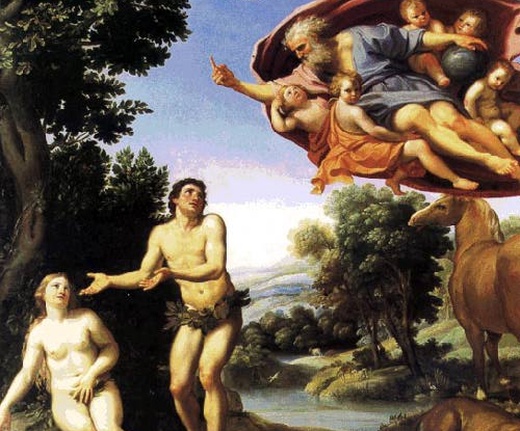
Image above: Detail of "The Rebuke of Adam and Eve" (1626) by Domenico Zampieri (Domenichino), the Italian Baroque era painter. From http://en.wikipedia.org/wiki/Domenichino
 
The agricultural community convened a Forum on April 4 to network, revisit past agricultural plans, and begin to identify priority goals and actions. Following a panel discussion of local agricultural leaders and a group brainstorm of the many challenges facing agriculture, break-out groups organized in eleven sectors to identify priority goals.

The goals identified are listed below, and a complete record of forum notes, including all input on challenges and goals, is available online at KauaiAgriculturalForum.Org Please use this website to highlight your own group or project and to connect with others that are interested in the agricultural future of the island. The purpose of the Forum is to support existing groups and blossom new initiatives through networking, collaboration, and planning. This is a community effort, and all are welcome to participate.

Available online now are past agricultural plans and other important documents, notes from the April 4 Forum, networking and blogging tools, a listing of Farmers Markets and CSAs, important links, and information about many existing projects, including contact information to get involved.

The priority goals listed below reflect the diverse opinions and contributions of the many stakeholders that attended the Forum, and additional information will be incorporated into the process of updating the island’s Agricultural Plan. Information from past plans and workshops, industry white papers, agricultural data, and other published literature related to food production on Kaua`i will be compiled to inform a more complete review of the current agricultural situation on the island.

Stakeholder interviews will also contribute significantly to the planning process. Malama Kaua`i has already begun this phase, interviewing over 20 farmers on the North Shore, as well as restaurateurs, grocers, and others involved in the local food chain. A summary of findings so far is available online.

The purpose of compiling information and conducting interviews is not to create “another” plan that is difficult to implement. The goals of this process are to:

1. Identify and prioritize strategic goals for increasing food production on Kaua`i.
2. Outline projects, initiatives, and groups whose efforts contribute to meeting strategic goals, as well as “leverage points” where action is needed.

3. Enhance communication and networking opportunities among the projects, initiatives, and groups within the agricultural community.

4. Develop a means for individuals to access reliable information online and get involved with existing projects, initiatives, and groups.
5. Catalyze action based on reliable information in the private sector, from the grassroots community level, and from policy-makers.
Mahalo to all of the sponsors that made the Kaua`i Agricultural Forum on April 4 possible, including Common Ground, County of Kaua`i – Office of Economic Development, Garden Island Resource Conservation and Development, Mālama Kaua`i, Permaculture Kaua`i, and Rapozo Kama`āina Fund. Special thanks to Sandy Hernon, Your Chef On Kaua`i, and her team of volunteers, as well as the many farmers that contributed to a delicious all-local lunch.

Strategic Goals Identified by Working Groups
*These goals were provided by working groups, and do not necessarily reflect theviews and opinions of event organizers or other participants. They are not listedby priority.**Goals may overlap. Sectors will be more clearly defined in subsequent planning documents.

Action-Step Categories
To better understand what the next steps to realizing each goal are, they have been assigned one or more action categories. This is an imperfect system, and is simply a tool to begin to understand what next steps are needed. Nothing noted here is determinate.

ABBREVIATION APPENDIX FOR FOLLOWING MATERIAL
Policy County (PC) – Primary action involves county level policy change.
Policy State (PS) – Primary action involves state level policy change.
Community Organizing (CO) – Initial steps require organizing. May include establishing committees or groups, gathering stakeholders, creating better communication channels, or increasing community support for existing projects.
Infrastructure (IN) – Primary action requires major infrastructural changes or improvements.
Business Opportunity (BO) – Private sector opportunities exist.
Research (R) – Initial steps require that research be conducted (does not include changes in research institutions).
Education (E) – Involves general public education and awareness-raising (does not include systematic changes in educational institutions – see IC).
Institutional Change (IC) – Meeting this goal requires changes to an institution, such as Educational and Research Institutions or Financial Institutions. Willing Workers on Organic Farms (WWOOF) - Informal volunteer, apprentice, and internship arrangement to provide workers in alternative food production. [Added by Editor].

WATER
Priority goals:
1) Upgrade and maintain important irrigation systems. (IC, PS, PC)

2) Support existing and establish new watershed councils with local control, funding, and resources (adopt Oregon State Law). (PS, PC, CO)

3) Initiate a Water Kuleana Rights Summit (precluded by a task force to identify and unify agencies, stakeholders, landowners, councils, and their rights and responsibilities). (CO)

4) Initiate (and pass) a water conservation and restoration legislative package; include grey water, composting toilets, water catchment, ditch system restoration, water quality, no petroleum dependence for water delivery. (PS, PC)

5) Education: call for action – all persons should attend at least one watershed council meeting. (E)

6) Determine the island’s and each watershed’s “carrying capacity”. (R)

LAND
Priority Goals:
1) Protect and preserve best agricultural lands, and use the Important Agricultural Lands Study as a vehicle to compile data, engage the community, and revisit laws based on identified goals. (PC, PS)

2) Increase land access and availability by creating an ad hoc committee to identify potential areas for ag parks, community gardens, demonstration sites, and agro forestry. Incorporate a land acquisition discussion including private, state and county land-holders, and potential benefits (tax breaks, functioning watershed, ecosystem health). (CO)

3) Soil restoration and erosion control with a focus on locally-produced inputs. (E, BO)

LABOR
Priority Goals:
1) Formulate parameters and definitions for worker housing and pass necessary legislation (bringing down cost of living for farm workers). (PC)

2) Create training programs for new farmers and scholarship / subsidized tuition opportunities for these programs. (IC)

3) Establish islandwide WWOOF (or similar program) – network with national and international models that make labor more available and affordable. (CO)

4) Involve, educate, and motivate young people. (Also need to assist them with start-up funds / land). (E, IC, CO)

CAPITAL / FINANCING
Priority Goals:
1) Create a local investment opportunity office: (BO)
• Look for talent
• Look for investors
• Link to for or expand enterprises
2) Expand technical assistance for grant and loan applications, business plans and creative financing. (IC)

3) Identify how much money is needed to fund a sustainable agricultural system. (R)

4) Put pressure on banks to provide more funding for ag. (IC)

CROPS / COMMODITIES
Priority Goals:
1) Increase crop research on new and existing crops, including demonstration projects, crop potential studies, and cost of production analyses. Communication barriers between farmers and universities / research institutions need to be overcome for research to be executed properly. (IC, R)

2) Support and expand seed saving efforts, including seed exchanges, seed banks, and education. (CO, BO)

3) Increase research for small-scale and diversified ag. (IC, R)

4) Develop a local feed system (crop) for livestock. (BO, R, IN)

5) Demonstrate integrated systems – plants, animals and aquaculture. (E)

6) Secure on-island resources for inputs. (BO, R)

7) Increase research on and production of Hawaiian and Pacific Island crops. (IC, R, BO)

MARKETING
Priority Goals:
1) Branding and education / promotion: (CO, E)• Enhance “Kaua`i Grown” and other local-product awareness programs
• Use County Farm Fair to educate the public
• Increase usage of print media
• Create public service announcements and utilize other media outlets.
2) Establish a clear market management and business training program. (IC)

3) Connect farmers to the web and technology. (E)

4) Farm tours and other eco/ag-tourism. (BO)

DISTRIBUTION
Priority Goals:

1) Develop facilities for treatment, processing, packing, and distribution, including: (IN, BO, R)
• Slaughter house
• Dehydration facility
• Papaya de-infestation plant
• Pasteurization; community commercial kitchens; mobile processing
2) Establish cooperative efforts / resource for: (CO, BO)
• Shipping, transportation, marketing, insurance / bonds
• Labor, H2O, equipment, inputs, advertising, financial processing, health insurance, directories, bulk purchasing
• Coordinating marketing and distribution
3) Establish a permanent Farmers Market. (CO)

4) Hold an annual Barter Fair. (CO)5) Develop a “one-stop-shop” ag economic web tool with Craigslist functionality. (CO)

PESTS / DISEASE / INVASIVE SPECIES
Priority Goals:

1) Tap into existing infrastructure (under KISS) to create a task force for ag, similar to what the landscape community has been doing. (CO)

2) Prevention: (E, PS)
• Focus on buying local / producing locally
• Discourage imports and introductions
• Increase inspections (importers pay for inspections)
• Empower and educate farmers to prevent the spread of invasives through self-regulation and best management practice.
3) Management: (PS, E, CO)
• Support and secure funding for invasive species management on Kaua`i through coordinated effort of stakeholders / existing programs
• Establish farmer’s pledge program to prevent invasives
• Distribute and produce maps and materials specific to agricultural pests on Kaua`i (interactive online database)• Establish a position for a Kaua`i county environmental and ag liaison.

4) Education: (E)
• Link buy local / Kaua`i-made campaign to invasive species prevention messages
• Provide ahupua`a based integrated pest management workshops for farmers and backyard gardeners
• Incorporate invasive species info into all ag education programs and events.
5) Early Detection: (CO, E)
• Establish communication network for reporting and rapid response specific to farming community
• Train farmers in early detection to identify priority species• Provide pest alerts as outbreaks occur that reach out to ag community.
WASTE / RESOURCE STREAM
Priority goals:
1) Recycle / Compost all organic waste (ban organics from the landfill). An integrated solution for Ag Industry, Businesses and Resorts, and Residents. (PC, IN, E, BO)
2) Develop decentralized, community based waste / resource management facilities (regeneration stations) to close the loop for neighborhoods, community gardens and small farms. (PC, IN, CO)

3) Utilize bio-remediation to manage difficult / high impact materials (petroleum based hazardous waste, biosolids, food process waste, etc.). (E, PC)

4) Develop a recycling / re-manufacturing facility to produce local building materials out of the applicable resins and recycle anything else. (IN)

5) Develop cooperative programs to provide organic waste as a feedstock for cattle and other livestock, and to utilize livestock to assist farmers in land clearing and land management efforts. (CO, BO)

6) Increase the use of composting worms and small-scale vermicomposting. (E)

RESEARCH AND EDUCATION
Priority goals:
1) Enhance K-12 educational programs: seed to table, ag in the classrooms, health and nutrition: (IC, E)
• After school programs and summer camps
• Experiential learning – school gardens, field trips to farms, farmers as teachers
• Integration of curriculum (ex – aquaculture as a life science topic).
2) Establish more opportunities for farmer training (including business training) and ongoing technical support and financing. (IC)

3) Public education and community outreach on the health and economic benefits of backyard gardening. (E)

4) Integrate different systems of knowledge into research and education – cultural knowledge is foundational. (IC)

LEGISLATIVE OBJECTIVES
Immediate Priority Goals:
1) Create citizen advisory council for Important Ag Lands project / study. (PC, CO)
2) Educate Department of Health officials on the safety of sustainable technologies such as composting, grey-water, and value-added processing. (E, PS)
3) Ensure the passage of a strong Farm Worker Housing bill. (PC)

General Priorities:
 1) Planning / Zoning
• Important ag lands study (farmers input needed) (PC)
• Update CZO (PC)
• Sustainable overlay (follow model established by Canada) (PS, PC)
•Moratorium on subdividing ag lands (PC)
• Enforce farm dwelling agreement (PC)
2) Health
• Greywater recycling (PS, PC)• Composting toilets (PS, PC)
• Water catchment (PS, PC)
• Allow for the sale of Value-Added foods at Sunshine Farmers Markets (PC)
3) Building
• Local building materials (PS, PC)
• Green building (PS, PC)• Farm worker housing (PC)4) Fiscal
• Tax policies (5 acre min for ag dedication) (PS, PC)
• Violation money – support ag (PS, PC)
• GE tax exemptions for “locally grown” (PS)
*COMMUNITY AND HOME GARDENING
1) To provide training to individuals, families and neighborhood/community organizations or businesses interested in learning the skills essential to prepare and manage a home or neighborhood garden.
2) To render such technical assistance as is essential in supporting the successful development and expansion of home and neighborhood gardens into an island-wide network of food production and distribution operations.
3) To recruit and employ successful farmers as the instructional staff of the Community Gardens Project and provide them with the training and support needed to render both instructional services and on-going technical support to the expanding network of community gardens.
4) To continue promoting, expanding and supporting the expansion of this gardening network into a viable supply of locally grown food of all kinds and varieties as a means of gradually achieving a suitable level of food self-sufficiency for Kauai's residents, businesses and visitors.
5) To develop such additional programs and projects as needed to support the educational, research, business and financial development of the Community Gardens Project as a major component in contributing to the sustainable of Kauai's treasured rural lifestyle.
* These goals are provided by the Community Gardens Project, sponsored by Kauai Community College and the Kauai Food Industry Forum, as many participants expressed the need to incorporate a sector specifically on Gardens. There was no break-out group at the April 4 Forum for this section.

Scaffold for Social Change

SUBHEAD: We have to care about whats happeningour world to do something about it. its an inner process everyone must go through.
By Daniel Pinchbeck on 10 April 2009 in Conscious Choice http://consciouschoice.com/2009/04/pinchbeck0904.html Image above: Chip Monk directed putting together the scaffolding for the Woodstock music festival in 1969 For the most part, the mainstream media and federal government still treat the economic collapse as something that can be fixed, so that economic growth can resume in a few years. But some commentators are beginning to realize that our meltdown represents a deeper and more permanent paradigm shift. The physical environment can no longer withstand the assaults of our industrial culture. We are experiencing a termination of capitalism as we have known it, a shutdown that was recently dubbed “The Great Disruption” by The New York Times' Thomas Friedman. Until recently a leading cheerleader for Neo-Liberal globalization, Friedman has come to the late realization: “that the whole growth model we created over the last 50 years is simply unsustainable economically and ecologically and that 2008 was when we hit the wall.” The longer the general population is allowed to remain in denial about what is happening, the more dire the probable consequences, such as widespread famine, civil unrest and a disintegration of basic services. The truth is that we need to make a deep and rapid change in our current social systems and in the underlying models and ideals of our society. It is highly unlikely that those who have been part of the power structure, whether within government or the mainstream media, possess the necessary will, vision or inspiration to make this happen. Also, when we consider their self-serving support for a delusional model of infinite growth on a finite planet, ignoring all evidence to the contrary, our mainstream pundits and politicos have clearly forfeited any claim to authority, and should never be trusted again. Many elements of an alternative paradigm, a participatory model in which power is restored to local communities, have been developed over the last decades. In previous columns, I have discussed the “Transition Town” model from the UK as a foundation to help communities move toward resilience and self-reliance. Extraordinary initiatives are presented annually at the Bioneers Conference, and their website maintains an archive of these projects, from bioremediation to complementary currencies, that could be rapidly scaled up if the collective will is mobilized. The nonprofit organization Pro Natura has developed an alfalfa leaf extract that can fulfill a person’s annual nutritive needs for a negligible sum — and many other innovators and activists are holding crucial pieces of the new puzzle we need to assemble quickly. What blocks real efforts at social transformation is the current level of human consciousness. The Italian political philosopher Antonio Negri has noted that the most important form of production in our post-industrial culture is the “production of subjectivity” — our media and education systems have mechanically imprinted a certain level of awareness onto the masses, a passive, consumer consciousness. People have not been encouraged to think or to act for themselves. Now, their very survival may depend upon learning these unfamiliar skills. Since I comprehended the full depth of the crisis heading our way, I have been working with friends and collaborators to envision and enact solutions. We saw the need for an alternative social network and media that could integrate many aspects of the new paradigm while providing a scaffold for a large-scale process of social transformation. Facebook and MySpace have shown the extraordinary power of social networks to reach an enormous audience, but they have mainly provided a place for people to display and distract themselves in new ways. Most popular social networks are designed to support what media critic Thomas de Zengotita has called the “flattered self,” constantly craving attention. The main purpose of these networks is to make a profit for large corporations. We have just launched Evolver.net, an independent social network, built on open-source software that is designed to support collaboration between individuals and groups and to engage people in the process of transforming their own consciousness and their local communities. While we still use many of the standard social networking tools, we have shifted the focus to members’ mission and projects. We have also created an internal rating system for members to vote on the initiatives presented by other members, so that the best ideas in every area will rise to the top and gain more attention. Our plan is to facilitate a network of local groups, across the U.S. and eventually globally, that meet in person and engage in immediate actions to change their world. Years ago, Barbara Marx Hubbard wrote, “If the positive innovations connect exponentially before the massive breakdowns reinforce one another, the system can repattern itself to a higher order of consciousness and freedom without the predicted economic, environmental, or social collapse.” We are quickly approaching the critical threshold where breakdown or breakthrough becomes inevitable. I don’t know if Evolver will reach mass popularity as a tool to bring about this repatterning. Of course, I hope this is the case. In the guise of a for-profit company, we have sought to create something akin to a social utility. At a turbulent time when nobody knows what is going to happen next, it feels good, at least, to have launched something into the world that can help the process of transformation. see also: Island Breath: The End is Near! 4/20/09 Island Breath: Premature Triumphalism 11/21/08