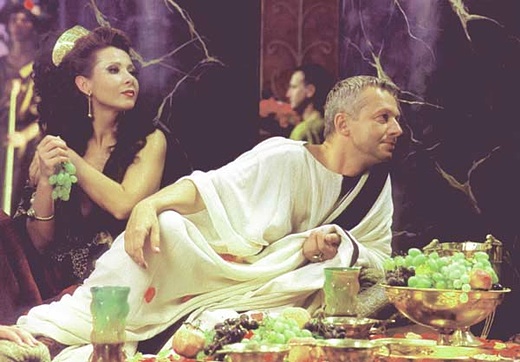
image above: Still from 1938 film "Robin Hood" starring Errol Flynn from http://thisdistractedglobe.com/2007/03/27/the-adventures-of-robin-hood-1938
Hence, the time is ripe to reconsider the institutional structure and moral assumptions of American capitalism, from the bottom up. While Obama's advisers are likely to exercise better judgment than the free market ideologues who have run the show in recent years, progressives should not count on people like Larry Summers and Timothy Geithner, establishment figures with deep ties to the corporate establishment, to address the deeper questions. They may have the technical expertise to contain the fire and calm the markets down, but they are not going to push for a fundamentally new set of economic priorities.
Already the $819 billion stimulus package the administration aimed to push through Congress in its first month has been criticized for relying too much on tax cuts and lacking an overarching vision for its public investment components. Other liberal economists believe that the scale of the stimulus package, while huge, is still inadequate to the task at hand. In the meantime, questions about whether (or when) the federal government will pursue nationalization of banks grow louder with every passing week. And still others question whether Obama's goal must be not simply ramping up the economic growth machine again but moving toward a different kind of economy, an economy that places human needs, respect for community, and ecological sustainability ahead of GDP growth.
Obama's Inaugural Address showed that the president understands the need to move toward new barometers for measuring economic health. Obama flatly stated that we must judge the economy not on its size but on the extent to which it delivers opportunity to all. Obama has also moved to make "green jobs" and energy efficiency a centerpiece of his recovery plan.
Calling for a bold change of direction and actually taking meaningful steps in that direction are two different things, of course. It's up to progressive social movements to take advantage of the historic opportunity the Obama administration represents by pushing for a fundamentally new set of economic priorities. But if spiritual progressives and our allies are to become a credible, forceful voice, we will need to pay close attention to the hard-headed realities of how our existing system works (and fails to work), and to directly challenge dominant ideologies justifying the status quo.
Fortunately, three important new books-Joel Magnuson's Mindful Economics; Douglas Hicks and Mark Valeri's edited collection, Global Neighbors; and Gar Alperovitz and Lew Daly's Unjust Deserts-have arrived on the scene to help show the way. Together these books provide a well-timed critique of the fundamentals of our economic system, in each case connecting the critiques explicitly to ethical and in some cases theological conceptions of what makes for a good human life and what makes for a just society.
These books each do what religion does at its best: they break through the dominant economic discourses and provide an alternative way of viewing social reality. They then describe measures for improving our economic system that would help much more than corporate bailouts.
To Get Good Government, Voters MUST Understand Economics-So Read This Book
Much discussion of economic policy is wrapped-arguably quite deliberately-in a shroud of mystery. When former Treasury Secretary Henry Paulson forcefully demanded that Congress approve a $750 billion bailout this past September, the strongest argument offered was "because we say so." Few members of Congress, let alone ordinary citizens, were equipped to understand in any level of detail either the causes of the financial crisis or the nature of the institutions involved in the crisis and subsequent bailout.
There is no hope of holding political elites (be they Republican or Democrat) accountable on economic policy if ordinary citizens do not understand the nature of the institutions governing American capitalism...
...If it turns out that little of what the wealthy control now is attributable to individual effort, how can large fortunes such as that accumulated by Bill Gates be justified? Alperovitz and Daly argue that they can't. To be sure, there is a pragmatic case for continuing to permit patents and for providing other incentives to stimulate further research and creative activity. But we must reject the idea that the person who happens to add the last increment of value to a vast, collective creation produced over many generations is thereby entitled to the whole.
If we were to take seriously the reality that our affluence is primarily the result of the accumulated knowledge and capital of the past and not our personal efforts, we would be forced to reject the assumption that the highly unequal distribution of wealth we witness both nationally and globally are in any way the byproduct of just economic arrangements. (Importantly, recognizing this point does not require abandoning the moral intuition that there should be some connection between economic reward and effort.) Those who claim a disproportionate, lion's share of economic wealth are not simply claiming their just deserts; rather, they are usurping the common inheritance of humanity, while excluding the vast majority of the national and world populations from a fair share of that inheritance.
Alperovitz and Daly thus (like Magnuson) call for a fundamental rethinking of how wealth is distributed, and for developing new forms of ownership that are democratic and that "spread the wealth around," as Barack Obama has put it. Alperovitz and Daly's argumentation and practical proposals offer progressives a chance, after a generation of playing defense, to again assume the initiative in challenging the grotesque distribution of wealth and resources and explaining why, not as a matter of charity or expedience but of moral desert, wealth should indeed be spread around.
A Moral Argument Obama Will Have to Use
Note also that the logic of the tight constraints facing Obama as he assumes the presidency will almost certainly force Obama in this direction: if the resources needed to carry out health care reform and other expensive proposals are to be garnered, the natural place to start is with the incomes and estates of the super-rich. But Obama will not be able to tap that vast well of resources too often so long as he appeals only to pragmatic arguments to explain why.
At some point, he must exercise the same kind of leadership he carried out with respect to America's racial divide during the primary campaign, and explain to the American people that the vast fortunes accumulated by America's wealthiest are not the product so much of their holder's individual virtues but of the supportive environment provided by the United States and by the long accumulation of human knowledge that undergirds our current wealth. There is no reason, Obama might argue, why continued expansion of our technological capacities should have the effect of hardening economic inequalities, rather than being harnessed toward the common good and (as called for in his Inaugural Address) the extension of "the reach of our prosperity" to "every willing heart."
The very rich will not like it, and the right wing will predictably cry "socialism." But a President Obama willing to withstand the criticism and make the case would not only bolster his prospects for getting the resources needed to fund his programs; it would also help alter our public understanding of wealth and how it is created, steering us away from the myth that individuals create wealth simply through their individual efforts and toward recognition of the central role of community, extending across both time and space, in making prosperity possible.
Rethinking American Capitalism
SUBHEAD: A moral argument Obama will have to use.
By Thad Williamson on 20 March 2009 in Tikkun Magazine
http://www.tikkun.org/article.php/mar09_williamson
[Editor's Note: This is a excerpt from the beginning and ending of this article. Click on link above for full article.]
Barack Obama ascends to the presidency in the midst of the most severe crisis American capitalism has faced since the Great Depression. Resolving that crisis will almost certainly require dramatic public action on a scale not seen since the 1930s. But dramatic action that fails to address the fundamental structural issues driving the crisis-and in particular the generation-long trend toward rapidly growing inequality-is unlikely to be successful.
INDEX:
Economics,
Politics,
Spirituality
The Big Takeover
SUBHEAD: How Wall Street insiders are using the bailout to stage a revolution.
By Matt Taibbi on 20 March 2009 in RolloingStone
[Editor's note: Please, click above to read all of this lengthy article at its source.]
It's over — we're officially, royally fucked. no empire can survive being rendered a permanent laughingstock, which is what happened as of a few weeks ago, when the buffoons who have been running things in this country finally went one step too far. It happened when Treasury Secretary Timothy Geithner was forced to admit that he was once again going to have to stuff billions of taxpayer dollars into a dying insurance giant called AIG, itself a profound symbol of our national decline — a corporation that got rich insuring the concrete and steel of American industry in the country's heyday, only to destroy itself chasing phantom fortunes at the Wall Street card tables, like a dissolute nobleman gambling away the family estate in the waning days of the British Empire.
image above: Famous 1903 photograph of J. P. Morgan by Edward Steiglitz seemingly holding a knife and not a chair arm.
The latest bailout came as AIG admitted to having just posted the largest quarterly loss in American corporate history — some $61.7 billion. In the final three months of last year, the company lost more than $27 million every hour. That's $465,000 a minute, a yearly income for a median American household every six seconds, roughly $7,750 a second. And all this happened at the end of eight straight years that America devoted to frantically chasing the shadow of a terrorist threat to no avail, eight years spent stopping every citizen at every airport to search every purse, bag, crotch and briefcase for juice boxes and explosive tubes of toothpaste. Yet in the end, our government had no mechanism for searching the balance sheets of companies that held life-or-death power over our society and was unable to spot holes in the national economy the size of Libya (whose entire GDP last year was smaller than AIG's 2008 losses).
So it's time to admit it: We're fools, protagonists in a kind of gruesome comedy about the marriage of greed and stupidity. And the worst part about it is that we're still in denial — we still think this is some kind of unfortunate accident, not something that was created by the group of psychopaths on Wall Street whom we allowed to gang-rape the American Dream. When Geithner announced the new $30 billion bailout, the party line was that poor AIG was just a victim of a lot of shitty luck — bad year for business, you know, what with the financial crisis and all. Edward Liddy, the company's CEO, actually compared it to catching a cold: "The marketplace is a pretty crummy place to be right now," he said. "When the world catches pneumonia, we get it too." In a pathetic attempt at name-dropping, he even whined that AIG was being "consumed by the same issues that are driving house prices down and 401K statements down and Warren Buffet's investment portfolio down."
Liddy made AIG sound like an orphan begging in a soup line, hungry and sick from being left out in someone else's financial weather. He conveniently forgot to mention that AIG had spent more than a decade systematically scheming to evade U.S. and international regulators, or that one of the causes of its "pneumonia" was making colossal, world-sinking $500 billion bets with money it didn't have, in a toxic and completely unregulated derivatives market.
Nor did anyone mention that when AIG finally got up from its seat at the Wall Street casino, broke and busted in the afterdawn light, it owed money all over town — and that a huge chunk of your taxpayer dollars in this particular bailout scam will be going to pay off the other high rollers at its table. Or that this was a casino unique among all casinos, one where middle-class taxpayers cover the bets of billionaires.
People are pissed off about this financial crisis, and about this bailout, but they're not pissed off enough. The reality is that the worldwide economic meltdown and the bailout that followed were together a kind of revolution, a coup d'état. They cemented and formalized a political trend that has been snowballing for decades: the gradual takeover of the government by a small class of connected insiders, who used money to control elections, buy influence and systematically weaken financial regulations.
The crisis was the coup de grâce: Given virtually free rein over the economy, these same insiders first wrecked the financial world, then cunningly granted themselves nearly unlimited emergency powers to clean up their own mess. And so the gambling-addict leaders of companies like AIG end up not penniless and in jail, but with an Alien-style death grip on the Treasury and the Federal Reserve — "our partners in the government," as Liddy put it with a shockingly casual matter-of-factness after the most recent bailout.
The mistake most people make in looking at the financial crisis is thinking of it in terms of money, a habit that might lead you to look at the unfolding mess as a huge bonus-killing downer for the Wall Street class. But if you look at it in purely Machiavellian terms, what you see is a colossal power grab that threatens to turn the federal government into a kind of giant Enron — a huge, impenetrable black box filled with self-dealing insiders whose scheme is the securing of individual profits at the expense of an ocean of unwitting involuntary shareholders, previously known as taxpayers.
I. PATIENT ZERO
The best way to understand the financial crisis is to understand the meltdown at AIG. AIG is what happens when short, bald managers of otherwise boring financial bureaucracies start seeing Brad Pitt in the mirror. This is a company that built a giant fortune across more than a century by betting on safety-conscious policyholders — people who wear seat belts and build houses on high ground — and then blew it all in a year or two by turning their entire balance sheet over to a guy who acted like making huge bets with other people's money would make his dick bigger.
That guy — the Patient Zero of the global economic meltdown — was one Joseph Cassano, the head of a tiny, 400-person unit within the company called AIG Financial Products, or AIGFP. Cassano, a pudgy, balding Brooklyn College grad with beady eyes and way too much forehead, cut his teeth in the Eighties working for Mike Milken, the granddaddy of modern Wall Street debt alchemists. Milken, who pioneered the creative use of junk bonds, relied on messianic genius and a whole array of insider schemes to evade detection while wreaking financial disaster. Cassano, by contrast, was just a greedy little turd with a knack for selective accounting who ran his scam right out in the open, thanks to Washington's deregulation of the Wall Street casino. "It's all about the regulatory environment," says a government source involved with the AIG bailout. "These guys look for holes in the system, for ways they can do trades without government interference. Whatever is unregulated, all the action is going to pile into that."
The mess Cassano created had its roots in an investment boom fueled in part by a relatively new type of financial instrument called a collateralized-debt obligation. A CDO is like a box full of diced-up assets. They can be anything: mortgages, corporate loans, aircraft loans, credit-card loans, even other CDOs. So as X mortgage holder pays his bill, and Y corporate debtor pays his bill, and Z credit-card debtor pays his bill, money flows into the box.
The key idea behind a CDO is that there will always be at least some money in the box, regardless of how dicey the individual assets inside it are. No matter how you look at a single unemployed ex-con trying to pay the note on a six-bedroom house, he looks like a bad investment. But dump his loan in a box with a smorgasbord of auto loans, credit-card debt, corporate bonds and other crap, and you can be reasonably sure that somebody is going to pay up. Say $100 is supposed to come into the box every month. Even in an apocalypse, when $90 in payments might default, you'll still get $10. What the inventors of the CDO did is divide up the box into groups of investors and put that $10 into its own level, or "tranche." They then convinced ratings agencies like Moody's and S&P to give that top tranche the highest AAA rating — meaning it has close to zero credit risk.
Suddenly, thanks to this financial seal of approval, banks had a way to turn their shittiest mortgages and other financial waste into investment-grade paper and sell them to institutional investors like pensions and insurance companies, which were forced by regulators to keep their portfolios as safe as possible. Because CDOs offered higher rates of return than truly safe products like Treasury bills, it was a win-win: Banks made a fortune selling CDOs, and big investors made much more holding them.
The problem was, none of this was based on reality. "The banks knew they were selling crap," says a London-based trader from one of the bailed-out companies. To get AAA ratings, the CDOs relied not on their actual underlying assets but on crazy mathematical formulas that the banks cooked up to make the investments look safer than they really were. "They had some back room somewhere where a bunch of Indian guys who'd been doing nothing but math for God knows how many years would come up with some kind of model saying that this or that combination of debtors would only default once every 10,000 years," says one young trader who sold CDOs for a major investment bank. "It was nuts."
Now that even the crappiest mortgages could be sold to conservative investors, the CDOs spurred a massive explosion of irresponsible and predatory lending. In fact, there was such a crush to underwrite CDOs that it became hard to find enough subprime mortgages — read: enough unemployed meth dealers willing to buy million-dollar homes for no money down — to fill them all. As banks and investors of all kinds took on more and more in CDOs and similar instruments, they needed some way to hedge their massive bets — some kind of insurance policy, in case the housing bubble burst and all that debt went south at the same time. This was particularly true for investment banks, many of which got stuck holding or "warehousing" CDOs when they wrote more than they could sell. And that's were Joe Cassano came in.
Known for his boldness and arrogance, Cassano took over as chief of AIGFP in 2001. He was the favorite of Maurice "Hank" Greenberg, the head of AIG, who admired the younger man's hard-driving ways, even if neither he nor his successors fully understood exactly what it was that Cassano did. According to a source familiar with AIG's internal operations, Cassano basically told senior management, "You know insurance, I know investments, so you do what you do, and I'll do what I do — leave me alone." Given a free hand within the company, Cassano set out from his offices in London to sell a lucrative form of "insurance" to all those investors holding lots of CDOs. His tool of choice was another new financial instrument known as a credit-default swap, or CDS.
The CDS was popularized by J.P. Morgan, in particular by a group of young, creative bankers who would later become known as the "Morgan Mafia," as many of them would go on to assume influential positions in the finance world. In 1994, in between booze and games of tennis at a resort in Boca Raton, Florida, the Morgan gang plotted a way to help boost the bank's returns. One of their goals was to find a way to lend more money, while working around regulations that required them to keep a set amount of cash in reserve to back those loans. What they came up with was an early version of the credit-default swap.
In its simplest form, a CDS is just a bet on an outcome. Say Bank A writes a million-dollar mortgage to the Pope for a town house in the West Village. Bank A wants to hedge its mortgage risk in case the Pope can't make his monthly payments, so it buys CDS protection from Bank B, wherein it agrees to pay Bank B a premium of $1,000 a month for five years. In return, Bank B agrees to pay Bank A the full million-dollar value of the Pope's mortgage if he defaults. In theory, Bank A is covered if the Pope goes on a meth binge and loses his job.
When Morgan presented their plans for credit swaps to regulators in the late Nineties, they argued that if they bought CDS protection for enough of the investments in their portfolio, they had effectively moved the risk off their books. Therefore, they argued, they should be allowed to lend more, without keeping more cash in reserve. A whole host of regulators — from the Federal Reserve to the Office of the Comptroller of the Currency — accepted the argument, and Morgan was allowed to put more money on the street.
What Cassano did was to transform the credit swaps that Morgan popularized into the world's largest bet on the housing boom. In theory, at least, there's nothing wrong with buying a CDS to insure your investments. Investors paid a premium to AIGFP, and in return the company promised to pick up the tab if the mortgage-backed CDOs went bust. But as Cassano went on a selling spree, the deals he made differed from traditional insurance in several significant ways. First, the party selling CDS protection didn't have to post any money upfront. When a $100 corporate bond is sold, for example, someone has to show 100 actual dollars. But when you sell a $100 CDS guarantee, you don't have to show a dime. So Cassano could sell investment banks billions in guarantees without having any single asset to back it up.
Secondly, Cassano was selling so-called "naked" CDS deals. In a "naked" CDS, neither party actually holds the underlying loan. In other words, Bank B not only sells CDS protection to Bank A for its mortgage on the Pope — it turns around and sells protection to Bank C for the very same mortgage. This could go on ad nauseam: You could have Banks D through Z also betting on Bank A's mortgage. Unlike traditional insurance, Cassano was offering investors an opportunity to bet that someone else's house would burn down, or take out a term life policy on the guy with AIDS down the street. It was no different from gambling, the Wall Street version of a bunch of frat brothers betting on Jay Feely to make a field goal. Cassano was taking book for every bank that bet short on the housing market, but he didn't have the cash to pay off if the kick went wide.
In a span of only seven years, Cassano sold some $500 billion worth of CDS protection, with at least $64 billion of that tied to the subprime mortgage market. AIG didn't have even a fraction of that amount of cash on hand to cover its bets, but neither did it expect it would ever need any reserves. So long as defaults on the underlying securities remained a highly unlikely proposition, AIG was essentially collecting huge and steadily climbing premiums by selling insurance for the disaster it thought would never come.
Initially, at least, the revenues were enormous: AIGFP's returns went from $737 million in 1999 to $3.2 billion in 2005. Over the past seven years, the subsidiary's 400 employees were paid a total of $3.5 billion; Cassano himself pocketed at least $280 million in compensation. Everyone made their money — and then it all went to shit.
II. THE REGULATORS
Cassano's outrageous gamble wouldn't have been possible had he not had the good fortune to take over AIGFP just as Sen. Phil Gramm — a grinning, laissez-faire ideologue from Texas — had finished engineering the most dramatic deregulation of the financial industry since Emperor Hien Tsung invented paper money in 806 A.D. For years, Washington had kept a watchful eye on the nation's banks. Ever since the Great Depression, commercial banks — those that kept money on deposit for individuals and businesses — had not been allowed to double as investment banks, which raise money by issuing and selling securities. The Glass-Steagall Act, passed during the Depression, also prevented banks of any kind from getting into the insurance business.
But in the late Nineties, a few years before Cassano took over AIGFP, all that changed. The Democrats, tired of getting slaughtered in the fundraising arena by Republicans, decided to throw off their old reliance on unions and interest groups and become more "business-friendly." Wall Street responded by flooding Washington with money, buying allies in both parties. In the 10-year period beginning in 1998, financial companies spent $1.7 billion on federal campaign contributions and another $3.4 billion on lobbyists. They quickly got what they paid for. In 1999, Gramm co-sponsored a bill that repealed key aspects of the Glass-Steagall Act, smoothing the way for the creation of financial megafirms like Citigroup. The move did away with the built-in protections afforded by smaller banks. In the old days, a local banker knew the people whose loans were on his balance sheet: He wasn't going to give a million-dollar mortgage to a homeless meth addict, since he would have to keep that loan on his books. But a giant merged bank might write that loan and then sell it off to some fool in China, and who cared?
The very next year, Gramm compounded the problem by writing a sweeping new law called the Commodity Futures Modernization Act that made it impossible to regulate credit swaps as either gambling or securities. Commercial banks — which, thanks to Gramm, were now competing directly with investment banks for customers — were driven to buy credit swaps to loosen capital in search of higher yields. "By ruling that credit-default swaps were not gaming and not a security, the way was cleared for the growth of the market," said Eric Dinallo, head of the New York State Insurance Department.
The blanket exemption meant that Joe Cassano could now sell as many CDS contracts as he wanted, building up as huge a position as he wanted, without anyone in government saying a word. "You have to remember, investment banks aren't in the business of making huge directional bets," says the government source involved in the AIG bailout. When investment banks write CDS deals, they hedge them. But insurance companies don't have to hedge. And that's what AIG did. "They just bet massively long on the housing market," says the source. "Billions and billions."
In the biggest joke of all, Cassano's wheeling and dealing was regulated by the Office of Thrift Supervision, an agency that would prove to be defiantly uninterested in keeping watch over his operations. How a behemoth like AIG came to be regulated by the little-known and relatively small OTS is yet another triumph of the deregulatory instinct. Under another law passed in 1999, certain kinds of holding companies could choose the OTS as their regulator, provided they owned one or more thrifts (better known as savings-and-loans). Because the OTS was viewed as more compliant than the Fed or the Securities and Exchange Commission, companies rushed to reclassify themselves as thrifts. In 1999, AIG purchased a thrift in Delaware and managed to get approval for OTS regulation of its entire operation.
Making matters even more hilarious, AIGFP — a London-based subsidiary of an American insurance company — ought to have been regulated by one of Europe's more stringent regulators, like Britain's Financial Services Authority. But the OTS managed to convince the Europeans that it had the muscle to regulate these giant companies. By 2007, the EU had conferred legitimacy to OTS supervision of three mammoth firms — GE, AIG and Ameriprise.
That same year, as the subprime crisis was exploding, the Government Accountability Office criticized the OTS, noting a "disparity between the size of the agency and the diverse firms it oversees." Among other things, the GAO report noted that the entire OTS had only one insurance specialist on staff — and this despite the fact that it was the primary regulator for the world's largest insurer!
"There's this notion that the regulators couldn't do anything to stop AIG," says a government official who was present during the bailout. "That's bullshit. What you have to understand is that these regulators have ultimate power. They can send you a letter and say, 'You don't exist anymore,' and that's basically that. They don't even really need due process. The OTS could have said, 'We're going to pull your charter; we're going to pull your license; we're going to sue you.' And getting sued by your primary regulator is the kiss of death."
When AIG finally blew up, the OTS regulator ostensibly in charge of overseeing the insurance giant — a guy named C.K. Lee — basically admitted that he had blown it. His mistake, Lee said, was that he believed all those credit swaps in Cassano's portfolio were "fairly benign products." Why? Because the company told him so. "The judgment the company was making was that there was no big credit risk," he explained. (Lee now works as Midwest region director of the OTS; the agency declined to make him available for an interview.)
In early March, after the latest bailout of AIG, Treasury Secretary Timothy Geithner took what seemed to be a thinly veiled shot at the OTS, calling AIG a "huge, complex global insurance company attached to a very complicated investment bank/hedge fund that was allowed to build up without any adult supervision." But even without that "adult supervision," AIG might have been OK had it not been for a complete lack of internal controls. For six months before its meltdown, according to insiders, the company had been searching for a full-time chief financial officer and a chief risk-assessment officer, but never got around to hiring either. That meant that the 18th-largest company in the world had no one checking to make sure its balance sheet was safe and no one keeping track of how much cash and assets the firm had on hand. The situation was so bad that when outside consultants were called in a few weeks before the bailout, senior executives were unable to answer even the most basic questions about their company — like, for instance, how much exposure the firm had to the residential-mortgage market...
"But wait a minute," you say to them. "No one ever asked you to stay up all night eight days a week trying to get filthy rich shorting what's left of the American auto industry or selling $600 billion in toxic, irredeemable mortgages to ex-strippers on work release and Taco Bell clerks. Actually, come to think of it, why are we even giving taxpayer money to you people? Why are we not throwing your ass in jail instead?"
But before you even finish saying that, they're rolling their eyes, because You Don't Get It. These people were never about anything except turning money into money, in order to get more money; valueswise they're on par with crack addicts, or obsessive sexual deviants who burgle homes to steal panties. Yet these are the people in whose hands our entire political future now rests.
Good luck with that, America. And enjoy tax season.
INDEX:
Economics,
Government,
Politics
The Mother of all Bells
SUBHEAD: Ben Bernanke cranks up the printing presses.
By Peter Schiff on 20 March 2009 in Financial Sense
There is an old adage on Wall Street that no one rings a bell at major market tops or bottoms. That may be true in normal times, but as many have noticed, we are now completely through the looking glass. In this parallel reality, Ben Bernanke has just rung the loudest bell ever heard in the foreign exchange and government debt markets. Investors who ignore the clanging do so at their own peril. The bell's reverberations will be felt by everyday Americans, whose lives are about to change in ways few can imagine.
image above: The largest bell in Europe in the Koln Dom in Germany. From http://picasaweb.google.com/BlairBRobertson/GermanyDay6#5059566584781996050
While nearly every facet of America's economy has been devastated over the past six months, our national currency has thus far skipped through the carnage with nary a scratch. Ironically, the U.S dollar has been the beneficiary of the global economic crises which the United States set in motion. As a result, our economy has thus far been spared the full force of the storm.
This week the Federal Reserve finally made clear what should have been obvious for some time - the only weapon that the Fed is willing to use to fight the economic downturn is a continuing torrent of pure, undiluted, inflation. The announcement should be seen as a game changer that redirects the fury of the financial storm directly onto our shores.
In its statement, the Fed announced its intention to purchase an additional $1 trillion worth of U.S. treasury and agency debt. The purchases, of course, will be made with money created out of thin air through the Fed's printing presses. Few can doubt that they will persist with these operations until the economy returns to its former health. Whether or not this can ever be accomplished with a printing press alone has never been seriously considered. Bernanke himself admits that we are in uncharted waters, with no map or compass, just simply a hope that more dollars are the answer.
Rather than solving our problems, more inflation will only add to the crisis. Falling asset prices, the credit crunch, declining consumer spending, bankruptcies, foreclosures, and layoffs are all part of the necessary rebalancing of our economy. These wrenching movements, however painful, are the market's attempts to resolve the serious problems at the root of our bubble economy. Attempts to literally paper-over these problems will lead to disaster.
Now that the Fed has recklessly shown its hand, the mad dash to get out of Treasuries and dollars should not be far off. The more the Fed prints to buy bonds the less the dollar is worth. Holders of our debt (read China and Japan) understand this dynamic. We must expect that they will not only refuse to buy new bonds, but they will look to unload those bonds they already own.
Under normal circumstances, if creditors grew concerned that inflation was eating into their returns, the Fed would raise interest rates to entice them to buy. However, the Fed will avoid this course of action as it fears higher rates are too heavy a burden for our debt laden economy to bear. To maintain artificially low rates, the Fed will be forced to purchase trillions more debt then it expects as it becomes the only buyer in a seller's market.
Just last week, Chinese premier Wen Jiabao voiced concern about his country's massive investments in U.S. government debt. In the most unequivocal statement yet by the Chinese leadership on this issue, Wen made it plain that he was concerned with depreciation, not default. With his fears now officially confirmed by the Fed statement, we must wonder when the Chinese will finally change course.
There is a growing consensus that if China no longer wants to buy our bonds, we can simply print the money and buy them ourselves. This naïve view fails to consider the consequences implicit in such a change. When the Treasury sells bonds to China, no new dollars are printed. Instead, China prints yuan which it then uses to buy treasurers. This effectively allows America to export its inflation to China. However, now that we will be printing the money ourselves, the full inflationary impact will fall directly on us.
With such a policy in place, America has now become a banana republic. It won't be too long before our living standards reflect our new status. Got Gold?
INDEX:
Economics,
Government
Nawiliwili No-Superferry Party
SUBHEAD: A pot-luck, community get-together, party - to mourn the passing of HSF
SOURCE: Rich Hoeppner, richoep@aloha.net
Hurray! The Superferry is pau... maki pau. Let's come together Sunday in Nawiliwili Harbor. Bring a pot-luck plate, your musical instruments and anything else you might need to have a good time with friends.
image above: One year anniversary "Jam the Harbor" party in Nawiliwili Harbor on 24 August 2008.
Photo by Juan Wilson
WHAT:
Community Celebration of Superferry-Free Kauai
WHERE:
Nawiliwili County Park
Near Pier One (ex-Superferry landing)
WHEN:
Sunday, March 22, 2009 - From 3:00 to 5:00pm
Note: This scheduled time was our error. The right time was Noon - 3:00pm
We arrived at 4:00pm and the event was still ongoing, none the less.
CONTACT:
Rich Hoeppner
phone: 808-639-1954
email: richoep@aloha.net
see also:
Island Breath: Nawiliwili Ti Party 11/3/07
INDEX:
Celebration,
Community,
Superferry
White House Vegetable Garden
SUBHEAD: Obama's planned garden is a victory for victory gardens.
By Marian Burros on 19 March 2009 in The New York Times
http://www.nytimes.com/2009/03/19/dining/19garden-web.html?_r=1&hp
On Friday, Michelle Obama will begin digging up a patch of White House lawn to plant a vegetable garden, the first since Eleanor Roosevelt’s victory garden in World War II. There will be no beets (the president doesn’t like them) but arugula will make the cut.
While the organic garden will provide food for the first family’s meals and formal dinners, its most important role, Mrs. Obama said, will be to educate children about healthful, locally grown fruit and vegetables at time when obesity has become a national concern.
image above: The White House Rose Garden in Washington DC in a recent photo.
In an interview in her office, Mrs. Obama said, “My hope is that through children, they will begin to educate their families and that will, in turn, begin to educate our communities.”
Twenty-three fifth graders from Bancroft Elementary School in Washington will help her dig up the soil for the 1,100-square-foot plot in a spot visible to passers-by on E Street. (It’s just below the Obama girls’ swing set.) Students from the school, which has had a garden since 2001, will also help plant, harvest and cook the vegetables, berries and herbs.
Almost the entire Obama family, including the president, will pull weeds, “whether they like it or not,” Mrs. Obama said laughing. “Now Grandma, my mom, I don’t know.” Her mother, she said, would probably sit back and say: “Isn’t that lovely. You missed a spot.”
Whether there would be a White House garden has been more than a matter of landscaping. It’s taken on political and environmental symbolism as the Obamas have been lobbied for months by advocates who believe that growing more food locally could lead to healthier eating and lessen reliance on huge industrial farms that use more oil for transportation and chemicals for fertilizer.
In the meantime, promoting healthful eating has become an important part of Mrs. Obama’s agenda.
“The power of Michelle Obama and the garden can create a very powerful message about eating healthy and more delicious food,” said Dan Barber, an owner of Blue Hill at Stone Barns in Pocantico Hills, N.Y., an organic restaurant that grows many of its own ingredients. “I don’t think it’s a stretch to say it could translate into real change.”
The Clintons grew some vegetables in pots on the roof of the White House. But the Obamas’ garden will have 55 varieties of vegetables — from a wish list of the kitchen staff — grown from organic seedlings started at the executive mansion’s greenhouses.
The Obamas will feed their love of Mexican food with cilantro, tomatilloes and hot peppers. Lettuces will include red romaine, green oak leaf, butterhead, red leaf and galactic. There will be spinach, chard, collards and black kale. For desserts, there will be a patch of berries. And herbs will include some more unusual varieties, like anise hyssop and Thai basil. A White House carpenter who is a beekeeper will tend two hives for honey.
Total cost for the seeds, mulch, etc., is $200.
The plots will be in raised beds fertilized with White House compost, crab meal from the Chesapeake Bay, lime and green sand. Ladybugs and praying mantises will help control harmful bugs.
Cristeta Comerford, the White House’s executive chef, is eager to plan menus around the garden, and Bill Yosses, the pastry chef, is looking forward to berry season.
Sam Kass, an assistant White House chef who prepared healthful meals for the Obama family in Chicago and is an advocate of local food, will oversee the garden. The White House grounds crew and kitchen staff will do most of the work, but other White House staff members have volunteered.
“First of all,” Mrs. Obama said, “there’s nothing really cooler than coming to the White House and harvesting some of the vegetables and being in the kitchen with Cris and Sam and Bill, and cutting and cooking and actually experiencing the joys of your work.”
Mrs. Obama, who said that she never had a vegetable garden before, said the idea for it came from her experiences as a working mother trying to feed her daughters, Malia and Sasha, a good diet. Eating out three times a week, ordering a pizza, having a sandwich for dinner took it’s toll. The children’s pediatrician told her she needed to be thinking about nutrition.
“He raised a flag for us,” she said, and within months the children lost weight.
For children, she said, food is all about taste, and fresh and local taste better.
“A real delicious heirloom tomato is one of the sweetest things that you’ll ever eat,” she said. “And my children know the difference, and that’s how I’ve been able to get them to try different things.
“I wanted to be able to bring what I learned to a broader base of people. And what better way to do it than to plant a vegetable garden in the South Lawn of the White House.”
The country’s one million community gardens, she said, can also play an important role for urban dwellers who have no backyards.
But, sitting in her office in the East Wing, Mrs. Obama stressed that she doesn’t want people to feel guilty if they don’t have the time to have a garden: there are still many small changes they can make.
“You can begin in your own cupboard by eliminating processed food, trying to cook a meal a little more often, trying to incorporate more fruits and vegetables,” she said.
see also:
Forgive the students
SUBHEAD: A real stimulus package would forgive our students their debts.
By Juan Wilson on 18 March 2009
Sallie Mae began life in 1972 as a GSE (Government Sponsored Entity) like Freddy Mac. It was created to serve young college students. Since the Bush Administration came into power it has preyed on them.
In November, 2005, former Sallie Mae employee Michael Zahara filed a federal lawsuit against the company, alleging that it had a pattern and practice of granting forbearance in a purposeful effort to increase total student loan debt. That lawsuit is still ongoing.
image above:" X-Generation" portrait by Hannu Eskelinen
In February, 2007, New York Attorney General Andrew Cuomo launched an investigation into alleged deceptive lending practices by student loan providers, including The College Board, EduCap, Nelnet, Citibank, and Sallie Mae. (see http://en.wikipedia.org/wiki/Sallie_Mae).
This private corporation has morphed from a public service for students to a pernicious corporation both lending and acting as a collection agency. Sallie Mae profits most from students inability to payback their loans.
On 27 February 2009 Bloomberg News reported that President Barrack Obama and his Education Secretary Arne Duncan plan to end government subsidies to third-party lenders and establish the federal government as the sole provider of federal student loans. The would represent 74% of the loans of Sallie Mae's (Student Loan Marketing Association) loans. Not a bad idea. As a for profit operation with guarantees from the public funds, it ought to go away.
I don't think that the Obama Administration has gone far enough. If they want a real stimulus package that will bring hope to the young to strive for a new and better life I advise that we forgive all student debt in exchange for a short period of public service.
This could get some useful work done and unburden our young to withering debt obligations. It would be expensive. Recent college graduates from four year colleges had a debt exposure on average of $12,000. As of 2002, there were about 11-million such students a year. That's about 130 billion a year. If we were to forgive all student debt it would likely cost over $500 billion dollars. Yeah. Really expensive.
I still think it is a better investment than continuing to bail out the Titanic. It would be a kindness that would help to heal the generational wounds that have separated the boomers from the exers. It would give them a jolt and allow them to move on to solve how we will carry on after the Starbucks and Burger Kings are gone.
One thing I'll bet on - the young people will be around longer than AIG or CitiGroup.
INDEX:
Economics,
Education,
Government
Fargo's final HSF press conference
SUBHEAD: Fargo delivers statement concerning end of Superferry operations.
By Lee Tepley, leetepley@earthlink.net, on 19 March 2009
video above: See the HSF DEO's TV press conference at http://www.kitv.com/video/18968855/index.htm
I am confident that hauling military vehicles (and maybe troops) will finally turn HSF into a money making operation. It may even help Lehman get a few more billons of dollars worth of military contracts for similar vessels.
I am sure that the Superferry will have many more voyages - but, hopefully, not too many of them will be in Hawaiian waters.
INDEX:
Economics,
Justice,
Superferry
The Collapse of ‘09
SUBHEAD: Forecasting trends of a depressive atmosphere.
By Gerald Celente on 19 March 2009 in The Daily Reckoning
The "Panic of ‘08" will be followed by "The Collapse of ‘09." In 2008, when the world’s largest financial firms and equity markets crumbled, Wall Street’s woes preoccupied the media.
In 2009, the focus will broaden to include a range of calamities that will leave no sector unscathed. Next in line is retail, which accounts for some 70 percent of consumer spending, 26 percent of which is holiday sales.
image above: Crumblng banks illustration from http://photo.net/photodb/photo?photo_id=3853977&size=lg
After the numbers are tallied to reveal a dismal retail Christmas, more big chain bankruptcies will follow. Besides leaving masses unemployed, defunct retailers will leave behind thousands of empty stores. Who will rent them? - Nobody!
Add to these empties commercial space vacated by defunct financial firms and an array of troubled businesses, from restaurants to architectural firms, to high tech operations, to offset printers, etc., etc. The inescapable result (that we predicted over a year ago and is only now being discussed in the business media) is a commercial real estate bust that will be costlier, wreak greater havoc, and prove more intractable than the residential market decline.
Because most people don’t live and shop on Wall Street, the "Panic of ‘08" was viewed by Main Street as if from afar - even though many were losing money. But, when commercial real estate crashes, it will hit much closer to home. The depressive atmosphere of thinly shopped, half-vacant malls will strike emotional chords and all the senses.
In office buildings, vacant floors and empty cubicles will dampen the workday spirit of the still-employed; ever present reminders of laid-off friends and colleagues and of the fragility of employment.
Abandoned, untended business and industrial parks will highlight the already mournful scene. In cities studded with soaring towers and new construction predicated on eternal economic growth, streets lined with "For Rent/For Sale" signs will complement stilled cranes and uncompleted buildings.
As retail and commercial real estate collapse, the credit card sector and all its interrelated processing and back office support businesses will suffer and be forced to scale back. Hordes of consumers who have been living off credit cards and racking up debt to the limit will lack the funds to service their debt… much less pay it off, and they will be forced to default. Given the nearly $3 trillion in consumer debt at risk (excluding auto and mortgage) an inevitable default snowball will add momentum to the in-progress Collapse of ‘09.
The "D" word is being uttered - in some cases by those who have the most to lose and whose best interests are not served by spreading gloom and doom. "The world and country are in a depression," said celebrity tycoon Donald Trump. He then later softened the blow, downgrading it to a "virtual depression."
"Virtual" to the few who will never have to worry where the next dollar will come from, it will be painfully real and hardly virtual to the multitudes who are and will be worrying. The virally proliferating Greatest Depression is the Trend of Trends for 2009.
Even so, beware! Over the course of free-falling 2009, the word from most official sources will be "recession," and from the few mainstream trophy pessimists,"deep recession."
For example, the oft-quoted naysayer, Nouriel Roubini, New York University professor of economics, forecasts a two year recession … not Depression. On the sunnier side of Wall Street, the Federal Reserve predicts the US economy will contract only through the middle of 2009 and pledged, "In any event, the Committee agreed to take whatever steps were necessary to support the recovery.”
What "steps?" The Bernanke Two-Step? Adjust interest rates or print more money? Neither stopped the credit crisis from worsening, the real estate market from tanking or the stock markets from crashing.
It was Fed finagling, Washington deregulation and Wall Street’s compulsive gambling that created the crisis. To trust or to seriously consider pronouncements, analyses and predictions made by any of these sources is an exercise in willful self-deception. Yet, with pensions, IRAs, 401ks, stocks and mutual funds evaporating, many of those most affected deny reality and take hope that forecasts made by proven incompetents will miraculously restore their losses.
Throughout the many years leading up to what we term the "Greatest Depression," The Trends Research Institute provided copious data and Globalnomic analysis to support our forecasts of economic upheaval. In the past year alone, we have provided so much hard evidence (housings starts, home sales, foreclosures, bankruptcies, bank failures, unemployment figures, stock indices, leading economic indicators, retail sales, etc.) that further elaboration should be superfluous.
Those waiting to hear the "D" word from economic experts, talking heads and TV anchors before taking action will most certainly regret their indecisiveness.
Absent from the economic scenarios ranging from second quarter recovery, deep recession and "virtual" depression are the multiplicity of social, environmental, health, political, emotional/psychological and geopolitical factors that point beyond just Depression. They point to The Decline and Fall of Empire America.
Well before Inauguration Day, Barack Obama was cast as the next Franklin Delano Roosevelt. If he follows in FDR’s footsteps he could freeze deposits by declaring a "holiday" to stop a run on the banks. While FDIC insurance may cover deposits, even after banks reopen, withdrawal amounts may be restricted. (As the Argentine government did in 2001-2002.)
Author’s Note: Suspicious of the soundness of the banking system, I requested to withdraw a substantial sum from our Key Bank account, leaving funds sufficient to cover ongoing business operations. First they tried to dissuade me, then they stonewalled me, and finally they turned openly hostile.
I was forced to sign a series of documents, including one acknowledging that since I was carrying a large sum I could be the target of a robbery. To enhance that possibility, the teller slammed down the bag of cash on the counter and publicly announced the sum.
Despite repeated requests in the days preceding my withdrawal to get the cash in hundreds, they gave it to me in twenties, making for a bag five times the size and more robber-friendly. When I complained to the bank manager who had processed the request, the response amounted to "take it or leave it."
This will not be an isolated event. If you attempt to withdraw a large chunk of money from your account, negotiate the details in advance and anticipate possible hassle and obstruction.
We’ve heard similar accounts from clients and Trends Journal subscribers who, over the past several months, tried to close out mutual funds, 401ks and assorted sinking equities. They were dissuaded, cajoled, belittled and arm-twisted by brokers desperate to keep their accounts. Many caved in under the pressure, didn’t close them and lost most of what they had.
So, we leave you with a Greatest Depression consideration: How safe is your money? How sound is your bank? At the end of November, Citigroup, once America’s largest bank, was on the rocks. Fifty-two thousand employees were laid off. In just three days its stock lost more than half its value. Rumors swirled that Citi was so desperate they were looking to sell or split up the company.
Is your money deposited in a local bank whose reputation you can bank on? Are you with a teetering giant or a poorly-managed regional? If either of the latter, it would be in your best interest to assess the risks.
Take some out if you think there is risk; take it all out if you think there’s high risk. You may consider spreading it around and even banking abroad … after all, this is the Global Age
Government in Transition
SUBHEAD: Rethinking government expenditures.
By Tom Whipple on 19 March 2009 in Falls Church News-Press
Nearly every day brings news of trillion-dollar government interventions in the world's economies.
With the power of deficit financing and the printing press, Washington is clearly leading the pack. Using the credit accumulated over many decades as the world's largest economy and issuer of the world's reserve currency, the U.S. is on track to borrow several trillion dollars over the course of a year or two that will be spent attempting to reverse the recession and credit freeze.
image above: "The Metamorphosis of Narcissus" by Salvador Dali (1937) from http://www.intentblog.com/archives/2007/11/metamorphosis_o.html
How well these multi-trillion efforts will succeed is still very much up in the air. The administration, which must, of course, be seen as optimistic, is predicting some sort of an economic revival next year. Others are not so sure. They believe the massive borrowing at home and abroad at close to zero interest rates will be coming to an end as soon as lenders simply run out of funds and the willingness to invest in U.S. government securities. Rates will rise, the government will resort to printing money, and a whole new set of still more serious economic problems will occur. Current policies will come to an end soon for they are simply unsustainable.
In America, government is not just Washington. We have 50 state governments and thousands of local ones that provide most of the services that hold our civilization together - water, sewers, sanitation, schools, roads, police, fire, courts, welfare, and prisons. Now these governments have another set of problems. They can't print money, most are already indebted to the hilt, and many are under legal restrictions to balance their budgets. In recent decades, the prevailing political America sentiment has become one of opposition to taxes. Without much thought being devoted to just what goods, services and edifices might be bought with the tax money, a substantial portion of the body politic is convinced that nearly all government is a waste of money and that the less taxes, the better off we will all be.
This of course is what comes from nearly 70 years of good economic times. There are few left to remember the bad years of the 1930's when life, even in America, was a struggle for survival and not just deciding what to buy today.
There is no question that state and local governments are in trouble. Revenues are falling and were it not for the recent stimulus package of federally-borrowed money, tens of thousands more teachers and municipal employees would be drawing unemployment before the end of the year. The bottom line is that state and local governments that provide really essential services, have taken a first step in becoming more dependent on the federal government for part of their funding. Some local jurisdictions are so poor that there is simply nothing left to tax. These are already dependent on state governments to shuffle money from wealthier places to poorer ones.
Many, however, believe the days of the great federal borrowing binge are numbered. The favored scenario says that the U.S. Treasury will one day no longer sell increasing amounts of debt, interest rates will soar into double digits, the government will turn on the printing presses and we will all be living in the Weimar Republic with a worthless currency.
From a peak oil perspective, the notion of returning to days of vibrant economic growth is simply not in the cards. Economic growth takes oil; world production has already started to drop; and there will be much competition for that which is left. While gasoline is currently cheap, three to five years from now it won't be, as a combination of slowly increasing rates of oil depletion and lack of investment in new production will lead to shortages and growth-stifling prices.
At some point, the federal government which, through inertia and good lobbying, tends to fund all sorts of relics from bygone eras - space travel, submarine fleets, jet fighters, and a world-wide military presence -- will have to rethink what it is doing. There clearly are vast amounts of "government" expenditures which can be cut before we get to elementary teachers, sanitation departments, and public health.
If the past year is any example, the next few decades will be ones of extreme hardship. Governmental priorities are already [moving] from nice-to-do to can't-survive-without. The relationship among and services provided by the various levels of government will change - perhaps radically. For the coming fiscal year we seem to have a new paradigm under which the federal government borrows and sends enough money to lower levels of government to keep them functioning. If the borrow-without-much-taxing model is to continue to work, then some flavor of continuing federal support for local services will have to continue.
The transition from a lifestyle in which we live on dwindling reserves of fossil energy to something more sustainable is obviously going to take increasing amounts of government support just to keep functioning. We have built a very complex civilization in which we are dependent on a complex supply chain for the essentials of life - food, warmth, sanitation, health. The days of the independent, self-sufficient farmer are over for 98 percent of us. Take away or even start to reduce supplies of food, electricity, natural gas, and gasoline and we are in a lot of trouble.
As the supply of liquid fuels dwindles and increases in price, travel, particularly by aircraft, is likely to fall sharply. Services provided by the federal government - defense, foreign relations, interstate highways, and regulation -- that have grown to massive proportions in the last 70 years are likely to take on a much lower priority in favor of food, clothing, shelter, public safety, education, health care, and employment that will be provided at the local level.
Over the next 20 years we are almost certain to witness major changes in the functions performed by various levels of government and whether we like it or not, the share of our resources going to pay for these functions [is going to increase] - i.e. higher taxes. Although it is not yet generally recognized, this great transition has already begun.
INDEX:
Energy,
Future,
Government
Navy operation coincides with fishkill
Subhead: The Defense Advanced Research Projects Agency tests new weapons technology.
By Joan Conrow on 17 March 2009 in The Hawaii Independent
http://www.thehawaiiindependent.com/hawaii/niihau/2009/03/17/classified-military-operations-coincided-with-fish-kill/
A Navy contractor was engaged in classified operations around Ni‘ihau in mid-January when a major fish kill and dead humpback whale calf were reported on the island’s shores.
Chris Swenson, coastal program administrator for the U.S. Fish and Wildlife Service, said crews involved with a project to eradicate rats on Lehua had to leave the islet “four or five times” between Jan. 3 and 21 to accommodate classified military operations on the north end of Ni’ihau.
Lehua is about a half-mile from Ni’ihau, where thousands of fish began washing up on Jan. 17 and a dead humpback whale calf was seen on Jan. 21. Another humpback whale calf washed up between Kekaha and Kauai’s Pacific Missile Range Facility (PMRF) on Feb. 9, and a mass kill of squid and lanternfish was discovered at Kauai’s Kalapaki Bay on Jan. 20. Scientists do not know if the events are related.
Swenson said that a representative of DARPA — the Defense Advanced Research Projects Agency, which develops and tests new technology for the Department of Defense — told him that Fish and Wildlife crews could not be on Lehua at night between Jan. 3 and mid-February. The same DARPA official told him that Ni‘ihau residents also had been told to stay off the north part of their island during that time.
PMRF spokesman Tom Clements previously refused to confirm whether military activities had been conducted on the range, saying only: “If an anomaly occurred at that time that people are trying to connect to our activities, we’re saying they were no different than the activities that have been done on the range over the past 40 years.”
According to the DARPA website, “Over the years, DARPA has responded to issues of national importance with new ideas and technology that have changed the way wars are fought and even changed the way we live. Since the very beginning, DARPA has been the place for people with ideas too crazy, too far out and too risky for most research organizations. DARPA is an organization willing to take a risk on an idea long before it is proven.”
Swenson said he objected to the DARPA request because “it’s a big hassle and a lot of extra risk” to repeatedly helicopter his crew off Lehua, where they were monitoring the Jan. 6 and 13 aerial applications of the rodenticide diphacinone.
“We told them we’d stay in our tents and not look out, but they weren’t buying it,” Swenson said. “They said they were doing a lot with aircraft, aerial stuff, and we had to be off Lehua at night during that time.”
During the day, Swenson said, “we saw a lot of boat activity. A lot of torpedo chasers were out cruising around.”
The January 2009 undersea warfare training exercise (USWEX), which in previous years has involved the use of sonar, also was under way during that same period, beginning at 4 p.m. Jan. 15 and ending at noon Jan. 18.
The whale deaths, and the fact that many of the beached Ni‘ihau fish had distended swim bladders, has prompted some to question whether sonar or under water explosions may have played a role.
Swenson said that sonar testing and underwater explosions “would correlate with the distended swim bladders.” As for the lanternfish and squid kills, “those are both deep water species, so something happened deep down quickly that nailed a bunch of them.”
In regard to the Ni‘ihau fish kill, Swenson said, “My gut suspicion is something got spilled during Naval exercises up there. They had the Port Royal grounding and sewage spill they [the Navy] weren’t going to tell us about.”
Swenson was referring to a guided missile cruiser that ran aground near the Honolulu International Airport’s reef runway on Feb. 5. The navy discharged about 7,000 gallons of untreated wastewater from the ship without first informing the state Department of Health.
Thierry Work, the federal wildlife biologist who conducted a necropsy on one fish collected from the Ni‘ihau fish kill, said he did not want to add to speculation about the cause. He found “acute inflammation and swelling of the gills,” which he said can be caused by a number of factors, including chemical irritants and natural toxins.
When asked why many of the fish had distended swim bladders, Work replied: “I’m stumped.” That condition occurs when a fish “loses the ability to compensate buoyancy for whatever reason,” he said, and is typically associated with hooking a fish and quickly bringing it up from deeper waters.
However, the Ni‘ihau fish kill involved shallow water reef fish — primarily humuhumu and nenue — and the specimen Work examined showed no sign of being hooked. He said detonating dynamite in the water also could cause the condition, “but then you would think all sorts of fish would be affected, not just triggerfish.”
“Each fish has different swim bladder characteristics, so even if there were many species in an area that was blasted, only a few species would have extended swim bladders,” said Dr. Carl J. Berg, a Kauai research scientist with deep-sea research experience. “Deep water fish and squid come up closer to the surface to feed at night, then go back down into the dark depths during the day, so they could have gotten nailed at night when they were nearer the surface. My guess is by underwater explosions or sonar.”
Work was unaware of the Jan. 20 lanternfish kill at Kalapaki, but said that on Jan. 26 state conservation officers gave him two lanternfish to necropsy after a number of that species washed ashore at Maui’s Puunoa Beach. He has not yet conducted tissue studies on the samples.
Although some have speculated that the rodenticide diphacinone may be the cause of the Ni‘ihau fish and whale deaths, both Swenson and Don Heacock, the state aquatic biologist for Kauai, discounted that possibility.
“There’s no way it [diphacinone] could get into a baby whale,” Heacock said. “They’re only drinking milk and the mamas don’t feed here.”
Tissue tests done on opihi and 18 live fish caught off Lehua following the rodenticide application showed no sign of diphacinone, Swenson said. Results are still pending for aama crab and seawater.
Monitoring work done on Lehua found “no detectable movement” of the pellets on land, Swenson said.
Swenson said the Health Department is testing fish from the Ni‘ihau kill for diphacinone and pesticides, but has not yet released the results.
see also:
Island Breath: PMRF DEIS 8/7/07
INDEX:
Environment,
Military,
Ocean
Mayor’s 'Aloha Garden’ takes root
SUBHEAD: The Victory Garden movement on Kauai.
By Dennis Fujimoto on 17 March 2009 in The Garden Island
People are invited to the dedication of the “Mayor’s Aloha Garden” at 3:30 p.m. today, at the front lawn of the Peace & Freedom Convention Hall.
One of five major initiatives taken on by the Kaua‘i Agricultural Initiative (KAI), the garden is a 30-foot diameter circle ringed with rocks and an irrigation system that forms the pie-shaped logo of KAI, said Barbara Bennett, a KAI coordinator.
“Most of the work for this garden has been done by volunteers, or in-kind work,” said Jeremy Inman, a farmer in Kalaheo and an adviser to KAI.
Bennett said KAI was formed to help promote agriculture on Kaua‘i, and the idea behind the garden is to have an edible garden with community volunteers helping to maintain and harvest it.
The garden will have eight pie-shaped wedges that is part of the KAI logo. “The outside will be ringed with marigolds for good insect control,” Inman said. “The rock wall forming the border of the garden has been donated, too.”
Inman said one of the groups helping with the project is Kapa‘a High School.
Eventually, the harvested vegetables will be turned in to the Kaua‘i Food Bank and a network of community volunteers to maintain and harvest it will be worked out, Bennett said.
The Mayor’s Aloha Garden is a symbolic garden sending a message to the island and communities that residents must “grow gardens” to take care of the people of Kaua‘i with aloha and the food that will sustain the island’s culture and way of life, states an invitation to the dedication.
“Eventually, we want to see a seven-day Farmer’s Market at the Kaua‘i Product Fair,” Bennett said. “Currently, they have some vendors and they are selling out each time they go.”
Additionally, KAI is planning a community by-invitation only event later this month where they will be concentrating on agro-tourism.

image above: Backyard organic garden in Hanapepe Valley. Potted greens, lemon-grass, dryland taro, papaya, mint, bean poles, etc.
Photo by Juan Wilson.
Growing New Ways of Learning
By Aaron Newton on 17 March 2009 in Powering Down
Calling for one third of the US population to begin participation in agriculture paints a picture unlike what most Americans have envisioned for their future. In fact explicitly calling for 100 million new farmers in the US played somewhat awkwardly to those willing to listen to such a striking strategy over the past few years. We all love farmers and the idea of having more of them, embedded in a plan to return America to its agriculture roots, is a sensible idea in light of all we’ve lost and all we’re facing. But to many, especially those suffering from a serious case of what James Kunstler calls, the psychology of previous investment, such a plan just hasn’t seemed reasonable or realistic until recently.
However the idea that we need more people doing the work of growing food is gaining traction. I spent time yesterday with soil specialist Ron Danise who told me that at a recent seminar he helped put on, a US Senator from South Carolina showed up with that state’s Commissioner of Agriculture and said SC wanted, “thousands of new 20 acre farms.” That sounds like support to me.
About the project of reimagining American agriculture, Post Carbon Institute Fellow Jason Bradford recently said, “…spending too much time trying to circumscribe the problem may delay us moving towards appropriate responses. I believe the broad vision of what needs to be done already exists—food that is more local, organic, produced, processed and distributed by renewable energy systems, and using cultivation methods that put the soil health first.” It seems logical that we need to get the work of, as author Michael Pollan describes it, “resolarizing the American farm.”
I believe that the time to begin this work in earnest is here and I think getting our hands dirty at this stage is particularly important because the transitional strategies we choose will ultimately affect the resulting agricultural system we wind up with.
Gene Logsdon said in an interview, “Information dose not make one successful at farming and gardening. Experience does. We have been led to believe that a college degree brings success; not having a degree brings failure. That is so stupid. …the degree does not bring success. Love and bullheadedness bring success, especially in food production.” What systems and organizations might be useful in helping us transition to more sustainable system of agriculture? What strategies can help us get our hands dirty and give us the experience needed to grow more food? How might we best go about fostering love and bullheadedness? These are the questions of how we should proceed with transitional strategies aimed at remaking agriculture.
It’s true that resources like access to land, equipment and capital and the mentorship of experienced farmers are more easily shared with coordinated efforts that bring to bear the assets of existing organizations. For example NC State is collaborating with the Orange County Cooperative Extension Center and the Economic Development Commission on the farm incubator program PLANT (People Learning Agriculture Now for Tomorrow) at the W.C. Breeze Family Farm Agricultural Extension & Research Center. Now there’s a mouthful.
Closer to home I graduate this Thursday evening from a class I’ve been taking to become a Participating Farmer in the new Farm Incubator program in Cabarrus County, NC. This program is like PLANT and others all across the country aimed at helping gardeners make the leap to market farming. Is gives participants access to resources they need like land and offers help with everything from shared equipment to classes on production and marketing. I’m learning skills like how to construct a greenhouse and build soil fertility but also I’ve had help putting together a business plan. With the assistance of this program I’ll be running a CSA program this summer as well as documenting the Farm Incubator process in a new book I’m calling Hatched.
It seems reasonable that the Farm Incubator model can serve as a useful transitional strategy aimed at creating a more sustainable system of agriculture but we need other strategies as well. Writing about the project of growing a 100 million new farmers in the US, Bradford says, “not only is the absolute number very large compared to today, but given the age of the current crop of farmers it implies that a rapid education of youth will be required to keep bread on the table.” We need more gardening and farming in schools with programs like The Edible Schoolyard program pioneered by Alice Waters. Bradford is himself doing some excellent work with schoolyard farming and farm start up which he chronicles in How to Start a Farm With No Land and Little Money. One of my favorite models centered around an educational institution is the olive oil production project at UC Davis where olives from trees on the university campus were derided as a nuisance before that school began harvesting the fruit and pressing it into oil for sale.
An examples I’m more familiar with is Will Hooker who, along with and others, has been teaching permaculture out of the Department of Agriculture and Life Sciences at NC State for nearly two decades. Four year institutions certainly have the resources to help with the changes we’re facing. However these institutions can be reluctant to change quickly enough to address the critical needs facing agriculture today; especially those who are funded by agricultural corporations who stand to profit from a continuation of the status quo for as long as that is possible. The result could be that more inflexible organizations like large universities unable to stay relevant and effective in a world where adaptivity and flexibility are need to draw the new breath necessary to rapidly transform our agricultural system.
On the other hand schools like Central Carolina Community College in Pittsboro, NC have been practicing and teaching sustainable agriculture for more than a decade. Without all the trappings of a large university they are unable to meet the needs of tens of thousands of students a year but remain more adept at meeting the local needs of students in a community that has become a hotbed for sustainable research and development in part because of this very useful school.
There is no doubt we need programs for helping huge industrial farms scale back without going bankrupt or causing severe disruptions to our food supply. As a society, we have spent decades degrading rural life and farm culture. We will desperately need the knowledge embodied in the farmers who have managed to stay in business, often by working on the farm as well as doing the work of growing our food. Not only do we owe it to them to help big farmers make the transition to a more sustainable model, it’s likely we won’t be able to feed ourselves without their help. What would programs designed to help foster this change look like?
An of course individuals are likely to begin learning on their own and sharing what they learn. David Holmgren, talking about this process of planning for the future says,
“One of the things I think a lot of urban planners miss is that they assume that any future framework will be driven by public policy and forward planning and design, whereas I think given the speed with which we are approaching this energy descent world and the paucity of any serious consideration, planning or even awareness of it, we have to take as part of the equation that the adoptive strategies to it will happen just organically, incrementally by people just doing things in response to immediate conditions.”
In our book, A Nation of Farmers, Sharon Asyk and I call on the rich iconography of the Victory Garden movement. We suggest, as many others have, a reinvigoration of the VG idea not in an effort to battle others abroad but in the effort to fight hunger here at home, a battle waged on the home front against all the ills of industrial agriculture. We both believe that home food production is an important component of the bullseye diet, the attempt to eat as locally as possible. It may be here in the myriad laboratories of backyard and frontyard gardens all across the country that we see the work of reinvigorating agriculture take root. Programs for harnessing this experimentation and its innovation that help share knowledge and experience with others and scale it up where appropriate- marrying those with old resources to those with new ides- might mean new cultural vehicles of education going forward.
see also:
INDEX:
Agriculture,
Education,
Food
Subscribe to:
Posts (Atom)