Our first pullet egg

SUBHEAD: It has taken months, but we have our first source of home grown protein=

By Juan Wilson on 13 January 2009 for Island Breath -
(http://islandbreath.blogspot.com/2009/01/our-first-pullet-egg.html)

For years we have intended to produce some eggs at home. We finally have.

My wife, Linda, and I spent half the summer on the mainland with my kids and their friends. They are in their 20's and 30's and our time together was at our family homestead in western New York. The area is mostly woods and Amish country.

Image above: Our pullet egg (left) compared with organic egg from Lawai. Photos by Juan Wilson

My son and his buddy were taking care of chickens there and Linda and I got into the habit of collecting eggs from them. The experience of harvesting a protein breakfast by simply walking across the dewy lawn to the coop was all it took to push me to build a chicken coop on Kauai. As soon as we got back I bought material from Home Depot and started cutting up lumber.


Image above: Chicken coop with enclosed yard that can be closed from outside and also separated from coop. Useful for keeping chickens enclosed while cleaning the coop or dealing with sick chicken.

I built a 4' x 8' raised platform with a walk-in coop and a shed roof housing seven boxes for laying. We went to Harvey's Feed Store in Kalaheo for supplies. Russell advised us to get Production Reds and we got four chicks and some special feed. We were soon in the habit of providing them water and feed everyday.

Our plan, from the beginning, was to have our chickens free-range in our yard (half acre). The wild chickens seem to love our place, and we'd rather be feeding our own chickens and collecting their eggs.

An early mistake was letting the chicks free too early. We were able, with some difficulty, to herd them back to the coop. To give them a taste of outdoors we made a temporary open topped enclosure for the chicks. It was too temporary, and was blown over in a gust of wind. One chick was lost in the collapse. We went back to Harvey's and bought four more chicks (one rooster and three hens).


Image above: egg laying boxes inside with a separated area for chicks below. Actually only a couple at a time are ever used. Note roosting bars are above wiremeshed "windows". Chickens have 360ยบ view of the ground around the coop.

We then added a 4' x 8' permanent chicken-wire enclosed outdoor area as a yard. From a couple of sources it was recommended that we not release the hens to our yard until after they began laying. That way they would have an incentive to come back to the coop in the evening.

Once they were big enough we started them on regular feed with a calcium supplement. we found by trial-and-error that our chickens don't like much greenery in their diet... except for haole koa leaves. I thought haole koa was for goats, but our chickens fight over the stuff. I have just about stripped all haole koa saplings from my yard in the last month.

Well, after four-and-a-half months our chicks have grown to pullets. On the morning of January 1st 2009 we had our first egg. Our biggest chicken, Henna, is now laying one small, dark, beautiful egg every afternoon.


Image above: "Secret" backdoor to get eggs without entering the coop. This doo was subsequently split into two doors for more flexibility.

Recently we have noticed paw marks on the sides of the coop that indicate at least one neighborhood dog shares an interest in our chickens. He's been back several times, even on top of the wired yard.

If anyone is interested, and as we gain more experience, we will go into more detail on the chicken coop and our experience raising chickens.

TVA disaster hits far and wide

SUBHEAD: TVA coal ash disaster much worse than originally thought
By Erin Brochovich on 13 Janaury 2009 in Huffington Post http://www.huffingtonpost.com/erin-brockovich-and-robin-greenwald
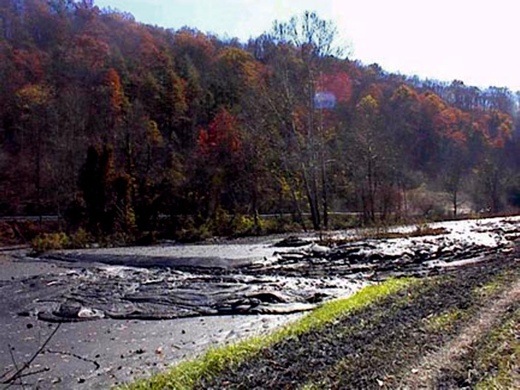
As a result of a 1.1 billion gallon spill of contaminated fly ash, there has been discussion, press reportage and blogging about the environmental disaster in eastern Tennessee Most of us have seen the pictures -- a 300+ acre area strewn with black and brown muck as far as the eye can see. Houses lifted off their foundations and thrown across the road, yards filled so high with ash that people can't leave their homes without stepping in it, roadways littered with the ash from trucks going to and from the site, and an eerie still where active life once existed. While this story continues to unfold -- as more samples are taken that delineate the true toxicity of this mess, as TVA makes plans to contain and abate the disaster -- there is a story that has not been told. It is a story that must be told. And that story is the lives of innocent bystanders that have been turned upside down by this avoidable disaster.
image above: TVA’s Kingston Power Plant in Harriman, Tennessee source of spill
I learned of this disaster on the news just as we all did. Usually I receive an email from someone in the community where there has been an environmental problem. At first, it was all quiet. About 10 days after the tragedy I got the first email, then another one and another one and another one, and they kept coming. I also started receiving anonymous tips. It occurred to me that maybe more was going on than what I could gather from the news. With an invitation from the community, I decided to make the trip. Let's be honest. Usually when I am called into an environmental disaster, I anticipate that industry isn't going to step up to the plate and do what's right by the people. Lawsuits almost always ensue; it would be foolish for me to walk into a situation like this without an attorney. Besides, I consult with two law firms in the United States: Girardi & Keese in Los Angeles and Weitz & Luxenberg in New York. I traveled to the area with an attorney, Robin Greenwald from Weitz and Luxenberg, along with some experts. In many instances such as this disaster, government agencies are absent due to lack of funds and can only rely on the information that industry gives them; and industry generally operates under concealment. When I first arrived on the site, I was pretty quiet. It took a while to absorb what I was looking at. I knew there was a lake but an entire area was gone. I kept wondering "Where did the water go?" I couldn't decide if it looked more like a tornado had gone through, a mudslide, landslide, maybe a volcano erupted or a tidal wave. It is now a "moonscape." The landscape has completely changed. It is almost unidentifiable. Watching TV never gives you an idea of the extent of damage. It's only when you stand there that you can actually feel the magnitude. It struck me that I had an unusual taste on my lips and in my mouth. I asked others if they noticed that, and they did. Some experienced scratchy throats, respiratory problems, itchy and burning eyes and tasted what one expert believed to be sulfuric acid. If we were experiencing this much discomfort after a few minutes, what on earth are the people who live here feeling? The other thing that stood out in my mind was how fortunate it was that this event took place when it did. What would it have been like had this occurred in the summer during the middle of the day? Hundreds of people boat on this lake. Children swim and play in these waters. I was struck by the number of deaths that might have occurred but didn't. This corner of Roane County Tennessee is off the beaten path. It is remote, distant from any main street and city noise. It is easy to see the beauty of rolling mountains, lakes, rivers, comfortable family homes. It is serene, a piece of heaven on earth. This was a safe place to raise kids, to teach them to fish and swim, to enjoy family and have barbecues or sit quietly to watch the sunset on warm summer nights. I could see why people live there. Over the past couple of weeks we have had the opportunity to speak with people about life both before December 22. Life in the Kingston/Harriman area was idyllic. It was a place people chose as their home. It was a place that, even if jobs took people away in their youth, they awaited the day they could return and did so as soon as possible. It is a beautiful place, with water bodies everywhere. There are green meadows laced among the waters. These shared memories come to life in the "before" photographs that residents showed us. The pictures show children diving from docks into the lake, people canoeing along the rivers, families tubing in the hot summer sun and children and their dogs walking along the shore. A favorite scene of many residents is the sunset over the water, with the soft nighttime colors glistening on the lake. It went from pristine to profaned overnight. The "after" picture is nothing but a sludge-filled lake, dead fish and miles and miles of contamination flowing out of control. And what cannot be captured by photographs is the human toll of this disaster. The child who wakes up nightly with nightmares; the woman whose cough is so severe she can hardly speak and has been diagnosed with acute asthma from the ash spill; the tri-athlete who can no longer train in his environs; the families scared to death to go outside for fear they breathe in the toxic ash in the air; people realizing that TVA's recommendation to boil their water before drinking it in the wake of the disaster was a false comfort and bottled water, at their own expense, is the only solution for drinking; and the couple who lives downwind of the disaster who, following walking their dog on a hilltop on a windy night, suffered severe nose bleeds. This is a very frightening time for the people of this community. This community is incredibly brave, but it is also rightfully fearful -- they love their community, their homes, their environment and they don't want to leave, but they also don't want to stay at the risk of their health. They want answers and they can't get them. Many people have the same tale: they call the TVA hotline for answers and help but no one answers or returns their calls. Why does this happen? What did they do to deserve such treatment? I can only imagine the sadness of the families. The whole area looks like a wound on the land. To heal it, it's going to take more than a band-aid and a squirt of Bactine. The next day of my visit we did a fly over of the site, which showed the big picture. Extending for at least 5 to 6 miles downstream, we could see a plume of this toxic ash floating down the river, resting on the banks. We saw the remaining refrigerator and patch of roof where the now demolished house once stood. We saw a child's trampoline, once in someone's backyard, now buried in TVA's toxic sludge. We saw miles of ash, still traveling down river, contaminating riverbanks along the way. In truth, there are no words to describe the scenes of devastation from this disaster. The pictures are powerful, but they simply cannot capture the panorama of devastation. This was a sludge tsunami -- but one caused by corporate neglect, not natural occurrences. And what it left behind from this tsunami are mounds of toxic rubble where a lake once existed, where rivers flow and where children used to play. We all wonder what will happen to the ecosystem: the fish and wildlife. The human life. How far reaching is this event? What does the future hold for the public health and safety? Overnight a whole community's lifestyle is gone. It is bad enough that TVA mismanaged this 50+ year old waste pile of coal ash. But to put salt in the wounds of its neighbors by failing to provide critically important answers and aid is incomprehensible. TVA should have mobilized hundreds of medical experts to go to peoples' homes and answer their questions. They need to be honest and transparent about their knowledge of the make-up of the sludge, what they plan to do with it and how they intend to return life to what it used to be, if that is even possible. TVA should have a hotline that is manned sufficiently so that no one is ever put on hold or, worse yet, not answered at all. The residents of this community deserve to be treated with honesty and respect, and that is not happening. Even local elected officials are letting residents down, spending their time telling residents not to work with attorneys instead of camping outside TVA's doors demanding honest and fast answers to critically important health questions. As you know, we work on the legal side. While we cannot fully appreciate the pain and fear of those who are living the fall out of this disaster on a daily basis, we saw and heard enough to understand that our presence and our voice is critically important to ensure that this community is treated fairly and provided the truth about the present situation and their future. We will continue to aid this community as it struggles through the haze that TVA has created and continues to fuel. So many questions come to mind but there aren't any answers. My motto has become "Prevention rather than Rescue." Hindsight always shows how these tragedies could have been prevented. If history teaches us anything, it shows us that yesterday is our "crystal ball." In the now famous case, Pacific Gas and Electric knew that their contamination was affecting innocent people yet did nothing but try to convince people that the poison was good for them. If TVA knew of leaks years before this disaster and sat and waited, is "oops" we're sorry" going to be enough? The infrastructure handling coal fly ash in the U.S. is old and needs to be replaced. Can we worry about the cost of replacing the old with the new when health and safety and the environment depends on it? We can see that contamination moves through air, land and water. Can we sit back and wait for communities to get sick when we can prevent it now? Science usually lags behind the law. But in this case, law lags behind science because coal fly ash handling is not regulated as it should be. And we have a pretty good grasp on the fact that Coal Fly Ash is not healthy. A poison is a poison. It certainly can't be good for you. Does anyone believe that the arsenic in the fly ash along with other heavy metals won't leech into the groundwater? 5.4 million cubic yards of toxic compounds unleashed into the garden. We don't need a crystal ball to see the rough road ahead.
See also:

GMO's killing honeybees?

SOURCE: Jeri DiPietro ofstone@aol.com
SUBHEAD: Genetically modified crops implicated in honeybee colony collapse disorder.

By Patty Donovan on 11 January 2009 in Natural News -  
http://www.naturalnews.com/025287.html


Image above: a honeybee on a garaldton wax flower. From http://www.bibliotecapleyades.net/ciencia/ciencia_bees.htm
 
As the disappearance of honeybees continues, researchers are trying desperately to discover the cause of Colony Collapse Disorder (CCD). General concensus at this point is that there is more than once cause and the latest culprit may be genetically modified crops. This is one area of research being neglected as mainstream scientists insist GM crops are safe.

For the last 100 years, beekeepers have experienced colony losses from bacteria, (foulbrood), mites (varroa and tracheal) and other pathogens. These problems are dealt with by using antibiotics, miticides and and other methods of pest management. Losses are slow and expected and beekeepers know how to limit the destruction. This new mass die-off is different in that it is virtually instantaneous with no warning of the impending collapse.

John McDonald, a bee keeper in Pennsyvania with a background in biology, speculated that genetically modified crops could play a role in CCD. Although the government constantly reassures us that these genetic manipulations are safe for both humans and the environment, his hope is that looking more closely at these issues might raise questions about those assumptions. The common bacterium, bacillus thuringiensis (Bt) supplies the most commonly used segment of transgenic DNA.

Bt has been used for decades by farmers and gardeners to control crop damage from butterfy larvae. Now, instead of spraying this bacterium directly on the crops, where it is eaten only by the target insects, the genes containing the insecticidal traits are incorporated into the genome of the plant itself. As the genetically modified plant grows, these Bt genes are replicated in every cell of the plant, including pollen.

Therefore, every cell of each GM plant contains its own poison aimed to kill the target insect. The target insects consume some portion of the plant, then once ingested, the toxin produced by the Bt genes causes crystallization in the guts of boring larvae and thus death. The primary toxin is a protein called Cry1Ab. In the case of field corn, the targeted insects are stem and root-borers and butterfly larvae.

Although scientists "assure" us that bees (hymenopterans) are not affected, there are Bt variants available that target beetles, flies and mosquitoes. There is indisputable proof that Cry1Ab is present in beehives. Beekeepers spray Bt under hive lids to control the wax moth because the larvae cause messy webs on the honey. Canadian beekeepers have noted the disappearance of this moth even in untreated hives, apparently the result of bees ingesting Cry1Ab while foraging in GM canola plants.

Bees forage heavily on corn flowers to obtain pollen for the rearing of young bees. These pollen grains also contain the Bt genes of the parent plant, because they are present in the cells from which pollen forms. Mr. McDonald believes it may be possible that while Cry1Ab has no direct lethal effect on young bees, there may be some sub-lethal effect, such as immune suppression, acting as a slow killer.

Tens of millions of acres of genetically modified crops are allowing the Bt genes to move off crop fields and contaminate other flowers from which bees gather flowers. "Given that nearly every bite of food that we eat has a pollinator, the seriousness of this emerging problem could dwarf all previous food disruptions".(John McDonald) He proposed an experiment to compare colony losses of bees from regions where there are no GM crops to losses of colonies where they are exposed. He wanted to put test hives where GM crops are so distant from the hives that the foraging worker bees would have no exposure to GM crops.

Researches readily dismissed his ideas and no one followed through with such an experiment. At this point, he decided to do his own investigation at his own expense. He established 8 colonies in new wooden hives to ensure no possible disease transfer from old hives. The bees were fed continuously with sugar syrup until the hives were placed at the selected locations. "At both sites the flowers of goldenrod provided ample pasturage, with the honey flow commencing in the middle of August and tapering off by the second week in October.

Medium-depth empty honey storage supers (a super is the part of the beehive used to collect honey) were put on the hives at this time in addition to the three brood chambers already there. By the simple expedient of lifting the hives from behind, progress could be roughly monitored. This monitoring showed that the hives of the farmland bees, while numerous, were not gaining weight.

Meanwhile, the non-farm colonies steadily gained weight. This part of the experiment was terminated Oct. 14 with the removal of the honey storage supers, with these results: The farmland bees had not even started to work in the honey supers and will require extensive feeding before winter sets in. The non-farm bee colonies produced, in total, nearly 200 pounds of extra honey in addition to about 150 pounds per hive stored in the over-wintering brood supers. These colonies will be left in place to see whether the die-off of last season is repeated.

These results should encourage new research to determine what factor or factors are present in farm country to cause such a discrepancy in honey production." John McDonald John McDonald is a beekeeper in Pennsylvania. He welcomes comments or questions about the bee problem at mactheknife70@hotmail.com. Another study indicating that Bt may be contributing to the death of honey bees was undertaken in Mexico.

This study compared the effects on young adult honeybees of 2 concentrations of Cry1AB (3 and 5000 parts per billion) to a chemical pesticide, imidacloprid. 3 different effects were evaluated by the researchers: 1. Survival of honeybees during sub-chronic exposure to Cry1Ab. 2. Feeding behavior. 3. Learning performance at the time that honeybees become foragers.

Neither test concentration of Cry1Ab had lethal effects on the honeybees, however, when exposed to the higher concentration, feeding behavior was affected. The bees spent longer ingesting the syrup which contained the Cry1Ab which could mean smaller amounts of pollen would be collected. These bees also had impaired learning performance.

Honeybees normally do not continue responding to an odor when no food is present, but should be discouraged and seek other sources. These bees continued responding to the odor which again, could affect pollen gathering efficiency. This study indicates that although Bt is not directly lethal to honeybees, it could indirectly lead to colony death due to failure to collect enough food to sustain the hive.

These findings may be the key to the difference in honey production in Mr. McDonald's experiment. Bt appears to have non-lethal effects which become apparent only when the lethal effect is absent. Although not directly lethal to non-target organisms, the toxins from the Bt gene potentially puts non-target insects such as honeybees at risk.


See also:
http://persianoad.wordpress.com/2008/01/10 http://www.ncbi.nlm.nih.gov/pubmed/18206234
Island Breath: Colony Collapse Disorder

The biophysical economy

SUBHEAD: A new model of the economy is needed that includes the environment By George Mobus on 6 January 2009 in Question Everything http://questioneverything.typepad.com The big issue right now, for Obama and the new administration, is the economy. We are in the worst recession, according to all of the 'in-the-know' economists, since the Great Depression of the 30's. Well they should know. They predicted it, right? OK, not really. In fact the big question in my mind is:
Just exactly what do economists know? They have been appallingly bad at predicting much of anything, certainly of late, and yet politicians and media people keep going back to the economic 'experts' in an attempt to understand what is happening to our world. The problem is, the economists actually don't know the very basics of economic reality. They are working on a bunch of hypothetical principles (not even real theories in the scientific sense) that are flat out wrong in many cases. But most of all, they don't understand the very basis of economic activity - the flow of energy through the system. It is energy flow that allows any system to increase in complexity and stability over time, that is to evolve to its maximum state of organization. It does this by virtue of physical work, either mechanical or electrochemical, being done on the components within the system to increase their 'utility' within that system.
Some of those components are imported from the environment, others may be recycled materials from decayed components. Work must also be done to export material that is no longer usable (maximum entropy state) so that it doesn't clutter and choke the system's workings. Energy of high potential and in a usable form must constantly be brought into the system to achieve this end. This description is completely general and universal. It applies to all systems, of any scale, and any location in the universe. It applies to living systems and to the economic systems created by human endeavor. Humans take in both low entropy material and its stored chemical energy and use the latter to do the work of maintaining the body as well as generating muscle power to, among other things, acquire more material and energy (better known as food!) The human economy is, at its roots, a social form of an extended metabolism. It is basically both a kind of ecosystem and a metabolism whereby artifacts and organizations form and develop in order to facilitate more work being done.
That, of course, means more energy needs importing in order to keep up growth and development. Whereas the economy of the body is designed and regulated by genetics, that of the human economy is developed by human ingenuity and culture. Genes and culture are both sources of knowledge to guide the respective energy flows through bodies and through economies. An economy is subject to the same phenomena that plague a living body when energy is restricted. It appears, now, that it is also subject to the same problems that arise from taking in too much energy relative to the energy flow balance that would be found in a natural, healthy individual — namely the individual gets obese and bodily functions are often deleteriously affected. Our economy, our social body, I suggest, is obese and we are seeing the detriment of that obesity in situations like our credit crisis and the Madoff Ponzi scheme. Things, institutions, are not working properly. Certainly our regulatory apparatuses are failing in their duties. But in terms of what happens to a body on a diet, we should be mindful of what happens because we are now on what appears to be a restriction of energy flow that will worsen over time. Initially the body responds to restriction of caloric input by exhausting the stores of glycogen (stored carbohydrates) and turning to burning fat stores to keep the system running. We basically loose fat volume (unfortunately we don't lose adipose cells which during more profligate times will just go back to storing up fat!) and weight. But if the restriction continues we begin to use up other stores, namely protein in muscle, and our bodies can become emaciated and weak. At some point our organs can go into failure and we die from starvation. Recall the images of the prisoners at Auschwitz at the end of WWII. Here is what I think is happening and what I think its effects will be. This is based on the basic principle of biophysical economics voiced above. It takes energy to do work, plain and simple. Reduce the influx of high-grade energy and you will reduce the amount of work that can be done. And we are in the throes of energy restriction now. The first thing you have to understand about energy input to the economy is that it now has to be very high-grade (high potential) and in a form that is able to drive our prime movers (motors, turbines, and heaters) directly. This is the kind of power that you get from high energy dense fossil fuels. The second thing you have to grasp is that it requires energy to get energy. That is, you have to build drilling rigs and pumps and such to get the oil from underground, and now from deep water fields, and it takes no small amount of energy to build this stuff. You have to subtract the energy you use to build energy extraction/capture equipment and the energy used to move the fuels to points of use from the total energy available. In other words, the net energy available to do economic work (other than energy extraction) is what counts as input to the economy. And that net value has been declining since the 70's. The biggest input to our economy now is oil. And here I mean high-grade liquids. Oil shales and tar sands are anything but high-grade — they require too much extra energy to convert to usable form to produce a viable net gain. With the move to non-traditional oil extraction, especially off-shore platforms for wells, the net energy gain to society has been starting to decline. The meaningful measure here is energy return on energy invested (EROEI or EROI). As this ratio (energy out/energy in) declines due to more energy being expended just to get the oil out of the earth, the net gain for each unit of energy goes down as well. For the past several decades we have been exploiting our large and giant oil fields at a greater rate even while the net gain has been decreasing. This provided the comforting feeling that our energy influx was still increasing. So we felt we could do ever more work and generate ever more wealth in our economy. But another, related phenomenon was starting to raise its ugly head. Oil is, and all fossil fuels are, a finite resource. There is only so much in the earth and we have been pumping it out at an accelerating rate for the past 100 years. Or at least we were trying to do so. Back in the 50's M. King Hubbert, a geoscientist working for Shell labs proposed a theory about the long term properties of oil production. Essentially he showed that oil production follows what looks like a normal curve, i.e. it rises semi-exponentially but then peaks and starts to fall in a symmetrical fashion. This theory, Peak oil, proved prescient for oil production in the lower 48 states, where production did, indeed peak in the early 70's. Hubbert's model has been applied to the world oil production as a whole but it is hard to draw precise conclusions since so much of today's oil production is nationalized and data on production rates (as well as valid numbers on so-called proved reserves) are not available for analysis. Still some basic principles apply and there is no reason to think that the pattern of new oil finds (which has been dropping steadily) and subsequent peaking of production will not follow for the earth as a whole. Indeed there is growing circumstantial evidence that suggests the peak is already here. A number of analysts have begun converging on a date in the early 21st century. Indeed production rates seem to have been flat since 2005. Some believe that looked at close up the reality is not a peak per se, but a plateau in which there is considerable fluctuation generated by various feedback loops, such as the price of oil and our financial system acting counter to one another to keep the price and availability of oil in wild volatility, averaged around the plateau level. Sound like anything we've seen lately? The combination of peak oil and declining EROEI from early in this century have had a devastating effect on wealth production. Manufacturers and certain kinds of service companies have sought cheaper labor costs in an attempt to forestall higher cost production. We know where that one got us. Put simply, we are not able to produce as much wealth because we have less net energy. In other words, our economy is starting to go on a diet and before long it will be starving. What makes this worse is that Hubbert's peak theory actually applies to any commodity that is finite. It applies to all fossil fuels, but also to necessary minerals and even uranium. And there is no recovery. The curve tends downward after the peak until it bottoms out at essentially zero. This is the case for all finite resources. Period. Moreover, don't forget that to get coal out of the ground it takes diesel fuel (from oil). So as oil becomes less available, so does coal (and natural gas). Imagine yourself on a diet where each year your caloric intake was decreased and at an exponential rate! At some point your body crashes. You need a minimum caloric input just to maintain yourself. And children, of course, need to grow, let alone maintain. Now imagine the economy as this extended body with its metabolism being restricted by its food supply diminishing. It is as if you need fruits, vegetables, and meat, but you are only able to find grass, bark, and bugs; because of their poor energy content you are still starving. Another fall out from this economic diet, the money that everyone thought was the currency will not be able to buy anything. And what there will be will take too many dollars to obtain in the old ways. Money is almost meaningless any more. The prices of stuff, especially fuels, is disconnected from the underlying value. Our financial system was built on borrowing against a future of wealth production that will never come. It is really no mystery at all why we're seeing this crisis. Pumping more dollars into the systems (creating fiat money with no backing) will only make matters worse in the not-so-long-term. Even if there is some minor recovery in the economy (that is we go back to spending and consuming junk just so we maintain jobs for people who need to borrow to spend on junk) it will be shallow and only lead to a worse crash. Our whole economy is little more than a giant Madoff Ponzi scheme. Or a pyramid scheme that has no base. Now lest you maintain that hope for technology to come to the rescue, bear a couple of things in mind. First, the amount of energy coming from renewable sources today is exactly zero. That's right, zero. Secondly, alternative energy sources, such as wind and solar, account for little more than 1% of the total energy consumed by American society. That means a massive build up of these sources would have to happen almost over night. And the reason I claim we get no energy from renewables is that the equipment used to capture sunlight and wind is built using oil, coal and natural gas (with a minor input from hydroelectric). And unless those capital goods can be built using strictly their own energy capture then they are not truly renewable, or sustainable for the long term. That is the problem. We use way too much energy, both collectively and per capita, compared with what we could get in a truly sustainable way, in a time frame necessary to prevent a real crash. There is no way to get there from here. Third is that any policy based on the magical thinking that a new, revolutionary energy source will be found if only we put the right incentives out there for entreprenuers and inventors is going to be dead wrong. These are the thoughts of people who have never studied science and technology in depth, do not understand the nature of the second law of thermodynamics (as in you will NEVER invent a perpetual motion machine), and who were spoiled by the apparent effects of Moore's law as it works in digital electronics (but not in energy systems). There will be new technology. There will be breakthroughs that will help. But there will be nothing in the offing that will replace fossil fuels at the current level of demand (I know, never say never; but energy technology is truly constrained by laws that don't leave me with great hope.) Even if new technologies are forthcoming you still have the scale up, and adoption times to contend with. Believe me, this is a tough nut to crack. I know that this is hard to swallow because of the implications — that the American/Western way of life is coming to an end. But it is time to face reality and start planning for the most likely scenarios. Rather than trying to jump-start the old consumer, wasteful economy, Obama should be leading the charge to get Americans off the energy splurge we have been on and start dieting ASAP. We have to shed the fat and conserve the raw energy as much as possible. This is the only way we will be able to have enough fossil fuels to bootstrap a new economy based on true renewable resources. It will mean abandonment of current lifestyles and beliefs about human destiny to be rich. It will require humans to recognize the ways of nature and forego hubris. It will require sapience! Unfortunately, as I will be revealing in my future post on the evolution of sapience and its likely future, I am somewhat discouraged about the current species' capacity for sapient decision making. More likely, I suspect, that as the contraction gets more serious and people start dying governments will resort to what they always have resorted to in the past. We'll use up the last bits of fossil fuels trying to steal the resources from someone else. But, of course, we'll then not be able to exploit them even if we succeed. More likely we'll just go out with a bang.

The Depression has come

SUBHEAD: Let's finish the job right! Happy new year, happy new age. By Jan Lundberg on 6 January 2009 in Culture Change (http://culturechange.org/cms/index.php?option=com_content&task=view&id=276&Itemid=1)
Image above: People gather scrap metal near former Chernobyl nuclear power plant.
Critical Comment - Culture Change Letter #227 - The New York Times made my day when it reported on the state of the economy and world trade on January 3, after the first business day of the new year. We won't see a corporate media headline of "Depression Cuts Greenhouse Gases Drastically" or "This is What Petrocollapse Looks Like" very soon because not enough people see the interconnections of history's trends on energy and limits. But I'll take what I can get for some winter good cheer.
With the Earth's climate at the tipping point to spin the planet into overheated mass extinction, some of us are thankful for the economy's collapse. "The worst slowdown since the Great Depression," said the New York Times (Business Day, Jan. 3). While it's true some kinds of environmental protection slacken when times are rougher for certain industries, on the whole there's a direct relationship between consumption and ecological destruction. Another relationship is between increased consumption (and work and debt) to unhappiness, mental illness and diminished social cohesion.
In addition to climate concerns and society's pathologies, we need to terminate our dangerous reliance on petroleum, coal, natural gas, uranium other metals and poisons that have built up our toxic house of cards. There are positive trends, such as dam removal and the radicalization of America's top climate scientist, James Hansen. Although overpopulation has already been achieved thanks to petroleum's former rising abundance, and petrocollapse began last year with sustained skyrocketing prices, we can cushion the blows from the collapsing house of cards by cutting our losses. This means retreating into our local communities' economies and their inherent social structures for mutual aid. With every step we start to undo some of the momentum to kill off the climate as we've known it. Essential economic activity goes on in a Depression, but there's less wealth generated. The problem is when the rich try to get richer off the poor's inability to pay for housing. As tough as the housing crisis may become if landlords and banks try to create mass homelessness -- that is, if people don't resist effectively -- our collective problem will not be shelter. For there's plenty of unused living space: churches, office buildings, second homes of the rich, etc. What there's not going to be enough of is food, when nine energy inputs from fossil fuels go into food production for every one unit of calories yielded by the food in question (in the U.S.). As for transporting the food, we have gotten used to the average morsel traveling 1,500 miles before reaching the plate. So we have a painful rebalancing of energy ahead. Indications are that it has started, although some changes at this point are publicized as lifestyle news stories for leisurely readers of green lore. Examples are the "Loving the 100 Mile Diet" and "Sail Transport Network Hauls Food Across the Sea." Clearly, "alternatives" such as those as well as urban food gardens, pedal power produce-hauling, and more veganism need to begin in ernest. These methods for local self-sufficiency and sustainable food and freight were laughed at by most of the "mainstream" until now. Now they make more sense to anyone questioning buying a car or shelling out scarce dollars for expensive, long-distance hauled food. To pursue these strategies now, to strip the car and oil industries of "earnings," will accelerate the fall of the corporate petroleum state. Its days are numbered, prompting a call for the proactive dissolution of the U.S. (Culture Change Letter #221). There's more to be done to finish the job of this oil-shock induced Depression, for more positive outcomes than we'll get if we cling to yesterday's economic system. It's too fantastic this week anyway, but what about ceasing 90% of the "Defense" budget to help bring an end to the deadly economic system heating the climate? We cannot foresee how soon collapse will be able to run its course to put the self-serving weapons industry mostly out of business. But we can rejoice in the fact that:
"The U.S. economy was on even weaker footing than commonly believed as 2008 came to a close. Moreover, the signal from the export orders index is that the rest of the world is right there with us. Hardly a signal for economic recovery anytime soon. New orders... are at the lowest level on record going back to January 1948." (New York Times, Jan. 3)
Who would have thought just six months ago that widgets and other pollution boxes would start to dry up so soon, with much fewer freighters from China now coming to the U.S.? "Maybe there's a god after all," said a street person priding herself on consuming less and less new stuff [overheard at a climate change activist meeting].
We are bombarded with corporate hope and sympathy for the polluting giants of industry: the phrase "economic recovery" is propagandistic mantra that all of us are supposed to join in -- even though the present economy is based on theft, fraud, exploitation and destruction. Is there another way? This is answered in the affirmative by Culture Change columnist Chuck Burr ("A Better Way of Making a Living for Humanity", link below) and in many other essays in Culture Change's two decades. More propaganda: "Grim readings come from the Asia-Pacific region, including China and India." (New York Times, Jan. 3) Let's keep in mind that China has been putting up one new coal-fired power station per week while economic growth was about 10% annually -- a disaster for the planet's ecosystem and our health. Hallelujah that things are finally changing, even faster than we could have dreamed. This means hope for life on Earth to flourish in its diversity, instead of being snuffed out by the great evil of history: economic growth and its inextricable sins. Celebrate! "The manufacturing sector (of China) had contracted for a fifth consecutive month... the steepest decline in its history." Thank you gods and goddesses! These developments occurred because of peak oil and peak money. Praise be to petrocollapse. More wonderful news from the same edition of the Times: "November Chip Sales Slipped 10%" (from Reuters). Shucks, the Silicon Valley Toxics Coalition must be in tears. Of joy. "Desperate Retailers Try Frantic Discounts and Giveaways." Remember folks, do your duty to your local economy by never buying any corporate or far-away-made product -- get it used or local-made. "Manufacturing is Suffering Globally" -- this undue pessimism about contraction is part of the imbalanced so-called journalism practiced by the nation's "newspaper of record." The Earth gets a break at long last, but this is "grim"? And "Worsening data..." -- this is objectivity? What a gift from Santa Claus to start a year of more peace and less war on nature and, if trends continue, between the oil-greedy U.S. against other nations. If concerns such as militarism and generating positive feedback loops for the climate don't matter much today to Joe Sixpack, he can at least raise his Bud to this other news item in the same New York Times Business Day: "What's the use in endless collections calls? Creditors take what they can get." (from a story headlined as "Lenders Race to Settle While the Borrowers Still Have a Few Cents.") Happy new year, happy new age. .

Kalaheo Pocket Valley

SUBHEAD: A poem about living in a small wet valley on the southside of Kauai By Jonathan Jay on 9 January 2009 for Island Breath (http://islandbreath.blogspot.com/2009/01/kauai-southside-valley.html)
Image above: a 2006 view of the moon and Venus
The body of Luna Hoaka glows faintly in our pacific earthshine while below, her creamy melon flesh crescent cheshire grin bobs.Gondola moon ploughs through clouds under beaming venus, to sink slowly into branches along western jellied ridge wallof my Kalaheo pocket valley.
In my pocket valley, three weeks now Makahiki rains resounding falling popcorn acoustics splatter-chatter pounding! Each rain drop sizzling - fissile into myriad rivulets that cascade off my wet tin roof congregating into pummeled soils, squishingly past saturation - thickly. Deeply. Now unnamed Lauoho intermittent stream first begins to flow, then boil - but i can't hear it under the pounding of my corrugated drumskin.Silently to me it roils through jungle past banyan over ford, past yurt, through citrus grove pushing piles of freshly fallen jungle debris.Pools rise amongst the feet of drunken banana trees en route to Lawai. Two warm, dry, freshly fed cats recline at my bare feet as i write this. He is fat and happy - she is small and insistent - a tiny tank for love.Now Imua in my lap. Now Imua bat-bat-bat my toes.Now Moku chew my heel. Now Moku velvet nose.Soon they will chase and tackle, then growl and rumble, then tongue and drift to sleep. Sibling playmates their entire lives - do they miss their middle sister, Amanda? She the black-bearded pirate girl, she with freckles on her nose, She the cleverest one whom first figured out the door,She who now sleeps beneath tumbling stream.Can cats remember their kittened days? Shoyu melts into butter; outside the pounding staccato slows, easing like one ocean liner slips im-per-cep-tab-ly into berth. Creaking now like one stubborn old house through bitter mid-winters, but here in my pocket valley, the 30th of December brings 70 degrees and a fierce sponge-bath from the cloudy skies of Kalaheo. Now i finally hear the rustle of Lauoho `A`alu (Leaf-head stream) my own private flash flood writhes through the Kalaheo pocket valley. It only took twenty inches for one Mahina to prime the pump. The Garden Island, lime and starfruit prunings crackle in the breadbox woodstove - a little dry heat a bump to nudge back the mouldering fungal damp. Tiny red lights like incence tips from my several power strips softly peer. Tonight is a special night! - the battered Trojan 105's behold buzz: electricity! A miracle for my fragile solar system, even more fantastic from the month of rain.Too precious for mere illumination, shall i celebrate by with music, laptop, movie? Mahalo ke Akua loa for allowing me to be in this small part of the world.

Warning - More doom ahead

SOURCE: Brad Parsons (mauibrad@hotmail.com)
SUBHEAD: As the U.S. economy shrinks, the entire global economy will go into recession.
By Nouriel Roubini on 7 January 2009 in Foreign Policy - Image above: 'Tracks Fade" by Dan Chusid (2003) from (www.pbase.com/camera0bug/image/13107594)
“Because the United States is such a huge part of the global economy, there’s real reason to worry that an American financial virus could mark the beginning of a global economic contagion.” – Nouriel Roubini, March 2008
Last year’s worst-case scenarios came true. The global financial pandemic that I and others had warned about is now upon us. But we are still only in the early stages of this crisis. My predictions for the coming year, unfortunately, are even more dire: The bubbles, and there were many, have only begun to burst.
The prevailing conventional wisdom holds that prices of many risky financial assets have fallen so much that we are at the bottom. Although it’s true that these assets have fallen sharply from their peaks of late 2007, they will likely fall further still. In the next few months, the macroeconomic news in the United States and around the world will be much worse than most expect. Corporate earnings reports will shock any equity analysts who are still deluding themselves that the economic contraction will be mild and short. Severe vulnerabilities remain in financial markets: a credit crunch that will get worse before it gets any better; deleveraging that continues as hedge funds and other leveraged players are forced to sell assets into illiquid and distressed markets, thus leading to cascading falls in asset prices, margin calls, and further deleveraging; other financial institutions going bust; a few emerging-market economies entering a full-blown financial crisis, and some at risk of defaulting on their sovereign debt. Certainly, the United States will experience its worst recession in decades. The formerly mainstream notion that the U.S. contraction would be short and shallow—a V-shaped recession with a quick recovery like the ones in 1990–91 and 2001—is out the window. Instead, the U.S. contraction will be U-shaped: long, deep, and lasting about 24 months. It could end up being even longer, an L-shaped, multiyear stagnation, like the one Japan suffered in the 1990s. In Europe, Canada, Japan, and the other advanced economies, it will be severe. Nor will emerging-market economies—linked to the developed world by trade in goods, finance, and currency—escape real pain. What constitutes a “recession” will depend on the country in question. For China, a hard landing would mean annual growth falls from 12 to 6 percent. China must grow by 10 percent or more each year to bring 12 to 15 million poor rural farmers into the modern world. For other emerging markets, such as Brazil or South Korea, growth below 3 percent would represent a hard landing. The most vulnerable countries, such as Ecuador, Hungary, Latvia, Pakistan, or Ukraine may experience an outright financial crisis and will require massive external financing to avoid a meltdown. For the wealthiest countries, a debilitating combination of economic stagnation and deflation might happen as markets for goods go slack because aggregate demand falls. Given how sharply production capacity has risen due to overinvestment in China and other emerging markets, this drop in demand would likely lead to lower inflation. Meanwhile, job losses would mount and unemployment rates would rise, putting downward pressure on wages. Weakening commodity markets—where prices have already fallen sharply since their summer peak and will fall further in a global recession—would lead to still lower inflation. Indeed, by early 2009, inflation in the advanced economies could fall toward the 1 percent level, too close to deflation for comfort. This scenario is dangerous for many reasons. A number of central banks will be close enough to setting interest rates of zero that their economies fall into a triple whammy: a liquidity trap, a deflation trap, and debt deflation. In a liquidity trap, the banks lose their ability to stimulate the economy because they cannot set nominal interest rates below zero. In a deflation trap, falling prices mean that real interest rates are relatively high, choking off consumption and investment. This leads to a vicious circle wherein incomes and jobs are falling, with demand dropping still further. Finally, in debt deflation, the real value of nominal debts rises as prices fall—bad news for countries such as the United States and Japan that have high ratios of debt to GDP. As orthodox monetary tools become ineffective, policymakers will turn to unorthodox approaches. We’ll see traditional fiscal policy, in the form of tax cuts and spending increases, but also worldwide bailouts of lenders, investors, and financial institutions, as well as borrowers. Central banks will inject massive amounts of cash into financial systems to unclog the liquidity crunch. More radical actions, such as outright purchases of corporate and government bonds or subsidization of mortgage rates, might also be necessary to get credit markets functioning properly again. This crisis is not merely the result of the U.S. housing bubble’s bursting or the collapse of the United States’ subprime mortgage sector. The credit excesses that created this disaster were global. There were many bubbles, and they extended beyond housing in many countries to commercial real estate mortgages and loans, to credit cards, auto loans, and student loans. There were bubbles for the securitized products that converted these loans and mortgages into complex, toxic, and destructive financial instruments. And there were still more bubbles for local government borrowing, leveraged buyouts, hedge funds, commercial and industrial loans, corporate bonds, commodities, and credit-default swaps—a dangerous unregulated market wherein up to $60 trillion of nominal protection was sold against an outstanding stock of corporate bonds of just $6 trillion. Taken together, these amounted to the biggest asset and credit bubble in human history; as it goes bust, the overall credit losses could reach as high as $2 trillion. [Ed. note--Total losses will be much greater than $2 trillion.] Unless governments move with more alacrity to recapitalize banks and other financial institutions, the credit crunch will become even more severe. Losses will mount faster than companies can replenish their balance sheets. Thanks to the radical actions of the G-7 and others, the risk of a total systemic financial meltdown has been reduced. But unfortunately, the worst is not behind us. This will be a painful year. Only very aggressive, coordinated, and effective action by policymakers will ensure that 2010 will not be even worse than 2009 is likely to be." .

Bastion of American socialism

SUBHEAD: In an age of dwindling resources a socialist system may be better. By Dmitry Orlov on 10 January 2009 in ClubOrlov - (http://cluborlov.blogspot.com/search?q=Bastion+of+American+socialism+) Image above: "Lenin With Villagers" painted by Evdokiya Usikova in 1959 as example of Socialist Realism www.marxists.org Over the past few months the American mainstream chatter has experienced a sudden spike in the gratuitous use of the term "Socialist." It was prompted by the attempts of the federal government to resuscitate insolvent financial institutions. These attempts included offers of guarantees to their clients, injections of large sums of borrowed public money, and granting them access to almost-free credit that was magically summoned ex nihilo by the Federal Reserve. To some observers, these attempts looked like an emergency nationalization of the finance sector was underway, prompting them to cry "Socialism!" Their cries were not as strident as one would expect, bereft of the usual disdain that normally accompanies the use of this term. Rather, it was proffered with a wan smile, because the commentators could find nothing better to say – nothing that would actually make sense of the situation.
Not a single comment on this matter could be heard from any of the numerous socialist parties, either opposition or government, from around the globe, who correctly surmised that this had nothing to do with their political discipline, because in the US "socialism" is commonly used as a pejorative term, with willful ignorance and breathtaking inaccuracy, to foolishly dismiss any number of alternative notions of how society might be organized. What this new, untraditional use of the term lacks in venom, it more than makes up for in malapropism, for there is nothing remotely socialist to Henry Paulson's "no banker left behind" bail-out strategy, or to Ben Bernanke's "buy one – get one free" deal on the US Dollar (offered only to well-connected friends) or to any of the other measures, either attempted or considered, to slow the collapse of the US economy. A nationalization of the private sector can indeed be called socialist, but only when it is carried out by a socialist government. In absence of this key ingredient, a perfect melding of government and private business is, in fact, the gold standard of fascism. But nobody is crying "Fascism!" over what has been happening in the US. Not only would this seem ridiculously theatrical, but, the trouble is, we here in the US have traditionally liked fascists. We had liked Mussolini well enough, until he allied with Hitler, whom we only eventually grew to dislike once he started hindering transatlantic trade. We liked Spain's Franco well enough too. We liked Chile's Pinochet after having a hand in bumping off his Socialist predecessor Allende (on September 11, 1972; on the same date some years later, I was very briefly seized with the odd notion that the Chileans had finally exacted their revenge). In general, a business-friendly fascist generalissimo or president-for-life with no ties to Hitler is someone we could almost always work with. So much for political honesty. As a practical matter, failing at capitalism does not automatically make you socialist, no more than failing at marriage automatically make you gay. Even if desperation makes you randy for anything that is warm-blooded and doesn't bite, the happily gay lifestyle is not automatically there for the taking. There are the matters of grooming, and manners, and interior decoration to consider, and these take work, just like anything else. Speaking of work, building socialism certainly takes a great deal of work, a lot of which tends to be unpaid, voluntary labor, and so desperation certainly helps to inspire the effort, but it cannot be the only ingredient. It also takes intelligence, because, as Douglas Adams once astutely observed, "people are a problem." In due course, they will learn to thwart any system, no matter how well-designed it might be, be it capitalist, socialist, anarchist, Ayn Randian, or one based on a strictly literal interpretation of the Book of Revelation. However, here a distinction can be drawn: systems that attempt to do good seem far more corruptible than ones that have no such pretensions. Thus, a socialist system, inspired by the noblest of impulses to help one's fellow man, quickly develops social inequalities that it was designed to eradicate, breeding cynicism, while a capitalist system, inspired by the impulse to help oneself through greed and fear, starts out from the position of perfect cynicism, and is therefore immune to such effects, making it more robust, as long as it does not become resource-constrained. It seems to be a superior system if your goal is to keep the planet burning brightly, but when the fuel starts to run low, it is quickly torn apart by the very impulses that motivated its previous successes: greed turns to profiteering, draining the life blood out of the economy, while fear causes capital to seek safe havens, causing the wheels of commerce to grind to a halt. It could be said that an intelligently designed, well-regulated capitalist system could be made to avoid such pitfalls and persevere in the face of resource constraints, but the US seems laughably far from achieving this goal. Taking intelligence itself as an example, if having more of it is a good thing, then a bit of socialism could have helped a lot. Let us start with the observation that intelligence, and the ability to benefit from higher education, occur more or less randomly within a human population. The genetic and environmental variation is such that it is not even conceivable to breed people for high intellectual abilities, although, as a look at any number of aristocratic lineages will tell you, it is most certainly possible to breed blue-blooded imbeciles. Thus, offering higher education to those whose parents can afford it is a way to squander resources on a great lot of pampered nincompoops while denying education to working class minds that might actually soak it up and benefit from it. A case in point: why exactly was it a good idea to send George W. Bush to Yale, and then to Harvard Business School? A wanton misallocation of resources, wouldn't you agree? At this point, I doubt that I would get an argument even from his own parents. Perhaps in retrospect they would have been happier to let someone more qualified decide whether young George should have grown up to incompetently send men into battle or to competently polish hub caps down on the corner. Many countries, upon achieving a certain level of collective intelligence, or upon finding themselves blessed with a sufficiently intelligent benevolent dictator, followed a similar line of reasoning, and organized a system of public education that meted out educational opportunities based on the ability to learn, not the ability to pay. In countries where such reforms were successful, society benefited from the far more efficient allocation of resources, becoming more egalitarian, better-educated, and more stable and prosperous. The United States is one such country, where, following World War II, the GI Bill did much to mitigate against the oppressive social stratification of American society during the Great Depression, giving it a new lease on life. In a politically honest country, this achievement would have been touted as a great socialist victory. Here, instead of building on this success, it was allowed to ebb away, until now fewer and fewer qualified candidates can shoulder the high cost of higher education, and even these have to forgo education proper in favor of vocational training, in order to be in a position to pay back student loans. Other traditional socialist victories include securing the right to housing, child care, health care, and retirement. In the context of US public policy, many people will point to Roosevelt's New Society "middle-class entitlements" as examples of such victories, Social Security and Medicare being the big ones. As they point, they should also laugh. What pitiable excuse for public housing are these "projects" in which many of the poor are forced to live? Are inner-city public schools "education," or are they, as many of the teachers who work in them would agree, jails for young people? Is free medical care such a great achievement if you have to survive to retirement age, either as a wage slave, or without access to health care, in order to qualify for it? To add insult to injury, there is a limitless supply of pundits and experts, who can always get free air time to claim that even these feeble attempts at an equitable society are fiscally unsustainable and therefore must be curtailed. Poor embargoed Cuba can afford to provide such luxuries, but the United States is too poor to do the same? Pardon me while I attempt to knit my brows into an incredulous frown while simultaneously twisting my lips into a disdainful sneer! Might there perhaps be another reason? Could it be that the lack of socialist education policies has allowed our collective intelligence to drop to a level where the bulb glows too dimly for us to see what is being done to us? No, these are not victories, and they are certainly not socialist. You might think that an argument could be made that this is all irrelevant, because the flip side of a socialist defeat is a capitalist victory. You might think that all of this talk of social rights causes erosion of respect for money and property, followed by other kinds of moral decay. You might also think that it is unfettered free enterprise that has made mainstream American society the economically stratified, downwardly mobile and economically insecure place that it is, which is just as it should be. Alas, that argument is no longer plausible: the flip side of a socialist defeat is a capitalist defeat. No matter what your political persuasion might be, there is simply no way that an economically insecure, badly educated, badly treated population can be made to thrive, and this sets the stage for some very bad economic performance. As the economy collapses and economic losses mount, social and political instability become inevitable. Luckily, the converse of case is not inevitable: a capitalist defeat does not automatically mean a socialist defeat. While an economy that has lost its ability to grow signals the onset of terminal illness for any capitalist system, socialist institutions can operate at a loss virtually ad infinitim, delivering worse and worse results, but distributing them equitably, so that no-one has more cause to complain or to rebel than anyone else. In an age of dwindling resources – be they mineral, ecological or financial – a socialist system stands a better chance of holding together than a capitalist one. To further elucidate this fine point, let us consider two different environments: the cruise ship and the life boat. Aboard the cruise ship we find Bill Gates, Larry Ellison, George Soros and Warren Buffet, along with their assorted henchmen, fellow-travelers and capitalist stool pigeons. While they are aboard the cruise ship, these four worthies try to outdo each other in their outlandish spending behavior, and all rejoice in their orgy of conspicuous consumption. But now the cruise ship hits an iceberg and starts to go down, and the four capitalist luminaries take to the lifeboat, along with the passengers and the crew. While leaping aboard, Warren Buffet falls overboard and sinks like a rock because of all the gold bullion sewn into his belt, leaving three worthies to contend for the meager supply of biscuits and fresh water. They hold an auction, and Gates wins all of the biscuits. But before he manages to wolf down a single biscuit, he is compelled, under murky and tumultuous circumstances, to swallow a great quantity of seawater, bringing on hallucinations, renal failure, and death. Larry Ellison then announces that he has just gone on a diet, while George Soros looks around in confusion and says "Don't worry everyone, I am buying." The captain of the sunken cruise ship then asserts his authority, and, with everyone's vocal consent, confiscates all money and all provisions, and institutes biscuit and water rations. Luckily, it is the monsoon season, and the plentiful rain allows everyone to drink their fill by catching water in their hats, but the biscuits soon run out, and it becomes necessary to eat someone. They draw lots, and Ellison gets the short straw. Before he gets done explaining how many millions he is willing to spare in exchange for them sparing his life, a member of the crew drives a boat hook through his eye socket, and he is promptly eaten. By a strange and suspicious coincidence, Soros is eaten next. But then, after a month adrift, the castaways are finally rescued by a passing freighter. No charges are brought against any of them, because the acts of murder and cannibalism were deemed necessary to survival, and were performed fairly, by the drawing of lots, in accordance with the ancient custom of the sea. If their rescue were delayed, they could have eaten each other down to one final ancient mariner, who would then starve to death, all fair and square and above board. But how, you might reasonably want to rejoin, might the sinking cruise ship of the United States conceivably effect a transition from a highly-capitalized, highly-leveraged system of for-profit private enterprise to a more socialist-minded lifeboat model? What institutions can aide with the transition? Would the whole thing need to be scrapped and rebuilt from the ground up? Now, these are very serious questions indeed. Currently, a great many people are filled with hope that the incoming Obama administration will bring much-needed change. Unfortunately, Mr. Obama inherits an office much tainted by his predecessor, whose attempt at securing his legacy included a clandestine trip to Baghdad where, when he attempted to speak of victory, someone threw shoes at him and called him a filthy dog, all on international television. The US presidency is now a carnival side show: "Step right up, ladies and gentlemen, and toss your shoes at Mr. President, for a chance to win an all-expense-paid stay at our luxurious Abu Ghraib suite!" Alas, Obama inherits an imperial mantle that has been trampled in the mud. Due to a certain quirk of the national character, most Americans have trouble understanding that honor is something you lose exactly once. (As H. L. Mencken pointed out, in America honor is used only in reference to members of Congress and the physical integrity of women.) This quirk may not be significant in domestic politics, but the US crucially depends on the rest of the world for every kind of support. There are countries, in the Muslim part of the world especially, where honor is of paramount importance, and having the highest office in the land turned into a laughing-stock is not conducive to securing their support.
And then there are the additional problems of poor advice and lack of authority. To build support for his plans, Mr. Obama must rely on the consensus advice of mainstream American economists. These astrologers to the wealthy, with their fancy astrolabes they call "models," may be popular during flush times, in spite of the feeble predictive abilities of their "science," but they start to seem downright foolish and feckless once the economy starts to implode. Still, these pseudo-scientists, with their pseudo-Nobel prizes and their tenured faculty positions, are quite entrenched, and will be difficult to dismiss, because the fiction they spin is so much more cheerful than the physical reality it is designed to obscure. Add to this the fact that the financial and economic levers of control that are available to Mr. Obama are no longer connected to anything real. Mr. Obama's plans at economic stimulus may succeed in filling our pockets with newly printed money, but that money will promptly turn out to be worth its weight in kindling as soon as people try spending it, because there is no longer any faith or credit to back it up, and no growing economy in which to invest it. Should these money-printing initiatives succeed in stimulating a quarter or two of the usual anemic growth, the economy will again run into the same set of resource constraints, cause the next spike in commodity prices, another round of demand destruction, and economic collapse will resume apace. What is needed, of course, is a concerted effort to build a new, vastly different economy, not squander remaining resources on attempts to resuscitate the current, moribund one. But politicians are never willing to dismantle the system that got them into power, and, like Gorbachev before him, Obama will do all he can to restart the current economy instead of letting it shut down and concentrating on planting the seeds of a new one. If Presidential authority is unlikely to do the trick, then what of the US Congress? Even supposing that it members could betray their friends the lobbyists who write much of the legislation they pass without even reading it, as well as their base of well-heeled supporters, what could they do? What they do do is legislate. Perhaps someone might want to argue that there is a critical shortage of legal documents in the United States, and too few lawyers to creatively interpret them. No, if there is anything that is still in sufficient supply, it is tortuous legalese, the minions who toil over it, and the various courts, offices, and jails in which they toil. When it comes to economic collapse and social disintegration, an old and venerable legal codex is no handier than an old and venerable phone book. What is generally needed, to preserve life and order, is to commandeer and redistribute resources, and to compel people to do what needs to be done, legal niceties be damned. There is no time to stand idly by and wait while swarms of lawyers exercise their legal jowls. This calls for men and women of action, not a deliberative body that is accustomed to controlling the purse strings of a purse that they have finally succeeded in emptying. The third and final branch of American government – the judiciary – does not seem capable of the sort of judicial activism the situation calls for, and is entirely unlikely to try to get too far ahead of the legislative curve. So much for civics. What, then, remains of that elusive American dream of having a country, rather than a country club, that offers something to everyone, and not just its most privileged members, even as the situation becomes progressively more dire? Well, there is just one such institution, but it is huge. I choose to call it, with all due bombast, the Bastion of American Socialism. Not only is it a huge institution in America itself – in fact, it is the largest, – but it is arguably the most powerful institution on the entire planet, at least in its destructive abilities, at least for the moment. It is the United States military. Since it is undeniably a bastion of sorts, I will concentrate on explaining why I think it is a socialist institution. The various branches of the armed services provide numerous benefits to the enlisted men and women, the officers, and the veterans. These range from free family housing and day care to free medical care to access technical training and to higher education. For many sons and daughters of working class families, the military offers the only path away from the farm, the poor neighborhood or the ghetto, and toward a more prosperous life in the trades and even the professions. The Air Force even provides unlimited free travel and a chance to see the world. It is the single most socially progressive large institution that the United States has. In a bitter twist of irony, it is also its most brutal, designed, as it is, for politically sanctioned mass murder. Of the working-class elderly, about the only ones who receive adequate medical care are those who have access to the Veterans Administration medical system. True, the services are often rationed, there are waiting lists to see specialists, and proving that you were injured in the line of duty often involves an exhausting paper chase. True, certain popular ailments, such as exposure to Agent Orange and depleted uranium, Gulf War Syndrome and the increasingly popular Post-Traumatic Stress Disorder are politicized and judiciously misdiagnosed and ignored. But this is exactly what one generally expects to see in a system of socialized medicine. I would like to assure everyone that I am definitely not any sort of American military triumphalist. The American military tradition is heir to the British one, and, as H. L. Mencken pointed out, the Anglo-Saxon has never been known to seek out a fair fight. The British military did its best work using rifles against pygmies armed with ripe fruit, and using machine guns to cut down cavalry. A wealth of racist terminology was brought to bear, to dehumanize the enemy, making such massacres palatable: the kaffir, the jap and the gook. They were all brutes, to be exterminated. The Americans have carried this tradition into the nuclear age, and used a nuke or two to subdue the Japanese, who had all the other weapons that were modern during that era. In the other theater of that war, on the Western front, the supposedly good fight was won by sitting it out for as long as possible, then ponderously bombing various hitherto picturesque historical districts of Europe in order to time the entry into Berlin to coincide with the arrival of the Soviet troops, who had a great deal more to lose, and could be relied upon to do all of the heavy lifting and most of the dying. So much for valor. It is valid to ask whether the US military, aside from its socialist policies for those who serve it, is the least bit useful. Perhaps it is just a colossal, incompetent public money sponge that ruins countless lives and gives the country a bad name. In all the more recent conflicts save one (Reagan's invasion of the island of Grenada) the US military has not come out as the victor. Korea, Viet Nam, Gulf Wars I and II, Afghanistan, Lebanon, Somalia are all fiascos of one sort or another. It can be said that the US military cannot win; it can only blow things up. Now, blowing things up can be great fun, but it cannot be the only element in a winning military strategy. The key element is winning the peace, and here the US military has, time and again, demonstrated outright incompetence, remaining stalemated and waiting for political support to be withdrawn and the troops pulled out and sent home. In spite of these many failures, the US military blunders on undeterred. This immunity to the effects of failure is also a socialist trait: if a company does badly, the government gives it more money and hopes for the best. This trait extends to military contracts. For instance, Raytheon's Patriot missiles, as delivered, would shoot down trees, apartment buildings, each other – anything but the target. This was hushed up, and then Raytheon got more money and told to try again. Another example: the greatest threat to the US Navy is not any enemy, foreign or domestic, but Microsoft's Blue Screen of Death, because their heavily computerized systems run on the notoriously crashy Windows NT. The response is to reward Microsoft's inability to write reliable software with more government contracts. It is also valid to ask whether the US military, in its current highly mechanized, mobile form, has any sort of future in a world of dwindling oil supplies, much of them controlled by foreign governments. The US military is currently the single largest consumer of oil in the world, maintaining over a thousand military bases on foreign soil, and burning prodigious amounts of fuel in resupplying them, rotating the troops, and maintaining patrols. As fuel supplies dwindle, these bases will have to be abandoned, and the troops repatriated. Luckily, such extreme mobility and global reach will be neither necessary nor desirable once the United States finds its new place in the world as an inward-looking failed former superpower. Once Hawaii is claimed by Japan or China, and Alaska reverts to Russian control, the remaining United States will be a contiguous landmass that can be traversed on foot. Thus, the US military may yet have a bright future, as an infantry equipped with small arms, horses, mules, bicycles and canoes. Such a downsized military would not be able to project force halfway across the globe on a moment's notice, but it may be able to redeploy to a neighboring county, or even a neighboring state, by sometime next month, provided the weather cooperates. The modest defense services it would be able to provide would certainly be needed: the citizenry of the United States, much more than that of most other countries, needs to be defended from itself at all times. The number of unresolved social conflicts, old grievances and injustices waiting to be avenged, requires a constant police presence to be maintained at all times in most of the thickly settled areas – a presence that will dwindle along with municipal budgets. Add to that the already very high homicide rate, and the huge prison population – largest in the world – that will be released en masse once the municipal and federal funds needed to maintain it can no longer be allocated to the purpose, and you have a recipe for non-stop murder and mayhem. To mitigate against these effects, federal troops can be strategically stationed in some of the more troublesome areas. Local and state troops would be far less effective: it has been known since Roman times that forces brought in from another province are far more effective at quelling unrest than those drawn from the local population. Beyond maintaining order and preventing unnecessary bloodshed, the military possesses a property almost unique among government agencies: the ability to execute arbitrary orders, not subject to political authority, not limited to job description, and not subject to questioning, because "an order is an order!" Issuing orders is quicker and easier than legislating, because laws are blunt instruments, and are always subject to interpretation. Don't even try telling a lawyer "A law is a law! Shut up!" It just doesn't work. To get things done in an emergency, it is better to bypass lawyers and courts altogether. One useful order would be: "Grow potatoes!" As the current system of industrial agriculture runs out of the chemicals, fuel and credit needed to fund and run its large-scale operations, many more hands will suddenly be needed to operate hoes, shovels and pitchforks in order to grow enough food to meet even the minimum caloric requirements of the population. Although I am sure that my gentleman-farmer friends will do their patriotic utmost to keep us all fed, bringing to bear all that they are currently busy learning about organic farming methods, permaculture, no-till agriculture and other helpful techniques, having access to an organized, disciplined labor force would help the process immeasurably. Despite these significant positives, life under what would amount to a military occupation, where the customary civilian rights are routinely disregarded, and where the citizen is constantly faced with arbitrary authority backed up by the threat of force, can hardly be described as pleasant. But here, too, the result may be an improvement of sorts. Since the end of the Civil War, Americans have become accustomed to thinking of war as something that happens elsewhere, to other people. Thus, the news that the US is bombing this or that land, for no adequate reason, killing and maiming numerous civilians, produces in us neither the normal human reaction of revulsion, nausea and disgust, nor the conviction that we must take the fight to our own monstrous leaders, lest we too become monsters. Life under domestic military occupation might bring home some welcome realizations, and start Americans down the long road of atoning for the sins of their forefathers, who have run roughshod over much of the rest of the planet for far too long. Paradoxically, as the legacy of US militarism fades away, it may leave behind a society that is far more humane, socialist even, than the one that gave rise to it. .